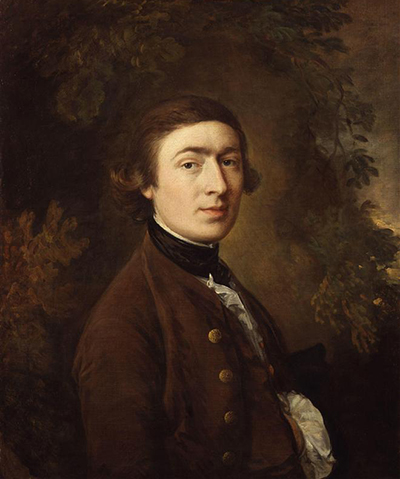
 by Tom Gurney
Tom Gurney BSc (Hons) is an art history expert with over 20 years experience
Published on June 19, 2020 / Page Updated on November 5, 2026
Email: tomgurney1@gmail.com / Phone: +44 7429 011000
Introduction
Thomas Gainsborough's life looks, at first, like a clean eighteenth-century success story: a talented boy from Sudbury, early training in London, provincial beginnings, a rise through Bath society, a move to London, royal favour, rivalry with Reynolds and lasting fame. The outline is true, but it is too smooth. Gainsborough's biography is more interesting as a sequence of pressures: between local and metropolitan art worlds, portrait commissions and landscape ambition, institutional recognition and personal independence, public elegance and private experiment.
He was born in Sudbury, Suffolk, in 1727 and died in London in 1788. Between those dates he became one of the leading British painters of his age. He was a founder member of the Royal Academy, a favourite painter of George III and his family, a highly successful portraitist, and one of the most important figures in the development of British landscape painting.[1][2] Yet the career never settled comfortably into one identity. Portraiture made his name and supported his household. Landscape remained an abiding field of desire and invention. Drawing, prints, technical experiment and letters show a restless maker rather than a polished social machine.
The best biography of Gainsborough therefore has to avoid two opposite temptations. It should not romanticise him as a pure landscape painter imprisoned by portrait commissions. It should also not reduce him to a society portraitist with an attractive manner. His life was built in the friction between those roles. That friction produced public icons, land-and-marriage portraits, Bath society images, Suffolk woods, family pictures, musician portraits and late rustic landscapes.
At a Glance
- Born1727 [1]
- BirthplaceSudbury, Suffolk [1]
- ParentsJohn and Mary Gainsborough [1]
- London trainingFrom about age thirteen, including work with Hubert-François Gravelot [1]
- MarriageMargaret Burr, 1746 [1]
- FamilyDaughters Mary and Margaret appear repeatedly in his art [8][17]
- Key working centresSudbury, Ipswich, Bath and London [1]
- Royal AcademyFounder member in 1768 [1][2]
- Known forPortraits, landscapes, drawings, prints and fancy pictures
- Died1788, aged sixty-one [1]
Contents
- Introduction
- Sudbury and Early Talent
- London Training
- Suffolk and Ipswich Beginnings
- Bath and the Fashionable Portrait Market
- Royal Academy and Public Exhibition
- London and Schomberg House
- Family, Friends and Studio Circles
- Landscape, Drawing and Experiment
- Letters, Temperament and Voice
Sudbury and Early Talent
Thomas Gainsborough was born in Sudbury, Suffolk, in 1727. Gainsborough's House identifies him as the youngest of nine children of John and Mary Gainsborough, born into a family connected with the local cloth and wool trade.[1] Sudbury matters because it was more than the name of a birthplace. The surrounding woods, fields, lanes and East Anglian countryside became part of the imaginative ground from which his landscape art grew.
It is easy to overdo the romance of the gifted child sketching outdoors. A childhood landscape does not explain every later painting. But Gainsborough's House is clear that his early talent for drawing and painting appeared young, and that the woods and fields around Sudbury were important to the formation of his landscape interests.[1] That early habit of looking would remain with him even after he became an artist of fashionable Bath and London.
Sudbury also gave Gainsborough a social position outside the aristocratic world he would later paint. He did not begin as a court artist or as the son of a grand patron. His path upward depended on training, skill, adaptability and the market for likeness. This background is important because many later works present aristocratic ease so fluently that the labour behind that fluency can disappear. Gainsborough learned how to enter the visual language of rank from outside it.
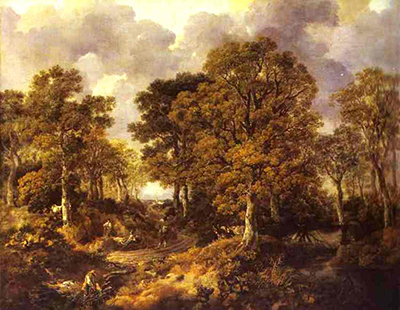
The Suffolk setting also helps explain why landscape never became merely a decorative backdrop in his art. Paths, trees, common land, cattle, cottages and rural light had a personal and pictorial charge. When early landscapes such as Cornard Wood, near Sudbury, Suffolk look back to the area around Sudbury, they do so through both place and painting tradition. The National Gallery's record for Cornard Wood links the picture to the Great Cornard area while also pointing to Dutch influence and present material changes in the painting.[6] That combination—local memory shaped by art—begins early in Gainsborough's story.
London Training
Gainsborough left for London as a teenager. Gainsborough's House gives the age as thirteen and identifies Hubert-François Gravelot as a key training figure.[1] Gravelot mattered because he connected the young artist to French design, illustration and a graceful linear culture that would leave traces in Gainsborough's later ease of drawing. London also brought him into the orbit of the St Martin's Lane Academy, associated with figures such as William Hogarth and Francis Hayman.[1]
This training should not be imagined narrowly as a schoolroom apprenticeship in oil painting. London exposed Gainsborough to drawing, engraving, illustration, theatrical and decorative design, portraiture, old-master pictures and a circulating art market. The capital's collections and print culture gave a young provincial artist access to European models. Gainsborough's House later notes the importance of Dutch landscape painting and the availability of continental images through London's art trade and collections.[1]
The London years gave Gainsborough a flexible visual education. He learned from French rococo design, British portrait practice, Dutch landscape and the wider culture of prints. That mixture helps explain why his later art can be difficult to classify. The portraits are not just likenesses; they are designed images. The landscapes are not just views; they are composed from memory, older art and studio practice. The drawings are not marginal; they are a working language.
London also taught him that art was a market. Artists needed patrons, collectors, publishers, exhibitions, reputations and networks. Gainsborough's later quarrels with institutions and patrons should not obscure his professional intelligence. He may have resisted some demands, but he understood how a career had to be made.
The National Gallery of Art's artist record is useful here because it does not present Gainsborough as a single-masterpiece painter. It places him inside a spread of selected works, including portraits, landscapes and later collection histories.[4] That modern institutional spread mirrors the mixed training of his youth. From early on, Gainsborough's career did not point toward one narrow specialism. It pointed toward a flexible practice capable of serving sitters, landscape ambition, drawing, reproduction and public display.
Training also gave him the habit of translation. A design could become an engraving; a drawing could become a painted landscape; an old-master memory could become a modern portrait costume; a rural motif could shift from sketch to oil to print. This flexibility helps explain why his mature art looks so fluid. The ease was not merely temperament. It grew from a young artist learning that images moved between media, markets and audiences.
Suffolk and Ipswich Beginnings
In 1746 Gainsborough married Margaret Burr. Gainsborough's House records the marriage and the artist's return to Sudbury, where he worked as a portrait painter for local gentry and mercantile patrons.[1] The marriage belongs to the life story, but it should not be turned into unsupported romance or speculation. Margaret's role in Gainsborough's domestic and professional life deserves respect, but the public biography should remain evidence-led.
The late 1740s and early 1750s were years of local practice. Gainsborough needed sitters, and the available market in Sudbury was limited. Portraiture was the practical means of earning, but the young artist was also making landscapes and experimenting with the relationship between figures and setting. The early double and conversation-piece tradition, including works such as A Couple in a Landscape, shows the problem already forming: how can a likeness, a social relation and an outdoor setting occupy one picture?[7]
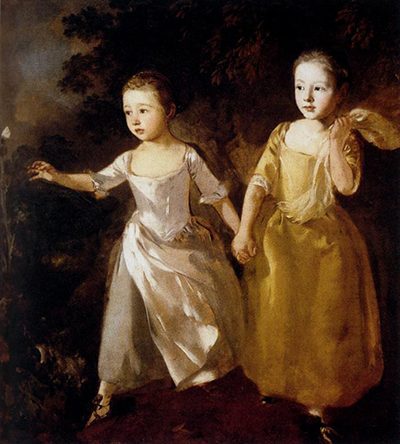
The family history was marked by both continuity and loss. Gainsborough and Margaret's surviving daughters, Mary and Margaret, would later become important subjects in his art. The National Gallery's catalogue material on The Painter's Daughters Chasing a Butterfly identifies Mary and Margaret and connects the picture with the Ipswich period.[8] The daughter portraits are not simply charming family scenes; they preserve the private texture of Gainsborough's life inside a public art-historical record.
The return to Suffolk also reminds us that Gainsborough's career developed before he had access to the large clientele of Bath. Local portraits could improve technique and reputation, but they could not sustain unlimited ambition. Gainsborough's next move was therefore not just biographical wandering. It was a response to the available market.
This is also where the biography needs to resist a modern habit of treating “provincial” as lesser. Gainsborough's Suffolk and Ipswich years were not a failure before success began. They were the period in which he learned how likeness, local status and landscape could be made to work together. The sitters were not as grand as later Bath and London patrons, but the artistic problems were already serious. How much setting does a portrait need? How does a local gentleman or couple signal property, taste or aspiration? How can a painter make a modest commission feel visually alive?
Those questions never left him. The later society portraits may be grander, but they still depend on the same negotiation between person and setting. The later landscapes may be freer, but they still depend on habits of looking first developed in East Anglia. Gainsborough's early career therefore supplies more than background. It supplies the grammar of the mature work.
In 1752 Gainsborough moved with his family to Ipswich. Gainsborough's House describes the move as following the exhaustion of Sudbury's patron circle and notes that his skill as a portrait painter improved during the Ipswich years.[1] Ipswich was not London, but it was a larger town with a broader professional and gentry network. It gave him new sitters and a more substantial base.
These years are important because they show Gainsborough learning to work between necessity and interest. Portraiture was essential, and local patrons expected recognisable likenesses. At the same time, the surrounding countryside and East Anglian setting continued to feed his landscape art. The Ipswich period helped refine both the practical and imaginative sides of his work.
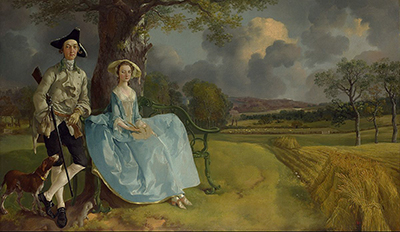
Mr and Mrs Andrews, painted in the late 1740s or around 1750 according to the National Gallery's object and catalogue evidence, belongs close to this early world and has become one of the defining works of Gainsborough's youth.[9] It is not only a double portrait. It is a painting about marriage, land, estate identity, unfinished surface and the joining of people to place. The picture's full argument needs extended attention, but the biography must register its importance: Gainsborough had found a way to make portraiture and landscape interdependent very early.
The Ipswich years also produced family pictures. The Painter's Daughters Chasing a Butterfly is likely to have been painted in Ipswich in or about 1756, according to the National Gallery catalogue.[8] That work gives a different kind of biographical evidence from a formal portrait. It shows Gainsborough using his daughters as subjects, not in a straightforward domestic snapshot, but in a wooded scene whose movement, vulnerability and unfinished condition make it one of the most memorable images of his family life.
Ipswich had limits, however, and Gainsborough's ambitions and household needs required the larger field of patronage that Bath would provide.
Bath and the Fashionable Portrait Market
Gainsborough moved to Bath in 1759. This was the decisive professional move of his middle career. Bath was a fashionable spa town, full of visitors and residents who wanted to be seen, remembered and represented. The National Gallery notes that the move brought many portrait clients, and Gainsborough's House describes the new clientele as more cosmopolitan and aristocratic than the circles he had found in Suffolk.[1][2]
Portraiture became the centre of his working life, though not necessarily the centre of his imagination. Portraits were lucrative, visible and socially necessary; they connected Gainsborough to patrons and built his reputation. But he continued to paint landscapes and to fuse landscape with portraiture in ways that remained innovative.[1]
Bath encouraged a new kind of sitter. The local gentry and merchants of Suffolk gave way to a more fashionable clientele: aristocrats, professionals, visitors, military men, musicians and social figures. The portrait became more than a likeness. It became a performance of ease, status and refinement. Gainsborough's handling also changed. Earlier likenesses could be relatively stiff; the mature portraits are known for fluid brushwork, naturalism and responsiveness.[1]
Van Dyck became increasingly important as a model for elegance, long forms, costume and aristocratic presence. The National Galleries of Scotland summarises this well: Gainsborough built on Van Dyck's grand manner while introducing informality through imaginative landscape backgrounds and lively brushwork.[5] That balance is one of the keys to Bath and later London portraiture. He could borrow grandeur without becoming heavy.
Bath also intensified the strain in Gainsborough's career. The demand for portraits brought success and overwork. Gainsborough's House notes that from the 1760s onward the demand was such that he suffered from overwork.[1] This is not just a personal detail. It helps explain the recurring tension between what patrons wanted and what the artist wished to explore. Portraiture was both opportunity and pressure.
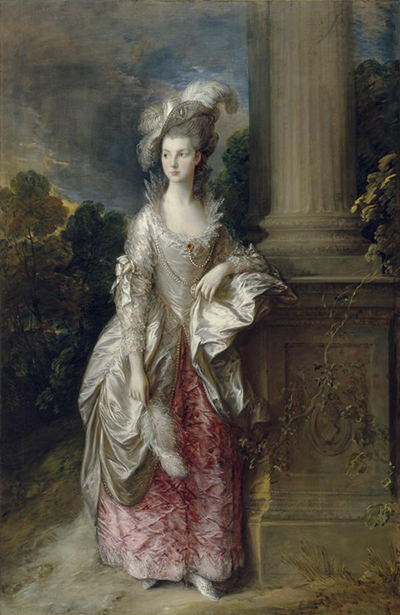
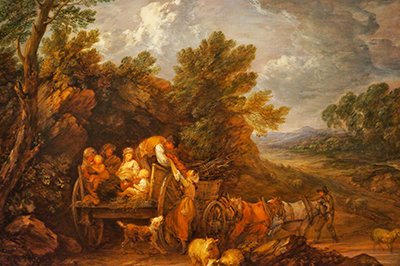
Several major works and themes connect to Bath. The Honourable Mrs Graham, though painted later in the 1770s, belongs to the world of high-status portraiture that Bath helped make possible.[10] Captain William Wade connects directly to Bath's social rituals and the role of the Master of Ceremonies. The Harvest Wagon, exhibited in the 1760s according to the Barber Institute record, shows that rustic and landscape interests continued alongside portrait demand.[11]
Gainsborough's Bath career therefore should not be described as a detour from landscape. It was the phase in which he mastered the society portrait while keeping landscape alive as counterweight, background and independent ambition.
The National Portrait Gallery's records are especially valuable for understanding the size and complexity of this portrait world. Gainsborough is not just represented there as an artist with a few famous sitters. He appears as a portrait and landscape painter associated with a large number of portraits, and the NPG's catalogue material situates him inside mid-Georgian portrait culture.[29] That kind of record reminds us that portraiture is cumulative. A career is made not only by celebrated paintings but by repeated acts of likeness, networking, display and reputation.
Bath also changed the kind of body Gainsborough was asked to paint. Earlier local portraits often emphasised legibility and professional standing, while Bath demanded grace from sitters who wanted to appear modern, fashionable and socially fluent. Gainsborough's solution was not to harden the portrait into status symbols, but to soften status through movement and air. Dress becomes animated; foliage becomes responsive; faces are held within a surface that seems to move around them. The portrait is still a social object, but it breathes.
This is why the “portrait versus landscape” story can mislead. Landscape did not simply wait outside the studio for moments of escape. It entered the portraits as background, atmosphere and imaginative pressure. The wooded settings behind Bath and London sitters are not always literal places. They create a world in which elegance can look natural, even when the portrait is highly constructed. Gainsborough's biography at Bath is therefore also the biography of a visual solution: a way to make fashionable portraiture less rigid without making it less powerful.
Royal Academy and Public Exhibition
The Royal Academy was founded in 1768, and Gainsborough was a founder member.[1][2][5] That fact places him inside the new institutional structure of British art. He was not an outsider throwing stones from the margins. He belonged to the Academy's beginning, exhibited publicly and participated in the professional world that defined artistic reputation in the capital.
The relationship was uneasy. Gainsborough's House records that after moving to London he resided in the west wing of Schomberg House on Pall Mall, held regular studio exhibitions, and by 1783 had stopped showing at the Academy's annual exhibitions.[1] The National Gallery likewise notes both his founding membership and later quarrel over the hanging of his pictures.[2]
Hanging was more than vanity. In the crowded exhibition culture of the eighteenth century, position affected visibility, status and interpretation. A picture placed too high or in an unfavourable relation to others could be damaged in public effect. Gainsborough's conflict with the Academy therefore belongs to the practical politics of display as much as to temperament.
His relation to Reynolds is often used as shorthand for the period. Reynolds, first president of the Academy, represented theory, institution and a version of the grand manner built around classical and Renaissance models; Gainsborough worked differently. The National Gallery emphasises that unlike Reynolds he avoided references to Italian Renaissance art and the antique, showing sitters in fashionable contemporary dress.[2] The National Galleries of Scotland adds an important nuance: the two were artistically and temperamentally different, but developed mutual respect.[5]
That nuance matters. A good biography should not turn Gainsborough and Reynolds into a cartoon duel between feeling and intellect. Gainsborough had his own intelligence, ambition and professional strategy. Reynolds had his own painterly strengths. Their difference helps define the British art world of the period, but it should not be made to explain everything.
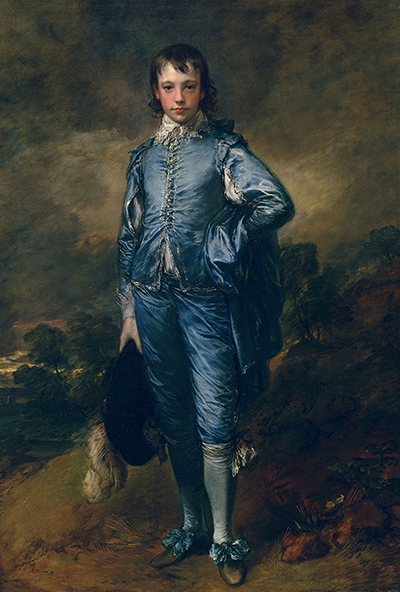
The Blue Boy belongs to Gainsborough's biography not simply because it is famous, but because it shows the artist's public ambition in portraiture. The Huntington's records date the painting to around 1770 and preserve the familiar title while also managing the sitter question carefully.[12] Project Blue Boy material adds conservation history, Van Dyck costume context and modern uncertainty around identification.[13]
The painting was exhibited at the Royal Academy as A Portrait of a Young Gentleman. Its later nickname and afterlife have become so powerful that they can obscure the original problem: a young sitter presented through costume, colour, painterly display and old-master reference. The blue satin costume looks backward to Van Dyck, but the handling is Gainsborough's own. The painting is a portrait and a statement about portraiture.
For the biography, the key point is that Gainsborough could use a commission or sitter image to assert artistic freedom. The Blue Boy is not merely an elegant likeness. It is a performance of skill, art-historical memory and surface. It stands near the centre of his reputation because it turns portraiture into spectacle without losing the immediacy of a living figure.
The full history of the painting—its sitter uncertainty, Huntington purchase, conservation and return to London for exhibition—needs a fuller account. In the biography, it marks the moment when Gainsborough's portrait practice becomes visibly ambitious enough to carry a later national and international myth.
London and Schomberg House
In 1774 Gainsborough moved to London and settled in Schomberg House on Pall Mall.[1] The move placed him at the centre of metropolitan art, patronage and display, changing the terms of a career that Bath had made fashionable and London made unavoidable.
In London, Gainsborough worked for elite and royal patrons, held studio exhibitions and continued to navigate the Academy world. The National Gallery notes that he became a favourite painter of George III and the royal family.[2] Gainsborough's House similarly records his later success and royal favour.[1] Royal patronage strengthened his status, but it did not remove his restlessness. He remained sensitive to exhibition conditions and continued to pursue landscapes, fancy pictures and technical experiment.
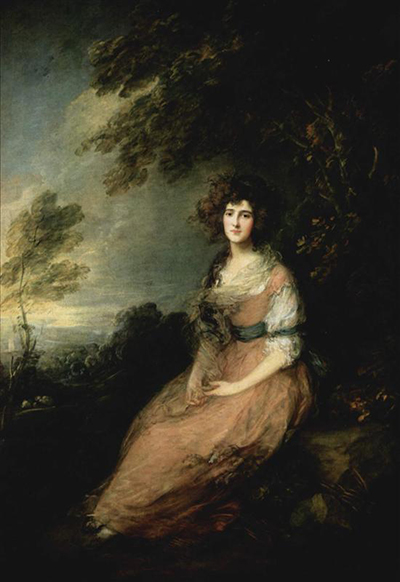
The London years produced some of his most admired late portraits. Mrs Richard Brinsley Sheridan, dated by the National Gallery of Art to 1785-1787, is a good example of late portraiture as atmosphere and social poise.[14] Mr and Mrs William Hallett, The Morning Walk, painted shortly before the couple's marriage in 1785, shows late elegance in motion.[15] These works should not be treated as interchangeable society images. Each has its own sitter context and visual temperature. But together they show Gainsborough's mature ability to make portraiture look fluent, airy and alive.
London also saw continued landscape work. The Watering Place, exhibited at the Royal Academy in 1777, connects Gainsborough to Rubens, drawing, etching and a more ambitious mode of landscape painting.[16] The National Gallery's record notes that the painting echoes Rubens's work while transforming it into a tranquil evening scene, showing Gainsborough not abandoning landscape in London but using the capital's collections and exhibition culture to enlarge it.
The late London studio becomes a place of convergence: portraits for status, landscapes for invention, studio exhibitions for direct audience control, and experiments with materials and display. Gainsborough's biography in this phase is not a peaceful triumph. It is a successful career under pressure from its own contradictions.
Schomberg House also matters symbolically. It put Gainsborough in a visible, fashionable location while allowing him a degree of control over how visitors encountered his work.[1] Studio exhibitions were not the same as Academy exhibitions: they offered a different relation between artist, patron and viewer. For a painter who cared about hanging and display, this was not incidental. It was part of the work's public life.
The London period sharpened the question of audience. Gainsborough was painting for patrons, for exhibitions, for studio visitors, for royal attention and for future reputation, each with different expectations. A royal portrait required one kind of decorum; a landscape shown publicly required another kind of ambition; a private daughter picture or musician portrait carried another register. The late career becomes richer when we see the artist managing several audiences at once.
The same period also complicates the idea of “late style.” Gainsborough's later handling can look free, but the freedom did not mean retreat from the world. It was produced inside a highly public, demanding career. A loose brushstroke in a late portrait is not the mark of withdrawal; it is a way of making society portraiture feel alive under pressure. A late landscape is not a holiday from reputation; it is an argument that landscape could bear serious artistic ambition.
Family, Friends and Studio Circles
Gainsborough's life was not only a sequence of addresses and patrons; family and friendship shaped the work. His daughters Mary and Margaret appear repeatedly in his art. The National Gallery's daughter material emphasises the personal significance of these pictures and the way music, family and unfinished handling come together in them.[17] They give the biography a human centre that is different from the commissioned portrait world.
Mary and Margaret were not simply studio props. Their images show Gainsborough returning to family as subject over time. The Painter's Daughters Chasing a Butterfly presents them in childhood; later daughter portraits connect them to music and adulthood. These works can be tender, but they are not only tender. They are also experiments in movement, intimacy and incomplete paint. Gainsborough knew his daughters, but the paintings still transform them into art.
Music was another recurring part of Gainsborough's world. He was known for his love of music, and musician portraits such as Karl Friedrich Abel reveal a network of artistic friendship and cultural sociability.[18] Abel's portrait is not just an image of a sitter. It belongs to a world where painting and music were mutually valued arts, and where Gainsborough's own identity as a painter was shaped by friendships beyond the portrait market.
Gainsborough Dupont, his nephew and assistant, adds another studio-family strand. The National Portrait Gallery identifies Dupont as painter and mezzotint engraver, nephew and assistant to Thomas Gainsborough; the Government Art Collection also places him in relation to apprenticeship, studio continuity and later work.[19][20] Dupont's importance is not only biographical. He becomes part of later questions around Gainsborough's studio, prints, copies and even The Blue Boy sitter debate.
Biography should use these figures carefully. It should not turn every sitter into a close friend or every family image into confession. But it should show that Gainsborough's career was made in circles: household, studio, patrons, musicians, Academy colleagues, royal sitters and later collectors.
Landscape, Drawing and Experiment
Gainsborough's landscape interest lasted all his life. Gainsborough's House goes further than a casual statement of preference, describing him as the first important British artist to paint landscapes consistently and as a figure who helped establish landscape painting in England.[1] That claim needs context: in eighteenth-century Britain, landscape did not have the same status or earning power as portraiture. Gainsborough's commitment to it was therefore both artistic and professional complicated.
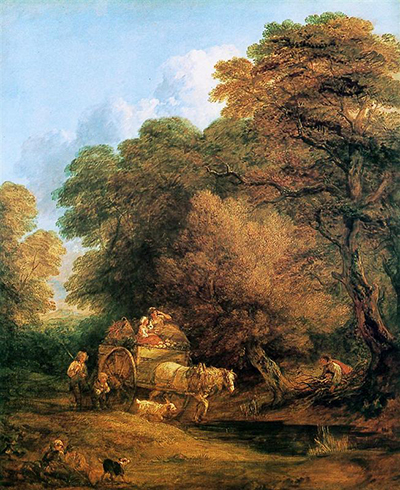
His landscapes were not simply outdoor views. Dutch seventeenth-century painting influenced his early landscape thinking; later, Van Dyck, Rubens and other old masters contributed to his confidence and range.[1] The National Gallery's records for works such as Cornard Wood, The Market Cart and The Watering Place show how landscape can involve local geography, old-master influence, exhibition history, drawing, printmaking and late studio invention.[6][16][21]
Drawing was essential to this practice. Gainsborough's House describes him as an avid draughtsman and experimental artist, using drawing and printmaking techniques including soft-ground etching and aquatint, and even unconventional materials in mixtures and drawings.[1] Those details matter because they push against the idea of Gainsborough as only a fluent oil painter; he explored process.
Technical experiment also belongs to the biography because it reveals temperament in material form. A painter frustrated by portrait demands might still turn that frustration into unusual methods, rapid handling, studio devices, drawings, prints and landscapes. The National Gallery Technical Bulletin material on Dr Ralph Schomberg gives specialised evidence for studio practice and handling, while Project Blue Boy demonstrates how conservation can reveal the material life of a famous work.[13][22]
The late works often feel especially free, but freedom should not be mistaken for carelessness. A loose surface can be controlled, a landscape can be invented from memory and drawings, and a fancy picture can be emotionally suggestive without being literal narrative. Gainsborough's experiment was not a rejection of skill; it was one form of skill.
In his later years, Gainsborough expanded beyond conventional portraiture and landscape into mythological and so-called fancy pictures with stronger narrative or emotional content, as Gainsborough's House notes.[1] The word “fancy” needs careful handling. It can describe child, rustic, cottage, peasant or genre-like subjects, but it can also become vague. A good biography should introduce the tendency without claiming that every rustic figure has the same meaning.
Works such as The Market Cart, The Harvest Wagon and The Painter's Daughters show different ways Gainsborough used rural and child subjects. The Market Cart is a late landscape with figures, movement and a wooded road.[21] The Harvest Wagon, anchored by the Barber Institute, connects rustic figures with Bath-period exhibition and patronage evidence.[11] The Painter's Daughters brings family and woodland movement together.[8]
These works reveal Gainsborough testing kinds of feeling that formal portraiture could not easily contain. Rural children, carts, animals, cottages, roads and evening light become vehicles for tenderness, theatricality, movement and melancholy. But they should not be read as direct social documents without support. Gainsborough's rural figures are painted images, not transparent access to rural lives.
The fancy-picture strand also shows why the biography cannot end with royal favour. Gainsborough's late career was not only a climb into establishment prestige, but also a period of continuing invention in subjects that sometimes moved away from direct portrait commissions. The artist who painted elite sitters also created images of rural movement and imaginative landscape mood; both belong to the same life.
Letters, Temperament and Voice
Gainsborough's letters are famous because they preserve a lively, sometimes exasperated voice. They reveal professional affairs, patron relations, display concerns, materials, humour, anxiety and impatience. Gainsborough's House notes that original letters in its collection are important for understanding his character, professional dealings, methods, materials and concern with how pictures were displayed.[23]
The biography can use that fact, but it should not raid quote lists. Gainsborough is vulnerable to attractive but poorly sourced sayings. Exact wording needs stricter documentary control than a life narrative can provide. Here, it is enough to say that his letters support the picture of an artist who cared intensely about working conditions, deadlines, patrons and display.
Archive records help ground that voice: the British Library lists Gainsborough letters and related documents, including correspondence with James Unwin printed by Mary Woodall.[24] The Folger catalogue records a 1766 letter to David Garrick.[25] The Morgan Library records a 1773 letter to William Hoare concerning Reynolds and technique.[26] These records do not license loose quotation, but they do show the breadth of surviving documentary traces.
Gainsborough's temperament has often been simplified: sensitive, impatient, charming, difficult, spontaneous. Such labels may contain truth, but biography should keep them attached to evidence. His actions show a man who could be ambitious, sociable and professionally successful, yet uneasy with institutional control and patron demand. The letters give voice to that tension; the paintings give it form.
The letters also help explain why display recurs throughout his biography. They are not only amusing documents from a witty painter. They show a working artist concerned with where pictures hang, how patrons respond, whether commissions arrive on time, and how artistic effect survives social negotiation.[23] That concern joins the whole life together. A boy who learned by drawing in Suffolk became an artist intensely alert to the conditions under which pictures were seen.
This is why biographical voice must be handled differently from anecdote. Anecdotes can brighten a life, but they can also distort it. Gainsborough's letters should illuminate the professional world rather than decorate it. In a biography, the safer and more useful move is to show what the letters prove about the shape of the career: wit, impatience, technical interest, display anxiety and a constant negotiation with patrons.
Slavery, Patronage and Modern Questions
Modern biography must also acknowledge that Gainsborough's portrait world intersected with systems of wealth and power that are now being researched more fully. The National Gallery's artist entry records ongoing research into slavery connections. It notes, for example, The Byam Family and the family's plantation wealth, and also discusses Gainsborough's 1768 portrait of Ignatius Sancho in relation to the Duke and Duchess of Montagu.[2]
This material must be handled with care. It should not be ignored, because portraiture was part of the social world of wealth, empire and status. But it should not be carelessly generalised across every sitter or painting. The National Gallery's research is specific, naming particular works and contexts.[2] A responsible biography should do the same.
Gainsborough himself should not be made into a simple emblem of either innocence or guilt. He worked within a patronage culture where wealth could come from many sources, including colonial and slave-owning systems. Some sitters and families require direct attention. Others do not carry the same documented evidence. The task is not to attach a generic paragraph to the artist, but to keep the evidence available for the works where it matters.
The biography can alert readers to the issue, but specific sitter and family contexts should be discussed only where the sources support them. Mr and Mrs Andrews needs careful treatment of land and class. Other portraits may need different social histories. The same ethical attention should be applied case by case.
Gainsborough died in 1788 at the age of sixty-one. Gainsborough's House records that he died widely considered one of the greatest artists of his era and that he is buried in Kew Churchyard, London, alongside his wife Margaret.[1] The National Galleries of Scotland gives London as his place of death.[5]
The end of his life did not end the life of his pictures. Some works remained with families, some entered collections, some were reproduced, some became icons and some changed meaning as scholarship developed. The afterlife of Gainsborough's art is therefore part of the biography, but it belongs after the life, not as a replacement for it.
His death also left the problem of studio continuity. Gainsborough Dupont, as nephew and assistant, remained important in the immediate afterlife of the studio and in the production or completion of works after Thomas Gainsborough's death.[19][20] Prints, copies, reference objects and later reproductions complicate the neat boundary between life and reputation.
The burial at Kew offers a quiet ending, but not a simple one. Gainsborough had moved through Suffolk, London, Ipswich, Bath and London again. He had entered royal and aristocratic circles, quarrelled with institutions, painted family members and anonymous rural figures, and made landscapes that carried Suffolk memory into metropolitan art. The body stops at Kew; the pictures keep travelling.
Death, Reputation and Afterlife
Gainsborough's reputation has changed repeatedly. In his own day, he was recognised as a major artist. Later, certain pictures became symbolic far beyond their original contexts. The Blue Boy became a transatlantic icon after its sale and arrival at the Huntington, and its conservation and return to London in the twenty-first century renewed public attention.[12][13][27] Mr and Mrs Andrews became a major work for thinking about land, marriage, property and class.[9]
Modern retrospectives and museum records have restored the breadth of the career. The National Gallery of Art's 2003 exhibition presented 63 paintings and 30 drawings, including portraits, landscape paintings and scenes of the rural poor.[28] That range is important. It resists the narrowing of Gainsborough to a few famous images.
Gainsborough's House, reopened after major redevelopment in 2022 as an expanded centre for the artist, also shapes the modern reputation.[1] Its emphasis on paintings, drawings, prints, archives and location in the artist's childhood home helps reconnect the metropolitan master to Sudbury and to working method.
The museum's collection role is especially important for biography because it gathers the different Gainsboroughs back together: painter, draughtsman, printmaker, letter-writer and Sudbury native.[3] A life that moved outward into Bath, London, royal patronage and international collections is now also interpreted through the house where it began. That return should not be sentimentalised, but it is powerful. It allows the biography to end not only with fame, but with study: objects, archives, birthplace, materials and local memory brought into one setting.
The National Portrait Gallery, National Gallery, National Galleries of Scotland, Huntington, NGA and other institutions each preserve a different Gainsborough. One holds portraits and person records; another preserves major public paintings; another holds a famous icon; another offers a broad American collection and bibliography. Modern Gainsborough is therefore not one museum's artist. He is a networked figure whose work has to be reconstructed across collections.
That reconstruction also means accepting uncertainty: sitter identities can change, titles can be corrected and paintings can be restored. A famous story may become less certain when conservation or catalogue research intervenes. Gainsborough's reputation is strongest when it is not protected from those changes.
Why the Biography Still Matters
Gainsborough's life matters because it explains the pressure inside the paintings without reducing them to diary entries. Sudbury helps us understand landscape memory, but it does not explain every tree. London training helps us understand design, drawing and European influence, but it does not make him merely derivative. Bath explains the portrait market, but not the whole artist. The Royal Academy explains public ambition and conflict, but not all his choices. Family explains some intimate pictures, but not every image of childhood or rural feeling.
The biography is therefore a structure, not a key that unlocks everything. It tells us what problems Gainsborough faced: how to make a living, how to satisfy patrons, how to continue landscape in a portrait economy, how to manage display, how to work with old-master models without becoming academic, how to make British art feel light without making it trivial.
The life also reveals the artist's contradictions. He was successful and restless, belonged to institutions and resisted them, painted aristocrats and rural figures, used fashionable portrait conventions and loosened them through brushwork. He loved landscape, but depended on portraiture. He could be sociable, witty and professional while leaving behind a reputation for impatience and independence.
Those contradictions are not flaws in the story; they are the story. Gainsborough's art remains compelling because it was made from unresolved tensions rather than settled doctrines. A satin sleeve, a wooded path, a daughter's gesture, a musician's presence, a cart in evening light or a young man in blue costume can all carry that tension. The biography helps the reader see why.
It also keeps individual paintings from having to retell the whole life each time.
That is the quiet practical value of biography in a substantial account of an artist like this one. It gives readers a steady chronology while leaving individual paintings free to answer their own visual and historical questions in depth, with steadier interpretation instead of repeated background. It also helps keep the artist's contradictions visible: ambition and ease, sociability and impatience, fashionable success and persistent longing for landscape. Those tensions give the life its continuing force and prevent the paintings from becoming merely graceful surfaces or neat episodes in eighteenth-century taste. The dates matter because they keep that pressure tied to actual places, patrons and professional choices rather than drifting into legend.
Frequently Asked Questions
Discussion
Which part of Gainsborough's life most changes how you read his portraits or landscapes?
Reader Insights
How does the movement from Sudbury to Ipswich, Bath and London change the role of landscape in the career?
Where do fashionable commissions support, constrain or sharpen Gainsborough's experiments?
What do the pictures of his daughters and the role of Gainsborough Dupont add to the public career?
Join the Conversation
Share your reading below.
References
- Gainsborough's House, “About Thomas Gainsborough.” View source.
- National Gallery, London, “Thomas Gainsborough.” View source.
- Gainsborough's House, “Collection.” View source.
- National Gallery of Art, Washington, “Thomas Gainsborough.” View source.
- National Galleries of Scotland, “Thomas Gainsborough.” View source.
- National Gallery, London, “Cornard Wood, near Sudbury, Suffolk.” View source.
- Dulwich Picture Gallery, “A Couple in a Landscape.” View source.
- National Gallery, London, “The Painter's Daughters Chasing a Butterfly” object and catalogue entry. Object record; Catalogue entry.
- National Gallery, London, “Mr and Mrs Andrews” object and catalogue entry. Object record; Catalogue entry.
- National Galleries of Scotland, “The Honourable Mrs Graham.” View source.
- Barber Institute of Fine Arts, “Thomas Gainsborough.” View source.
- The Huntington, “The Blue Boy.” View source.
- The Huntington, “Project Blue Boy: History.” View source.
- National Gallery of Art, Washington, “Mrs Richard Brinsley Sheridan.” View source.
- National Gallery, London, “Mr and Mrs William Hallett ('The Morning Walk').” View source.
- National Gallery, London, “The Watering Place.” View source.
- National Gallery, London, “Gainsborough's daughters.” View source.
- The Huntington, “Karl Friedrich Abel.” View source.
- National Portrait Gallery, London, “Gainsborough Dupont.” View source.
- Government Art Collection, “Gainsborough Dupont, after.” View source.
- National Gallery, London, “The Market Cart.” View source.
- National Gallery Technical Bulletin, “Dr Ralph Schomberg.” View source.
- Gainsborough's House, “Books and manuscripts.” View source.
- British Library Archives and Manuscripts, Gainsborough-related archive search results. View source.
- Folger Shakespeare Library, “Autograph letter signed from Thomas Gainsborough, Bath, to [David Garrick].” View source.
- Morgan Library & Museum, “Autograph letter in third person, not signed: [n.p.], to [William] Hoare.” View source.
- National Gallery, London, “Gainsborough's Blue Boy.” View source.
- National Gallery of Art, Washington, “Thomas Gainsborough, 1727-1788.” View source.
- National Portrait Gallery, London, “Thomas Gainsborough.” View source.