 by Tom Gurney
Tom Gurney BSc (Hons) is an art history expert with over 20 years experience
Published on June 19, 2020 / Page Updated on November 5, 2026
Email: tomgurney1@gmail.com / Phone: +44 7429 011000
Introduction
Thomas Gainsborough is remembered above all as a painter, but prints belong firmly within his artistic world. They matter for two related reasons. First, Gainsborough himself experimented with printmaking, especially in relation to landscape, drawing and tonal effect. Second, prints after Gainsborough helped carry his images beyond the original painting or drawing, making his landscapes and portraits available to different audiences in different forms. A good account of Gainsborough and print therefore has to distinguish original prints by the artist from later reproductive prints after his works.
The British Museum identifies Gainsborough as a painter, draughtsman and printmaker, as well as a landscape and portrait painter and etcher.[1] That concise record is important because printmaking was not an external afterlife added by other people alone. Gainsborough had a direct relationship with etching, soft-ground methods and aquatint, and his print activity sits close to his drawings. Prints are not the main body of his art, but they reveal how he thought about line, tone, paper, landscape and circulation.
Gainsborough's House also presents him as an artist whose practice extended beyond oil painting into drawing and printmaking, while still rooting his career in the familiar sequence from Sudbury to Ipswich, Bath and London.[6] That wider context matters because his prints make best sense as part of a larger technical curiosity. They belong with his works on paper, his landscape experiments and his desire to make images move between private invention and public recognition.
This distinction protects the subject from two common confusions. Not every print of a Gainsborough image is an original print by Gainsborough. Many prints are reproductive works made by later engravers, publishers or copyists after his paintings. At the same time, it would be wrong to treat Gainsborough's original printmaking as a minor curiosity. His prints show him translating landscape invention into another medium, one capable of echoing chalk, wash and atmosphere in ways ordinary line engraving could not always manage.
At a Glance
- ArtistThomas Gainsborough
- Core roleOriginal prints extend Gainsborough's drawing and landscape experiments [1]
- Principal subjectsWooded paths, riders, carts, cattle and rural movement [2][3]
- MethodsEtching, soft-ground etching and aquatint [1][3]
- Country-cart printSoft-ground etching and aquatint, circa 1770s–1780s [3]
- Related drawingA black-chalk drawing survives at the Whitworth Art Gallery [3]
- Riders printWooded Landscape with Riders, mid-1780s [2]
- Posthumous publicationJohn and Josiah Boydell published Gainsborough plates in 1797 [2][3]
- Cross-media sequenceThe Watering Place moved through chalk, oil and print [5]
- Key distinctionOriginal prints by Gainsborough differ from reproductive prints after his paintings
Contents
- Introduction
- Gainsborough as Etcher
- Soft-Ground Etching and Aquatint
- Wooded Landscape with Riders
- The Watering Place: Drawing, Painting, Etching
- Boydell and Posthumous Publication
- Original Prints and Prints After Gainsborough
- Prints, Landscape and Reputation
- Reading Gainsborough Prints Carefully
- Explore Related Practice
Gainsborough as Etcher
Gainsborough's printmaking is inseparable from his work as a draughtsman. The British Museum bibliography lists John Hayes's Gainsborough as Printmaker alongside catalogues of the paintings, drawings and landscape paintings, which shows that the prints have long required specialist treatment.[1] The National Gallery of Art record for Wooded Landscape with Riders also cites Hayes's 1972 print catalogue, identifying the work as no. 14, state ii.[2] This is a compact but important scholarly trail: Gainsborough's prints need catalogue control, not loose image recognition.
The printmaker in Gainsborough is mostly a landscape artist. His print subjects tend toward wooded paths, riders, carts, herdsmen, cattle, cottages and rural movement rather than formal portrait likeness. That emphasis makes sense. In portraiture, the painted surface and sitter's identity usually mattered most. In landscape, Gainsborough could explore tonal structure, soft textures and atmospheric passage in media that could travel between drawing and print.
Etching suited an artist who thought through line and movement. Unlike a reproductive engraver translating another artist's finished painting into precise linear systems, Gainsborough could use etching as an extension of his own hand. Soft-ground etching was especially relevant because it could imitate the look of chalk or crayon more closely than standard hard-line engraving. Aquatint added tonal fields, allowing broader shadows and soft transitions.
This is why Gainsborough's prints should be discussed near his drawings. The same questions recur: how does a wooded path recede, how do figures move through trees, how does a dark mass balance a pale opening, and how can rural atmosphere survive when translated into monochrome? The print is not merely a smaller version of a painting. It is a different answer to the same visual problem.
Soft-Ground Etching and Aquatint
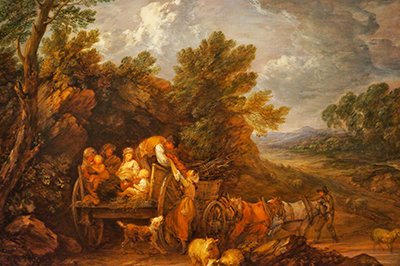
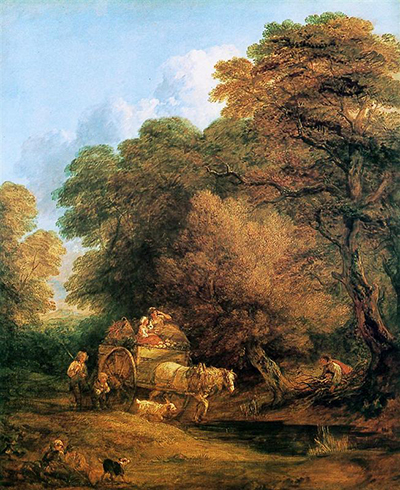
The British Museum's Wooded landscape with country cart and figures is a strong anchor because it records medium, date, related drawing evidence and state information. The museum identifies it as a print made by Thomas Gainsborough, titled Wooded landscape with country cart and figures, dated circa 1770s-1780s, on paper, using soft-ground etching and aquatint.[3] The description gives the subject: a horse-drawn cart, figures, a rocky bank, trees, sheep and a small pool.[3] This is Gainsborough's landscape world in print form.
The curator's comments are especially valuable. They connect the print with an original black-chalk drawing in the Whitworth Art Gallery, Manchester, and note a unique impression before aquatint was added over the soft-ground etching.[3] That evidence reveals printmaking as sequence. A drawing exists; a soft-ground state exists; aquatint is added; different impressions and later reprints have different appearances. A print is not only an image. It is a material process unfolding through states.
The same British Museum record notes that the exhibited impression is printed in grey and pasted on a contemporary wash-line mount, while Boydell reprints in 1797 seem to be printed in brown.[3] That detail matters because colour in prints is not only an image question but an impression question. Grey and brown impressions can produce different moods from the same plate. The woodland scene can feel cooler, warmer, softer or denser depending on ink, paper and state.
Soft-ground etching allowed Gainsborough to bring the feel of drawing into print. The British Museum comment says the broad, soft handling of the chalk in the related Whitworth drawing suggests a date in the mid to late 1770s, and that the soft-ground etching belongs to that period.[3] The print therefore sits close to drawing in both chronology and technique. It is not a later mechanical copy after a famous oil. It is part of Gainsborough's exploration of landscape through works on paper.
Aquatint is equally important because it provided tone. A landscape made only of outline risks becoming brittle. Gainsborough's rural images often depend on shade, mass and atmospheric recession. Aquatint helped carry those values into print. It could darken trees, soften ground and make a wooded path or pool feel more tonal than purely linear. In Gainsborough's hands, printmaking became a way to ask how far drawing's softness could survive pressure, plate and paper.
Wooded Landscape with Riders
Wooded Landscape with Riders shows how Gainsborough's print images could continue beyond his lifetime through publication. The National Gallery of Art identifies the work as Wooded Landscape with Riders, mid-1780s, published 1797, with Thomas Gainsborough as artist and John and Josiah Boydell as publishers.[2] The medium is aquatint on wove paper, and the record gives the plate and sheet dimensions, accession number 1976.39.2, and Hayes catalogue reference.[2]
The inscription is particularly useful because it names both authorship and publication: “Designed & Engraved by Tho.s Gainsborough” and published on 1 August 1797 by J. & J. Boydell.[2] Since Gainsborough died in 1788, the 1797 publication belongs to posthumous circulation rather than to a lifetime release. This distinction matters. The image was Gainsborough's design and engraving, but its published afterlife was handled by publishers after his death.
The National Galleries of Scotland record for Wooded landscape with riders identifies a related work as soft-ground etching on paper, published 1971, with the accession number P 2724.6.[4] This later publication history reminds us that Gainsborough's plates and images could have lives far beyond the eighteenth century. Modern impressions and institutional holdings are part of how viewers encounter the prints today, but they must not be confused with the original moment of making.
The subject is again typical: riders moving through a wooded landscape, with trees dominating the space and the path curving inward.[2] The scene has little interest in named identity. Its force lies in passage. Riders, trees and path create a journey through shade. This is exactly the kind of composition that suits Gainsborough's printmaking because it depends on tonal movement rather than portrait detail.
The image also shows why printmaking mattered to a painter of landscapes. A painted landscape can use colour, scale and brushwork to create atmosphere. A print must make atmosphere through line, tone, ink and paper. Gainsborough's wooded subjects become tests of translation. How much of the painted or drawn world can be carried into a plate? How can a path remain soft? How can a tree mass breathe? These are not secondary questions. They are technical and imaginative ones.
The Watering Place: Drawing, Painting, Etching
The Watering Place gives the cleanest example of Gainsborough moving among drawing, painting and print. In the National Gallery account, the finished canvas is part of a wider group of related works: a chalk study from the middle 1770s, the Royal Academy landscape shown in 1777, and a soft-ground-and-aquatint version that remained unpublished while Gainsborough was alive.[5]
The National Gallery also shows how the design changed from one medium to another. The oil painting increases the weight of the trees, changes the central landscape action around water, adds figures and animals, and differs again from the etching, where the scene is simplified and opened out.[5] That sequence shows printmaking as transformation, not copying. Gainsborough changed the image as it moved between media.
This point is essential for understanding prints. A print after a painting may reproduce an image, but Gainsborough's own printmaking often belongs to a more fluid process. Drawing, oil painting and etching can be related without being identical. Each medium changes the balance of figures, trees, light, distance and mood. The print is therefore a sibling, not simply a servant.
The Watering Place example also connects printmaking to exhibition ambition. The painting went to the Royal Academy, where it entered public display under the title “A large landscape.”[5] The etching remained unpublished during Gainsborough's lifetime.[5] The same landscape idea could therefore exist in public painting and private or limited print form. Gainsborough did not use printmaking here as a straightforward commercial machine. He used it as another way of thinking the image.
The technical choice of soft-ground etching with aquatint is again revealing. A subject built from fading light, trees, water, animals and rural quiet needs tone more than crisp outline. Soft-ground and aquatint allowed the print to preserve some of the drawing-like and atmospheric qualities that mattered to Gainsborough. The print is not merely about subject. It is about the feel of looking through shade.
Boydell and Posthumous Publication
John Boydell and Josiah Boydell are important because they link Gainsborough's printmaking to the wider print market. The National Gallery of Art record for Wooded Landscape with Riders names them as publishers and records publication in 1797.[2] The British Museum record for Wooded landscape with country cart and figures notes Boydell reprints in 1797, apparently printed in brown.[3] These details show how Gainsborough's plates entered a publishing environment after his death.
Boydell's name matters because eighteenth-century British print culture was highly organised. Prints could preserve, advertise, circulate and monetise images. They could also reshape an artist's reputation by making certain works familiar beyond the owners of original paintings or drawings. For Gainsborough, the Boydell connection shows how landscape inventions moved into a broader visual economy.
Yet the posthumous date also demands caution. A 1797 print may carry Gainsborough's design and engraved work, but its publication belongs to a later moment. The artist was not supervising every impression or marketing decision. Ink colour, paper, state and publication context can all shape how the work appears. To write about such prints responsibly, one must distinguish designing, engraving, printing, publishing and later collecting.
This is especially important because a print's title, state and impression can vary. A plate may be reprinted, catalogued under variant wording, or understood differently by later scholars. Hayes's catalogue references in the National Gallery of Art and British Museum records help stabilise that history.[2][3] They do not make every question simple, but they provide a controlled framework.
The Boydell afterlife also helps explain why Gainsborough's prints are not merely studio experiments. Even if some were unpublished in his lifetime, they became part of how later audiences encountered him. Prints turned private or limited inventions into objects that could circulate, be mounted, collected and studied. They bridged the artist's personal landscape practice and the public culture of reproduction.
Original Prints and Prints After Gainsborough
The phrase “Gainsborough print” can mean several things, and the differences matter. It may mean an original print designed and worked by Gainsborough, such as the examples discussed above. It may mean a posthumous impression from a plate associated with him. It may mean a print by another artist after one of his paintings. It may mean a much later reproduction using a modern process. These categories should not be collapsed.
Original prints by Gainsborough are part of his own artistic practice. They belong with his drawings, landscape experiments and technical curiosity. Prints after Gainsborough belong to reception history. They can be historically important, but their authorship is different. An engraver translating a portrait after Gainsborough may preserve composition and likeness while replacing Gainsborough's painted surface with another artist's linear system.
This distinction is not pedantry. It changes interpretation. If a print is by Gainsborough, its marks may tell us about his own handling, interests and technical decisions. If a print is after Gainsborough, it tells us how another maker or publisher translated his image for circulation. Both can be valuable, but they answer different questions.
The British Museum collection material shows the range clearly, listing prints made by Gainsborough, prints after Gainsborough, and prints involving other printmakers or publishers.[1][3] The presence of “after” in a record should be taken seriously. It is not a small label. It identifies a different relationship to the original image.
This matters especially for portrait prints. Gainsborough's painted portraits were widely admired and often reproduced, but a reproductive portrait print is not evidence of his own printmaking touch unless he made it. It may be evidence of his fame, market, sitter reception or later collecting. Any serious account of his graphic afterlife has to hold both stories apart: original landscape printmaking, and the broader reproductive life of his painted images.
Prints, Landscape and Reputation
Gainsborough's original printmaking strengthens the case for seeing him as a landscape inventor as well as a portraitist. The British Museum record identifies him as both landscape and portrait painter and etcher.[1] The surviving print examples repeatedly turn toward wooded landscapes, carts, riders, cattle and rural movement.[2][3][4] This is not accidental. Landscape gave him a field in which drawing, etching and tone could meet.
Prints also show Gainsborough thinking in monochrome. Without oil colour, he had to depend on tonal mass, texture, recession and compositional movement. A wooded path becomes a structure of darks and lights. Riders or carts become accents. A pool or opening becomes relief. These are the same visual problems found in drawings, but the plate fixes them differently.
The relationship with drawing is especially close. The British Museum's Wooded landscape with country cart and figures record connects the print to a black-chalk drawing in Manchester.[3] The Watering Place connects drawing, painting and etching in one chain.[5] The print therefore often stands between drawing and painting, or alongside them. It can preserve the softness of chalk while giving the image another material life.
This helps explain why Gainsborough's prints are not numerous in the way some print specialists' works are. Their importance lies not in volume but in insight. They show what happened when a painter-draughtsman used printmaking to pursue landscape tone. They reveal a side of Gainsborough less tied to sitter demand, closer to experiment and image migration.
The prints also help correct a simple divide between private pleasure and public reputation. Gainsborough may have treated many landscapes and drawings as personal or semi-private inventions, but prints create the possibility of wider circulation. Publication by Boydell after his death made that possibility concrete.[2][3] Through prints, Gainsborough's landscapes could continue to travel even when original paintings remained in particular collections.
Reading Gainsborough Prints Carefully
To read a Gainsborough print well, begin with authorship. Is it made by Gainsborough, after Gainsborough, or published from a plate associated with him? Then look at medium. Soft-ground etching, aquatint, line engraving and later reproduction do different things. Then look at state and date. A print published in 1797, a modern impression, and an eighteenth-century lifetime proof do not occupy the same historical position.
Next, consider the relation to other media. Does the print connect with a drawing, as in the British Museum's Wooded landscape with country cart and figures?[3] Does it connect with a painting and etching sequence, as in The Watering Place?[5] Does it survive through later publication, as with Wooded Landscape with Riders?[2][4] These relations determine whether the print is a source for Gainsborough's process, a record of later circulation, or both.
Finally, look at the image itself. Gainsborough's landscape prints often organise vision through wooded depth. The eye travels along paths, between trunks, past riders or carts, toward pools, gaps and light. Figures are usually small and mobile. Trees carry the main weight. Tone matters as much as outline. A good print reading should make those visual facts clear rather than treating the work as a mere illustration.
This method also prevents misleading hierarchy. Prints are not lesser paintings; they are different objects. They have their own surfaces, papers, inks, pressures and states. A soft-ground etching with aquatint can preserve a kind of drawn atmosphere that an oil painting cannot reproduce in exactly the same way. The print should be allowed to be a print.
Gainsborough's prints matter because they sit at the crossing point of hand, plate, paper and landscape imagination. They show him thinking beyond oil paint without leaving behind the subjects that mattered to him most. They also show how later publishers and collectors helped extend his art's reach. In that sense, prints are not a side corridor in the Gainsborough story. They are one of the best places to see his images moving.
Explore Related Practice
Follow Gainsborough's printmaking into the drawings, landscapes and paintings that the manuscript connects directly.
Frequently Asked Questions
Discussion
Which printmaking distinction most changes how you understand Gainsborough's graphic work?
Reader Insights
Is the impression by Gainsborough, after Gainsborough, or from a plate published later?
How do soft-ground etching and aquatint translate chalk, shadow and atmosphere?
What changes as a landscape moves among drawing, painting and print?
Join the Conversation
Share your reading below.
References
- British Museum, “Thomas Gainsborough.” View source.
- National Gallery of Art, Washington, “Thomas Gainsborough, John Boydell and Josiah Boydell, Wooded Landscape with Riders.” View source.
- British Museum, “Thomas Gainsborough, Wooded landscape with country cart and figures.” View source.
- National Galleries of Scotland, “Thomas Gainsborough, Wooded landscape with riders.” View source.
- National Gallery, London, “Thomas Gainsborough, The Watering Place.” View source.
- Gainsborough's House, “About Thomas Gainsborough.” View source.