 by Tom Gurney
Tom Gurney BSc (Hons) is an art history expert with over 20 years experience
Published on June 19, 2020 / Page Updated on November 5, 2026
Email: tomgurney1@gmail.com / Phone: +44 7429 011000
Introduction
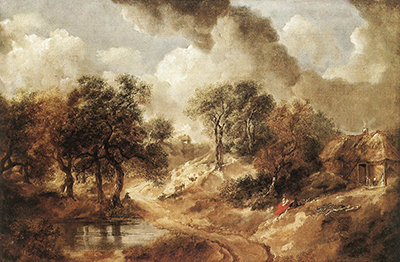
Thomas Gainsborough's Landscape in Suffolk belongs to the early landscape world that shaped his art before Bath and London made him famous as a portraitist. The painting is modest in scale, but it raises large questions: how a young British painter learned from Dutch landscape models, how Suffolk could become pictorial material, and how much can responsibly be said when the available object evidence comes through a Kunsthistorisches Museum Wien record presented by Google Arts & Culture rather than a full direct KHM catalogue essay.
That caveat matters. The Google Arts record identifies the work as Landscape in Suffolk, by Thomas Gainsborough, dated 1746/1750, connected with Kunsthistorisches Museum Wien in Vienna.[1] It gives the provenance as acquired in 1913 and the inventory number as GG 6271.[1] It also presents the dimensions as w950 by h660, with a unit display that should be handled carefully; KHM-derived image metadata elsewhere gives the more plausible measurement as 95 by 66 centimetres.[1][2] The essential point is that the painting is a small early landscape, not a grand late work.
The record's interpretation is more useful than its awkward dimension display. It places the painting in Gainsborough's Ipswich-period landscape practice, links it to Dutch landscape motifs, and describes a shallow pond, gnarled trees, a winding path, a constricted horizon, a country house, dark clouds, reflected blue, and a small red-clothed staffage figure.[1] Those details are enough to support a careful account of the picture, provided the reading remains modest.
At a Glance
- ArtistThomas Gainsborough
- Date range1746/1750 [1]
- CollectionKunsthistorisches Museum Wien, Vienna [1]
- InventoryGG 6271 [1]
- Acquired1913 [1]
- DimensionsApproximately 95 × 66 cm [1][2]
- Key motifsPond, gnarled trees, winding path, country house and red-clothed figure [1]
- InfluenceSeventeenth-century Dutch landscape motifs [1]
- Early contextAssociated with Gainsborough’s Ipswich-period landscape practice [1]
- ExploreCornard Wood; Landscapes; The Market Cart; Paintings; Technique
Contents
- Introduction
- The Available Object Record
- Suffolk Before Bath and London
- Dutch Motifs, English Ground
- Colour and the Red Figure
- Lightness, Rococo Agility and Ruisdael
- Near Cornard Wood, But Not the Same
- What the Painting Teaches
- Why Landscape in Suffolk Matters
The Available Object Record
The Google Arts presentation should not be treated as if it were a deep stand-alone KHM catalogue entry. It is a KHM-linked object record with a short interpretive text, basic data and a museum connection.[1] That gives the work a usable foundation: title, artist, date range, collection, acquisition year, inventory number and central visual description. It does not give the same depth of provenance, technical history or catalogue debate that supports some National Gallery paintings.
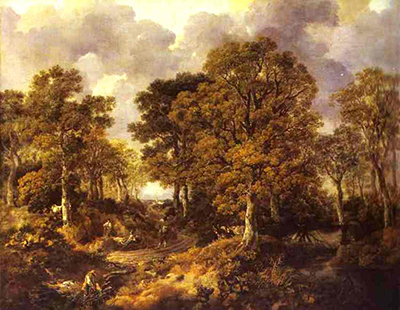
For this reason, Landscape in Suffolk asks for a different kind of confidence from works such as Cornard Wood, near Sudbury, Suffolk. The National Gallery record for Cornard Wood offers detailed geography, village-use rights, material condition, provenance and even Gainsborough's later comment on the painting.[3] The KHM-linked record for Landscape in Suffolk is narrower. Its value lies in anchoring the painting within early Gainsborough landscape and Dutch-influenced composition, not in solving every question about exact place or history.
This does not make the work minor. It makes it sensitive. A small early landscape can be very important precisely because it shows how Gainsborough was learning. The fewer the secure facts, the more carefully the interpretation should proceed. The painting should not be inflated into a complete biography of Suffolk, nor dismissed because the accessible record is brief.
The title itself should also be treated with care. Landscape in Suffolk names a county, not a precise village, estate, common or road. That means the word Suffolk should guide the reading without becoming an unsupported topographical claim. The painting can be placed within Gainsborough's East Anglian formation, but the title alone does not identify an exact view.
This kind of caution is not merely defensive. It helps the painting become visible on its own terms. The work does not need an invented local address in order to matter. Its importance lies in the way Suffolk, Dutch example and youthful experiment meet inside a small landscape. If later evidence clarifies the exact place, the reading can become more specific. Until then, the strongest account is the one that respects the scale of the record.
Suffolk Before Bath and London
Gainsborough was born in Sudbury, Suffolk, in 1727. Gainsborough's House describes him as the youngest child of John and Mary Gainsborough and presents the surrounding woods and fields as central to his early looking.[4] It also explains that after early training in London he returned to Suffolk, worked in Sudbury and Ipswich, and developed as both portraitist and landscape painter.[4]
That early geography matters, but it should not be made sentimental. Suffolk was not a magic origin that explains every later tree or path. It was a local environment in which the young painter learned to see roads, ponds, trees, cottages, fields and rural figures as possible subjects. It also placed him near collections and prints through which Dutch landscape could become available as an artistic language.
The Google Arts record says that Gainsborough never left his native land, but found opportunity to study important examples of Dutch landscape painting in English collections.[1] It places Landscape in Suffolk among works made after he moved to Ipswich, where he received early portrait commissions and painted a series of landscapes.[1] This is a useful frame. The painting belongs to a moment when landscape practice, local patronage and Dutch example were developing together.
The Ipswich context helps explain the painting's scale and ambition. It is not trying to compete with the grand full-length portraits of Gainsborough's later Bath and London career. It is testing how a rural scene can be composed, balanced and given pictorial interest. A shallow pond, a gnarled tree, a path and a distant house become the means by which a local-looking landscape enters the language of art.
Rosenthal's Paul Mellon Centre study is useful here because it treats Gainsborough's career as a negotiation between artistic desire, professional opportunity and the market for pictures.[5] Landscape in Suffolk belongs near the beginning of that negotiation. It shows the young painter working with rural subject matter before landscape had become a late-career emblem of memory and freedom. The modest format should therefore not be mistaken for modest ambition. It is an early attempt to discover what kind of picture an English landscape could become.
Dutch Motifs, English Ground
The Google Arts text identifies several motifs as traditional in Dutch painting: the shallow pond at the left, the surrounding gnarled trees and the winding path leading into the distance.[1] This is the core of the painting's importance. Gainsborough was not simply recording a Suffolk view. He was organising English rural material through a pictorial grammar associated with seventeenth-century Dutch landscape.
Dutch influence should not be used as a vague compliment. In this work it appears as structure. The low and restricted horizon, the path receding into depth, the weight of trees, the water reflecting sky, and the modest staffage figure all help turn a small landscape into a composed scene. These elements make the viewer move through the painting rather than simply recognise a place.
The country house at the centre further constricts the horizon.[1] That detail prevents the landscape from opening into wide panoramic space. The eye is led inward and slightly held. The house acts as a point of pressure, a distant mark of habitation within a scene otherwise shaped by pond, path, tree and weather. It is not enough evidence for a social history of the house, but it is enough to show that human presence is embedded in the composition.
The dark clouds are also important. The record notes that their form and colour correspond to the basic shades of the landscape below, while the small body of water reflects the blue of the sky.[1] This makes the painting more than a diagram of Dutch motifs. It becomes an exercise in tonal unity. Sky, earth and water answer one another, producing a compact visual world rather than a loose collection of features.
Colour and the Red Figure
The KHM-linked text singles out the red clothing of the staffage figure resting beside the path as the one disturbance in the otherwise unified colour scheme.[1] That observation is valuable because it shows how small a detail can control the viewer's experience. The figure is not large, but the red note changes the rhythm of the painting.
In a muted landscape, a red accent can act almost like a pulse. It draws the eye, confirms scale and gives the path human life. Without such a figure, the scene might become a study of trees, water and weather alone. With the figure, the landscape becomes inhabited. The viewer senses rest, passage and rural presence, even without a developed story.
This is where staffage needs careful handling. The resting figure should not be turned into a fictional biography. The available record does not give a name, occupation or narrative. The figure's role is pictorial: to animate the path, interrupt the tonal unity and give human scale. Gainsborough's later rustic paintings would do more with figures, carts, labour and movement, but in this early work the human presence remains small and strategic.
The record's contrast between the red clothing and the unified coloration also points to Gainsborough's early control of emphasis.[1] He already understands that a landscape can be organised by restraint. Most of the painting stays within a related range of tones; one small area breaks that harmony. The result is not dramatic in a theatrical way, but it is visually alert.
Lightness, Rococo Agility and Ruisdael
The Google Arts text describes the paint handling as marked by Rococo-style lightness and agility, contrasting the work with Ruisdael's heavier, more heroic landscape in the Kunsthistorisches Museum.[1] The comparison is useful if handled cautiously. It does not mean Gainsborough was imitating Ruisdael directly in this picture, nor that he was simply choosing lightness over seriousness. It means the painting's touch and mood differ from a more weighty Dutch heroic manner.
Lightness here is an artistic choice. The painting's small size, agile handling and casual elegance create a landscape that feels refined rather than monumental. That suits the early Gainsborough described in the record: a young painter building a career in England, looking at Dutch examples, and adapting them to local taste.[1] He takes motifs associated with Dutch art and gives them a different social and painterly temperature.
The word Rococo should also be kept descriptive rather than inflated. It helps name the painting's elegance, softness and agility, but it should not turn the landscape into decoration. The pond, path, trees and sky still carry structure. The work is light in handling, not empty in design.
This distinction matters because Gainsborough's landscapes are often praised for charm. Charm can be a lazy word if it stops looking. In Landscape in Suffolk, charm is made from decisions: the small red figure, the tightened horizon, the reflective water, the dark clouds, the gnarled trees and the winding path. The painting feels easy because the elements have been quietly organised.
Near Cornard Wood, But Not the Same
Landscape in Suffolk naturally invites comparison with Cornard Wood, near Sudbury, Suffolk, but the comparison must be limited. Cornard Wood is dated 1748 by the National Gallery and anchored to a specific view near Great Cornard, with Abbas Hall, Great Henny, local access and labour, village activity and altered present appearance all described in detail.[3] It is a richly documented early landscape with a strong local and social frame.
Landscape in Suffolk is not documented in the same way through the currently accessible record. Its title names Suffolk, and the KHM-linked text places it among Ipswich-period landscapes, but it does not identify a precise location equivalent to Cornard Wood.[1][3] The two works can be discussed together as early Suffolk landscapes shaped by Dutch example, but one should not borrow the exact geography or local-rights interpretation from the other.
The comparison is still useful. Both works show Gainsborough learning how to make local English landscape legible through older pictorial models. Both use paths, trees, water, figures and distance. Both belong before the great Bath portrait practice. But Cornard Wood carries a more explicit social and topographical argument, while Landscape in Suffolk remains a smaller, more general landscape exercise.
That difference protects the reading. If Landscape in Suffolk is made into another Cornard Wood, its own qualities disappear. It is quieter, less documented, and more dependent on the interplay of motif and surface. Its importance lies not in grand claims but in early formation: a young painter absorbing Dutch structure, Suffolk memory and a taste for elegant rural composition.
The difference also protects Cornard Wood. That painting should keep its own evidence: Great Cornard, Great Henny, village use, faded Prussian blue and the later Gainsborough letter.[3] Those facts are not a general early-landscape toolkit. They belong to that object. Landscape in Suffolk gains clarity when it is allowed to remain smaller and less fully documented, rather than being padded with better-evidenced details from a neighbouring work.
What the Painting Teaches
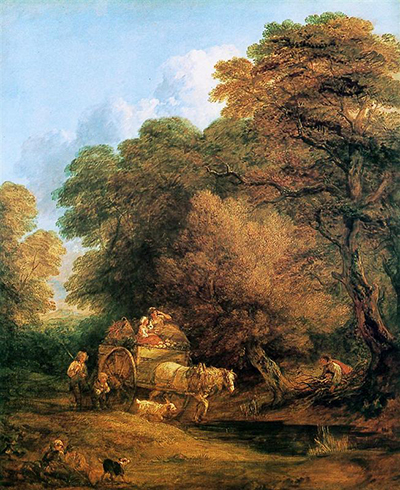
The first lesson of Landscape in Suffolk is that Gainsborough's landscape art began as disciplined looking, not as late nostalgia. The painting belongs to the 1746/1750 range, decades before The Market Cart and the late rustic subjects.[1] The motifs are already present: path, trees, water, figure, cloud and rural habitation. Later works would enlarge and transform these motifs, but the early vocabulary is visible here.
The second lesson is that place and art are inseparable but not identical. Suffolk matters. Gainsborough's birth and early career matter. Yet the painting is not a transparent window onto an exact county view. It is an English landscape shaped through Dutch visual habits and refined handling. The local ground is already artful.
The third lesson is evidential. Some Gainsborough works come with deep institutional records, technical notes and catalogue histories. This one, at least in the accessible form used here, asks for more restraint. The title, date range, inventory number, acquisition year and interpretive description are enough for a focused essay. They are not enough for confident claims about exact topography, ownership history before acquisition, or a detailed original context.
That restraint is not a weakness. It is part of responsible looking. A painting can be worth attention even when the record is brief. Landscape in Suffolk helps explain the young Gainsborough's landscape language precisely because it sits close to the moment of formation. It shows a painter learning how local material could be made elegant, saleable and visually coherent.
The painting also clarifies a wider habit in Gainsborough's art. He rarely treats landscape as empty scenery. Even here, in a compact early work, the eye is asked to move: from water to tree, from path to house, from cloud to reflection, from muted colour to the red figure. This movement is not dramatic, but it is deliberate. The scene teaches the viewer how to travel through it.
That travelling eye would remain central to Gainsborough. Later portraits use outdoor settings to guide social presence; later rural landscapes use roads, carts, ponds and figures to carry time. Landscape in Suffolk offers an early, quieter version of the same problem: how to make looking mobile without losing pictorial unity.
Why Landscape in Suffolk Matters
Landscape in Suffolk matters because it gives a compact view of Gainsborough before fame hardened into reputation. It belongs to the early field of Suffolk and Ipswich landscapes, where Dutch models, local scenery and small-scale invention came together. It reminds us that the later portraitist never began as portraitist alone.
The painting also matters because it sharpens the difference between a named landscape and a known place. The title points to Suffolk, but the present accessible record does not justify exact topographical certainty. That makes the work a useful lesson in how to read landscape titles. A place-name can guide interpretation without granting permission to invent details.
Finally, the work matters because it shows Gainsborough's early gift for making modest material visually alive. A pond, gnarled trees, a winding path, dark clouds, a distant house and a small red figure become a complete pictorial world. Nothing needs to be overstated. The painting's value lies in its quiet evidence of formation: a young artist learning from Dutch landscape while finding a lighter, English, Suffolk-inflected voice of his own.
Frequently Asked Questions
Discussion
What makes this small early landscape feel complete?
Reader Insights
Where do pond, path, trees and horizon reveal an inherited pictorial grammar?
How does one small colour accent animate the painting and establish human scale?
What can the title and accessible object record support, and where should interpretation stop?
Join the Conversation
Share your reading below.
References
- Google Arts & Culture / Kunsthistorisches Museum Wien, “Thomas Gainsborough, Landscape in Suffolk.” View source.
- Wikimedia Commons, “Thomas Gainsborough — Landschaft in Suffolk — GG 6271 — Kunsthistorisches Museum,” KHM-derived image metadata. View source.
- National Gallery, London, “Thomas Gainsborough, Cornard Wood, near Sudbury, Suffolk.” View source.
- Gainsborough's House, “About Thomas Gainsborough.” View source.
- Michael Rosenthal, The Art of Thomas Gainsborough: "A Little Business for the Eye" (New Haven and London: Yale University Press for the Paul Mellon Centre for Studies in British Art, 1999). Publication record.