 by Tom Gurney
Tom Gurney BSc (Hons) is an art history expert with over 20 years experience
Published on June 19, 2020 / Page Updated on November 5, 2026
Email: tomgurney1@gmail.com / Phone: +44 7429 011000
Introduction
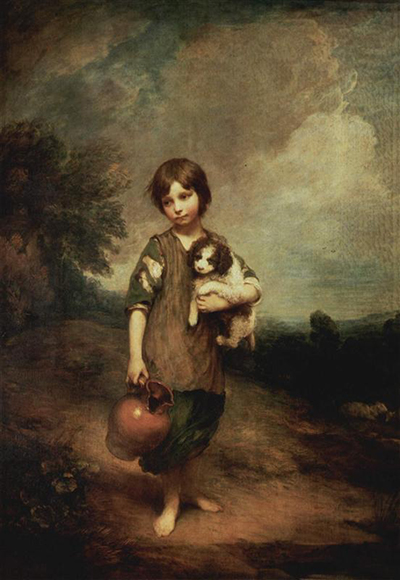
A Peasant Girl with Dog and Jug is a familiar Gainsborough image with an unusually difficult evidence problem. Reproduction records commonly attach Thomas Gainsborough's name, the title, oil-on-canvas medium, large dimensions and a private-collection location to the work.[1] Those details should be handled with caution. Without a current holder record, museum catalogue entry or reliable sale catalogue, the safest reading is not to build a full object history from repeated internet data. The picture can still be discussed, but it should be discussed as an under-documented rustic subject rather than a securely catalogued masterpiece.
That caution does not make the image uninteresting. It makes it a useful test of how to look at Gainsborough's rustic and so-called fancy subjects. The girl, dog and jug invite sympathy, but they also invite overstatement. The title presents the figure as a peasant girl, yet the available evidence does not identify a sitter, a location, a first owner or an exhibition history. The strongest approach is therefore visual and comparative: what kind of image is this, how does it relate to Gainsborough's better-documented rustic subjects, and what should remain uncertain?
At a Glance
- ArtistThomas Gainsborough
- Familiar titleA Peasant Girl with Dog and Jug [1]
- Medium trailOil on canvas in reproduction records, treated cautiously [1]
- Current holderNot confirmed by an authoritative holder record
- SitterUnidentified
- SubjectYoung rural figure with a small dog and jug
- SettingRural and non-topographical
- Interpretive fieldRustic figure and so-called fancy subject [4]
- Evidence statusUnder-documented; date, dimensions and ownership remain provisional
- ExploreFancy Pictures; Landscapes; Paintings; Portraits
Contents
- Introduction
- A Familiar Image, A Thin Record
- Girl, Dog and Jug
- Rustic Figure and Fancy Picture
- Children Without Overclaiming
- Rustic Sympathy and Social Distance
- Late Rural Subjects
- What Should Remain Uncertain
- How to Look at the Picture
- Why This Image Matters
A Familiar Image, A Thin Record
The common reproduction trail gives a basic identity: A Peasant Girl with Dog and Jug, attributed to Thomas Gainsborough and associated with a private-collection line.[1] Such statements may ultimately rest on a legitimate older catalogue or sale source, but the accessible public trail does not prove that foundation. A responsible account should not repeat the date, dimensions or private ownership as settled fact.
This means the work is different from National Gallery paintings such as The Market Cart or The Painter's Daughters chasing a Butterfly, where the museum records give firm object data, provenance, dimensions and interpretation.[2][3] Here the title and image are available, but the documentary scaffolding is thin. That changes the task. The image can be placed within Gainsborough's late rustic interests, but it should not be burdened with unsupported precision.
The word peasant is itself a caution. It may describe the conventional subject type, but it does not identify a real social biography. The girl in the image appears in simple dress with a dog and jug, and the setting reads as rural. That is enough for visual description. It is not enough to claim that Gainsborough documented a particular rural child, social condition or place.
This makes the title useful but not decisive. It tells the viewer how the image has circulated, but it does not settle how Gainsborough, an owner, a dealer or a later cataloguer understood the work. The public title may preserve a long-standing convention while the interpretation keeps that convention at arm's length. In other words, the painting can be discussed under the familiar name without letting the name do the work of evidence.
Girl, Dog and Jug
The composition centres on a young female figure accompanied by a small dog and a jug. The elements are simple, almost emblematic: child, animal, vessel, earth and open setting. Each detail can be made sentimental if handled carelessly. The girl can become generic innocence; the dog can become pure loyalty; the jug can become a symbol of poverty or labour. Gainsborough's art deserves more restraint.
The dog matters because it changes the emotional tone. A child alone might be read as abandoned or merely picturesque. A child with a dog becomes part of a small relationship. The animal brings warmth and alertness, while also giving the figure something to hold or protect. Yet even here caution is needed. The dog does not tell us the girl's life. It gives the image an affective focus.
The jug matters in a different way. It suggests carrying, water, milk, domestic task or rural labour, but none of those possibilities should be narrowed into a story without evidence. In Gainsborough's rustic imagery, ordinary objects often provide structure and feeling rather than exact narrative. A cart, basket, jug, stick or animal can organise the viewer's attention while leaving biography open.
The girl's clothing also asks for care. Simple or worn dress can suggest modest means, but the painter's arrangement may also be shaped by convention, costume and studio invention. It would be easy to turn visible simplicity into a complete social argument. The better reading is to say that the image uses rustic dress and setting to create vulnerability and tenderness, while leaving the factual life behind the figure unknown.
The background deserves the same restraint. A rural setting can support mood without proving topography. Vegetation, path, earth and open air establish an outdoor world, but they do not identify a village, estate, common, roadside or exact region. Gainsborough often used landscape to tune the emotional register of a figure. Here the surroundings help move the image away from formal portraiture and toward rustic feeling, but they do not give a map.
Rustic Figure and Fancy Picture
Gainsborough's House describes landscape as an abiding concern across the artist's career, even while portraiture remained more lucrative.[4] It also notes a later broadening toward mythological and so-called fancy subjects, with a greater interest in narrative content.[4] A Peasant Girl with Dog and Jug belongs most naturally near that territory, if the attribution and title are accepted provisionally.
The category needs care. A fancy or rustic subject is not a licence to invent meaning. It is a way of recognising that Gainsborough often made images in which named portraiture loosened, rural figures became emotionally central, and landscape or setting supported a poetic mood. Such works sit between portrait, genre-like scene, landscape and invented rural image.
The girl in this picture is not presented with the social specificity of a commissioned portrait. There is no secure name, family, patron or collection context in the accessible evidence. At the same time, she is not merely a landscape accessory. The image gives her centrality. That in-between status is exactly why the work should be read beside Gainsborough's better-documented child and rustic pictures.
The title's rustic language also needs historical tact. Eighteenth-century collectors could enjoy images of rural simplicity, poverty, childhood or feeling without sharing the social conditions such images implied. A figure called a peasant may be less a documentary subject than a pictorial role. The picture's emotional force may depend on the viewer seeing rural vulnerability from a safe distance.
Children Without Overclaiming
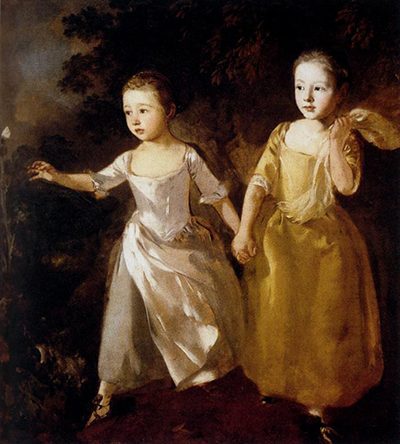
The National Gallery's The Painter's Daughters chasing a Butterfly offers a useful control because its figures are securely identified. Mary and Margaret Gainsborough are named, the work is dated probably about 1756, and the painting's unfinished condition and butterfly motif are described with care.[2] Even there, the National Gallery presents the butterfly's meaning cautiously, saying it may suggest the fleeting nature of childhood.[2]
That cautious wording is a model for A Peasant Girl with Dog and Jug. If a securely documented picture of Gainsborough's own daughters still requires interpretive restraint, an under-documented rustic child image requires even more. The girl's expression, dress, dog and jug may suggest vulnerability, but suggestion is not proof.
The comparison also shows how active Gainsborough's child figures can be. His daughters run, reach and move through a wooded scene.[2] The peasant girl, by contrast, appears more still and frontal in the common image. That stillness can feel poignant, but it should not be converted into a fixed moral lesson. Gainsborough's children and young figures often hold several possibilities at once: likeness, sympathy, play, uncertainty, vulnerability and pictorial experiment.
Rustic Sympathy and Social Distance
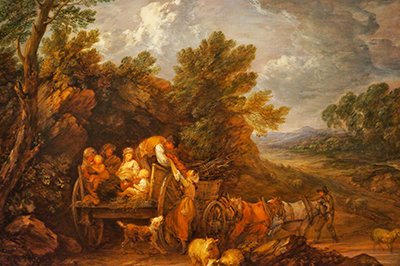
The Barber Institute's The Harvest Wagon provides another useful comparison. In that record, a group of rural figures rides home after labour, and the Barber emphasises both the unusual prominence of the figures and Gainsborough's careful study of them.[5] It also notes that two women were based on Gainsborough's daughters and that the painting was connected with Walter Wiltshire and the grey horse.[5] That evidence gives The Harvest Wagon a specific structure of place, patronage, family study and rustic movement.
A Peasant Girl with Dog and Jug does not currently have that kind of structure. It has a title and a familiar image, but not the same object record. Therefore it should not borrow The Harvest Wagon's secure details. What can be borrowed is method: look for how rustic subjects combine sympathy, studio invention and painterly design.
Rustic sympathy is never neutral. A viewer may feel tenderness toward a child in simple dress with an animal and jug, but that feeling is shaped by the distance between viewer and subject. Gainsborough's rustic figures often appeal to patrons and collectors who were not themselves living the lives implied by such imagery. The painting's charm can therefore soften social realities even while depending on them.
This does not make the image cynical. It makes it historically complex. Gainsborough could make rustic figures visually compelling without producing modern social reportage. The girl may invite compassion, but the picture does not give the full conditions of her life. It offers a painted presence, not a documentary biography.
The dog intensifies that complexity. Companion animals often invite affection, and a small dog beside a poor or simply dressed child can make the viewer feel immediate tenderness. But tenderness is not evidence. It is an effect produced by composition, pose and association. The picture asks the viewer to respond emotionally, while the record asks the viewer not to confuse that response with knowledge.
Late Rural Subjects
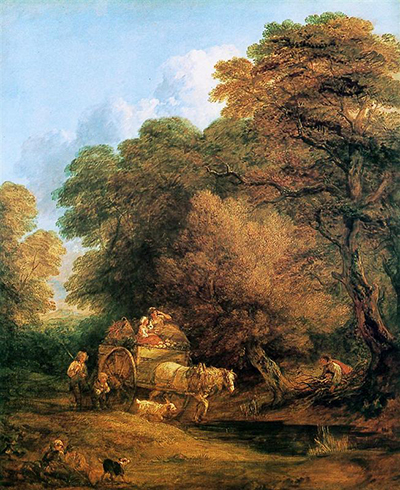
The National Gallery's The Market Cart, painted in 1786, shows how Gainsborough could turn late rural subject matter into a large, ambitious landscape.[3] That painting includes children, produce, travellers, dogs and a cart moving toward market, yet the National Gallery warns against reducing it to accurate rural documentation or idealised landscape.[3] This warning is especially useful for the peasant-girl image.
If A Peasant Girl with Dog and Jug belongs to Gainsborough's later years, it should be read within a world of rustic invention rather than as a simple portrait of rural poverty. The chronology commonly attached to the image would place it close to works where Gainsborough was exploring fancy and rustic themes, but that chronology should remain provisional unless stronger evidence appears.[1]
The visual ingredients also fit late rustic interests: a young figure, an animal, a humble object, a rural setting and an emotional mood. Such ingredients recur across Gainsborough's landscape and fancy-picture practice, but recurrence does not prove exact context. It only supports a careful placement within a broader field.
That field includes both tenderness and artifice. Gainsborough was not merely discovering rural innocence. He was composing images that turned rustic subjects into objects of visual pleasure. The girl, dog and jug are therefore not raw fact. They are arranged for looking.
This is why the image belongs near, but not inside, the fully documented core of Gainsborough's late rustic work. It can help modern viewers understand the appeal of such subjects, but it should not be used as primary proof for claims about his late career. Better-documented paintings must carry the firm historical weight. This one can carry a more modest visual and interpretive role.
What Should Remain Uncertain
Several questions should remain open. The sitter is not securely named. The first owner is not securely established through the accessible evidence. The current holder is not confirmed by a museum or catalogue record. The date and dimensions circulate in reproduction records but should not carry the same authority as a holder record.[1] The exact relationship to Gainsborough's late fancy pictures remains plausible rather than proven.
This uncertainty can be frustrating, but it is useful. It prevents the image from being absorbed too easily into a sentimental Gainsborough. A child with a dog and jug can look immediately readable. The record makes it less readable. The viewer has to separate what is visible from what is repeated, and what is plausible from what is proven.
The distinction is especially important because images like this often circulate as reproductions. Familiarity can create false confidence. A title, date and private-collection line repeated across websites can begin to feel like evidence. It is not enough. A Waterhouse+ reading needs firmer ground, or else it must openly keep the ground narrow.
How to Look at the Picture
A careful reading should begin with the figure's centrality. The girl is not a minor detail within a landscape. The picture is organised around her presence. Then look at the dog, which adds attachment and vulnerability, and at the jug, which introduces ordinary task and rural material. These elements create emotional pressure without requiring a full narrative.
Next, consider the setting. It appears rural rather than architectural or elite. That matters because Gainsborough's portraits often use costume and landscape to construct social identity. Here, the rural frame reduces status display and increases the sense of exposure. Yet the image still belongs to art, not life directly. The setting is a painted environment.
Then look for what the picture does not say. It does not name the girl. It does not identify her family. It does not tell the viewer where she stands or why she carries the jug. It does not prove whether the image began from a model, a sketch, a studio arrangement or a collector's desired subject. Those absences should remain part of the interpretation.
Finally, resist the easiest emotional reading. The girl may seem sad, poor, innocent or lonely. Such responses are understandable, but they are modern reactions to a painted image. Gainsborough's achievement, if the attribution is secure, is to make such responses possible through arrangement, expression, texture, animal presence and rural setting. The feeling is made by paint.
The jug offers a final example. It can be seen as a humble object, a sign of rural task, a shape that balances the dog, or a narrative prompt. All of these are possible visual functions. None requires a detailed story. The object matters because it gives the girl's body a task and the viewer's eye a second focus. It anchors the image in ordinary material life while leaving that life undescribed.
Why This Image Matters
A Peasant Girl with Dog and Jug matters because it reveals both the appeal and the danger of Gainsborough's rustic imagery. The appeal is clear: a child, an animal and a humble object can create immediate human interest. The danger is just as clear: weak evidence and strong sentiment can combine to produce confident but unsupported claims.
The image also matters because it sits beside better-documented works that show how carefully Gainsborough handled children, rustic figures and rural movement. The Painter's Daughters chasing a Butterfly controls the child-picture comparison.[2] The Harvest Wagon controls rustic figure and wagon imagery.[5] The Market Cart controls late rural movement and warns against documentary simplification.[3] Together they provide a safer context for looking at the peasant girl without pretending that her own record is complete.
Rosenthal's Paul Mellon Centre study is useful as the wider scholarly frame because it presents Gainsborough's career within the visual and commercial culture of eighteenth-century Britain.[6] A rustic image like this one belongs to that world of taste, feeling, collection and painterly invention. It should be allowed to remain touching, but not allowed to become falsely certain.
The best conclusion is therefore modest. A Peasant Girl with Dog and Jug can stand as an evidence-limited Gainsborough rustic subject: visually engaging, emotionally suggestive, and connected to the artist's late interest in rural and child figures, but not secure enough for detailed claims about ownership, sitter, date, dimensions or original context. Its value lies partly in that honesty. It teaches the viewer to look closely, feel cautiously and distinguish the charm of an image from the strength of its record.
Frequently Asked Questions
Discussion
How should feeling and uncertainty be balanced in this rustic image?
Reader Insights
Where does the small relationship create tenderness without supplying biography?
How do ordinary objects and rural space suggest task without fixing a story?
Which familiar claims should remain provisional until a holder or catalogue record appears?
Join the Conversation
Share your reading below.
References
- WikiArt, “Thomas Gainsborough, A peasant girl with dog and jug.” Weak reproduction trail; use only as a common public image/title record, not as final authority for object facts. View source.
- National Gallery, London, “Thomas Gainsborough, The Painter's Daughters chasing a Butterfly.” View source.
- National Gallery, London, “Thomas Gainsborough, The Market Cart.” View source.
- Gainsborough's House, “About Thomas Gainsborough.” View source.
- The Barber Institute of Fine Arts, “Thomas Gainsborough, The Harvest Wagon.” View source.
- Michael Rosenthal, The Art of Thomas Gainsborough: "A Little Business for the Eye" (New Haven and London: Yale University Press for the Paul Mellon Centre for Studies in British Art, 1999). Publication record.