 by Tom Gurney
Tom Gurney BSc (Hons) is an art history expert with over 20 years experience
Published on June 19, 2020 / Page Updated on November 5, 2026
Email: tomgurney1@gmail.com / Phone: +44 7429 011000
Introduction
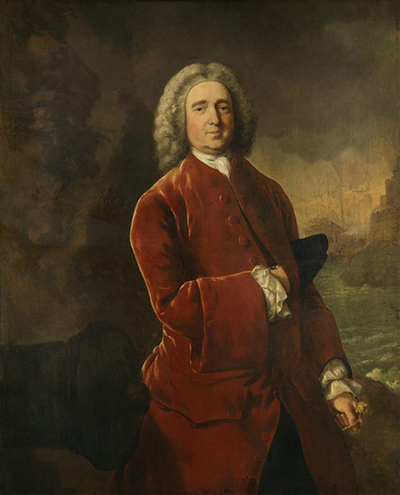
Thomas Gainsborough's Edward Vernon is a compact early portrait of a public naval figure, but it is also a good lesson in version and attribution caution. The National Portrait Gallery identifies the work as Edward Vernon, by Thomas Gainsborough, oil on canvas, circa 1753, measuring 49 3/4 × 40 7/8 inches, or 1264 × 1038 mm.[1] It was purchased in 1891, belongs to the NPG Primary Collection, and is recorded as NPG 881.[1] The current NPG record says it is on display at Gainsborough's House, Sudbury.[1]
The sitter is Admiral Edward Vernon, 1684-1757, a naval officer widely known as "Old Grog."[1] The NPG explains that Vernon led the capture of Porto Bello during the War of Jenkins' Ear in 1739 and that his 1740 order to dilute sailors' rum with water and lemon juice helped create the drink-name "grog," from his nickname.[1] That public identity matters, but the portrait should not be turned into a full naval biography. It is a painting first.
The image shows Vernon in a red coat, white cravat and shirt, with a black hat under his arm and a maritime background. The extended NPG entry describes grey eyes, bushy brown eyebrows, grey wig, fresh complexion, gilt sword hilt, rocks and cannon, sea, yellow sky and dark grey clouds or smoke.[2] Gainsborough compresses military reputation, public confidence and atmospheric setting into a single three-quarter-length likeness.
At a Glance
- ArtistThomas Gainsborough
- SitterAdmiral Edward Vernon, 1684–1757 [1]
- DateCirca 1753 [1]
- MediumOil on canvas [1]
- Dimensions1264 × 1038 mm (49 3/4 × 40 7/8 in.) [1]
- CollectionNational Portrait Gallery Primary Collection [1]
- AccessionNPG 881; purchased 1891 [1]
- Current displayGainsborough’s House, Sudbury [1]
- Portrait typeThree-quarter-length naval portrait with maritime setting
- ExploreBiography; The Blue Boy; Mr and Mrs Andrews; Paintings; Portraits
Contents
- NPG Object Facts
- The Sitter: Admiral Edward Vernon
- Version and Attribution Caution
- Physical Description
- Sea, Smoke and Public Reputation
- Early Gainsborough at Ipswich
- Engraving and Reproduction
- Conservation and Material History
- How to Look
- Why the Portrait Matters
NPG Object Facts
The National Portrait Gallery object record gives the essential public facts: Edward Vernon, by Thomas Gainsborough, oil on canvas, circa 1753, NPG 881, purchased in 1891, and on display at Gainsborough's House.[1] Those details should anchor the account before interpretation begins.
The date is significant. Around 1753, Gainsborough was not yet the celebrated Bath and London portraitist. Gainsborough's House notes that he moved with his family to Ipswich in 1752 and improved considerably as a portrait painter there before moving to Bath in 1759.[3] Vernon's portrait belongs to that early Ipswich world, where Gainsborough was still building range, clients and confidence.
The painting's scale is neither miniature nor grand full-length. It is large enough to carry public identity, but compact enough to concentrate the sitter's face, costume and background. That middle scale suits Vernon. He is presented as a recognisable public man rather than as a full-length aristocratic display.
The NPG record also notes current display at Gainsborough's House.[1] That location is fitting, because the portrait now returns an early Gainsborough likeness to the artist's Sudbury context. The display note should be treated as current collection information from the NPG record, not as a biographical claim about where the work was made.
The purchase date, 1891, adds another layer.[1] By the time the National Portrait Gallery acquired the portrait, Gainsborough's reputation was long established, but early works and version histories still required judgement. The painting entered a national collection not simply as an image of Vernon, but as a work whose attribution and relationship to other versions had to be assessed.
That distinction is useful. The portrait is visually direct, but the evidence around it is not flat. A viewer can meet Vernon immediately through face, red coat and sea. A historian has to hold the object record, the extended catalogue and the version history together.
The Sitter: Admiral Edward Vernon
Vernon was a public figure before Gainsborough painted him. The NPG identifies him as Admiral Edward "Old Grog" Vernon and highlights the 1739 capture of Porto Bello.[1] That naval victory made Vernon widely known in Britain. The painting therefore had to represent a man whose reputation already existed beyond private circles.
The "Old Grog" identity is useful because it connects Vernon's public fame to a concrete naval reform. The NPG explains that his nickname came from grogram clothing and that the diluted rum drink took the name "grog" from him.[1] This story should be included because it is source-led and helps readers understand why Vernon remained memorable.
Still, the nickname should not reduce the sitter to anecdote. Vernon appears in the portrait as a senior naval personality, not as a comic origin story for a drink. The red coat, sword hilt, hat and seascape all work to present public authority.
The face is central. Vernon looks outward with composure, perhaps even a hint of amused confidence, but the expression should not be over-psychologised. The old local copy imagined a jovial relationship with the painter; the evidence does not require that. The painting gives character through appearance, not documentary intimacy.
His age also matters pictorially. Vernon was born in 1684, so a circa 1753 portrait shows him in later life.[1] Gainsborough does not hide that maturity. The grey wig, brows and settled face give the sitter authority that comes from experience rather than youth. This is not the swagger of Ligonier beside his horse; it is a different register of public confidence.
The portrait therefore depends on recognition and reputation. Vernon had already become a known naval figure. Gainsborough's job was not to invent importance from nothing, but to give an existing public identity a persuasive painted form.
Version and Attribution Caution
The extended NPG entry is especially important because it does not present the object history as perfectly simple. It says Philip Thicknesse saw two portraits in Gainsborough's painting room at Ipswich in 1753 and that these are likely to be the two extant versions: NPG 881 and another version that had belonged to the sitter and was later in the Dashwood heirlooms sale at Christie's in 1914.[2]
This means NPG 881 should not be treated as an isolated image with no version history. Gainsborough appears to have made more than one version of Vernon's portrait, or at least the catalogue links the surviving evidence in that direction. That matters because versions, copies and engravings can change how a portrait is understood.
The entry also records earlier doubt. It says NPG 881 is perhaps not a typical Gainsborough and that Scharf tended to attribute it to Highmore before acquisition, while Waterhouse accepted it.[2] The responsible phrasing is therefore not smooth certainty without history. It is an accepted Gainsborough portrait with a recorded attribution discussion.
Waterhouse's acceptance matters because it supports the NPG's present attribution, but it should not erase the earlier hesitation. The portrait's value lies partly in this layered record: early Ipswich evidence, likely versions, an alternative attribution view, later scholarly acceptance and the present NPG object record.
The word "likely" also deserves attention. The NPG says Thicknesse's two portraits are likely to be the two extant versions.[2] That is strong enough to shape interpretation, but cautious enough to avoid pretending that every link is beyond question. The language keeps the chain of evidence honest.
This is why Vernon's portrait is a useful training case for Gainsborough studies. Some works are famous enough that their record feels settled before anyone looks closely. NPG 881 asks for a slower method: start with the present attribution, then keep the older doubts and related version visible.
Physical Description
The NPG extended description is unusually helpful. It notes grey eyes, brown bushy eyebrows, a grey wig and fresh complexion.[2] Those features make the face vivid without turning it into caricature. Vernon appears mature, alert and self-possessed.
The clothing is equally important. The red coat supplies the portrait's strongest colour. The white cravat and shirt brighten the centre of the image, while the black hat under the arm adds a formal note.[2] Vernon does not need a full uniform display to appear official. Costume and bearing are enough.
The gilt sword hilt provides a controlled sign of naval and military identity.[2] Like many eighteenth-century portrait attributes, it is not merely an object. It tells the viewer how to read the sitter's public role. The sword's presence confirms authority without turning the picture into a battle scene.
The background extends that meaning. The NPG notes greenish-brown rocks and a fortress to the right, rocks and black cannon to the left, grey-green sea, yellow sky and dark grey clouds or smoke.[2] The setting makes Vernon's naval identity visible without naming a specific episode in the main title.
The red coat is more than a bright costume note. It fixes Vernon firmly in the foreground and gives the portrait heat against the cooler maritime distance. The colour also helps the face emerge, because the white cravat and shirt sit between complexion and coat like a band of light.
The black hat under the arm is a compact sign of manners. It keeps Vernon within the language of gentlemanly portraiture even as cannon, sea and sword point toward war. Gainsborough lets naval identity and polite bearing share the same body.
Sea, Smoke and Public Reputation
The maritime background gives the portrait a public horizon. Vernon is not placed in a domestic interior or neutral studio space. Sea, cannon, rocks, fortress and cloud connect him to naval theatre.[2] The setting turns his reputation into atmosphere.
The clouds or smoke are especially suggestive. The NPG description does not force the viewer to choose between weather and battle residue, and that ambiguity should be preserved.[2] The dark forms behind Vernon create a mood of action remembered rather than action occurring.
The fortress is also important because Vernon's public fame was tied to Porto Bello.[1] The painting does not need to illustrate that event literally for a viewer to connect Vernon with naval attack, coastal fortification and imperial war. The background gives enough visual language for a naval hero.
At the same time, Gainsborough keeps the portrait focused on the sitter. The sea and military setting support Vernon; they do not engulf him. The face, red coat and upright pose remain the composition's centre.
This balance distinguishes the portrait from a marine battle picture. Gainsborough borrows enough of the naval world to identify Vernon, but he does not turn the canvas into an event. The background is memory, reputation and attribute. The subject is still the person.
That choice suits Vernon's late public identity. He was remembered for action and reform, but he is painted as a man whose fame has settled into presence. The drama is behind him, literally and figuratively.
Early Gainsborough at Ipswich
Vernon's portrait belongs to the years after Gainsborough moved to Ipswich. Gainsborough's House notes that he relocated there in 1752 and that his portrait skills improved considerably during this period.[3] The National Gallery also places his early career before Bath within Suffolk and local patronage before his broader fashionable success.[4]
That timing gives the painting particular interest. Gainsborough was not yet relying on the grand social formulas of Bath portraiture. In Vernon, he had a sitter with national public identity. The portrait gave the young artist a chance to handle fame, naval authority and atmospheric setting on a manageable scale.
The extended entry's reference to Thicknesse seeing two portraits in the Ipswich painting room in 1753 reinforces this early-career context.[2] It places the Vernon image within Gainsborough's working space, not simply within later museum classification. The portrait is tied to the practical studio life of the young painter.
Rosenthal's Paul Mellon Centre study is helpful for the wider frame because it treats Gainsborough's art through professional pressure, social exchange, pictorial pleasure and the business of looking.[5] Vernon fits that frame neatly. The sitter brings public fame; the painter gives that fame an image that is both recognisable and atmospheric.
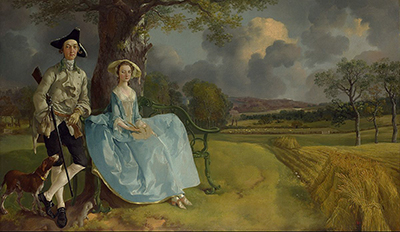
The painting also shows how early Gainsborough could adapt portrait format to sitter type. Vernon did not require the expansive land-and-marriage structure of Mr and Mrs Andrews or the later aristocratic flourish of a Charles Howard. He required a compact form of public remembrance: naval setting, confident costume, face and reputation compressed into one image.
That flexibility is one reason the portrait belongs in the wider Gainsborough sequence. It shows a young painter learning that likeness was never only likeness. Each sitter brought a different social problem, and the portrait had to solve it visually.
Engraving and Reproduction
The NPG extended entry notes that the type was engraved by James McArdell and others, while also remarking that McArdell's mezzotint perhaps suggests rather different handling from NPG 881.[2] That comment is a useful warning. Reproductive images can preserve a portrait's fame while also changing how its handling is perceived.
Mezzotint was especially important for eighteenth-century portrait circulation. A painted portrait could hang in one collection, but an engraved version could travel much more widely. For a public figure like Vernon, reproduction was part of reputation.
The reference to different handling should not be ignored. If a mezzotint suggests another surface quality, it may reflect another version, engraver's interpretation or the translation from paint to print. The NPG does not turn that into a simple conclusion, and neither should a public account.
This is one of the reasons Vernon's portrait is more complex than it first appears. It is a likeness of a naval officer, but it also belongs to a network of versions, engravings, catalogue judgments and later display. The image has a life beyond the canvas.
For a sitter like Vernon, that afterlife is especially appropriate. His fame had already depended on circulation: reports of Porto Bello, stories of naval reform, political speech and public reputation. The portrait and its engraved type continued that movement in visual form. Paint made the reputation visible; print helped it travel.
Conservation and Material History
The NPG extended entry records small areas of retouching, particularly to the right side of the face, the right cuff and the boat in the background.[2] It also records that the surface was cleaned, polished and varnished in September 1895 and July 1901.[2] These details are modest but important.
They remind us that the portrait has a material history. The face, cuff and background are not untouched survivals from 1753. They have been maintained, altered in small areas and cared for across time. That does not weaken the portrait. It makes it a real object rather than a disembodied image.
The conservation note also matters because visual interpretation depends on surviving surface. If the painting has retouching and an old cleaning history, the viewer should be cautious about reading every brush passage as an unmediated trace of Gainsborough's hand. Object history and attribution history belong together.
This is especially true for a painting whose extended entry already records version and attribution discussion. The surface, the versions and the reproductive prints all form part of the evidence. Vernon's portrait asks for a careful eye, not just a quick identification.
The conservation note also tempers visual confidence. A passage that seems vivid today may be partly affected by retouching, cleaning or varnish history. That does not make looking impossible. It simply means that visual pleasure should be joined to object awareness.
How to Look
Begin with Vernon's face. The grey wig, brows and steady expression give him a composed public presence. He is not shown in action; he is shown as someone whose action is already known.
Then look at the red coat. It dominates the centre of the painting and gives Vernon authority without excessive ornament. The red is warm but controlled, making the sitter stand firmly against the darker setting.
Next, notice the black hat under his arm and the sword hilt. These details sharpen the distinction between gentlemanly bearing and martial identity.[2] Vernon appears both socially polished and professionally marked.
Finally, move into the background. Sea, rocks, cannon, fortress and cloud or smoke make the portrait maritime without turning it into a narrative history painting.[2] Gainsborough lets the setting carry Vernon's public world while the sitter remains the visual anchor.
Why the Portrait Matters
Edward Vernon matters because it shows Gainsborough handling public identity early in his career. The sitter brought naval fame, a memorable nickname and political reputation, but the painting translates those into portrait form through face, costume, sword and seascape.[1][2]
It also matters because the NPG record preserves complexity. The work is accepted as by Gainsborough, but the extended entry records likely versions, earlier attribution hesitation, Waterhouse acceptance, reproductive engravings and conservation history.[2] That is not a problem to hide. It is the portrait's historical texture.
The painting also broadens the Gainsborough group. Vernon is not an aristocratic equestrian portrait like Ligonier, not a studio-family image like Dupont, not a musician like Abel and not a late ceremonial duke like Charles Howard. He brings naval public life into the sequence, in an early Ipswich work that is compact but historically dense.
The strongest reading therefore begins with object discipline. NPG 881 is a circa 1753 oil portrait purchased in 1891 and now recorded as on display at Gainsborough's House.[1] The extended catalogue warns that versions and attribution history matter.[2] Within those bounds, the painting can be enjoyed for what it does very well: turning Admiral Edward Vernon into an image of aged public confidence, naval atmosphere and early Gainsborough ambition.
It is also a portrait about controlled memory. Vernon is not shown in the moment of victory, nor in the act of issuing a naval order. He is shown after fame has attached itself to him. Gainsborough gives him a stillness that allows the viewer to recognise the public man without needing to see the public event.
Frequently Asked Questions
Discussion
How does this early portrait turn Vernon’s naval reputation into a controlled image while preserving its complex object history?
Reader Insights
How do Vernon’s mature face, red coat, hat and sword establish authority without depicting action?
How do cannon, fortress, sea and cloud or smoke evoke naval reputation without illustrating a named battle?
Why should likely versions, engraving, retouching and earlier attribution hesitation remain visible together?
Join the Conversation
Share your reading below.
References
- National Portrait Gallery, “Edward Vernon,” NPG 881 overview. View source.
- National Portrait Gallery, “Edward Vernon,” NPG 881 extended catalogue entry. View source.
- Gainsborough's House, “About Thomas Gainsborough.” View source.
- National Gallery, London, “Thomas Gainsborough,” artist biography. View source.
- Michael Rosenthal, The Art of Thomas Gainsborough: "A Little Business for the Eye" (New Haven and London: Yale University Press for the Paul Mellon Centre for Studies in British Art, 1999). Publication record.