 by Tom Gurney
Tom Gurney BSc (Hons) is an art history expert with over 20 years experience
Published on June 19, 2020 / Page Updated on November 5, 2026
Email: tomgurney1@gmail.com / Phone: +44 7429 011000
Introduction
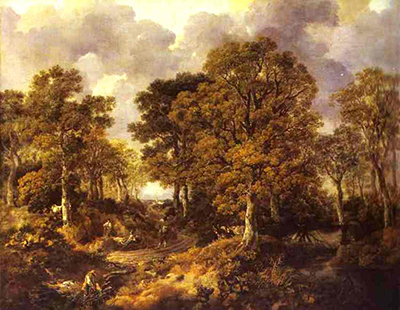
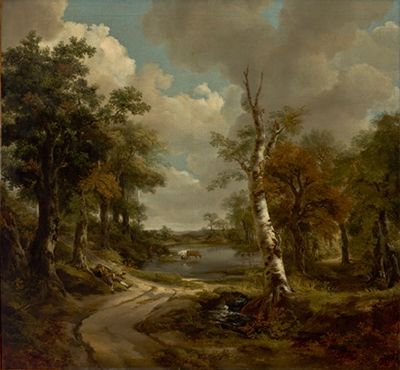
Thomas Gainsborough's Drinkstone Park (The Woods of Cornard [?]) is an early landscape whose title carries its own warning. MASP gives the title as Drinkstone Park (The Woods of Cornard [?]), dates the painting to 1747, identifies the medium as oil on canvas, gives the dimensions as 146 × 156.5 × 4 cm, and records the inventory number as MASP.00198.[1] The painting entered MASP through the Santos Vahlis donation in 1951.[1]
The question mark in the title is not a decorative flourish. It is part of the evidence. MASP explains that there is doubt about the place represented: the work may relate to Cornard Woodland, associated with other Gainsborough landscapes, or to Drinkstone Park, since the park's owner was also the owner of this canvas.[1] A responsible account therefore has to preserve the uncertainty rather than turn the painting into a straightforward topographical view.
The image itself shows a wooded landscape with a curving road, heavy trees, broken light, a sleeper near the road and cattle in the middle distance. Human presence is modest. Vegetation, atmosphere and pictorial structure carry the main force. The result is one of the strongest early cases of Gainsborough using landscape not as background, but as the central subject.
At a Glance
- ArtistThomas Gainsborough
- MASP titleDrinkstone Park (The Woods of Cornard [?]) [1]
- Date1747 [1]
- MediumOil on canvas [1]
- Dimensions146 × 156.5 × 4 cm [1]
- CollectionMuseu de Arte de São Paulo (MASP) [1]
- InventoryMASP.00198 [1]
- AcquisitionSantos Vahlis donation, 1951 [1]
- Landscape typeAmbitious early wooded landscape with disputed place identity
- ExploreCornard Wood; Landscapes; The Market Cart; Paintings; Technique
Contents
- Introduction
- MASP Object Facts
- A Title with a Question Mark
- Vegetation as the Main Actor
- Road, Grove and Asymmetry
- Clouds and Diffuse Light
- Dutch Models and Free Variation
- Relationship to Cornard Wood
- The Sleeping Figure
- Why the Painting Matters
MASP Object Facts
MASP identifies Gainsborough as the author and gives his life dates as Sudbury, England, 1727, to London, England, 1788.[1] The work is classified as a painting, and the museum title is explicit: Drinkstone Park (The Woods of Cornard [?]). That title should be followed because it keeps two possibilities in play.
The date, 1747, places the painting in Gainsborough's early Suffolk period.[1] Gainsborough's House notes that he returned to Sudbury as a young married artist after training in London and before his later move to Ipswich, Bath and London.[2] This was the phase in which local landscape, Dutch example and professional ambition were still being worked through at close range.
The scale is important. MASP's catalogue text notes that Drinkstone Park is the largest landscape Gainsborough painted before the Bath period.[1] That makes the work more than a minor youthful exercise. Its size suggests a young artist willing to attempt breadth and complexity in landscape before portraiture became his main professional engine.
The painting should therefore be read as an ambitious early landscape with a disputed place identity. The title gives a location problem; the canvas gives a pictorial solution. Gainsborough builds the scene through trees, road, water, figures, animals and sky, letting landscape organisation carry the viewer's attention.
That combination of uncertainty and ambition is very Gainsborough. Rosenthal's Paul Mellon Centre study is useful for the wider career because it treats Gainsborough's art through the pressures and pleasures of looking, professional choice and social exchange rather than through a flat division between portrait and landscape.[4] The MASP painting belongs to that wider field. It is not a retreat from the public world of art; it is a young painter's serious bid to make landscape carry value.
A Title with a Question Mark
The title asks the viewer to hold two ideas together. Drinkstone Park points toward a named Suffolk estate connection. The Woods of Cornard [?] points toward another Gainsborough landscape identity and another place association. MASP's own text says the title shows doubt about the place depicted.[1]
That uncertainty is not unusual in early landscape history. Works can be named by later owners, dealers, cataloguers or scholars. A place name may come from ownership, local memory, visual comparison, an older title, or a hypothesis about subject matter. In this case, MASP keeps the uncertainty visible instead of forcing a tidy answer.
This matters because Cornard Wood, near Sudbury, Suffolk at the National Gallery is a separately anchored work. The National Gallery identifies that painting as a view near Great Cornard, taken from Abbas Hall and looking toward Great Henny, and also connects it to common-land use around Sudbury.[3] Those facts should not be transferred automatically to the MASP painting.
The safer reading is more interesting anyway. Drinkstone Park (The Woods of Cornard [?]) sits in a field of Suffolk memory, Dutch landscape study, ownership history and comparison with other early Gainsborough works. It does not need to be reduced to one settled map point in order to matter.
The ownership link to Drinkstone Park is still meaningful. MASP's explanation notes that the park's owner was also the owner of the canvas.[1] That makes Drinkstone more than a random label, even if it does not prove that the picture is a measured view of the estate. The name may preserve a patronal or collection memory rather than a literal viewpoint.
Cornard, by contrast, pulls the painting toward Gainsborough's better-known early Suffolk landscape cluster. The question mark allows both kinds of memory to remain active: one attached to ownership, the other attached to visual and artistic comparison. For a landscape painting, that is a productive instability. Place can enter through more than one door.
Vegetation as the Main Actor
MASP's curatorial text gives a clear visual reading: in the scene, a man sleeps beside a road within a wooded grove, but his presence is only a detail, while vegetation plays the leading role.[1] That is the best doorway into the painting.
The trees dominate the composition. A mass of foliage rises at the left, while a pale, stripped trunk stands nearer the centre-right. The road curves into depth, but the viewer's eye is repeatedly pulled back into the density of the wooded margins. Landscape is not passive space. It acts.
The sleeping figure is important because he measures the scale of the grove, but he does not control the image. He is absorbed into the roadside. His rest turns the landscape into a place of pause, shade and bodily vulnerability, yet the human story remains minimal.
The cattle in the distance perform a similar function. They animate the watery middle ground without turning the work into an animal subject. They help establish rural use, but the vegetation, road and sky still command the composition. Gainsborough lets ordinary life flicker inside a much larger structure of trees and air.
This distribution of attention is one of the painting's most sophisticated features. Many youthful landscapes depend on a picturesque incident to hold the viewer. Here the incident is deliberately subdued. The viewer notices the sleeper, the road and the cattle, but the eye keeps returning to branching trunks, tangled foliage and cloud mass. The human and animal elements are folded into the landscape rather than placed in front of it.
That choice changes the emotional register. The painting is not pastoral comedy or rustic anecdote. It is quieter and heavier. The grove seems to exist before and after the human pause at the roadside. Gainsborough gives the scene a sense of duration, as if the trees and weather belong to a longer time than the sleeper's rest.
Road, Grove and Asymmetry
MASP describes a landscape language built from curved roads, empty areas, trees and groves arranged asymmetrically, in such a way that a complete view is interrupted and the spectator feels as if walking through the landscape.[1] That observation is crucial for understanding the painting's movement.
The road does not simply lead from foreground to background in a clean line. It bends, narrows and disappears into the wooded space. The curve gives the painting a bodily rhythm. Viewers are invited to imagine movement along the path, even while the sleeping figure remains still.
The asymmetry keeps the scene alive. Trees bunch heavily on one side, open ground appears in another, and the sky breaks through in uneven passages. Nothing feels like a balanced classical stage. The painting depends on interruption, partial view and the promise of further space.
This is one reason the title problem does not paralyse interpretation. Even if the exact place remains uncertain, the spatial experience is clear. Gainsborough is creating a landscape that feels entered rather than merely seen from a fixed distance.
The curving road is especially important because it gives the viewer a role. A straight road would make distance simple. This road bends around the foreground, slips past the sleeper, and turns the middle ground into a lived passage. It makes the viewer imagine walking, pausing and continuing.
The grove also controls what cannot be seen. Dense trees block the broad view, while openings toward sky and water reveal only partial distance. The painting's pleasure depends on this withheld prospect. Gainsborough does not offer a survey; he offers passage.
Clouds and Diffuse Light
MASP notes the dense clouds and diffuse lighting, with greens and browns illuminated across the landscape.[1] The sky is not a background strip. It presses down on the grove and controls the painting's mood. Large cloud forms break the light, producing an atmosphere of movement and weather.
The diffuse light suits the woodland subject. Instead of spotlighting a single figure or incident, it spreads across road, trunks, foliage and water. The eye moves slowly because the illumination does not force a single focus. This is a landscape of distributed attention.
The brown and green tonal range gives the painting a mature gravity for such an early work. The colours suggest earth, bark, leaf, moisture and shade. The blue intervals in the sky are important, but the painting's weight belongs to the wooded ground.
That tonal gravity helps separate the painting from a simple picturesque view. It has charm, but also density. Gainsborough is already thinking about how landscape can hold mass, light and movement without depending on dramatic incident.
The central pale trunk is one of the strongest devices in that system. It stands almost like a vertical interruption against the softer movement of clouds and foliage. Its broken upper branches add a note of age or damage without becoming symbolic drama. It gives the composition a hard accent, keeping the right side from dissolving into atmosphere.
The sky, meanwhile, opens the painting upward. The heavy foreground grove might have become oppressive, but the cloud breaks make the scene breathable. This contrast between enclosed woodland and open sky is part of the work's early confidence.
Dutch Models and Free Variation
Luciano Migliaccio's MASP catalogue text preserves an important scholarly debate. He reports Waterhouse's view that the painting is not, as usually stated, a view of Drinkstone Park, but a free variation on a work by Jacob van Ruisdael.[1] Migliaccio then presents a more nuanced position, allowing the MASP painting to be understood as a trade-off between a Dutch model and actual landscape.[1]
This is the right kind of complication for Gainsborough. He did not simply copy Dutch art, nor did he merely record Suffolk scenery. He learned from Dutch landscape composition and then remade those lessons through English terrain, memory and studio invention.
The National Gallery's account of Cornard Wood helps explain the broader pattern. It says Gainsborough began teaching himself landscape by studying and copying Dutch artists, especially Wijnants and Ruisdael, and that East Anglia itself shared visual features with the Netherlands: river meadows, ponds and windmills.[3] That background gives the MASP painting a plausible artistic context without fixing its exact topography.
Migliaccio also notes the connection between the MASP work, a drawing after the Dutch model in Manchester, and the National Gallery painting known as Cornard Wood or Gainsborough's Forest in older discussions.[1] The point is not to collapse these objects, but to understand how early Gainsborough landscapes could grow from copying, variation, place memory and ambitious enlargement.
That kind of growth complicates the idea of originality. Gainsborough's originality does not require isolation from models. It lies in transformation: taking compositional lessons from Dutch landscape, testing them against English terrain and making a new surface from the encounter. A "free variation" can be more artistically revealing than a literal view because it shows what the painter chose to carry forward and what he chose to alter.
The MASP painting therefore belongs to a learning process, but not to a timid one. Its scale, dense handling and layered title suggest a young painter already using study as a way to make something large and saleable. The work is educational, commercial and imaginative at once.
Relationship to Cornard Wood
The relationship with Cornard Wood has to be handled with care. The National Gallery painting has unusually strong place evidence: Great Cornard, Abbas Hall, Great Henny, common-land rights, a dated 1748 claim by Gainsborough and a long title history.[3] The MASP painting does not carry that same chain of facts.
Instead, MASP keeps Cornard as a possibility inside a questioned title. The wording The Woods of Cornard [?] signals an association, not a settled identification.[1] That distinction matters. It prevents the MASP work from being turned into a second version of the National Gallery painting.
The two works can still illuminate each other. Both belong to Gainsborough's early landscape concerns. Both involve woodland, paths, Dutch example and the problem of place. Both show that the young artist was already deeply invested in landscape as a field of ambition.
But their differences should remain visible. Cornard Wood is crowded with common-land activity and a named local prospect. Drinkstone Park (The Woods of Cornard [?]) is more atmospheric and less socially specific. The sleeper, cattle and road are present, but the leading role belongs to the grove itself.
That distinction also protects the National Gallery painting from being used as a shortcut. Cornard Wood carries a documented social world of common rights and village use.[3] The MASP work does not need to borrow that whole argument. Its social life is quieter, located in ownership history, rural movement, the resting body and the way a viewer is drawn into the path.
Seen this way, the two landscapes enrich each other by difference. One shows Gainsborough making a crowded local common into a major pictorial field. The other shows him making uncertainty, Dutch memory and wooded atmosphere into a large early landscape. Both demonstrate ambition, but not the same ambition.
The Sleeping Figure
The sleeping man beside the road is small, but he changes the emotional key of the painting. A walking figure would emphasise travel. A working figure would emphasise rural labour. A sleeping figure gives the landscape a pause.
MASP's later catalogue text notes that the theme of a subject asleep at the edge of a trail appears in Gainsborough only in this work and in Rest by the Way at the Philadelphia Museum of Art, and that the motif may stem from the influence of Nicolaes Berchem.[1] That comparison should remain cautious, but it helps explain why the sleeper feels like more than anecdote.
Sleep makes the body vulnerable to the landscape. The figure is not mastering the view, measuring land or claiming ownership. He is resting within it. That reversal supports MASP's observation that vegetation has the leading role.[1]
The sleeper also slows the viewer. The road invites movement, but the resting body interrupts it. The painting therefore holds two tempos at once: the path drawing the eye onward and the figure asking it to stop.
The figure's smallness is essential. If the sleeper were larger, the painting might become a narrative of fatigue or rural leisure. At this scale, he becomes part of the landscape's rhythm. He is almost another low form along the road, more pause than protagonist.
This allows Gainsborough to test a subtle hierarchy. The human body remains necessary because it gives scale, rest and mood. Yet the body is not sovereign. The trees, clouds and road organise the world around it.
Why the Painting Matters
Drinkstone Park (The Woods of Cornard [?]) matters because it keeps early Gainsborough landscape open rather than settled. It has a date, a museum record, dimensions and a strong collection identity, but its title still preserves place uncertainty.[1] That combination is exactly what makes it valuable.
The painting also matters because it shows how ambitious Gainsborough could be before Bath. MASP's text calls it his largest landscape before that later period.[1] At 1747, he was still young, yet the work already handles scale, wooded structure, road movement, cattle, figure, light and sky with confidence.
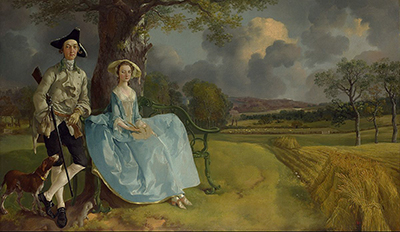
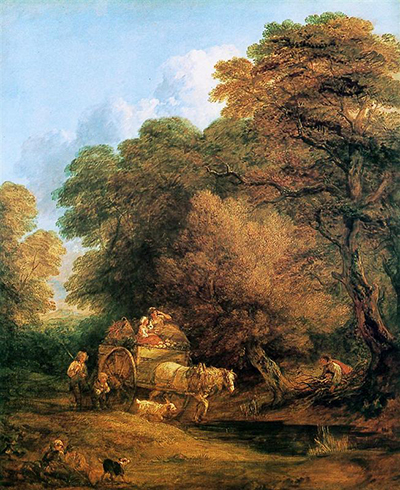
It also expands the Gainsborough landscape group beyond the most familiar British holdings. The work now in São Paulo sits in conversation with Cornard Wood in London, Landscape in Suffolk, A Coastal Landscape, The Market Cart and the landscape-supporting passages of Mr and Mrs Andrews. It reminds viewers that Gainsborough's landscape career cannot be told from one collection alone.
Above all, the painting teaches the discipline of uncertain titles. Drinkstone, Cornard and Dutch-model variation all belong near the work, but none should be allowed to erase the others. Gainsborough's landscape is strongest when read as a meeting point: Suffolk association, ownership history, Dutch compositional memory, young ambition and the visual dominance of trees, road, sky and quiet rural presence.
It also teaches a larger lesson about early Gainsborough. Landscape was not an innocent sideline waiting for portraiture to become serious. In this work, landscape already carries scale, intellectual memory, market potential, atmosphere and material authority. The young painter was learning how to make trees and roads think.
Frequently Asked Questions
Discussion
How does Gainsborough make the grove—not the sleeper—the painting’s main actor?
Reader Insights
How do the curving path and sleeping figure set movement against stillness?
Where do dense foliage, the pale broken trunk and diffuse cloud light control attention?
How can Drinkstone ownership, Cornard association and Dutch variation remain visible without becoming one fixed location?
Join the Conversation
Share your reading below.
References
- MASP, “Thomas Gainsborough, Drinkstone Park (The Woods of Cornard [?]),” MASP.00198. View source.
- Gainsborough's House, “About Thomas Gainsborough.” View source.
- National Gallery, London, “Thomas Gainsborough, Cornard Wood, near Sudbury, Suffolk.” View source.
- Michael Rosenthal, The Art of Thomas Gainsborough: "A Little Business for the Eye" (New Haven and London: Yale University Press for the Paul Mellon Centre for Studies in British Art, 1999). Publication record.