 by Tom Gurney
Tom Gurney BSc (Hons) is an art history expert with over 20 years experience
Published on June 19, 2020 / Page Updated on November 5, 2026
Email: tomgurney1@gmail.com / Phone: +44 7429 011000
Introduction
Thomas Gainsborough's Conversation in a Park is an early work in which portraiture, landscape and social play are held in a delicate balance. The Louvre gives the title as Conversation dans un parc, dates the painting to the second quarter of the eighteenth century, specifically 1746-1748, and identifies Thomas Gainsborough as the artist.[1] The inventory number is RF 1952 16, and the work belongs to the Louvre's Département des Peintures.[1]
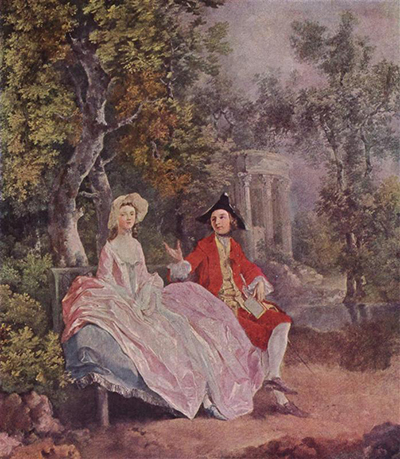
The English title, Conversation in a Park, is a useful translation, but the French title should remain visible because it is the Louvre's title. The painting shows a seated woman in a pale pink dress and a seated man in red costume within a wooded setting. They appear close enough to form a social pair, but the painting does not give modern viewers a secure named identity for either sitter. That uncertainty is part of the work's interest.
The Louvre describes the painting as one of Gainsborough's first examples of the conversation piece.[1] That phrase matters. The picture is not just a landscape with figures, nor simply a double portrait. It belongs to a genre in which people, setting, manners and social relationship are arranged together for looking.
At a Glance
- ArtistThomas Gainsborough
- Louvre titleConversation dans un parc [1]
- Date1746–1748 [1]
- MediumOil on canvas [1]
- Dimensions0.73 × 0.68 m; 0.99 × 0.9 m with accessory [1]
- CollectionMusée du Louvre, Département des Peintures [1]
- InventoryRF 1952 16 [1]
- GenreEarly conversation piece [1]
- SittersUnnamed; former identifications remain unconfirmed
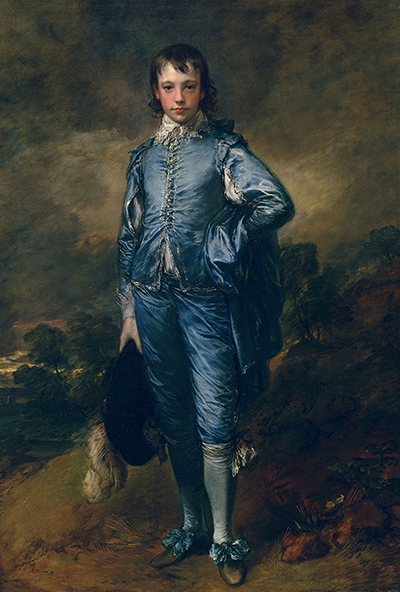
- ExploreBiography; The Blue Boy; Mr and Mrs Andrews; Paintings; Portraits
Contents
- Louvre Title and Object Facts
- Former Titles and Sitter Caution
- The Conversation Piece
- Figures in a Park Setting
- French Taste and English Form
- Early Gainsborough
- Relationship to Later Couple Portraits
- Provenance and Collection History
- How to Look
- Why the Painting Matters
Louvre Title and Object Facts
The core facts are controlled by the Louvre. The object name is Conversation dans un parc.[1] The materials are oil on canvas, and the dimensions are 0.73 m high by 0.68 m wide; with accessory, the measurements are 0.99 m high by 0.9 m wide.[1] The record gives the acquisition mode as donation, the acquisition date as 1952, ownership by the French state, and holding by the Musée du Louvre, Département des Peintures.[1]
The date range, 1746-1748, places the painting very early in Gainsborough's career.[1] Gainsborough's House notes that he was born in Sudbury, trained in London, returned to Suffolk, and married Margaret Burr in 1746.[2] The National Gallery likewise frames him as a painter who began in Suffolk before developing his major portrait career in Bath and London.[3]
That early setting is important because Conversation in a Park does not yet belong to the grand public portrait world of late works such as Charles Howard, 11th Duke of Norfolk. It is smaller, lighter and more experimental. Gainsborough is testing how a couple can be integrated into a landscape without making either the figures or the setting secondary.
The Louvre currently gives the location as Château - Domaine national de Versailles, and its exhibition list includes Jardins des Lumières (1750-1800) at Versailles from 5 May to 27 September 2026.[1] That present display context should not alter the object facts, but it does show how naturally the painting can be read within garden, pleasure and Enlightenment sociability themes.
Former Titles and Sitter Caution
The Louvre's former-title field is especially useful because it records earlier attempts to identify the figures. Former titles include Portrait de Thomas Gainsborough et de sa femme, Margaret Burr (1728-1798), Portrait de Thomas Sandby (1721-1798), dessinateur et architecte) et de sa femme, and Portrait de Paul Sandby (1725-1809).[1]
These former titles are not the same as secure identifications. They show how viewers and cataloguers have tried to anchor the painting in known names. The Louvre's description explains that the painting has often been connected with a Louvre drawing of a couple in a landscape from the same period, probably Gainsborough and his future wife, but that a relatively recent annotation naming Paul Sandby and his wife led to an identification that was repeated for RF 1952 16 until 1997.[1]
That history demands restraint. The painting can be discussed as an early conversation piece and as a work once associated with named couples, but it should not be presented as a confirmed portrait of Gainsborough and Margaret Burr, Thomas Sandby and his wife, or Paul Sandby. The Louvre's current title does not identify the sitters by name.[1]
This caution strengthens rather than weakens the painting. Uncertainty lets the viewer focus on the social form: a couple in a park, arranged through costume, gesture, proximity and landscape. The people remain specific enough to be engaging, but not securely documented enough to carry a biographical account.
The Conversation Piece
A conversation piece usually brings figures together in an informal social setting. It can resemble portraiture, but it is not limited to the head-and-shoulders likeness or the formal full-length. It often asks the viewer to read relations among people, objects and place.
The Louvre explicitly calls this one of Gainsborough's earliest examples of the type.[1] That makes the painting valuable within his development. It shows him exploring a format that allowed portraiture and landscape to cooperate. The figures are not imposed on a neutral background; the trees, path, bench and distant architecture shape the mood of their meeting.
The word "conversation" does not require a literal exchange of words. In this painting, the male figure gestures while the woman turns outward with a more reserved presence. The emotional drama is mild and ambiguous. The scene depends on social poise rather than narrative climax.
This is why the painting should not be over-described as romance, proposal or domestic certainty. It gives a social encounter in a cultivated outdoor setting. The forms of conversation-piece painting allow suggestion, but the evidence does not require a fixed story.
Figures in a Park Setting
The composition places the couple on a bench or seat within a wooded park. The woman occupies much of the left and central foreground through the volume of her pale dress. The man sits beside her in red, angled toward her and toward the viewer. Their costumes produce a clear colour contrast, but neither figure is isolated from the surrounding trees.
The park is not a named estate in the Louvre title. It is a pictorial environment: wooded, sheltered, cultivated and gently theatrical. The trees frame the figures, while a path and architectural feature in the background suggest depth beyond the immediate encounter. Gainsborough is already thinking about landscape as a social space.
The woman's pale pink dress is central to the painting's visual effect. It expands across the foreground like a soft luminous field. The man's red coat supplies a stronger accent and gives the pair a sharper rhythm. Between them, the viewer reads both closeness and difference.
The setting helps manage that relationship. The couple appears outdoors, but not in wild countryside. The park is ordered enough to support sociability. It is nature adjusted for pleasure, looking and conversation. That balance between natural growth and social arrangement would remain important in Gainsborough's later art.
French Taste and English Form
The old local description rightly sensed a French connection, but it should be handled carefully. The Louvre record itself does not require a full claim about direct influence from named French painters. What can be said more safely is that the painting belongs to a mid-eighteenth-century world in which garden scenes, elegant couples and polite leisure moved across English and French visual culture.
The French title and Louvre collection history naturally encourage that comparison, but the painting remains a work by a British artist at the beginning of his career.[1] It uses an English conversation-piece format while also sharing the lighter social atmosphere associated with European scenes of leisure. The result is not imitation alone. It is a young artist adapting fashionable pictorial possibilities to his own emerging interests.
Gainsborough's later career would make the fusion of figure and landscape one of his great strengths. In this early work the fusion is still compact and slightly staged. The foliage creates a shelter, the architecture provides refinement, and the figures give the setting a social purpose.
Rosenthal's Paul Mellon Centre study helps frame this early experiment because it presents Gainsborough's art within a living economy of spectatorship, pleasure, ambition and social performance.[4] Conversation in a Park fits that pattern at a youthful scale. It is a picture about seeing people in a place, and about making social ease visually pleasurable.
The painting also shows how quickly Gainsborough could turn a small format into a test of pictorial relations. The figures, foliage and architecture are modest in scale, yet they ask the same basic question that would animate much of his later career: how can a person belong to a setting without being swallowed by it?
Early Gainsborough
The date 1746-1748 puts the painting near the beginning of Gainsborough's adult life and career.[1] This is before the mature Bath portrait business, before the London Schomberg House exhibitions, and long before the late aristocratic portraits. It belongs to a period when the artist was finding how portraiture and landscape could answer each other.
Gainsborough's House presents his career as moving through Sudbury, London training, Ipswich, Bath and London, with landscape and portraiture always intertwined rather than neatly separated.[2] Conversation in a Park makes that entanglement visible from the start. The figures need the landscape, and the landscape needs the figures.
The painting also has a freshness that differs from Gainsborough's later, more assured grand manner. The couple is posed, but the whole scene feels more intimate than official. The outdoor setting reduces ceremony. Instead of rank proclaimed through baton, coronet or heraldry, status appears through dress, leisure, setting and cultivated ease.
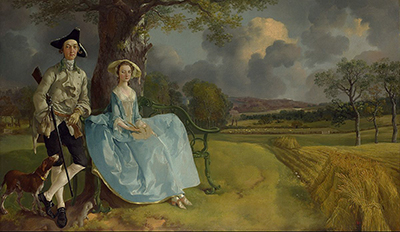
This helps explain why the work can be compared lightly with Mr and Mrs Andrews without being made to do the same job. Both paintings place a couple outdoors. But Mr and Mrs Andrews is tied to land, marriage, property and the unresolved empty lap. Conversation in a Park is more elusive: a small social scene whose identities have not settled into certainty.
Relationship to Later Couple Portraits
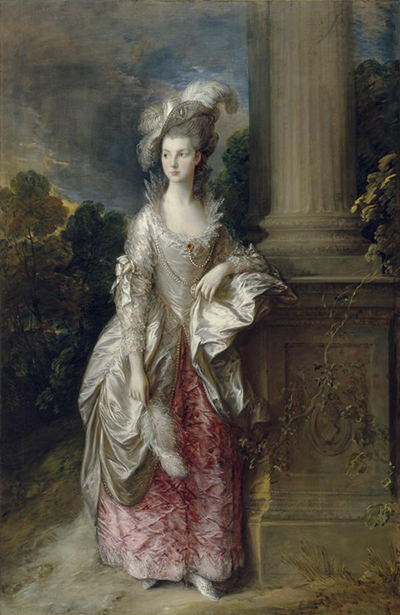
Gainsborough would return repeatedly to the problem of figures in landscape. A Couple in a Landscape at Dulwich uses a wooded setting and x-ray evidence of a reused canvas to open another kind of portrait-landscape question. Mr and Mrs Andrews anchors a couple within a recognisable estate world. The Morning Walk turns a married pair into a late image of elegance, motion and social polish.
Conversation in a Park sits near the beginning of this long field. It does not have the documentary weight of the National Gallery's Andrews portrait or the late brushwork confidence of The Morning Walk. Its importance is quieter. It shows the young Gainsborough already understanding that landscape could be more than scenery behind people.
The figures are embedded in the setting rather than cut out against it. Their conversation, whether literal or implied, is also a conversation with the park: bench, trees, architecture, path and air. The painting invites the viewer to read social relationship as spatial relationship.
That is why unsupported sitter identification would narrow the work too much. If the couple were forced into a fixed biography, the painting's broader experiment would be reduced. The Louvre's cautious title leaves room for the image to be understood as an early study in social landscape.
Provenance and Collection History
The Louvre record gives a detailed history. It says the painting was probably made around 1746-1747, and records an 1806 London sale description that treated it as a small full-length in a landscape, the portrait of Gainsborough and his wife.[1] It then traces the work through the 1832 G. Watson Taylor sale, Norton, Rev. Dr. Burney in 1834 and his descendants, Rev. Charles Burney of Surbiton, Charles Sedelmeyer in Paris in 1890, Camille Groult in Paris, Jean Groult, and Pierre Bordeaux-Groult, who donated it in 1952.[1]
That history shows how strongly earlier ownership and sale descriptions shaped identity. The 1806 and 1832 descriptions tied the painting to Gainsborough and his wife, while the 1877 Royal Academy exhibition label named Rev. Charles Burney as lender and presented a different Sandby identification.[1] These shifting names belong to the work's reception history, not to settled sitter fact.
The 1952 donation by Pierre Bordeaux-Groult brought the painting into the French national collection.[1] Since then it has been part of the Louvre's British painting holdings and has appeared in exhibitions on landscape, genre painting, love, gardens and British art.[1] That exhibition life fits the painting's hybrid character.
The work's bibliography is also substantial. The Louvre lists Waterhouse, Hayes, the 1980-81 Gainsborough exhibition, the 1997 Young Gainsborough exhibition, Martin Postle's 2002 publication, the 2013 Louvre British paintings catalogue, and Hugh Belsey and Jonathan Yarker's 2019 Gainsborough portrait study among later references.[1] That trail shows that a modest early painting can still carry serious scholarly weight.
How to Look
Begin with the woman's dress. Its pale pink surface dominates the foreground and establishes the painting's refined tone. The dress is not merely costume; it is the main visual mass around which the scene is organised.
Then look at the man's gesture. His red coat and active hand give the composition a conversational spark. He seems to address or persuade, but the painting does not tell us exactly what is being said. The ambiguity is part of the social charm.
Next, follow the trees. They do not simply fill the background. They frame the figures and give the scene privacy. The dark trunk at the left and the softer foliage above create a protective enclosure.
Finally, look beyond the couple to the architecture and path. These details prevent the park from feeling wild. They suggest cultivated leisure, a world arranged for strolling, sitting and looking. Gainsborough gives the conversation a stage, but keeps the stage soft enough for the figures to breathe.
Why the Painting Matters
Conversation in a Park matters because it shows Gainsborough discovering a form that could unite portraiture and landscape. The Louvre's description as one of his first conversation pieces is therefore central.[1] The painting is small compared with later full-length portraits, but its artistic problem is large.
It also matters because it teaches caution. Former titles connected the figures with Gainsborough and Margaret Burr, Thomas Sandby and his wife, and Paul Sandby.[1] Those names are historically interesting, but the present Louvre title refuses a firm sitter identification. A responsible account should preserve that uncertainty.
The painting's early date gives it another importance. Around 1746-1748, Gainsborough had not yet become the great Bath and London portraitist. Yet he was already exploring the relationship between people and landscape that would remain central to his art.[1][2] The conversation piece allowed him to make that exploration socially legible.
The final value of the work lies in its poised ambiguity. It is affectionate without being biographical, elegant without being grand, landscaped without becoming pure scenery. A couple sits in a park, perhaps conversing, perhaps posing, perhaps being remembered through names later attached and later withdrawn. Gainsborough turns that uncertainty into a graceful early experiment in seeing people together outdoors.
That makes the painting more than a charming youthful scene. It is a small rehearsal for a lifelong problem. Gainsborough would repeatedly return to the question of how figures carry identity through light, costume, trees, paths and air. Conversation in a Park shows that question already alive.
Frequently Asked Questions
Discussion
How does Gainsborough make social relationship visible without fixing the sitters’ identities?
Reader Insights
How do the pale pink dress, red coat and active hand create a social exchange?
Where do bench, trees, path and architecture turn landscape into a setting for sociability?
What becomes more visible when former sitter identifications are treated cautiously?
Join the Conversation
Share your reading below.
References
- Louvre Collections, “Conversation dans un parc,” RF 1952 16. View source.
- Gainsborough's House, “About Thomas Gainsborough.” View source.
- National Gallery, London, “Thomas Gainsborough,” artist biography. View source.
- Michael Rosenthal, The Art of Thomas Gainsborough: "A Little Business for the Eye" (New Haven and London: Yale University Press for the Paul Mellon Centre for Studies in British Art, 1999). Publication record.