 by Tom Gurney
Tom Gurney BSc (Hons) is an art history expert with over 20 years experience
Published on June 19, 2020 / Page Updated on November 5, 2026
Email: tomgurney1@gmail.com / Phone: +44 7429 011000
Introduction
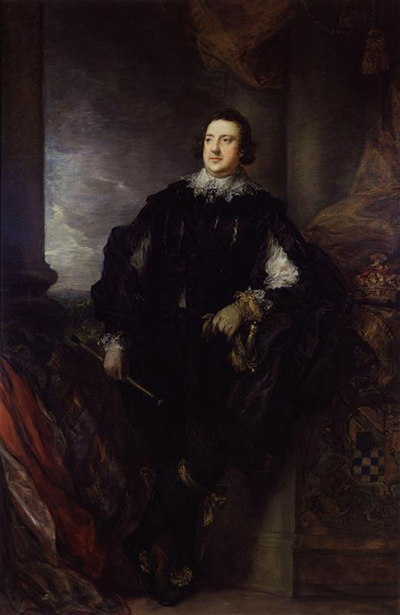
Thomas Gainsborough's Charles Howard, 11th Duke of Norfolk is one of the most revealing late portraits in his career because the sitter's rank changed while the painting was still being made. The National Portrait Gallery identifies the work as Charles Howard, 11th Duke of Norfolk, by Thomas Gainsborough, oil on canvas, 1784-1786, measuring 91 1/2 × 60 inches, or 2324 × 1524 mm, and catalogued as NPG 5294.[1] It was accepted in lieu of tax by H. M. Government and allocated to the Gallery in 1980; the NPG records it as on display at Arundel Castle.[1]
The sitter was Charles Howard, 1746-1815, later 11th Duke of Norfolk, a politician and Member of Parliament for Carlisle and Arundel.[2] He had been Lord Surrey when Gainsborough began the portrait. By the time the finished image took its present form, he was Duke of Norfolk and Earl Marshal.[3] That shift is not background gossip. It is visible in the painting itself, because the coronet, robes, arms and baton belong to the later ducal identity.[3]
The portrait is therefore not simply a likeness of a nobleman. It is a record of transition: an image begun for one title and completed around another. Gainsborough had to make rank, costume, inheritance and bodily presence cohere on the same tall canvas.
At a Glance
- ArtistThomas Gainsborough
- NPG titleCharles Howard, 11th Duke of Norfolk [1]
- Date1784–1786 [1]
- MediumOil on canvas [1]
- Dimensions2324 × 1524 mm [1]
- Current holderNational Portrait Gallery; displayed at Arundel Castle [1]
- AccessionNPG 5294 [1]
- Sitter’s officeDuke of Norfolk and Earl Marshal [3]
- Portrait typeRevised full-length aristocratic state portrait
- ExploreBiography; The Blue Boy; Mr and Mrs Andrews; Paintings; Portraits
Contents
- Introduction
- Object and Date
- From Lord Surrey to Duke of Norfolk
- Costume and Criticism
- Regalia, Arms and Office
- Gainsborough’s Late Portrait Manner
- How to Look
- Rank and Likeness
- Why the Portrait Matters
Object and Date
The National Portrait Gallery's overview gives the secure object facts: oil on canvas, 1784-1786, NPG 5294, by Thomas Gainsborough.[1] The extended catalogue entry adds the crucial production history. It states that the painting's complex paint structure would confirm that it is the portrait Gainsborough was working on between 1784 and 1786.[3]
That date range places the work in Gainsborough's last decade. Gainsborough's House notes that he moved to London in 1774 and lived at Schomberg House on Pall Mall, while the National Gallery describes him as a favourite painter of George III and his family after his move to the capital.[4][5] Howard's portrait belongs to that London environment of aristocratic patronage, exhibition, rivalry and ambitious public likeness.
The painting's scale is important. At more than seven and a half feet high, it is not a modest private likeness. It belongs to the world of full-length status portraiture, where costume, setting and insignia help define the sitter's public role. Yet the image is complicated by its making. This was not a simple, single-state conception carried through without change.
The NPG records that Gainsborough exhibited an incomplete portrait of Lord Surrey at Schomberg House in July 1784, with only the head finished and the rest intended for dress from the previous century.[3] The same portrait was still in hand in April 1786, and it was exhibited in autumn 1786.[3] The final image therefore carries traces of a developing commission.
Schomberg House matters because it gave Gainsborough a setting partly under his own control. A portrait shown there did not enter the world in exactly the same way as a conventional Royal Academy exhibit. It could be presented within the artist's own London premises, where patrons and viewers encountered Gainsborough's work as part of a carefully managed professional display. Howard's portrait, still changing as title and costume shifted, fits that atmosphere of active presentation.
The date range also keeps the work close to the end of Gainsborough's life. He died in 1788, only two years after the autumn exhibition noted by the NPG.[5] That proximity should not be turned into melodrama, but it does mean the portrait belongs to a mature phase in which Gainsborough had long experience with aristocratic commissions. The canvas shows an artist who knew how rank was staged, but who still handled paint with mobility and atmosphere.
From Lord Surrey to Duke of Norfolk
Charles Howard succeeded as 11th Duke of Norfolk on 31 August 1786.[3] Before that, he had been Lord Surrey and had been nominated in 1782 as deputy Earl Marshal to his father.[3] The NPG states that the portrait now shows him as Duke and Earl Marshal, with coronet, robes, arms and baton, all of which must have been added to the original composition.[3]
This is the heart of the painting. The portrait was not merely updated with accessories; its meaning was elevated. Lord Surrey could be shown as a noble heir in historical dress. The Duke of Norfolk and Earl Marshal required ceremonial signs of hereditary office.
The baton in his right hand is especially important. It gives the figure an official rhythm: the hand lowers, the baton points, and the viewer reads the body through authority. The coronet and arms to the right confirm rank, while the robes to the left bring crimson and ceremony into the darker surrounding space.[3]
These additions do not feel like small details. They help organise the composition's social argument. Howard stands not only as a person, but as the bearer of an inherited office. Gainsborough had to turn altered status into pictorial order.
The change from heir to duke also affects how the viewer understands the body. A standing full-length portrait asks the sitter to occupy social space. When the sitter becomes a duke, that occupation becomes more than elegant bearing. It becomes a form of public embodiment: the noble title is made visible through height, stance, costume and ceremonial objects.
That is why the additions should not be treated as decorative afterthoughts. The coronet, arms, robes and baton alter the work's claim. They move the portrait from expectation to possession, from future inheritance to present authority. The painting had to absorb a new political and hereditary fact without losing the continuity of the likeness already begun.
Costume and Criticism
The NPG's extended entry preserves a telling response to the portrait's costume. When it was exhibited in autumn 1786, the painting was regarded as a fine portrait, but the costume was criticised twice: once because it was not crimson, and once because it was thought to distract from the likeness.[3] Those objections reveal how carefully viewers read costume in eighteenth-century portraiture.
Howard is shown in dark purple Van Dyck dress with black breeches, gold garters and gold shoe buckles.[3] The reference to Van Dyck dress matters. Gainsborough and his patrons often used seventeenth-century costume to produce an air of lineage, taste and aristocratic refinement. In this case, however, costume also had to coexist with newly added ducal and Earl Marshal symbols.
The criticism that costume could detract from likeness is worth taking seriously. Portraiture was expected to identify the sitter, but elite portraiture also needed to construct social presence. Gainsborough's task was to balance resemblance with theatre. If the costume became too assertive, viewers could feel that the sitter had been partly swallowed by role.
That tension is still visible. Howard's face is comparatively calm and pale against a dark, sweeping field of dress. The body carries large signs of office, but the head remains the point of human encounter. Gainsborough lets the costume build authority while keeping the sitter's expression relatively open.
The dark purple dress is especially subtle because it refuses the obvious splendour that some critics expected. Crimson would have made ceremonial force more immediate. Gainsborough's darker choice gives the figure gravity instead. The colour allows lace, gloves, gold garters and buckles to register as accents rather than as a flood of display.
This restraint helps the portrait avoid becoming merely heraldic. Howard is surrounded by inherited language, but he is not buried beneath it. The costume creates historical distance, while the face and hands keep the sitter present. Gainsborough's portraiture often works at precisely this threshold: theatrical enough to satisfy rank, yet alive enough to remain a likeness.
Regalia, Arms and Office
The portrait's official language is concentrated around the hands and surrounding emblems. Howard holds the Earl Marshal's gold baton in his right hand.[3] His left hand is associated with grey, gold-fringed gloves, while peer's robes, a ducal coronet and the Norfolk arms complete the ceremonial setting.[3]
The NPG catalogue is careful about the arms. It describes some quarterings as only partly legible and notes a dark, illegible escutcheon of pretence, presumably intended for Scudamore of Holm Lacy through Howard's second wife, Frances.[3] This is exactly the kind of detail that should not be smoothed away. The painting presents heraldic authority, but the surviving painted evidence is not equally clear in every part.
That partial legibility is useful rather than embarrassing. It reminds us that a grand portrait is still a material object, with painted marks that can be more or less explicit. The arms are present to establish dynastic identity, but their execution is not a crisp legal document. Gainsborough's brush moves between symbolic clarity and painterly abbreviation.
The baton and coronet are more immediately readable. They tell the viewer that Howard's public identity has changed. If the head belonged to the earlier Lord Surrey stage, the surrounding insignia declares the later Duke and Earl Marshal stage. The portrait becomes a layered image of time.
The Earl Marshal identity carries particular visual demands. It is not an abstract honour. It requires objects that can be seen and named. The baton makes office portable, something Howard holds in his own hand. The coronet and arms, by contrast, anchor him within lineage. One sign is bodily and immediate; the other signs are dynastic and surrounding.
The gloves add another note. They belong to aristocratic finish and ceremony, but they also emphasise the hands as instruments of rank. One hand holds office; the other carries refined restraint. Gainsborough does not need to narrate Howard's political life in detail. The painting lets gesture and emblem do the work.
Gainsborough's Late Portrait Manner
Howard's portrait belongs to the final phase of Gainsborough's career, when London patrons expected display, distinction and modern elegance. The National Gallery notes that Gainsborough was elected to the Royal Academy in 1768 but later quarrelled with it, while Gainsborough's House records his Schomberg House studio exhibitions.[4][5] Howard's portrait sits within that world of exhibition and independent presentation.
The painting is grand, but its surface is not stiff. The dark costume and surrounding drapery create broad tonal masses, while the head, lace, gloves, garters and metallic details catch light. Gainsborough's late portraiture often depends on such contrasts: refined faces emerging from loose, lively handling.
The Van Dyck costume also points to artistic self-consciousness. Gainsborough admired earlier portrait traditions, but he did not simply copy them. He used historical dress to make modern sitters look both contemporary and ancestral. In Howard's case, that strategy is intensified by the ducal transformation.
Rosenthal's Paul Mellon Centre study is helpful for this broader context because it treats Gainsborough's career as a negotiation between artistic pleasure, professional tactics, clients and the culture of looking.[6] Howard's portrait is exactly such a negotiation. It must satisfy rank, likeness, costume, exhibition and painterly style at once.
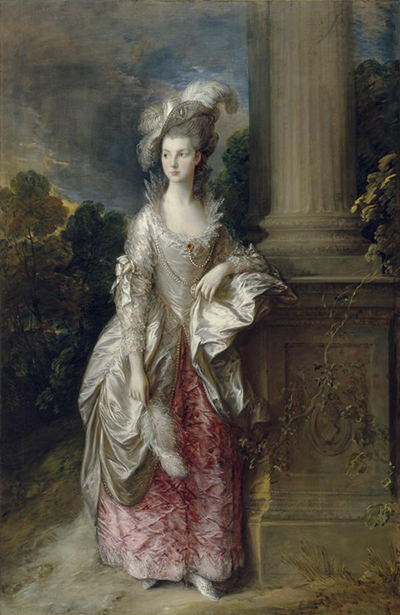
That negotiation distinguishes Howard from the more intimate sitters in the same Gainsborough group. The Abel portraits depend on friendship and music. The Sheridan portrait turns celebrity, beauty and landscape mood into a refined likeness. Howard's portrait works through office and inheritance. The brush may remain loose and atmospheric, but the social grammar is harder, heavier and more official.
Yet the painting is not impersonal. Gainsborough's dark tonal design gives Howard a kind of inwardness within ceremony. The sitter stands amid symbols of public identity, but the face is not reduced to a mask. There is a mildness in the expression that complicates the grand scale. That contrast gives the painting much of its interest.
How to Look
Begin with the head. Howard's face is small relative to the scale of the canvas, but it controls the portrait. The body and regalia declare office; the face gives the viewer a person to meet.
Then look at the baton. Its diagonal line cuts through the lower part of the figure and gives the hand official purpose. It prevents the pose from becoming merely decorative. The sitter is not only dressed for rank; he holds an emblem of office.
Next, move across the robe, coronet and arms. These elements build the portrait's public identity. They also reveal the painting's revised state, since the NPG says they must have been added to the original composition after Howard's succession.[3] The viewer is seeing a portrait adjusted to history.
Finally, notice how much of the painting is dark. Gainsborough uses darkness not as emptiness, but as atmosphere. The deep costume, shadowed setting and heavy drapery create a stage from which pale face, lace, gloves and gold details emerge. The portrait is ceremonial, but it is also tonal and painterly.
The lower edges deserve attention too. The robes, baton and shoe buckles keep the viewer aware of the whole standing body, not only the face. Gainsborough's full-length format asks the eye to move from title-bearing head to status-bearing feet. Rank is distributed across the figure.
The stone support with coronet and arms works differently. It is less bodily and more architectural. It gives the ceremonial emblems a place to rest, and it balances the moving darkness of fabric with a harder surface. The portrait therefore combines flesh, textile, metal, heraldry and stone into one image of social authority.
Rank and Likeness
The most interesting question is not whether the portrait is formal. It plainly is. The better question is how Gainsborough keeps formality from becoming mechanical. Howard stands with the materials of high rank around him, yet the portrait does not reduce him to heraldry.
The face is restrained rather than commanding. The body is poised, but not aggressively martial. The baton is official, but the hand that holds it is relaxed enough to preserve an aristocratic ease. Gainsborough's achievement lies in that balance.
The costume criticism recorded by the NPG shows that contemporary viewers were alert to the same balance.[3] A fine portrait could still be faulted if dress seemed to pull attention away from resemblance. Howard's image therefore sits at a lively boundary between likeness and display.
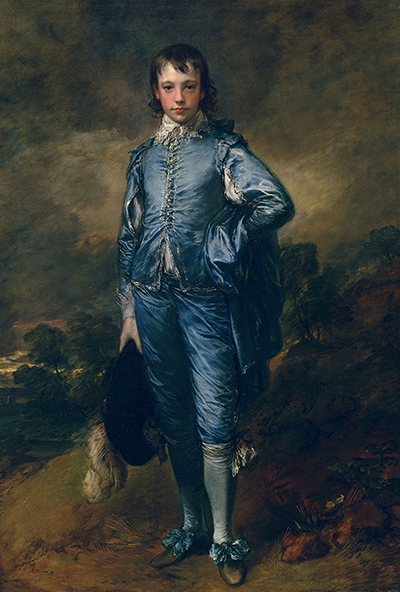
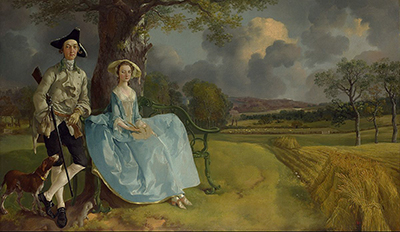
That boundary is also what makes the work valuable within Gainsborough's wider portrait group. Compared with the musical intimacy of Karl Friedrich Abel, Howard is all public office. Compared with the companionable landscape world of Mr and Mrs Andrews, he is dynastic and ceremonial. Compared with The Blue Boy, his historical dress is less an aesthetic performance alone than a vehicle for rank and office.
The comparison with The Blue Boy is useful because both portraits involve historicising costume, but the pressures are different. The Blue Boy turns Van Dyckian dress into an image of style, youth and painterly bravura. Howard's dress participates in that same historical taste, yet it must answer to a more explicit institutional identity. The sitter is not merely made elegant by old-fashioned costume; he is made legible as a holder of rank.
The comparison with Mr and Mrs Andrews is equally revealing. That earlier double portrait binds land, marriage and class identity into a rural setting. Howard's portrait removes landscape almost entirely and replaces landed context with interior ceremony. Both works are about status, but they speak different dialects of status: estate and marriage in one, office and hereditary title in the other.
Why the Portrait Matters
Charles Howard, 11th Duke of Norfolk matters because it makes a change of status visible. The painting began while Howard was Lord Surrey and was completed around his emergence as Duke of Norfolk and Earl Marshal.[3] The final image carries that change through added regalia, heraldry and ceremonial dress.
It also matters because it preserves an unusually clear case of portrait revision. The NPG's catalogue does not merely list a sitter and date; it explains that the painting's structure and exhibition history connect it to Gainsborough's work between 1784 and 1786.[3] That makes the portrait a good example of how elite likenesses could evolve with events.
The work also helps show the range of Gainsborough's late portraiture. He could paint intimate musician friends, fashionable women, aristocratic couples and major office-holders without using one formula for all of them. Howard required a language of office, succession and inherited dignity, and Gainsborough answered with scale, costume, baton, coronet, arms and atmospheric paint.
The portrait's cautionary lesson is just as important. It should not be described as if every emblem was part of the first idea, nor as if incompletion were a romantic mystery. The evidence is more interesting: a portrait in progress, a sitter whose title changed, a composition adjusted, and a finished image that still lets that layered history be read.
For that reason, Howard's portrait is one of the strongest late examples of Gainsborough's ability to work inside social pressure without surrendering painterly intelligence. The canvas is about rank, but it is also about timing. It shows a man becoming publicly legible as a duke, while Gainsborough turns that moment into a dark, imposing and carefully revised image.
It is also a reminder that aristocratic portraiture was not static. Titles changed, offices were assumed, family symbols had to be displayed, and public expectations could press hard on the painter's choices. Gainsborough's portrait meets those demands without becoming dry. The grandeur is real, but so is the atmosphere. The rank is explicit, but the painting still breathes.
Frequently Asked Questions
Discussion
How does Gainsborough turn Howard’s changing rank into a revised public image?
Reader Insights
Where do coronet, robes, arms and baton reveal the move from Lord Surrey to Duke?
How does the dark Van Dyck dress build rank without swallowing the face?
How do baton, heraldry and deep tonal masses make authority visible?
Join the Conversation
Share your reading below.
References
- National Portrait Gallery, “Charles Howard, 11th Duke of Norfolk,” NPG 5294 overview. View source.
- National Portrait Gallery, “Charles Howard, 11th Duke of Norfolk,” person record. View source.
- National Portrait Gallery, “Charles Howard, 11th Duke of Norfolk,” NPG 5294 extended catalogue entry. View source.
- Gainsborough's House, “About Thomas Gainsborough.” View source.
- National Gallery, London, “Thomas Gainsborough,” artist biography. View source.
- Michael Rosenthal, The Art of Thomas Gainsborough: "A Little Business for the Eye" (New Haven and London: Yale University Press for the Paul Mellon Centre for Studies in British Art, 1999). Publication record.