 by Tom Gurney
Tom Gurney BSc (Hons) is an art history expert with over 20 years experience
Published on June 19, 2020 / Page Updated on November 5, 2026
Email: tomgurney1@gmail.com / Phone: +44 7429 011000
Introduction
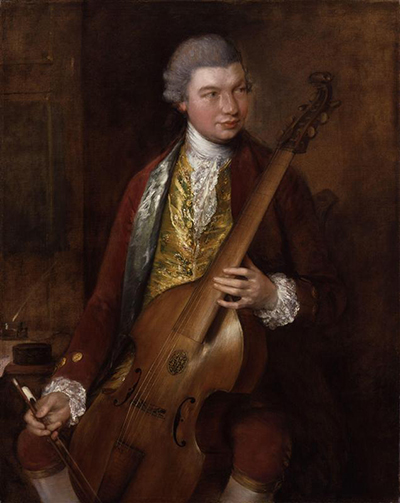
Thomas Gainsborough's circa 1765 portrait of Karl Friedrich Abel is a more compact and direct image than the later full-length Abel portrait now at the Huntington. The National Portrait Gallery identifies this work as Karl Friedrich Abel, by Thomas Gainsborough, circa 1765, oil on canvas, measuring 49 7/8 × 39 7/8 inches, or 1267 × 1013 mm overall, and catalogued as NPG 5947.[1] The sitter is Karl Friedrich Abel, the German composer and concert impresario who became one of Gainsborough's closest musical friends.[1]
The portrait shows Abel seated with a six-string viola da gamba between his knees.[1] He wears a powdered wig, deep red coat, and a gold, green and maroon flowered waistcoat.[1] His face is turned slightly to the side, while his hands hold both instrument and bow. The result is not a performing scene in the theatrical sense. It is a portrait of musical identity, built around touch, posture and concentration.
This painting deserves to stand apart from the Huntington's 1777 full-length. The two works represent the same sitter, the same friendship and the same instrument-world, but they are different objects with different dates, compositions, histories and emphases. The National Portrait Gallery's record makes the distinction clear: the circa 1765 painting predates the Huntington whole-length by about twelve years.[1]
At a Glance
- ArtistThomas Gainsborough
- NPG titleKarl Friedrich Abel [1]
- DateCirca 1765 [1]
- MediumOil on canvas [1]
- Dimensions1267 × 1013 mm overall [1]
- Current holderNational Portrait Gallery, London [1]
- AccessionNPG 5947 [1]
- InstrumentSix-string viola da gamba [1]
- Related studyNPG 5081, circa 1765 [2]
- ExploreBiography; The Blue Boy; Mr and Mrs Andrews; Paintings; Portraits
Contents
- Introduction
- A Distinct Early Abel Portrait
- Friend, Musician and Sitter
- The Viola da Gamba as Likeness
- Costume, Colour and Interior Space
- The Related Drawing
- Rediscovery and Attribution
- Comparison with the 1777 Abel Portrait
- How to Look
- Why the Portrait Matters
A Distinct Early Abel Portrait
The strongest starting point is the object itself. NPG 5947 is a half-length portrait centred on Abel and his instrument, not a whole-length composition with table, dog and score. Its format brings the sitter forward. There is little narrative furniture around him. The viewer meets Abel through face, costume, hands and viola da gamba.
That closeness changes the portrait's meaning. In the Huntington painting, Abel appears as a composer at a table, probably writing a score, with his instrument resting against his thigh and a dog nearby.[4] In the National Portrait Gallery work, the instrument is not secondary to writing. It is the portrait's central visual partner. Abel's body and the viola da gamba are locked into one arrangement.
The date also matters. A circa 1765 work belongs to Gainsborough's Bath period, before his move to London in 1774.[5] The National Gallery describes Bath as the place where Gainsborough became a fashionable portrait painter after earlier years in Suffolk, and it notes that he later settled in London and became a favourite of George III and the royal family.[6] The earlier Abel painting therefore belongs to a different stage of Gainsborough's career from the 1777 full-length.
This is why the title should remain disciplined. The portrait is best understood as Karl Friedrich Abel, or more descriptively as Abel with his viola da gamba. Numbering the painting as if Gainsborough or a catalogue created a formal sequence would distort the evidence. The institution gives a title, date, medium, dimensions and accession number; those details should lead.
Friend, Musician and Sitter
The National Portrait Gallery stresses the closeness between Abel and Gainsborough. It describes them as friends who shared a love of life and a passion for the viola da gamba.[1] That is unusually important here because the portrait is not just an image of a client with an attribute. It is an image by a painter who understood the instrument and cared about the person holding it.
Gainsborough was more than a casual admirer of music. The NPG catalogue notes that he became a skilful performer on the viola da gamba and that his portrayal of the bow grip in both the painting and the related drawing reflects understanding of the instrument.[1] This gives the portrait a kind of technical sympathy. The hands are not merely decorative. They show attention to the physical grammar of playing.
Abel's musical identity also carried social significance. The NPG person record identifies him as a composer and concert impresario, one of the last great viola da gamba virtuosi, and says he arrived in London in 1759 before becoming famous through subscription concerts organised with Johann Christian Bach.[3] That career made him a public musician in a sophisticated urban culture, not simply a private amateur.
The portrait balances those two identities: Abel as public musical figure and Abel as intimate friend. The sitter is well dressed and carefully posed, yet the image feels personally observed. Gainsborough gives him dignity without turning him into a remote emblem of fame.
The Viola da Gamba as Likeness
The viola da gamba is not a prop in the ordinary sense. It is part of Abel's likeness. A portrait can resemble a person through face, body, costume and expression, but here it also resembles a vocation. The six-string instrument between Abel's knees tells the viewer what kind of musician he was.[1]
The pose is especially telling. Abel holds the instrument upright and close, with the neck rising across his body. His hands locate the act of playing even though the scene is still. The bow is present, but performance has not begun. Gainsborough suspends Abel between readiness and reflection.
That suspension suits the character of music in painting. Sound cannot literally be heard in oil on canvas, so Gainsborough makes it legible through touch. The instrument's scale, curve, strings and fingerboard become visual equivalents of tone. The portrait asks the viewer to imagine music through the body that could produce it.
The NPG catalogue's attention to Abel's grip is valuable because it keeps interpretation grounded in observation.[1] Gainsborough is not using the instrument as a vague sign of refinement. He is painting a musician's relationship to a specific object of practice. That specificity gives the image authority.
Costume, Colour and Interior Space
The costume does a great deal of quiet work. Abel's flowered waistcoat and red coat give the portrait warmth and status.[1] The clothing is elegant, but not so overpowering that it absorbs the sitter. Instead, it frames the instrument and brightens the half-length format.
The colour relationship between coat, waistcoat and wooden instrument is particularly effective. The red of the coat deepens the surrounding shadows, while the gold and green of the waistcoat catch light near the instrument's upper body. Abel's face is set between these warm surfaces and the darker interior. Gainsborough uses colour to make the sitter both vivid and contained.
The setting is relatively restrained. There is no landscape opening, no elaborate concert hall and no social group. The focus remains on the single musician. That restraint makes the portrait more inward than ceremonial. It does not need external drama because the sitter's relation to the instrument supplies enough.
This is also where Rosenthal's Paul Mellon Centre study is useful for the wider Gainsborough picture. Rosenthal treats Gainsborough's art as bound up with looking, sociability, professional calculation and pleasure rather than as a simple division between portraits and landscapes.[7] Abel's portrait fits that richer pattern: a commissioned-looking likeness that is also a deeply personal image of shared taste.
The Related Drawing
The National Portrait Gallery also holds a related drawing of Abel, NPG 5081, made in black and white chalk with stump on blue paper, circa 1765.[2] The drawing is described as a preliminary study for the oil painting, and the NPG notes that Abel's clothes differ from the finished portrait and that he holds a different musical instrument.[2] This makes the drawing especially useful for seeing Gainsborough's thought in motion.
The drawing's existence confirms that the oil painting was not a casual one-off. Gainsborough worked through the composition, adjusting costume and instrument as he moved toward the final painting. The NPG's extended entry adds that the drawing differs chiefly in the buttoned coat, the higher neck of the viola da gamba, and a window on the left.[2]
Those changes matter because they show Gainsborough refining the portrait's balance. The final painting brings the instrument and sitter into a more settled relationship. The vertical thrust of the viola da gamba remains, but the costume, light and half-length composition become more unified.
The study also strengthens the attribution history. The NPG catalogue for NPG 5947 explains that the rediscovery of the drawing in 1975 helped clarify the relationship between the circa 1765 Abel image and the later Huntington whole-length.[1] A drawing can therefore do more than show preparation. It can restore confidence in a sitter identity and a sequence of works.
Rediscovery and Attribution
The history of NPG 5947 was not always straightforward. The NPG catalogue says that between 1885 and 1988 the painting's appearance was known, if at all, through a photograph, while the Huntington whole-length became more familiar after its 1925 acquisition.[1] That imbalance partly explains why the later picture has often dominated Abel's visual afterlife.
Earlier scholars had reasons for caution. The NPG records that Waterhouse, looking from a photograph in 1958, observed that the features did not altogether agree with the Huntington portrait; Hayes later remarked in 1970 that the sitter was not certainly Abel.[1] Those are not failures of scholarship. They show sensible caution when evidence was fragmentary.
The picture changed when related evidence re-emerged. The NPG says the related drawing was rediscovered in 1975 and that, when NPG 5947 itself reappeared in 1988, it became apparent that the painting predated the Huntington whole-length by about twelve years and that the likeness was not inconsistent.[1] Costume and the sitter's apparent age support the circa 1765 dating.[1]
That history is worth preserving because it prevents over-simplification. The portrait is now anchored securely enough to discuss as a distinct Gainsborough painting, but it reached that clarity through comparison, rediscovery and catalogue work. Its modern stability is the result of careful looking over time.
Comparison with the 1777 Abel Portrait
The Huntington portrait and the National Portrait Gallery portrait should be compared, but not collapsed. The Huntington work is a full-length oil painting of about 1777, accession 25.19, showing Abel at a writing table, probably composing, with his dog nearby and a viola da gamba resting against his thigh.[4] The NPG work is a circa 1765 oil painting centred on Abel holding a six-string viola da gamba between his knees.[1]
The later picture emphasises creative labour through the score and pen. The earlier picture emphasises the performer through grip, instrument and direct bodily presence. One shows a musician composing; the other shows a musician defined by touch and instrument. Both are musical portraits, but they are musical in different ways.
The difference is also biographical. In the circa 1765 portrait Abel appears younger, closer to the beginning of his established London fame. In the 1777 whole-length he appears as a more mature figure, surrounded by signs of professional status and domestic ease. The two images together suggest a friendship and musical identity sustained across time.
The NPG's wider Abel iconography reinforces this distinction. Its catalogue trail lists the circa 1765 painting and drawing by Gainsborough, then the 1777 whole-length now at the Huntington, along with later and related Abel likenesses.[3] The record therefore supports a small but important Abel group, not a single image duplicated under different names.
How to Look
Start with Abel's hands. They organise the portrait. One hand steadies the instrument while the other controls the bow. The hands are not theatrical gestures; they are the practical signs of a player.
Then follow the instrument upward. The viola da gamba rises across the body, creating a strong diagonal and vertical rhythm within the half-length format. It divides the picture without breaking it, giving structure to a composition that might otherwise have relied only on face and costume.
Look next at Abel's expression. He does not meet the viewer with a grand public stare. His gaze turns slightly aside, as if listening inwardly or attending to something just beyond the visible room. Gainsborough keeps the face alert but restrained.
Finally, consider the darkness around him. The interior is not empty; it gives the musician privacy. The surrounding shadow lets the red coat, pale wig, bright waistcoat and wooden instrument hold the surface. The portrait becomes a chamber image in the fullest sense: intimate, musical and enclosed.
Why the Portrait Matters
This Abel portrait matters because it shows Gainsborough's musical imagination before the famous 1777 whole-length. It is a portrait of a friend, a virtuoso and a public musician, but it refuses spectacle. Its power comes from closeness.
It also matters because it reveals how exact Gainsborough could be when a sitter's art intersected with his own interests. The NPG's comments on the bow grip and Gainsborough's own skill with the viola da gamba allow us to see the painting as informed observation, not generic musician imagery.[1] The painter understood the physical culture of the instrument.
The portrait also demonstrates why Abel should not be reduced to a single image in Gainsborough's career. The circa 1765 NPG painting, the related drawing and the 1777 Huntington whole-length form a meaningful sequence.[1][2][4] Each gives Abel a different emphasis: study, performer, composer.
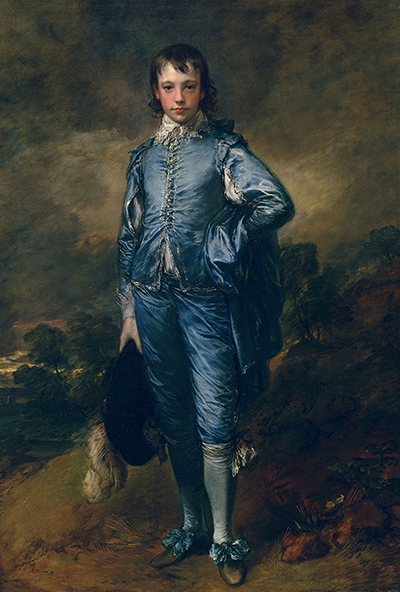
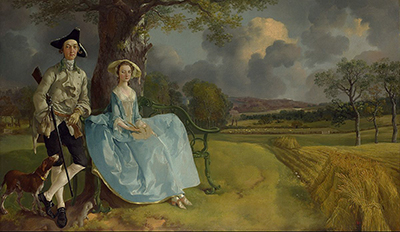
For the Gainsborough group as a whole, NPG 5947 offers a bridge between portraiture, friendship and artistic practice. It is not as famous as The Blue Boy or as socially expansive as Mr and Mrs Andrews, but it has a special intimacy. Gainsborough turns one man's relation to an instrument into a full likeness, and in doing so he makes music visible without needing to stage a concert.
Frequently Asked Questions
Discussion
How does the instrument become part of Abel’s likeness in this earlier portrait?
Reader Insights
Where does Gainsborough’s knowledge of the viola da gamba become visible in Abel’s practical hold?
How does the upright six-string viol dominate the close half-length composition?
What changes when this performer-centred portrait is compared with the later composer-at-table image?
Join the Conversation
Share your reading below.
References
- National Portrait Gallery, “Karl Friedrich Abel,” NPG 5947, Mid-Georgian Portraits Catalogue. View source.
- National Portrait Gallery, “Karl Friedrich Abel,” NPG 5081. View source.
- National Portrait Gallery, “Karl Friedrich Abel,” person and iconography record. View source.
- The Huntington Library, Art Museum, and Botanical Gardens, “Thomas Gainsborough, Karl Friedrich Abel,” accession 25.19. View source.
- Gainsborough's House, “About Thomas Gainsborough.” View source.
- National Gallery, London, “Thomas Gainsborough,” artist biography. View source.
- Michael Rosenthal, The Art of Thomas Gainsborough: "A Little Business for the Eye" (New Haven and London: Yale University Press for the Paul Mellon Centre for Studies in British Art, 1999). Publication record.