 by Tom Gurney
Tom Gurney BSc (Hons) is an art history expert with over 20 years experience
Published on June 19, 2020 / Page Updated on November 5, 2026
Email: tomgurney1@gmail.com / Phone: +44 7429 011000
Introduction
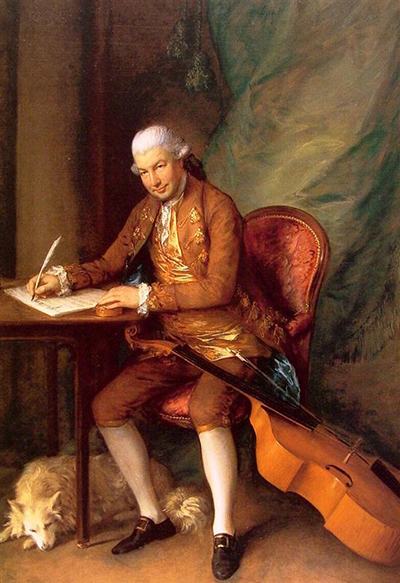
Thomas Gainsborough's Karl Friedrich Abel is one of his most revealing musician portraits because it shows friendship, professional identity and creative labour in the same image. The Huntington identifies the work as Karl Friedrich Abel, dates it to about 1777, gives the accession number as 25.19, names Thomas Gainsborough as maker, and identifies the sitter as the German musician Karl Friedrich Abel, 1723-1787.[1] The painting is oil on canvas and measures 88 3/4 × 59 1/2 inches, or 225.4 × 151.1 cm.[1]
The painting is a full-length portrait, but not a stiff ceremonial one. Abel sits at a table, with a dog beside him and an instrument resting on his left thigh.[1] The Huntington describes him as probably writing the score of one of his compositions.[1] Its label text sharpens that idea: Gainsborough portrays his close friend in a moment of inspiration, with the pen resting on the first bar of a new musical score and the viola da gamba against his thigh.[1]
That combination makes the portrait unusually intimate. Abel is not shown merely as a fashionable gentleman who happens to be musical. He is shown as a working musician at the instant when notation, instrument, thought and companionship converge. The portrait turns composition into presence.
At a Glance
- ArtistThomas Gainsborough
- Huntington titleKarl Friedrich Abel [1]
- DateAbout 1777 [1]
- MediumOil on canvas [1]
- Dimensions225.4 × 151.1 cm [1]
- Current holderThe Huntington Library, Art Museum, and Botanical Gardens [1]
- Accession25.19 [1]
- InstrumentViola da gamba [1]
- Portrait typeFull-length seated musician portrait
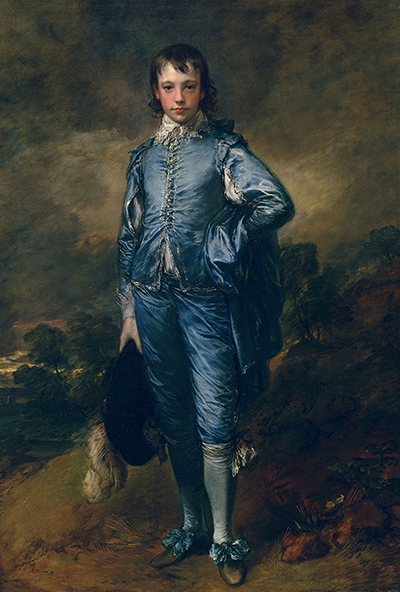
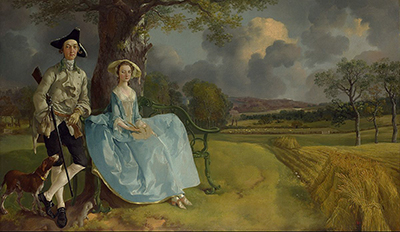
- ExploreBiography; The Blue Boy; Mr and Mrs Andrews; Paintings; Portraits
Contents
- Introduction
- The Huntington Object
- Composer at the Table
- The Viola da Gamba
- Dog, Colour and Character
- Friendship and Musical Life
- Related Abel Portraits
- Gainsborough’s London Portrait World
- How to Look at the Portrait
- Why the Portrait Matters
The Huntington Object
The Huntington record provides the core facts. The work belongs to the European Art department of the Huntington Library, Art Museum, and Botanical Gardens, and the credit line is to that institution.[1] Its date of about 1777 places it in Gainsborough's London period, after the artist had left Bath and settled in the capital. Gainsborough's House notes that he moved to London in 1774, lived at Schomberg House on Pall Mall, and later held studio exhibitions there.[2]
That London context matters. Abel was not simply another wealthy sitter. He belonged to a metropolitan world of performance, patronage, friendship and artistic sociability. A portrait of Abel could speak to audiences who understood music as a refined art, a social accomplishment and a professional calling. Gainsborough, who loved music deeply, was especially suited to that kind of sitter.
The painting's scale is striking. A full-length format gives Abel more than private likeness. It grants him public stature. Yet the pose resists empty grandeur. Instead of standing with attributes arranged around him, he sits at a table in the midst of work. The scale says importance; the posture says concentration.
This is why the title should remain simple. Karl Friedrich Abel is enough. The Huntington title identifies the sitter and stabilises the object. There is no need to create artificial numbering from inherited image labels. The surviving object record should lead.
Composer at the Table
The table is central because it turns the portrait from social display into an image of making. Abel's pen rests on the opening of a new score, according to the Huntington label.[1] That detail gives the sitter an active mind. The image is not just about someone who has written music; it is about someone caught at the threshold of writing it.
This moment must be handled carefully. The Huntington says Abel is probably writing the score of one of his compositions.[1] The word probably matters. It allows the viewer to read the image as an act of composition without pretending that the exact piece of music is known. The portrait gives us a musical situation, not a documented performance or named work.
The open score also changes the portrait's tempo. A full-length oil painting usually asks the sitter to appear finished, stable and available for admiration. Here, the sitter appears interrupted by looking. Abel seems to exist in a pause between thought and notation. The viewer catches him not after achievement, but during the imaginative process.
That is a powerful choice for a musician portrait. Music is temporal and disappears as it sounds; painting is fixed and silent. Gainsborough solves that difference by showing the written trace before sound. The score becomes visible music. The instrument suggests performance, but the pen suggests invention.
The result is not simply a portrait with props. The table, score and pen give the image its intellectual centre. Abel's profession is not announced by a label or costume alone. It is embodied in an act.
The Viola da Gamba
The Huntington identifies the instrument resting against Abel's thigh as a viola da gamba and notes that it is a forerunner of the modern cello.[1] The instrument is crucial because it makes Abel's musical identity physical. It is not an abstract reference to sound. It occupies the same space as the sitter's body.
The instrument's placement is intimate. It rests against Abel, close enough to be part of his bodily presence. The portrait therefore joins performer and instrument without making Abel play. He is between writing and sounding, between composition and performance. That in-between state is the painting's quiet drama.
The National Portrait Gallery's Mid-Georgian Portraits catalogue confirms the importance of this 1777 whole-length image, describing the Huntington painting as Abel seated at a table with his viola da gamba across his knee.[3] That independent portrait trail reinforces the Huntington description and helps separate this object from other Abel likenesses.
The viola da gamba also places Abel within a particular musical identity. It was not merely any instrument. In the portrait, it stands for a cultivated, specialised musical world. Gainsborough did not need to paint an orchestra, a concert room or an audience. The single instrument is enough to make professional practice visible.
The bowing, sound and touch are absent, but their possibility is everywhere. A viewer can imagine the instrument being lifted into action, just as the score can be imagined becoming music. Gainsborough paints anticipation rather than performance.
Dog, Colour and Character
The dog beside Abel is one of the portrait's most disarming details. The Huntington label calls it a charming canine companion and links it to an impression of character that is both likeable and intelligent.[1] The animal softens the image without trivialising it. Abel is serious, but not severe.
Dogs in portraits often signal loyalty, affection, status or domestic warmth. Here the dog also changes the atmosphere of work. Composition is not shown as solitary grandeur in a cold studio. Abel's thought occurs in a room with companionship. The animal makes the portrait warmer and more particular.
Colour performs a similar function. The Huntington label notes the rich palette of emerald, crimson and sapphire, connecting it with Abel's wealth and professional status.[1] Those colours prevent the image from becoming a plain study of concentration. Abel's world is materially rich. Music, status and taste meet on the surface of the painting.
The colour also reminds us that Gainsborough was not making documentary illustration. The scene is shaped for pictorial pleasure. Fabric, furniture, dog, instrument and score are arranged so that the sitter's profession becomes visually luxurious. Abel's work is made elegant.
That elegance should not be mistaken for emptiness. The thoughtful expression, pen, score and instrument keep the image anchored in mind and practice. Gainsborough's achievement is to make creative concentration look socially refined without losing its inwardness.
Friendship and Musical Life
The Huntington label describes Abel as Gainsborough's close friend.[1] This is not a small point. Gainsborough painted many sitters for professional reasons, but musician portraits often feel especially close to his own pleasures and affinities. Gainsborough's House notes that he was an avid draughtsman and an experimental artist, and the National Gallery also records his impatience with portrait demands and his private inclination toward landscape and rustic scenes.[2][4] Music gave him another imaginative world.
The portrait does not need to become autobiography, but it does show an artist looking at someone whose art he understood as a fellow practitioner. Abel composes; Gainsborough paints. Both arts depend on timing, touch, structure and performance. The portrait quietly lets those affinities meet.
This may help explain the tenderness of the image. Abel is not arranged as a remote celebrity. He is given dignity, but also warmth. The dog, seated pose and worktable reduce the distance between sitter and viewer. The portrait honours the musician by showing him at work rather than by surrounding him with empty spectacle.
The friendship also affects how we read the likeness. The image suggests sympathy, not merely accuracy. Gainsborough seems interested in Abel as a mind and temperament. The sitter is intelligent, absorbed and companionable. The painting invites respect, but it also invites affection.
That affection should remain tied to evidence. The Huntington supplies the close-friend wording and the label's character reading.[1] Beyond that, the public account should not invent studio conversations, musical evenings or private emotions. The painting gives enough.
Related Abel Portraits
The National Portrait Gallery record is especially useful because it shows that Abel's portrait identity is not limited to one image. It lists earlier Gainsborough painting and drawing connections around 1765, the 1777 whole-length Huntington painting, a small half-length version attributed to Gainsborough, a related head in an American private collection, later images by other artists, and caricature material.[3] This broader trail matters for title discipline.
The Huntington portrait is the full-length object controlled by accession 25.19.[1] It should not automatically be split into separate works simply because modern inherited labels sometimes use numerals or variants. NPG's list shows a more complicated iconographic field, but it does not prove that every modern Abel label refers to a separate surviving Gainsborough oil suitable for an independent treatment.
For this painting, the safe approach is to stay with the Huntington object. The sitter is Karl Friedrich Abel; the date is about 1777; the format is full-length; the table, score, dog and viola da gamba define the image.[1][3] Other Abel images can be acknowledged as part of a wider portrait trail, but they should not be folded into this object as if they were the same evidence.
This matters because Abel's musical fame and Gainsborough's friendship with him can make repetition tempting. The same biography could easily be retold across every Abel-related image. A better method is to let this full-length portrait do its own work: composer at table, instrument against thigh, dog nearby, colour rich, mind active.
The NPG also records that Queen Charlotte acquired the Huntington painting after Abel's death, and that it later appeared in her 1819 sale.[3] This is important collection-history context. It shows that the portrait moved through high-status musical and royal circles after Abel's lifetime. Even so, the portrait remains anchored in Abel's identity as a musician rather than becoming primarily a royal-collection story.
Gainsborough's London Portrait World
The date of about 1777 places the painting after Gainsborough's move to London.[1][2] Gainsborough's House says that in London he lived at Schomberg House, while the National Gallery notes that he settled in London in 1774 and became a favourite painter of George III and his family.[2][4] Abel's portrait belongs to that environment of courtly, musical and artistic networks.
The painting is not court portraiture in the strict sense, but it brushes against royal culture through Abel's musical standing and later Queen Charlotte connection.[3] It also brushes against the world of exhibition, performance and fashionable sociability. A musician could be both an artist and a public figure, and Gainsborough treats Abel accordingly.
This makes the portrait different from Bath society portraits such as Captain William Wade. Wade's authority is ceremonial and civic. Abel's is artistic. Wade's medallion marks office; Abel's score and instrument mark creation. Gainsborough adjusts the language of portraiture to fit each form of public identity.
It also differs from the naval-aristocratic Hervey portrait. Hervey's full-length image depends on uniform, anchor and martial memory. Abel's full-length depends on table, instrument and thought. Both are male portraits of status, but the status comes from different worlds. Gainsborough's flexibility lies in his ability to make those differences visible.
Abel's portrait therefore broadens the Gainsborough field. The artist was not only a painter of landowners, aristocrats, actresses and fashionable women. He could also paint a fellow artist whose achievement lay in sound, notation and performance. The result is one of the cluster's strongest links between visual art and music.
How to Look at the Portrait
Begin with the seated body. Abel is full-length, but not standing. The seated pose brings the viewer closer to work rather than ceremony. The table is not a background object; it is the platform for composition.
Then look at the hand and pen. The Huntington's label places the pen on the first bar of a new score.[1] That small detail gives the portrait its time. Abel has not merely finished something; he is at the beginning of something. The painting makes a beginning visible.
Next, look at the viola da gamba. It rests against him, not apart from him. The instrument tells us that the written score is connected to embodied performance. Music is both hand and ear, both notation and touch.
The dog changes the emotional register. It brings the image down from pure professional status into companionship. Abel becomes not just a musician to admire, but a person one might like. That is exactly the combination the Huntington label identifies: professional status joined to likeable intelligence.[1]
Finally, look at the colour. Emerald, crimson and sapphire give the image richness, while the working pose prevents that richness from becoming hollow.[1] Gainsborough lets wealth and practice coexist. Abel appears both successful and absorbed, both socially visible and privately engaged.
Why the Portrait Matters
Karl Friedrich Abel matters because it shows Gainsborough painting creativity itself. Many portraits show rank, marriage, office, property or celebrity. This one shows composition. The open score, pen and instrument make artistic work the subject of the image.
It matters also because it preserves one of Gainsborough's most important friendships in visual form. The Huntington's close-friend label gives the portrait emotional weight without requiring invented anecdote.[1] Abel appears as someone Gainsborough respected, understood and wanted to present with warmth.
The portrait also matters for the history of musician imagery. Abel is not turned into a decorative performer or a generic gentleman with an instrument. He is shown in the act of making music intellectually. That gives the portrait a seriousness equal to its charm.
For the Gainsborough group, the work is a useful corrective. It reminds viewers that the artist's portrait world was not only about social rank. It was also about shared culture: music, drawing, conversation, performance, taste and friendship. Rosenthal's Paul Mellon Centre study is helpful here because it treats Gainsborough's career as a living negotiation between artistic ambition, clients, sociability and the pleasures of looking.[5] Abel's portrait belongs to that texture with unusual directness.
The final lesson is one of evidence. The Huntington object should carry the main account. NPG's wider iconography helps explain related images and later collection history, but it also warns against multiplying Abel works without proof.[3] A strong reading begins with the full-length painting itself: Abel at the table, dog beside him, viola da gamba against his thigh, pen at the start of a score, and Gainsborough turning the silence of paint into an image of music about to begin.
Frequently Asked Questions
Discussion
How does Gainsborough make musical creation visible in a silent portrait?
Reader Insights
How does the first bar of the score turn the portrait into an image of beginning?
How does the viola da gamba connect composition to embodied performance?
How do dog, colour and seated ease temper public stature with warmth?
Join the Conversation
Share your reading below.
References
- The Huntington Library, Art Museum, and Botanical Gardens, “Thomas Gainsborough, Karl Friedrich Abel,” accession 25.19. View source.
- Gainsborough's House, “About Thomas Gainsborough.” View source.
- National Portrait Gallery, “Karl Friedrich Abel,” Mid-Georgian Portraits Catalogue. View source.
- National Gallery, London, “Thomas Gainsborough,” artist biography. View source.
- Michael Rosenthal, The Art of Thomas Gainsborough: "A Little Business for the Eye" (New Haven and London: Yale University Press for the Paul Mellon Centre for Studies in British Art, 1999). Publication record.