


Sculpture Projects and Surviving Evidence
Leonardo da Vinci Sculptures needs a different kind of introduction from the painting pages. Leonardo planned monumental equestrian works, studied horses with extraordinary persistence and left drawings that later sculptors, collectors and scholars have read as sculptural evidence. Yet no surviving statue can be introduced as a securely documented, universally accepted autograph sculpture by Leonardo [2].
That makes sculpture one of the most revealing categories in the Leonardo story. It shows how an artist can be historically important in a medium even when the material record is fragile, lost, debated or filtered through later copies and reconstructions. The difficulty is part of the subject.
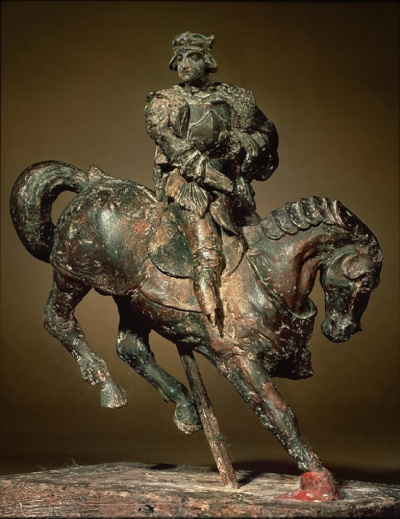
Leonardo's sculpture is best understood through several evidence types. There are his reported and documented sculptural ambitions, especially the great equestrian monuments. There are drawings of horses and riders, some tied to commissions and others to late project ideas. There is the small Budapest bronze, Horse and Rider, which the Museum of Fine Arts, Budapest presents as attributed to Leonardo da Vinci, with object facts and a continuing debate around authorship [1]. There are later modern monuments inspired by Leonardo's unfinished projects, including Nina Akamu's Leonardo's Horse in Vinci [7]. There are also existing images and local sculpture pages that remain useful only when clearly caveated.
The strongest account keeps those forms of evidence distinct. Leonardo the sculptor should not be reduced to a single contested bronze, a wax figure, or a modern monument. His sculptural imagination survives through projects, drawings, technical ambitions, disputed objects and the long afterlife of an unfinished idea.
At a Glance
- Page titleLeonardo da Vinci Sculptures
- SectionLeonardo's sculpture projects, horse studies and attribution questions
- Categorysculpture projects and attribution guide
- Core subjectLeonardo's sculptural ambition, monument projects, horse studies, attributed small bronzes and later reconstructions
- Evidence basisno single governing object record; source contexts must remain separate
- Strongest cautionno documented statue by Leonardo survives, nor one widely accepted as certainly by him [2]
- Key object laneBudapest Horse and Rider, attributed to Leonardo da Vinci, first half of the 16th century, bronze, height 24.4 cm, Museum of Fine Arts, Budapest, inv. 5362 [1]
- Key drawing lanesSforza and Trivulzio horse monument studies in the Royal Collection [5] [6]
- Modern reconstruction laneNina Akamu's Leonardo's Horse, a modern work inspired by the unfinished Sforza project [7]
- Image noteimages of sculpture-related material require separate source and rights checks
Contents
- Why Sculpture Is Different for Leonardo
- Monument Projects Before Surviving Objects
- The Trivulzio Monument
- The Budapest Horse and Rider
- Technical Evidence and Its Limits
- Horse and Rider, Rearing Horse, and Page Discipline
- Modern Monuments and Leonardo's Afterlife
- How to Read Leonardo Sculpture Claims
- Why Sculpture Still Belongs in Leonardo's Story
Why Sculpture Is Different for Leonardo
Leonardo trained in an artistic world where painting, drawing, metalwork, modelling and sculpture were closely related. Verrocchio's workshop in Florence was not a narrow painting school. It was a place where young artists learned to think through bodies, surfaces, relief, bronze, ornament, anatomy and mechanical process. Leonardo's later notebooks show the same restless crossing of boundaries.
The problem is that Leonardo's surviving fame does not rest on an accepted sculptural corpus. His paintings are rare but visible. His drawings and notebooks are abundant enough to show method, curiosity and invention. Sculpture is different. The great projects were not completed, the models are lost or uncertain, and the objects later associated with his hand are debated.
That uncertainty has encouraged two opposite mistakes: treating every compelling horse or rider linked to Leonardo as his own work, or dismissing sculpture because no secure statue survives. Leonardo's sculptural thinking is better approached through the evidence itself: drawings, documented projects, attributed bronzes and modern monuments each tell a different part of the story.
The wording matters. A work attributed to Leonardo is not the same as a documented sculpture by Leonardo. A drawing connected to a monument does not prove a finished bronze. A modern monument inspired by Leonardo belongs to his afterlife, not to his surviving Renaissance output.
Monument Projects Before Surviving Objects
The strongest place to begin is not with a surviving sculpture but with Leonardo's monument projects. His work for the Sforza monument in Milan and later equestrian ideas show that sculpture was not peripheral to his imagination. It was bound up with patronage, prestige, warfare, dynastic memory and the Renaissance dream of turning a ruler's power into bronze.
The Royal Collection Trust's Studies of a horse, RCIN 912317, dates to about 1490 and relates the drawings to Leonardo's work for the Sforza monument. The record notes that many studies for that monument depict individual horses Leonardo drew in the stables of the Milanese army, and that a small sketch shows the intended pose of the monument's horse [5]. This is precious evidence because it connects observation to sculptural planning. Leonardo was not merely inventing a symbolic horse from imagination. He was looking at actual animals, studying mass, posture and movement.
The Sforza project was monumental in both scale and ambition. It asked how a colossal horse could be conceived, modelled and cast. Leonardo's challenge was not only artistic but technical. A horse on that scale is a problem of weight, balance, armature, clay, mold, metal and furnace capacity. Even where the monument failed to materialize, the drawings reveal the size of the problem he chose.
This matters for the Sculptures page because it moves the discussion away from the false question, Where are Leonardo's statues? The better question is, What evidence survives for Leonardo thinking sculpturally? The Sforza studies answer that question powerfully. They show him working at the boundary between living anatomy and public bronze.
The Trivulzio Monument
The Trivulzio monument gives the page a second major project lane. Royal Collection Trust's record for Studies for the Trivulzio monument, RCIN 912355, dates the sheet to about 1508-10 and identifies it as related to a proposed equestrian monument for Gian Giacomo Trivulzio. The record explains that Leonardo prepared variant sketches and a detailed costing for a life-size bronze horse and rider on a marble base with a sarcophagus, while also making clear that there is no evidence he began physical work on the project [6].
For the Trivulzio monument, the distinction is crucial. The material is sculptural evidence, but it is not a surviving sculpture. It shows commission, design, cost, format and ambition. It does not give us a finished bronze by Leonardo.
The Trivulzio lane also helps readers understand why horse-and-rider imagery keeps returning in Leonardo sculpture discussions. Equestrian monuments were ideal vehicles for public memory. They demanded knowledge of the horse, the rider, the base, the site, the casting and the patron's identity. Leonardo's drawn studies show that he could imagine these problems in detail. They do not prove that every later small bronze horse should be folded into his oeuvre.
That distinction may feel exacting, but it protects the page from myth. Leonardo's failures, abandoned plans and unexecuted projects are not embarrassing footnotes. They are central to his career. Sculpture, perhaps more than painting, reveals the gap between what Leonardo could imagine and what Renaissance circumstances allowed him to complete.
The Budapest Horse and Rider
The most important surviving object lane is the Budapest Horse and Rider. The Museum of Fine Arts, Budapest identifies the statuette as Attributed to Leonardo da Vinci, Horse and Rider, first half of the 16th century, bronze, height 24.4 cm, inventory 5362 [1]. That source is strong enough to support discussion of the Budapest object. It is not strong enough to transform the entire Sculptures page into a certainty claim.
The Budapest object has a complicated modern history. It was bought in Rome between 1818 and 1824 by the Hungarian sculptor István Ferenczy; its earlier provenance is unknown [1]. The Museum of Fine Arts purchased the Ferenczy collection in 1914 [1]. Simon Meller published the statuette in 1916 as a model intended by Leonardo for the Trivulzio monument, and the Budapest source records that the attribution was received favourably but with reservations [1].
That provenance gap matters. The bronze does not arrive with a Renaissance document naming Leonardo. Its attribution has had to depend on style, comparison, technical analysis and the history of scholarly interpretation. For a figure as famous as Leonardo, that creates pressure. The object becomes a wish, a puzzle and an argument all at once.
Zoltán Kárpáti's attribution essay is especially useful because it resists triumphalism. It explains how the Budapest Horse and Rider has moved through changing scholarly opinions and emphasizes a core methodological problem: if no documented statue by Leonardo survives, and not even one is widely accepted as certainly his, then judging any sculpture as Leonardo's becomes unusually unstable [2].
That does not make the Budapest bronze unimportant. It makes it more interesting. It is a case study in how attributions are built, questioned and revised.
Technical Evidence and Its Limits
Technical research has strengthened the Budapest bronze's historical seriousness, but it has not settled authorship. The Budapest research project states that the statuette underwent comprehensive technical investigation, including work at the National Gallery of Art in Washington and later neutron-based investigations in Budapest [3]. The Washington examination led researchers to conclude that the Budapest bronze was most probably cast in the early sixteenth century, while two similar horse figures were late nineteenth-century copies [3].
That is an important distinction. A sixteenth-century cast is a very different object from a later copy. It places the Budapest bronze near Leonardo's world in time, materials and Renaissance casting practice. It explains why the object continues to draw serious attention.
But early casting is not the same as Leonardo authorship. Technical evidence can tell us about metal, casting method, structure, core material and relative dating. It can help separate early objects from later copies. It cannot, by itself, identify the modeller's hand. Language such as proved by technical analysis would therefore go too far.
The National Gallery of Art's 2009 exhibition, The Budapest Horse, is useful here because it presented the Budapest object with related small bronzes and explanatory material around technical examination [4]. The exhibition context supports the idea that the object is an important scholarly problem. It does not turn the problem into a solved case.
For readers, this is one of the most valuable lessons of the Sculptures page. Science can narrow possibilities. It can remove some doubts. It can create new questions. It does not always produce the simple yes-or-no answer that public art history wants.
Horse and Rider, Rearing Horse, and Page Discipline
The local Leonardo cluster already contains sculpture-adjacent pages that need careful separation. Rearing Horse and Mounted Warrior can be used as a bounded comparison for the Budapest Horse and Rider lane. It should keep Attributed to Leonardo da Vinci; attribution debated as the governing posture. The separate Horse and Rider wax-sculpture lane remains caution-led and should not be used as a settled source for this page.
This distinction is not pedantic. Similar titles can make different objects collapse into one another. A bronze, a wax model, a cast, a later copy and a modern reconstruction may all involve horses and riders, but they are not the same evidence.
If the public article mentions the local Horse and Rider page, it should do so as a caution lane. It should explain that not every object associated with Leonardo's sculptural imagination is equally ready for public treatment. Some pages can be discussed from institutional records; others require further source-lineage review.
Handled well, uncertainty sharpens the story rather than weakening it.
Modern Monuments and Leonardo's Afterlife
Modern monuments inspired by Leonardo belong on the Sculptures page only if they are clearly described as modern works. Museo Leonardiano's page on contemporary art in Vinci identifies Nina Akamu's Leonardo's Horse as an equestrian monument inspired by Leonardo's unfinished project for a colossal statue of Francesco Sforza. It records that the completed statue was donated to Vinci and installed in Piazza della Libertà in 2001 [7].
That is a meaningful part of the sculpture story. Leonardo's unfinished projects did not disappear. They continued to invite reconstruction, homage and public imagination. A modern monument can reveal the scale of his ambition and the cultural power of the idea. It cannot be treated as Leonardo's own sculpture.
Leonardo's sculptural legacy includes absence. The Sforza monument survives as drawings, documents, stories and later attempts to give form to what was never cast. Modern sculpture can help visitors feel the ambition of the lost project, but it belongs to Leonardo's reception history rather than to his Renaissance output.
Admiration and precision can work together: the ambition remains extraordinary even when the category is modern reception rather than Renaissance object.
How to Read Leonardo Sculpture Claims
A good Leonardo sculpture claim should answer several questions. What is the object or project? What source governs it? Is it a drawing, a recorded commission, a surviving bronze, a later cast, a modern reconstruction or a local existing image? Does the source say by Leonardo, attributed to Leonardo, after Leonardo, inspired by Leonardo, or something else?
Those words are not interchangeable. By Leonardo requires much stronger evidence than attributed to Leonardo. After Leonardo may describe influence, copying or design descent. Inspired by Leonardo may be entirely modern. Keeping those distinctions visible makes the sculpture story stronger, not weaker.
The same caution applies to images. A photograph or reproduction can help identify a sculpture-related object, but it should not imply that the attribution, source lineage or reproduction rights are settled. The evidence for the object and the status of the image remain separate questions.
Why Sculpture Still Belongs in Leonardo's Story
Sculpture belongs in Leonardo's story because it reveals him thinking about bodies in space. His horse studies are not just animal drawings. They are attempts to understand weight, strain, motion and public monumentality. His equestrian projects show him imagining art at civic scale. The Budapest bronze debate shows how strongly later scholars wanted, and still want, material proof of Leonardo's three-dimensional work.
The absence of a secure surviving corpus does not erase that history. It makes it sharper. It asks readers to distinguish between what Leonardo made, what he planned, what others may have made after him and what modern culture has built in his memory.
Sculpture therefore asks for a different rhythm from a single artwork article. It is part guide, part cautionary note and part map of a partly lost medium. The limits of the evidence are not a distraction from the subject; they are part of what makes the subject worth reading.
Leonardo's sculpture is not a room full of secure statues waiting to be admired. It is a field of traces: drawings of horses, unrealized monuments, disputed bronzes, later reconstructions and inherited images. Those traces are enough to tell a rich story, provided the page lets them remain traces.
Frequently Asked Questions
Discussion
Which evidence type matters most for Leonardo's sculpture legacy: monument drawings, the Budapest bronze, lost projects or modern reconstructions?
Reader Insights
How should an attributed object be presented when no secure surviving sculpture baseline exists?
What do the Sforza and Trivulzio studies tell us about Leonardo thinking sculpturally?
Where should modern monuments and reconstructions sit in the story?
Join the Conversation
Share your reading of Leonardo's sculpture evidence below.
References
- Museum of Fine Arts, Budapest / Szépművészeti Múzeum Leonardo Project, The Statuette, accessed 30 July 2026.
- Zoltán Kárpáti, A Brief History of an Attribution, Budapest Leonardo Project, accessed 30 July 2026.
- Museum of Fine Arts, Budapest / Szépművészeti Múzeum Leonardo Project, Research, accessed 30 July 2026.
- National Gallery of Art, The Budapest Horse, accessed 30 July 2026.
- Royal Collection Trust, Studies of a horse, RCIN 912317, accessed 30 July 2026.
- Royal Collection Trust, Studies for the Trivulzio monument, RCIN 912355, accessed 30 July 2026.
- Museo Leonardiano di Vinci, Contemporary art for Leonardo, accessed 30 July 2026.
Related Leonardo da Vinci Pages
Rearing Horse and Mounted Warrior
A bounded attributed-object case study connected with the Budapest Horse and Rider lane.
Leonardo da Vinci Drawings
The source-led drawing guide for studies, projects, notebooks and visual evidence.
Leonardo da Vinci Biography
Career, patronage and workshop context for Leonardo's unfinished projects.
Leonardo da Vinci Paintings
A catalogue guide that keeps secure, attributed, version and lost-work lanes separate.
