

 by Tom Gurney
Tom Gurney BSc (Hons) is an art history expert with over 20 years experience
Published on June 19, 2020 / Updated on August 2, 2026
Email: tomgurney1@gmail.com / Phone: +44 7429 011000
Annunciation by Leonardo da Vinci
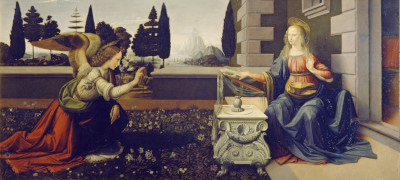
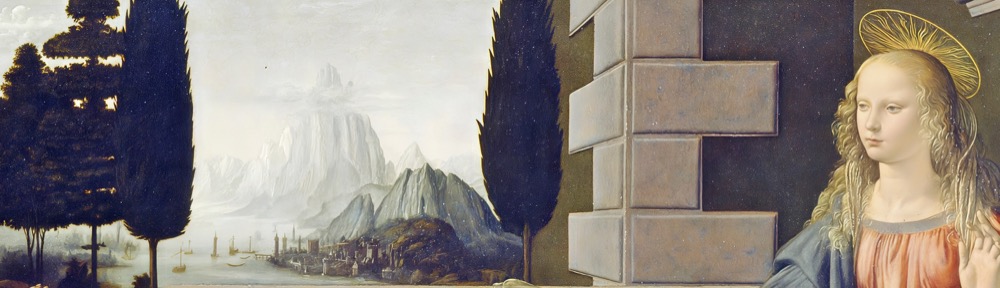
Leonardo da Vinci’s Annunciation turns a sacred encounter into an event unfolding in the visible world. The Archangel Gabriel kneels in a flowering meadow while the Virgin Mary sits at a lectern outside a Renaissance palace. Between them stretches a measured interval of grass, stone and air. Beyond the garden wall, trees, water and blue mountains recede towards a luminous horizon.
Painted when Leonardo was still associated with Andrea del Verrocchio’s Florentine workshop, the panel already shows a distinctive attention to natural observation. Gabriel has weight: his knee presses towards the ground, his drapery folds around a solid body and his shadow falls across the grass. His wings are constructed like those of a large bird rather than arranged as flat emblems. Plants vary across the meadow, and the remote landscape changes gradually with distance.
The painting is equally concerned with order. Architecture, paving and garden walls create a perspective framework, while the wide format keeps Gabriel and Mary apart without disconnecting them. Their exchange is carried across the intervening space by glances, gestures and the stem of the angel’s lily. Stillness and arrival, enclosure and distance, sacred meaning and earthly detail all meet within one long horizontal design.
The work is now in the Uffizi Galleries in Florence. The museum dates it to about 1472 and describes it as one of Leonardo’s youthful paintings. Its patron and original destination are unknown, and one of its most discussed features—the Virgin’s unusually long right arm—must be approached as an open visual problem rather than a solved mistake.[1]
At a Glance
- ArtistLeonardo da Vinci
- TitleAnnunciation [1]
- DateAbout 1472 [1]
- MediumOil on wood [1]
- Dimensions90 × 222 cm [1]
- Inventory1890 n. 1618 [1]
- CollectionUffizi Galleries, Florence [1]
- Gallery locationRoom A35, Leonardo da Vinci [1]
- Known provenanceTransferred to the Uffizi in 1867 from San Bartolomeo a Monteoliveto [1]
- Original destinationUnknown; commissioner also unknown [1]
Contents
- Introduction
- At a Glance
- An Early Work in Verrocchio’s Florence
- The Annunciation Story
- An Earthly Setting
- Gabriel: Arrival, Weight and Wings
- Mary, the Book and the Lectern
- Perspective and the Wide Format
- Light, Colour and the Distant Landscape
- Provenance and Unanswered Questions
- Annotated Details
Annotated Details from Annunciation
The annotated image follows the wide panel from Gabriel to Mary, pausing on the lectern, the garden setting and the atmospheric distance that organise the scene.
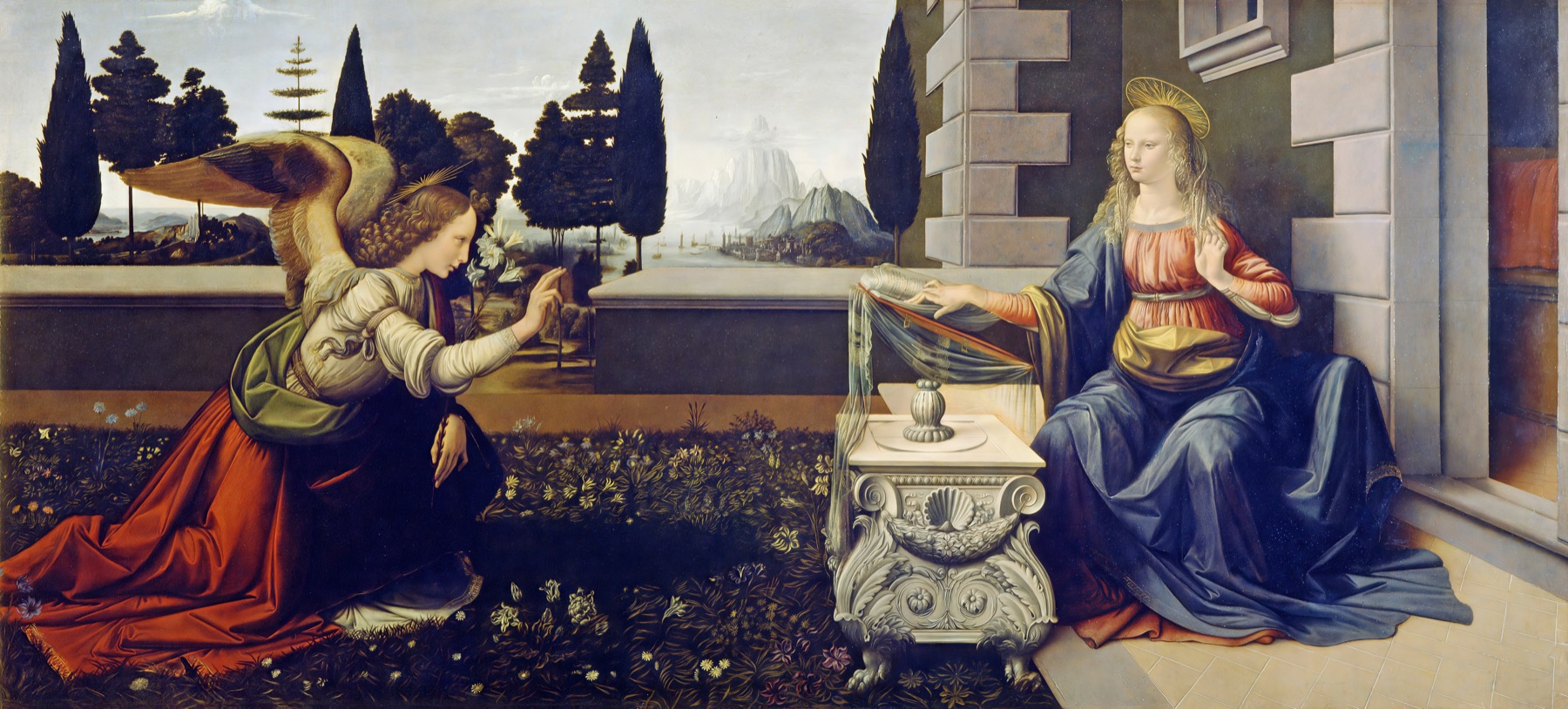
Details from ANNUNCIATION
Close looking highlights the details that structure this Leonardo page while keeping object and image-source caveats separate.
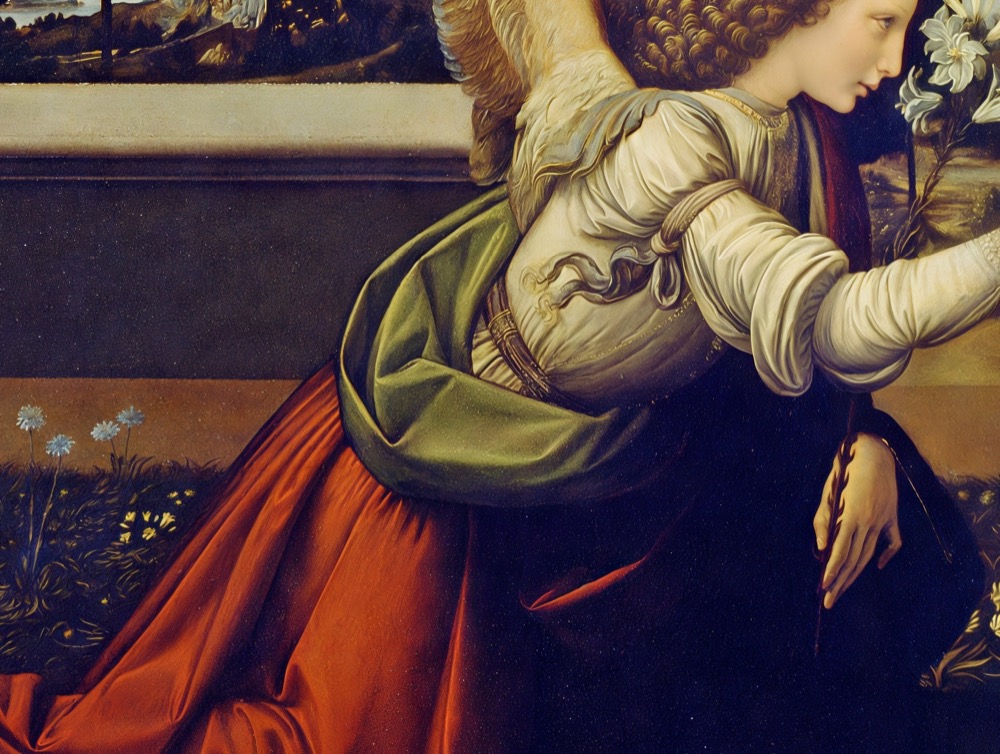
Gabriel's kneeling figure
Gabriel's gesture begins the narrative on the left and directs the eye across the garden.
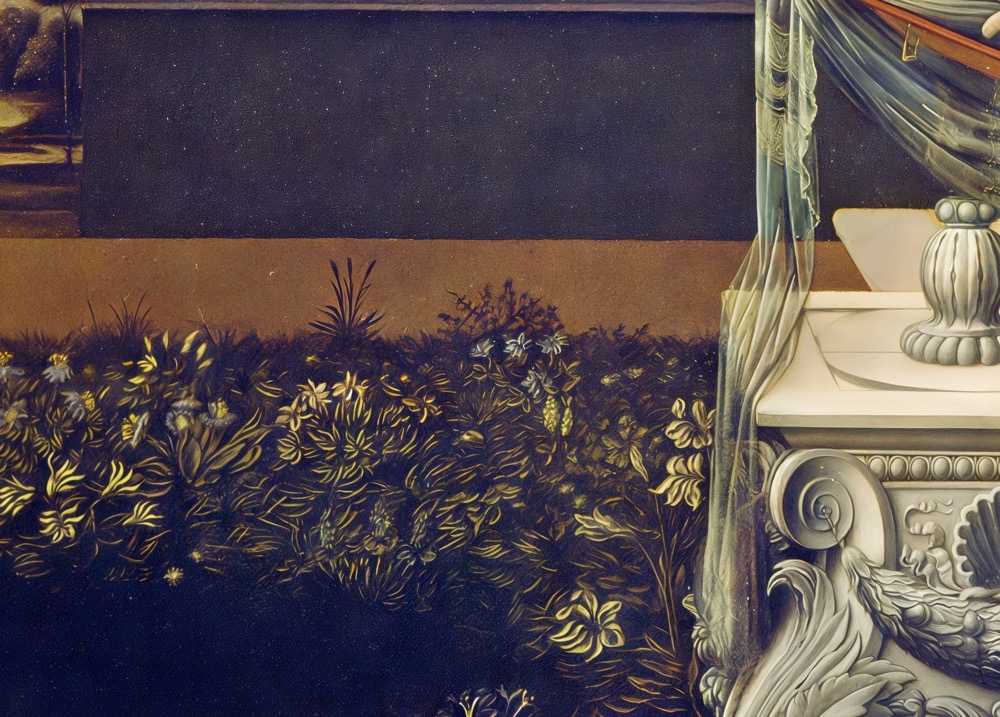
Lectern and lilies
The lectern and lilies concentrate the picture's devotional symbols between the figures.
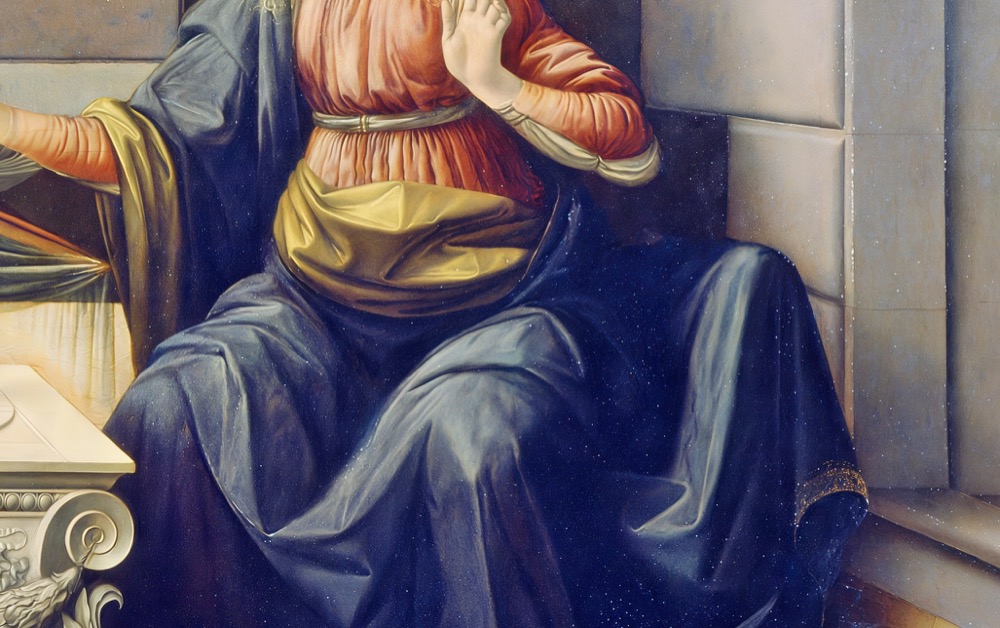
Mary at the right
Mary's poised response balances Gabriel's arrival and closes the wide composition.
Distant landscape
The far trees and water open the scene into the atmospheric world behind the garden wall.
An Early Work in Verrocchio’s Florence
Leonardo was born in 1452 and entered the orbit of Andrea del Verrocchio, a painter, sculptor and workshop master whose practice trained artists across several materials. The Uffizi places the Annunciation in this environment and generally regards it as a youthful work made while Leonardo was still working in Verrocchio’s studio.[1]
Workshop membership did not prevent artistic independence. The Metropolitan Museum of Art’s chronology records Leonardo as an independent master by 1472, the same approximate year now assigned to the painting.[4] In Renaissance Florence, professional status and workshop collaboration could overlap. A young artist might complete independent work while continuing to draw on a master’s designs, techniques, assistants and professional network.
The panel makes that relationship visible. Its clear perspective, precise architecture and carefully ordered surface belong to the disciplined culture of a major Florentine workshop. The elaborate lectern also adapts a Verrocchio invention. According to the Uffizi, its form recalls Verrocchio’s tomb for Piero de’ Medici in the church of San Lorenzo.[1] This is more specific than a vague claim of “influence”: a sculptural design associated with the master has been transformed into a painted piece of furniture.
At the same time, the picture’s natural effects point towards Leonardo’s developing priorities. Gabriel’s bird-like wings, the shadow on the grass, the variety of plants and the atmospheric landscape all give close observation a structural role. Nature is not a decorative border around the sacred story. It helps make the story credible.
The Baptism of Christ, painted by Verrocchio with Leonardo’s participation around 1470–75, provides a useful comparison. The Uffizi identifies the younger artist’s contribution with the angel at the left and describes the work as tempera and oil on panel.[3] The collaboration shows Leonardo learning within a shared object rather than working in isolation. In the Annunciation, the same workshop formation supports a more expansive and increasingly individual experiment.
It is therefore misleading to choose between calling the panel “workshop-bound” and “fully Leonardo.” Its historical importance lies partly in that tension. Forms inherited from Verrocchio coexist with a new intensity of looking, and traditional sacred imagery is reorganised through the particular conditions of a garden, a body, a wing and a distant atmosphere.
The Annunciation Story
The subject comes from Luke 1:26–38. Gabriel is sent to Nazareth to announce that Mary will conceive and bear Jesus. Mary is troubled, asks how this will happen and receives an explanation centred on the action of the Holy Spirit. She then accepts the divine message.[5]
Artists had to compress this dialogue and sequence of responses into a single image. Certain attributes make the scene recognisable: Gabriel, the Virgin, a lily, a book, a domestic or enclosed setting and gestures of greeting and response. Yet the biblical text does not prescribe a palace garden, a marble lectern or an extensive mountain landscape. These are pictorial decisions that translate the event into a fifteenth-century visual language.
Leonardo chooses the moment of encounter. Gabriel has arrived and kneels at the left. Mary turns from her reading at the right. His raised hand conveys address or blessing; hers opens in response. Neither figure is frozen as an isolated symbol. Each action depends on the other.
The distance between them matters. It gives the message room to travel. The open grass is not empty filler but an active interval crossed by sight, speech and gesture. Gabriel’s forward direction meets Mary’s turning movement, while the strong horizontal format makes the viewer follow their exchange from side to side.
Mary’s book associates her with attentive reading and contemplation. Its presence does not mean that she is shown literally reading the Gospel account in which she appears. In Annunciation imagery, a book can signal devotion, scriptural understanding and fulfilment. Leonardo makes the interruption gentle: the book remains open, and Mary’s response grows out of an already composed state.
The scene is sacred, but it is not detached from ordinary physical experience. Stone has mass, cloth has weight, plants occupy soil and late light settles across the landscape. The miracle is presented within nature rather than by suspending natural order. This balance between theological subject and observed world is one of the painting’s defining achievements.
An Earthly Setting
Many Annunciations place Mary inside a chamber or beneath an arcade. Leonardo brings both principal figures into an open garden terrace. A palace rises behind Mary, but the encounter takes place in the air and light outside it. The architecture frames her without enclosing the entire scene.
The garden is cultivated but abundant. Low flowers and grasses spread across the foreground. A boundary wall separates this controlled space from the broader landscape, where trees, water and mountains extend into the distance. The wall marks an enclosure, yet the view remains open above it.
The Uffizi describes this as a hortus conclusus, Latin for “enclosed garden.” In medieval and Renaissance Christian imagery, the enclosed garden alludes to Mary’s purity.[1] The symbol works through setting rather than inscription. A familiar physical place—a protected garden—becomes a way to express a theological idea.
Enclosure does not mean sterility. The meadow is flourishing, and the wider world beyond it appears fertile and expansive. The contrast allows purity to be associated with living growth. Leonardo’s close attention to plant forms strengthens that meaning without requiring every flower to carry a separate code.
The palace also establishes dignity. Its cut stone, columns and restrained ornament create a setting appropriate to Mary’s role, while the outdoor encounter prevents grandeur from becoming remote. Human scale remains important: the ledge can be touched, the book can be turned, and the meadow can receive a kneeling body.
This setting differs from Sandro Botticelli’s later San Martino Annunciation of 1481, also in the Uffizi. Botticelli places the event within a Renaissance palace and portico, with Mary’s room and its furnishings more fully exposed; a walled garden still contributes Marian symbolism.[6] The comparison shows how artists could use similar architectural and garden elements while changing the balance between interior devotion and the world outside.
Leonardo’s landscape gives the encounter an unusually broad horizon. Mary and Gabriel occupy a protected foreground, but the message belongs to a world that stretches far beyond the garden. The spatial opening makes theological consequence visible without adding a crowd or a secondary episode.
Gabriel: Arrival, Weight and Wings
Gabriel kneels on the meadow with one leg advanced and the other folded. His pose combines descent with stability. He seems to have just arrived, yet the body is sufficiently grounded to cast a shadow. The Uffizi emphasises this corporeal quality and connects it with the folds of his clothing and their apparent study from life.[1]
The shadow is a small but decisive observation. It fixes the angel within the same light as the garden. Rather than weakening his supernatural identity, physical presence makes the apparition more immediate. Mary is not responding to an abstract sign; a messenger has entered her space.
Gabriel’s right hand rises in a formal gesture. The fingers are controlled, and the wrist redirects the movement back towards Mary. His other hand holds a lily, its long stem bridging part of the gap between the figures. The flower is traditionally associated with the Virgin’s purity, an interpretation reinforced here by the enclosed garden.
The wings command particular attention. Their layered feathers and articulated edges resemble the anatomy of a powerful bird. The Uffizi describes them as based on a bird of prey, and its Leonardo room presents the angel as landing and closing his wings.[1] [2] These are museum interpretations of the visible form, not proof that one exact species served as the model.
Leonardo’s solution joins observation to invention. A real bird’s wing is adapted to a human shoulder and to the demands of a horizontal composition. The lower wing line helps contain Gabriel’s body, while the upper feathers direct energy towards the centre. Natural study supports a being that nature alone does not provide.
The drapery plays a similar role. Folds describe the angle of a bent knee and the turn of a torso, giving the angel weight. At the same time, the cloth spreads into elegant rhythms that separate him from the meadow. Physical description and formal grace work together.
Gabriel’s face is calm rather than theatrical. His arrival carries authority, but his kneeling posture also conveys reverence. This double character—messenger and worshipper—helps explain the restraint of the exchange. The angel brings a world-changing announcement without overwhelming the person who receives it.
Mary, the Book and the Lectern
Mary sits at the right, behind a stone or marble-like lectern. Her body is aligned with the palace, while her head and right arm turn towards Gabriel. The pose links stable architecture with responsive movement.
The open book establishes the activity that has been interrupted. One hand remains near the pages; the other extends outward. The contrast between them creates a sequence from reading to recognition. Mary does not abandon contemplation so much as redirect it towards the messenger before her.
Her raised hand is one of the panel’s most debated passages. The forearm and fingers appear unusually extended, especially when viewed straight on. The Uffizi proposes that the apparent anomaly may relate to Leonardo’s early research into optics and to an intended lateral, lower viewpoint from the right, perhaps over a side altar.[1]
That explanation should remain a proposal. It combines a visual observation with a hypothetical original display, but the same Uffizi record states that neither the first location nor the commissioner is known.[1] There is therefore no surviving installation that proves exactly where a contemporary viewer stood.
The arm can still be read productively without deciding the issue. Its length carries Mary’s gesture across the broad panel and brings her hand closer to the open space between the figures. From a position to the right, some relationships may appear less strained; from the front, the elongation adds expressive reach. Both effects are visible, but intention must be distinguished from certainty.
The lectern has a different kind of evidence. Its ornamental form derives from a Verrocchio design associated with the Medici tomb in San Lorenzo.[1] Leonardo changes scale and function: a sculptural vocabulary created for a funerary monument becomes a support for Mary’s book.
This transformation is characteristic of workshop invention. Artists did not simply copy a motif as a detached ornament. They carried forms between sculpture, metalwork, architecture and painting, adjusting them to new purposes. The lectern connects Leonardo’s panel with the broad material culture of Verrocchio’s practice.
Mary’s clothing balances the elaborate support. Broad folds organise her seated body, while colour separates her from the pale stone and dark opening behind. She is dignified but not inaccessible. Her expression and open hand preserve the human sequence of attention, questioning and assent found in Luke’s narrative.[5]
Perspective and the Wide Format
At 222 centimetres across and only 90 centimetres high, the panel is more than twice as wide as it is tall.[1] This unusual proportion shapes every compositional decision. The figures cannot simply be stacked beneath a high arch; they must communicate laterally.
Leonardo uses linear perspective, a system in which receding parallel lines appear to converge towards a vanishing point. The Uffizi identifies a central vanishing point in the architectural construction.[1] Paving, walls and the palace establish a measured world even as the natural landscape softens those lines.
The perspective does not operate like an empty demonstration. It sets the distance between Gabriel and Mary and relates them to the ledges, garden boundary and palace. The space feels traversable. A viewer can imagine moving across it, even though the sacred exchange defines an invisible boundary of its own.
Horizontal accents unify the design: the lower edge of the palace, the top of the garden wall, the distant water and the long foreground all lead the eye sideways. Vertical elements—the palace corner, trees and figures—interrupt that movement at controlled intervals. The central landscape prevents the interval between Gabriel and Mary from becoming blank.
The vanishing system and the proposed side view are related but not identical questions. The architecture can possess a coherent central perspective while a figure is adjusted for another viewing condition. Renaissance artists sometimes coordinated several visual aims within a single work rather than submitting every part to one theoretical position.
The format also controls tempo. A square image might bring the two figures closer; a tall one might emphasise descent from heaven. Leonardo’s long panel encourages a slow crossing from arrival to response. The landscape then extends that movement beyond the encounter.
The viewer’s position remains active. From the centre, the symmetry of separation is especially clear. From the right, Mary, the lectern and palace become more dominant. The Uffizi’s optical proposal invites this kind of testing, provided it is not presented as a proven reconstruction.
Light, Colour and the Distant Landscape
The light is subdued rather than sharply radiant. The Uffizi calls it crepuscular—associated with twilight—and notes how it unifies the forms and sets dark trees against blended distance.[1] This low, even illumination allows sacred presence to emerge through atmosphere instead of a separate burst of gold.
Gabriel’s shadow demonstrates a local effect of light. Farther back, the same illumination behaves differently: contrasts weaken, colours cool and edges become less distinct. These changes create atmospheric perspective, the visual impression that distant forms are softened and shifted by the air between them and the viewer.
The water and mountains do more than fill a horizon. Their recession enlarges the meaning of the foreground event. The garden belongs to a particular place, while the landscape suggests a world continuing beyond it. Near and far are held together by graduated colour.
Trees form a dark screen near the garden wall, making the lighter distance more luminous. Their vertical rhythm echoes the figures and architecture without repeating them exactly. The landscape therefore supports both depth and composition.
Leonardo’s treatment of nature differs from a simple catalogue of objects. Individual plants, stones, feathers and reflections are observed, but each is subordinated to the larger effect. Detail persuades the eye that the place is real; atmosphere prevents detail from fragmenting the picture.
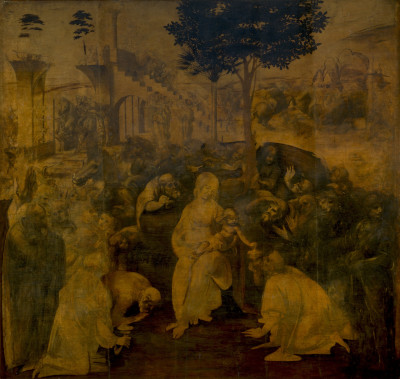
The Uffizi’s 2018 display places the Annunciation opposite the Baptism of Christ and near the Adoration of the Magi. The museum describes the arrangement as a way to compare the stylistic development of the young Leonardo.[2] Seen in that group, the landscape belongs to a broader early inquiry into water, rock, vegetation, bodies and changing light.
Symbolism Without a Secret Code
The painting contains recognisable Marian symbols, but symbols work best when anchored in established traditions and visible relationships. The lily held by Gabriel and the enclosed garden both refer to Mary’s purity.[1] The book connects her with devotion and sacred understanding. The palace conveys dignity and order.
These meanings do not require every plant to have an exact theological label. Botanical variety can carry several kinds of value at once: it makes the meadow plausible, demonstrates close study and contributes to the garden’s fertility. Assigning an unsupported identity and meaning to each small flower would replace observation with speculation.
The same caution applies to colour. Blue has a long association with the Virgin in Christian art, but the interpretation of every fold or pigment depends on technical and historical evidence. The strongest reading begins with how colour organises Mary against the architecture and landscape.
The panel’s spiritual effect arises from structure as much as from attributes. Distance conveys address; gesture conveys response; enclosure conveys purity; shadow conveys presence; recession opens the event towards the world. Meaning is distributed across the whole composition.
This is why the painting remains accessible even to viewers unfamiliar with every convention. The narrative can be read through bodies in relation: one figure arrives, another turns, and the space between them becomes charged. Iconographic knowledge deepens that experience but does not create it from nothing.
Provenance and Unanswered Questions
The painting entered the Uffizi in 1867 from the church of San Bartolomeo a Monteoliveto, outside Porta San Frediano in Florence.[1] This is the secure modern transfer recorded by the museum.
That church is not identified as the original destination. The Uffizi explicitly states that the commissioner and first location are unknown.[1] The distinction matters because later presence in a church does not prove that the painting was made for it.
Uncertainty affects several questions. The panel’s wide proportions might reflect a particular architectural setting, and the proposed lateral viewpoint could imply a side altar. Yet no surviving commission or installation document closes the argument. Responsible interpretation can describe the visual evidence and museum hypothesis while leaving the original arrangement open.
The painting’s authorship also belongs to an early workshop context, but the current Uffizi record identifies Leonardo as the artist and treats the work as a youthful painting made during his Verrocchio years.[1] Unsupported claims of a specific division among several hands should not override that catalogue position.
The work is now protected in a climate-controlled, anti-glare case in the Uffizi’s Leonardo room, part of the arrangement inaugurated in 2018.[2] Its neighbours—the Baptism and unfinished Adoration—allow early technique and ambition to be compared without collapsing the three works into one simple progression.
Provenance is not merely a list of addresses. It defines the boundary between what documentation establishes and what visual inference proposes. For the Annunciation, that boundary is unusually important: the known 1867 transfer is firm, while the first patron, first altar and first viewing angle remain unresolved.
Annunciation in Florentine Painting
Leonardo worked within a rich Florentine tradition. Earlier and later artists repeatedly set Gabriel’s message within buildings, bedrooms, loggias and gardens. Shared attributes made the story recognisable; different arrangements changed its emotional and spatial character.
Botticelli’s San Martino Annunciation of 1481 uses a palace interior, portico and visible room while retaining the walled garden as a sign of Mary’s purity.[6] His later Cestello Annunciation of 1489–90 intensifies gesture within a more contained architectural setting and includes words from Luke on its original frame.[7]
These named comparisons clarify Leonardo’s choices. His figures remain separated across an outdoor foreground, the horizon is unusually expansive, and the angel’s physical arrival receives as much attention as the furnishings of Mary’s dwelling. The contrast is not a contest for innovation. It shows how flexible the subject remained.
The painting’s early date is also important. Later Florentine Annunciations could respond to solutions developed across the 1470s and 1480s. Leonardo’s panel belongs near the beginning of that sequence, when his own professional identity was still forming.
Comparison is most useful when it identifies a specific pictorial problem. How much interior should be shown? Should Gabriel stand, fly or kneel? How close should he come to Mary? Should the moment feel sudden, ceremonial or contemplative? Leonardo’s answers depend on the long format, open air and measured gap.
Place in Leonardo’s Career
The Annunciation does not yet display every quality associated with Leonardo’s mature paintings, nor should an early work be judged only by how closely it predicts them. Its value lies in the seriousness with which it solves its own problems: a sacred dialogue, a very wide panel, two separated figures and a continuous natural setting.
Still, several enduring interests are present. Gesture carries thought between bodies. Light unifies different materials. Landscape suggests depth through changing colour and clarity. Natural structures—plants, feathers, fabric and shadow—are studied closely, then adapted to imaginative purposes.
The Verrocchio connection remains visible in the lectern and in the broader workshop setting. The comparison with the Baptism of Christ shows how collaboration formed part of Leonardo’s early development.[2] [3] The nearby Adoration of the Magi then reveals a much more crowded and openly revisional approach from around a decade later.
The three Uffizi works should not be arranged as a simplistic ladder from error to mastery. The Annunciation is controlled and spacious; the Baptism is collaborative; the Adoration is ambitious and unfinished. Together they show that development can involve different tasks, scales and modes of making.
The much-discussed arm illustrates the danger of retrospective judgement. Calling it merely a youthful mistake closes inquiry; calling it a proven optical correction goes too far in the other direction. The Uffizi’s proposal is valuable because it encourages viewers to consider angle and placement while retaining the language of possibility.[1]
The painting’s freshness comes from this mixture of discipline and experiment. Perspective orders the setting, but air softens it. Workshop design shapes the lectern, but observed wings animate the angel. Tradition supplies the story, but the meadow, shadow and horizon give it a new physical presence.
Looking Across the Panel
A useful way to study the Annunciation is to begin at the left edge and resist jumping immediately to Mary. Gabriel’s drapery first establishes a pattern of dense folds against the grass. The eye then rises through his bent body to the lifted hand and follows the lily’s stem towards the centre. His movement gives the reading a direction.
The open meadow slows that movement. Small plants hold attention near the surface while the garden wall creates a firm boundary beyond them. Above the wall, the landscape continues into water and mountains. Near detail and far distance therefore occupy the same central interval: the message travels across a garden, but the view opens towards a much larger world.
Mary’s hand receives the movement before the eye reaches her face. The extended arm, however anatomically unusual it may appear from the front, has a clear compositional effect: it projects response into the space between the figures. The open book and lectern then draw attention downwards, returning the sacred event to reading, touch and material form.
The palace stops the left-to-right journey with verticals and dark openings. Mary is visually supported by architecture in a way Gabriel is not. He belongs to arrival and the meadow; she belongs to dwelling and ordered space. Yet the shared light prevents those territories from splitting into separate pictures.
Finally, the viewer can reverse direction. From Mary, the hand leads back across the lectern and grass to Gabriel’s blessing. This return journey makes the exchange reciprocal rather than merely narrative. The painting is not only an illustration of a messenger approaching a recipient. Its lines repeatedly carry attention between announcement and response.
Artist Up Close: Learning from a Wing
Gabriel’s wings offer a compact lesson in Leonardo’s method. They must communicate an angelic identity immediately, yet Leonardo treats them as structures capable of weight, folding and movement. Rows of feathers differ in length and direction. The wing joins the shoulder, turns through space and appears to be settling after arrival.
The Uffizi relates the design to a powerful bird of prey and describes the angel in the Leonardo room as landing and closing his wings.[1] [2] The comparison should remain general: the painting does not provide a labelled specimen. What matters is the conversion of observed anatomy into a credible invention.
Observation alone would not solve the artistic problem. A bird’s wing has to be scaled and repositioned for a human figure, fitted within the panel and made legible against the garden. Leonardo selects, reorganises and idealises. Natural knowledge becomes a tool of imagination.
The same process appears elsewhere in the picture. Shadow gives a supernatural messenger bodily presence. Botanical detail gives a symbolic garden living variety. Atmospheric change turns pigments into distance. Leonardo studies nature not to replace sacred meaning, but to give that meaning a persuasive world.
Frequently Asked Questions
Discussion
Use this space to discuss Annunciation by Leonardo da Vinci, its source evidence and how it fits into Leonardo da Vinci's wider cluster.
Keep comments focused on close looking, attribution language, object evidence and page-specific caveats.
Reader Insights
Which detail on this page most changes how you read the work?
How does this page connect to Leonardo's paintings, drawings, inventions or workshop context?
Where should the wording stay cautious because the source evidence is qualified?
Join the Conversation
Share your reading of Annunciation by Leonardo da Vinci below.
References
- Gallerie degli Uffizi, “Annunciation,” collection record by Daniela Parenti, accessed 28 July 2026.
- Gallerie degli Uffizi, “The New Room of Leonardo da Vinci”, accessed 28 July 2026.
- Gallerie degli Uffizi, “The Baptism of Christ”, accessed 28 July 2026.
- Metropolitan Museum of Art, “Florence and Central Italy, 1400–1600 A.D.,” Heilbrunn Timeline of Art History, accessed 28 July 2026.
- United States Conference of Catholic Bishops, “Luke, Chapter 1”, accessed 28 July 2026.
- Gallerie degli Uffizi, “Annunciation” by Sandro Botticelli, 1481, accessed 28 July 2026.
- Gallerie degli Uffizi, “Annunciation” by Sandro Botticelli, 1489–90, accessed 28 July 2026.