


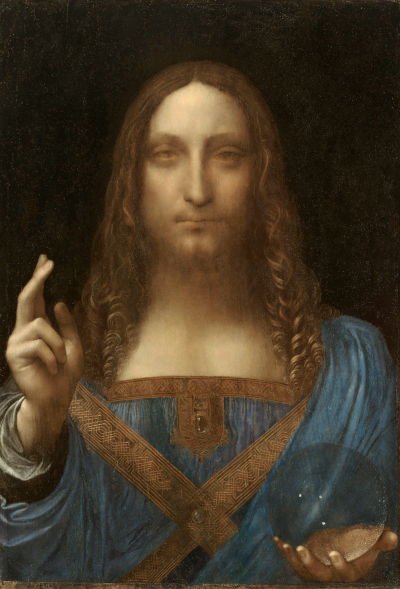
Salvator Mundi
Salvator Mundi is among the most famous and disputed paintings associated with Leonardo da Vinci. It shows Christ facing the viewer, one hand raised in blessing and the other holding a transparent orb.
Christie’s sold the panel in 2017 as a Leonardo for about $450m, making it the most expensive artwork sold at auction. The sale made the painting instantly familiar far beyond art history, but it did not settle the central question: how much of the surviving picture should be understood as Leonardo’s own work, and how much may belong to restoration, workshop practice or later intervention?
The page therefore begins from caution. Salvator Mundi is best described here as a disputed panel attributed to Leonardo da Vinci, not as an uncomplicated “Leonardo painting.”
There are strong pro-attribution arguments, including the 2011 National Gallery exhibition context, the 2017 Christie’s attribution, modern technical study and scholarship associated with Martin Kemp and other supporters. There are also serious cautionary arguments. Frank Zöllner has emphasised the uncertainty of the early provenance, the lack of secure contemporary documentation for an autograph Leonardo Salvator Mundi, the condition of the panel and the need to compare all related versions carefully before treating the matter as closed [6]. Other scholars and reported expert positions have argued for partial Leonardo involvement, workshop execution or alternative attributions [9].
That contested status is central to the painting’s modern history. Salvator Mundi sits where Leonardo studies, conservation history, the Old Master market, museum diplomacy and public fascination with rediscovered masterpieces meet.
The painting was sold at auction as a Leonardo. It has been studied technically. It belongs to a wider tradition of Salvator images, drawings and copies. It was linked to a high-profile planned display at Louvre Abu Dhabi after the 2017 sale. None of those facts, by itself, proves a single settled authorship.
At a Glance
Contents
- What does Salvator Mundi show?
- The 2017 sale and why it changed the painting’s public life
- Why attribution is still disputed
- Technical evidence: useful, but not a verdict by itself
- Conservation and the problem of the surviving surface
- Provenance: secure modern history and qualified earlier claims
- Copies, versions and the design tradition
- Current location and public access
- Why the price should not dominate the page
- Looking at the face
- The blessing hand and the problem of skill
- The orb: symbol, science and overinterpretation
- How Salvator Mundi relates to Leonardo’s accepted works
- The workshop problem
- What the 2011 exhibition did and did not do
- What Zöllner adds to the discussion
- What Bambach and Landrus add
- What can be said with confidence
- How the painting should be described now
- A practical way to read the painting
- Annotated Details
Annotated Details from Salvator Mundi
This annotated image is used under the page's caution-first attribution posture: it helps readers inspect the face, blessing hand, orb and robe without turning disputed authorship into certainty.
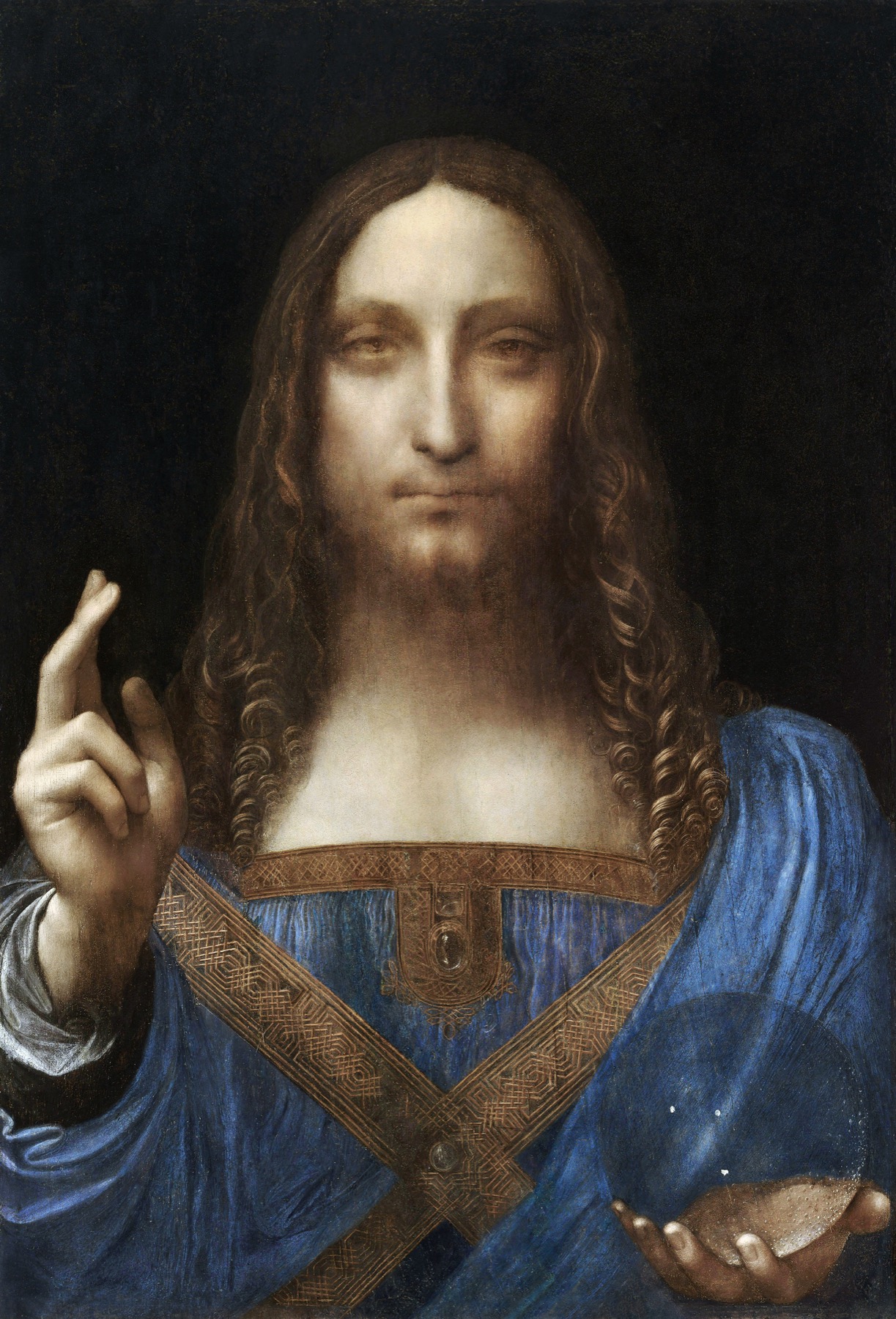
Details from SALVATOR MUNDI
Close looking highlights the details that structure this Leonardo page while keeping object and image-source caveats separate.
Face and frontal gaze
The face is central to the painting's public identity and to the care needed around attribution language.
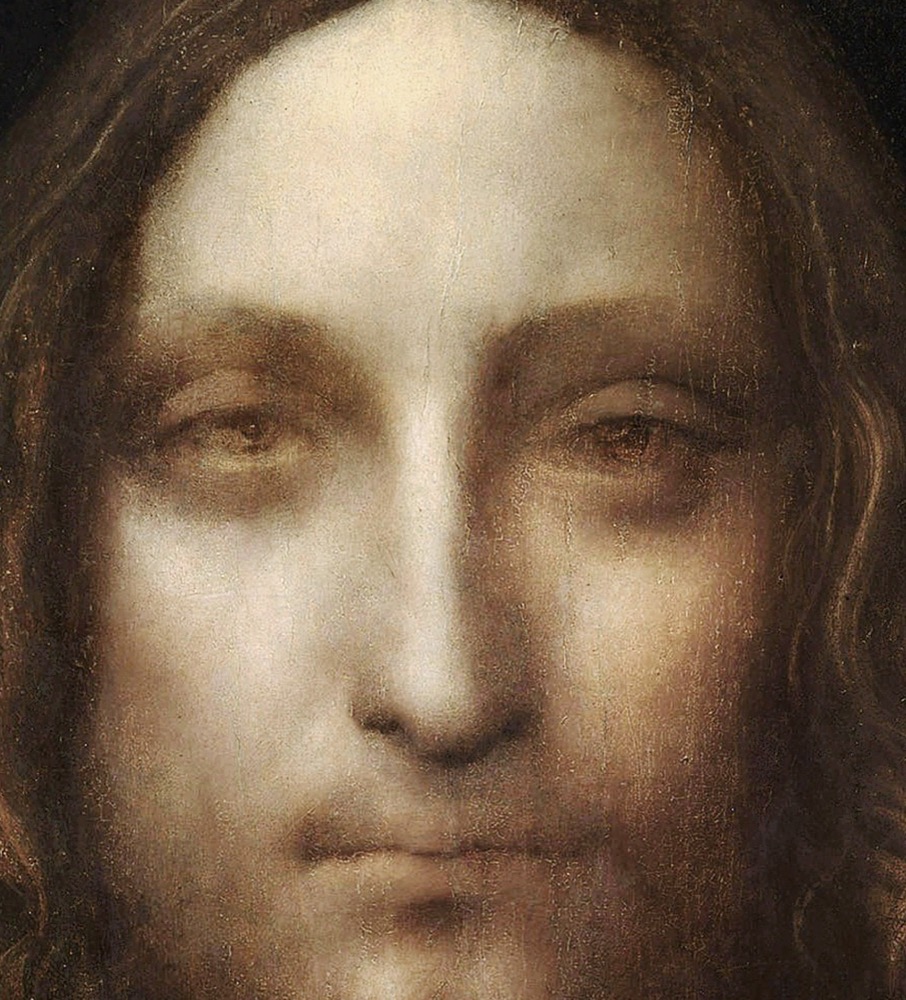
Blessing hand
The raised hand carries the image's devotional formula and should be read with the page's attribution caveat in mind.
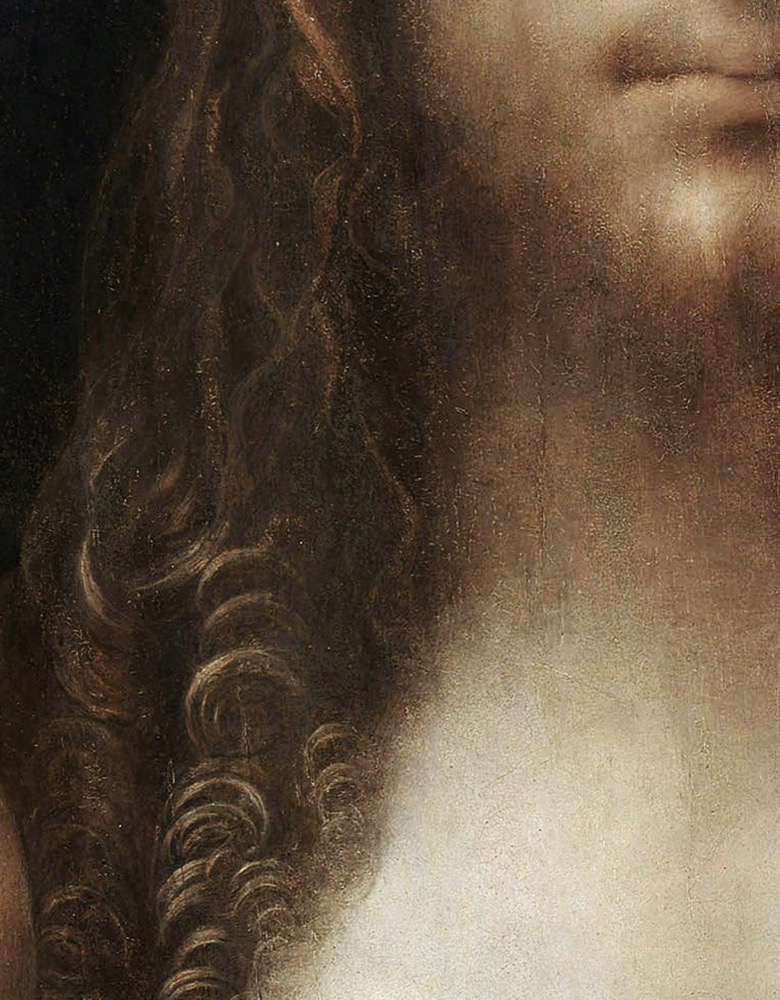
Crystal orb
The orb is one of the most discussed passages in the picture's modern reception.
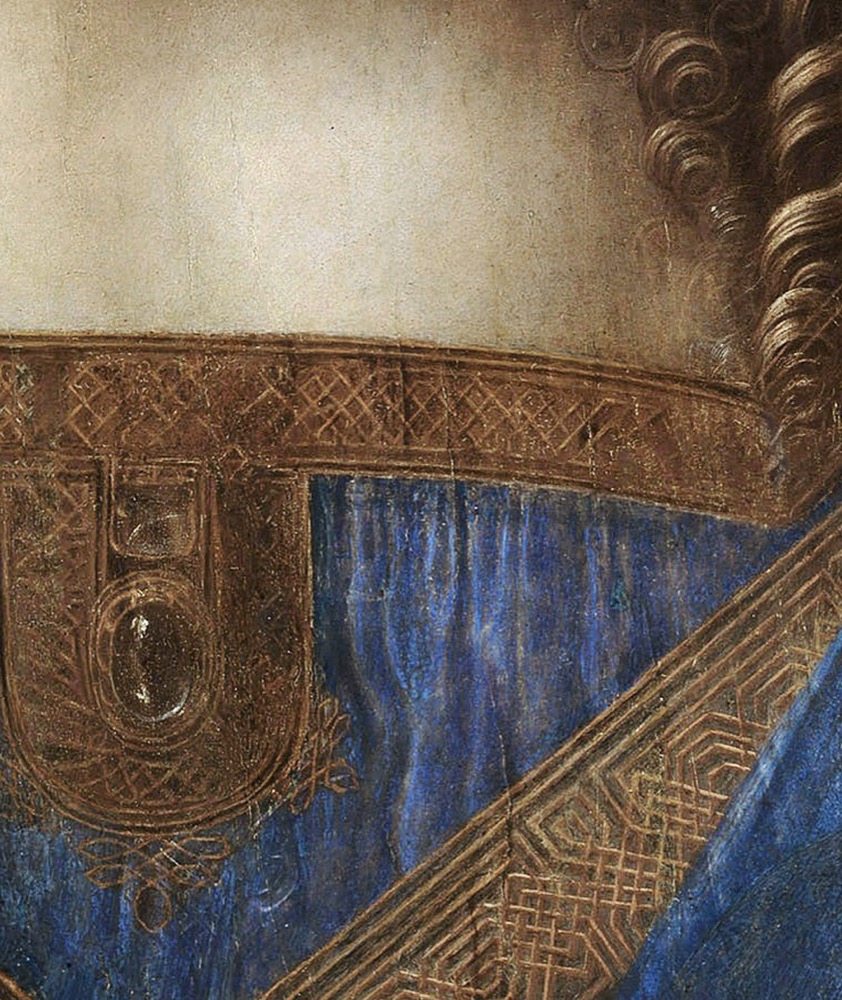
Robe and curls
Hair, robe and shadow help explain why technical and condition claims need careful sourcing.

What does Salvator Mundi show?
The Latin phrase Salvator Mundi means “Saviour of the World.” In this image Christ is shown frontally, close to the picture plane, with his right hand lifted in blessing. His left hand holds a clear sphere. The composition combines devotional stillness with intellectual curiosity. The face is calm, almost mask-like. The hair falls in ordered curls. The blessing hand is measured and prominent. The orb, one of the most discussed features of the painting, invites both religious and optical readings.
The subject was not invented by Leonardo. Images of Christ as Saviour of the World circulated widely in late medieval and Renaissance Europe. Artists adapted the type for devotional panels, prints and copies. In many versions Christ holds a globe or orb as a sign of dominion over creation. The distinct issue here is whether the surviving panel sold in 2017 preserves a work by Leonardo himself, a design by Leonardo executed partly or largely by others, a later version from his circle, or a more complicated object shaped by damage and restoration.
The subject and the attribution need to be kept separate. The subject is clear enough: Christ as Salvator Mundi. The attribution is contested. The version tradition is complex. The current panel is a restored object with a documented twenty-first-century market and exhibition history.
The 2017 sale and why it changed the painting’s public life
Christie’s offered the painting in New York in November 2017 as Leonardo da Vinci, Salvator Mundi. The lot record described it as oil on panel, measuring 65.7 by 45.7 centimetres, and dated it around 1500 [1]. The sale price, including buyer’s premium, made it the most expensive artwork sold at auction. That price transformed a specialist attribution debate into a global news event.
The sale is important evidence for the painting’s modern history, but it needs careful handling. Christie’s catalogue is an auction source. It records the commercial presentation, the claimed attribution, the listed materials, dimensions, provenance narrative and bibliography. It also contains qualified early provenance language, including “possibly” and “probably” in key parts of the earlier history [1]. Those qualifications matter. A public page should not flatten Christie’s sale narrative into a continuous, certain chain from Leonardo’s studio to the present.
After the sale, Christie’s issued a statement saying that the Department of Culture and Tourism – Abu Dhabi was acquiring the painting and that Christie’s was delighted it would be made available for public view at Louvre Abu Dhabi [2]. Abu Dhabi Culture & Tourism also announced in 2017 that it had acquired the painting and planned a Louvre Abu Dhabi display. Those statements are evidence of acquisition and display intent at that time. They are not the same as a current public object record.
This distinction matters for current-location claims. A later planned display was reported as postponed, and no current official public Louvre Abu Dhabi, DCT Abu Dhabi or Louvre collection-object page has been located for the painting. The page therefore avoids saying that Salvator Mundi is currently displayed at Louvre Abu Dhabi, currently in a named public collection, or currently located in a specific place unless a current official source later supports that claim.
Why attribution is still disputed
The painting’s modern fame depends heavily on the attribution to Leonardo. Yet attribution in Renaissance painting is rarely a single yes-or-no switch. It can involve design, underdrawing, workshop execution, later overpaint, conservation history, copies, documents and comparisons with securely accepted works. In the case of Salvator Mundi, those categories are especially hard to separate because the panel has suffered damage and restoration, and because related versions and copies complicate the evidence.
Christie’s argued strongly for Leonardo’s authorship. The catalogue connected the picture with Leonardo’s late Milanese and early sixteenth-century work, cited technical and stylistic evidence, and presented the painting within a history of rediscovery and conservation [1]. Martin Kemp, one of the most visible supporters of the attribution, has also framed the work in relation to Leonardo’s design intelligence, drapery studies, copies and optical choices. In a 2024 British Academy account, Kemp called the painting “very disputed” while still supporting a Leonardo design and painting claim [5]. That combination is useful: even a leading supporter does not present the public situation as free of dispute.
The 2011 National Gallery exhibition Leonardo da Vinci: Painter at the Court of Milan is another important part of the painting’s modern reception. The exhibition focused on Leonardo as a painter in Milan and brought together rare paintings and drawings connected with that period [3]. National Gallery board minutes from July 2011 record that the Salvator Mundi was expected to be included in the forthcoming exhibition, and also note the Gallery’s policy that works recently on the market could be included on scholarly merits if they contributed to the exhibition and catalogue argument [4]. That evidence supports exhibition history and institutional seriousness. It does not by itself settle attribution for all time.
The opposing and cautionary positions are equally important. Zöllner’s study of the Salvator Mundi tradition stresses that the attribution remains controversial. He points to uncertain early provenance, the absence of secure contemporary sources naming an autograph Leonardo Salvator Mundi, the painting’s condition and restoration, and the need for fuller documentation and exhaustive comparison with related versions [6]. Carmen Bambach’s position has been reported as rejecting a simple full Leonardo attribution and assigning much of the painting to Boltraffio while allowing Leonardo involvement in specific passages [9]. Matthew Landrus has been reported as arguing for a Luini or workshop attribution, again placing the painting within Leonardo’s circle rather than treating it as straightforwardly autograph [9].
The evidence does not lead to a single uncontested conclusion. The painting was sold and promoted as a Leonardo; some scholars defend a Leonardo attribution or substantial Leonardo involvement, while others argue for partial authorship, workshop execution or serious uncertainty.
Technical evidence: useful, but not a verdict by itself
Technical study has made the painting more legible, but it cannot carry the whole attribution argument alone. A 2020 Heritage Science paper examined the panel’s materials and techniques through microscopic samples and cross-sections [7]. The study identified a complex material structure: a walnut panel; preparatory, ground and paint layers; pigments including lead white, vermilion, red earth, red lake, natural ultramarine, lead-tin yellow, umber and black; and a walnut-oil medium. It also described subtle layer sequences and optical effects in the paint structure [7].
Those findings matter because they can place the object within a technically sophisticated Renaissance painting practice. They can support discussion of how the picture was built, how colour and modelling operate, and why its surface is difficult to read. They also help separate observable material evidence from later myth. But technical compatibility is not the same as full authorship. Materials and methods can be consistent with Leonardo’s period or circle without proving that every significant passage was painted by Leonardo himself.
The same caution applies to the orb. A 2026 npj Heritage Science article examined the transparent sphere and argued that the speckles and optical behaviour can be understood in relation to rock crystal rather than as simple optical error [8]. The article is useful because the orb has become a popular shorthand for the attribution debate: supporters have interpreted it as evidence of Leonardo’s optical thinking, while skeptics have pointed to perceived distortions or inconsistencies. But the orb is one feature in a damaged and restored picture. Even if its handling is technically more plausible than some critics assumed, that does not settle the whole painting.
Technical evidence is strongest when it is kept to technical claims. Pigments, panel structure, layering, restoration sensitivity and orb analysis can clarify the object, but they do not by themselves prove the attribution.
Conservation and the problem of the surviving surface
The painting known today is not simply a pristine object revealed unchanged from Leonardo’s studio. It is a panel with a complicated material history. Conservation made the image visible and helped bring the work into the modern attribution debate, but restoration also makes the surviving surface difficult to discuss in simple terms.
That does not mean restoration disqualifies the painting. Many Renaissance works survive in altered condition. Panels crack, pigments change, varnishes darken, paint layers are abraded, old repairs accumulate, and later conservation can both reveal and reshape what viewers see. The question is not whether the painting has been restored, but how precisely public writing distinguishes original material, damaged passages, reconstructed passages, technical observation and interpretive argument.
This is where the source standard has to remain high. Modestini’s conservation account and the Syson/Keith National Gallery catalogue material are important sources for a future full account, but those detailed pages remain constrained unless directly consumed from accessible sources. The 2020 Heritage Science paper gives a strong technical base, yet it also points toward further imaging and mapping rather than pretending the technical record is complete [7]. Zöllner’s caution about condition and restoration should therefore remain visible in any article [6].
The phrase “restored to its original state” should not be used. A better formulation is that conservation and technical study contributed to the painting’s rediscovery, visibility and interpretation, while the extent of damage and restoration remains part of the attribution debate.
Provenance: secure modern history and qualified earlier claims
Provenance is central to Salvator Mundi, but it must be split into categories. The secure modern record includes the 2011 National Gallery exhibition context and the 2017 Christie’s sale. The auction catalogue also presents an earlier provenance narrative, including possible and probable links to royal collections and later owners [1]. Those earlier links are historically important, but the qualifiers should stay attached to them.
The temptation is to tell a smooth story: Leonardo painted the picture, it entered royal collections, disappeared, was rediscovered, restored, authenticated and sold. That story is readable, but it is too clean. Zöllner’s caution is useful precisely because it interrupts that smoothness. He stresses that early provenance is not securely documented in the way a settled autograph Leonardo would ideally require [6]. A public page should therefore distinguish secure modern sale and exhibition history from earlier proposed or probable provenance.
The 2019 Oxford Academic record for Leonardo's Salvator Mundi and the Collecting of Leonardo in the Stuart Courts helps define the pro-attribution and collecting-history lane [10]. Its abstracts frame the book around discovery, identification, conservation, scientific analysis, archival research and Stuart collecting. That is directly relevant to a future manuscript, especially for the Stuart and provenance questions. But locked chapter text should not be treated as consumed evidence unless accessed directly.
Provenance is best read in layers: documented modern history, auction-catalogue claims, proposed earlier royal connections and unresolved current location. Keeping those layers separate makes the uncertainty visible.
Copies, versions and the design tradition
The existence of related images is one of the most important reasons Salvator Mundi remains so interesting. It is also one of the reasons the attribution is difficult. A design can be by Leonardo while a surviving panel may be by Leonardo, by his workshop, by a follower, by a later copyist or by some combination of hands. Copy and version evidence can prove that a composition existed and circulated. It cannot automatically prove that a particular damaged panel is fully autograph.
The British Museum holds Wenceslaus Hollar’s 1650 etching after Leonardo da Vinci, showing the Salvator Mundi type [11]. Royal Collection and Google Arts records also connect drapery studies to a Salvator Mundi design tradition [12]. Zöllner discusses multiple early versions and argues that comparison among them is necessary for any responsible attribution judgment [6]. These sources help establish that the composition belongs to a broader historical tradition, not a single isolated auction object.
This context should shape the public article. The page should not treat related drawings and copies as simple confirmation that the 2017 painting is wholly by Leonardo. Instead, it should explain how drawings, prints and copies complicate the problem. They can support the idea of a Leonardo design or invention. They can also make it harder to know which surviving painted version best preserves the original idea.
Current location and public access
The current public-location issue is not a minor footnote. After the 2017 sale, Christie’s stated that DCT Abu Dhabi was acquiring the painting and that public view at Louvre Abu Dhabi was expected [2]. Abu Dhabi Culture & Tourism also announced acquisition and planned display. But the planned display was later reported as postponed, and the source review behind this article did not locate a current official public object, display or location page from Louvre Abu Dhabi, DCT Abu Dhabi or the Louvre.
That means the page must say less, not more. It can state the 2017 acquisition/display-intent history. It can state that no current public official object page was located during source review. It can state that public location/display status remains unresolved from official public sources. It should not speculate about private storage, political reasons, conservation reasons or ownership changes unless a reliable source is introduced and approved.
For readers, that may feel unsatisfying. But it is better than filling the gap with rumor. The absence of a current official object page is part of the painting’s present-day story. It reinforces why Salvator Mundi should be framed as a disputed and unresolved object, not simply as a record-breaking masterpiece waiting to be admired.
Why the price should not dominate the page
The 2017 price belongs in the article because it is part of the painting’s public history. It explains why people who never follow Old Master scholarship know the title. It also shaped later coverage, speculation and public expectation. But the price should not control the page.
Market value does not prove authorship. A buyer can pay for belief, prestige, scarcity, narrative, national ambition, speculation or a combination of those things. In the case of Salvator Mundi, the sale price amplified the attribution debate rather than resolving it. It made every technical claim, expert opinion and rumor about location more visible.
A balanced page should therefore mention the price once or twice in context, then return to the art-historical problems: subject, material structure, restoration, attribution, provenance, copies, current public status and cautious language. The page is about a painting and its debate, not a ranked list of expensive artworks.
Looking at the face
The face of Christ is the emotional centre of the painting, but it is also one of the hardest areas to discuss responsibly. In a simple devotional reading, the stillness of the face creates authority. Christ looks outward, neither dramatic nor narrative. The frontal pose gives the image a direct relationship with the viewer. The parted hair, long curls, soft modelling and symmetrical arrangement all contribute to the feeling of a sacred presence suspended outside ordinary time.
In an attribution debate, however, those same qualities become evidence under pressure. Supporters of the Leonardo attribution have pointed to the softness of the transitions, the psychological quietness and the way the features avoid hard outline. Those are traits often associated with Leonardo’s mature painting. But a damaged and restored face cannot be treated as a transparent record of one hand. The surviving surface has passed through condition loss, cleaning, reconstruction and modern interpretation. Any public description should therefore distinguish what viewers can see now from what can be securely attributed to Leonardo’s own brush.
It is safe to describe the face as calm, frontal and devotional. It is safe to say that supporters see Leonardo-like softness and inwardness in the modelling. It is also necessary to say that skeptics question whether the surviving surface preserves enough original autograph paint to support a full attribution. The face is not just an image of Christ; it is a test case for how much confidence can be placed in style after damage and restoration.
The blessing hand and the problem of skill
The raised blessing hand is another point where visual response and attribution debate meet. The fingers are carefully arranged, and the gesture is one of the clearest signs of the subject. In Christian iconography, Christ’s blessing hand is not a casual pose. It signals authority, doctrine and sacred presence. The hand also gives the composition a structural rhythm: one hand blesses, the other holds the orb.
In public discussion, the blessing hand is often treated as evidence of exceptional skill. The problem is that skill alone is not a secure attribution method. Leonardo was a superb observer of hands, anatomy and gesture, but his pupils and followers also worked in an environment shaped by his designs. A convincing hand can support an argument, yet it cannot settle authorship by itself. It has to be weighed alongside underdrawing, materials, documentary history, related drawings, condition and comparisons with accepted works.
The hand should therefore be described as a strong visual and iconographic feature rather than a proof. It helps readers understand why the painting has attracted such serious attention. It should not be isolated from the rest of the object as if one passage could decide the whole attribution.
The orb: symbol, science and overinterpretation
The orb has become the most famous detail in the painting because it seems to invite a direct test of Leonardo’s mind. If Leonardo studied optics, anatomy, water, light and transparent bodies, should the orb display perfect optical behaviour? If the orb does not distort Christ’s robe in the expected way, does that weaken the attribution? If the speckles inside the sphere resemble inclusions in rock crystal, does that strengthen it?
Those questions are reasonable, but public answers need restraint. The 2026 npj Heritage Science article argues that the orb should not be dismissed as a simple optical mistake and that its speckled effects can be read in relation to rock crystal [8]. That is valuable because it moves the discussion away from easy internet claims that “Leonardo would never have painted the orb like that.” The article gives the orb a technical context and explains why its appearance may be more deliberate or materially plausible than quick criticism suggests.
At the same time, the orb cannot bear the entire attribution. Even if the sphere is technically sophisticated, it remains one feature in a complex painting. It does not solve the provenance. It does not identify the current owner. It does not distinguish every hand involved in the final surface. It does not remove the need to compare related versions. It does not approve use of technical images. The correct public wording is therefore narrow: the orb is an important technical and symbolic feature, and recent scholarship has challenged simplified criticisms of it, but orb analysis does not prove full Leonardo authorship.
Symbolically, the orb matters because it turns Christ’s authority into an image of the world. In many Salvator Mundi images the globe or sphere stands for universal dominion. In this painting, the transparency of the orb creates a more delicate effect. It is not a flat emblem. It appears as an object held gently in the hand, catching light and inviting close attention. That visual delicacy is one reason the detail has become so central to both admiration and dispute.
How Salvator Mundi relates to Leonardo’s accepted works
Any Leonardo page has to be careful about comparison. Securely accepted works such as the Mona Lisa, The Last Supper, Virgin of the Rocks, Saint John the Baptist and The Virgin and Child with Saint Anne give readers a framework for Leonardo’s interests: ambiguous expression, soft transitions, complex light, devotional intensity, bodily presence and psychological stillness. Salvator Mundi appears to share some of those concerns, especially in its frontal quietness and the controlled relation between face, hands and atmosphere.
But comparison can become circular. If one already believes the painting is by Leonardo, then every soft passage may look like Leonardo. If one doubts the attribution, every damaged or awkward passage may look like evidence against him. The page should not use accepted Leonardo works as decorative proof. It should use them as context: Leonardo’s circle worked with particular ideas of light, gesture, sacred presence and visual ambiguity, and the Salvator Mundi debate asks whether the surviving panel belongs within Leonardo’s own hand, his design activity, his workshop, or a later tradition shaped by him.
The 2011 National Gallery exhibition is relevant here because it placed the painting in a serious Leonardo-at-court context [3]. The exhibition’s focus on Leonardo as a painter in Milan mattered because the Salvator Mundi attribution was often argued in relation to Leonardo’s mature court style and related drawings. Yet exhibition inclusion does not remove the need for caution. It shows that the work was considered important enough to enter a major scholarly exhibition. It does not mean all later scholars agreed.
The workshop problem
Leonardo did not work in isolation from assistants, pupils and followers. His designs circulated. His pupils learned from him. Workshop participation could involve preparation, copying, adaptation and collaboration. This is why attribution language such as “Leonardo,” “Leonardo and workshop,” “attributed to Leonardo,” “workshop of Leonardo,” “follower of Leonardo” or “after Leonardo” carries real meaning.
For Salvator Mundi, the workshop problem is not a minor technicality. It is central. A painting can be connected to Leonardo without being wholly by Leonardo. It can preserve a Leonardo invention through another hand. It can contain passages that some scholars assign to Leonardo and other passages assigned to assistants or later restoration. It can also be a high-quality version that entered the market with stronger claims than all scholars accept.
That is why the recommended attribution line is Attributed to Leonardo da Vinci; attribution disputed. It keeps Leonardo visible because the painting is historically and publicly connected with him. It also refuses to erase the dispute. This is better than swinging between extremes: either presenting the panel as an unquestioned Leonardo or dismissing it as a fraud. The evidence is more complicated than either slogan.
What the 2011 exhibition did and did not do
The National Gallery’s 2011 exhibition gave the painting a major public stage [3]. For many viewers, that exhibition marked the moment when the rediscovered Salvator Mundi entered the world of serious Leonardo scholarship rather than only the world of private conservation and sale. The Gallery’s board minutes also show that the inclusion of a work with market history was handled consciously, under a policy that asked whether it was included on merits and whether it contributed to exhibition scholarship [4].
Those facts should be included because they help explain why the painting was taken seriously before the 2017 auction. They also help explain why Christie’s could present the work as more than a speculative attribution. But a public article must avoid turning exhibition history into a final verdict. Exhibitions can include disputed works. Catalogues can argue. Scholars can disagree after an exhibition. The responsible phrase is not “the National Gallery proved it was Leonardo,” but “the painting was included in the National Gallery’s 2011 Leonardo exhibition, an important step in its modern reception.”
What Zöllner adds to the discussion
Zöllner’s contribution is especially useful for a caution-first page because it keeps several issues separate at once. He does not merely say that the painting is disputed. He explains why it is disputed: early provenance, documentary absence, restoration, condition and the need to compare related versions [6]. Those are not superficial objections. They are the ordinary tools by which Old Master attributions are tested.
His emphasis on the broader Salvator Mundi tradition is also important. If multiple versions existed, then the question is not just whether a Leonardo-like image existed. The question becomes which version, if any, preserves Leonardo’s own execution, which preserves his design, and how later copies or workshop images relate to each other. This helps prevent public writing from treating the 2017 painting as though it appeared in isolation.
Using Zöllner does not require rejecting every pro-attribution argument. It requires presenting the debate accurately. A caution-first page can say that strong arguments have been made for Leonardo’s involvement while also saying that serious scholarship continues to question the degree and nature of that involvement.
What Bambach and Landrus add
Bambach and Landrus matter because they represent named dissenting or partial-attribution lanes rather than anonymous skepticism. Public reporting of Bambach’s view indicates that she did not support the full attribution claimed at auction and that she saw much of the painting as connected with Boltraffio while allowing for Leonardo in certain passages [9]. Reports of Landrus’s position have similarly connected the work with Leonardo’s circle, including a Luini attribution, rather than treating it as a fully autograph Leonardo.
These positions should be used carefully because the strongest public page would ideally cite primary text from the scholars themselves. Where only secondary reporting is accessible, the page should say “has been reported as arguing” rather than presenting the position as if the primary page had been fully consumed. Even with that caveat, the positions matter. They prevent the article from becoming an auction-catalogue paraphrase. They show readers that the disagreement is not vague internet doubt but part of a real scholarly split.
What can be said with confidence
Even with all these caveats, several points can be stated confidently:
First, Salvator Mundi is a historically important painting connected with Leonardo studies. Its modern exhibition history, technical study and sale history make it impossible to ignore.
Second, the subject is Christ as Saviour of the World, shown frontally with a blessing gesture and transparent orb.
Third, Christie’s sold the panel in 2017 as a Leonardo, and that sale made it the most expensive artwork sold at auction [1].
Fourth, DCT Abu Dhabi acquisition and planned Louvre Abu Dhabi display were announced in 2017, but current official public location/display evidence has not been located in the sources reviewed for this page [2].
Fifth, technical research has clarified important materials and features of the painting, including panel, pigments, paint structure and orb interpretation [7] [8].
Sixth, attribution remains disputed. Supporters argue for Leonardo’s design or execution; cautionary and skeptical voices argue for partial involvement, workshop execution, copy tradition, uncertain provenance or insufficient surviving original surface [5] [6] [9] [10].
Those points are enough for a public article, but only if the article remains transparent about what it cannot settle.
How the painting should be described now
The best public description is deliberately restrained:
Salvator Mundi is a disputed panel associated with Leonardo da Vinci and his workshop. Christie’s sold it in 2017 as a Leonardo, and some scholars support a full or substantial Leonardo attribution. Other scholars argue for partial involvement, workshop execution or serious uncertainty. Technical study has clarified materials and features of the surviving painting, but does not by itself settle authorship. The painting’s current public location or display status remains unresolved from current official public sources reviewed for this page.
That description does not deny the painting’s importance. It protects it. It allows readers to understand why the work matters without presenting an unstable attribution as settled fact. It also allows the page to be updated later if a current official object page appears, if new scholarship is published, or if stronger primary evidence becomes available.
The public value of Salvator Mundi is not that it gives easy answers. Its value is that it exposes the machinery of attribution. Readers can see how museums, auction houses, conservators, scientists, scholars and collectors each contribute different forms of evidence. Some evidence concerns materials. Some concerns style. Some concerns documents. Some concerns copies. Some concerns price and ownership. Good public history keeps those categories separate.
For that reason, the final tone should be neither promotional nor dismissive. It should not read like a sale catalogue. It should not read like a debunking article. It should read like a careful guide to why the painting became famous, why it remains disputed, and what a reader can responsibly say about it now.
A practical way to read the painting
For a viewer, the most useful approach is to hold three ideas together.
First, the image is devotional before it is financial. Christ’s face, blessing hand and orb belong to a long religious tradition in which the Saviour is shown as ruler and redeemer of the world. The painting should not be reduced to its auction result. However disputed the attribution remains, the image itself is built around stillness, authority and direct address.
Second, the object is material before it is mythical. It is a painted panel with layers, pigments, damage, conservation history and a surviving surface that has to be studied rather than assumed. The 2020 technical study is valuable because it moves the conversation from slogans to observable materials [7]. The 2026 orb study is valuable for the same reason: it treats a famous detail as a technical question rather than a meme [8]. But material evidence has limits. It can clarify how the painting was made and restored; it cannot, alone, turn a disputed attribution into a settled one.
Third, the attribution is historical before it is emotional. Many people want the painting either to be a lost Leonardo or not to be a Leonardo at all. The evidence does not reward that simplicity. A responsible reader should ask narrower questions. What evidence supports Leonardo’s design? What evidence supports his direct execution? Which passages are most affected by condition or restoration? Which claims come from auction presentation, which from technical study, which from scholars, and which from later reporting? Which claims depend on inaccessible or unresolved sources?
These questions produce a better account than certainty for its own sake. They also explain why Salvator Mundi belongs on a Leonardo site even when its authorship is disputed. The painting has become part of Leonardo’s modern reception, part of the history of attribution, and part of the public argument over how old paintings are valued. Its page should help readers navigate that argument without pretending to end it.
This approach also gives the painting room to change in public understanding. If new official location evidence, primary scholarly access or technical documentation appears, the article can tighten its claims. Until then, caution is not hesitation. It is the most accurate form of description.
For now, the responsible conclusion is that Salvator Mundi is both a major Leonardo-related object and a cautionary case. It shows how difficult attribution can be when a painting is damaged, restored, intensely marketed, linked to major institutions and separated from a stable public collection record. Its power lies not only in the face of Christ or the transparent orb, but in the pressure it puts on the way museums, scholars, markets and readers decide what they are willing to call a Leonardo.
Frequently Asked Questions
Discussion
How should a Leonardo page handle disputed attribution, traditional titles and incomplete object evidence?
Reader Insights
Which source context feels strongest, and which remains too uncertain?
Does the warning language make the attribution boundary clear enough?
How should public-domain or existing images be separated from authorship claims?
Join the Conversation
Share your reading of Salvator Mundi below.
References
- Christie’s, Leonardo da Vinci, Salvator Mundi, Lot 9B, New York, 15 November 2017, accessed 30 July 2026.
- Christie’s, Statement: Salvator Mundi by Leonardo da Vinci, 8 December 2017, accessed 30 July 2026.
- National Gallery, London, Leonardo da Vinci: Painter at the Court of Milan, accessed 30 July 2026.
- National Gallery, London, Minutes of the Board of Trustees, July 2011, accessed 30 July 2026.
- Martin Kemp, British Academy, Salvator Mundi: Leonardo da Vinci’s missing masterpiece?, 2024, accessed 30 July 2026.
- Frank Zöllner, Il Salvator Mundi di Leonardo, Art-DOK, accessed 30 July 2026.
- N. Gutman Rieppi, B. Price, K. Sutherland et al., Salvator Mundi: an investigation of the painting’s materials and techniques, Heritage Science, 2020, accessed 30 July 2026.
- J. M. García-Ruiz and D. Modestini, A crystallographic approach to the orb of the New York Salvator Mundi, npj Heritage Science, 2026, accessed 30 July 2026.
- Apollo Magazine, Leonardo expert declines to support attribution of Salvator Mundi, 2019, accessed 30 July 2026.
- Margaret Dalivalle, Martin Kemp and Robert B. Simon, Leonardo’s Salvator Mundi and the Collecting of Leonardo in the Stuart Courts, Oxford Academic / Oxford University Press, 2019, accessed 30 July 2026.
- British Museum, Wenceslaus Hollar, Salvator Mundi, 1650, accessed 30 July 2026.
- Google Arts & Culture / Royal Collection Trust, The drapery of a chest and sleeve, Leonardo da Vinci, accessed 30 July 2026.
Related Leonardo da Vinci Pages
Leonardo Paintings
The paintings catalogue keeps Salvator Mundi visibly caveated.
Mona Lisa
A securely governed flagship painting page for contrast.
The Last Supper
A source-led flagship painting page with conservation caveats.
Mary Magdalene
Another caution-first attribution case.
