


 Buy Art Prints Now
from Amazon
Leonardo da Vinci Drawings
Leonardo's drawings show how he studied bodies, faces, machines, landscape, proportion, horses and movement. Some are individual museum objects; others belong to notebook or codex traditions; several are preparatory evidence for lost or unfinished projects.
This guide groups the drawing pages by evidence type. It keeps named sheets, cartoons, folios, copy traditions and disputed identity claims separate so readers can move through the drawings without flattening them into a single category.
At a Glance
- Page titleLeonardo da Vinci Drawings
- Categorymedium guide and catalogue guide
- Main subjectLeonardo's drawing practice across art, science, engineering and observation
- Core source familiesRoyal Collection Trust, Gallerie dell'Accademia, Uffizi/Euploos, Louvre graphic arts, British Museum, Musei Reali/Biblioteca Reale, Ambrosiana/Codex Atlanticus
- Main public distinctionnamed sheets, notebook folios, preparatory cartoons, lost-work evidence and disputed material must stay separate
- Important linked pagesVitruvian Man, Study of Hands, Burlington House Cartoon, Portrait of Isabella d'Este, Profile of an Ancient Captain, Head of a Woman (Turin), red-chalk self-portrait, The Battle of Anghiari, Leda and the Swan and the engineering-folio pages
- Image evidenceimage reuse depends on source-lineage and rights status; object evidence and reproduction status are separate
- Avoid claimingevery famous drawing on the legacy catalogue is certainly by Leonardo
Contents
- Drawing as Leonardo's Working Language
- Materials, Marks and the Problem of Visibility
- Anatomy, Proportion and the Body
- Landscape and the First Dated View
- Cartoons and Preparatory Sheets
- Portraits, Heads and Identity Cautions
- Horses, Animals and Movement
- The Red-Chalk Self-Portrait Problem
- Lost Works and Copy Traditions
- Engineering, Codices and Designs
- Disputed and Caution-Led Material
- How to Use This Drawings Catalogue
- A Catalogue With Different Levels of Certainty
- The Relationship Between Drawings and Paintings
- Why Leonardo's Drawings Still Matter
Explore Leonardo da Vinci Drawings
These cards connect the drawings guide to the principal drawing, cartoon and folio pages while leaving attribution, date and image-source cautions to each page.
Vitruvian Man
The Accademia sheet page for proportion, body and notebook context.
Study of Hands
A close page into gesture, drawing practice and preparatory evidence.
Burlington House Cartoon
The National Gallery cartoon page, not the Louvre Saint Anne painting.
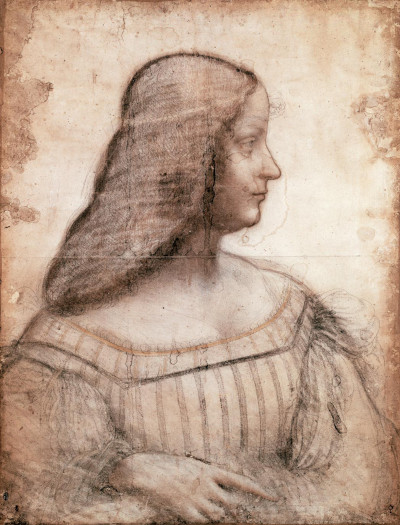
Portrait of Isabella d'Este
A source-backed portrait drawing page with a known search-image caveat.
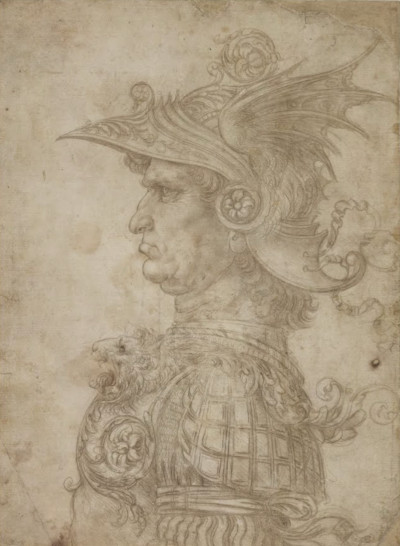
Profile of an Ancient Captain
The British Museum drawing page, kept within its object-record lane.
Head of a Woman (Turin)
A Turin head-study page with date and title variance kept visible.
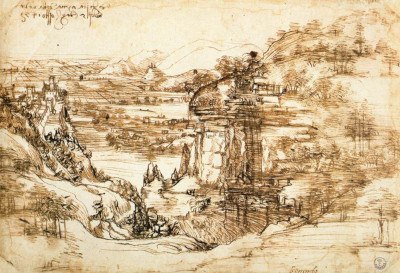
Landscape Drawing for Santa Maria della Neve
The Uffizi/Euploos drawing page for Leonardo's early landscape sheet.
Wreath of Laurel, Palm and Juniper
The NGA reverse-reading companion to Ginevra de' Benci.
Drawing as Leonardo's Working Language
Leonardo was trained as a painter, but drawing became one of his primary working languages. It let him break a subject apart and return to it from several directions. In a painting, the final surface can hide the decisions that came before it. In a drawing, the decisions often remain visible: first outlines, strengthened contours, corrections, repeated poses, notes, measurements and competing ideas on the same sheet.
That is why Leonardo's drawings can feel so alive. They are not always polished objects. Many are studies. Some were made for practical use in a workshop or notebook. Some record a problem rather than a solution. The viewer sees the motion of thought: a head turned slightly, a hand tested again, a wing reimagined, a landscape reduced to lines and tones, a body understood as structure.
Royal Collection Trust's material on Leonardo's anatomy drawings is especially useful for this broader point. Martin Clayton describes Leonardo's anatomical work as a sustained programme of investigation that moved beyond what a painter strictly needed [1]. Leonardo studied bones, muscles, nerves, organs and motion because he wanted to understand how bodies worked. Drawing was not decoration after the fact. It was part of the inquiry.
The same habit appears in his engineering drawings. A machine drawing can look like a plan for a finished object, but many of Leonardo’s designs survive as exploratory sheets, folios or later models based on manuscript evidence. The drawing is the core historical object; the later model is an interpretation.
Materials, Marks and the Problem of Visibility
Leonardo's drawings were made in different media and for different purposes. Metalpoint, chalk, pen and ink, wash, prepared paper, touches of colour and white heightening can all appear in the drawing story. Each medium changes how a sheet looks and how it ages.
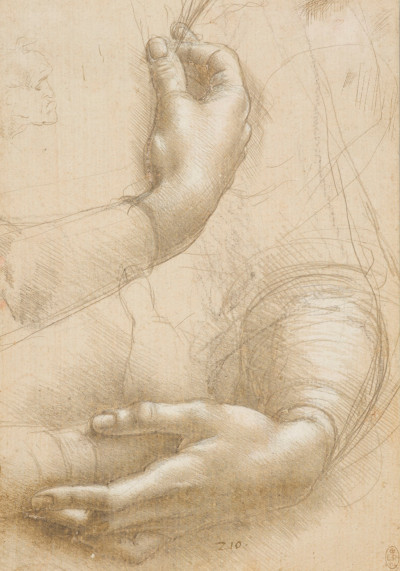
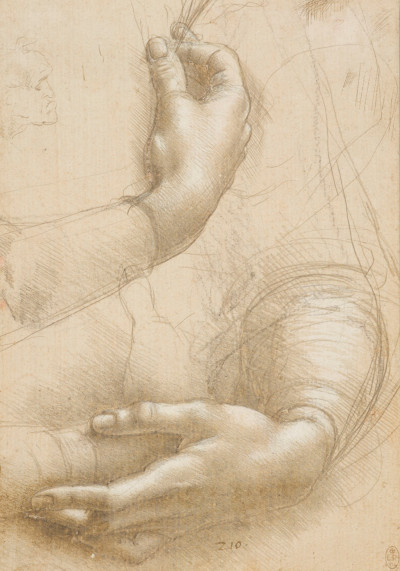
The Study of Hands page gives a clear example. Royal Collection Trust records the sheet as Studies of hands, c. 1480, RCIN 912615 [2]. It also explains that several Leonardo sheets in the Royal Collection appear nearly blank under normal light but reveal themselves under ultraviolet examination [2]. In this case, a drawing once described as heavily rubbed and almost invisible became legible through technical examination.
That story matters for the Drawings guide because it shows why a drawing is not simply an image on a screen. A sheet is a physical object. Its marks may fade. Its surface may change. Its history of visibility can affect how viewers understand it. A web reproduction may show a cleaned-up or technically enhanced view, while the object itself remains fragile, light-sensitive or difficult to see.
A museum page can make a drawing visible online without granting permission to reuse the image in every later context. Object facts and image-use claims remain separate.
Anatomy, Proportion and the Body
Leonardo's anatomical drawings are among the most powerful examples of drawing as investigation. Royal Collection Trust's anatomy essay describes two broad campaigns of anatomical research, around 1490 and between 1506 and 1513, and explains that Leonardo recorded his findings in many drawings and notes [1]. The material covers bones, muscles, organs, the nervous system, the heart and reproduction. It also shows Leonardo adapting visual methods that make complex three-dimensional structures easier to understand [1].
Anatomy needs careful handling here. There is no separate Anatomical Studies page in this set, so the Drawings guide treats anatomy as a major subject while linking only to existing pages such as Study of Hands, Vitruvian Man and The Battle of Anghiari.
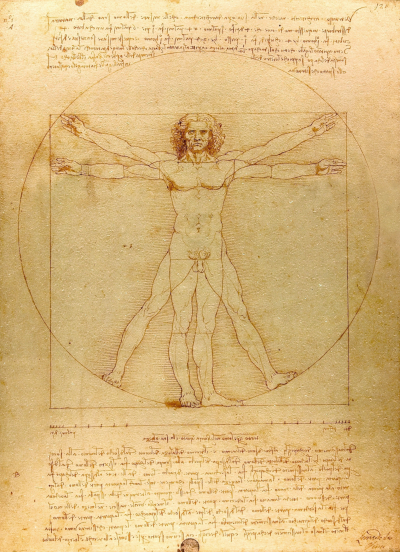
Vitruvian Man belongs beside anatomy but not inside it entirely. The Gallerie dell'Accademia record governs the drawing known as Studio di proporzioni del corpo noto come Uomo vitruviano [3]. The individual page treatment preserves the relationship with Vitruvius, Alberti, geometry and proportion, while also remembering that the drawing is a fragile object with display limits. It is a sheet about ideal relation, measurement and the body in space, not a generic symbol of "Renaissance genius" detached from its source record.
Together, Study of Hands and Vitruvian Man show two different kinds of bodily knowledge. One turns toward touch, fading marks and the close study of form. The other turns toward proportion, inscription and geometry. Both depend on drawing as a tool for thinking.
Landscape and the First Dated View
Leonardo's landscape drawings add another dimension to the guide. The Landscape Drawing for Santa Maria della Neve page is governed by the Uffizi/Euploos record for Paesaggio, inventory 8 P r. [4]. That record gives the sheet's institutional footing and describes its technique and material: pen and two types of iron-gall ink, leadpoint and traces of blind stylus on paper [4].
The landscape lane is narrow. It does not turn every background landscape in Leonardo’s paintings into a drawing claim. The Uffizi sheet matters because it is a named drawing with a stable institutional record, showing Leonardo responding to land, water, atmosphere and terrain through a graphic vocabulary different from the figure studies.
Landscape also helps readers see Leonardo's breadth. The drawings are not only about bodies and machines. They include places, views and natural structures. The eye that studies a hand or wing can also study a valley. The guide can use that contrast to show Leonardo moving between the human figure, the natural world and designed systems.
Cartoons and Preparatory Sheets
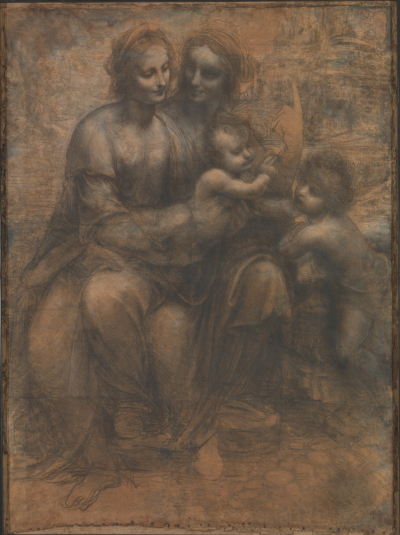
Some Leonardo drawings are best understood through painting practice. A cartoon can be a full-scale preparatory drawing, a working object that mediates between idea and finished painting. The National Gallery’s The Virgin and Child with Saint Anne and Saint John the Baptist governs the Burlington House Cartoon lane.[5] It remains distinct from the Louvre Virgin and Child with Saint Anne painting, even though the subjects are related.
The Portrait of Isabella d’Este is another essential preparatory lane. The Louvre collection record identifies the drawing as Portrait d’Isabelle d’Este, around 1499/1500, MI 753, Recto.[6] The Louvre record and graphic-arts catalogue describe its mixed materials and the evidence of pricking connected with transfer.[6] [7] The drawing can be read as both a portrait and a working object; it is not evidence that Leonardo completed the intended painting.
These works teach readers that drawing can stand between observation and execution. It can be beautiful in its own right, but it can also be part of a process: preparing, testing, transferring or leaving a project unresolved. Leonardo's drawings often preserve that middle state.
Portraits, Heads and Identity Cautions
Leonardo's drawings of heads and faces are easy to love because they feel direct. A profile, a young woman's head, or an aged face can seem to bring a person close. But identity and title must be handled carefully.
Profile of an Ancient Captain is governed by the British Museum record for museum number 1895,0915.474.[8] The British Museum describes the sheet as a bust of a warrior turned to the left, wearing a winged helmet and armour. The familiar captain language belongs to the page title and tradition; the object record controls the factual claim.
The Turin red-chalk self-portrait needs even more caution. It is best described as known as, traditionally identified as, or considered Leonardo's self-portrait. The sitter should not be treated as certainly Leonardo, and the drawing should not be presented as proof of Leonardo's appearance or of a mirror process unless a direct source is cited.
Head of a Woman (Turin) has its own object-title problem. The route title is a reader-facing bridge, while the object facts are governed through the Volto di fanciulla / Study for the Angel in the Virgin of the Rocks source spine and the 15572 D.C. controls. The sheet can be introduced as a head study connected to the Virgin of the Rocks tradition without flattening the evidence into a vague “Leonardo woman drawing.”
Portrait and head studies are therefore a test of tone. The writing can be inviting without becoming overconfident: precise, modest and useful is the right balance.
Horses, Animals and Movement
Leonardo's drawings of animals belong naturally on the Drawings guide because they show his interest in movement as much as appearance. He did not study horses only as decorative additions to paintings. He studied them as bodies in motion, as structures of bone and muscle, and as subjects whose force could help him imagine battle, sculpture and narrative action.
Royal Collection Trust’s record for Studies of horses and horses’ heads, RCIN 912285, gives one stable lane for this material.[10] The object record anchors the horse-study discussion to an exact sheet rather than to a vague idea of Leonardo as a universal animal observer.
Another Royal Collection Trust sheet, Horses, St George fighting the Dragon, and a lion, RCIN 912331, gives a different but related lane [11]. The record identifies a late sheet with studies of horses in motion, St George and the Dragon, and a lion, with black chalk, pen and ink, and wash on paper [11]. It also preserves the broader point that Leonardo was interested in animal movement, not just animal outline.
This material links several Leonardo families without merging them. Horse studies touch the Sforza monument project, battle imagery, animal observation and sculpture-related thinking, but they do not settle the separate Horse and Rider or Sculptures questions.
The animal material also helps explain Leonardo's method. He often treated living things as systems of motion. A horse rearing, a dragon twisting, a lion crouching or a bird's wing beating could become part of the same inquiry into movement. That is one reason his drawings can feel so dynamic even when they are small.
The Red-Chalk Self-Portrait Problem
The drawing traditionally called Leonardo's self-portrait is famous enough to distort the whole drawings story if it is handled carelessly. A bearded head in red chalk can easily become a shorthand for Leonardo himself. It appears in books, exhibitions, posters and public memory as the old master looking back at us. But the public page must keep the identity question cautious.
The individual drawing is best described with terms such as known as, traditionally identified as, or considered his self-portrait. Musei Reali's public self-portrait page provides useful institutional context for the drawing's history and modern reception [12]. That context supports tradition and reception, not documentary proof of Leonardo's face.
That distinction is not pedantic. Portrait identity affects how readers interpret the whole sheet. If the drawing is presented as certainly Leonardo, every feature becomes biographical evidence: the beard, the gaze, the age, the expression. If the identity is presented cautiously, the drawing can still be important without becoming a false photograph of the artist. It remains part of Leonardo's reception, his legend and the history of how later viewers have imagined him.
The same caution applies to mirror claims and appearance claims. Without a direct source, the Turin red-chalk drawing is not proof that Leonardo drew himself in a mirror, proof of exactly how he looked, or a secure psychological self-image. Its fame and its traditional identification both need to be visible.
Lost Works and Copy Traditions
Drawings are sometimes the best surviving evidence for works that are lost, unfinished or known through copies. The Battle of Anghiari and Leda and the Swan both belong in this lane.
The Battle of Anghiari keeps Leonardo's lost mural, preparatory studies and later copy tradition separate. Royal Collection Trust's anatomy essay is useful here because it connects the Anghiari project with Leonardo's renewed study of bodies in action [1].
Leda and the Swan should be handled in a similar spirit. The public page does not present a surviving Leonardo painting. It explains a lost project known through drawings, versions and later copies. On the Drawings guide, Leda belongs as an example of how drawings and copy traditions preserve an absent work, not as a simple catalogue entry for a surviving autograph.
This is one of the most important jobs of the Drawings page. It can teach readers that absence is not failure. A lost painting can still leave a historical footprint through preparatory drawings, copies and written records. But those forms of evidence must not be confused.
Engineering, Codices and Designs
Leonardo's engineering drawings now have several linked subjects: Flying Machine, Ornithopter, Helicopter, Parachute, Diving Suit, Crossbow and Machine Gun. They are also connected with the broader Inventions guide, where folio evidence remains distinct from claims about built machines.
The Ambrosiana’s Codex Atlanticus page is a central source family for this material.[9] The codex preserves a vast range of Leonardo’s notes, drawings and designs, but each engineering claim still depends on the relevant folio or model evidence.
The accepted engineering pages repeatedly draw the same line. Helicopter is a reader-facing title bridge for the Aerial Screw, not proof that Leonardo invented the modern helicopter. Parachute and Diving Suit separate Codex Atlanticus folios from later models. Crossbow and Machine Gun distinguish drawings and museum models from built Renaissance weapons.
This engineering lane also helps the page avoid a narrow definition of drawing. A drawing is not only a study for a painting. It can be a design, a diagram, a thought experiment, a mechanical proposal or a record of a system. Leonardo's drawings move between art and engineering because he did not keep those activities in separate mental boxes.
Disputed and Caution-Led Material
Disputed material belongs in the guide only with clear labels. La Bella Principessa has a protected page, but the accepted Leonardo work keeps it held after balanced attribution, provenance and technical review. It is not presented here as a settled Leonardo drawing.
Other caution-led pages also stay out of confident catalogue claims. Horse and Rider, Mary Magdalene, Triple Barrel Cannon, Sculptures and Salvator Mundi all have different problems, but none should be promoted through an unqualified card or summary.
Uncertainty is part of the guide. Some sheets have direct institutional records and stable inventories. Some subjects survive through copies or preparatory studies. Some works are disputed. Some pages are preserved while evidence remains incomplete.
The tone is calm: what is secure, what is connected, what remains disputed, and where to read more.
How to Use This Drawings Catalogue
The Drawings guide works like a map. It does not need to say everything about every sheet; it helps readers choose their path.
Readers interested in the body can go to Vitruvian Man and Study of Hands. Readers interested in painting preparation can go to the Burlington House Cartoon or Portrait of Isabella d'Este. Readers interested in expressive heads can go to Profile of an Ancient Captain, Head of a Woman (Turin) or red-chalk self-portrait page. Readers interested in lost works can move toward The Battle of Anghiari and Leda and the Swan. Readers interested in machines can move to the Inventions guide and the engineering pages.
The medium itself is central. Leonardo’s drawings are not only illustrations attached to better-known paintings. They are evidence of process: how an artist studies, how a designer imagines, how a notebook preserves unfinished thought, how a fragile sheet changes over time, and how later institutions interpret what survives.
That is why this page matters in the cluster. It gives structure to a scattered but essential part of Leonardo's legacy.
A Catalogue With Different Levels of Certainty
The page does not arrange every drawing as if the evidence were identical. A sheet with a direct museum object record, stable inventory number and accepted title sits differently from a drawing known through a broader source family, a lost-work tradition or a disputed attribution.
One practical way to do that is to organise the later catalogue by evidence type. Stable named sheets can form the core: Vitruvian Man, Study of Hands, the Burlington House Cartoon, Portrait of Isabella d'Este, Landscape Drawing for Santa Maria della Neve, Profile of an Ancient Captain, Head of a Woman (Turin) and the red-chalk sheet traditionally identified as a self-portrait. Each of those can be linked to a dedicated page or to a clearly described source context.
Lost-work and copy-tradition material has its own character. The Battle of Anghiari and Leda and the Swan are not ordinary surviving-object entries. They belong to a world of preparatory drawings, copies, descriptions and later reconstruction of intent.
Engineering and codex material forms another lane. It belongs to the Drawings guide because the evidence is fundamentally graphic: folios, diagrams, manuscript designs and later model interpretations. A flight study or military-machine design is still part of Leonardo’s drawing practice, but it is not proof of a working device.
Disputed and caution-led material does not blur the catalogue. La Bella Principessa, for example, can be acknowledged as part of Leonardo discourse without being presented as a secure Leonardo sheet.
This kind of catalogue structure gives the reader confidence. It says, in effect: Leonardo's drawing world is large, but it is not a heap. Some paths lead to stable object records. Some lead to notebooks and codices. Some lead to lost works. Some lead to disputed attributions. The page's job is to keep those paths visible.
The Relationship Between Drawings and Paintings
The Drawings guide also helps readers move between Leonardo's works without implying that every drawing is preparatory for a known painting. Some drawings are directly connected with painting projects. The Burlington House Cartoon is a major example because it belongs to the cartoon tradition and relates closely to Leonardo's wider Saint Anne inventions [5]. Portrait of Isabella d'Este also belongs to the problem of an unrealised or uncompleted painted portrait [6] [7].
Other drawings are more independent. Vitruvian Man is not a preparatory study for a painting. Study of Hands matters partly because it reveals technical and observational processes rather than serving only as a direct painting study [2]. A landscape drawing may illuminate Leonardo's eye for terrain and atmosphere without being reducible to one background. Engineering diagrams may share habits of observation with painting, but they have their own mechanical purpose.
That mixture is why the Drawings guide links both to Paintings and to Inventions, without collapsing into either. The drawings sit between them. They show how Leonardo moved from looking to making, from an observed form to an imagined system, from a bodily pose to a composition, from a note to a visual argument.
The page avoids a simple “drawings behind the masterpieces” structure. That would make the drawings subordinate. A stronger structure treats them as works, tools and documents at the same time.
That balance is the guide's real value. It can make Leonardo's paintings easier to understand while also giving the drawings their own dignity.
Why Leonardo's Drawings Still Matter
Leonardo's drawings still matter because they show a mind in motion. They let us see him thinking through line, tone, measurement, repetition and correction. They connect his art to his science, his engineering to his observation, and his imagination to the physical world.
The paintings often carry the fame. The drawings often carry the process. They show Leonardo before the final statement: testing an arm, studying a skull, diagramming a machine, imagining a battle, recording a landscape, tracing a profile or measuring a body. They are where speculation and discipline meet.
Handled carefully, the Drawings guide can become one of the clearest pages in the Leonardo cluster. It can preserve the excitement of the catalogue while lowering the temperature of doubtful claims. It can link readers to individual works without pretending that every sheet has the same evidentiary status. It can admire Leonardo without making him simpler than he was.
That balance is worth keeping. Leonardo's drawings do not need to be inflated into myths. Their real power is already there: the restless, searching line of someone trying to understand how the world is made.
Frequently Asked Questions
Discussion
Which Leonardo drawing lane helps you understand him best: anatomy, proportion, landscape, cartoons, portraits, lost works or engineering diagrams?
Reader Insights
How can a guide page keep named sheets, folios, cartoons and copy evidence distinct?
Where does cautious wording matter most: portraits, self-portrait tradition, lost works or disputed sheets?
How does knowing that some sheets are faded, restored or technically examined change your reading?
Join the Conversation
Share your reading of Leonardo's drawings below.
References
- Royal Collection Trust, Leonardo's Study of Anatomy, by Martin Clayton, accessed 30 July 2026.
- Royal Collection Trust, Studies of hands, RCIN 912615, accessed 30 July 2026.
- Gallerie dell'Accademia, Venice, Studio di proporzioni del corpo noto come Uomo vitruviano, accessed 30 July 2026.
- Progetto Euploos / Gallerie degli Uffizi, Scheda Catalogo "8 P r." - Paesaggio - di Leonardo da Vinci, accessed 30 July 2026.
- The National Gallery, London, The Virgin and Child with Saint Anne and Saint John the Baptist, NG6337, accessed 30 July 2026.
- Louvre Collections, Portrait d'Isabelle d'Este, MI 753, Recto, accessed 30 July 2026.
- Louvre Arts Graphiques, Portrait d'Isabelle d'Este, accessed 30 July 2026.
- The British Museum, drawing, museum number 1895,0915.474, accessed 30 July 2026.
- Veneranda Biblioteca Ambrosiana, Codex Atlanticus, accessed 30 July 2026.
- Royal Collection Trust, Studies of horses and horses' heads, RCIN 912285, accessed 30 July 2026.
- Royal Collection Trust, Horses, St George fighting the Dragon, and a lion, RCIN 912331, accessed 30 July 2026.
- Musei Reali Torino, Leonardo's Self-Portrait: history and contemporaneity of a masterpiece, accessed 30 July 2026.
 Leonardo da Vinci.jpg)
 Leonardo da Vinci.jpg)
