

 by Tom Gurney
Tom Gurney BSc (Hons) is an art history expert with over 20 years experience
Published on June 19, 2020 / Updated on August 2, 2026
Email: tomgurney1@gmail.com / Phone: +44 7429 011000
Lady with an Ermine by Leonardo da Vinci
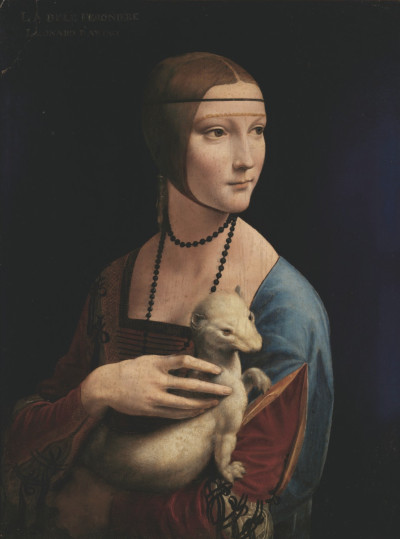
Leonardo da Vinci’s Lady with an Ermine shows Cecilia Gallerani turning with the animal in her arms. Her head, shoulders, hand and the ermine’s raised body form a controlled movement across the panel, giving the portrait an unusual sense of alertness.
The sitter is identified as Cecilia Gallerani, a celebrated young woman at the Milanese court of Ludovico Sforza. Leonardo probably painted her around 1490, when he was working in Milan and Cecilia was closely connected with its ruler. The ermine may refer to Ludovico, to Cecilia’s name, to traditional ideas of purity and honour, or to more than one of these meanings at once. The painting turns portraiture into a field where likeness, movement, status and private association meet.[1] [3]
Its present appearance also has a history. The black background is later overpaint, not Leonardo’s original setting. Scientific study indicates that the first background was dark grey with subtle tonal variation, while the inscription at the upper left belongs to a later misunderstanding of the sitter. The portrait is therefore both a remarkably preserved work by Leonardo and an object altered by centuries of ownership, travel and interpretation.[1] [2] [4]
At a Glance
- ArtistLeonardo da Vinci [1]
- TitleLady with an Ermine, also known as Portrait of Cecilia Gallerani [1]
- Datec. 1490 [1]
- MediumOil on walnut panel [4]
- DimensionsApproximately 54 × 39 cm [4]
- SitterCecilia Gallerani [1] [6]
- Object numberMNK XII-209 [1]
- CollectionNational Museum in Kraków [1]
- DisplayMNK Czartoryski Museum, Gallery 7 [7]
- Key physical changeThe original dark-grey background was later covered with black paint [2] [4]
Contents
- Introduction
- At a Glance
- A Portrait That Begins with a Turn
- Who Was Cecilia Gallerani?
- Leonardo in Ludovico Sforza’s Milan
- Looking at the Ermine
- What Does the Ermine Mean?
- The Altered Background
- From Italy to the Czartoryski Collection
- Place in Leonardo’s Portraiture
A Portrait That Begins with a Turn
The painting does not show Cecilia seated squarely before us. Her torso angles in one direction while her head turns farther, producing a spiral through shoulders, neck and face. The ermine repeats this action on a smaller, sharper scale. Its body lies diagonally across her, but its chest and head rise towards the same side as her gaze.
This coordinated turn creates the impression of a moment rather than a fixed pose. We can imagine that someone has approached, spoken or moved nearby, but the cause remains outside the frame. Leonardo supplies the response without the event. That omission matters: it gives the sitter an existence that seems to continue beyond the viewer’s access.
The National Museum in Kraków emphasises the novelty of the three-quarter presentation and the movement created by Cecilia’s attention to something outside the picture.[1] Portraits had long communicated identity and rank through profile, clothing and heraldic signs. Leonardo retains the social function of portraiture but makes recognition unfold through time. Cecilia is not merely available to be inspected; she appears to be perceiving.
The animal prevents the turn from becoming a simple gesture of the head. Cecilia’s arms must support a living body with its own weight and direction. The ermine’s alertness strengthens hers, while her hand steadies its forward movement. Figure and animal are neither still nor uncontrolled. Their balance gives the portrait its peculiar combination of composure and suspense.
Who Was Cecilia Gallerani?
Cecilia Gallerani was born around 1473 into a Milanese family. A notarised act of 7 May 1489 records her as about fifteen, placing her in her mid-teens at the period associated with the portrait.[6] She became closely connected with Ludovico Sforza, known as il Moro, the dominant political figure at the Milanese court and later Duke of Milan.
The museum identifies Cecilia as Ludovico’s mistress and states that she gave birth to their son Cesare in 1491. Ludovico married Beatrice d’Este in January of that year. Cecilia subsequently left the immediate court environment, married Ludovico Carminati de’ Brambilla, known as Count Bergamino, and settled at the Carmagnola palace.[1]
Those facts place the portrait within a relationship shaped by sharp differences in power, age and social position. They should not reduce Cecilia to a romantic role. Contemporary praise presented her as educated and accomplished. The museum describes her as a donna docta, a learned woman, and notes her reputation as a poet and intellectual presence, although her poems have not survived.[1]
The portrait does not show Cecilia with a book, a sheet of verse or a musical instrument. Instead, Leonardo presents intelligence through posture, controlled movement and alert expression. She appears mentally active without being reduced to a single readable mood.
This distinction is important because later stories about Renaissance courts can turn women into supporting characters in the lives of rulers and artists. Cecilia’s connection with Ludovico is essential to the commission and symbolism, but it is not her only historical identity. Her later household was known as a place of literary and learned exchange, extending the cultural reputation already associated with her youth.
Leonardo in Ludovico Sforza’s Milan
Leonardo had moved from Florence to Milan during the 1480s. By the end of that decade, he was working within the orbit of Ludovico Sforza, producing paintings, designs, entertainments and plans that joined art to courtly display. The National Gallery dates Leonardo’s entry into Ludovico’s service to about 1489 and places Lady with an Ermine among the portraits that transformed his Milanese career.[3]
Court portraiture served several purposes. It could preserve a likeness, advertise a marriage, honour a relationship, establish status or circulate an ideal image of the sitter. Cecilia’s portrait does not fit neatly into a single category. She was not Ludovico’s wife or a dynastic bride. The animal connects the painting with him, while the sitter’s identity and presence remain central.
The National Museum describes the portrait as made for Ludovico.[1] That is a strong institutional position, but the exact circumstances of ordering, first display and ownership are not documented in a surviving contract. It is therefore safer to say that Ludovico was probably the patron and that the painting belongs to the period of his relationship with Cecilia. The object’s meanings support this account more clearly than a detailed reconstruction of where it first hung or how it was presented.
Leonardo’s role at court helps explain why the portrait can work on several levels at once. It is an intimate likeness, an experiment in movement and light, and a compact symbolic performance. A viewer familiar with Cecilia and Ludovico could recognise references unavailable to a stranger. Yet the work does not depend entirely on private knowledge. Its alert turn remains compelling even when the history is unknown.
When Was Lady with an Ermine Painted?
The National Museum dates the painting to about 1490, while the National Gallery’s 2011–2012 exhibition used about 1488–1490.[1] [3] These ranges correspond with Cecilia’s adolescence, Leonardo’s court activity and Ludovico’s receipt of the Order of the Ermine in 1488.
Dating the portrait to a particular month or to a precisely defined stage in Cecilia’s relationship with Ludovico goes beyond the available evidence. The painting is often described as showing her at sixteen or seventeen; the 1489 notarial document records her as about fifteen.[1] [6] Approximate ages in Renaissance documents and later biographies do not produce an exact birthday or sitting date.
The broad conclusion is secure: Leonardo painted a young Cecilia in Milan near the end of the 1480s or around 1490. This was after Ginevra de’ Benci, his early Florentine portrait, and before later Milanese portraits such as La Belle Ferronnière. The sequence shows Leonardo returning to the problem of how a sitter might occupy space and suggest thought without relying on narrative action.
The Face and the Unseen Event
Cecilia’s face is turned towards the right side of the picture, but her eyes do not lock onto a point we can locate. The whites of the eyes are restrained, and the gaze remains calm rather than startled. Her lips are closed, with the slightest shift at the corners. Light passes across the forehead, nose, cheek and chin, while softer shadow shapes the opposite side.
The effect depends on withholding. Leonardo gives enough information to make Cecilia seem responsive but not enough to define the response. She could be listening, greeting someone or pausing during conversation. The painting refuses to select one story.
Her head appears more strongly turned than her torso. This difference sets the neck between opposing directions and makes the body feel capable of further movement. The outline from the cheek to the throat is delicate; the darker band of the necklace crosses beneath it and stabilises the composition.
The later black background intensifies the contrast around the face. Leonardo’s original grey field was also dark, but it contained variations of tone.[4] The present surface therefore exaggerates the isolation of the figure. Cecilia now seems to emerge from an almost absolute darkness, whereas the initial effect was probably more atmospheric and spatially modulated.
The Hand as a Second Portrait
Cecilia’s right hand is one of the painting’s most memorable passages. Its long fingers lie across the animal’s shoulder and chest, following rather than crushing the underlying form. The index finger extends along the ermine’s upper body; the smaller fingers descend in a measured rhythm. Light describes joints, tendons and knuckles without turning the hand into a separate anatomical display.
The hand carries social and emotional meaning because it joins care with control. Cecilia supports the animal, but she also restrains it. The ermine’s body leans forward while her fingers maintain contact. Their interaction suggests familiarity without becoming a domestic scene.
Leonardo coordinates the hand with the face. Both are pale, carefully modelled forms set against darker surroundings. Both register an action: the face turns, and the hand adjusts. Viewers move between them, reading expression above and touch below.
The relationship also complicates scale. The animal is large enough to fill Cecilia’s embrace, and its body passes across the broadest part of her torso. Her hand seems elegant partly because it is measured against fur, claws and muscular movement. The portrait does not isolate human grace from animal vitality; it creates each through the other.
Looking at the Ermine
The animal has a long neck, a pointed head, small rounded ears and a powerful front paw. Its fur is not rendered as a uniform white mass. Grey and brown shadows describe the chest, shoulder, foreleg and underside, while stronger light catches the upper surfaces. The head is more sharply defined than parts of the body, directing attention towards its eye and lifted muzzle.
The ermine’s anatomy is stylised. Leonardo was not making a zoological specimen sheet, and the animal’s scale and form have prompted debate over exactly what kind of mustelid served as a model. The title and institutional interpretation identify it as an ermine, which is the historically meaningful reading.[1] [3] That name does not require every painted feature to match a wild animal with scientific precision.
What matters visually is the parallel between animal and sitter. Both face the same direction. Both have a twisting body. Cecilia’s hand and the ermine’s front paw create two different kinds of articulation: long human fingers spread gently over fur, while the animal’s clawed foot grips and reaches.
The animal is not a decorative accessory added to an otherwise complete likeness. It changes the sitter’s posture, fills the lower half of the panel and establishes a second centre of attention. Remove it mentally and Cecilia’s arms no longer have a clear action. The portrait’s movement would collapse into a simple turn of the head.
What Does the Ermine Mean?
The ermine carries several plausible meanings, and their overlap is more important than choosing one as the final answer.
First, it points towards Ludovico Sforza. In 1488 he received the Order of the Ermine from the King of Naples and was associated with the name Ermellino Bianco, or White Ermine. Both the National Museum and the National Gallery treat the animal as an allusion to him.[1] [3] If Ludovico ordered the portrait, the creature could make the patron symbolically present beside Cecilia.
Second, the animal may play on Cecilia’s surname. The museum connects Gallerani with the Greek word galē, used for an ermine or weasel-like animal.[1] Renaissance court culture delighted in such verbal and visual associations. The creature could therefore refer simultaneously to the sitter and her patron.
Third, the ermine had traditional associations with purity and honour. The National Gallery notes that Leonardo himself wrote about the creature as a symbol of these qualities.[3] Such symbolism may seem paradoxical when attached to a woman in a relationship outside marriage, but courtly emblems did not function as literal moral verdicts. They praised, idealised and linked individuals through recognised signs.
The National Museum also records interpretations connecting the animal with intimacy and the possibility that Cecilia was pregnant.[1] This is an interpretive proposal, not a biological fact visible in the portrait. The date of conception cannot be read from Cecilia’s body or from the animal alone. The safer conclusion is that the ermine could carry associations relevant to her relationship with Ludovico without serving as a coded medical announcement.
These readings are compatible. An emblem of Ludovico can also make a pun on Gallerani and invoke an admired virtue. Leonardo’s courtly intelligence lay in allowing one form to sustain several associations. The animal is meaningful because it belongs to a network, not because it solves into a single message.
Dress, Hair and Courtly Identity
Cecilia’s clothing is elegant but controlled. A blue mantle crosses her shoulder and wraps around the lower figure. Beneath it, a reddish dress is edged and tied with dark ribbons. A dark beaded necklace forms a strong horizontal and then falls vertically down the chest, bringing order to the turning body.
Her hair is parted smoothly and drawn close to the head. A fine veil lies over it, held by a dark band across the forehead, while the gathered hair extends behind. These details place the sitter within Milanese court fashion without overwhelming the portrait with jewels or brocade.
Texture matters throughout. Light moves differently across skin, polished beads, fabric, hair and fur. The blue mantle has broad folds; the dress is tighter and more patterned; the veil is almost transparent. Leonardo builds social refinement through the coordination of surfaces rather than through a display of expensive objects.
The clothing also helps the body turn. Lines at the neckline and shoulder show the torso’s direction, while the mantle and animal create opposing diagonals. The portrait’s apparent spontaneity depends on this careful structure.
Light, Shadow and Three-Dimensional Form
The National Museum describes a single light source falling from above and to the right of the sitter.[1] That light does more than reveal Cecilia. It organises the pair into a shared volume. Bright areas connect her forehead, cheek, throat, hand and the upper fur; shadows gather beneath the jaw, between fingers and around the animal’s body.
This modelling is often called chiaroscuro: the use of light and dark to create form and dramatic focus. In Lady with an Ermine, it does not operate as a harsh spotlight. Transitions across skin are gradual, while stronger contrasts clarify the hand, ribbons and parts of the animal.
Light also establishes depth. Cecilia’s nearer hand comes forward because its pale upper surface contrasts with dark cloth and fur. The animal’s head projects because its muzzle is lit against the background. Her farther shoulder recedes through reduced contrast.
The later black background changes these relationships. It sharpens the silhouette and makes illuminated passages appear more theatrical. Scientific evidence for a dark grey original with slight variations suggests that Leonardo’s figure emerged from a subtly changing field, not a flat void.[4] The current painting still preserves his modelling, but the space around it has been simplified.
How Leonardo Built the Painting
The portrait is painted in oil on a walnut panel. Technical study led by specialists from the National Museum in Kraków identifies a palette including lead white, vermilion, iron-based earths, lead-tin yellow, copper-containing pigments and natural ultramarine.[4] These materials were layered and blended to distinguish flesh, textiles, beads and fur.
Oil paint allowed Leonardo to work with both opaque passages and thin glazes. A glaze is a translucent layer that modifies colour beneath it. In the flesh, lighter areas contain more opaque lead white, while tonal transitions could be developed with thinner iron-based layers.[4] The result is not a smooth surface everywhere but a controlled variation between edges, textures and depths.
X-radiography and infrared examination reveal that the visible image was reached through revision. Technical researchers found drawing lines around the sitter’s chest and clothing and differences between the radiographic structure and the final costume.[4] This evidence shows Leonardo adjusting the relationship between body and dress as he worked.
It does not justify every popular claim about hidden versions. In particular, the current museum-led technical synthesis does not establish a simple sequence in which the portrait first had no animal, then a grey animal and finally a white one. Claims of that kind depend on a separate imaging interpretation and should not replace the results reported by the painting’s custodians.
The technical evidence instead supports a more measured picture of invention. Leonardo prepared, drew, layered, altered and modelled. The portrait’s lifelike immediacy was produced through deliberation. Its apparent instant—a woman and animal turning together—is the endpoint of a material process.
The Altered Background
The background is the largest later change to Lady with an Ermine. It was covered with black paint, probably before the work entered the Czartoryski collection. Small gaps near the figure preserve indications of the earlier field, and scientific analysis has helped distinguish Leonardo’s material from the overpaint.[2] [4]
Researchers once proposed that the original background might have included a window or landscape. The 2024 technical synthesis does not support that reconstruction. Elemental analysis found a dark grey ground with slight tonal changes and no copper-based pigment pattern confirming a hidden blue or green landscape.[4]
This finding replaces one kind of mystery with another. We cannot reconstruct every gradation of the initial surface, but we can describe its character: dark, modulated and more spatially active than the black layer now visible. Cecilia and the ermine would still have emerged from shadow, though their outlines may have felt less cut out.
The later overpaint is part of the object’s history, even when it obscures Leonardo’s intention. Removing it would be a major conservation decision involving risk and uncertainty. The painting is cared for by the conservation studio of the Princes Czartoryski Museum, which monitors its condition and has supervised its loans.[4] Understanding the change does not mean that it can or should be reversed.
Inscription, Misidentification and Sitter Evidence
An inscription at the upper left names “La Belle Ferronière” and Leonardo in an altered spelling. It is not Leonardo’s title or signature. It reflects an early Czartoryski-era belief that the woman was connected with Francis I of France.[2] [4]
The mistaken name became entangled with another portrait by Leonardo now in the Louvre and known as La Belle Ferronnière. The two works show how titles can migrate when a sitter’s identity is uncertain. A label added after a painting’s creation may shape centuries of interpretation without preserving original knowledge.
Cecilia’s identification emerged through archival research at the end of the nineteenth century. The National Museum points to correspondence between Cecilia and Isabella d’Este and to a sonnet by the court poet Bernardo Bellincioni.[1] Isabella’s request to borrow a portrait of Cecilia painted by Leonardo establishes that such a likeness existed and was known within courtly circles.
The identification is persuasive because image, documents and symbolism converge. The sitter’s apparent age fits Cecilia in the late 1480s. The ermine connects with Ludovico, with whom she was associated. The recorded Leonardo portrait provides an independent documentary anchor. No single feature carries the whole argument.
A Likeness Remembered and Shared
The correspondence with Isabella d’Este does more than help name the sitter. It shows that Cecilia’s portrait remained known after the immediate circumstances of its making had passed. Isabella, an important patron with a sustained interest in portraiture, wanted access to Leonardo’s likeness of Cecilia as a point of comparison.[1] The request places the painting within a courtly network where images could be remembered, discussed and temporarily exchanged.
That history changes how we understand the portrait’s intimacy. The work may have originated within Ludovico’s circle, but it was not necessarily destined to remain a private token visible to only two people. A painted likeness could move among households or be shown to selected visitors. Its value lay partly in making an absent person present and partly in demonstrating the painter’s ability.
Cecilia’s painted youth also acquired a different meaning over time. By the date of Isabella’s correspondence, the political and personal situation of the Milanese court had changed, and Cecilia had established another household. The image still showed her at the earlier moment. It separated likeness from ordinary time, preserving a particular conjunction of age, attention, dress and courtly association.
The portrait was therefore capable of being read in at least two ways. Those close to its origin could recognise references to Cecilia and Ludovico. Later viewers could admire Leonardo’s construction of a turning figure even as the sitter’s name faded from memory. The eventual “La Belle Ferronière” inscription demonstrates how fully documentary knowledge could be lost while admiration for the object survived.[2] [4]
This movement between recognition and forgetting is central to portrait history. A likeness begins with an individual, but its survival depends on owners, labels, inventories and stories. When those records break, visual details may be forced to carry identities they were never designed to prove alone. In Lady with an Ermine, the recovery of Cecilia’s name required the image to be reunited with archival evidence.
From Italy to the Czartoryski Collection
Adam Jerzy Czartoryski bought the painting in Italy around 1800 and gave it to his mother, Princess Izabela Czartoryska. From 1809 it was displayed in the Gothic House at Puławy, part of an early museum devoted to art, memory and Polish history.[1] [2] [4]
Political upheaval repeatedly displaced the collection. After the November Uprising of 1830–1831, the painting was evacuated and eventually taken to Paris, where it remained at the Hôtel Lambert. The Czartoryski Museum opened in Kraków in 1876, and the portrait was brought there in 1882.[2] [4]
During the First World War it was deposited in Dresden. In 1939, following the German invasion of Poland, it was seized by the Nazis. The painting passed through Berlin and occupied Kraków, where it was associated with the residence of Governor-General Hans Frank, before being moved again late in the war. It was recovered in Bavaria and returned to Kraków in 1946.[2] [4]
Each movement exposed a thin wooden panel to changes in temperature, humidity, handling and security. The museum-led technical study describes the work as in good condition and among Leonardo’s best-preserved paintings, but good preservation does not mean an absence of vulnerability.[4]
The wider Czartoryski collection became the property of the Polish State in 2016 and was transferred to the National Museum in Kraków under a 2017 agreement.[5] After the renovated Princes Czartoryski Museum reopened in December 2019, Lady with an Ermine returned to its permanent setting there.[4] The museum currently lists it on the second floor in Gallery 7.[7]
Place in Leonardo’s Portraiture
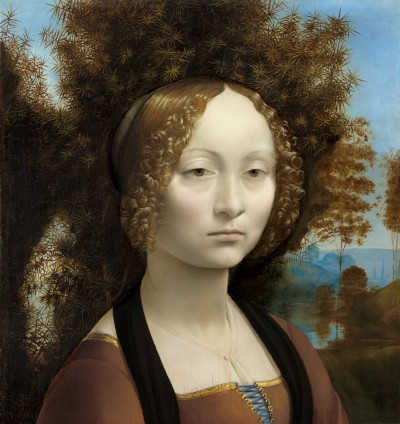
Leonardo’s surviving portraits are few, which makes differences between them especially revealing. Ginevra de’ Benci, painted earlier in Florence, sets a three-quarter sitter against juniper and a distant landscape. Lady with an Ermine removes the outdoor setting, gives the sitter a more extensive bodily turn and introduces an animal whose movement activates the entire lower composition.
In La Belle Ferronnière, painted later in Milan, the sitter faces the viewer with a more stable, monumental geometry. The Portrait of a Musician uses a turning male figure and an identifying attribute, but its authorship, finish and sitter questions create a different kind of historical problem. Together, these works show that Leonardo did not rely on one portrait formula.
The achievement of Lady with an Ermine is sometimes described through claims that it is the first “modern” psychological portrait. Such labels recognise its vitality but risk making a gradual history sound like a single invention. Three-quarter portraiture, animated poses and expressive likenesses had precedents. Leonardo’s distinction lies in how completely he coordinated them.
Cecilia’s turn is bodily, optical and social. The animal turns with her. Light travels across both. Symbols connect sitter and patron without erasing the sitter’s independence. The work feels psychologically alive because it gives us evidence of attention while withholding its cause.
That balance distinguishes the portrait from an anecdote. We know something about Cecilia’s situation, yet the painting cannot be reduced to a secret court romance. We recognise the ermine’s associations, yet no one meaning exhausts it. We see an instant, yet it was built through layers, revisions and technical control.
Artist Up Close: Follow the Movement
Begin at Cecilia’s left shoulder, where the blue mantle forms a broad curve. Move across the neckline to the dark necklace. Its horizontal strand stabilises the torso before the vertical beads draw the eye downward.
Now follow the head. The chin and nose point towards the right edge, while the eyes continue the movement beyond the panel. Notice that the expression is not surprised. Leonardo makes the turn active without opening the mouth or widening the eyes.
Drop to the hand. Trace the index finger along the ermine’s shoulder, then compare the intervals between the other fingers. The hand is not resting on a flat surface; it responds to the animal’s rounded body.
Continue through the ermine. Its torso crosses Cecilia’s, its foreleg descends, and its head rises. The animal repeats her turn but makes it more urgent. Compare its dark eye with hers: both look in the same general direction, but each belongs to a different kind of awareness.
Finally, examine the boundary with the background. The present black creates a sharp silhouette around veil, cheek, hand and fur. Imagine that boundary softened by Leonardo’s original dark-grey variations. This last step separates what survives from what technical research tells us has changed.
Frequently Asked Questions
Discussion
Use this space to discuss Lady with an Ermine by Leonardo da Vinci, its source evidence and how it fits into Leonardo da Vinci's wider cluster.
Keep comments focused on close looking, attribution language, object evidence and page-specific caveats.
Reader Insights
Which detail on this page most changes how you read the work?
How does this page connect to Leonardo's paintings, drawings, inventions or workshop context?
Where should the wording stay cautious because the source evidence is qualified?
Join the Conversation
Share your reading of Lady with an Ermine by Leonardo da Vinci below.
References
- National Museum in Kraków, “Lady with an Ermine”, accessed 28 July 2026.
- National Museum in Kraków, “Lady with an Ermine — Portrait of Cecilia Gallerani”, accessed 28 July 2026.
- National Gallery, London, “Leonardo da Vinci: Painter at the Court of Milan”, accessed 28 July 2026.
- Julio M. del Hoyo-Meléndez et al., “The Lady with an Ermine — Portrait of Cecilia Gallerani: Research into Leonardo da Vinci’s Painting Materials and Techniques”, accessed 28 July 2026.
- National Museum in Kraków, “Collections Department of the MNK Czartoryski Museum”, accessed 28 July 2026.
- State Archives of Milan, “III.7 Cecilia Gallerani”, accessed 28 July 2026.
- National Museum in Kraków, “Frequently Asked Questions”, accessed 28 July 2026.