

Parachute
Leonardo da Vinci's Parachute belongs to his studies of air, descent and artificial flight. The evidence is not a story of Leonardo building, testing or flying with a parachute. It is a story of a drawing, a written design idea, later museum models and the long afterlife of Leonardo's thinking about how a falling body might be slowed.
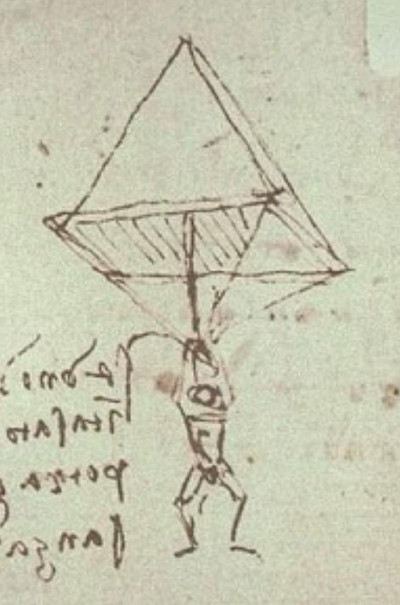
The safest source spine begins with Codex Atlanticus, f. 1058 verso, presented by Google Arts and Culture with the Veneranda Biblioteca Ambrosiana. That record identifies Leonardo as the creator, dates the sheet to c. 1487-1490, and describes it as a pen-and-ink drawing on paper concerned with aerodynamics and artificial flight [1]. It also gives the key page fact: the upper part of the sheet includes a parachute, while the lower part includes drawings of a mechanical wing [1].
The later model evidence belongs to a separate lane. Museo Nazionale Scienza e Tecnologia Leonardo da Vinci presents a 1953 Parachute model, inventory n.423, made by Alberto Mario Soldatini and Vittorio Somenzi [2]. The model helps readers understand the design, but it is not Leonardo's own object.
At a Glance
- TitleParachute
- CategoryFlight-design manuscript and model interpretation
- Governing folio sourceCodex Atlanticus, f. 1058 verso
- CreatorLeonardo da Vinci
- Folio datec. 1487-1490
- Governing model sourceMuseo Scienza Parachute, 1953 model, inventory n.423
- Design formQuadrangular-pyramid parachute
- ScaleBase and height about 7 metres
- Evidence limitNo evidence Leonardo built, tested, flew or proved a working parachute
- Imageillustrative design image; not proof of a Leonardo-built parachute
Contents
- The Codex Atlanticus Sheet
- What the Design Looks Like
- Air as Resistance
- The 1953 Museo Scienza Model
- Other Model Records
- The Anonymous Comparison
- Modern Tests and What They Can Prove
- Why the Parachute Matters
The Codex Atlanticus Sheet
The sheet comes before the legend. The Ambrosiana / Google Arts and Culture source identifies Codex Atlanticus, f. 1058 verso as a drawing by Leonardo, dated c. 1487-1490, in pen and ink on paper [1]. Its subject is not only the parachute. The record describes the sheet as containing studies on aerodynamics and artificial flight, with the parachute in the upper part and a mechanical wing below [1].
That matters because it places the parachute inside Leonardo's broader study of air. It was not an isolated curiosity. It sat near problems of resistance, mechanical wings and controlled motion. The cited source record does not support detailed reconstruction from uncited transcription, modern aerodynamic calculation or performance testing.
What the Design Looks Like
Museo Scienza gives the clearest institutional description of the parachute form. It presents a quadrangular-pyramid parachute concept and explains that the base and height are about 7 metres [2]. The design is not a round modern parachute. It is a pyramidal canopy, closer in outline to a tent or four-sided frame than to the fabric domes most readers imagine.
Museo Scienza also explains the physical idea through a broad, starched cloth surface and compressed-air resistance [2]. The same source notes that Leonardo's drawing includes a human figure, but that the figure's proportions do not match the written dimensions [2]. That caveat prevents the sketch from being treated as a precise construction drawing.
Air as Resistance
Leonardo's parachute belongs to a broader habit of thinking about air as a material problem. Museo Scienza frames the idea around compressed air, resistance and support [2]. The Ambrosiana flight-study context also places f. 1058 verso within Leonardo's changing study of flight and cautions against mythic simplification [3].
For Parachute, the relevant idea is descent. A broad, shaped surface could slow a body's fall by meeting air. That is a serious and recognizably modern question, but the evidence remains Renaissance design evidence. Leonardo was exploring how surface, shape and air might be used in a descent device; he was not writing a modern parachuting manual.
The 1953 Museo Scienza Model
Museo Scienza's Parachute record translates the folio idea into museum-model context. The object is a 1953 model, inventory n.423, made by Alberto Mario Soldatini and Vittorio Somenzi [2]. It is displayed in the Leonardo da Vinci Galleries, main building, floor 2 [2].
The model supplies useful practical detail: pyramid form, about-7-metre base and height, starched cloth, compressed-air resistance, the human-figure proportion problem and an anonymous Sienese comparison [2]. It remains a model, belonging to the twentieth-century interpretation and display history of Leonardo's design rather than to Leonardo's own workshop.
Other Model Records
The Science Museum Group and Museums Victoria records support the later model evidence, but neither governs the main folio story. The Science Museum Group record identifies a Model of Parachute of Leonardo da Vinci, object number 1929-926, in the aeronautics category [4].
Museums Victoria records a Parachute Model - Leonardo da Vinci Design, Italy, 1483, item ST 23602 [5]. Its page identifies the object as a model built by the Museum for a 1953 exhibition marking the fiftieth anniversary of flight, gives dimensions of 260 by 260 by 245 millimetres, and records the item as currently in storage [5]. A model title that uses a date such as 1483 does not override the Ambrosiana / Google Arts and Culture folio date lane of c. 1487-1490 [1] [5].
The Anonymous Comparison
Museo Scienza notes a similar idea in a drawing by an anonymous Sienese engineer [2]. That comparison is worth mentioning, but it remains comparison context. It is not a Leonardo source and not evidence that Leonardo copied a specific design.
The image evidence remains explanatory. An illustration may help readers understand the design, but it is not proof that Leonardo built, tested or used a parachute.
Modern Tests and What They Can Prove
Modern-test claims belong in a separate evidence lane. Any discussion of a modern parachute test needs direct reliable sourcing and must state exactly what was tested: scale, materials, frame, descent conditions and safety systems.
The present source record does not claim Leonardo built, tested or proved a parachute. It records a manuscript design, later models and institutional interpretation. That is enough.
What to Notice First
Notice the shape first. Leonardo's parachute is not the round canopy most readers expect. It is a four-sided pyramidal form, described through a base and height of about 7 metres in the Museo Scienza interpretation [2].
Notice the air next. The idea depends on air pushing back against a broad surface. Then notice the sheet: the parachute appears on a Codex Atlanticus folio that also contains mechanical-wing drawings [1]. Finally, notice the models. They make the idea visible, but they are later interpretive objects.
Why the Parachute Matters
The Parachute matters because it shows Leonardo thinking about a problem that is both simple and profound: how can a falling body be slowed by air? A broad surface, a controlled shape and an understanding of resistance all come together in one compact idea.
It also matters because it shows the range of Leonardo's flight imagination. Many of his flight pages are about ascent: wings, beating mechanisms, rotating screws and human-powered machines. The parachute is different. It is about descent. It asks how air might be used not to rise, but to fall more safely.
Leonardo's parachute is compelling because it treats air as a workable physical problem. The drawing is imaginative, the idea is memorable and the later models are useful. The evidence does not need to be inflated into a hidden, fully tested modern technology.
Frequently Asked Questions
Discussion
Where does Leonardo's parachute become clearest: in the Codex Atlanticus sheet, the pyramid form, the museum model, or the no-test caveat?
Reader Insights
How does the later model change your reading of Leonardo's drawing?
What evidence would be needed before a modern-test claim belonged here?
Does the pyramid form change how you imagine the design?
Join the Conversation
Share your reading of Leonardo's Parachute below.
References
- Google Arts and Culture / Veneranda Biblioteca Ambrosiana, Atlantic Codex (Codex Atlanticus), f. 1058 verso, accessed 30 July 2026.
- Museo Nazionale Scienza e Tecnologia Leonardo da Vinci, Parachute, collection record, accessed 30 July 2026.
- Google Arts and Culture / Veneranda Biblioteca Ambrosiana, Codex Atlanticus - Studies on flight, accessed 30 July 2026.
- Science Museum Group Collection, Model of Parachute of Leonardo da Vinci, object record 1929-926, accessed 30 July 2026.
- Museums Victoria Collections, Parachute Model - Leonardo da Vinci Design, Italy, 1483, item ST 23602, accessed 30 July 2026.