

 by Tom Gurney
Tom Gurney BSc (Hons) is an art history expert with over 20 years experience
Published on June 19, 2020 / Updated on August 2, 2026
Email: tomgurney1@gmail.com / Phone: +44 7429 011000
Madonna Litta and the Leonardo Attribution Question
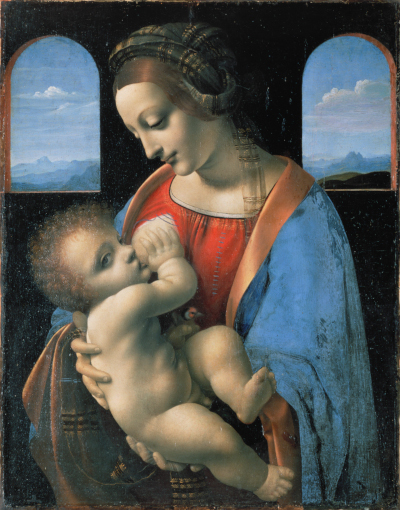
Madonna Litta is an attribution-sensitive painting attached to Leonardo da Vinci's Milanese years. The State Hermitage Museum presents the work in its digital collection under Leonardo's name, with the title Madonna and Child (Madonna Litta), dating it to the mid-1490s and recording it as tempera on canvas transferred from wood [1].
Other institutional sources make clear that the picture belongs to a complicated Leonardo-circle problem rather than to a simple story of unqualified solo authorship. The Louvre, discussing Andrea Solario's related Virgin and Child, describes the Hermitage painting as probably conceived by Leonardo but painted by one of his pupils, possibly Marco d'Oggiono [2].
That tension should be kept visible. Madonna Litta matters because it stands at the meeting point of invention, workshop practice, devotion and later reputation. It is not useful to treat it as either an uncomplicated masterpiece by Leonardo alone or as a mere copy with no relation to him. The safer reading is more interesting: a small, intensely focused Madonna and Child image whose composition belongs to Leonardo's orbit, whose object record is governed by the Hermitage, and whose authorship has to be explained with care.
The painting shows the Virgin Mary breastfeeding the Christ Child. Mary is shown in profile, seated before a dark interior with arched windows opening toward a pale landscape. The Child turns outward while still attached to the intimate act of nursing. His body is active, his gaze alert, and his small hand grips a goldfinch. The scale is modest, but the emotional pressure is high. The image turns a familiar devotional subject into a concentrated study of contact: mother and child, flesh and fabric, interior and world, human tenderness and sacred meaning.
At a Glance
- Evidence basisHermitage presents the work under Leonardo da Vinci's name; attribution/execution remains qualified
- WorkMadonna Litta
- Source titleMadonna and Child (Madonna Litta)
- DateMid-1490s
- Medium and supportTempera on canvas transferred from wood/panel
- Dimensions42 × 33 cm
- CollectionState Hermitage Museum
- InventoryГЭ-249
- AcquisitionEntered the Hermitage in 1865 from Antonio Litta's Milan collection
- Page focusMadonna and Child iconography, Leonardo's Milanese circle, attribution caution and workshop transmission
Contents
- Introduction
- Object Facts and Hermitage Context
- A Nursing Madonna
- Leonardo's Milanese Circle
- Composition and Close Reading
- Copies, Followers and the Spread of the Design
- Provenance and Name
- How to Talk About Attribution
- What to Notice First
- Why Madonna Litta Matters
Object Facts and Hermitage Context
The Hermitage record supplies the central object spine for the page. It identifies the work as Madonna and Child (Madonna Litta), by Leonardo da Vinci, from the Florentine school, made in Italy in the mid-1490s [1]. The painting measures 42 by 33 centimetres and is listed as tempera on canvas transferred from wood [1]. Its inventory number is ГЭ-249, and the Hermitage records that it entered the museum in 1865 after being acquired from Antonio Litta's collection in Milan [1].
The name Madonna Litta therefore comes from provenance as much as subject. The picture was associated with the Litta family collection before entering the Hermitage, and the name has remained attached to it. That history matters because the title does not describe a special episode in the life of Mary. It describes a familiar devotional type, the nursing Madonna, through the ownership history that made this particular image famous.
The transfer from wood to canvas is also important. It means that the painting's present support is not the same as the original panel support recorded in the older physical history of the work. Without a dedicated technical source, the transfer should be treated as a material fact rather than a melodramatic conservation story. The painting reaches modern viewers through a layered history: a Renaissance image, a later collection history, a transfer, and a museum record that preserves both the object and the questions around it.
The Hermitage object record is strong enough to govern the basic facts of title, date, material, dimensions, inventory and acquisition. It is not enough, by itself, to erase all attribution caution. That is why the page needs both the Hermitage record and the balancing institutional sources that describe the painting in the context of Leonardo's pupils and followers.
A Nursing Madonna
The subject is the Virgin nursing Christ, often called the Madonna lactans. In this kind of image, Mary's body is not distant or abstract. Her motherhood is physical. The Christ Child is not only the divine infant but a dependent child held at the breast. The subject makes the Incarnation tangible: the divine enters the world through birth, hunger, touch and care.
Madonna Litta presents that theme with unusual restraint. Mary does not look out at the viewer. Her attention is lowered toward the Child, and her profile gives the composition a calm, almost sculptural silhouette. The Child, by contrast, turns outward. His body twists, his gaze opens, and the goldfinch introduces a symbolic note within the intimate scene.
The goldfinch is often associated with Christ's Passion because of later Christian symbolism linking the bird to thorns and blood. In this painting, it works subtly. The Child is still nursing, but the bird hints at the future that Christian viewers would know is coming. The image therefore holds two times together: infancy and sacrifice, domestic care and sacred destiny.
The windows behind Mary expand that structure. The room is quiet and enclosed, yet the arched openings lead toward landscape and light. Leonardo's art repeatedly uses thresholds like this. Interior darkness and distant landscape do not simply decorate the figures. They make the figures feel placed between worlds: the domestic room and the open distance, the human and the divine, the immediate body and the larger order of nature.
Leonardo's Milanese Circle
The painting belongs to the world of Leonardo's Milanese production. The date supplied by the Hermitage, the mid-1490s, places it near a period when Leonardo's inventions for sacred figures, portraiture and workshop transmission were especially influential [1]. This was not a modern studio in which one artist made every object alone and assistants merely watched. Designs, drawings, cartoons, partial execution, copies and variants could circulate through a master's orbit. That is why a painting can be closely tied to Leonardo without every visible passage being safely described as his own hand.
The Louvre's contextual record is valuable precisely because it states that problem clearly. In discussing Solario's Virgin and Child, the Louvre refers to the Hermitage Madonna Litta as a composition probably conceived by Leonardo but painted by one of his pupils, possibly Marco d'Oggiono [2]. The sentence links the invention to Leonardo while warning against treating the entire painted surface as settled autograph work.
This is where the painting becomes more than a small devotional image. It is a case study in how Leonardo's inventions moved through his circle. A composition could carry his authority, his visual intelligence and his name, while still raising questions about execution. For readers, that is not a weakness. It is part of the history of Renaissance art. Attribution is not only a label at the top of a museum page; it is an argument about design, touch, sources, copies, workshop practice and later collecting.
The familiar title remains useful because the Hermitage presents the object under Leonardo's name [1]. The attribution-sensitive evidence also belongs in the foreground: the Hermitage record gives the governing object facts, while the Louvre context keeps the Leonardo/workshop question open [1] [2].
Composition and Close Reading
The composition is built on a stable pyramid of forms. Mary's head, shoulders and arms create a protective enclosure around the Child, while the Child's twisting body disrupts the stillness just enough to make the scene alive. Her profile is severe and controlled. His movement is more immediate. The contrast between them gives the painting its emotional rhythm.
Mary's clothing intensifies that rhythm. The folds are broad and strong, and the contrast between red and blue helps separate body, garment and sacred identity. The opening of her dress is handled without embarrassment or display. It belongs to the subject. The nursing action is the centre of the image, but the painting keeps the mood quiet rather than sentimental.
The Child's pose is especially important. He is not a passive infant. He turns outward while still remaining physically joined to Mary. This creates a double address. The painting is about the intimate relation between mother and child, but the Child also looks into the viewer's world. He is both held and revealed.
The goldfinch adds another layer. It is small, but it changes the tone of the scene. Without it, the picture might read primarily as domestic tenderness. With it, the image becomes more explicitly devotional. The future Passion is folded into the present infancy. The Child's hand, the bird and the breast all become part of one network of meaning: nourishment, sacrifice and redemption.
The background is spare but not empty. The paired arched windows frame fragments of distance. They give the small picture a sense of breath. The room is dark, the figures are close, yet the world beyond remains visible. This balance between enclosure and distance is one reason the composition has been so powerful for later viewers and copyists.
Copies, Followers and the Spread of the Design
The National Gallery's The Virgin and Child, attributed to a follower of Leonardo, helps show how the Madonna Litta design circulated [3]. The National Gallery describes its painting as closely based on the Hermitage Madonna Litta and places it within the world of Leonardo's followers [3]. That makes the London picture useful as reception evidence. It shows that the composition did not remain isolated. It became a model.
This does not mean the National Gallery picture proves the authorship of the Hermitage painting. It does something different. It shows the prestige and transmissibility of the composition. Artists around Leonardo and after Leonardo could adapt, repeat or respond to his figure inventions. The existence of such copies and related works is one reason the authorship of a famous composition may remain layered: design, execution and later repetition do not always belong to the same hand.
The Louvre Solario record adds another context. Solario's Virgin and Child, known as The Virgin of the Green Cushion, is not the Hermitage Madonna Litta, but the Louvre discusses it in relation to Leonardo's circle and to the Hermitage painting [2]. This helps place Madonna Litta within a wider field of nursing Madonna imagery in Milanese art. The subject was not a single isolated solution. It was a theme through which artists explored intimacy, theology and the inheritance of Leonardo's inventions.
The British Museum drawing record provides a further, more cautious support lane [4]. The record concerns Leonardo drawings of the Virgin and Child and includes curator-comment literature connecting one faint lead-point study plausibly to the Hermitage Madonna Litta [4]. That relationship should be used carefully. It is not a licence to claim that a drawing proves the painting's full execution by Leonardo. It is better to say that drawings and related studies show how the motif can be studied within Leonardo's design practice and later scholarly debate.
Provenance and Name
The painting's modern name points back to the Litta collection. The Hermitage records that the work entered the museum in 1865 and was acquired from Antonio Litta's collection in Milan [1]. That provenance gives the painting one of those compact museum names that can feel like a proper title even though it is partly a collecting label.
This is useful for readers. Madonna Litta sounds like a person, but it is not the name of Mary or the Child. It is the name by which this particular Madonna-and-Child painting became known through ownership and museum history. Explaining that helps separate subject, title and provenance.
The provenance also reinforces the Milanese context. The painting was acquired from a Milanese collection, and its artistic problem belongs to Leonardo's Milanese orbit. This does not by itself settle authorship, but it fits the broader pattern: a design associated with Leonardo, a painting preserved under his name in the Hermitage, and other institutions that read the composition through pupils, followers and copies.
How to Talk About Attribution
Madonna Litta has to be read through two institutional statements. The Hermitage record presents the object as Leonardo da Vinci's Madonna and Child (Madonna Litta) and supplies the governing object facts [1]. The Louvre's institutional context says the Hermitage composition was probably conceived by Leonardo but painted by a pupil, possibly Marco d'Oggiono [2].
Those statements are not identical. The painting can be introduced through its traditional and museum association with Leonardo, while its execution and workshop role remain qualified in the body of the evidence.
Workshop does not mean worthless, and attribution-sensitive does not mean irrelevant to Leonardo. Renaissance workshops were places where invention and execution could be distributed. A composition probably conceived by Leonardo would still be closely connected to his artistic imagination even if a pupil painted much or all of the surface.
The painting is strongest when both sides of that evidence remain visible: its Hermitage identity and Leonardo association, and the workshop question raised by related institutional sources. Madonna Litta is powerful both as a devotional image and as evidence for how Leonardo's ideas moved through his circle.
What to Notice First
A good first reading of Madonna Litta should begin with the relation between closeness and reserve. The figures are physically joined through nursing, yet Mary remains contained within a profile pose. She is not theatrical. She does not gesture outward. Her body creates shelter, and her lowered gaze keeps the scene inward. The Child brings the viewer back out again. He turns, looks and holds the bird. The painting's emotional life depends on that contrast.
The small scale matters here. At 42 by 33 centimetres, the work is not a monumental altarpiece [1]. It invites close looking. The subject is intimate, and the object itself asks to be read at an intimate distance. That scale also suits the kind of devotional use a Madonna-and-Child image could have outside the largest public church settings. The painting offers a concentrated image for looking, prayer and possession, not a grand public narrative.
The windows should not be skipped. They are quiet architectural devices, but they change the mood of the image. Without them, the figures would be enclosed in a dark room. With them, the viewer senses air, distance and a world beyond the mother and child. This is one of the places where the composition feels related to Leonardo's broader interest in atmosphere and spatial transition, even while the final execution remains an attribution question.
The material history also shapes the way the picture should be described. The Hermitage records the present work as tempera on canvas transferred from wood [1]. That phrase should remain in the page because it tells readers that the painting has not come down to us as a simple untouched panel. But it should not become a dramatic conservation claim unless later technical sources support more detail. For this article, the safe public point is narrower: the work has a transferred support, and that fact belongs among the object details.
Finally, the viewer should notice how the image carries Leonardo's reputation through a problem rather than around it. The Hermitage source presents the object under Leonardo's name, while the Louvre context opens the pupil/execution question [1] [2]. Those two source positions make the painting a useful teaching page. It shows that attribution is not a footnote after the beauty of the image. It is part of how the image has to be read.
Why Madonna Litta Matters
Madonna Litta matters because it gives readers a concise way into several important Leonardo questions. It belongs beside the Benois Madonna and Madonna of the Carnation as part of the site's broader Madonna-and-Child group. It also belongs beside The Virgin and Child with Saint Anne, where Leonardo's sacred family compositions become larger, more complex and more psychologically layered.
But Madonna Litta has its own role. It is smaller, more intimate and more directly focused on the act of nursing. It brings theology into the body. It asks the viewer to understand sacred meaning through care, dependency and touch. The Child is divine, but he is also hungry. Mary is the Mother of God, but she is also a mother feeding her child.
The attribution problem is part of the painting's importance. Leonardo's influence cannot always be measured by a simple yes-or-no label. Some works are central because they are securely by him; others because they show how his designs, ideas and prestige moved through drawings, pupils, copies and collections.
Within Leonardo's work, Madonna Litta is best understood as a standalone devotional image with a qualified attribution history. The Hermitage provides the object spine, the Louvre supplies attribution balance, the National Gallery adds copy and reception context, and the British Museum drawing evidence shows how the composition circulated around Leonardo's circle.
Frequently Asked Questions
Discussion
Use this space to discuss Madonna Litta, its source evidence and how it fits into Leonardo da Vinci's wider cluster.
Keep comments focused on close looking, attribution language, object evidence and page-specific caveats.
Reader Insights
Which detail on this page most changes how you read the work?
How does this page connect to Leonardo's paintings, drawings, inventions or workshop context?
Where should the wording stay cautious because the source evidence is qualified?
Join the Conversation
Share your reading of Madonna Litta below.
References
- State Hermitage Museum, Madonna and Child (Madonna Litta), digital collection record 29633. https://hermitagemuseum.org/digital-collection/29633
- Louvre Collections, Andrea Solario, La Vierge allaitant l'Enfant, dit La Vierge au coussin vert, INV 673; MR 484. https://collections.louvre.fr/en/ark:/53355/cl010060911
- National Gallery, London, Follower of Leonardo da Vinci, The Virgin and Child, NG1300. https://www.nationalgallery.org.uk/paintings/follower-of-leonardo-da-vinci-the-virgin-and-child
- British Museum, The Virgin and Child, drawing record 1860,0616.100. https://www.britishmuseum.org/collection/object/P_1860-0616-100