

 by Tom Gurney
Tom Gurney BSc (Hons) is an art history expert with over 20 years experience
Published on June 19, 2020 / Updated on July 19, 2026
Email: tomgurney1@gmail.com / Phone: +44 7429 011000
A Gust of Wind by John Singer Sargent: Introduction
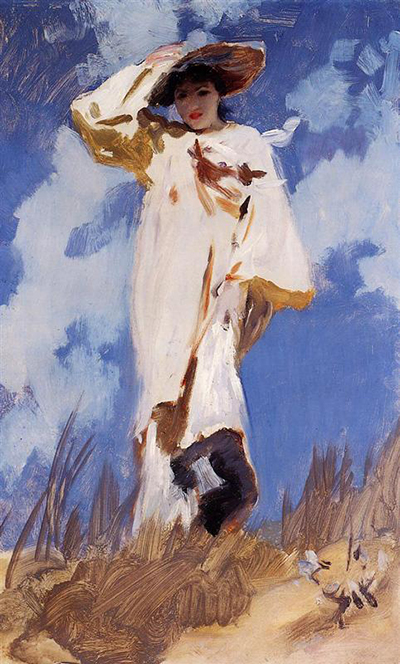
John Singer Sargent's A Gust of Wind turns a passing disturbance into the subject of the picture. A figure associated in the identified museum trail with Judith Gautier is caught by moving air, so that clothing, posture, and atmosphere become the drama. The work belongs to the part of Sargent's art where portraiture, outdoor looking, travel subjects, and quick painterly decision meet.
The title is small but exact. A gust is not a climate, a landscape, or a stable setting. It is a brief event. Sargent's challenge was to make that event visible without freezing it into stiffness. The picture matters because it asks one of the central questions in his art: how can paint hold an instant and still make it feel alive?
That question connects A Gust of Wind to Sargent's wider career. His portraits made bodies socially present. His watercolors made light, paper, architecture, and travel feel mobile. His outdoor paintings looked for effects that could vanish while the artist was still trying to catch them. A Gust of Wind sits among those concerns. It is not only a likeness and not only an outdoor scene. It is an image of motion made legible through a body.
Contents
- Introduction
- A Figure Caught By Weather
- Judith Gautier And The Portrait Question
- Paris, Exhibition Context And Early Ambition
- Wind, Motion And Controlled Freshness
- Travel Subjects And Outdoor Looking
- How To Look At A Gust Of Wind
- Related Works And Where To Go Next
A Figure Caught By Weather
The most important word in the title is "gust." It tells the viewer that the subject is not simply a woman, a costume, or a place. The subject is a sudden pressure moving through them. Wind has no body of its own, so the painter has to make it visible through effects: fabric pulled out of rest, posture adjusted against force, edges made lively, and the figure's relation to surrounding space slightly unsettled.
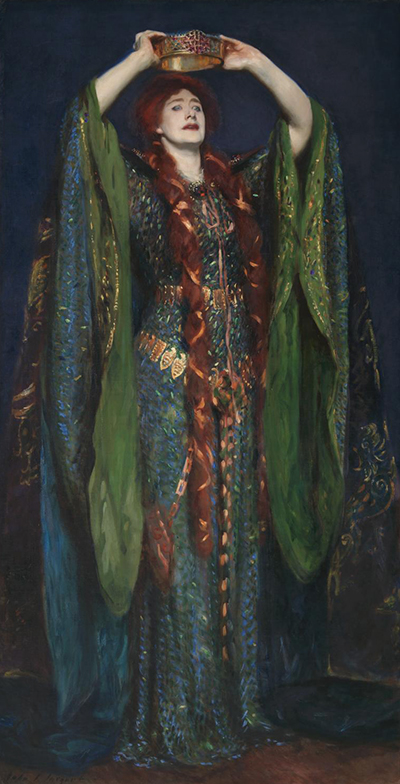
This makes A Gust of Wind a natural Sargent problem. He was a painter of bodies under pressure, though the pressure changes from work to work. In a society portrait, pressure may come from display, rank, beauty, or the demand to be seen. In a theatre portrait such as Ellen Terry as Lady Macbeth, it comes from costume and role. In Street in Venice, it comes from the act of moving through a narrow passage while others look on. In A Gust of Wind, the pressure is literal air, but it becomes pictorial and social as soon as it touches the figure.
The weather event also changes the status of clothing. Sargent was fascinated by costume and fabric, but here fabric is not merely decorative. It becomes the evidence of movement. A dress, wrap, scarf, sleeve, or loose edge can show what the invisible air is doing. This is why the title works so well. The viewer is asked to see wind by watching what wind disturbs.
That disturbance gives the image its charge. A calm portrait often depends on pose held over time. A gust interrupts pose. It catches the figure between self-command and reaction. Sargent does not need to narrate a full story. The brief event is enough: a body meets air, the arrangement shifts, and a moment that would ordinarily pass unnoticed becomes worthy of paint.
Judith Gautier And The Portrait Question
The Smithsonian Catalog of American Portraits trail connecting Judith Gautier and Sargent makes the work more than an anonymous weather subject [1]. It asks viewers to consider whether A Gust of Wind should be read as a portrait, a figure painting, an outdoor study, or some combination of those categories.
Sargent often worked precisely in that mixed territory. His portraits of artists, writers, actors, and friends could be freer than formal commissions. The Met and National Portrait Gallery exhibitions on Sargent's portraits of artists and friends emphasize that these works often allowed more experiment, intimacy, wit, and invention than conventional society portraiture [2], [3]. If Judith Gautier is the associated figure here, the picture belongs close to that larger field of creative and public personalities rather than to a simple list of commissioned likenesses.
At the same time, the title resists turning the figure into biography alone. It does not announce the subject only by name. It announces the event. That is significant. A named sitter would normally pull attention toward identity, reputation, and likeness. A Gust of Wind pulls attention toward motion. The person matters, but the visible drama is what happens to the person in air.
This balance is one reason Sargent's figure paintings can feel modern. He does not always choose between portrait and scene. A body can be particular without being fully explained. A sitter can be associated with a known name while the picture's meaning depends on gesture, weather, clothing, and setting rather than on biography. The result is not evasive. It is economical. Sargent gives the viewer enough identity to care about the figure and enough motion to prevent the image from settling into a static likeness.
Paris, Exhibition Context And Early Ambition
The Met's Sargent and Paris frame matters because Sargent's Paris years were the period in which his ambition, training, and public risk came into sharp focus [4]. He entered Carolus-Duran's atelier in the 1870s, learned direct painterly method, studied old masters, and sought recognition in a city where the Salon and exhibition culture could make a career visible [5], [6].
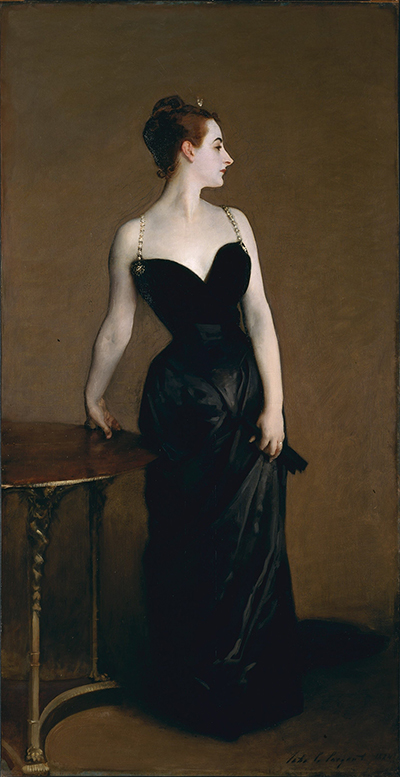
Paris also made Sargent alert to display. A picture was not only made in a studio; it entered rooms where viewers compared, judged, gossiped, admired, and misunderstood. That culture shaped the force of early works such as Dr. Pozzi at Home and Portrait of Madame X. A figure in Sargent's Paris world was never merely a private presence. It was a public image under scrutiny. [4]
A Gust of Wind should be seen against that pressure, even if the identified material does not supply every object detail. The work's inclusion in the Sargent and Paris exhibition context places it among the years when Sargent was testing how far figure painting could go: portrait, costume, modern style, outdoor light, and theatrical presence all belonged to his Paris-era vocabulary. [4]
Apollo's preview of the Musee d'Orsay presentation underscores the recent museum interest in these Paris years and notes Virginia Museum of Fine Arts lender context [7]. That setting is useful because it shows the work not as an isolated curiosity, but as part of a larger reassessment of Sargent's early formation. The Paris frame invites viewers to look for daring in seemingly brief subjects: a windblown figure can carry the same appetite for modern appearance that made the major portraits so charged.
Wind, Motion And Controlled Freshness
Sargent's style is often described as quick, but speed alone is a poor explanation. The better phrase is controlled freshness. His paintings and watercolors often look immediate because the large decisions are clear: dark against light, figure against space, sharp edge against open passage, essential detail against deliberate omission. The National Portrait Gallery's materials research and the completed technique evidence around Sargent show how much practical discipline sat underneath that apparent ease [8].
Wind is a demanding subject for that kind of art. It cannot be painted as an object. It has to be inferred. Sargent could make the inference convincing by distributing finish unevenly. The parts of the figure that anchor the body must be stable enough to believe. The edges touched by air must feel less settled. Fabric may need a sharper accent in one place and a loosened passage in another. The viewer has to sense both body and disturbance.
This is close to the logic of watercolor, even if the medium of A Gust of Wind is not fixed in the present evidence. Sargent's watercolors show his power of selection: what to reserve, what to wash, what to define, and what to omit [9], [10]. A wind subject calls for the same intelligence. Too much finish would kill the movement. Too little structure would dissolve the figure. The picture has to stop at the point where air still seems active.
That balance is also related to Sargent's portraits. A strong portrait depends on the viewer believing in the body even when much of the surface remains open. A hand, face, sleeve, or shoulder may carry more information than the background. In A Gust of Wind, the same hierarchy becomes kinetic. Sargent's decisions have to make the figure present while letting the title's weather continue to move.
Travel Subjects And Outdoor Looking
Sargent's travel and outdoor works help explain why A Gust of Wind feels important even without a full recorded history for the work. Away from formal portrait sittings, he repeatedly used streets, gardens, canals, coastlines, architecture, water, and passing figures to test what painting could seize from the visible world. The MFA summarizes his work across oils, watercolors, and sketches on a vast scale, while the Met's works-on-paper material places travel, drawing, and watercolor at the center of his practice beyond formal portraiture [11], [10].
Street in Venice is the closest comparison in spirit. There, Sargent turns a narrow alley into a scene of movement and social looking: a woman advances, men stand aside, and the viewer becomes part of the act of seeing [12]. A Gust of Wind is less about an urban corridor and more about air, but both works depend on a figure caught in a passing condition. Neither needs a grand landmark. The drama comes from the body's encounter with its surroundings.
Claude Monet Painting by the Edge of a Wood offers another useful comparison. Sargent shows Monet outdoors, absorbed in painting, so that the image becomes a portrait of artistic work and open-air practice at once [13]. That painting reminds us that Sargent's outdoor subjects were not merely scenery. They were about how bodies behave in places: working, walking, performing, pausing, or reacting.
The watercolors widen the point. In Venice, Spain, North Africa, and Alpine subjects, Sargent often used quick decisions to make light, architecture, and movement feel present [14], [9]. A Gust of Wind belongs to that same appetite for the unstable. It asks viewers to think of weather not as background but as an active force that changes the figure before our eyes.
How To Look At A Gust Of Wind
Begin with the title. It tells you to look for air by looking at what air changes. Do not search first for a story with a beginning and end. Search for disturbance: the altered edge of clothing, the body's adjustment, the sensation that a stable pose has just been interrupted.
Then consider the figure as both person and instrument. If Judith Gautier is the associated subject, the picture has a portrait dimension [1]. But the figure also becomes the means by which the weather becomes visible. Sargent often used clothing, hands, posture, and gaze to make identity legible. Here those same tools make motion legible.
Next, look for hierarchy. Which parts feel most anchored? Which seem freer? Sargent's best passages often depend on difference. A figure may hold together through a firm dark, a decisive contour, or a concentrated accent, while surrounding areas remain more open. That uneven finish is not carelessness. It is how the eye is directed.
After that, ask what the image refuses to explain. A windblown moment does not need a complete narrative. The viewer may not know what happened before or after. The point is the charged middle: the instant when air, figure, and paint meet.
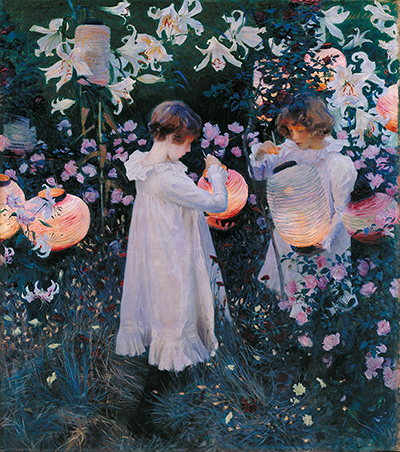
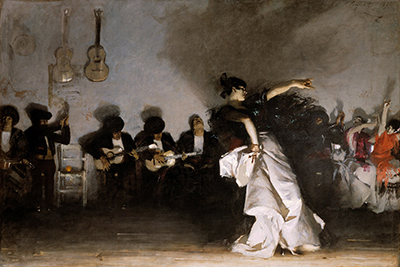
Finally, place the work beside Sargent's other images of movement. The dancer in El Jaleo, the woman in Street in Venice, Monet painting outdoors, children lighting lanterns in Carnation, Lily, Lily, Rose, and the travel watercolors all show Sargent thinking about moments that cannot be held for long. A Gust of Wind belongs to that family of images. It makes transience visible.
Related Works And Where To Go Next
For the artist's full career, begin with John Singer Sargent and Biography. They place the Paris years, portrait success, travel, murals, watercolors, and later work in order. [4]
For the portrait dimension, use Portraits, especially the sections on artists, writers, performers, costume, and the sitter encounter. For painting as a medium, use Paintings; for drawing, paper, and studies, use Drawings; for travel and outdoor practice, use Watercolors.
The closest individual comparisons are Street in Venice and Claude Monet Painting by the Edge of a Wood. The first shows Sargent using a moving figure in a city passage. The second shows him picturing an artist outdoors. For technique, Style and Technique explains controlled freshness, edges, omission, materials, and the balance between structure and speed. [4]
Frequently Asked Questions
It is best understood as a figure subject organized around a passing weather event. The title directs attention to moving air and to the way that air changes clothing, posture, and the image's sense of stability.
Yes, the Smithsonian Catalog of American Portraits source trail connects Judith Gautier and John Singer Sargent [1]. It is safest to treat that as an important portrait association while avoiding unsupported biographical expansion.
It has a portrait dimension because of the Judith Gautier association, but the title and visual problem point beyond ordinary likeness. It is also a study of motion, weather, costume, and outdoor looking.
The Met exhibition frame places the work within Sargent's Paris formation, when he was developing his public identity through portraiture, figure painting, style, and exhibition ambition [4]. That context helps explain why a seemingly brief subject can carry serious artistic purpose.
It shares their interest in selection, movement, and the unstable effects of light or air. Sargent's works on paper often show how much he could do with omission, quick structure, and decisive accents [10], [9].
Notice how the title teaches the eye. Look for wind through fabric, posture, edge, and interruption. The invisible force becomes visible because the figure and clothing register it.
The presently identified sources include exhibition and catalog paths rather than a complete object record. It is better to stay precise than to add unsupported facts.
Discussion
A Gust of Wind asks how a painter can make an invisible force visible. Sargent's answer is to let air pass through the figure, clothing, and edges until a brief disturbance becomes the whole subject.
Reader Insights
What is the first detail that shapes your reading of A Gust of Wind by John Singer Sargent: pose, setting, light, costume, brushwork or historical context?
Which small visual decision begins to matter more after a longer look, and how does it change the mood of the page?
Which comparison helps most: another Sargent portrait, a travel subject, a public commission, or a work by one of his contemporaries?
Join the Conversation
Share a thoughtful comment below about what you notice, question or compare when looking at this page.
References
- Smithsonian Catalog of American Portraits, Judith Gautier and John Singer Sargent source trail https://npg.si.edu/portraits/catalog-america?edan_fq%5B%5D=name%3A%22Gautier%2C+Judith%22&edan_fq%5B%5D=name%3A%22Sargent%2C+John+Singer%22&edan_q=65665
- Metropolitan Museum of Art, *Sargent: Portraits of Artists and Friends* https://www.metmuseum.org/exhibitions/listings/2015/sargent-portraits-of-artists-and-friends
- National Portrait Gallery, London, *Sargent: Portraits of Artists and Friends* https://www.npg.org.uk/whatson/exhibitions/2014/sargent-portraits-of-artists-and-friends-aa
- Metropolitan Museum of Art, *Sargent and Paris*, inside-the-exhibition material https://www.metmuseum.org/fr/exhibitions/sargent-and-paris/inside-the-exhibition
- Museum of Fine Arts, Boston, John Singer Sargent biography https://www.mfa.org/news/sargent-bio
- National Gallery of Art, John Singer Sargent retrospective https://www.nga.gov/exhibitions/john-singer-sargent
- Apollo, preview of *Sargent: The Dazzling Years in Paris* https://apollo-magazine.com/sargent-dazzling-paris-musee-orsay-paris-preview/
- National Portrait Gallery, "John Singer Sargent's suppliers of artists' materials" https://www.npg.org.uk/collections/research/programmes/artists-their-materials-and-suppliers/john-singer-sargents-suppliers-of-artists-materials
- Metropolitan Museum of Art, *John Singer Sargent Beyond the Portrait Studio* https://www.metmuseum.org/exhibitions/listings/2000/john-singer-sargent
- Metropolitan Museum of Art, *American Drawings and Watercolors in The Metropolitan Museum of Art: John Singer Sargent* https://www.metmuseum.org/fr/met-publications/american-drawings-and-watercolors-in-the-metropolitan-museum-of-art-john-singer-sargent
- Museum of Fine Arts, Boston, John Singer Sargent gallery https://www.mfa.org/gallery/john-singer-sargent
- National Gallery of Art, *Street in Venice* https://www.nga.gov/artworks/46428-street-venice
- Tate, *Claude Monet Painting by the Edge of a Wood* https://www.tate.org.uk/art/artworks/sargent-claude-monet-painting-by-the-edge-of-a-wood-n04103
- National Gallery of Art, *Sargent and Spain* https://www.nga.gov/research/publications/sargent-and-spain