

 by Tom Gurney
Tom Gurney BSc (Hons) is an art history expert with over 20 years experience
Published on June 19, 2020 / Updated on July 19, 2026
Email: tomgurney1@gmail.com / Phone: +44 7429 011000
Garden Study of the Vickers Children by John Singer Sargent: Introduction
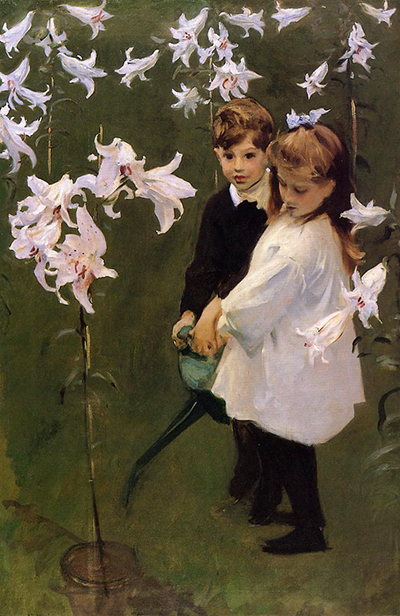
John Singer Sargent's Garden Study of the Vickers Children is a small key to a larger change in his art. Painted in 1884, it shows Vincent and Dorothy Vickers outdoors in a Sussex garden, watering flowers among lilies. The subject sounds gentle, but the painting is more than a pleasant image of childhood. It shows Sargent loosening the formal portrait into a scene of action, light, flowers, and broad handling.
The Flint Institute of Arts record identifies the work as one of eleven portraits Sargent painted of the Vickers family and says he began it in the summer of 1884 while visiting the Sussex home of Mr. and Mrs. Albert Vickers [1]. That fact matters. The painting is not an isolated garden fancy. It belongs to a family portrait group, but it does not behave like a grand society likeness. Instead of arranging the children as formal sitters, Sargent places them inside a garden task. Vincent and Dorothy water the flowers, and the portrait becomes a study of how children, lilies, movement, and outdoor air can share the same pictorial field.
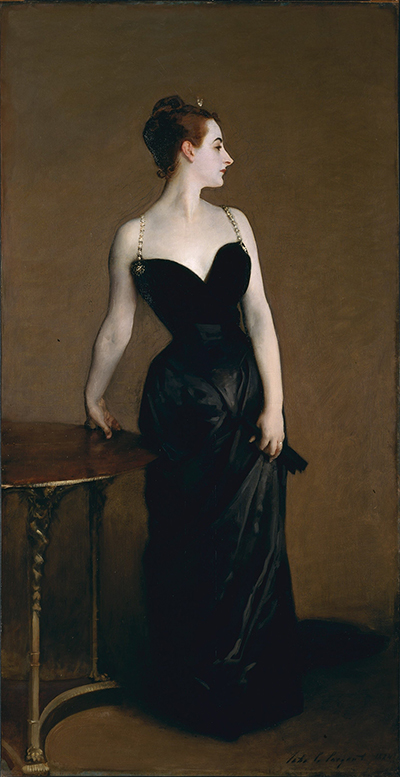
The work also stands near one of the turning points in Sargent's career. In 1884, Madame X had damaged his position in Paris. The MFA Boston biography notes that he had already been asked to paint members of the Vickers family in England, and that his hostile Salon reception was a significant factor in his decision to leave Paris for London [2]. Garden Study of the Vickers Children therefore belongs to the English path opening around him: patronage, countryside subjects, open-air experiment, and a new public beyond Paris.
Its title is useful. This is a garden study, not a monumental family picture. But "study" should not be mistaken for slightness. In Sargent's hands, study can mean testing: how to make a portrait informal without making it weak, how to use flowers as structure, how to let paint stay fluid, and how to show children without turning them into sentiment.
At a Glance
- ArtistJohn Singer Sargent [1]
- TitleGarden Study of the Vickers Children [1]
- Date1884 [1]
- MediumOil on canvas [1]
- Dimensions54 1/2 x 36 inches [1]
- SittersVincent and Dorothy Vickers [1]
- Settingthe Sussex, England, home of Mr. and Mrs. Albert Vickers [1]
- CollectionFlint Institute of Arts [1]
- Accession1972.47 [1]
- Credit lineGift of the Viola E. Bray Charitable Trust via Mr. and Mrs. William L. Richards [1]
- Displaythe Flint record lists the painting as on view [1]
Contents
- Introduction
- The Vickers Children In A Sussex Garden
- What Makes It A Study
- Children, Action And Anti-Sentiment
- Lilies, Pattern And Garden Space
- The 1884 Career Moment
- Brushwork, Light And Composition
- Related Works And Where To Go Next
The Vickers Children In A Sussex Garden
The named children in the painting are Vincent and Dorothy Vickers. Flint's object record gives the essential setting: Sargent began the painting in the summer of 1884 while visiting the home of Mr. and Mrs. Albert Vickers in Sussex [1]. The record does not require a long Vickers family biography to make the picture meaningful. What matters is more precise: Sargent was working within a patronage setting, among a family whose members he painted repeatedly, and he chose to represent these children outdoors rather than as studio figures.
That choice changes the portrait. A formal child portrait often gathers the sitter into stillness. Clothing, chair, curtain, toy, pet, or room can help define status and character. Here, the children are defined by an action. They water flowers. Their identity is not separated from the garden around them. The setting becomes part of the likeness.
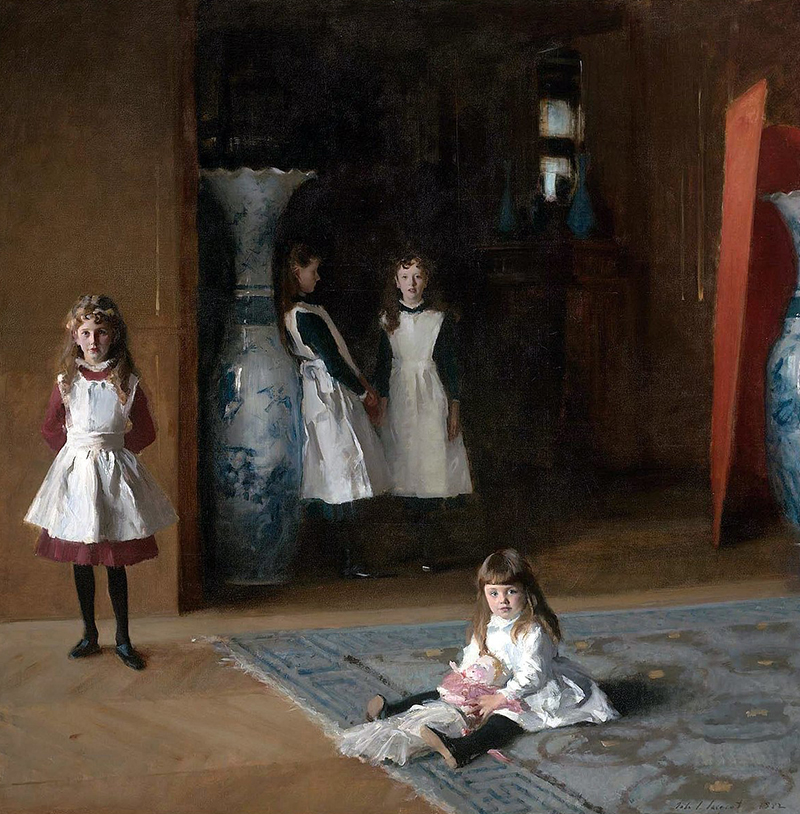
The work also suggests a kind of family intimacy different from Sargent's more public portraits. It is not the charged society image of a fashionable adult, nor the large, strange interior of The Daughters of Edward Darley Boit. It is a garden scene made within the orbit of a household visit. Sargent's eye turns patronage into observation.
Flint's record calls the composition seemingly spontaneous [1]. That phrase is important because the work depends on a balance between arrangement and freshness. The children appear caught in a practical task, yet the lilies and vertical canvas show that Sargent is organizing the scene carefully. Informality is the subject, but it is also the design.
What Makes It A Study
The word "study" in the title points toward the painting's special character. It does not ask to be read as a polished grand-manner portrait. It asks to be read as a work in which Sargent is thinking through a problem in paint. The problem is how to bring portraiture, garden design, child movement, and open-air handling into one image.
Flint's description gives the best technical clues. The painting is naturalistic, with broad fluid brushstrokes and flat areas of undefined color [1]. That combination is central to its effect. Naturalistic does not mean minutely finished. It means Sargent wants the scene to feel observed and alive. Broad handling lets the garden breathe. Flat color simplifies parts of the surface so the figures and lilies can become a pattern as well as a scene.
The study status also changes how one reads finish. Some passages may be less defined because exact description is not the aim everywhere. Sargent is not cataloguing every leaf. He is deciding how much information is needed for children, stems, flowers, and air to register together. That hierarchy of finish belongs to his larger method. He often sharpens the visual relation that matters most and lets surrounding areas remain active, suggestive, and open.
In a formal portrait, the sitter's face may carry the whole encounter. In Garden Study of the Vickers Children, the encounter is dispersed. The children matter, but so do the lilies above them, the water they pour, the outdoor light, and the sense of a garden continuing beyond the frame. The picture is therefore a study not only of Vincent and Dorothy but of a whole condition of seeing: children outdoors, absorbed in action, surrounded by cultivated growth.
That is why the work should not be treated as a minor pause between famous paintings. It shows Sargent testing a form of portraiture that makes atmosphere and setting share responsibility for meaning.
Children, Action And Anti-Sentiment
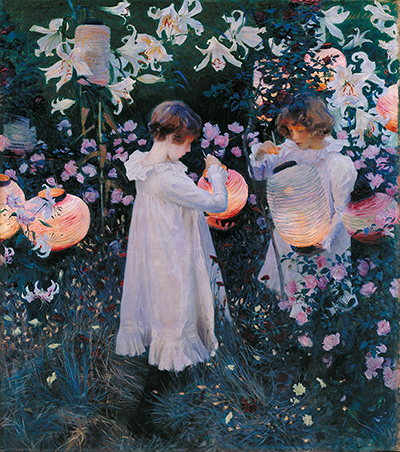
Sargent's strongest images of children avoid easy sweetness. The Daughters of Edward Darley Boit separates four sisters in a dark Paris interior, giving childhood distance and ambiguity. Miss Beatrice Townsend brings one young sitter close to the viewer but gives her a direct gaze, dark dress, and terrier rather than a simple emblem of innocence. Carnation, Lily, Lily, Rose shows children in a garden, but they are absorbed in lighting lanterns, not posing as decorative children.
Garden Study of the Vickers Children belongs to that wider pattern. Vincent and Dorothy are young, but Sargent does not make childhood a sugary theme. He gives them something to do. The watering action matters because it shifts the image away from passive display. The children are not merely looked at; they participate in the life of the garden.
That action also gives the scene a quiet dignity. Watering flowers is ordinary, but it requires attention. The children are connected to the lilies and flower stalks not through allegory but through touch, labor, and care. The garden becomes a shared environment rather than a decorative backdrop.
There is restraint here. The painting does not invite a story about what Vincent and Dorothy feel. It does not turn them into symbols of innocence, privilege, or family affection. It shows their relation to a place and an activity. That is a more serious kind of child portraiture than it may first appear to be.
The comparison with Carnation, Lily, Lily, Rose is especially revealing. In the later work, Dolly and Polly Barnard light paper lanterns in a flower-filled garden at dusk. There too, the children are defined through absorbed action. The Vickers children water flowers; the Barnard children tend lantern light. In both cases, Sargent finds a way to make childhood active, concentrated, and visually woven into the surrounding garden.
Lilies, Pattern And Garden Space
The lilies are among the painting's most important forms. Flint identifies Vincent and Dorothy as standing amidst stalks of lilies [1]. British Art Studies makes the connection to Sargent's later garden painting explicit: in the 1884 Vickers study, he had experimented with the flat decorative effect of lilies, and those lilies arc over the children in a way that anticipates the upper patterning of Carnation, Lily, Lily, Rose [3].
This is one of the strongest reasons to look carefully at the work. The lilies are not background. They shape the upper space of the painting. Their stalks and blooms rise around and above the children, turning the garden into a patterned screen. British Art Studies notes that the Vickers lilies are more realistically secured in pots than those in Carnation, but that they form a similar decorative arc across the picture space [3].
That arc matters because it changes the relation between figure and setting. The children do not stand before a garden as if the flowers were scenery. They are embedded inside vertical growth. The lilies frame them, press around them, and help flatten the upper part of the composition into a decorative field. Sargent is already thinking about the garden as a designed surface.
This does not make the painting abstract. It remains a naturalistic scene. But it shows how Sargent could make naturalism and decoration work together. A lily can be a flower in a Sussex garden and a compositional device at the same time. A child's body can be part of a family portrait and part of a pattern of light, color, and vertical forms.
The later Carnation would turn this problem into a larger and more famous achievement, with flowers, lanterns, dresses, and evening light held in a dense surface. The Vickers painting is quieter, but it shows an earlier experiment with the same kind of garden thinking.
The 1884 Career Moment
The date 1884 gives the painting more pressure than its gentle subject first suggests. That was the year of the hostile reception of Madame X at the Paris Salon. The MFA biography describes that reception as a significant factor in Sargent's decision to leave Paris for London, and notes that he had already been asked to paint members of the Vickers family in England [2].
The Vickers commission therefore belongs to the practical transition in Sargent's career. He was not simply leaving one city for another. He was moving from Parisian Salon ambition toward English patronage, London society, countryside subjects, and a different public. A garden study of children in Sussex may seem far from the drama of Madame X, but it belongs to the same historical turn.
The MFA biography also notes that in the absence of immediate portrait success in England, Sargent devoted himself to landscape and experiments with impressionism, producing open-air studies in the English countryside between 1885 and 1889 [2]. Garden Study of the Vickers Children comes just before that fuller phase. It already brings portraiture outdoors and lets figure painting meet garden light.
This position helps explain the painting's looseness. Sargent was not abandoning portraiture; he was testing how far portraiture could stretch. The Vickers family gave him sitters and a social setting. The garden gave him light, lilies, action, and surface. The result is not a retreat from ambition but a change in its scale.
In that sense, the work sits between two more famous poles. Behind it is the high-risk society portrait, Madame X, with its severe profile and public scandal. Ahead of it is Carnation, Lily, Lily, Rose, the patient garden-light picture that helped establish Sargent in Britain. Garden Study of the Vickers Children does not carry the fame of either, but it helps make the path between them visible.
Brushwork, Light And Composition
Flint's description of broad fluid brushstrokes and flat undefined color gives the best guide to looking [1]. The brushwork matters because it keeps the scene from hardening into a formal arrangement. The garden is active. The children are part of that activity. Paint needs to suggest leaves, stems, light, clothing, and movement without freezing each into separate description.
The vertical format, 54 1/2 by 36 inches, helps concentrate the scene. It is tall enough for the lilies to rise over the children and narrow enough to keep the figures and flower stalks close together. That shape suits a garden study better than a wide landscape. The viewer is not invited to roam through distance. The eye stays among bodies, stems, flowers, and the watering action.
Flat areas of color are just as important as fluid strokes. They let Sargent simplify the garden into larger relations. A passage of green does not need every leaf. A passage of clothing does not need every fold. The painting depends on the viewer's ability to complete what the brush suggests. That confidence is one reason Sargent's informal works can feel so alive.
The composition also depends on crossing roles. The children are sitters, but they are also figures in a garden picture. The lilies are plants, but they are also a decorative structure. The act of watering is an everyday task, but it is also the image's organizing gesture. Nothing in the painting belongs to only one category.
This is where Sargent's technical intelligence becomes visible. He knew how to make formal portraiture shimmer through fabric and skin, but here he lets pictorial force come from a looser field. The work's energy lies in the relation between the children and the garden. The figures do not dominate the setting, and the setting does not swallow them. They share the surface.
Related Works And Where To Go Next
For Sargent's wider treatment of young sitters, begin with The Daughters of Edward Darley Boit and Miss Beatrice Townsend. The Boit painting shows children separated by interior space and shadow. The Townsend portrait shows a single child made vivid through gaze, costume, and a pet. Garden Study of the Vickers Children gives another version: children defined through action in outdoor light.
The closest garden comparison is Carnation, Lily, Lily, Rose. British Art Studies directly connects the Vickers lilies to the later painting's decorative garden structure, making the two works natural companions [3]. The later painting is larger, more elaborate, and more technically documented, but the Vickers study shows Sargent already thinking about children, lilies, and patterned garden space.
For medium and method, the Sargent paintings essay is useful because it places garden works beside portraits, travel pictures, public murals, and war art. The style and technique essay helps explain why broad handling, selective finish, and the hierarchy of detail matter. The portraits essay places the Vickers children within Sargent's larger portrait world, where sitters appear through pose, setting, costume, action, and surface.
The biography gives the broader career setting: Paris training, the Madame X rupture, English patronage, open-air experiments, and the later London portrait career.
Frequently Asked Questions
The children are Vincent and Dorothy Vickers. The Flint Institute of Arts record identifies them as the children of Mr. and Mrs. Albert Vickers and says Sargent began the painting during a summer 1884 visit to the family's home in Sussex, England [1].
The Flint Institute of Arts dates the painting to 1884. That places it in the same year as the hostile reception of Madame X and just before Sargent's major English open-air work at Broadway in 1885 and 1886. [1]
The painting is in the collection of the Flint Institute of Arts. The museum lists it with accession number 1972.47 and states that it is on view [1].
It is oil on canvas and measures 54 1/2 x 36 inches, according to the Flint Institute of Arts object record [1].
The title points to the painting's informal, exploratory character. Sargent uses the garden setting, broad brushwork, flat color, and the children's watering action to test a looser kind of portrait image. It is finished enough to stand as a painting, but its force comes from experiment rather than grand formality.
British Art Studies connects the Vickers painting to Carnation, Lily, Lily, Rose through the lilies. In the Vickers work, Sargent experimented with lilies arcing over the children and creating a flat decorative pattern across the upper picture space, a concern that returns in the later garden picture [3].
It is gentle, but not merely sentimental. Sargent gives Vincent and Dorothy an action, places them within a structured garden, and uses broad handling to make childhood part of light, flowers, and movement. The children are not just decorative figures; they help animate the scene.
Discussion
Garden Study of the Vickers Children asks how informal a portrait can become before it turns into something else. Sargent's answer is generous: a portrait can be a garden study, a record of children, a pattern of lilies, and a moment of outdoor work at the same time.
Reader Insights
What is the first detail that shapes your reading of Garden Study of the Vickers Children by John Singer Sargent: pose, setting, light, costume, brushwork or historical context?
Which small visual decision begins to matter more after a longer look, and how does it change the mood of the page?
Which comparison helps most: another Sargent portrait, a travel subject, a public commission, or a work by one of his contemporaries?
Join the Conversation
Share a thoughtful comment below about what you notice, question or compare when looking at this page.
References
- Flint Institute of Arts, *Garden Study of the Vickers Children* https://collections.flintarts.org/objects/4/garden-study-of-the-vickers-children
- Museum of Fine Arts, Boston, John Singer Sargent biography https://www.mfa.org/news/sargent-bio
- Rebecca Hellen and Elaine Kilmurray, "Carnation, Lily, Lily, Rose and the process of painting" https://britishartstudies.ac.uk/issues/02/sargent-conservation