by Tom Gurney
Tom Gurney BSc (Hons) is an art history expert with over 20 years experience
Published on June 19, 2020 / Updated on October 22, 2026
Email: tomgurney1@gmail.com / Phone: +44 7429 011000
The Virgin of the Host
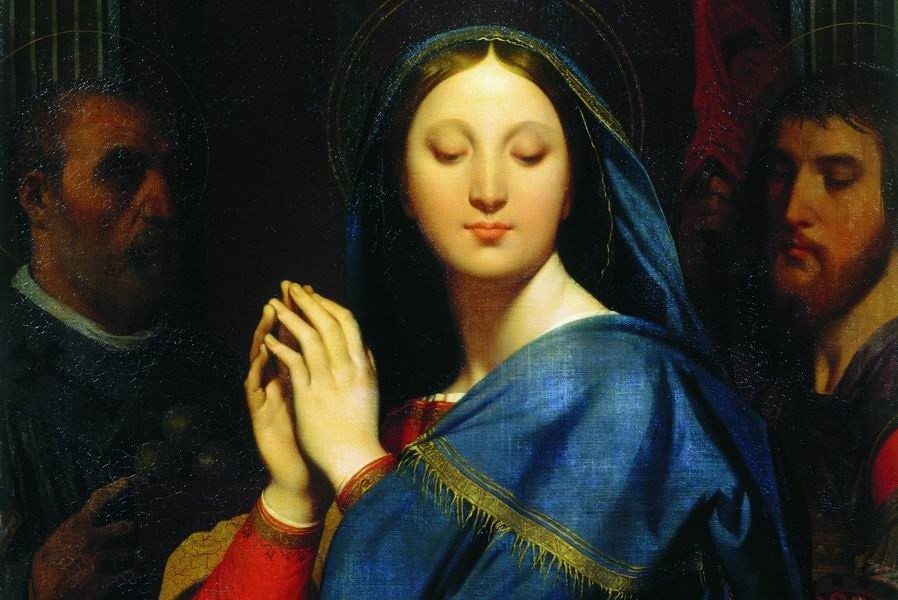
A white disc rests above a golden chalice. Behind it, Mary lowers her eyes, her hands joined beside her face; two saints emerge from the shadows at her shoulders. Ingres makes the smallest, plainest object in this richly coloured painting its devotional centre. The Virgin’s blue mantle occupies much of the canvas, yet the pale circle below her arrests the eye with equal force.
The 1841 painting in Moscow presents a sacred encounter in which very little happens outwardly. [1] Its interest lies in the relationships between the figures, the ceremonial objects and the person looking at them.
At a Glance
- ArtistJean-Auguste-Dominique Ingres
- Date1841
- MediumOil on canvas
- Size116 × 84 cm
- CollectionPushkin Museum of Fine Arts, Moscow, Ж-2761. [1]
- SubjectMary adoring Christ in the Eucharist, accompanied by two saints. [2]
- Look forThe contrast between the broad blue mantle and the small white Host.
This work across Ingres’s career
Agamemnon’s Ambassadors
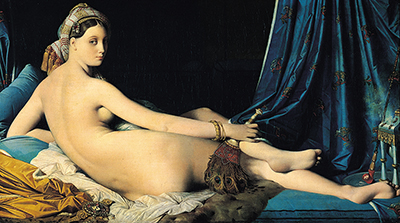
1801 (competition)Grande Odalisque
1814Louis XIII’s Vow
1824Monsieur Bertin
1832The Princesse de Broglie
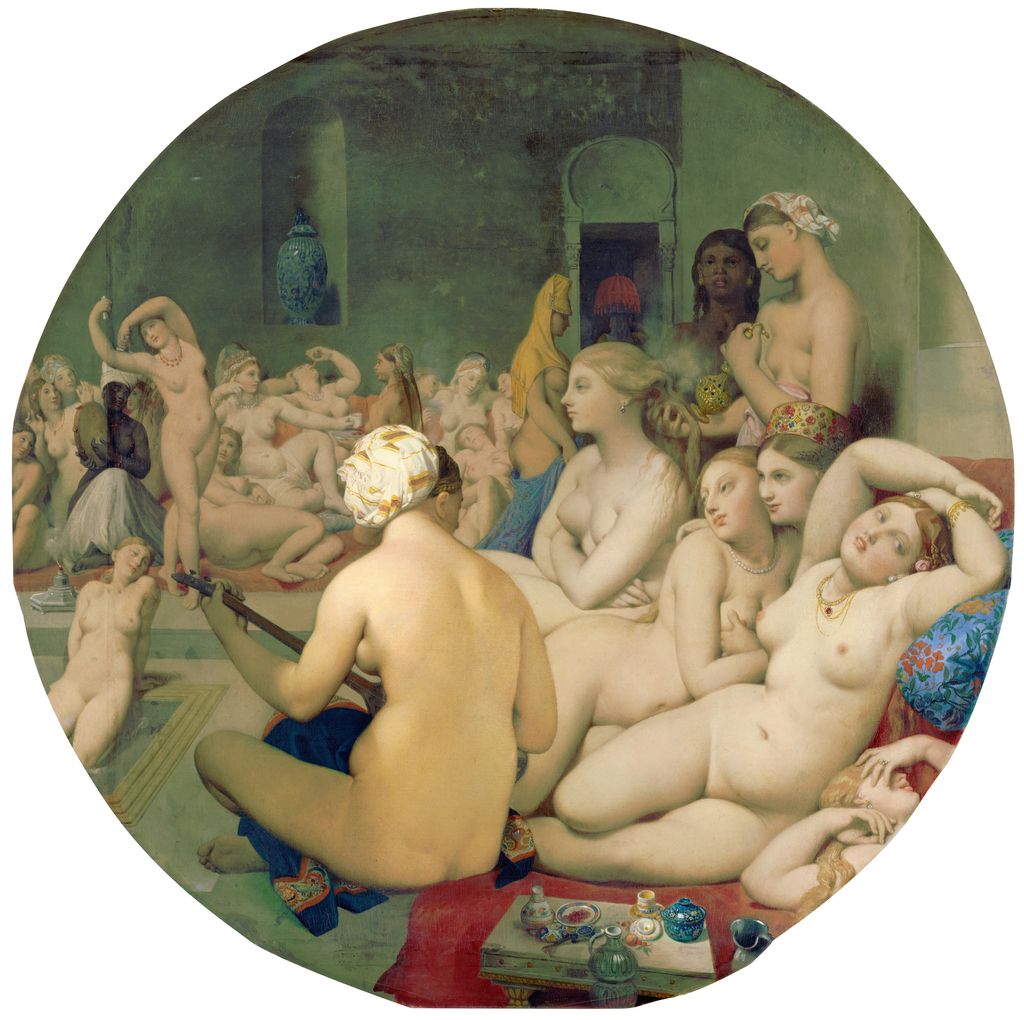
1851–1853The Turkish Bath
1859–1862Contents
- Looking across the altar
- What the Host means here
- A Russian commission and its saints
- From an earlier Madonna to the finished painting
- Raphael and the discipline of the image
- How Ingres changed the subject in later versions
- From private devotion to public exhibition
- Annotated details
Looking across the altar
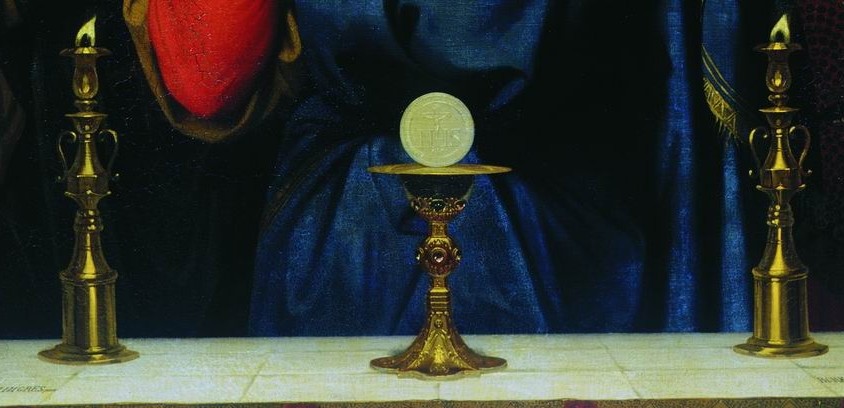
The white altar cloth runs almost horizontally across the bottom of the painting. Its shallow expanse establishes a boundary: the vessels and figures stand beyond it, while we approach from this side. The chalice rises at the centre, balanced by two slim candlesticks. Their flames are small, but the metal catches enough light to make each stem, foot and swelling ornament legible. Along the lower edge, the patterned hanging introduces another register of colour beneath the white cloth.
Above this carefully ordered foreground, Mary’s body produces a larger, less regular arrangement. Her face is almost frontal, but her hands move to our left, and her mantle extends across the opposite shoulder. The two sides answer one another without becoming mirror images. The praying hands give one side a cluster of pale, slender forms; the blue fabric gives the other a broad, uninterrupted weight. It is an unusually effective way of making a motionless figure feel composed rather than rigid.
The mantle deserves time. Gold edging draws a fine diagonal across the chest, with a fringe of small hanging threads. Below it, blue folds divide into deep shadows and broad illuminated surfaces. The cloth alternately conceals and suggests the body beneath. At the bent arm, the red sleeve and gold lining create a compact passage of warmth beside the cooler expanse of blue. Colour helps articulate the figure as clearly as an outline could.
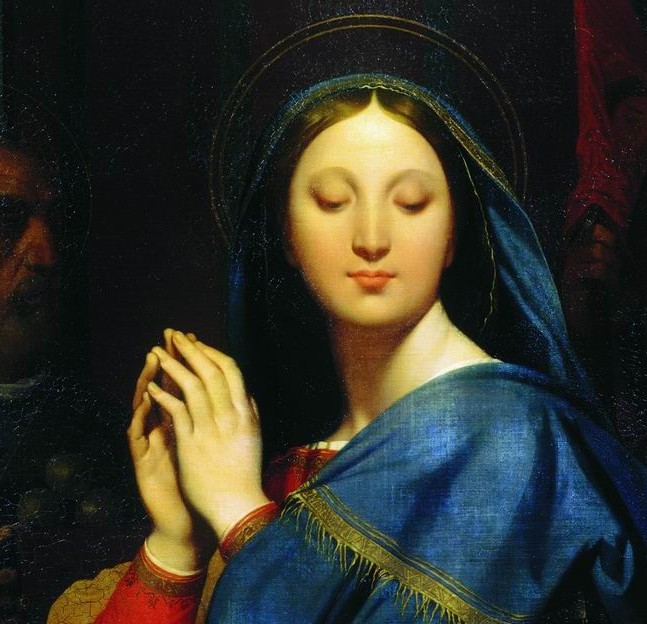
Mary’s face is quieter than her clothing. The light forehead narrows towards the nose and small mouth; lowered lids interrupt the otherwise smooth surface. A centre parting in her hair reinforces the face’s balance. Fine golden circles surrounding her head remain visible against the dark background without becoming a solid disc. They distinguish a sacred person while allowing the shadows and fabric behind her to continue through the same pictorial space.
The saints occupy that space differently. The older figure at the left turns inwards from deep shadow, while the younger, bearded figure at the right has a more exposed face. Their heads sit lower than the top of Mary’s halo. Dark architectural uprights at the edges enclose the group, and red fabric behind them deepens the recess. These surrounding forms make the central face seem unusually clear and available to sight.
There is a revealing difference between how the painting treats flesh and metal. The face is softly continuous; the chalice and candlesticks are broken into glints, edges and tiny ornaments. The eye can move from broad human form to minute workmanship without leaving the same concentrated scene. Its stillness contains an abundance of carefully differentiated surfaces.
Annotated Details from The Virgin of the Host
The numbered points identify visible features discussed in this article. Return from each detail to the whole composition. Ingres, The Virgin of the Host, 1841. Pushkin Museum of Fine Arts, Moscow, Ж-2761. Wikimedia Commons. Image source. Public domain.
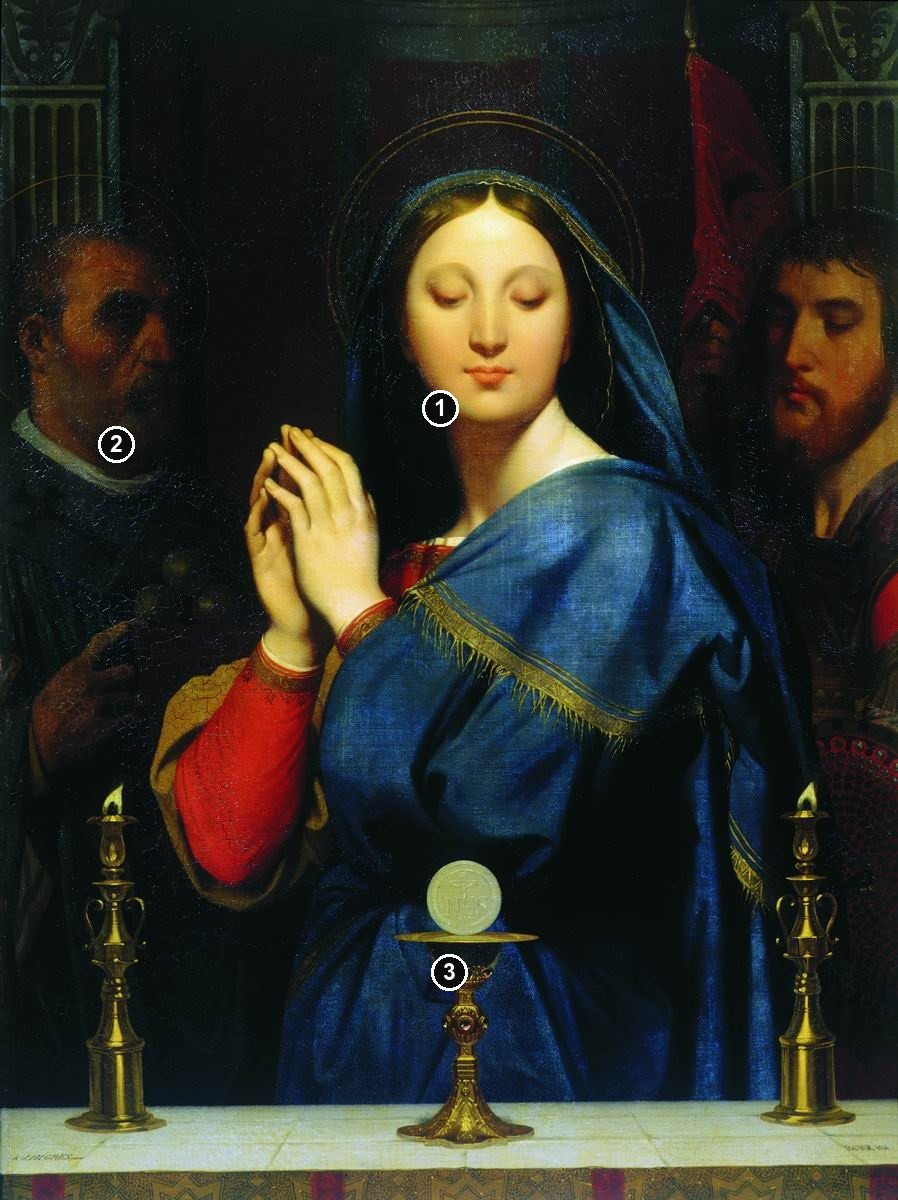
Details from THE VIRGIN OF THE HOST
Compare the central face and joined hands with the flanking saints and the objects set across the altar.
The lowered face and joined hands
The face inclines above two joined hands within the blue covering. The pale fingers and face form a compact group between the darker figures at either side.
The saints at either side
Two saints stand behind the central figure within the darker sides of the picture. Compare the different directions of their faces with Mary’s more frontal, lowered head.
The Host, vessel and candles
The circular Host rises above the central vessel between two burning candles. Their repeated upright forms rest on the broad white altar in front of the blue mantle.
What the Host means here
The title names the white sacramental wafer above the chalice. Ingres’s own account explains the relationship between this object and the Virgin. In a letter dated 5 September 1840, preserved in Henri Delaborde’s posthumous compilation, he described Mary as having already ascended to heaven and appearing again to the faithful. Before an altar, she adores her son’s divinity in the sacred Host and chalice, which he associates with humanity’s redemption. Two saints accompany her. [2]
This is a useful guide to an image that could otherwise be mistaken for a familiar Madonna whose child has somehow been omitted. Christ’s presence takes Eucharistic form. Mary’s joined hands and lowered eyes establish her as an adoring participant. In the artist’s explanation, her appearance brings the heavenly figure into a devotional encounter with the faithful. [2]
The visual arrangement makes that explanation intelligible. Mary does not hold the chalice, display the wafer in her hand or turn towards us to explain it. The objects stand independently on the altar, in the nearest accessible part of the sacred space. We see them before we reach her. Her prayer offers an example of how to attend to them, while the frontal presentation leaves the viewer directly before the same focus of devotion.
The scale of the Host is particularly striking. It is much smaller than Mary’s face and dwarfed by her mantle. Its light colour, simple outline and isolated position give it a force that physical size alone could not supply. Against the blue, the disc is immediately legible. The richness of the surrounding painting therefore serves a very spare central form.
Delaborde’s book appeared in 1870, after Ingres’s death, and brings together the artist’s letters, notes and an early catalogue. It transmits valuable testimony without functioning as a treatise prepared by Ingres for publication. Here the letter is especially helpful because it gives a specific account of the subject, rather than a general statement about religious art. [2] It supports a reading of apparition and adoration; it does not require us to invent a private mystical experience behind the painting.
A Russian commission and its saints
The Pushkin Museum’s archived record identifies the patron as the future Alexander II, then heir, and names Nicholas as his father’s patron saint alongside Alexander Nevsky. [1] The saints give the commission a dynastic association while sharing the Virgin’s act of devotion. [1] The commission names a patron. [1] Ingres’s letter describes an apparition and its devotional focus. [2] These documents leave the intended setting uncertain.
From an earlier Madonna to the finished painting
Delaborde’s catalogue preserves an account of an earlier conception: Mary, with joined hands, adoring the sleeping infant Jesus laid before her. It says that Ingres became dissatisfied and covered the picture with white paint, later removed by Raymond Balze. A separate painted study of the child also survived in the collection of Édouard Gatteaux. These are reports about related earlier works, not a description of the visible subject in the Pushkin canvas. [2]
The change from a sleeping child to the Host alters the whole encounter. A mother contemplating her infant gives the viewer a recognisable human relationship to observe. In the completed composition, prayer is directed towards sacramental objects. Much of the emotional communication has to pass through posture, light and the relationship between the altar and the people beyond it. The concentrated arrangement can be understood more clearly when placed beside that earlier idea, even though Delaborde’s account does not establish each intermediate stage of development.
Dating also requires care. Delaborde lists the Russian painting under 1840, the year of the explanatory letter; the Pushkin Museum dates it 1841. [1][2] A second letter provides a useful contemporary check. Writing to the architect Louis-Hippolyte Lebas on 21 March 1841, Victor Schnetz reported that Ingres had finished two paintings the previous day: a Madonna with two saints and the portrait of Cherubini accompanied by a muse. He included small sketches of both compositions. Eric Bertin published this evidence in the 2000 corrections to the Ingres portrait catalogue. [3] Schnetz’s single letter places the Madonna and the allegorical Cherubini portrait at the same moment of completion. [3]
The September letter should therefore be read as evidence of the project’s developed conception, rather than used by itself to date the completed canvas. It tells us that Ingres could already explain the subject precisely; Schnetz supplies testimony about its later completion. [2][3]
Raphael and the discipline of the image
The Pushkin Museum connects the Virgin with Raphael, without naming one exclusive model. [1] For a broader statement of Ingres’s attitude to earlier art, Delaborde records his advice to turn to the masters and speak to them because they remain alive. [2] Read alongside this canvas, that metaphor suggests an active relationship with inherited painting. The old forms are available for renewed use: they can be made to address a new patron, a different setting and a particular devotional subject.
Start with the long horizontal edge of the altar, then follow the chalice upwards to the Host. The red sleeve leads the eye left towards the pale hands; the gold fringe carries it back across the blue. Each route connects a small detail to a larger surface.
This is also why the rich blue matters so much. The mantle is the largest coloured field, supporting the luminous face above and the white Host below. Its folded surface links them while preventing the lower half of the image from becoming visually empty. The composition’s order is made through colour and volume as well as contour.
How Ingres changed the subject in later versions
The Russian commission became the starting point for further paintings. The Metropolitan Museum’s account records that Ingres showed the original in Paris in 1842 before sending it to Saint Petersburg. [4] Its departure did not end his engagement with the arrangement.
The smaller Virgin Adoring the Host, now at the Metropolitan Museum, dates from 1852 and measures 40.3 × 32.7 cm. Ingres gave it to Louise Marcotte, who had introduced him to Delphine Ramel, his second wife. [5] Here the accompanying saints are Louis and Helena, replacing the saints of the Russian commission. [4]
Seen beside the original, the smaller work makes the portability of the central design particularly clear. Mary keeps the joined hands, lowered eyes and blue mantle; the altar still separates her from the viewer, and the chalice retains its central place. The companions, however, bring different faces, costumes and attributes into the margins. These substitutions change the painting’s associations without dissolving its devotional structure.
The visible differences are worth attending to in their own right. In the Metropolitan painting the figure at the left wears an elaborate crown and holds a large cross. The right-hand figure’s patterned clothing and ermine create a much more decorative passage than the shadowed garments in the Russian painting. The blue mantle appears brighter in the available reproductions, although reproductions alone cannot establish the canvases’ original relative colour. What can be seen securely is how differently the surrounding details frame a remarkably persistent central figure.
Another substantial transformation came in 1854. The French state acquired a circular version, 113 cm in diameter, now associated with the Louvre’s long-term deposit at the Musée d’Orsay. Its commission had first been proposed in 1841 and was renewed in 1851. [6] Delaborde describes this version as replacing the two saints with angels. [2]
A circular painting, or tondo, necessarily changes the relationship between a central figure and the enclosing edge. In this case, the change of format accompanies a change in the surrounding sacred company. The later work is a separate object with its own history, not a round presentation of the Moscow canvas. Its state commission also gives a different context to a design first made for the Russian heir.
Delaborde lists further versions dated 1860 and 1866, describing modifications and a smaller repetition. His account associates the latter with the final weeks of Ingres’s working life. [2] The useful point is the persistence of the subject across decades. These paintings need to be distinguished by date, format and companions; a title alone cannot tell us which one we are seeing.

Ingres, The Virgin Adoring the Host, 1852. [7]
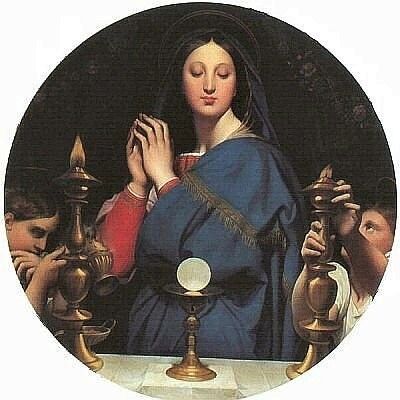
Ingres, The Virgin Adoring the Host, 1854. Louvre, deposited at the Musée d’Orsay, INV 20088. The circular version. [8]
From private devotion to public exhibition
The subject also acquired a public life. The 1854 tondo appeared in Ingres’s studio that year and at the 1855 Exposition Universelle. [6] Robert Rosenblum notes that it hung below The Apotheosis of Homer, between portraits of Comte Molé and the Comtesse d’Haussonville. He reads the arrangement as a meeting of the ideal world and contemporary portraiture, with the Virgin extending the symmetry of the classical composition above into a Christian subject below. [9]
This setting offers a different way to think about the family of paintings. An image organised for sustained devotion could also enter an exhibition in which viewers compared genres, careers and artistic traditions. Its concentrated frontality could work in both circumstances, inviting prayer in one context and close formal comparison in another. The documented display concerns the later tondo; it should not be transferred to the Russian original. The Apotheosis of Homer comparison is illuminating because it brings us back to the figures’ shared attention. In the Pushkin painting, the central object of that attention is tiny. The organisation of the whole scene makes its significance visible.
Artworks directory
Explore 150 paintings, drawings and an original lithograph. This selection includes related versions and studies; dates distinguish completed works from later revisions.
| Name | Date | Medium |
|---|---|---|
| The Apotheosis of Homer | 1827 | Painting |
| Grande Odalisque | 1814 | Painting |
| The Turkish Bath | 1859–1862 | Painting |
| Madame Moitessier Seated | 1856 | Painting |
| Portrait of Monsieur Bertin | 1832 | Painting |
| Napoleon I on His Imperial Throne | 1806 | Painting |
| Odalisque with Slave | 1839 | Painting |
| The Ambassadors of Agamemnon in the Tent of Achilles | 1801 (competition) | Painting |
| The Valpinçon Bather | 1808 | Painting |
| The Source | 1856 | Painting |
| Oedipus Explaining the Enigma of the Sphinx | 1808; revised probably before 1827 | Painting |
| The Vow of Louis XIII | 1824 | Painting |
| Antiochus and Stratonice | 1840 | Painting |
| The Comtesse d’Haussonville | 1845 | Painting |
| The Princesse de Broglie | 1851–1853 | Painting |
| Jupiter and Thetis | 1811 | Painting |
| The Dream of Ossian | 1813 | Painting |
| The Martyrdom of Saint Symphorian | 1834 | Painting |
| Venus Anadyomene | 1808–1848 | Painting |
| Portrait of Madame de Senonnes | 1814 | Painting |
| Madame Rivière | 1805 | Painting |
| Mademoiselle Caroline Rivière | 1805 | Painting |
| Portrait of Philibert Rivière | 1805 | Painting |
| Bonaparte First Consul | 1804 | Painting |
| The Death of Leonardo da Vinci | 1818 | Painting |
| Joan of Arc at the Coronation of Charles VII | 1854 | Painting |
| Madame Duvaucey | 1807 | Painting |
| La Belle Zélie | 1806 | Painting |
| Madame Panckoucke | 1811 | Painting |
| Portrait of Charles Marcotte d’Argenteuil | 1810 | Painting |
| Joseph Antoine Moltedo | c.1810 | Painting |
| Madame Leblanc | 1823 | Painting |
| Delphine Ingres-Ramel (Portrait of Madame Ingres) | 1859 | Painting |
| Portrait of Amédée de Pastoret | 1823–1826 | Painting |
| Portrait of Baronne de Rothschild | 1848 | Painting |
| Madame Marcotte de Sainte Marie | 1826 | Painting |
| Madame Gonse | 1852 | Painting |
| Aretino in the Studio of Tintoretto | 1848 | Painting |
| Don Pedro of Toledo Kissing Henry IV’s Sword | 1831/1832 | Painting |
| Raphael and La Fornarina | 1814 | Painting |
| Roger Freeing Angelica | 1819 | Painting |
| Romulus’ Victory over Acron | 1812 | Painting |
| Self-Portrait at the Age of Twenty-Four | 1804; revised 1841–1851 | Painting |
| Male Torso | c.1800 | Painting |
| Odalisque in Grisaille (Ingres and workshop) | c.1824–1834 | Painting |
| The Small Bather | 1826 | Painting |
| The Little Bather Harem Interior | 1828 | Painting |
| Jesus Among the Doctors | 1862 | Painting |
| The Virgin Adoring the Host | 1852 | Painting |
| The Virgin of the Host | 1841 | Painting |
| Virgin of the Adoption | 1858 | Painting |
| Paolo and Francesca | 1814 | Painting |
| Homer Deified (revised composition, Louvre RF5273) | 1865 | Drawing |
| Odalisque with Slave (Louvre RF4622) | 1858 | Drawing |
| Odalisque (Walters Art Museum; Ingres and Paul Flandrin) | 1842 | Painting |
| Madame Moitessier Standing (National Gallery of Art) | 1851 | Painting |
| Jacques-Louis Leblanc (The Metropolitan Museum of Art) | 1823 | Painting |
| Ferdinand-Philippe, Duke of Orléans (Louvre RF2005-13) | 1842 | Painting |
| Ferdinand-Philippe, Duke of Orléans (Versailles MV5207; Ingres and workshop) | 1843 | Painting |
| Ferdinand-Philippe, Duke of Orléans (Versailles MV5209; Ingres and workshop) | 1844 | Painting |
| Antiochus and Stratonice (Musée Fabre; Ingres and Raymond Balze) | 1866 | Painting |
| Antiochus and Stratonice (Kunstmuseum Bern, Gurlitt bequest) | Undated (early dating proposed) | Drawing |
| Composition study for Antiochus and Stratonice (MIB867.2193) | 1806 | Drawing |
| Study for the Figure of Stratonice (Met63.66) | 1834–1840 | Graphite, black chalk and charcoal |
| Nude figure study for Stratonice (Boijmans F II 36 PK) | c.1834–1840 | Drawing |
| Paolo and Francesca (The Barber Institute,54.6) | c.1814–1820 | Painting |
| Paolo and Francesca (The Hyde Collection,1971.24) | c.1855–1860 | Painting |
| Paolo and Francesca (Amsterdam Museum TA10970) | 1820 | Drawing |
| Paolo and Francesca (dedicated to Artaud de Montor) | 1816 | Drawing |
| Study for the Bust of Francesca (MIB867.1398) | 1819 | Drawing |
| Study for the Bust of Francesca (MIB867.1396) | 1819 | Drawing |
| The Archangel Raphael, first idea (MIB867.2488) | 1842 | Drawing |
| The Archangel Raphael (MIB867.2500) | 1842 | Drawing |
| The Archangel Raphael Carrying Human Prayers to God (Chantilly DE513) | 1844 | Drawing |
| Louis-Philippe as Saint Philip, stained-glass study | 1844 | Drawing |
| Marie Frédéric Eugène de Reiset (Ford Collection RBF171-2) | 1844 | Drawing |
| Virgil Reading the Aeneid (Toulouse) | Begun 1811 | Painting |
| Tu Marcellus Eris (Brussels, inv. 1836) | c.1814 (museum dating) | Painting |
| Jean-François Gilibert | 1804 | Painting |
| François-Marius Granet | 1807 (museum dating) | Painting |
| Count Nikolai Dmitrievich Guryev | 1821 | Painting |
| Caroline Murat, Queen of Naples | 1814 | Painting |
| Count Mathieu Molé | 1834 | Painting |
| Cherubini and the Muse of Lyric Poetry (Louvre) | 1842 | Painting |
| Luigi Cherubini (Cincinnati) | 1841 | Painting |
| Comtesse de Rayneval (Louvre RF4505) | 1841 | Drawing |
| Venus on Paphos (Antonie Balaÿ) | c.1852 | Painting |
| Prince Napoléon | 1855 | Painting |
| Study for The Apotheosis of Napoleon I (Petit Palais) | Late 1853 | Painting |
| The Apotheosis of Napoleon I (destroyed ceiling) | 1853 | Painting |
| The Journalist (MIB867.2733) | 1834? | Drawing |
| Henry VIII, after Holbein | c.1815–1820 (?) | Drawing |
| Madame Récamier, after David (MIB867.3637) | Undated (early Paris period) | Drawing |
| Study for Comtesse d’Haussonville (MIB867.259; background possibly by another hand) | 1842–1845 | Drawing |
| La Source (reduced version reported by Delaborde) | Date unrecorded; reported 1870 | Painting |
| Odalisque (autograph lithograph,NGA1946.21.117) | 1825; published1826 | Lithograph |
| Portrait of a Seated Lady | 1814 | Graphite |
| The Kaunitz Sisters (Leopoldine, Caroline, and Ferdinandine) | 1818 | Graphite |
| Portrait of a Man | 1814 | Graphite |
| Study for the Portrait of Louis-François Bertin (1766–1841) | n.d. | Black chalk and graphite |
| Studies for the Cadaver of Acron | ca. 1810–12 | Graphite on wove paper |
| Study for the Drapery of Molière in "The Apotheosis of Homer" | n.d. | Black chalk with stumping |
| Madame Guillaume Guillon Lethière, née Marie-Joseph-Honorée Vanzenne, and her son Lucien Lethière | 1808 | Graphite |
| Niccolò Paganini (1782–1840) | ca. 1830 | Counterproof or tracing strengthened with graphite and gouache on translucent paper |
| Lady Mary Cavendish-Bentinck (?-1843) | 1816 | Graphite |
| Madame Alexandre Lethière and Her Daughter Letizia | ca. 1815 | Graphite |
| Merry Joseph Blondel (1781–1853) | 1809 | Graphite |
| Ursin-Jules Vatinelle (1798–1881) | 1820 | Graphite |
| Bust of a Gypsy Girl (ascribed to Ingres) | 1819 | Graphite on wove paper |
| Study of a Seated Nude Male | n.d. | Graphite |
| The Archangel Raphael (Study for a stained-glass window in the chapel of Notre-Dame de la Compassion-Saint-Ferdinand, Neuilly) | ca. 1842 | Graphite |
| Lancelot-Théodore, comte Turpin de Crissé | probably 1818 | Graphite |
| Study for the Figure of the Iliad in "The Apotheosis of Homer" | ca. 1827 | Graphite and black chalk heightened with white chalk on brown paper |
| Comtesse Turpin de Crissé | probably 1818 | Graphite |
| Nude Figures for L'Âge d'Or, Château de Dampierre | n.d. | Graphite on brownish paper |
| Study of Figures (attributed to Ingres) | n.d. | Graphite |
| Study of Figures (attributed to Ingres) | n.d. | Graphite; squared in graphite |
| Admiral Sir Fleetwood Broughton Reynolds Pellew | 1817 | Graphite on wove paper |
| Madame Jean-Auguste-Dominique Ingres, née Madeleine Chapelle | 1814 | Graphite on off-white wove paper |
| Virgil Reading the Aeneid to Augustus, Livia, and Octavia | 1809/1819 (?) | Pen and black ink, graphite, brush and gray wash, white gouache heightening, Conté crayon on blue paper |
| General Louis-Étienne Dulong de Rosnay | 1818 | Graphite (hard and soft pencils) |
| Madame Alexandre Lethière, née Rosa Meli, and Her Daughter, Letizia | 1815 | Graphite |
| The Lawyer Paul Grand | 1834 | Graphite |
| Jean-Joseph Fournier | 1815 | Graphite |
| Armand Bertin | 1842 | Graphite |
| Madame Armand Bertin, née Marie-Anne-Cécile Dollfuss | 1843 | Graphite |
| The Architect Charles-Victor Famin | 1836 | Graphite |
| Henri Lehmann | 1850 | Graphite |
| Portrait of a Lady | ca. 1815–17 | Graphite |
| Edmond Cavé (1794–1852) | 1844 | Oil on canvas |
| Head of Saint John the Evangelist | probably ca. 1818–20 | Oil on canvas, laid down on wood |
| Madame Edmond Cavé (Marie-Elisabeth Blavot, ca. 1806–1883) | ca. 1831–34 | Oil on canvas |
| Madame Félix Gallois | 1852 | Graphite with touches of gold in oil to highlight jewelry, on buff wove paper. |
| Dr. François Mêlier | 1849 | Graphite with graphite framing lines, corrected with white, on buff wove paper |
| Portrait of Madame Rhode (Rhoda?) | 1810–20 | Graphite on pale buff wove paper |
| Study for "Raphael and the Fornarina"(?) | ca. 1814(?) | Graphite on white wove paper |
| Portrait of Madame Paul Meurice, née Palmyre Granger | ca. 1845–50 | Graphite on wove paper |
| Alexander the Great presenting Campaspe to Apelles | 1810 | Graphite, brush and brown wash; squared in graphite |
| Study of Hands for "Christ Among the Doctors" | 1852–62 | Graphite on tracing paper |
| Study for The Turkish Bath (RF34502) | about 1850 | Pen and brown ink with graphite, partially squared |
| Study for The Turkish Bath (RF23354) | Undated | Pen and brown ink with graphite on joined sheets |
| Study for The Turkish Bath (RF54702) | about 1859 | Pen and brown ink |
| Studies of women for The Turkish Bath (RF12292) | Undated | Black chalk |
| Achilles Receiving the Envoys of Agamemnon (Nationalmuseum sketch, NM2161) | 1801 | Oil on wood |
| Half-Length Bather (Musée Bonnat-Helleu,89) | 1807 | Oil on canvas |
| Oedipus and the Sphinx (National Gallery,NG3290) | about1826 | Oil on canvas |
| Oedipus and the Sphinx (Walters,37.9) | 1864 | Oil on canvas |
| Oedipus and the Valpinçon Bather, after David (MI.867.2035) | Undated | Graphite on tracing paper, after David |
| Study of the Virgin for The Vow of Louis XIII (Dijon,1758) | about1822 | Black chalk, stump and white chalk on brown wove paper |
| First Thought for The Vow of Louis XIII (MI.885.11.21) | 1822 | Oil on canvas |
Frequently Asked Questions
Ingres described Mary adoring her son’s divinity in the Host and chalice. Christ is present in Eucharistic form; an earlier conception with a sleeping infant was a different work. [2]
They retain a related devotional arrangement but change its companions and, in the 1854 version, its format. Delaborde distinguishes the Russian saints, later angels and further repetitions. [2]
Discussion
Look again at the images and ideas explored in The Virgin of the Host. These editorial prompts invite your observations.
Reader Insights
What holds your attention longest: Mary’s face, her joined hands or the small white Host? How does following that detail change the way you look at the rest of the group?
Compare the rectangular 1841 painting with the later circular composition. How does the outer shape change the space around Mary?
Which differences between the saints help you keep this Russian commission distinct from the later Marcotte gift?
Join the Conversation
Share a detail, comparison or question about The Virgin of the Host below.
References
- Pushkin Museum of Fine Arts, The Virgin before the Communion Chalice, Ж-2761. Archived collection entry. (In Russian.) View source.
- Henri Delaborde, Ingres, sa vie, ses travaux, sa doctrine, d’après les notes manuscrites et les lettres du maître. Paris: Henri Plon, 1870, p. 139; catalogue nos. 10–14, pp. 181–182, including Ingres’s letter of 5 September 1840. (In French.) View source.
- Eric Bertin, addenda and corrigenda, in Gary Tinterow, Charlotte Hale and Eric Bertin. “‘Portraits by Ingres: Image of an Epoch’: Reflections, Technical Observations, Addenda, and Corrigenda”. Metropolitan Museum Journal 35 (2000), pp. 214–215, fig. 23 and Schnetz’s letter to Lebas, 21 March 1841. View source.
- The Metropolitan Museum of Art, “The Virgin Adoring the Host,” Recent Acquisitions: A Selection, 2005–2006. The Metropolitan Museum of Art Bulletin 64, no. 2 (Fall 2006), p. 48. View source.
- The Metropolitan Museum of Art, The Virgin Adoring the Host, 1852, 2005.186. Collection entry. View source.
- Musée du Louvre, La Vierge à l’hostie, 1854, INV 20088. Collection entry, description and history. (In French.) View source.
- Supporting image. Ingres, The Virgin Adoring the Host, 1852. The Metropolitan Museum of Art; Gift of Lila and Herman Shickman, 2005. Image source. CC0 / Public domain.
- Supporting image. Ingres, The Virgin Adoring the Host, 1854. Louvre, deposited at the Musée d’Orsay, INV 20088. The circular version. Wikimedia Commons. Image source. Public domain.
- Robert Rosenblum, “Ingres’s Portraits and Their Muses,” in Gary Tinterow and Philip Conisbee, eds. Portraits by Ingres: Image of an Epoch. New York: The Metropolitan Museum of Art, 1999, pp. 3–4, 9–10, especially fig. 11. View source.
- Splash image. Ingres, The Virgin of the Host, 1841. Pushkin Museum of Fine Arts, Moscow, Ж-2761. Wikimedia Commons. Image source. Public domain.