by Tom Gurney
Tom Gurney BSc (Hons) is an art history expert with over 20 years experience
Published on June 19, 2020 / Updated on October 22, 2026
Email: tomgurney1@gmail.com / Phone: +44 7429 011000
Madame Panckoucke
The red necklace catches the eye before the white dress does. Its small beads make a bright, firm curve between Madame Panckoucke’s face and her exposed shoulders; further red bands circle her wrist below. Between these accents, the dress gathers, shines and folds, while a patterned shawl spreads across her arm. Almost everything invites the eye to move. Her gaze holds it still.
Ingres painted this portrait in Rome in 1811. [1] The encounter feels direct, yet the figure is carefully arranged: a tilted head, a turning body and hands brought together across the waist. Looking from one part to another reveals how much activity Ingres could contain within an apparently quiet likeness.
At a Glance
- ArtistJean-Auguste-Dominique Ingres
- Date and place1811, Rome
- MediumOil on canvas
- Dimensions93 × 68 cm
- CollectionMusée du Louvre, Paris; RF 1942 25. [1]
This work across Ingres’s career
Agamemnon’s Ambassadors
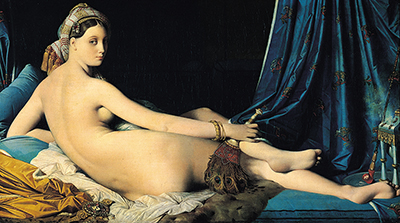
1801 (competition)Grande Odalisque
1814Louis XIII’s Vow
1824Monsieur Bertin
1832The Princesse de Broglie
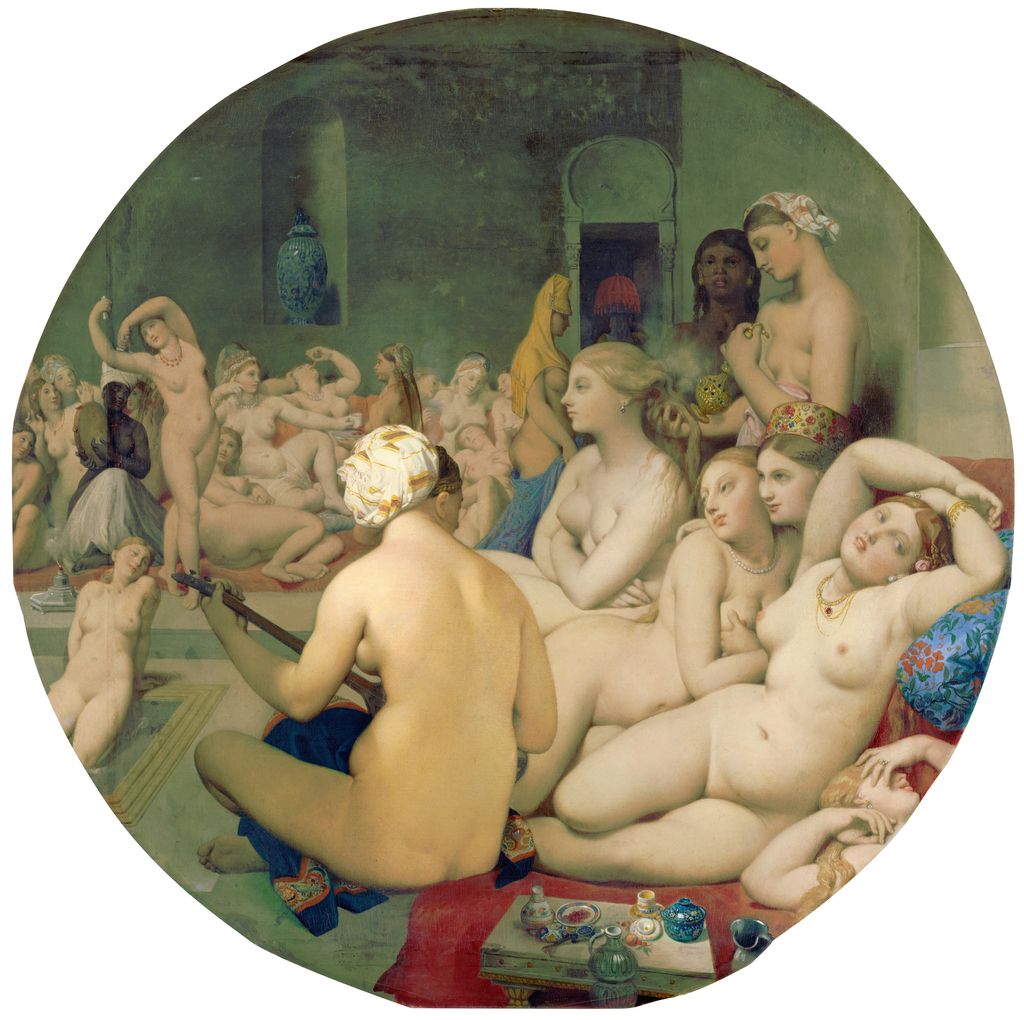
1851–1853The Turkish Bath
1859–1862Contents
- The face and the turning figure
- White fabric, red beads and a crowded shawl
- Cécile Bochet and the family commission
- A separate portrait on paper
- The oval and the later rectangle
- An image in print and in the Louvre
- Annotated details
The face and the turning figure
Madame Panckoucke looks towards us without squaring her body to the picture. Her head inclines gently towards the left of the image, while the exposed shoulder on the right carries the body away from that direction. The movement is slight enough to feel unforced. It also prevents the portrait from becoming a simple stack of head, shoulders and hands.
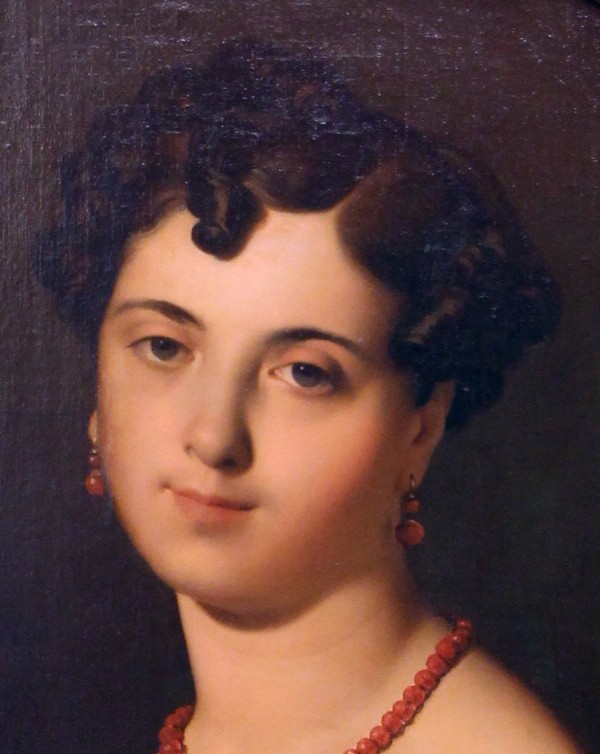
The dark curls are particularly effective in this arrangement. They gather above the forehead and at the sides of the head, with one curled lock descending towards its centre. Against the plain background, the hair’s irregular silhouette becomes legible before any individual strand does. The neck opens beneath it, then the necklace supplies another, much smaller boundary. Each change of scale brings the eye closer to the face.
The eyes are not perfectly level because the head is tilted. The mouth is closed, and its corners give little away. These are enough to make the expression engaging without supplying a reliable account of her thoughts. A viewer might find composure, reserve or a trace of amusement here. The picture allows those responses; it cannot tell us which describes the sitter’s experience of the sitting.
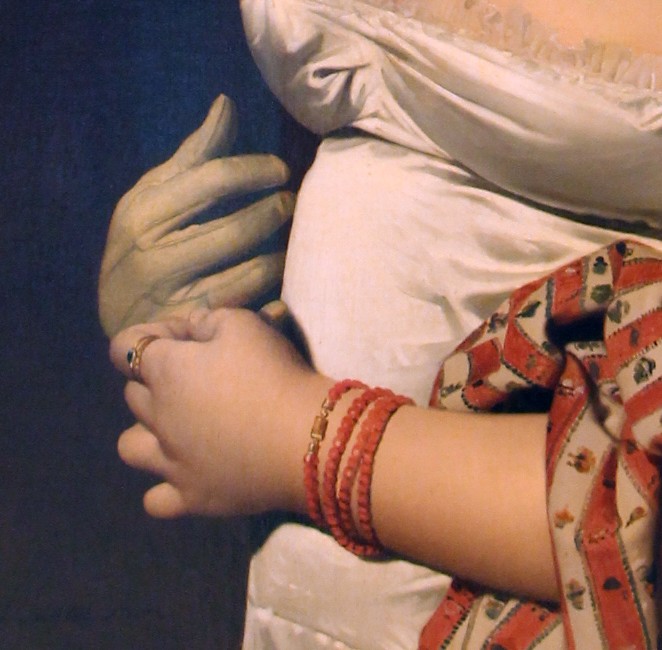
The hands offer a second point of attention. One rises towards the bodice beside pale gloves, while the other crosses lower down, with bracelets making a bright cuff around the wrist. The forearms create a loose enclosure across the body. That enclosure is open enough to accommodate the shawl, whose folds gather between the arm and the dress. What first seems a compact gesture turns out to organise several different materials.
There is no furnished room to explore behind her. The background gives the head and shoulders breathing space while keeping the details of dress close to the figure. Without a landscape, desk or architectural setting to carry the eye elsewhere, the portrait asks us to attend to the meeting of face, clothing and gesture.
White fabric, red beads and a crowded shawl
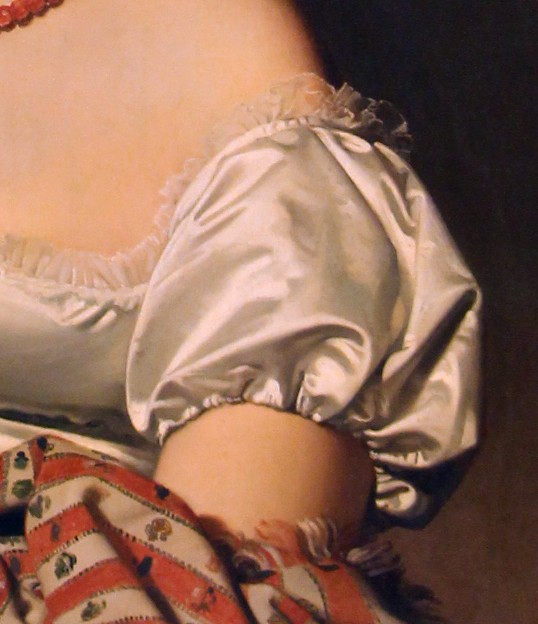
The dress is far from a blank white shape. Broad areas appear creamy or silver-grey, while sharper lights pick out folds around the neckline and the short puffed sleeve. Across the chest, the fabric pulls into a long, shallow sweep. At the sleeve it breaks into shorter, more angular ridges. Those different fold patterns let us read the garment as something both stretched across a body and gathered around it.
The exposed skin is quieter. Its transitions are broader and less broken than the highlights in the dress. The shoulder and upper arm consequently read as rounded forms beside the sleeve’s crumpled brightness. The contrast matters more than any attempt to count separate highlights: Ingres makes neighbouring pale areas feel unlike one another.
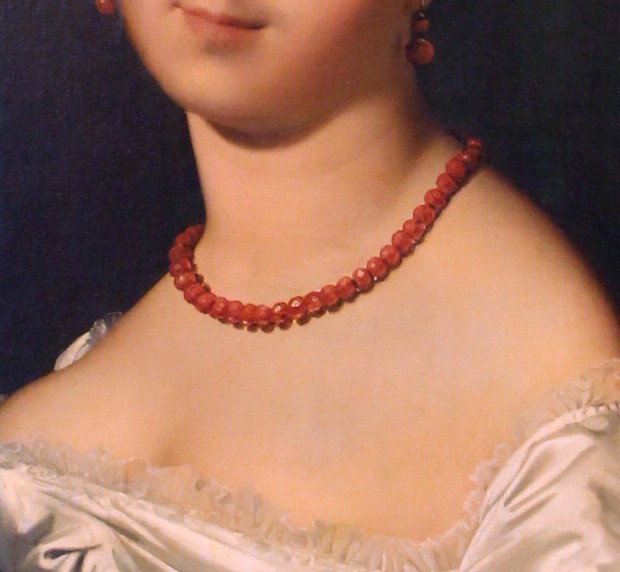
The red jewellery provides a different kind of clarity. The necklace remains easy to follow against the skin, and the bracelets repeat its colour lower down. Their small repeated units answer the curls above, but with greater regularity. The repetition links the face to the hands without requiring either to occupy the exact centre of the canvas.
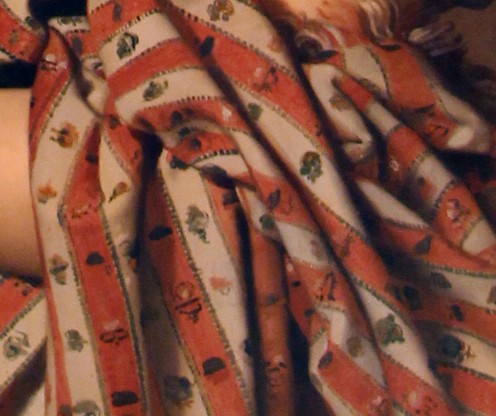
The shawl complicates this simple pattern. Its light and reddish stripes carry small dark motifs, and the stripes change direction as the cloth folds over the arm. Unlike the comparatively open chest and shoulders, this lower area is crowded with intersecting lines. The eye can follow one stripe, lose it in a fold and pick up another. The shawl gives the portrait a denser register of detail without covering the face or interrupting its outline.
These passages also create different kinds of visual weight. The sleeve seems light and inflated, the shawl heavier and more loosely suspended, the beads small and distinct. The pale gloves introduce another subdued colour near the hands. Even against a restrained background, the picture has a substantial colour structure: warm flesh, cool silvery fabric, dark hair and the scattered warmth of red. Its coherence depends on the relationships among them.
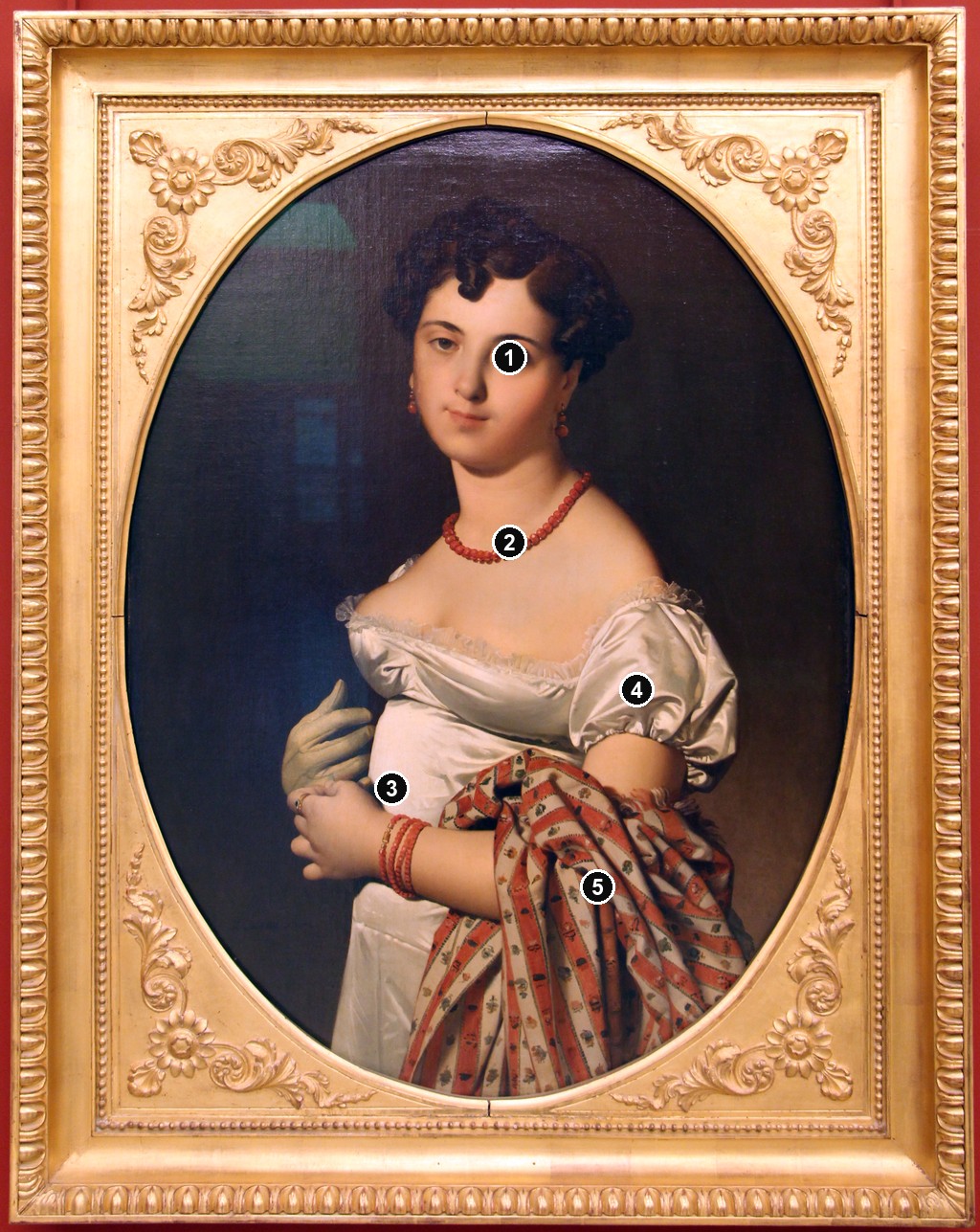
Annotated Details from Madame Panckoucke
The numbered points identify visible features discussed in this article. Return from each detail to the whole composition. Each caption identifies the work shown.
Madame Panckoucke — Framed Photograph
Madame Panckoucke beneath an oval frame. Photograph by Sailko; compare the framing with the full rectangular reproduction above. Wikimedia Commons. Image source. CC BY 3.0. Numbered overview: resized, with markers added. Detail images: cropped and JPEG-optimised. All these image derivatives are licensed CC BY 3.0.
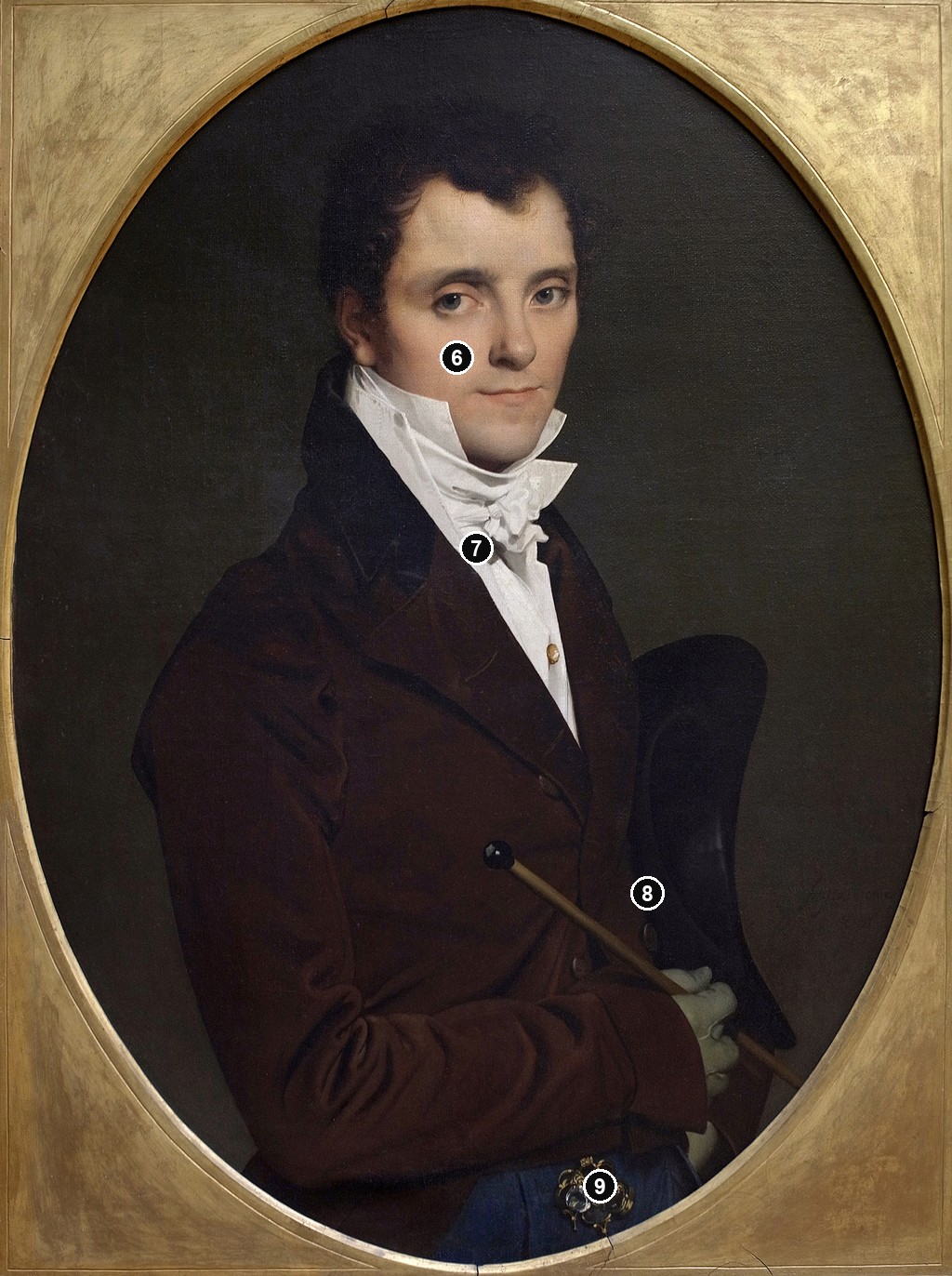
Edme Bochet
Ingres, Edme Bochet, 1811. Musée du Louvre, RF 194. The sitter was Cécile Bochet’s brother. Photograph: Philippel; Wikimedia Commons. Image source. CC BY-SA 4.0. Numbered overview: resized, with markers added. Detail images: cropped and JPEG-optimised. All these image derivatives are licensed CC BY-SA 4.0.
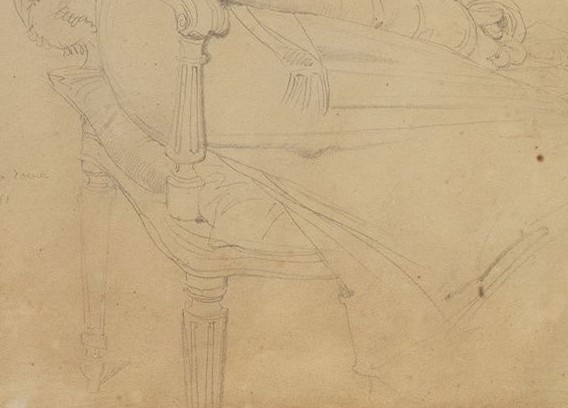
Madame Panckoucke — Separate Drawing
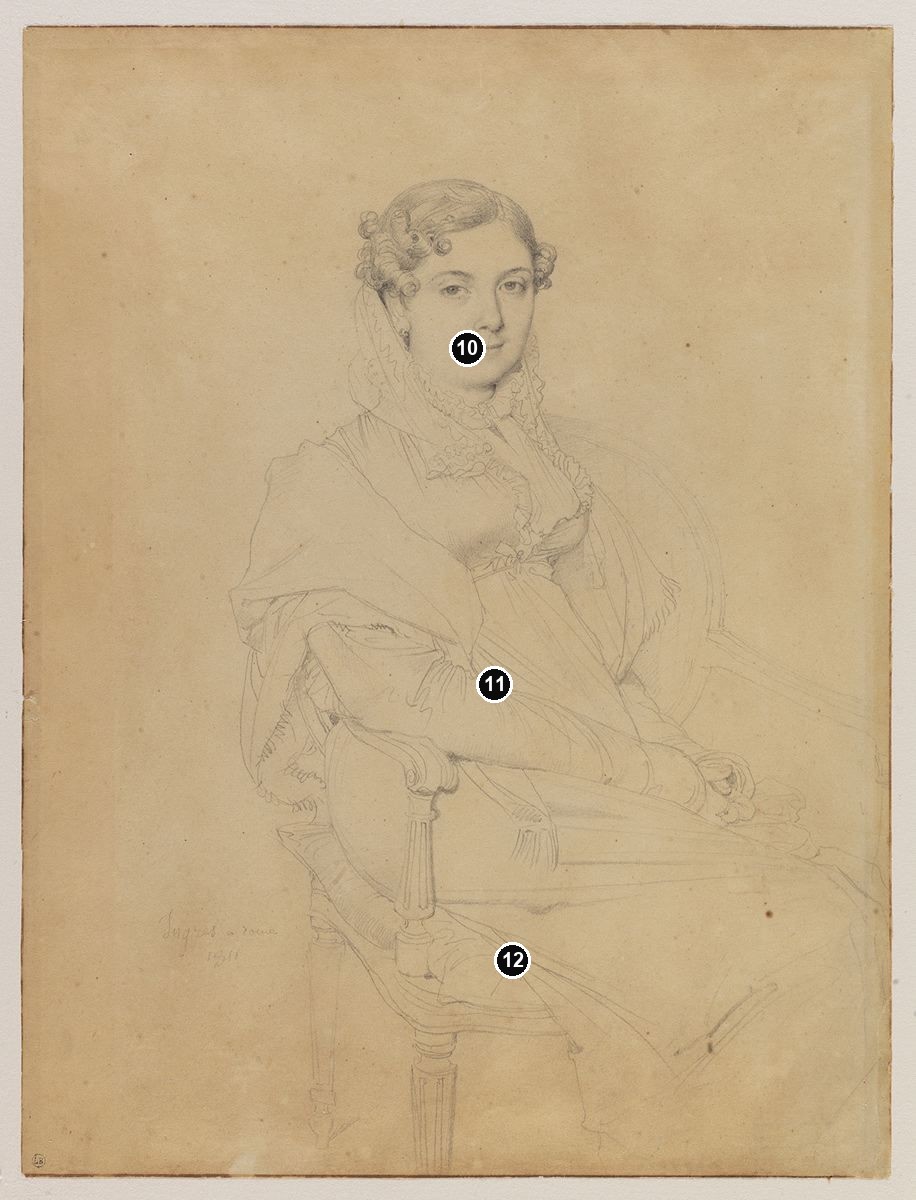
Ingres, Madame Panckoucke, 1811. Graphite portrait, Musée Bonnat-Helleu, Bayonne. A separate likeness on paper. Wikimedia Commons. Image source. Public domain.
Details from MADAME PANCKOUCKE
Compare Cécile’s painted portrait with her brother Edme’s canvas and her portrait on paper. Lapauze reproduced the drawing and painting separately in 1911; their order of making is not established by those images.
Madame Panckoucke — Framed Photograph
The tilted head beneath dark curls
Dark curls gather above the forehead and along the tilted head. The more open background gives this uneven outline room around the quieter face.
Red beads around the neckline
Small red beads form a clear curve below the neck. Their repeated rounded shapes contrast with the irregular pale lace and folds of the dress below.
The hands beside pale gloves
The hands and pale gloves gather beside the waist, with red bracelets encircling the lower wrist. Compare their overlapping shapes with the smoother stretch of forearm.
Bright folds across the puffed sleeve
The pale sleeve swells above the upper arm in several broad folds. Bright reflections and darker channels make a rounded shape beside the smoother bare shoulder.
The striped shawl over the arm
Light and reddish stripes bend over the arm and descend towards the lower edge. Small dark motifs move with these turns, making a dense pattern inside the oval.
Edme Bochet
The face above the white collar
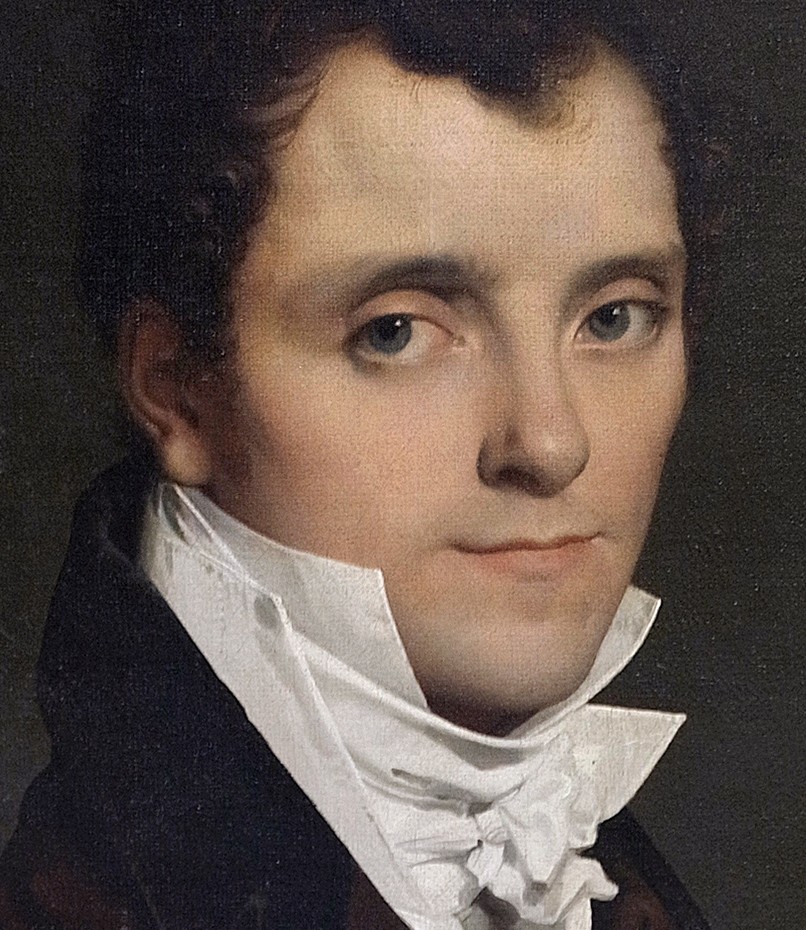
The face turns towards the viewer above a high white collar. Dark curls and the quieter background enclose the pale face without adding a separate setting.
White folds within the dark coat
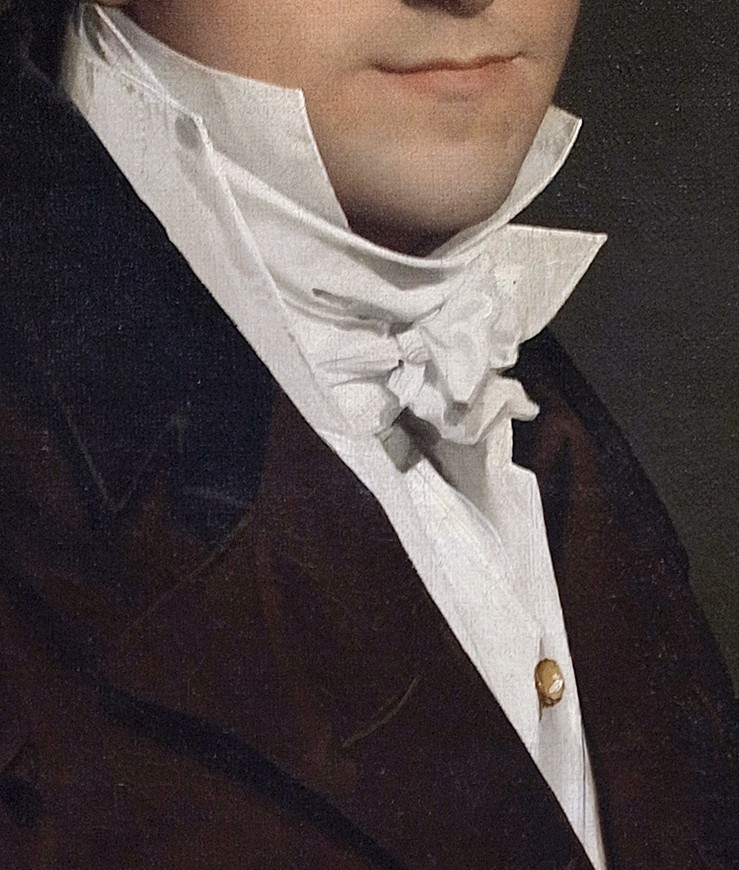
The high collar, tied cloth and white waistcoat create a bright inner shape beneath the darker coat. A small gold accent interrupts this narrow area of pale fabric.
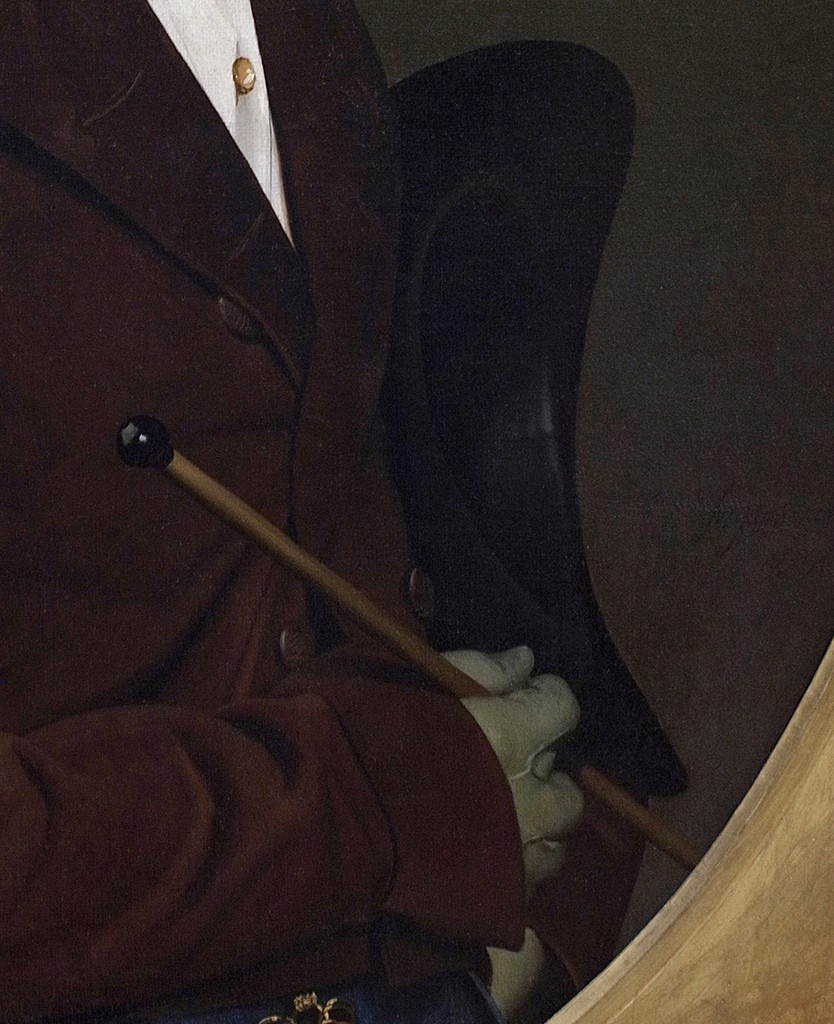
Gloves, cane and the tall hat
A gloved hand holds the cane beside the tall dark hat. The diagonal stick crosses the broad coat and brings a straighter line into the rounded pose.
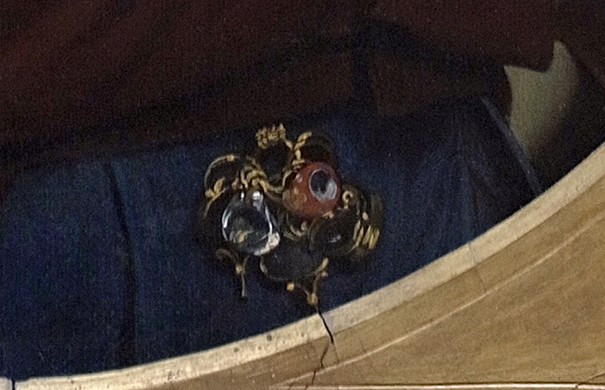
An ornament against blue trousers
A small ornament hangs against the blue trousers near the lower edge. Its warm and bright accents stand apart from the much broader areas of dark cloth above.
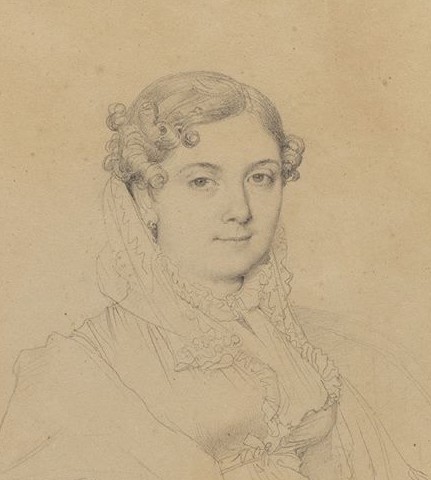
Madame Panckoucke — Separate Drawing
The head within a frilled collar
The small curls around the face meet the many points of the collar and the light veil. Compare the more concentrated face with the lighter lines describing the clothing.
The arms within a seated pose
The forearms cross the body above the curved chair arm. Long folds run through the sleeves and torso, joining the hands to the wider seated arrangement.
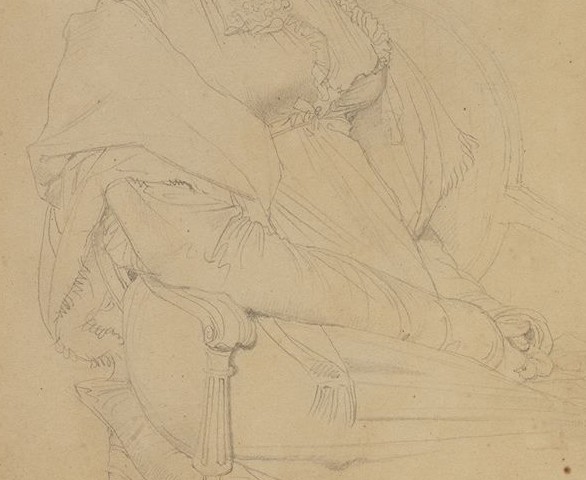
The chair support beside the skirt
The rounded chair support descends beside the long folds of the skirt. Its repeated curves and straighter lower leg give the seated figure a visible support.
Cécile Bochet and the family commission
The sitter was Cécile Bochet, sister of Edme Bochet. Her husband, Henri Panckoucke, worked in the land-registration administration; she later married M. Morande-Forgeot. The Louvre considers her brother the probable commissioner. [2] Philip Conisbee describes this and Edme’s 1811 portrait as pendants: companion paintings. Henri worked in the same Roman administration as Edme and died in 1812, aged thirty-two. [3] That later bereavement should not be read backwards into the sitter’s expression.
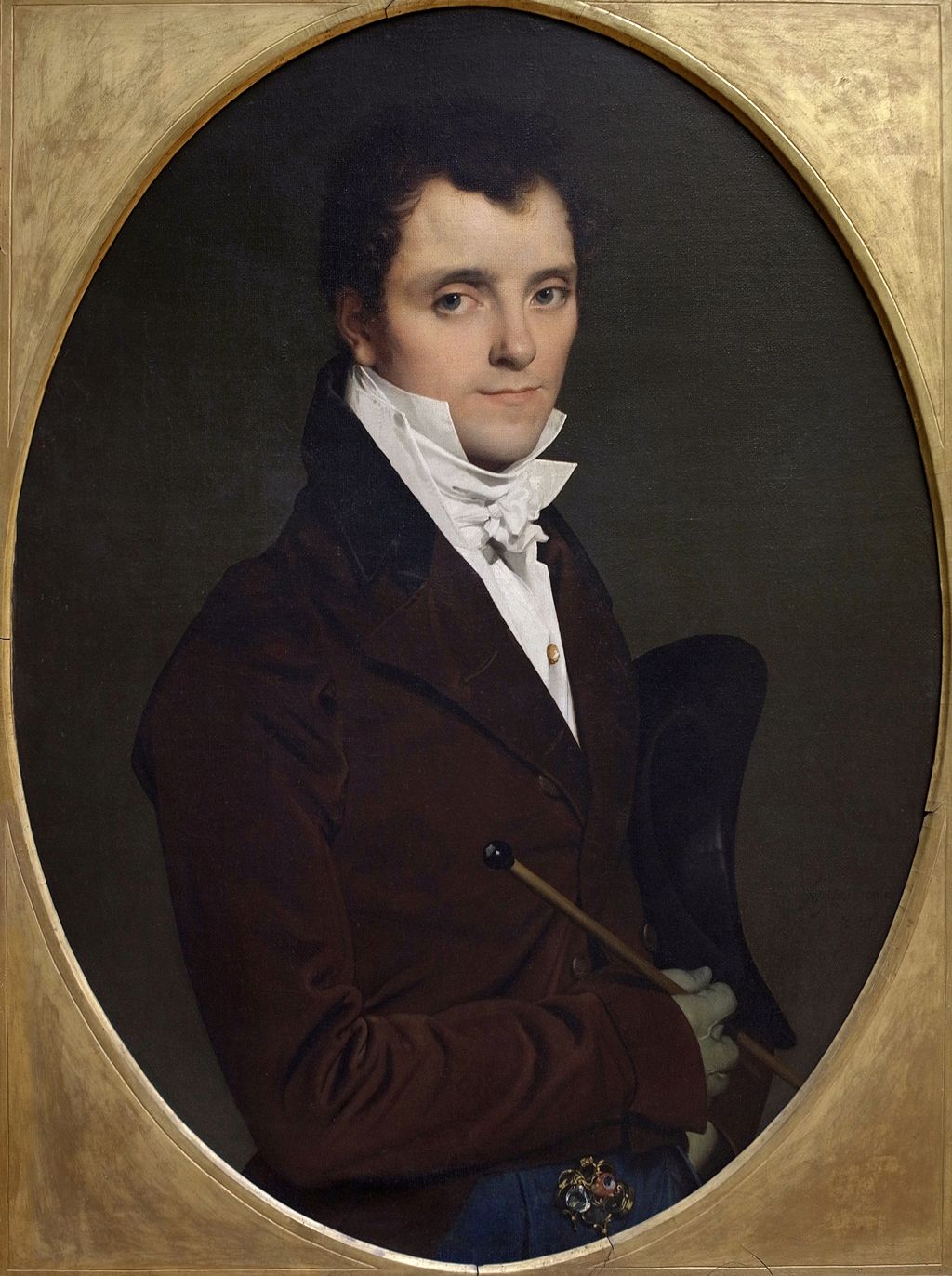
Ingres, Edme Bochet, 1811. Musée du Louvre, RF 194. The sitter was Cécile Bochet’s brother. [4]
The Louvre’s proposed family commission is useful context, but the commissioner’s identity is not firmly established. [2] Conisbee places the family within French administrative society in Napoleonic Rome, alongside sitters such as Charles Marcotte d’Argenteuil. [3] The wider pattern is explored in Ingres’s portraits.

Ingres, Portrait of Charles Marcotte d’Argenteuil, 1810. [5]
A separate portrait on paper
Another likeness of Madame Panckoucke dates from 1811: a pencil portrait catalogued at the Musée Bonnat in Bayonne. [6] Lapauze reproduced it in 1911 under the sitter’s married and maiden names, identifying the drawing with Bonnat’s collection. The painted portrait appears separately on plate 109, labelled as part of Henri Panckoucke’s collection. These captions describe the collections recorded in 1911; they should not be read as current ownership labels. The two reproductions give us a historical opportunity to compare the likenesses as distinct images. [7]
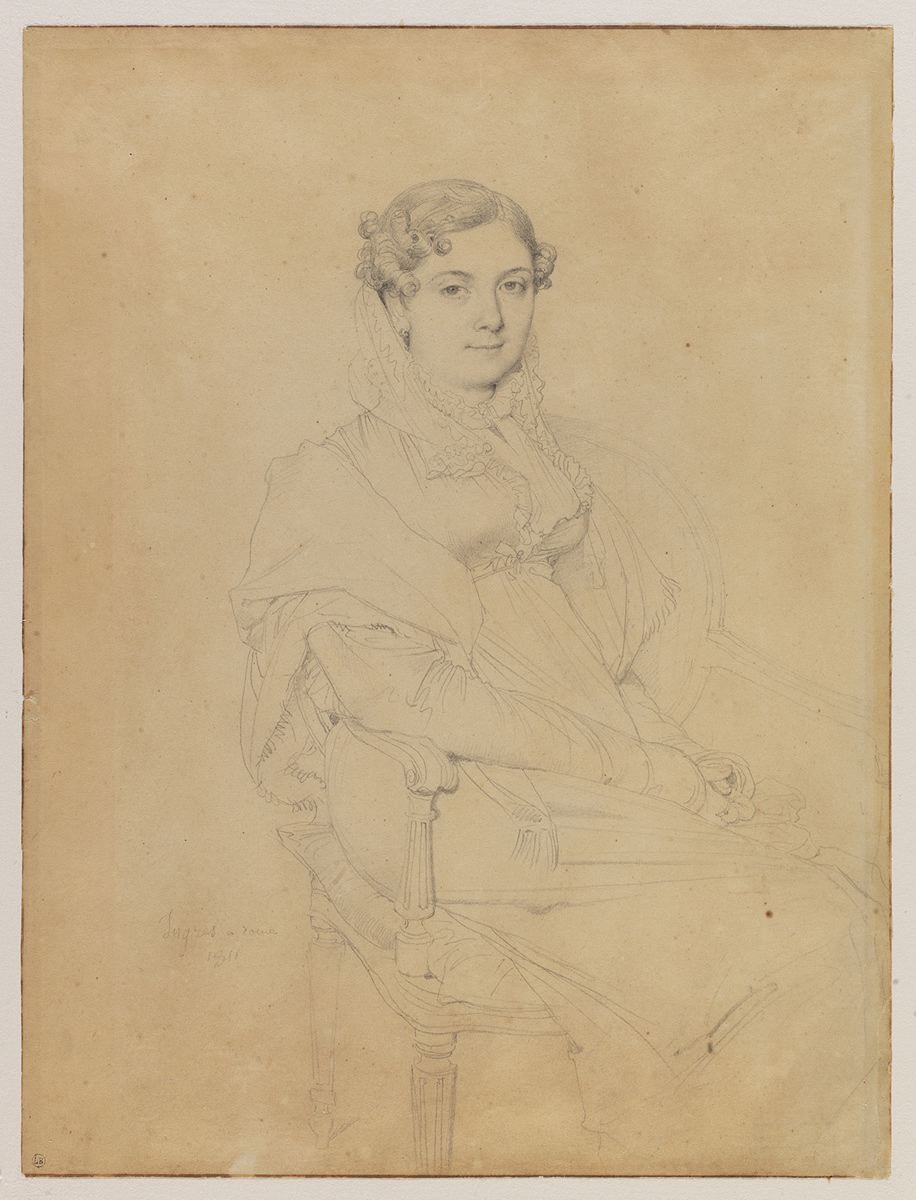
Ingres, Madame Panckoucke, 1811. Graphite portrait, Musée Bonnat-Helleu, Bayonne. A separate likeness on paper. [8]
The drawing gives the chair a conspicuous role. Its curved arm passes beneath the sitter’s forearm, then turns down into a support beside the skirt. A ruff and veil surround the face, while long lines carry the eye from the shoulders towards the hands. The painting offers another arrangement: bare skin above the white dress, hands gathered higher across the body, and a shawl filling the lower right. The sheet can be compared as an individual portrait within Ingres’s drawings. Neither 1911 reproduction establishes which likeness came first in the studio, or whether one prepared the other. Their shared year leaves that relationship open. [7]
The oval and the later rectangle
The Louvre records an original oval: the corners were painted in and both sides widened between 1921 and 1928. [2] An oval makes a continuous boundary around the figure; a rectangle emphasises corners and vertical edges. That change affects the space around the shoulders and shawl. The enlarged format belongs to the painting’s afterlife, beyond Ingres’s original composition.
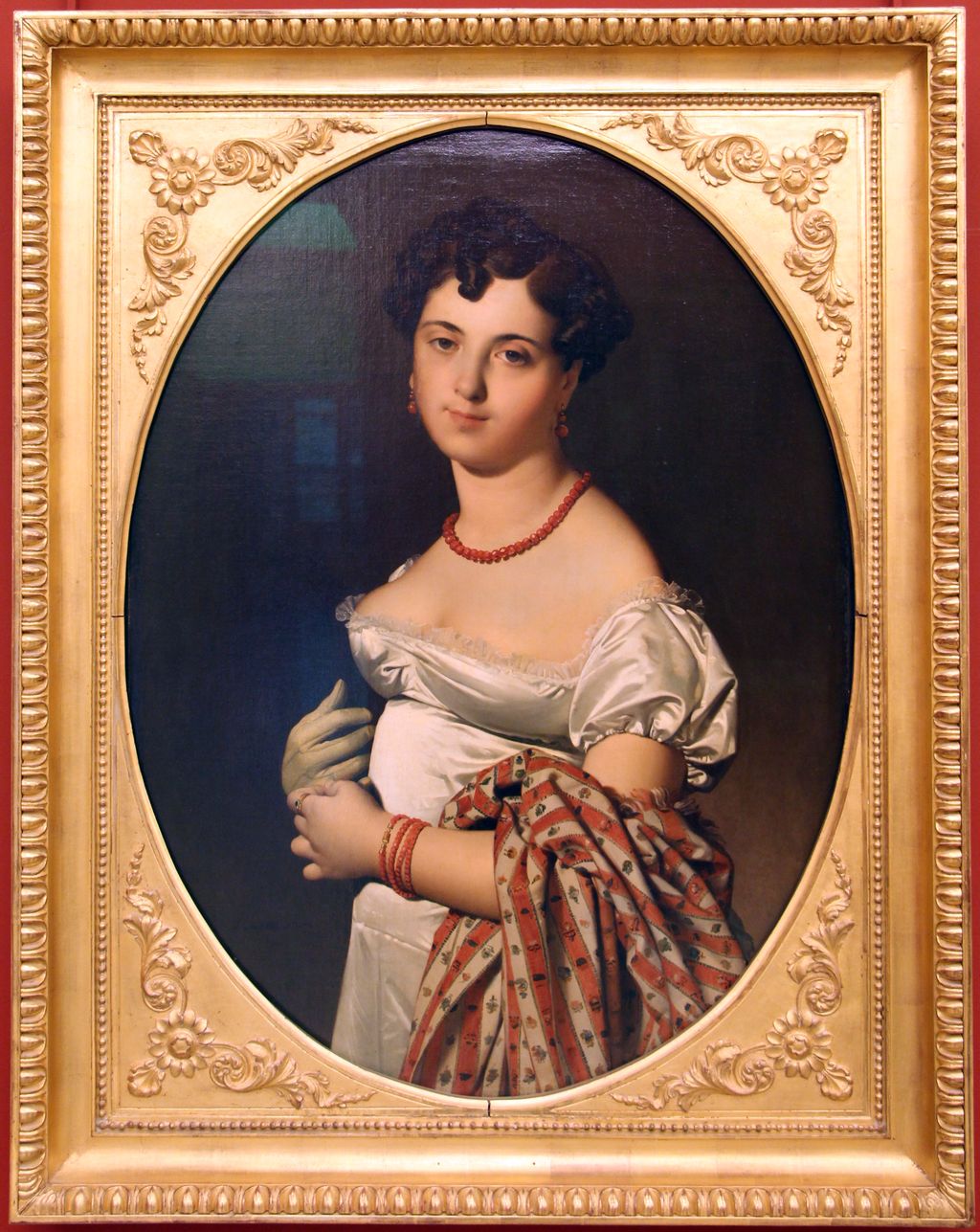
Madame Panckoucke beneath an oval frame. Photograph by Sailko; compare the framing with the full rectangular reproduction above. [9]
An image in print and in the Louvre
Henri Delaborde’s posthumous catalogue of 1870 lists the portrait under Madame Forgeot, records its Rome 1811 signature and notes an outline engraving in the publication issued by Magimel. It then belonged to M. Panckoucke. [7] The different surname is a reminder that historical catalogues may organise the same sitter’s likeness under names acquired at different stages of her life.
The French national collection database dates an engraving after the painting to 1851. [1] Reproduction gave the likeness a life beyond the privately owned canvas. An outline engraving necessarily changes the encounter: colour, tonal modelling and the distinction between flesh and shining fabric must be carried by a more restricted graphic vocabulary. The curls, neckline, arms and shawl offer conspicuous forms through which to consider that translation. Without comparing the actual impression, however, we cannot judge the engraver’s particular decisions. The broader relationship between painted originals and circulating images belongs to the history of prints and reproductions after Ingres. Joconde distinguishes the 1942 gift from the painting’s physical arrival in 1953. Carlos de Beistegui donated it subject to lifetime use, so ownership and possession changed at different moments. [1]
Artworks directory
Explore 150 paintings, drawings and an original lithograph. This selection includes related versions and studies; dates distinguish completed works from later revisions.
| Name | Date | Medium |
|---|---|---|
| The Apotheosis of Homer | 1827 | Painting |
| Grande Odalisque | 1814 | Painting |
| The Turkish Bath | 1859–1862 | Painting |
| Madame Moitessier Seated | 1856 | Painting |
| Portrait of Monsieur Bertin | 1832 | Painting |
| Napoleon I on His Imperial Throne | 1806 | Painting |
| Odalisque with Slave | 1839 | Painting |
| The Ambassadors of Agamemnon in the Tent of Achilles | 1801 (competition) | Painting |
| The Valpinçon Bather | 1808 | Painting |
| The Source | 1856 | Painting |
| Oedipus Explaining the Enigma of the Sphinx | 1808; revised probably before 1827 | Painting |
| The Vow of Louis XIII | 1824 | Painting |
| Antiochus and Stratonice | 1840 | Painting |
| The Comtesse d’Haussonville | 1845 | Painting |
| The Princesse de Broglie | 1851–1853 | Painting |
| Jupiter and Thetis | 1811 | Painting |
| The Dream of Ossian | 1813 | Painting |
| The Martyrdom of Saint Symphorian | 1834 | Painting |
| Venus Anadyomene | 1808–1848 | Painting |
| Portrait of Madame de Senonnes | 1814 | Painting |
| Madame Rivière | 1805 | Painting |
| Mademoiselle Caroline Rivière | 1805 | Painting |
| Portrait of Philibert Rivière | 1805 | Painting |
| Bonaparte First Consul | 1804 | Painting |
| The Death of Leonardo da Vinci | 1818 | Painting |
| Joan of Arc at the Coronation of Charles VII | 1854 | Painting |
| Madame Duvaucey | 1807 | Painting |
| La Belle Zélie | 1806 | Painting |
| Madame Panckoucke | 1811 | Painting |
| Portrait of Charles Marcotte d’Argenteuil | 1810 | Painting |
| Joseph Antoine Moltedo | c.1810 | Painting |
| Madame Leblanc | 1823 | Painting |
| Delphine Ingres-Ramel (Portrait of Madame Ingres) | 1859 | Painting |
| Portrait of Amédée de Pastoret | 1823–1826 | Painting |
| Portrait of Baronne de Rothschild | 1848 | Painting |
| Madame Marcotte de Sainte Marie | 1826 | Painting |
| Madame Gonse | 1852 | Painting |
| Aretino in the Studio of Tintoretto | 1848 | Painting |
| Don Pedro of Toledo Kissing Henry IV’s Sword | 1831/1832 | Painting |
| Raphael and La Fornarina | 1814 | Painting |
| Roger Freeing Angelica | 1819 | Painting |
| Romulus’ Victory over Acron | 1812 | Painting |
| Self-Portrait at the Age of Twenty-Four | 1804; revised 1841–1851 | Painting |
| Male Torso | c.1800 | Painting |
| Odalisque in Grisaille (Ingres and workshop) | c.1824–1834 | Painting |
| The Small Bather | 1826 | Painting |
| The Little Bather Harem Interior | 1828 | Painting |
| Jesus Among the Doctors | 1862 | Painting |
| The Virgin Adoring the Host | 1852 | Painting |
| The Virgin of the Host | 1841 | Painting |
| Virgin of the Adoption | 1858 | Painting |
| Paolo and Francesca | 1814 | Painting |
| Homer Deified (revised composition, Louvre RF5273) | 1865 | Drawing |
| Odalisque with Slave (Louvre RF4622) | 1858 | Drawing |
| Odalisque (Walters Art Museum; Ingres and Paul Flandrin) | 1842 | Painting |
| Madame Moitessier Standing (National Gallery of Art) | 1851 | Painting |
| Jacques-Louis Leblanc (The Metropolitan Museum of Art) | 1823 | Painting |
| Ferdinand-Philippe, Duke of Orléans (Louvre RF2005-13) | 1842 | Painting |
| Ferdinand-Philippe, Duke of Orléans (Versailles MV5207; Ingres and workshop) | 1843 | Painting |
| Ferdinand-Philippe, Duke of Orléans (Versailles MV5209; Ingres and workshop) | 1844 | Painting |
| Antiochus and Stratonice (Musée Fabre; Ingres and Raymond Balze) | 1866 | Painting |
| Antiochus and Stratonice (Kunstmuseum Bern, Gurlitt bequest) | Undated (early dating proposed) | Drawing |
| Composition study for Antiochus and Stratonice (MIB867.2193) | 1806 | Drawing |
| Study for the Figure of Stratonice (Met63.66) | 1834–1840 | Graphite, black chalk and charcoal |
| Nude figure study for Stratonice (Boijmans F II 36 PK) | c.1834–1840 | Drawing |
| Paolo and Francesca (The Barber Institute,54.6) | c.1814–1820 | Painting |
| Paolo and Francesca (The Hyde Collection,1971.24) | c.1855–1860 | Painting |
| Paolo and Francesca (Amsterdam Museum TA10970) | 1820 | Drawing |
| Paolo and Francesca (dedicated to Artaud de Montor) | 1816 | Drawing |
| Study for the Bust of Francesca (MIB867.1398) | 1819 | Drawing |
| Study for the Bust of Francesca (MIB867.1396) | 1819 | Drawing |
| The Archangel Raphael, first idea (MIB867.2488) | 1842 | Drawing |
| The Archangel Raphael (MIB867.2500) | 1842 | Drawing |
| The Archangel Raphael Carrying Human Prayers to God (Chantilly DE513) | 1844 | Drawing |
| Louis-Philippe as Saint Philip, stained-glass study | 1844 | Drawing |
| Marie Frédéric Eugène de Reiset (Ford Collection RBF171-2) | 1844 | Drawing |
| Virgil Reading the Aeneid (Toulouse) | Begun 1811 | Painting |
| Tu Marcellus Eris (Brussels, inv. 1836) | c.1814 (museum dating) | Painting |
| Jean-François Gilibert | 1804 | Painting |
| François-Marius Granet | 1807 (museum dating) | Painting |
| Count Nikolai Dmitrievich Guryev | 1821 | Painting |
| Caroline Murat, Queen of Naples | 1814 | Painting |
| Count Mathieu Molé | 1834 | Painting |
| Cherubini and the Muse of Lyric Poetry (Louvre) | 1842 | Painting |
| Luigi Cherubini (Cincinnati) | 1841 | Painting |
| Comtesse de Rayneval (Louvre RF4505) | 1841 | Drawing |
| Venus on Paphos (Antonie Balaÿ) | c.1852 | Painting |
| Prince Napoléon | 1855 | Painting |
| Study for The Apotheosis of Napoleon I (Petit Palais) | Late 1853 | Painting |
| The Apotheosis of Napoleon I (destroyed ceiling) | 1853 | Painting |
| The Journalist (MIB867.2733) | 1834? | Drawing |
| Henry VIII, after Holbein | c.1815–1820 (?) | Drawing |
| Madame Récamier, after David (MIB867.3637) | Undated (early Paris period) | Drawing |
| Study for Comtesse d’Haussonville (MIB867.259; background possibly by another hand) | 1842–1845 | Drawing |
| La Source (reduced version reported by Delaborde) | Date unrecorded; reported 1870 | Painting |
| Odalisque (autograph lithograph,NGA1946.21.117) | 1825; published1826 | Lithograph |
| Portrait of a Seated Lady | 1814 | Graphite |
| The Kaunitz Sisters (Leopoldine, Caroline, and Ferdinandine) | 1818 | Graphite |
| Portrait of a Man | 1814 | Graphite |
| Study for the Portrait of Louis-François Bertin (1766–1841) | n.d. | Black chalk and graphite |
| Studies for the Cadaver of Acron | ca. 1810–12 | Graphite on wove paper |
| Study for the Drapery of Molière in "The Apotheosis of Homer" | n.d. | Black chalk with stumping |
| Madame Guillaume Guillon Lethière, née Marie-Joseph-Honorée Vanzenne, and her son Lucien Lethière | 1808 | Graphite |
| Niccolò Paganini (1782–1840) | ca. 1830 | Counterproof or tracing strengthened with graphite and gouache on translucent paper |
| Lady Mary Cavendish-Bentinck (?-1843) | 1816 | Graphite |
| Madame Alexandre Lethière and Her Daughter Letizia | ca. 1815 | Graphite |
| Merry Joseph Blondel (1781–1853) | 1809 | Graphite |
| Ursin-Jules Vatinelle (1798–1881) | 1820 | Graphite |
| Bust of a Gypsy Girl (ascribed to Ingres) | 1819 | Graphite on wove paper |
| Study of a Seated Nude Male | n.d. | Graphite |
| The Archangel Raphael (Study for a stained-glass window in the chapel of Notre-Dame de la Compassion-Saint-Ferdinand, Neuilly) | ca. 1842 | Graphite |
| Lancelot-Théodore, comte Turpin de Crissé | probably 1818 | Graphite |
| Study for the Figure of the Iliad in "The Apotheosis of Homer" | ca. 1827 | Graphite and black chalk heightened with white chalk on brown paper |
| Comtesse Turpin de Crissé | probably 1818 | Graphite |
| Nude Figures for L'Âge d'Or, Château de Dampierre | n.d. | Graphite on brownish paper |
| Study of Figures (attributed to Ingres) | n.d. | Graphite |
| Study of Figures (attributed to Ingres) | n.d. | Graphite; squared in graphite |
| Admiral Sir Fleetwood Broughton Reynolds Pellew | 1817 | Graphite on wove paper |
| Madame Jean-Auguste-Dominique Ingres, née Madeleine Chapelle | 1814 | Graphite on off-white wove paper |
| Virgil Reading the Aeneid to Augustus, Livia, and Octavia | 1809/1819 (?) | Pen and black ink, graphite, brush and gray wash, white gouache heightening, Conté crayon on blue paper |
| General Louis-Étienne Dulong de Rosnay | 1818 | Graphite (hard and soft pencils) |
| Madame Alexandre Lethière, née Rosa Meli, and Her Daughter, Letizia | 1815 | Graphite |
| The Lawyer Paul Grand | 1834 | Graphite |
| Jean-Joseph Fournier | 1815 | Graphite |
| Armand Bertin | 1842 | Graphite |
| Madame Armand Bertin, née Marie-Anne-Cécile Dollfuss | 1843 | Graphite |
| The Architect Charles-Victor Famin | 1836 | Graphite |
| Henri Lehmann | 1850 | Graphite |
| Portrait of a Lady | ca. 1815–17 | Graphite |
| Edmond Cavé (1794–1852) | 1844 | Oil on canvas |
| Head of Saint John the Evangelist | probably ca. 1818–20 | Oil on canvas, laid down on wood |
| Madame Edmond Cavé (Marie-Elisabeth Blavot, ca. 1806–1883) | ca. 1831–34 | Oil on canvas |
| Madame Félix Gallois | 1852 | Graphite with touches of gold in oil to highlight jewelry, on buff wove paper. |
| Dr. François Mêlier | 1849 | Graphite with graphite framing lines, corrected with white, on buff wove paper |
| Portrait of Madame Rhode (Rhoda?) | 1810–20 | Graphite on pale buff wove paper |
| Study for "Raphael and the Fornarina"(?) | ca. 1814(?) | Graphite on white wove paper |
| Portrait of Madame Paul Meurice, née Palmyre Granger | ca. 1845–50 | Graphite on wove paper |
| Alexander the Great presenting Campaspe to Apelles | 1810 | Graphite, brush and brown wash; squared in graphite |
| Study of Hands for "Christ Among the Doctors" | 1852–62 | Graphite on tracing paper |
| Study for The Turkish Bath (RF34502) | about 1850 | Pen and brown ink with graphite, partially squared |
| Study for The Turkish Bath (RF23354) | Undated | Pen and brown ink with graphite on joined sheets |
| Study for The Turkish Bath (RF54702) | about 1859 | Pen and brown ink |
| Studies of women for The Turkish Bath (RF12292) | Undated | Black chalk |
| Achilles Receiving the Envoys of Agamemnon (Nationalmuseum sketch, NM2161) | 1801 | Oil on wood |
| Half-Length Bather (Musée Bonnat-Helleu,89) | 1807 | Oil on canvas |
| Oedipus and the Sphinx (National Gallery,NG3290) | about1826 | Oil on canvas |
| Oedipus and the Sphinx (Walters,37.9) | 1864 | Oil on canvas |
| Oedipus and the Valpinçon Bather, after David (MI.867.2035) | Undated | Graphite on tracing paper, after David |
| Study of the Virgin for The Vow of Louis XIII (Dijon,1758) | about1822 | Black chalk, stump and white chalk on brown wove paper |
| First Thought for The Vow of Louis XIII (MI.885.11.21) | 1822 | Oil on canvas |
Frequently Asked Questions
Cécile Bochet, sister of Edme Bochet and wife of Henri Panckoucke. [2]
The portrait is signed and dated Rome, 1811. [1]
The 1911 monograph reproduces the drawing and painting separately. It supplies no preparatory sequence between them; a shared date alone does not establish one. [7]
It belongs to the Louvre’s Department of Paintings, inventory RF 1942 25. [1]
Discussion
Look again at the images and ideas explored in Madame Panckoucke. These editorial prompts invite your observations.
Reader Insights
Follow the red necklace down to the bracelets, then look back at the face. Does the jewellery keep your attention moving through the portrait, or make the stillness of the expression more noticeable? Which passage—the face, sleeve, hands or shawl—holds your attention longest?
Compare the pale sleeve with the patterned shawl. Where does a small detail interrupt the larger arrangement of light and dark?
How might a different outer format change the balance around the sitter even when the figure remains familiar?
Join the Conversation
Share a detail, comparison or question about Madame Panckoucke below.
References
- Ministère de la Culture, Collections des musées de France (Joconde), Madame Panckoucke, notice 000PE001528, RF 1942-25. Updated 28 March 2025; identification, creation, inscriptions, reproduction and acquisition fields. (in French) View source.
- Musée du Louvre, Portrait de Madame Panckoucke, née Cécile Bochet (1787–1865), RF 1942 25. Updated 19 March 2026; historical and material record. (in French) View source.
- Philip Conisbee, catalogue entry on Edme Bochet, p. 135 and fig. 117; Kimberly Jones, catalogue entry on the Comtesse de Tournon, p. 138 and fig. 118, in Gary Tinterow and Philip Conisbee, eds., Portraits by Ingres: Image of an Epoch. New York: The Metropolitan Museum of Art, distributed by Harry N. Abrams, 1999. Selected passages on the Bochet family and the separate Panckoucke portraits. View source.
- Supporting image. Ingres, Edme Bochet, 1811. Musée du Louvre, RF 194. The sitter was Cécile Bochet’s brother. Photograph: Philippel; Wikimedia Commons. Image source. CC BY-SA 4.0. Resized and JPEG-optimised; image derivative licensed CC BY-SA 4.0.
- Supporting image. Ingres, Portrait of Charles Marcotte d’Argenteuil, 1810. National Gallery of Art, Washington, Samuel H. Kress Collection. Image source. Public domain.
- Yale University Press, A&AePortal, Cécile Bochet, Madame Panckoucke, image 81. Image metadata associated with Aileen Ribeiro, Ingres in Fashion: Representations of Dress and Appearance in Ingres’s Images of Women (1999); creator, date, medium and collection fields. View source.
- Henri Delaborde, Ingres, sa vie, ses travaux, sa doctrine, d’après les notes manuscrites et les lettres du maître. Paris: Henri Plon, 1870, p. 249, catalogue no. 120, Madame Forgeot. Posthumous compilation. (in French) Also Henry Lapauze, Ingres, sa vie et son œuvre (1780–1867), d’après des documents inédits, Paris: Imprimerie Georges Petit, 1911, pp. 107–111; drawing reproduced on p. 107 and painting on plate 109. Collection labels are historical; the reproductions do not establish a preparatory sequence. (in French) View source 1. View source 2.
- Supporting image. Ingres, Madame Panckoucke, 1811. Graphite portrait, Musée Bonnat-Helleu, Bayonne. A separate likeness on paper. Wikimedia Commons. Image source. Public domain.
- Supporting image. Madame Panckoucke beneath an oval frame. Photograph by Sailko; compare the framing with the full rectangular reproduction above. Wikimedia Commons. Image source. CC BY 3.0. Resized and JPEG-optimised; original photograph by Sailko, CC BY 3.0.
- Splash image. Jean-Auguste-Dominique Ingres, Madame Panckoucke, Rome, 1811. Oil on canvas, 93 × 68 cm. Musée du Louvre, Paris, RF 1942 25. Image source. Public domain.