by Tom Gurney
Tom Gurney BSc (Hons) is an art history expert with over 20 years experience
Published on June 19, 2020 / Updated on October 22, 2026
Email: tomgurney1@gmail.com / Phone: +44 7429 011000
Odalisque with Slave
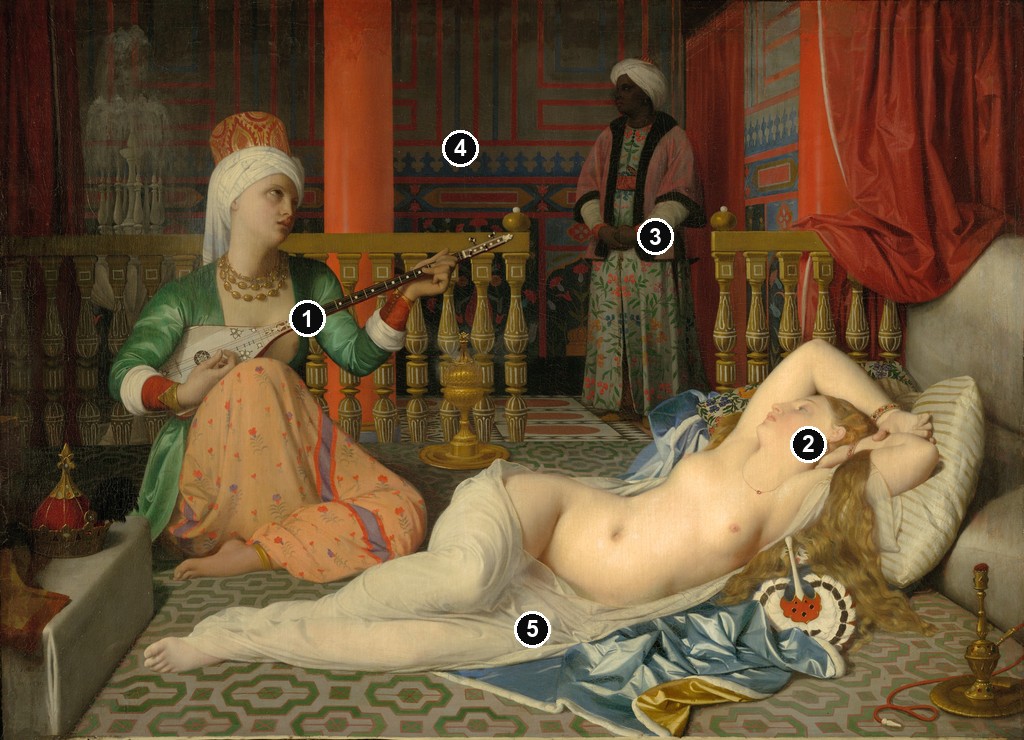
A reclining woman stretches across patterned carpets and crumpled silk. Beside her, a seated musician works the strings of a long-necked instrument; farther back, a standing attendant watches across a gilded balustrade. In Odalisque with Slave, the pleasure of looking is inseparable from an arrangement of bodies, objects and service. The pale, nearly naked figure occupies the foreground, while the people around her supply music and vigilance.
Jean-Auguste-Dominique Ingres painted this enclosed interior in 1839–40. It belongs to Harvard Art Museums, where it entered the Fogg Museum through the bequest of Grenville L. Winthrop. [1] The Walters’ garden version dates to 1842 and credits Ingres with Jean-Paul Flandrin. [2] Keeping the two objects distinct reveals how much a changed setting can alter a familiar composition.
At a Glance
- DateHarvard interior: 1839–40; Walters garden version: 1842
- ArtistHarvard interior: Jean-Auguste-Dominique Ingres; Walters garden version: Ingres and Jean-Paul Flandrin
- MediumHarvard interior: Oil on canvas; Walters garden version: Oil on canvas
- DimensionsHarvard interior: 72.1 × 100.3 cm; Walters garden version: 76 × 105 cm
- CollectionHarvard interior: Harvard Art Museums/Fogg Museum, Winthrop bequest; Walters garden version: Walters Art Museum, Baltimore, 37.887
- Distinguishing featureHarvard interior: Decorated wall closes the space; Walters garden version: Garden vista opens behind the group
Object details follow the museums’ records. [1][2]
This work across Ingres’s career
Agamemnon’s Ambassadors
1801 (competition)Grande Odalisque
1814Louis XIII’s Vow
1824Monsieur Bertin
1832The Princesse de Broglie
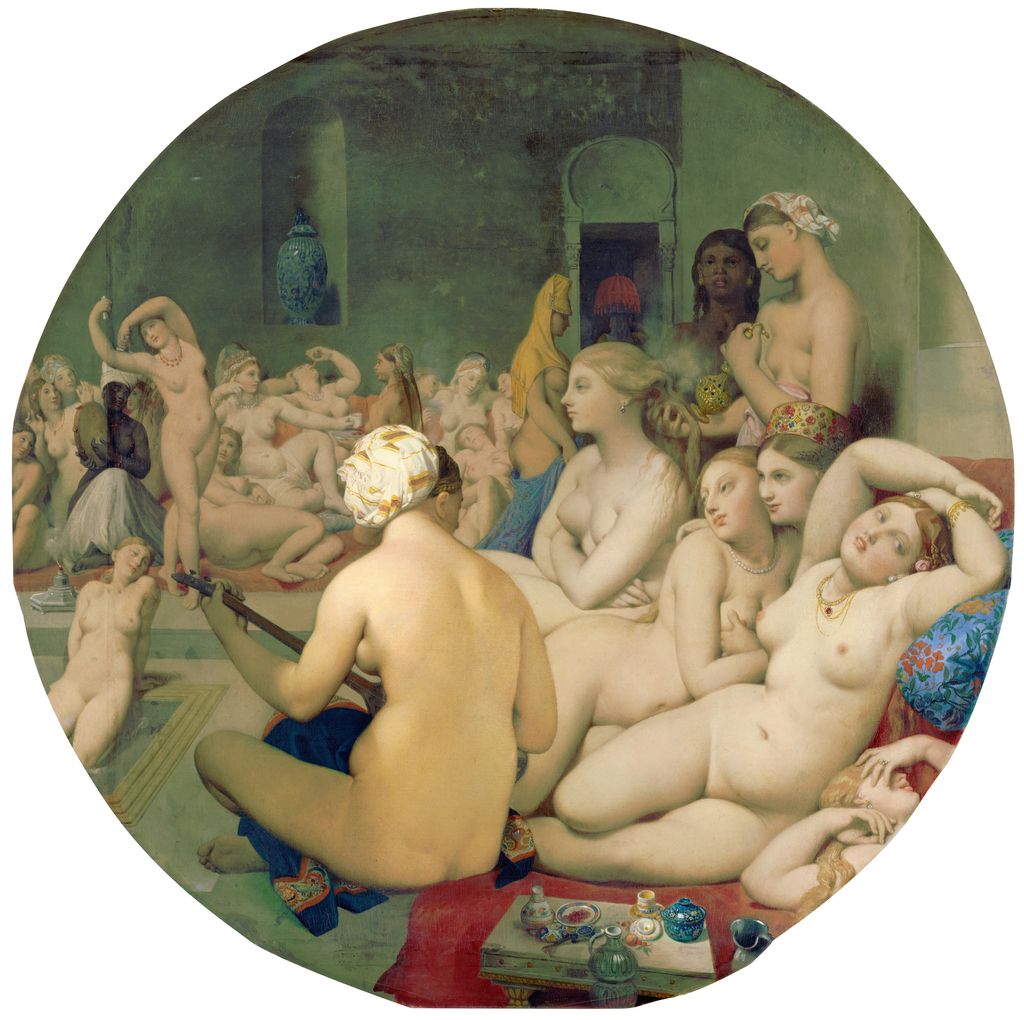
1851–1853The Turkish Bath
1859–1862Contents
- Looking across the room
- What does “odalisque” mean here?
- A painting for Charles Marcotte
- Music, stillness and the reclining nude
- The garden version and Paul Flandrin
- A later drawing, made as a gift
- From private collection to museum
- Annotated details
Looking across the room
The Harvard painting first catches the eye through contrasts of light and texture. The reclining woman’s skin forms a broad, relatively unbroken area within a surface crowded with ornament. Her head rests at the right, her feet extend towards the lower left, and her raised arms make an irregular frame around her face. A thin cloth passes over the lower body. It lets the legs remain legible while softening the point where the figure meets the carpet.
She lies diagonally, though the composition is wider than it is deep. Her torso rises towards the pillow, while the long sweep of her legs carries the eye back across the foreground. The position invites us to follow a continuous contour. At the waist and bent arms, however, that continuity changes direction, preventing the figure from becoming one simple arc. The eye moves between the outward sweep of the body and the smaller enclosure around the head.
The musician sits higher in the picture at the left. Her folded legs create a compact mound of orange fabric, patterned with small flowers and edged with bands of colour. A green outer garment surrounds her pale neckline and sleeves. Unlike the reclining figure, she is occupied: one hand meets the strings over the body of the instrument, and the other reaches along its neck. Her head turns towards the right and slightly upwards. The direction connects her visually to the other figures without making her a demonstrative performer facing an audience.
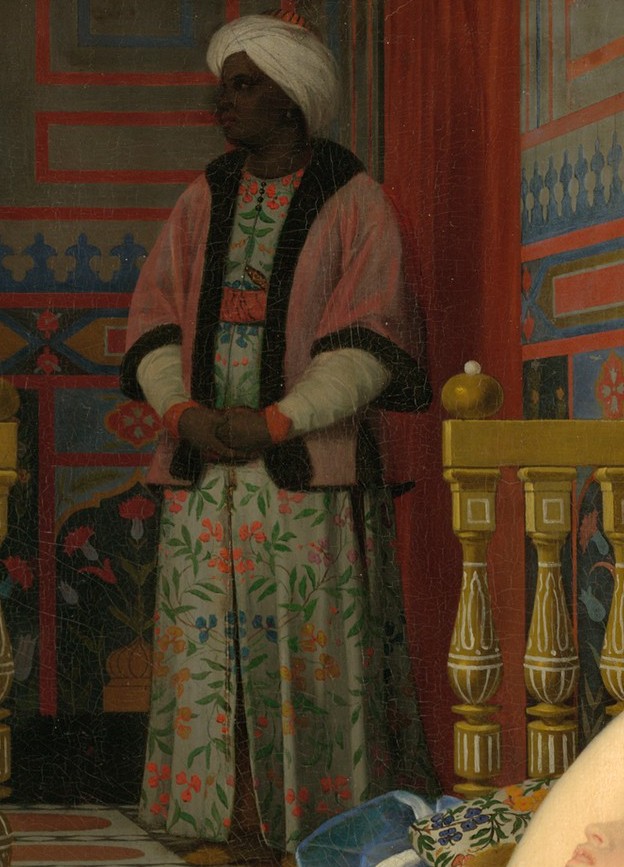
The standing man occupies a third level. His head rises above the balustrade, his hands meet near his waist, and his upright body answers the large orange column beside him. The different heights make the figures easy to separate: a long body close to us, a seated body to the left, an upright body behind. Yet the musician’s instrument cuts diagonally across the space between those levels. Its neck points towards the standing figure, carrying the eye away from the nude before the bright bedding draws it back.
The balustrade is particularly useful to watch. Its repeated golden supports establish a horizontal boundary behind the women, but a central opening allows the patterned floor to continue towards the attendant. He is set back without being sealed into a separate compartment. The rail also changes the scale of the ornament: broad areas of cloth in front give way to small repeated forms behind, then to the still finer decoration of the wall.
Surfaces that invite comparison
The textiles do more than describe wealth. Each offers a different kind of edge. The pillow beneath the woman’s head has a regular striped pattern. The blue silk beneath her shoulder gathers into sharp, reflective folds. The covering across her legs lies in softer, translucent layers. Those contrasts make the skin appear especially smooth, even though the entire arrangement is made of paint.
At the upper right, a large red curtain gathers and falls towards the couch. Its dense folds echo the lifted arms below, while its saturated colour gives weight to the corner. Across the lower edge, the blue drapery forms another concentration of folds. The figure lies between these two areas of fabric: a dark red canopy above and a cool, broken field below. Yellow lining exposed at the edge of the blue cloth adds a small warm accent close to the floor.
The carpet is less yielding. Its angular, interlocking pattern continues beneath the feet and around the bedding, giving the foreground a firm, almost diagrammatic surface. The woman’s curved outline reads clearly against those repeated angles. Ornament and anatomy are therefore closely involved with each other. The decorative setting helps us see the body’s shape; the body interrupts the decoration and gives it scale.
Small objects make the space feel occupied, yet they resist becoming a single story. A feathered fan lies close to the reclining woman’s hair. A metal vessel and a looping tube occupy the lower right. At the left, objects sit on a low surface, partly cut by the edge of the canvas. Their presence encourages the eye to linger, but the picture does not show an action that joins every object together. It offers a carefully assembled environment rather than an incident with an obvious beginning and end.
The wall behind the figures intensifies that effect. Panels and bands of ornament close the room, while the thick column interrupts the decoration with a largely unbroken orange surface. There is little distant space in which the eye can rest. Looking repeatedly returns us to the people and the objects immediately around them.
Annotated Details from Odalisque with Slave
The numbered points identify visible features discussed in this article. Return from each detail to the whole composition. Each caption identifies the work shown.
Odalisque with Slave — Harvard version
Odalisque with a Slave. Harvard. Wikimedia Commons. Image source. Public domain.
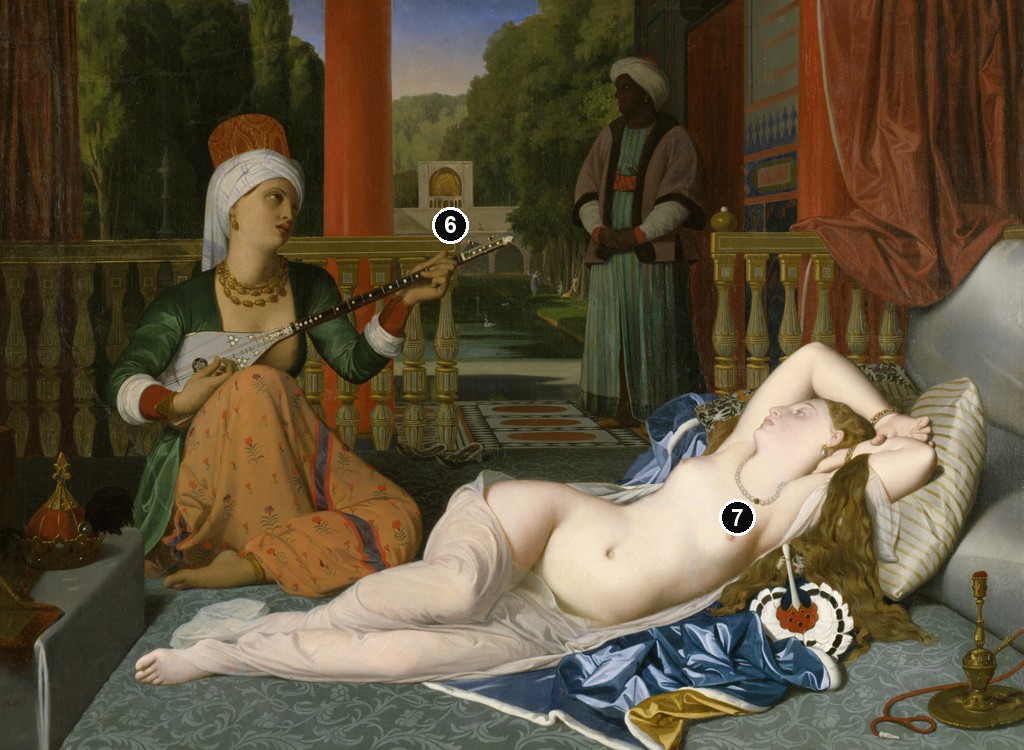
Odalisque — Walters garden version
Odalisque. 37.887. The garden version. Image source. CC0 / Public domain.
Details from ODALISQUE WITH SLAVE
Compare the music-making hands, reclining pose and standing figure, then look at the change from decorated wall to garden.
Odalisque with Slave — Harvard version
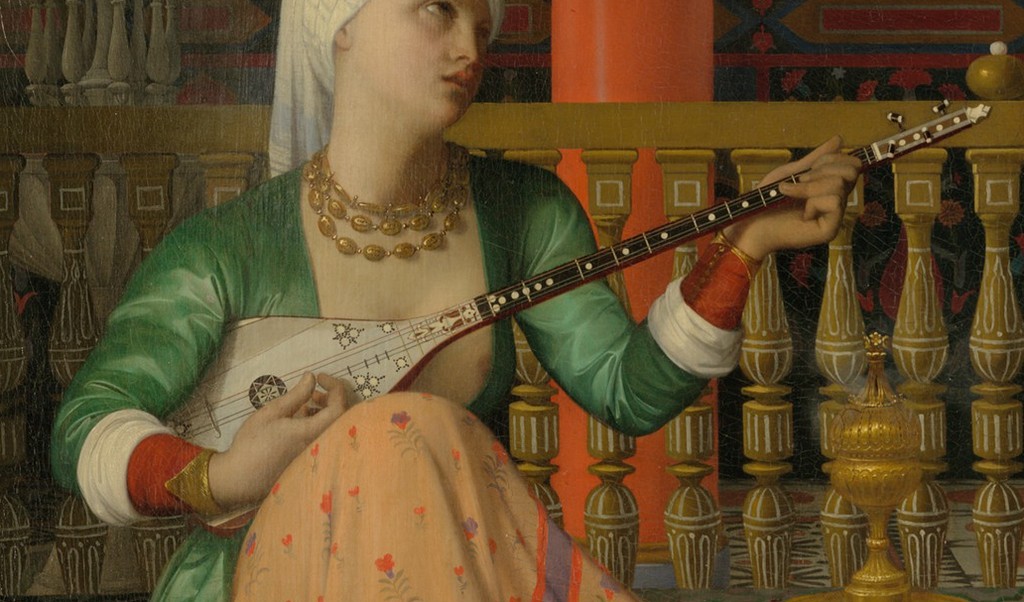
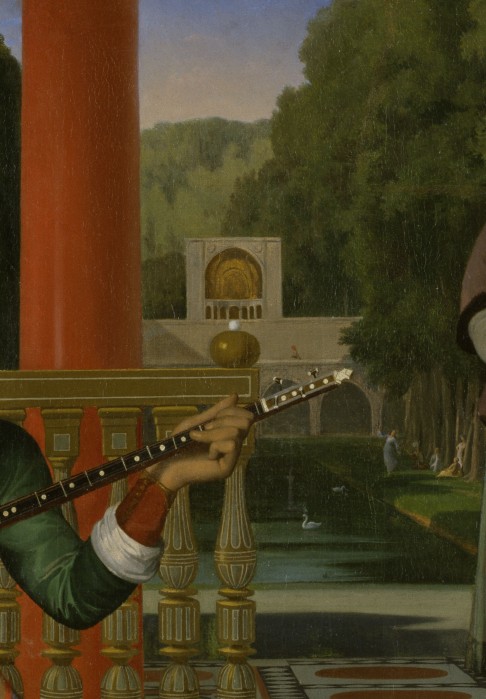
The musician’s hands and instrument
One hand meets the strings near the broad body of the instrument; the other reaches along its neck. The diagonal joins the two hands across the green sleeves and patterned skirt.
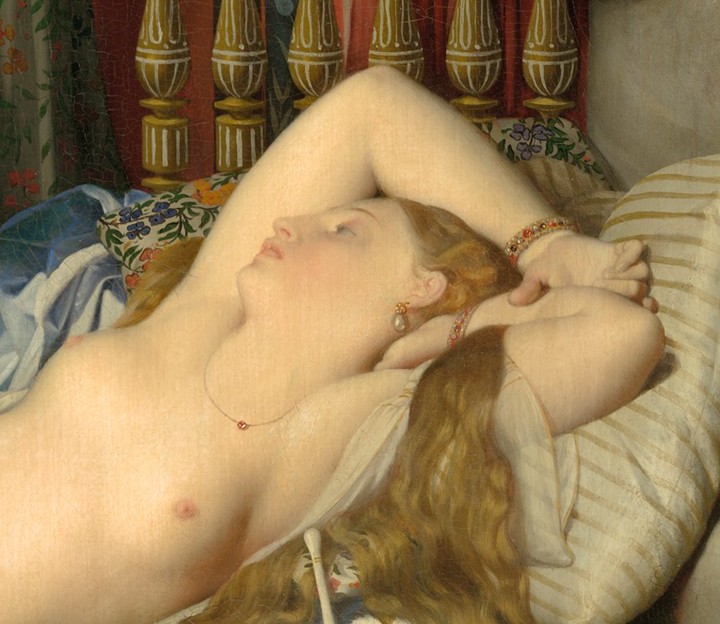
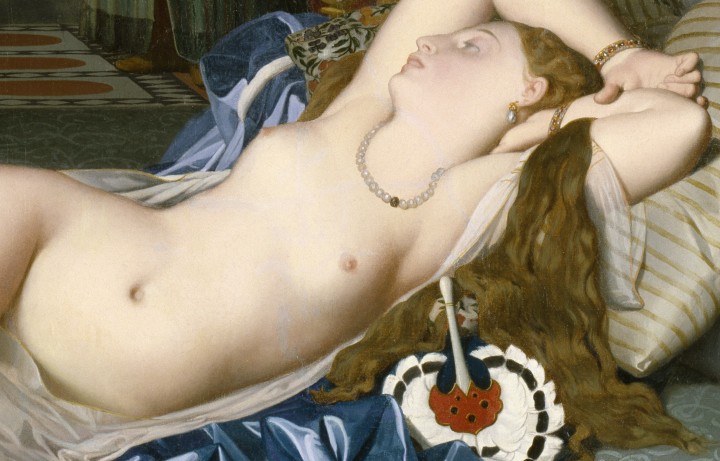
Arms around the reclining head
The lifted arms surround the tilted face. Pale skin, striped cushion and loose hair create different curves around the head, while small pieces of jewellery interrupt their edges.
The standing figure behind the rail
The upright figure occupies a narrow space behind the balustrade. Crossed hands, a floral garment and a pale head covering form a quieter vertical against the reclining body in front.
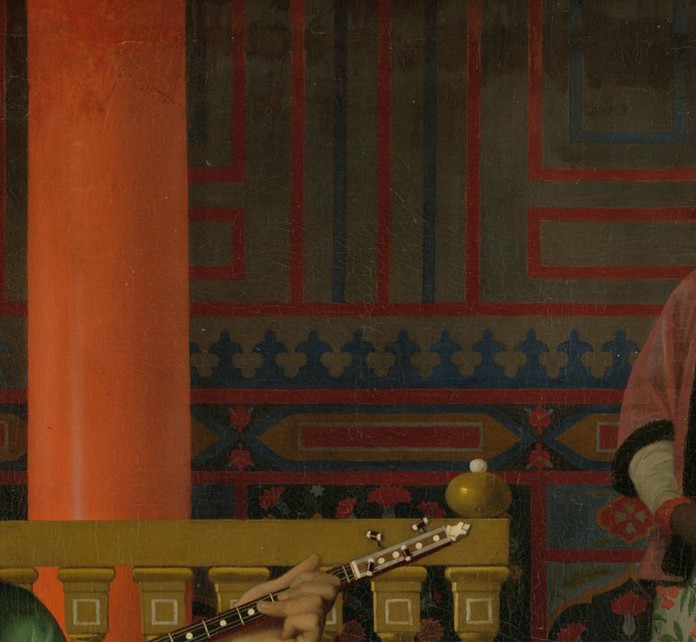
The wall and central column
A large red column divides the decorated wall. Repeated rectangular bands and smaller motifs continue around it, keeping the background as an enclosed patterned surface.
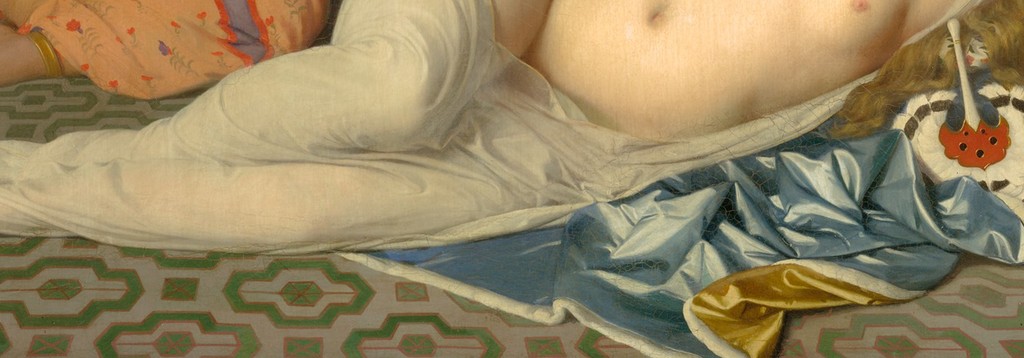
Linen, blue fabric and the extended legs
White cloth runs along the extended legs before meeting sharply folded blue fabric. The different folds carry the diagonal body towards the foreground and back towards the head.
Odalisque — Walters garden version
A garden beyond the rail
An opening now leads through trees towards water and a small architectural feature. Compare this recession with the flat decorated wall in the earlier painting.
Jewellery against skin and cloth
A necklace curves over the pale chest beside the long fall of hair. Blue folds and patterned cushions gather below, repeating the contrast between broad light surfaces and tightly described objects.
What does “odalisque” mean here?
The word carries a history that differs from the familiar European image of a reclining nude. The Louvre’s educational account defines an odalisque in Ottoman usage as an enslaved woman serving the women of a harem. European painting turned that position into an erotic subject, often presenting a woman at leisure amid luxurious furnishings. Ingres never visited the Ottoman Empire. His imagined interiors belong to European representations of it. [3]
This distinction matters because the title Odalisque with Slave can seem to divide the scene neatly between a privileged reclining woman and an enslaved companion. The historical term makes that division less secure. Neither the pose nor the richness of the room establishes freedom. Nor does the title identify named people whose individual circumstances we can reconstruct.
In the image itself, status is communicated through relationships. One woman receives attention while another performs. The standing figure remains at a distance. Clothes, position, illumination and bodily activity differentiate them before we know anything about the title. It is possible to understand that visual arrangement without treating the canvas as a reliable record of an actual household.
The room’s abundance also gives the spectator an unusually easy form of access. We see across the reclining body, into the musician’s hands and towards the attendant. No figure directly acknowledges our presence. The foreground offers a privileged view of a place presented as private. The standing man’s watchfulness makes that access more conspicuous: he marks a boundary inside the picture without preventing us from looking through it. The Walters interprets its figures through hierarchies of race, gender and labour, tentatively identifying the reclining woman as Circassian. [2] That proposal remains a reading of a European fantasy; it cannot identify the person who modelled for the picture.
Looking back at the Harvard interior, the issue becomes concrete. The lightest, most exposed body receives the greatest expanse of foreground space. The musician’s activity gathers around the instrument; the man’s dark face is placed against a darker background. Their unequal visibility is built into the composition. Close attention to that arrangement lets us recognise both the painting’s formal sophistication and the unequal world it imagines.
A painting for Charles Marcotte
The commission grew out of a durable friendship. Charles Marcotte, known as Marcotte d’Argenteuil, had met Ingres through the engraver Édouard Gatteaux. The friends’ extensive correspondence records a network in which paintings were discussed and judged as well as commissioned. [4]
Rebecca A. Rabinow’s chronology dates Marcotte’s order to 1834 and places completion in 1839–40, alongside Antiochus and Stratonice. The interval gives the painting a longer history than its finished appearance suggests. A scene of ease emerged from work spread across several years, during Ingres’s second Roman period. [5]
On 19 September 1840, Ingres announced that he had finished and dispatched Marcotte’s Odalisque the previous day, sending a crate to Paris through a merchant friend. The Musée Ingres Bourdelle preserves this document as probably a preliminary version; the slightly longer final letter belongs to the Fondation Custodia. [4]
His closing remarks bring the family into the exchange. He invokes Madame Marcotte’s modest eyes while asking her indulgence towards the picture’s erotic character. [4] A private commission still had to negotiate the expectations of a household; the imagined room would enter a real one. The dated message also explains why a painting associated with 1839 can be catalogued as 1839–40. A signature date and the moment of completion need not be identical: Delaborde’s account likewise places the finishing work in 1840. [1][6]
Ingres’s doubts and the work of finishing
Henri Delaborde’s posthumous book of 1870 publishes further correspondence about the painting. Its catalogue entry records the 1839 signature and explains that the work was completed in the second half of the following year. An August letter to Marcotte anticipates finishing and sending the canvas; a September letter to Gatteaux describes difficult work in oppressive heat. These are contemporary letters transmitted through a later editor, and they give a more complicated account than the apparent stillness of the finished room. [6]
Ingres told Gatteaux that the painting had required care, intelligence and determination. He distinguished that laborious progress from the more spontaneous momentum he would have preferred. He was also uncertain how the result would be received. Such remarks describe his judgement at a particular moment. They do not establish that the painting failed or that every unusual contour should be read as a symptom of frustration. [6]
By December, Gatteaux’s favourable response had reached him. Ingres expressed surprise at the picture’s success and compared it with Stratonice, which he valued differently. The exchange shows how much depended on trusted viewers. Marcotte was the owner, Gatteaux a sympathetic intermediary, and the painter continued to argue about his work after it had left the studio. [6]
Especially revealing is Ingres’s statement that many elements, perhaps almost all, had been painted from drawings in the absence of the living model. He also discussed the difficulty of positioning and lighting a model to match a desired picture. That account helps explain why the painting should be considered as a construction assembled through study and adjustment. It does not mean that he never used models in preparing it. [6]
The difference is visible in the finished work’s coordinated shapes. The raised arms, the long diagonal of the instrument and the upright column seem to belong to a single visual order even though the bodies occupy different positions. The composition asks the figures to serve relationships within the rectangle. Its persuasiveness comes from the way those relationships hold together, rather than from the claim that everything was observed at once in one room.
The frame was part of the discussion
Delaborde also preserves Ingres’s requests for a broad, richly ornamented frame. His suggestions moved between an idea of Turkish decoration and the ornaments described as modern Gothic, with particular finishes he wanted avoided. The language reveals a painter actively considering how an imagined foreign interior would meet a Parisian domestic setting. [6]
It is a revealingly hybrid proposal. The surroundings were to extend the picture’s decorative effect through ornaments available to its owner, rather than reproduce a securely documented Ottoman object. The requested frame would have stood at the point where Marcotte’s own room met the room in the painting. We need not identify any surviving frame as that commission to recognise the care Ingres gave to the transition.
Music, stillness and the reclining nude
The musician gives the Harvard scene a duration. Her hands suggest an activity that would continue, while the woman beside her remains at rest. A painted instrument cannot tell us what melody is being played, or whether the reclining woman is listening attentively. Yet the difference between performance and repose makes the scene feel suspended within an ongoing interval.
The instrument’s narrow neck has a particularly strong compositional role. Against the upright forms of the rail and column, it introduces a decisive sloping line. The musician’s fingers make that line intelligible as something handled, rather than simply another decorative stripe. Her pose joins skilled activity to the broader pattern of the room.
Music was familiar to Ingres through practice: Rabinow’s chronology records violin study and orchestral playing in Toulouse in his youth. Delaborde’s collection of his sayings connects musical training with the painter’s judgement: “If I could make you all musicians, you would gain from it as painters” — our translation. The surrounding passage compares the right relationships of forms with the right relationships of sounds. [5][6]
That comparison offers a useful way to look at this picture, without making it an encoded score. The large forms establish an arrangement, while the small ornaments vary its pace. Red appears in the curtain, column and the musician’s cuffs; green clothing responds to the patterned foreground; jewellery and metalwork punctuate the scene with small points of light. The relations between these colours matter as much as the clarity of the outlines.
Following the instrument draws attention to the person who plays it. Her carefully placed fingers bring a kind of concentration into the room that differs from the reclining woman’s ease. Music is both a subject within the scene and a means of drawing the eye towards its second female figure.
From Grande Odalisque to a social scene
The obvious comparison is Grande Odalisque, dated 1814 and shown at the Salon of 1819. That painting presents a woman largely from behind, turning her head towards the viewer. Its commission for Caroline Murat belongs to a different patronage history from Marcotte’s later picture. [7]
In Odalisque with Slave, the body turns towards us, but the face does not meet our gaze. The raised arms surround the head, and the eyes appear closed. The setting also supplies two other people, each with a separate task. The move from a single figure to a small group changes the subject of our looking. A body is now embedded in a visible arrangement of attention and service.
These are separate compositions, not stages revealed by repainting one canvas. Their kinship lies in the repeated experiment with reclining bodies, textiles and an imagined private setting. The Louvre’s account of Ingres’s earlier work places the reclining woman alongside another recurring type: the seated nude seen from behind in the Valpinçon Bather of 1808. [8]
The later Turkish Bath, completed in its circular form in 1862, brings many female figures into a much more crowded enclosure. [9] Seen between those works, Odalisque with Slave has a distinctive economy. Three people and a small number of strong directions are enough to establish the setting. The musician is especially important to that balance: she gives repose a companion activity and makes the pleasure represented in the picture depend on someone’s work.
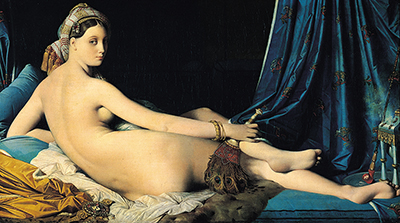
Ingres, Grande Odalisque, 1814. [10]
The garden version and Paul Flandrin
Wilhelm I of Württemberg commissioned the Walters canvas. [2] The principal figures remain recognisable, but the wall behind them gives way to trees, water and a distant architectural feature. The red curtain, column and golden rail preserve enough of the interior to make the opening feel like a deliberate change within the same visual structure.
The most immediate effect is depth. In the Harvard picture, the surface behind the group is richly patterned and close. In the garden version, the eye passes between the rail and the standing figure towards a receding stretch of water. The little arch and fountain-like feature provide a distant destination. The reclining woman still occupies the foreground, but she no longer holds the eye against a closed decorative background.
The opening also changes the standing figure’s role in our looking. In the interior, he belongs to the wall’s dark, ornate setting. In the garden version, his upright silhouette marks the edge of an outward view. He becomes a stronger hinge between the human group and the space beyond. The garden invites a spectator to imagine movement away from the couch, even though the people remain in place.
Other differences reward a slower comparison. The carpet has a more softly flowing floral pattern in the garden picture. The reclining woman wears a more conspicuous necklace, and her hair spreads prominently beside the pillow. The blue silk below her shoulder remains a field of crisp, reflective folds. Repetition preserves the composition’s main relationships while allowing its surfaces and accents to change.
Georges Vigne’s study of Ingres’s collaborators discusses testimony published in 1890 in which Flandrin recalled being assigned the repetition. According to that account, he painted both figures and landscape; Ingres selected a landscape motif from Flandrin’s study of the park at Dampierre and probably retouched the figure. Vigne acknowledges difficulties in assessing a late recollection. It is evidence for a substantial contribution, rather than a precise map of every surviving brushstroke. [11]
The Walters records both artists and a dated 1842 inscription; the older discussion used 1841. [2][11] A collaborative painting can still develop Ingres’s composition, and a pupil’s contribution can extend beyond the background. The attribution asks us to recognise both the directing artist and the painter working with him.
This case should not become a rule for all Ingres landscapes. Charlotte Hale’s technical study of other paintings found no clear evidence of a second hand in the portrait of Granet and linked figure and landscape within the making of Moltedo. Those examinations concerned different canvases; they show why authorship needs to be considered work by work. They neither erase the evidence for Flandrin here nor justify assigning unrelated backgrounds to another painter. [12]
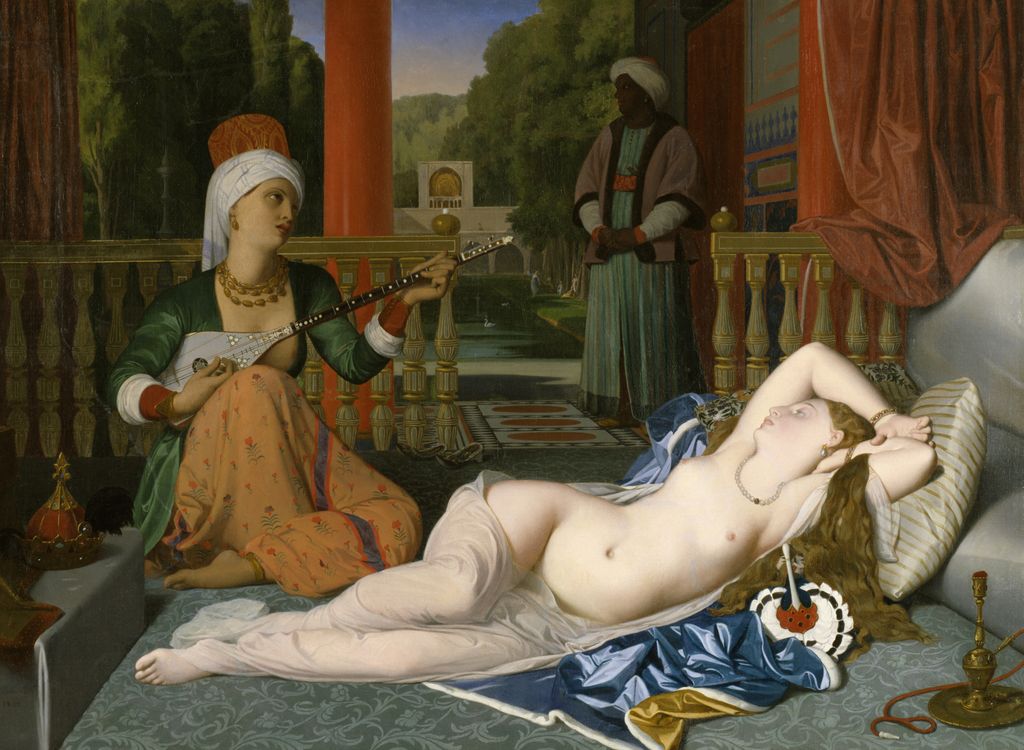
Ingres and Jean-Paul Flandrin, Odalisque, 1842. The Walters Art Museum, 37.887. The garden version. [13]
A later drawing, made as a gift
The composition’s life continued on paper. The Louvre owns a signed drawing dated 1858, L’Odalisque à l’esclave, RF 4622. Its record describes graphite, pen and brown ink, brown wash and white heightening on mounted tracing paper, measuring 34.5 × 47.5 cm. The museum identifies it as a return to the first, enclosed composition, reduced to approximately half its painted dimensions. [14]
Ingres gave the drawing to Émile Galichon; it later belonged to Roger Galichon and entered the Louvre through his bequest in 1918. [14] This is an instructive reversal of the usual sequence assumed between drawing and painting. A drawing related to a finished canvas may revisit it many years later as an independent gift. Its relationship to the interior does not make it an initial study for that painting.
The choice of the first setting also matters. The garden repetition had already demonstrated that the group could be opened towards landscape. In returning to the enclosed arrangement on paper, Ingres preserved another version of the composition’s identity. An artist’s repeated use of a subject need not lead in one direction towards a final, definitive solution.
The Louvre’s commentary also connects the drawing with William Haussoulier’s engraving in the Gazette des Beaux-Arts in 1868. Delaborde’s catalogue records both the Galichon drawing and an engraving after the subject. [6][14] This is a specific route from painting to drawing to printed reproduction. It helps explain how the composition could circulate beyond the rooms of its owners without requiring us to treat every later image as a direct copy of the canvas.
From private collection to museum
The painting’s beginnings were private, but its early audience widened. Rabinow records Marcotte’s loan of Odalisque with Slave to the 1846 exhibition at the Galerie des Beaux-Arts on boulevard Bonne-Nouvelle. It appeared among eleven Ingres paintings in a separate room. Delaborde also records its appearance at the Universal Exhibition of 1855. [5][6]
Those occasions belong to this painting’s own history. The Salon of 1819 belongs to Grande Odalisque; its much-discussed reception should not be transferred to Marcotte’s picture. Here, the letters supply a different early story: the work’s delayed completion, dispatch to a friend and favourable response from Gatteaux, followed by opportunities for a larger public to see it. [4][5][6][7]
Harvard’s interior eventually became part of the Winthrop bequest. The garden painting followed a separate collecting history: Henry Walters purchased it in 1925, and it passed to the museum by bequest in 1931. [1][2] Their separation now makes the two versions especially valuable as a comparison. One closes the room; the other offers an outward view. Together they show that setting can change the movement of attention even when the principal poses remain familiar.
Artworks directory
Explore 150 paintings, drawings and an original lithograph. This selection includes related versions and studies; dates distinguish completed works from later revisions.
| Name | Date | Medium |
|---|---|---|
| The Apotheosis of Homer | 1827 | Painting |
| Grande Odalisque | 1814 | Painting |
| The Turkish Bath | 1859–1862 | Painting |
| Madame Moitessier Seated | 1856 | Painting |
| Portrait of Monsieur Bertin | 1832 | Painting |
| Napoleon I on His Imperial Throne | 1806 | Painting |
| Odalisque with Slave | 1839 | Painting |
| The Ambassadors of Agamemnon in the Tent of Achilles | 1801 (competition) | Painting |
| The Valpinçon Bather | 1808 | Painting |
| The Source | 1856 | Painting |
| Oedipus Explaining the Enigma of the Sphinx | 1808; revised probably before 1827 | Painting |
| The Vow of Louis XIII | 1824 | Painting |
| Antiochus and Stratonice | 1840 | Painting |
| The Comtesse d’Haussonville | 1845 | Painting |
| The Princesse de Broglie | 1851–1853 | Painting |
| Jupiter and Thetis | 1811 | Painting |
| The Dream of Ossian | 1813 | Painting |
| The Martyrdom of Saint Symphorian | 1834 | Painting |
| Venus Anadyomene | 1808–1848 | Painting |
| Portrait of Madame de Senonnes | 1814 | Painting |
| Madame Rivière | 1805 | Painting |
| Mademoiselle Caroline Rivière | 1805 | Painting |
| Portrait of Philibert Rivière | 1805 | Painting |
| Bonaparte First Consul | 1804 | Painting |
| The Death of Leonardo da Vinci | 1818 | Painting |
| Joan of Arc at the Coronation of Charles VII | 1854 | Painting |
| Madame Duvaucey | 1807 | Painting |
| La Belle Zélie | 1806 | Painting |
| Madame Panckoucke | 1811 | Painting |
| Portrait of Charles Marcotte d’Argenteuil | 1810 | Painting |
| Joseph Antoine Moltedo | c.1810 | Painting |
| Madame Leblanc | 1823 | Painting |
| Delphine Ingres-Ramel (Portrait of Madame Ingres) | 1859 | Painting |
| Portrait of Amédée de Pastoret | 1823–1826 | Painting |
| Portrait of Baronne de Rothschild | 1848 | Painting |
| Madame Marcotte de Sainte Marie | 1826 | Painting |
| Madame Gonse | 1852 | Painting |
| Aretino in the Studio of Tintoretto | 1848 | Painting |
| Don Pedro of Toledo Kissing Henry IV’s Sword | 1831/1832 | Painting |
| Raphael and La Fornarina | 1814 | Painting |
| Roger Freeing Angelica | 1819 | Painting |
| Romulus’ Victory over Acron | 1812 | Painting |
| Self-Portrait at the Age of Twenty-Four | 1804; revised 1841–1851 | Painting |
| Male Torso | c.1800 | Painting |
| Odalisque in Grisaille (Ingres and workshop) | c.1824–1834 | Painting |
| The Small Bather | 1826 | Painting |
| The Little Bather Harem Interior | 1828 | Painting |
| Jesus Among the Doctors | 1862 | Painting |
| The Virgin Adoring the Host | 1852 | Painting |
| The Virgin of the Host | 1841 | Painting |
| Virgin of the Adoption | 1858 | Painting |
| Paolo and Francesca | 1814 | Painting |
| Homer Deified (revised composition, Louvre RF5273) | 1865 | Drawing |
| Odalisque with Slave (Louvre RF4622) | 1858 | Drawing |
| Odalisque (Walters Art Museum; Ingres and Paul Flandrin) | 1842 | Painting |
| Madame Moitessier Standing (National Gallery of Art) | 1851 | Painting |
| Jacques-Louis Leblanc (The Metropolitan Museum of Art) | 1823 | Painting |
| Ferdinand-Philippe, Duke of Orléans (Louvre RF2005-13) | 1842 | Painting |
| Ferdinand-Philippe, Duke of Orléans (Versailles MV5207; Ingres and workshop) | 1843 | Painting |
| Ferdinand-Philippe, Duke of Orléans (Versailles MV5209; Ingres and workshop) | 1844 | Painting |
| Antiochus and Stratonice (Musée Fabre; Ingres and Raymond Balze) | 1866 | Painting |
| Antiochus and Stratonice (Kunstmuseum Bern, Gurlitt bequest) | Undated (early dating proposed) | Drawing |
| Composition study for Antiochus and Stratonice (MIB867.2193) | 1806 | Drawing |
| Study for the Figure of Stratonice (Met63.66) | 1834–1840 | Graphite, black chalk and charcoal |
| Nude figure study for Stratonice (Boijmans F II 36 PK) | c.1834–1840 | Drawing |
| Paolo and Francesca (The Barber Institute,54.6) | c.1814–1820 | Painting |
| Paolo and Francesca (The Hyde Collection,1971.24) | c.1855–1860 | Painting |
| Paolo and Francesca (Amsterdam Museum TA10970) | 1820 | Drawing |
| Paolo and Francesca (dedicated to Artaud de Montor) | 1816 | Drawing |
| Study for the Bust of Francesca (MIB867.1398) | 1819 | Drawing |
| Study for the Bust of Francesca (MIB867.1396) | 1819 | Drawing |
| The Archangel Raphael, first idea (MIB867.2488) | 1842 | Drawing |
| The Archangel Raphael (MIB867.2500) | 1842 | Drawing |
| The Archangel Raphael Carrying Human Prayers to God (Chantilly DE513) | 1844 | Drawing |
| Louis-Philippe as Saint Philip, stained-glass study | 1844 | Drawing |
| Marie Frédéric Eugène de Reiset (Ford Collection RBF171-2) | 1844 | Drawing |
| Virgil Reading the Aeneid (Toulouse) | Begun 1811 | Painting |
| Tu Marcellus Eris (Brussels, inv. 1836) | c.1814 (museum dating) | Painting |
| Jean-François Gilibert | 1804 | Painting |
| François-Marius Granet | 1807 (museum dating) | Painting |
| Count Nikolai Dmitrievich Guryev | 1821 | Painting |
| Caroline Murat, Queen of Naples | 1814 | Painting |
| Count Mathieu Molé | 1834 | Painting |
| Cherubini and the Muse of Lyric Poetry (Louvre) | 1842 | Painting |
| Luigi Cherubini (Cincinnati) | 1841 | Painting |
| Comtesse de Rayneval (Louvre RF4505) | 1841 | Drawing |
| Venus on Paphos (Antonie Balaÿ) | c.1852 | Painting |
| Prince Napoléon | 1855 | Painting |
| Study for The Apotheosis of Napoleon I (Petit Palais) | Late 1853 | Painting |
| The Apotheosis of Napoleon I (destroyed ceiling) | 1853 | Painting |
| The Journalist (MIB867.2733) | 1834? | Drawing |
| Henry VIII, after Holbein | c.1815–1820 (?) | Drawing |
| Madame Récamier, after David (MIB867.3637) | Undated (early Paris period) | Drawing |
| Study for Comtesse d’Haussonville (MIB867.259; background possibly by another hand) | 1842–1845 | Drawing |
| La Source (reduced version reported by Delaborde) | Date unrecorded; reported 1870 | Painting |
| Odalisque (autograph lithograph,NGA1946.21.117) | 1825; published1826 | Lithograph |
| Portrait of a Seated Lady | 1814 | Graphite |
| The Kaunitz Sisters (Leopoldine, Caroline, and Ferdinandine) | 1818 | Graphite |
| Portrait of a Man | 1814 | Graphite |
| Study for the Portrait of Louis-François Bertin (1766–1841) | n.d. | Black chalk and graphite |
| Studies for the Cadaver of Acron | ca. 1810–12 | Graphite on wove paper |
| Study for the Drapery of Molière in "The Apotheosis of Homer" | n.d. | Black chalk with stumping |
| Madame Guillaume Guillon Lethière, née Marie-Joseph-Honorée Vanzenne, and her son Lucien Lethière | 1808 | Graphite |
| Niccolò Paganini (1782–1840) | ca. 1830 | Counterproof or tracing strengthened with graphite and gouache on translucent paper |
| Lady Mary Cavendish-Bentinck (?-1843) | 1816 | Graphite |
| Madame Alexandre Lethière and Her Daughter Letizia | ca. 1815 | Graphite |
| Merry Joseph Blondel (1781–1853) | 1809 | Graphite |
| Ursin-Jules Vatinelle (1798–1881) | 1820 | Graphite |
| Bust of a Gypsy Girl (ascribed to Ingres) | 1819 | Graphite on wove paper |
| Study of a Seated Nude Male | n.d. | Graphite |
| The Archangel Raphael (Study for a stained-glass window in the chapel of Notre-Dame de la Compassion-Saint-Ferdinand, Neuilly) | ca. 1842 | Graphite |
| Lancelot-Théodore, comte Turpin de Crissé | probably 1818 | Graphite |
| Study for the Figure of the Iliad in "The Apotheosis of Homer" | ca. 1827 | Graphite and black chalk heightened with white chalk on brown paper |
| Comtesse Turpin de Crissé | probably 1818 | Graphite |
| Nude Figures for L'Âge d'Or, Château de Dampierre | n.d. | Graphite on brownish paper |
| Study of Figures (attributed to Ingres) | n.d. | Graphite |
| Study of Figures (attributed to Ingres) | n.d. | Graphite; squared in graphite |
| Admiral Sir Fleetwood Broughton Reynolds Pellew | 1817 | Graphite on wove paper |
| Madame Jean-Auguste-Dominique Ingres, née Madeleine Chapelle | 1814 | Graphite on off-white wove paper |
| Virgil Reading the Aeneid to Augustus, Livia, and Octavia | 1809/1819 (?) | Pen and black ink, graphite, brush and gray wash, white gouache heightening, Conté crayon on blue paper |
| General Louis-Étienne Dulong de Rosnay | 1818 | Graphite (hard and soft pencils) |
| Madame Alexandre Lethière, née Rosa Meli, and Her Daughter, Letizia | 1815 | Graphite |
| The Lawyer Paul Grand | 1834 | Graphite |
| Jean-Joseph Fournier | 1815 | Graphite |
| Armand Bertin | 1842 | Graphite |
| Madame Armand Bertin, née Marie-Anne-Cécile Dollfuss | 1843 | Graphite |
| The Architect Charles-Victor Famin | 1836 | Graphite |
| Henri Lehmann | 1850 | Graphite |
| Portrait of a Lady | ca. 1815–17 | Graphite |
| Edmond Cavé (1794–1852) | 1844 | Oil on canvas |
| Head of Saint John the Evangelist | probably ca. 1818–20 | Oil on canvas, laid down on wood |
| Madame Edmond Cavé (Marie-Elisabeth Blavot, ca. 1806–1883) | ca. 1831–34 | Oil on canvas |
| Madame Félix Gallois | 1852 | Graphite with touches of gold in oil to highlight jewelry, on buff wove paper. |
| Dr. François Mêlier | 1849 | Graphite with graphite framing lines, corrected with white, on buff wove paper |
| Portrait of Madame Rhode (Rhoda?) | 1810–20 | Graphite on pale buff wove paper |
| Study for "Raphael and the Fornarina"(?) | ca. 1814(?) | Graphite on white wove paper |
| Portrait of Madame Paul Meurice, née Palmyre Granger | ca. 1845–50 | Graphite on wove paper |
| Alexander the Great presenting Campaspe to Apelles | 1810 | Graphite, brush and brown wash; squared in graphite |
| Study of Hands for "Christ Among the Doctors" | 1852–62 | Graphite on tracing paper |
| Study for The Turkish Bath (RF34502) | about 1850 | Pen and brown ink with graphite, partially squared |
| Study for The Turkish Bath (RF23354) | Undated | Pen and brown ink with graphite on joined sheets |
| Study for The Turkish Bath (RF54702) | about 1859 | Pen and brown ink |
| Studies of women for The Turkish Bath (RF12292) | Undated | Black chalk |
| Achilles Receiving the Envoys of Agamemnon (Nationalmuseum sketch, NM2161) | 1801 | Oil on wood |
| Half-Length Bather (Musée Bonnat-Helleu,89) | 1807 | Oil on canvas |
| Oedipus and the Sphinx (National Gallery,NG3290) | about1826 | Oil on canvas |
| Oedipus and the Sphinx (Walters,37.9) | 1864 | Oil on canvas |
| Oedipus and the Valpinçon Bather, after David (MI.867.2035) | Undated | Graphite on tracing paper, after David |
| Study of the Virgin for The Vow of Louis XIII (Dijon,1758) | about1822 | Black chalk, stump and white chalk on brown wove paper |
| First Thought for The Vow of Louis XIII (MI.885.11.21) | 1822 | Oil on canvas |
Frequently Asked Questions
Ingres never visited the Ottoman Empire. The setting is an imagined European construction, and the figures are not documented here as named inhabitants of an actual harem. [3]
It belongs to Harvard Art Museums/Fogg Museum, through the bequest of Grenville L. Winthrop. [1]
Discussion
Look again at the images and ideas explored in Odalisque with Slave. These editorial prompts invite your observations.
Reader Insights
Compare the closed wall with the garden opening. Does the distant view make you notice the standing attendant sooner, or does your attention still return immediately to the reclining woman? Which small change most alters your experience of the scene?
Look from the musician to the reclining woman. Does the distribution of colour bring them together or make their different roles more conspicuous?
What changes when you understand the room as an invented arrangement made for a particular patron?
Join the Conversation
Share a detail, comparison or question about Odalisque with Slave below.
References
- Harvard Art Museums, Odalisque with a Slave. Fogg Museum, Winthrop bequest. View source.
- The Walters Art Museum, Odalisque. 37.887. View source.
- Musée du Louvre, Une beauté idéale ?, educational dossier, p. 18, “La Grande Odalisque : Ingres et la sensualité des courbes féminines”. Definition of odalisque and imagined setting; Ingres’s absence of travel to the Ottoman Empire. (In French.) View source.
- Musée Ingres Bourdelle / Occitanie Musées, Lettre d’Ingres à Charles Marcotte, 19 September 1840. Transcription and curatorial note. (In French.) View source.
- Rebecca A. Rabinow, “Chronology”, in Portraits by Ingres, 1999, pp. 545, 551–552. View source.
- Henri Delaborde, Ingres, sa vie, ses travaux, sa doctrine, d’après les notes manuscrites et les lettres du maître. Paris: Henri Plon, 1870. “Notes et pensées”, pp. 123–124, on music and painting; catalogue no. 78, pp. 237–239, including letters of 25 August, 5 September and 17 December 1840 and framing requests; no. 228, p. 284, Galichon drawing. Posthumous editorial compilation. (In French; translation of the brief quotation is ours.) View source.
- Musée du Louvre, Une odalisque, dite La grande odalisque, RF 1158. Date, description, Caroline Murat commission and Salon of 1819. (In French.) View source.
- Musée du Louvre, “‘Ingresque’ eroticism”, Ingres, 2006 exhibition website, “1806–1824: Rome and Florence”. The Valpinçon Bather and reclining figure as recurring types. View source.
- Musée du Louvre, Le bain turc, RF 1934. Description and history: rectangular form in 1859, circular form completed in 1862. View source.
- Supporting image. Ingres, Grande Odalisque, 1814. Image source. CC0 / Public domain.
- Georges Vigne, “Ingres and Co.”, in Portraits by Ingres, 1999, p. 536. View source.
- Charlotte Hale, “Technical Observations”, in Gary Tinterow, Charlotte Hale and Eric Bertin, “‘Portraits by Ingres: Image of an Epoch’: Reflections, Technical Observations, Addenda, and Corrigenda”. Metropolitan Museum Journal 35 (2000), pp. 193–219, especially pp. 198–201, on Granet and Moltedo. These examinations concern those portraits, not the Walters canvas. View source.
- Supporting image. Odalisque. 37.887. The garden version. Image source. CC0 / Public domain.
- Musée du Louvre, L’Odalisque à l’esclave. RF 4622. Object record; Prat’s 2004 commentary quoted. (In French.) View source.
- Splash image. Odalisque with a Slave. Harvard. Wikimedia Commons. Image source. Public domain.