by Tom Gurney
Tom Gurney BSc (Hons) is an art history expert with over 20 years experience
Published on June 19, 2020 / Updated on October 22, 2026
Email: tomgurney1@gmail.com / Phone: +44 7429 011000
The Valpinçon Bather
A woman sits on the edge of a bed, her back almost filling the space between a dark green curtain and a white hanging. Her head turns away. Light travels across the exposed neck and shoulders, while a bundle of white cloth gathers around one arm. The scene offers an unusually close view of a body without offering the familiar encounter of a face.
Jean-Auguste-Dominique Ingres painted The Valpinçon Bather in Rome in 1808, as a submission from his years at the French Academy. Now in the Louvre, it places a large, illuminated figure within a tightly enclosed interior. [1] Its effect comes from the balance between that broad, illuminated body and the precise, sometimes easily overlooked things around it: striped fabric, embroidered linen, a discarded slipper and the narrow space beneath the bed.
At a Glance
- ArtistJean-Auguste-Dominique Ingres.
- Date and placeRome, 1808; signed and dated at the lower left.
- MediumOil on canvas, transposed (the painted layer transferred to a replacement support).
- Dimensions146 × 97.5 cm.
- CollectionMusée du Louvre, Paris, RF 259; purchased in 1879.
- Original contextAn academy submission, or envoi, from Rome. [1]
This work across Ingres’s career
Agamemnon’s Ambassadors
1801 (competition)Grande Odalisque
1814Louis XIII’s Vow
1824Monsieur Bertin
1832The Princesse de Broglie
1851–1853The Turkish Bath
1859–1862Contents
- Looking at the seated figure
- A nude study made in Rome
- The name belongs to a collector
- An earlier bather in Bayonne
- The pose moves into other worlds
- From solitary bather to musician in The Turkish Bath
- Intimacy, anonymity and the spectator
- From an academy submission to a museum painting
- Annotated details
Looking at the seated figure
Begin at the nape of the neck. The hair lies in a dark, compact patch below the red and white turban. Beneath it, the neck broadens into the upper back, with a soft transition that makes the shoulders seem to unfold from the head. The light is strongest towards the left shoulder. Across the back it becomes warmer and quieter, with a faint central channel and a deeper shadow where the right arm meets the body.
The two shoulders do different things. On the left, the silhouette makes a rounded rise before descending towards the folded cloth. On the right, it slopes into a longer, less interrupted curve. The head's slight turn introduces asymmetry at the very top of a figure that might otherwise appear almost frontal in reverse. A glimpse of ear and cheek tells us where the face is, but leaves its expression beyond reach.
Follow the left outline downwards. The cloth interrupts it, then the waist narrows before the hip spreads into the thigh. The nearer leg drops towards the floor and bends into the foot. Across the lower body, the disposition of the legs is much less immediately legible than the broad back. The body is convincing as a seated presence before every joint has been worked out by the eye. That difference is part of the experience: a long, readily followed silhouette contains a more complicated arrangement of weight and limbs.
At the right, a hand rests on the bed. Its small scale in the composition makes it easy to miss, yet it gives the figure a point of contact with her surroundings. The other arm is partly enclosed by the white fabric. These modest interruptions prevent the body from becoming a completely self-contained shape. Flesh touches cloth, and cloth leads into the bed on which she sits.
The back itself contains very little of the crisp descriptive activity found in the turban or the linen. The shoulder blades do not make sharp ridges; the spine does not become a ruled line. Ingres uses restrained changes of tone to give the surface breadth. The result can seem sculptural, but its effect depends on coloured light and neighbouring fabrics as much as on the outer contour.
White cloth, green curtain, red slipper
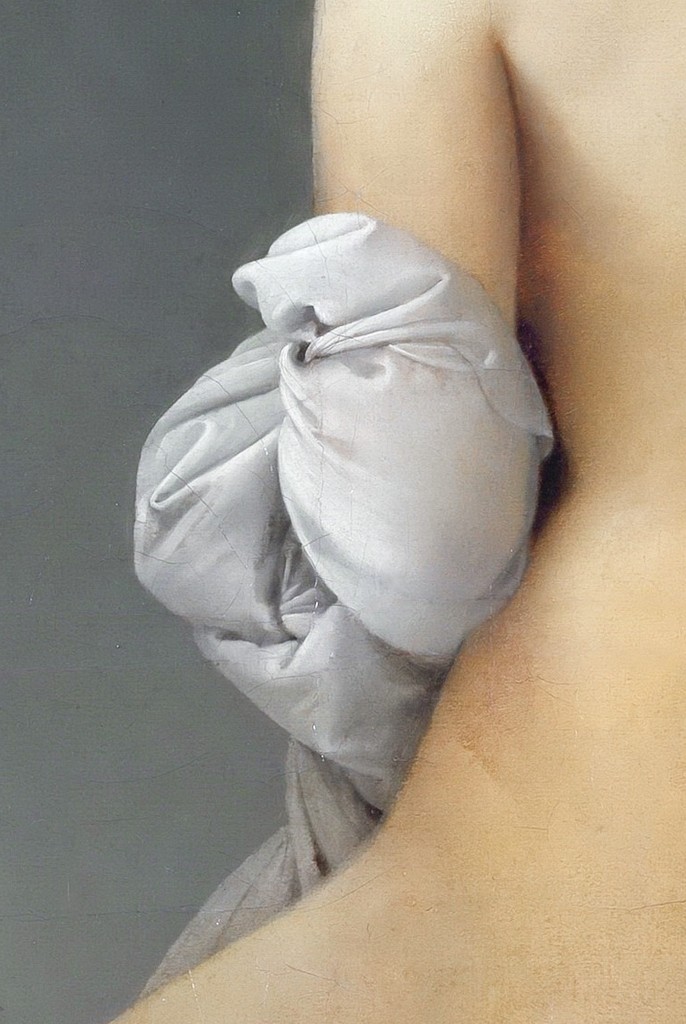
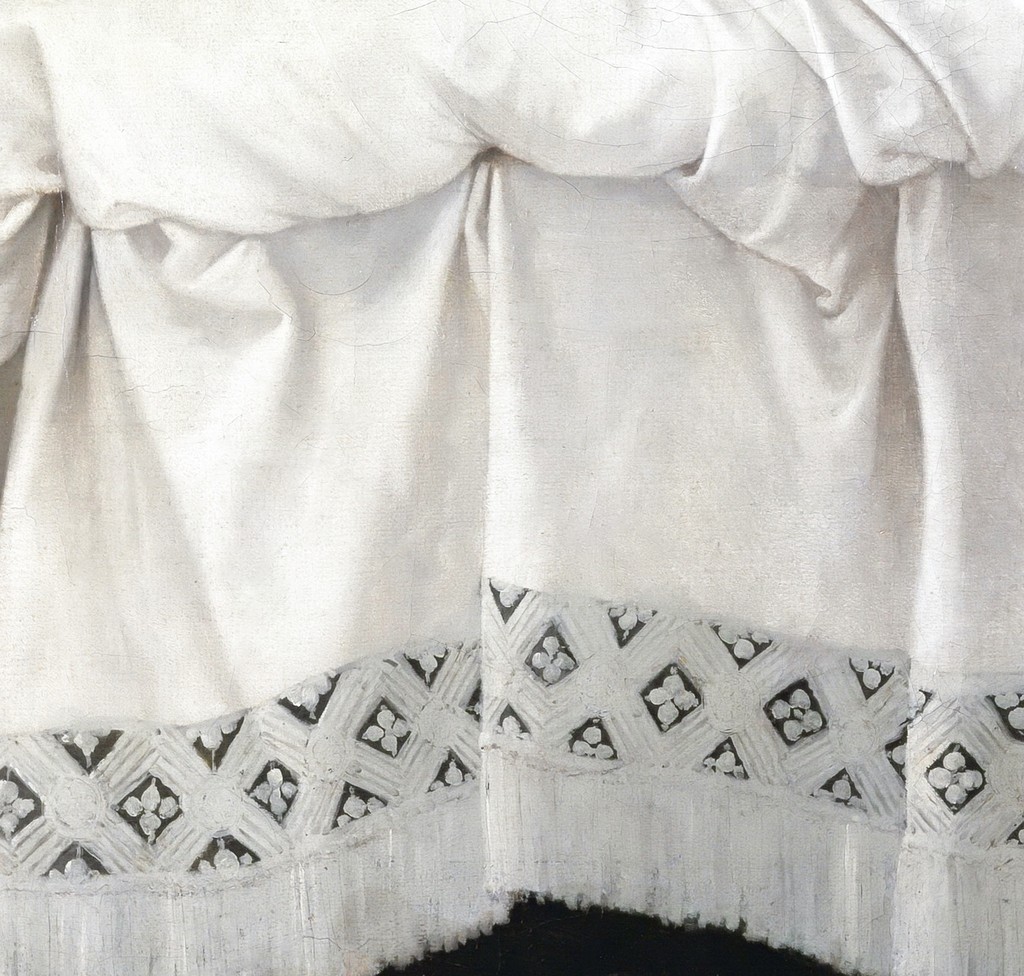
The whites are worth looking at separately. Around the arm, the cloth turns in short, compact folds, with cool shadows held close together. Under the figure, the bedding swells and compresses in broader forms. On the front of the bed, it falls towards a band of openwork embroidery. The diamond shapes and little floral forms in that border make the fabric's construction visible. Behind the right shoulder, the hanging is quieter, with long vertical changes of light.
These passages establish several kinds of softness. The arm cloth is crumpled; the sheet is pulled and weighted; the hanging descends. Against them, the body appears relatively continuous. Its smoothness becomes especially noticeable beside the busy, angular folds at the elbow. This is something the painted surface allows us to see; it does not by itself tell us what pigments or sequence of layers Ingres used.
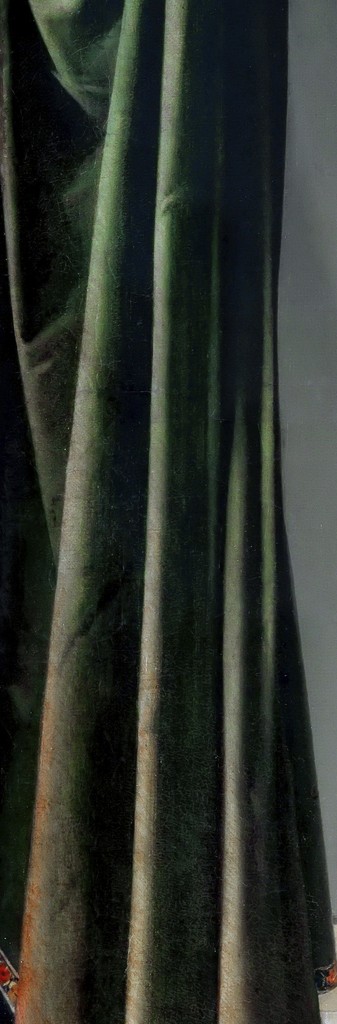
The dark green curtain occupies much of the left edge. Its folds are deep enough to create a substantial shadow, and a narrow patterned border carries small touches of red down towards the floor. Green also passes into the subdued background behind the figure. The curtain therefore does more than frame the nude: it gives the light flesh a dark neighbour and adds a heavy, vertical counterweight to the spread of the bedding.
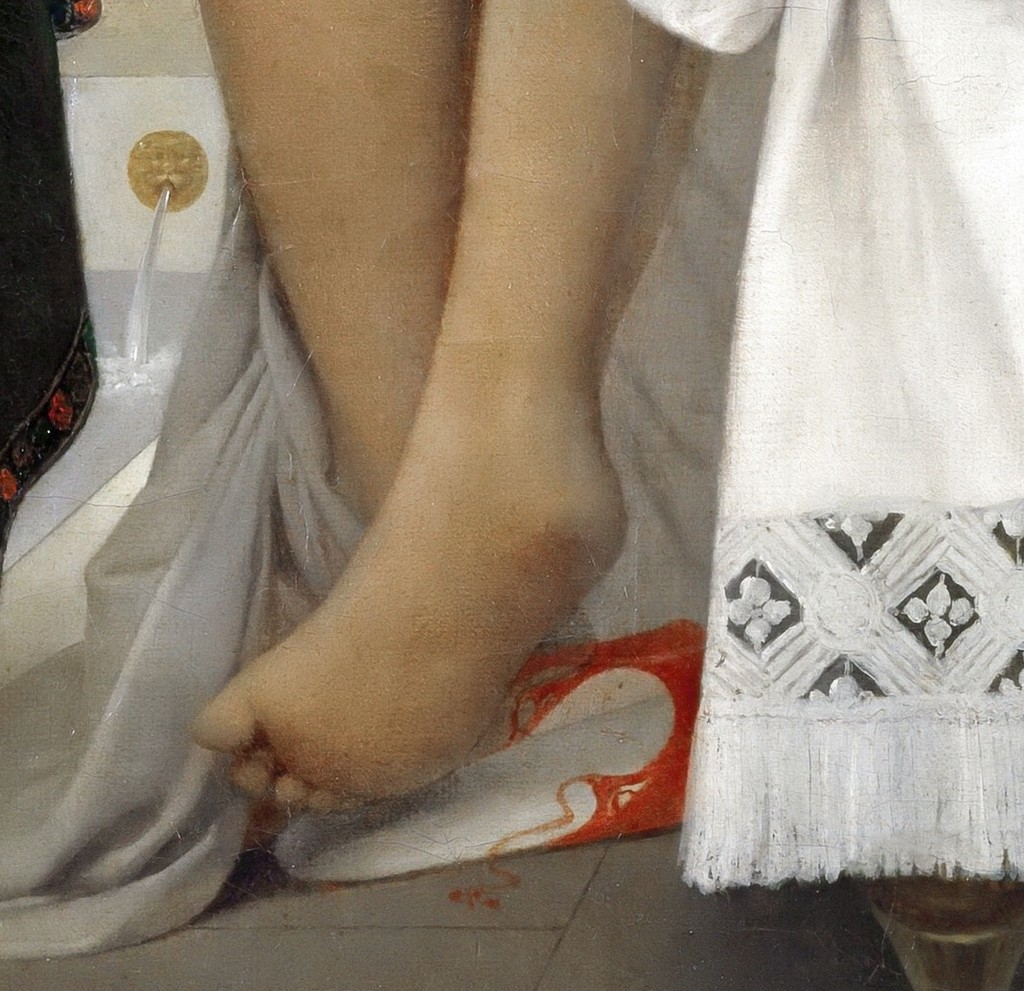
Red links the top and bottom of the scene. It threads through the turban, appears in the curtain's border and returns in the slipper beside the foot. The slipper is small, flat and partly obscured, in contrast to the ample folds above it. It brings the eye down from the distant-looking head to the ordinary business of a body sitting near the floor. The scene's intimacy depends partly on such things, which are neither grand attributes nor a complete narrative.
Near the bottom, a short bed leg emerges below the linen. Floor joints provide a few straight lines under the curves and folds. These details anchor the arrangement just when the expanse of white cloth might seem to float. The painting's simplicity is the result of selection: it contains enough furniture and fabric to make a setting, while keeping almost everything subordinate to the seated back.
Where is the bath?
At first glance, the bed can make the room look like a bedroom. The signs of bathing are less prominent than the title leads us to expect. Low on the left, beyond the curtain and beside the descending leg, a small fitting and a thin stream of water occupy a narrow part of the picture. Dark, hard surfaces contrast with the linen. They suggest a bathing arrangement without opening the space into a clearly mapped room.
There is no broad view into an adjoining chamber, no window establishing the source of the light and no second person explaining an action. The green curtain hides part of the setting, while the pale hanging makes the background feel close. We can trace the bed's front edge more confidently than we can reconstruct the whole interior.
This spatial uncertainty gives the figure unusual prominence. The surroundings supply materials and sensations—heavy cloth, cool shadow, white linen, running water—without becoming a competing subject. The spectator's position is correspondingly close and difficult to locate. We see enough to recognise a private activity, yet little that would explain how we have come to be looking at it.
Annotated Details from The Valpinçon Bather
The numbered points identify visible features discussed in this article. Return from each detail to the whole composition. Valpinçon Bather. RF 259. The dark green curtain at the left balances the illuminated back and white linen. Image source. CC0 / Public domain.
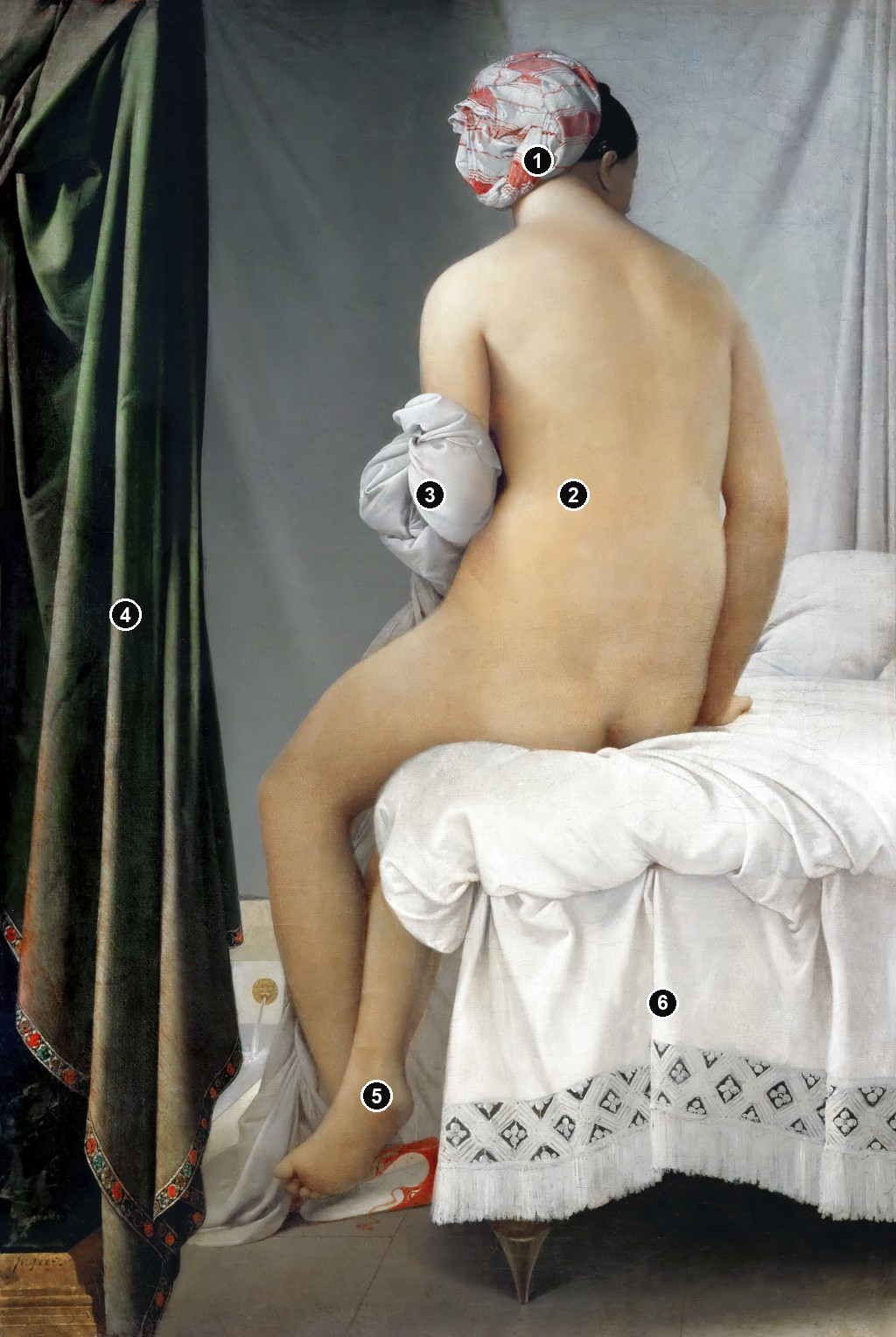
Details from THE VALPINÇON BATHER
Follow the contours of the back into the surrounding cloth, curtain and small stream of water.
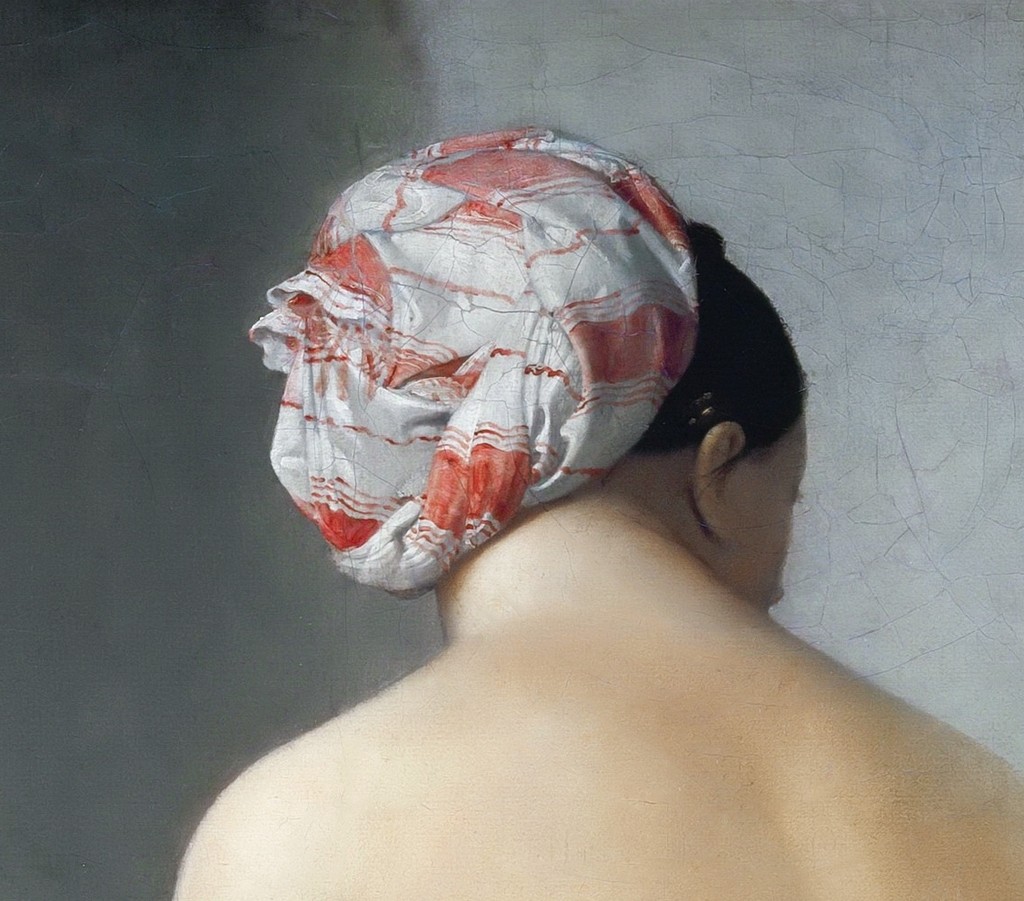
The turned head and wrapped cloth
A small portion of the face appears beyond the turned head. The striped wrapping introduces broken lines and folds above the broad, uninterrupted shape of the neck and shoulders.
The sweep of the back
The shoulders narrow towards the waist and widen again at the hip. Compare the soft changes of light within the back with the much firmer contour along its right side.
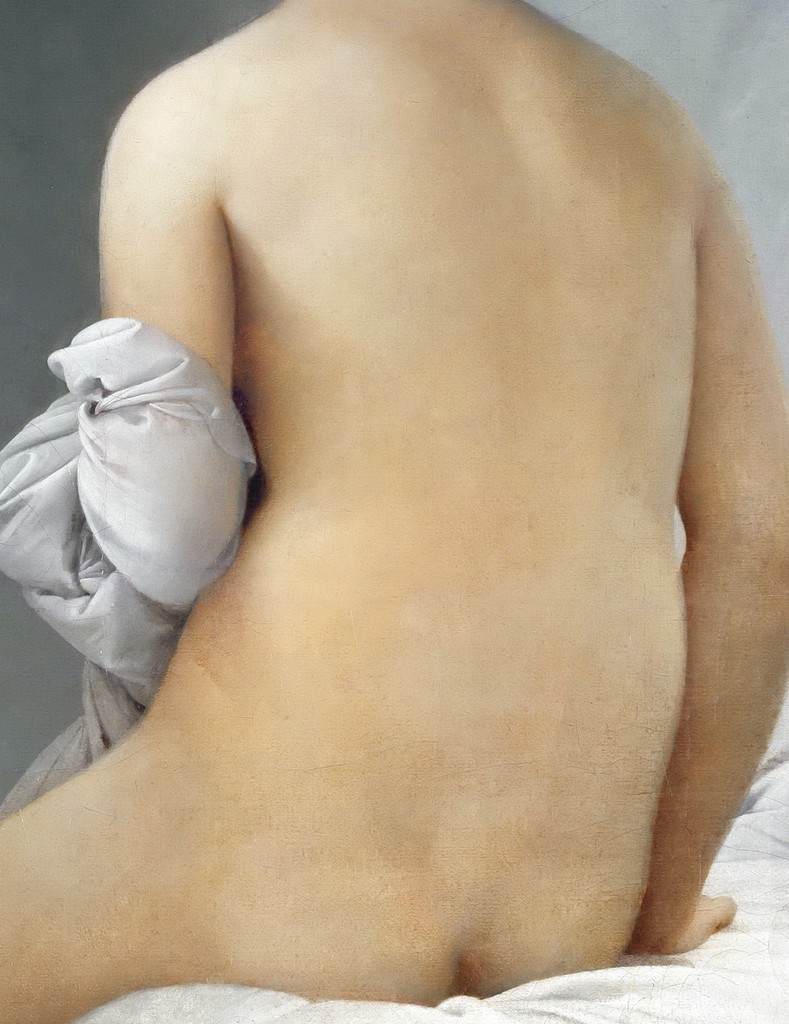
White fabric around the arm
The gathered white fabric wraps around the bent arm. Its small pointed folds make a concentrated patch of movement beside the smoother skin and quiet background.
The dark green curtain
Long folds form narrow bands of green and shadow. Their descending lines divide the curtain from the grey wall and provide a dark vertical beside the seated figure.
Feet and the small stream of water
The lowered legs end close to a small stream at the left. Follow the heels and toes around the pale cloth, then find the narrow line of water beneath the brass-coloured outlet.
Linen folds and the patterned border
Large rounded folds gather over the seat before falling towards a patterned border and fringe. The changes within the white cloth remain distinct from the pale skin above.
A nude study made in Rome
Ingres arrived at the French Academy in Rome in October 1806. Rebecca Rabinow's chronology records study there of anatomy and perspective, drawing from living models and study after antique sculpture. In 1808, the academy's annual exhibition included both the bather and Oedipus and the Sphinx. [2] The Louvre identifies the bather as an envoi: a work through which an academy pensioner demonstrated progress to the authorities in Paris. [1]
That background changes the apparent informality of the scene. The woman is seated in a setting of bedding and bathing, but the painting also makes a sustained demonstration of the artist's ability to organise a nude figure. The broad back, the turn of the head and the more intricate arrangement below the waist give him different problems within a single pose. Textiles allow additional contrasts of surface, weight and contour. The picture's economy makes those decisions especially exposed.
The related Oedipus Explaining the Enigma of the Sphinx offered a male figure within a recognisable mythological encounter. The two works belonged to the same period of academy assessment, although their subjects and the demands they made on a viewer differed. Rabinow records that both paintings received severe criticism when sent to Paris. [2] The bather's later prestige should therefore not be mistaken for evidence that its earliest academic audience immediately endorsed it.
In the bather, there is no mythological name to explain the woman's identity and no dramatic incident to direct the gaze. Attention rests on the figure's physical disposition and the relationships around it. The face, usually a powerful guide to narrative, is almost entirely withheld. This makes the nude study unusually independent: a body, a few objects and a carefully limited interior carry the whole painting.
A statement published after Ingres's death by Henri Delaborde helps explain the breadth he gave to drawing: “Drawing does not simply mean reproducing contours” (our translation). The passage goes on to include expression, interior form, planes and modelling within drawing. [3] The bather rewards that expansive definition. Her outline matters, but so do the gradual changes of tone within it, the pressure of the seated body against the sheet and the way the pale back occupies the space between the hangings. The picture cannot be understood by tracing its silhouette alone.
The name belongs to a collector
“Valpinçon” helps distinguish this large bather from Ingres's other bath scenes. It refers to a former collector, rather than identifying the woman represented. The Phillips Collection's account makes that distinction explicitly; Delaborde's 1870 catalogue records the large painting as belonging to M. Valpinçon. [3][4] The familiar title is therefore part of the picture's collecting history.
The French title used by the Louvre, La baigneuse, dite Baigneuse de Valpinçon, preserves the distinction: a bather, known as the Valpinçon bather. [1] There is no sound reason to turn the collector's surname into a sitter's name or to imagine that the picture portrays Madame Valpinçon.
An earlier bather in Bayonne
The large painting was preceded by a smaller investigation of the subject. Delaborde catalogued a back-facing, half-length Bather, signed in Rome in 1807, separately from the seated figure of 1808. [3] The Musée Bonnat-Helleu in Bayonne identifies its Baigneuse as an oil painting on canvas of 1807, inventory 89. It came through Léon Bonnat's 1922 bequest to the national museums and is a permanent Louvre deposit in Bayonne. [5]
This earlier work places the Valpinçon picture within a developing subject. The distinction between the two matters: the half-length study concentrates on part of the figure, whereas the large canvas gives the seated body room to extend into legs, bedding and an interior. A recurring point of view was already becoming available for further use. It does not follow that the paintings represent the same woman.
The Bayonne work also has its own material history. In May 2025, the city reported its restoration at the Centre de Recherche et de Restauration des Musées de France's Versailles workshops. A varnish that had become opaque and yellowed had obscured the colour relationships; treatment restored clearer distinctions between the figure and the landscape behind her. The city's account dates that painting to 1806–07. [6] These findings concern the earlier Bayonne picture. The Louvre's large Valpinçon Bather is a separate canvas, with a separate history; the appearance of one cannot supply a technical explanation for the other.
The pose moves into other worlds
In two smaller paintings, the large bather's pose becomes the organising figure for a more populated scene. Their similar English titles can be confusing, but The Small Bather of 1826 and The Little Bather: Harem Interior of 1828 are distinct works in different collections. [4][7]
The Small Bather, 1826
In the Phillips Collection's Small Bather, Ingres moved the seated figure outdoors, beside a stream. The museum describes a grass-covered ledge in place of the bed, with other women and a child in the surrounding landscape. It also identifies the continuing details of the pose, turban, cloth around the elbow and red slipper. [4]
That change of setting is a substantial alteration to the subject. The large picture's narrow, enclosed space gives way to a scene in which other bodies and activities extend beyond the main figure. What had seemed an isolated moment can now belong to a group. The borrowed pose supplies continuity while the environment supplies a new account of bathing.
Scale changes the encounter too. At approximately 33 × 25 cm, the Phillips painting is much smaller than the Louvre's 146 cm-high canvas. [1][4] The large bather can dominate the viewer's field of attention; the smaller painting gathers the repeated figure and her companions into a comparatively compact object. Recognition of the pose does not make the two experiences interchangeable.
The Phillips commentary compares the figure's rounded, smoothly continuous forms with the sculpture of Antonio Canova. [4] This is a useful visual analogy, provided it remains an analogy: a resemblance in the treatment of flesh does not establish that a particular sculpture was the painting's source.
The Little Bather: Harem Interior, 1828
The Louvre's Little Bather: Harem Interior measures 35 × 27 cm and was painted for the collector L. J. A. Coutan. The museum calls it a reduced and modified repetition of RF 259, the Valpinçon Bather. Its description again places the turbaned figure on a bed, with other women bathing in front of her and attendants farther back. [7]
The added figures make a previously ambiguous private interior into a more explicitly imagined harem setting. The seated back now divides the spectator from the group beyond, becoming a foreground presence through which the larger scene is approached. It is possible to recognise the starting point and still see a new composition: the central figure's relationships have changed because the space contains other people.
Taken together, the two small bathers show how Ingres could develop a motif without simply enlarging or reducing one fixed picture. A woodland gathering and a harem interior offer different settings for a closely related figure. The repeated back carries a visual memory of the earlier painting, but it does not carry an unchanging narrative. That is why the sequence is more revealing when each work keeps its own date, title and identity.

The Small Bather, 1826. [8]
 Jean-Auguste-Dominique Ingres.jpg)
Ingres, The Little Bather Harem Interior, 1828. [9]
From solitary bather to musician in The Turkish Bath
The most striking return occurs in The Turkish Bath. According to the Louvre, Ingres painted that composition in a rectangular format in 1859, then made it circular and completed it in 1862. [10] Fifty-four years separate the completed circular painting from the large bather of 1808. A pose worked out during his academy years remained active near the end of his life.
In the foreground of the later work, a woman with a wrapped head sits with her back towards us and holds a stringed instrument. The kinship is immediately visible in the turn of the head, the exposure of the nape and the sweep from shoulder to waist. Delaborde's account of The Turkish Bath also connected its development with an earlier isolated figure in approximately the attitude of his catalogue's large bather. [3]
The differences are as telling as the resemblance. The musician's arm reaches towards the instrument, and her bent leg spreads across the foreground. Women occupy the space before her, beside her and behind her. The circular boundary encloses the gathering; bodies continue almost to its edge. In the 1808 picture, the back is set against a relatively empty field. In the later painting, it is one substantial shape within an accumulation of bodies, gestures, fabrics and objects.
The figure also gains an activity. In the large bather, the arrangement of a hand and some cloth leaves the moment difficult to specify. In the later work, the instrument gives the hands a clear occupation. Her turned back makes her part of a gathering that faces in many directions. The old pose has become capable of joining the scene without looking out at its spectator.
This return should not make the early painting seem merely an unfinished idea awaiting its eventual destination. The large bather already has its own scale, material contrasts and tightly controlled space. The later musician demonstrates how much could be changed around a recognisable form. Seen together, the paintings make repetition an active part of composition: an established figure becomes a means of trying a different relation between the individual body and a group.
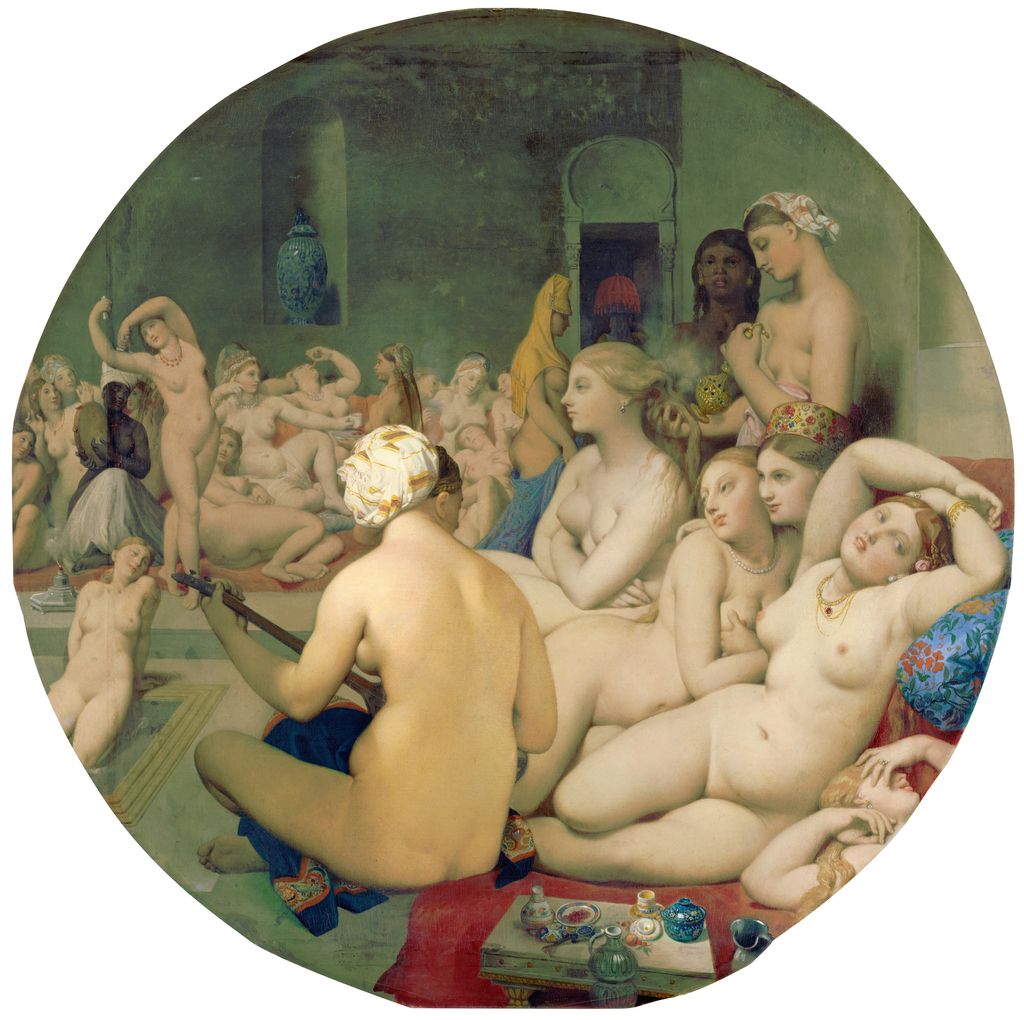
Ingres, The Turkish Bath, 1859–1862. [11]
Intimacy, anonymity and the spectator
In its 2006 Ingres exhibition, the Louvre treated the Valpinçon Bather as one of the artist's recurring types of female figure. Its essay emphasised the withheld face and read the painting as the establishment of a point of view and an erotic atmosphere that Ingres would revisit. [12] That interpretation helps explain why the picture's apparent restraint can feel charged. So much of the body is visible, while so little is offered by way of personal encounter.
The woman's head turns towards the interior rather than towards us. There is no exchanged glance to make the viewer a participant. Yet the placement of the body, the bed and the hanging provides an unusually close vantage point. The combination can produce a sense of distance inside intimacy: we stand near the figure in pictorial space while remaining unable to read her expression.
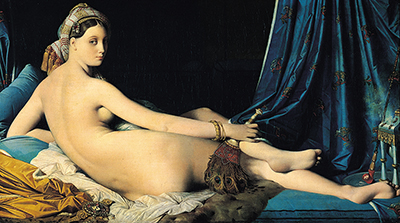
A brief comparison with Grande Odalisque makes the distinction clearer. The Louvre's essay links that reclining nude with the same broader exploration of the back-facing female body. [12] There, the head turns far enough for the eyes to address the spectator. Here, the head continues to withhold that encounter. The difference changes how looking feels, even before questions of setting and accessories enter the comparison.
Such effects belong to the organisation of the image. They cannot tell us what the model felt, whether she understood the finished work in the same way or what precise response Ingres intended every viewer to have. Calling the scene intimate describes the access the painting constructs. It supplies no evidence about the circumstances of an actual sitting.
There is also a difference between imagining a bath and recording one. The later reuse of the pose makes visible the artist's freedom to place a figure within different worlds. A turban, a bed or a group of bathers can suggest a setting, but each is part of a made composition. Reading the sequence as an evolving pictorial invention keeps the woman's anonymous body from becoming supposed testimony about a particular household or culture.
From an academy submission to a museum painting
The bather's public history joined several kinds of attention. It began within the academy system; it was later repeated by Ingres, reproduced in print, exhibited in 1855 and eventually purchased for the Louvre in 1879. [1][2][3] Those are different forms of attention, each changing the audience for the image.
Delaborde recorded the painting’s appearance in the 1855 exhibition and a line reproduction in the collection published by Albert Magimel. [3] The 1999 catalogue illustrates a Réveil engraving from Magimel’s 1851 Œuvres de J.-A. Ingres. [13] The existence of the reproduction gives a particularly useful counterpoint to the later exhibition date: familiarity with an image can spread beyond the circle of people able to see its painted surface.
A line reproduction would necessarily direct attention towards some of the bather's most distinctive features: the turn of the head, the continuous back and the configuration of limbs and draperies. It could not offer the same encounter with the warm skin, cool whites and dark green cloth. The painting's circulation therefore raises a useful question about its reputation. How much of its identity lies in a memorable arrangement of forms, and how much depends on the colour and light that hold those forms together?
Writing in 1870, Delaborde was openly admiring. He placed the back-facing figure among Ingres's especially learned and delicate achievements. [3] This is a historical judgement by an advocate of the artist, rather than a neutral report of every earlier response. Alongside the criticism recorded for the academy submissions, it shows why reception needs dates and speakers: an adverse assessment in one context and praise in another can belong to the same painting's history.
The Louvre's purchase in 1879 brought the large canvas into a public collection. [1] The familiar museum title still carries a trace of its former private ownership. Returning to the 1808 picture after those comparisons, the solitary figure seems especially concentrated. The other scenes reveal how much could be added; the large bather shows how much could be sustained by one turned body, a little cloth and a carefully measured surrounding space.
Artworks directory
Explore 150 paintings, drawings and an original lithograph. This selection includes related versions and studies; dates distinguish completed works from later revisions.
| Name | Date | Medium |
|---|---|---|
| The Apotheosis of Homer | 1827 | Painting |
| Grande Odalisque | 1814 | Painting |
| The Turkish Bath | 1859–1862 | Painting |
| Madame Moitessier Seated | 1856 | Painting |
| Portrait of Monsieur Bertin | 1832 | Painting |
| Napoleon I on His Imperial Throne | 1806 | Painting |
| Odalisque with Slave | 1839 | Painting |
| The Ambassadors of Agamemnon in the Tent of Achilles | 1801 (competition) | Painting |
| The Valpinçon Bather | 1808 | Painting |
| The Source | 1856 | Painting |
| Oedipus Explaining the Enigma of the Sphinx | 1808; revised probably before 1827 | Painting |
| The Vow of Louis XIII | 1824 | Painting |
| Antiochus and Stratonice | 1840 | Painting |
| The Comtesse d’Haussonville | 1845 | Painting |
| The Princesse de Broglie | 1851–1853 | Painting |
| Jupiter and Thetis | 1811 | Painting |
| The Dream of Ossian | 1813 | Painting |
| The Martyrdom of Saint Symphorian | 1834 | Painting |
| Venus Anadyomene | 1808–1848 | Painting |
| Portrait of Madame de Senonnes | 1814 | Painting |
| Madame Rivière | 1805 | Painting |
| Mademoiselle Caroline Rivière | 1805 | Painting |
| Portrait of Philibert Rivière | 1805 | Painting |
| Bonaparte First Consul | 1804 | Painting |
| The Death of Leonardo da Vinci | 1818 | Painting |
| Joan of Arc at the Coronation of Charles VII | 1854 | Painting |
| Madame Duvaucey | 1807 | Painting |
| La Belle Zélie | 1806 | Painting |
| Madame Panckoucke | 1811 | Painting |
| Portrait of Charles Marcotte d’Argenteuil | 1810 | Painting |
| Joseph Antoine Moltedo | c.1810 | Painting |
| Madame Leblanc | 1823 | Painting |
| Delphine Ingres-Ramel (Portrait of Madame Ingres) | 1859 | Painting |
| Portrait of Amédée de Pastoret | 1823–1826 | Painting |
| Portrait of Baronne de Rothschild | 1848 | Painting |
| Madame Marcotte de Sainte Marie | 1826 | Painting |
| Madame Gonse | 1852 | Painting |
| Aretino in the Studio of Tintoretto | 1848 | Painting |
| Don Pedro of Toledo Kissing Henry IV’s Sword | 1831/1832 | Painting |
| Raphael and La Fornarina | 1814 | Painting |
| Roger Freeing Angelica | 1819 | Painting |
| Romulus’ Victory over Acron | 1812 | Painting |
| Self-Portrait at the Age of Twenty-Four | 1804; revised 1841–1851 | Painting |
| Male Torso | c.1800 | Painting |
| Odalisque in Grisaille (Ingres and workshop) | c.1824–1834 | Painting |
| The Small Bather | 1826 | Painting |
| The Little Bather Harem Interior | 1828 | Painting |
| Jesus Among the Doctors | 1862 | Painting |
| The Virgin Adoring the Host | 1852 | Painting |
| The Virgin of the Host | 1841 | Painting |
| Virgin of the Adoption | 1858 | Painting |
| Paolo and Francesca | 1814 | Painting |
| Homer Deified (revised composition, Louvre RF5273) | 1865 | Drawing |
| Odalisque with Slave (Louvre RF4622) | 1858 | Drawing |
| Odalisque (Walters Art Museum; Ingres and Paul Flandrin) | 1842 | Painting |
| Madame Moitessier Standing (National Gallery of Art) | 1851 | Painting |
| Jacques-Louis Leblanc (The Metropolitan Museum of Art) | 1823 | Painting |
| Ferdinand-Philippe, Duke of Orléans (Louvre RF2005-13) | 1842 | Painting |
| Ferdinand-Philippe, Duke of Orléans (Versailles MV5207; Ingres and workshop) | 1843 | Painting |
| Ferdinand-Philippe, Duke of Orléans (Versailles MV5209; Ingres and workshop) | 1844 | Painting |
| Antiochus and Stratonice (Musée Fabre; Ingres and Raymond Balze) | 1866 | Painting |
| Antiochus and Stratonice (Kunstmuseum Bern, Gurlitt bequest) | Undated (early dating proposed) | Drawing |
| Composition study for Antiochus and Stratonice (MIB867.2193) | 1806 | Drawing |
| Study for the Figure of Stratonice (Met63.66) | 1834–1840 | Graphite, black chalk and charcoal |
| Nude figure study for Stratonice (Boijmans F II 36 PK) | c.1834–1840 | Drawing |
| Paolo and Francesca (The Barber Institute,54.6) | c.1814–1820 | Painting |
| Paolo and Francesca (The Hyde Collection,1971.24) | c.1855–1860 | Painting |
| Paolo and Francesca (Amsterdam Museum TA10970) | 1820 | Drawing |
| Paolo and Francesca (dedicated to Artaud de Montor) | 1816 | Drawing |
| Study for the Bust of Francesca (MIB867.1398) | 1819 | Drawing |
| Study for the Bust of Francesca (MIB867.1396) | 1819 | Drawing |
| The Archangel Raphael, first idea (MIB867.2488) | 1842 | Drawing |
| The Archangel Raphael (MIB867.2500) | 1842 | Drawing |
| The Archangel Raphael Carrying Human Prayers to God (Chantilly DE513) | 1844 | Drawing |
| Louis-Philippe as Saint Philip, stained-glass study | 1844 | Drawing |
| Marie Frédéric Eugène de Reiset (Ford Collection RBF171-2) | 1844 | Drawing |
| Virgil Reading the Aeneid (Toulouse) | Begun 1811 | Painting |
| Tu Marcellus Eris (Brussels, inv. 1836) | c.1814 (museum dating) | Painting |
| Jean-François Gilibert | 1804 | Painting |
| François-Marius Granet | 1807 (museum dating) | Painting |
| Count Nikolai Dmitrievich Guryev | 1821 | Painting |
| Caroline Murat, Queen of Naples | 1814 | Painting |
| Count Mathieu Molé | 1834 | Painting |
| Cherubini and the Muse of Lyric Poetry (Louvre) | 1842 | Painting |
| Luigi Cherubini (Cincinnati) | 1841 | Painting |
| Comtesse de Rayneval (Louvre RF4505) | 1841 | Drawing |
| Venus on Paphos (Antonie Balaÿ) | c.1852 | Painting |
| Prince Napoléon | 1855 | Painting |
| Study for The Apotheosis of Napoleon I (Petit Palais) | Late 1853 | Painting |
| The Apotheosis of Napoleon I (destroyed ceiling) | 1853 | Painting |
| The Journalist (MIB867.2733) | 1834? | Drawing |
| Henry VIII, after Holbein | c.1815–1820 (?) | Drawing |
| Madame Récamier, after David (MIB867.3637) | Undated (early Paris period) | Drawing |
| Study for Comtesse d’Haussonville (MIB867.259; background possibly by another hand) | 1842–1845 | Drawing |
| La Source (reduced version reported by Delaborde) | Date unrecorded; reported 1870 | Painting |
| Odalisque (autograph lithograph,NGA1946.21.117) | 1825; published1826 | Lithograph |
| Portrait of a Seated Lady | 1814 | Graphite |
| The Kaunitz Sisters (Leopoldine, Caroline, and Ferdinandine) | 1818 | Graphite |
| Portrait of a Man | 1814 | Graphite |
| Study for the Portrait of Louis-François Bertin (1766–1841) | n.d. | Black chalk and graphite |
| Studies for the Cadaver of Acron | ca. 1810–12 | Graphite on wove paper |
| Study for the Drapery of Molière in "The Apotheosis of Homer" | n.d. | Black chalk with stumping |
| Madame Guillaume Guillon Lethière, née Marie-Joseph-Honorée Vanzenne, and her son Lucien Lethière | 1808 | Graphite |
| Niccolò Paganini (1782–1840) | ca. 1830 | Counterproof or tracing strengthened with graphite and gouache on translucent paper |
| Lady Mary Cavendish-Bentinck (?-1843) | 1816 | Graphite |
| Madame Alexandre Lethière and Her Daughter Letizia | ca. 1815 | Graphite |
| Merry Joseph Blondel (1781–1853) | 1809 | Graphite |
| Ursin-Jules Vatinelle (1798–1881) | 1820 | Graphite |
| Bust of a Gypsy Girl (ascribed to Ingres) | 1819 | Graphite on wove paper |
| Study of a Seated Nude Male | n.d. | Graphite |
| The Archangel Raphael (Study for a stained-glass window in the chapel of Notre-Dame de la Compassion-Saint-Ferdinand, Neuilly) | ca. 1842 | Graphite |
| Lancelot-Théodore, comte Turpin de Crissé | probably 1818 | Graphite |
| Study for the Figure of the Iliad in "The Apotheosis of Homer" | ca. 1827 | Graphite and black chalk heightened with white chalk on brown paper |
| Comtesse Turpin de Crissé | probably 1818 | Graphite |
| Nude Figures for L'Âge d'Or, Château de Dampierre | n.d. | Graphite on brownish paper |
| Study of Figures (attributed to Ingres) | n.d. | Graphite |
| Study of Figures (attributed to Ingres) | n.d. | Graphite; squared in graphite |
| Admiral Sir Fleetwood Broughton Reynolds Pellew | 1817 | Graphite on wove paper |
| Madame Jean-Auguste-Dominique Ingres, née Madeleine Chapelle | 1814 | Graphite on off-white wove paper |
| Virgil Reading the Aeneid to Augustus, Livia, and Octavia | 1809/1819 (?) | Pen and black ink, graphite, brush and gray wash, white gouache heightening, Conté crayon on blue paper |
| General Louis-Étienne Dulong de Rosnay | 1818 | Graphite (hard and soft pencils) |
| Madame Alexandre Lethière, née Rosa Meli, and Her Daughter, Letizia | 1815 | Graphite |
| The Lawyer Paul Grand | 1834 | Graphite |
| Jean-Joseph Fournier | 1815 | Graphite |
| Armand Bertin | 1842 | Graphite |
| Madame Armand Bertin, née Marie-Anne-Cécile Dollfuss | 1843 | Graphite |
| The Architect Charles-Victor Famin | 1836 | Graphite |
| Henri Lehmann | 1850 | Graphite |
| Portrait of a Lady | ca. 1815–17 | Graphite |
| Edmond Cavé (1794–1852) | 1844 | Oil on canvas |
| Head of Saint John the Evangelist | probably ca. 1818–20 | Oil on canvas, laid down on wood |
| Madame Edmond Cavé (Marie-Elisabeth Blavot, ca. 1806–1883) | ca. 1831–34 | Oil on canvas |
| Madame Félix Gallois | 1852 | Graphite with touches of gold in oil to highlight jewelry, on buff wove paper. |
| Dr. François Mêlier | 1849 | Graphite with graphite framing lines, corrected with white, on buff wove paper |
| Portrait of Madame Rhode (Rhoda?) | 1810–20 | Graphite on pale buff wove paper |
| Study for "Raphael and the Fornarina"(?) | ca. 1814(?) | Graphite on white wove paper |
| Portrait of Madame Paul Meurice, née Palmyre Granger | ca. 1845–50 | Graphite on wove paper |
| Alexander the Great presenting Campaspe to Apelles | 1810 | Graphite, brush and brown wash; squared in graphite |
| Study of Hands for "Christ Among the Doctors" | 1852–62 | Graphite on tracing paper |
| Study for The Turkish Bath (RF34502) | about 1850 | Pen and brown ink with graphite, partially squared |
| Study for The Turkish Bath (RF23354) | Undated | Pen and brown ink with graphite on joined sheets |
| Study for The Turkish Bath (RF54702) | about 1859 | Pen and brown ink |
| Studies of women for The Turkish Bath (RF12292) | Undated | Black chalk |
| Achilles Receiving the Envoys of Agamemnon (Nationalmuseum sketch, NM2161) | 1801 | Oil on wood |
| Half-Length Bather (Musée Bonnat-Helleu,89) | 1807 | Oil on canvas |
| Oedipus and the Sphinx (National Gallery,NG3290) | about1826 | Oil on canvas |
| Oedipus and the Sphinx (Walters,37.9) | 1864 | Oil on canvas |
| Oedipus and the Valpinçon Bather, after David (MI.867.2035) | Undated | Graphite on tracing paper, after David |
| Study of the Virgin for The Vow of Louis XIII (Dijon,1758) | about1822 | Black chalk, stump and white chalk on brown wove paper |
| First Thought for The Vow of Louis XIII (MI.885.11.21) | 1822 | Oil on canvas |
Frequently Asked Questions
No. Delaborde lists the large bather and its smaller variants separately. [3]
Look at the foreground musician, seated with her back towards us. Her wrapped head and the broad arrangement of the back recall the earlier bather, with changes to the arms and legs. Delaborde connected the later composition with the earlier seated type; the Louvre dates the completed circular painting to 1862. [3][10]
Follow the three different whites: the compact cloth around the arm, the weighted bedding and the quiet hanging behind the figure. Then look down to the embroidered edge, the red slipper and the small space beneath the bed. They give the large, continuous body its contrasting textures and sense of support.
Discussion
Look again at the images and ideas explored in The Valpinçon Bather. These editorial prompts invite your observations.
Reader Insights
Does the hidden face make the bather feel more distant, or make you more aware of how close the viewpoint is? Compare the solitary figure with the foreground musician in The Turkish Bath: which change around the repeated pose most alters your response?
Compare the curtain here with the curtain in Grande Odalisque. Does the fabric chiefly enclose the body or guide your movement around it?
How does the absence of an answering gaze affect the distance you feel from the seated figure?
Join the Conversation
Share a detail, comparison or question about The Valpinçon Bather below.
References
- Musée du Louvre, Baigneuse de Valpinçon. RF 259. View source.
- Rebecca A. Rabinow, “Chronology”, in Gary Tinterow and Philip Conisbee, eds., Portraits by Ingres: Image of an Epoch. New York: The Metropolitan Museum of Art, distributed by Harry N. Abrams, 1999, pp. 546–547, entries for 1806–1809. View source.
- Henri Delaborde, Ingres, sa vie, ses travaux, sa doctrine, d'après les notes manuscrites et les lettres du maître. Paris: Henri Plon, 1870, p. 123 (“Notes et pensées”); catalogue nos. 72–74, pp. 234–235; no. 80, pp. 239–240. (In French; short artist quotation translated here.) View source.
- The Phillips Collection, The Small Bather. 0927, 1826. View source.
- Musée Bonnat-Helleu, Bayonne, “Les chefs-d'œuvre”, entry for Ingres, Baigneuse, 1807, inv. 89; collection and deposit history. (In French.) View source.
- Ville de Bayonne, “La Baigneuse a fait peau neuve”. 21 May 2025; restoration of the Musée Bonnat-Helleu painting dated 1806–07. (In French.) View source.
- Musée du Louvre, La petite baigneuse. Intérieur de harem, 1828, RF 1728. Collection record: dimensions, description and Coutan commission. (In French.) View source.
- Supporting image. The Small Bather, 1826. The Phillips Collection; Google Art Project via Wikimedia Commons. Image source. Public domain.
- Supporting image. Ingres, The Little Bather Harem Interior, 1828. Musée du Louvre; Photograph: JackyM59; Wikimedia Commons. Image source. CC BY-SA 4.0. Resized and JPEG-optimised; image derivative licensed CC BY-SA 4.0.
- Musée du Louvre, Le bain turc, 1862, RF 1934. Collection record: rectangular composition of 1859, circular format completed in 1862. (Historical fields in French.) View source.
- Supporting image. Ingres, The Turkish Bath, 1859–1862. Image source. CC0 / Public domain.
- Musée du Louvre, “‘Ingresque’ eroticism”, Ingres, 2006 exhibition website, “1806–1824 — Rome and Florence”. View source.
- Metropolitan Museum of Art, Portraits by Ingres: Image of an Epoch. 1999, p. 546, fig. 333: Réveil engraving from Magimel’s 1851 volume. View source.
- Splash image. Valpinçon Bather. RF 259. The dark green curtain at the left balances the illuminated back and white linen. Image source. CC0 / Public domain.