by Tom Gurney
Tom Gurney BSc (Hons) is an art history expert with over 20 years experience
Published on June 19, 2020 / Updated on October 22, 2026
Email: tomgurney1@gmail.com / Phone: +44 7429 011000
Madame Gonse
A pink ribbon sits between Madame Gonse’s face and the deep black of her dress. Its loose ends catch the light; above them, a raised hand approaches her chin. These small, bright forms give the portrait its rhythm. The broad dark bodice holds the centre steady while lace, ribbons and jewellery lead the eye towards the sitter’s direct gaze.
Ingres completed this portrait in 1852. Its subject, Joséphine Caroline Maille, married to Henri Gonse, belonged to his personal circle, although the familiar description of her as his pupil needs qualification. Today the painting belongs to the municipal collection at the Musée Ingres Bourdelle in Montauban. [1][2]
At a Glance
- ArtistJean-Auguste-Dominique Ingres.
- Date1852.
- Medium and sizeOil on canvas, 73 × 62 cm.
- SitterJoséphine Caroline Maille (1815–1901), Madame Henri Gonse. [1]
- CollectionMusée Ingres Bourdelle, Montauban; inventory MI.28.2.1. Acquired through the Lapauze bequest in 1928. [2]
- Look forThe pink bow below the chin, the open white cuff and the patterned shawl along the left edge.
This work across Ingres’s career
Agamemnon’s Ambassadors
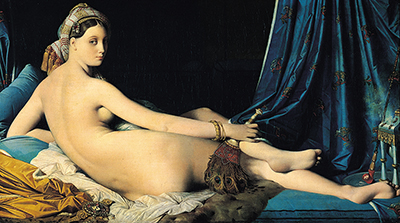
1801 (competition)Grande Odalisque
1814Louis XIII’s Vow
1824Monsieur Bertin
1832The Princesse de Broglie
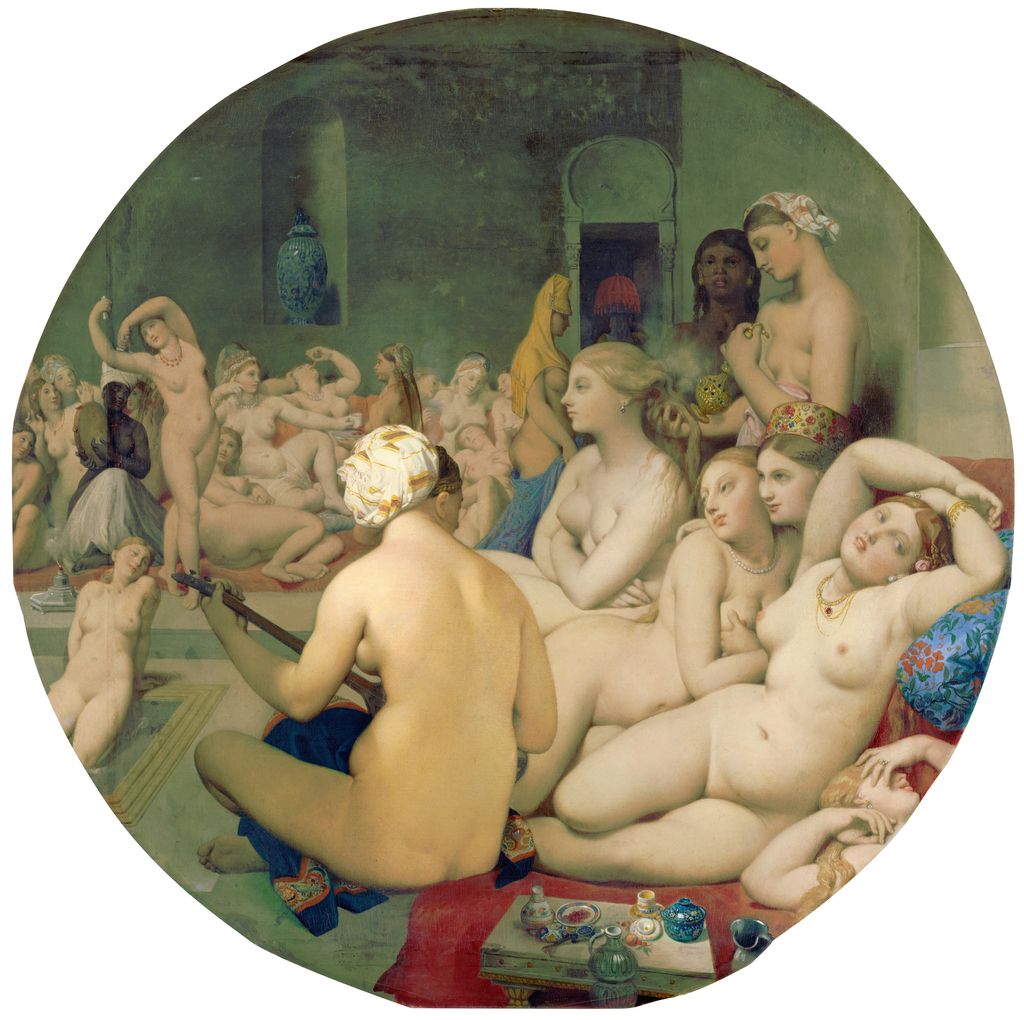
1851–1853The Turkish Bath
1859–1862Contents
- A face surrounded by colour
- The raised hand and the open cuff
- Who was Madame Gonse?
- A portrait that took time
- A familiar gesture, a different portrait
- From private portrait to Montauban collection
- Annotated details
A face surrounded by colour
The portrait is closely framed. Madame Gonse occupies most of the canvas, with little room between her head and the upper edge. The setting offers no long view into a house. A dark wall, the red upholstery of a chair and a shawl establish enough space for the seated figure; the face and clothing provide almost everything else.
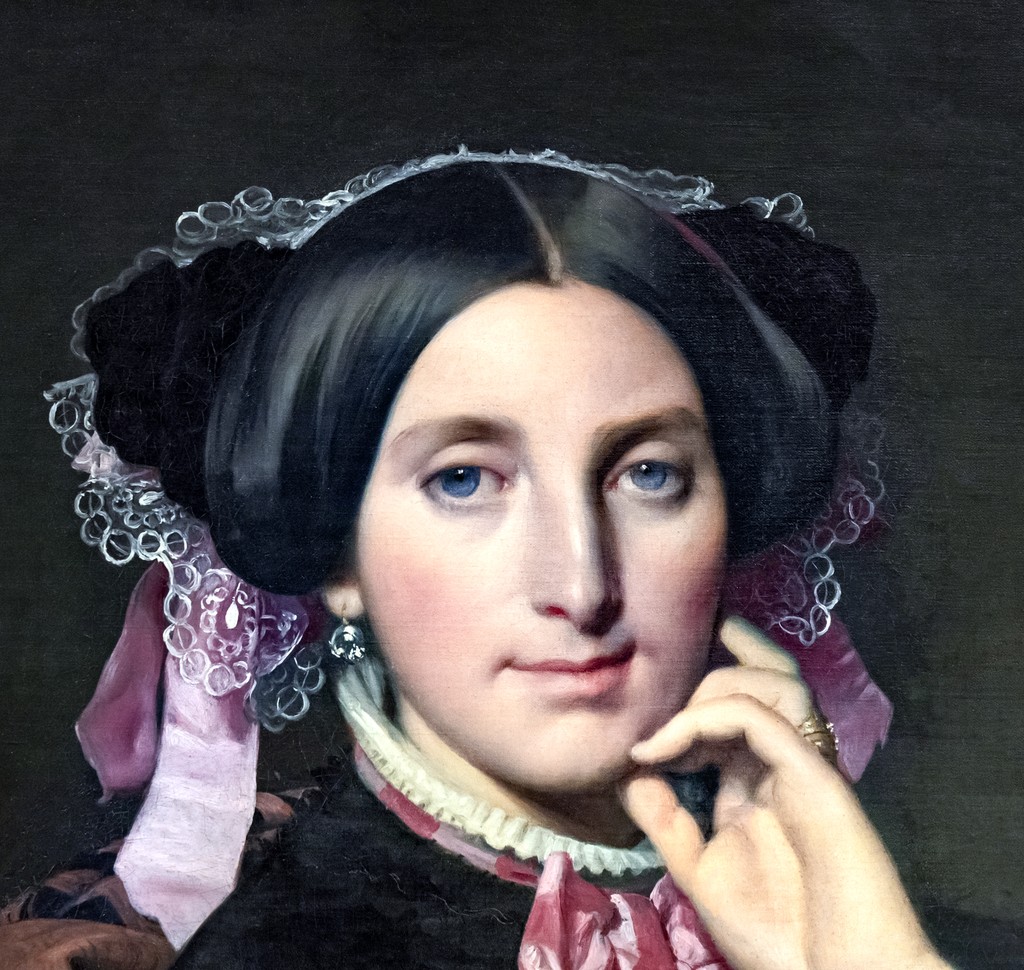
Her black hair is divided by a clear central parting. Smooth sections curve down beside the face, making its pale oval especially distinct. Around the hair, the bonnet’s delicate edging breaks into small loops. Pink ribbons descend beside the cheeks, while tiny touches of blue and white enliven the head ornament. These scattered accents keep the silhouette from becoming a single heavy enclosure.
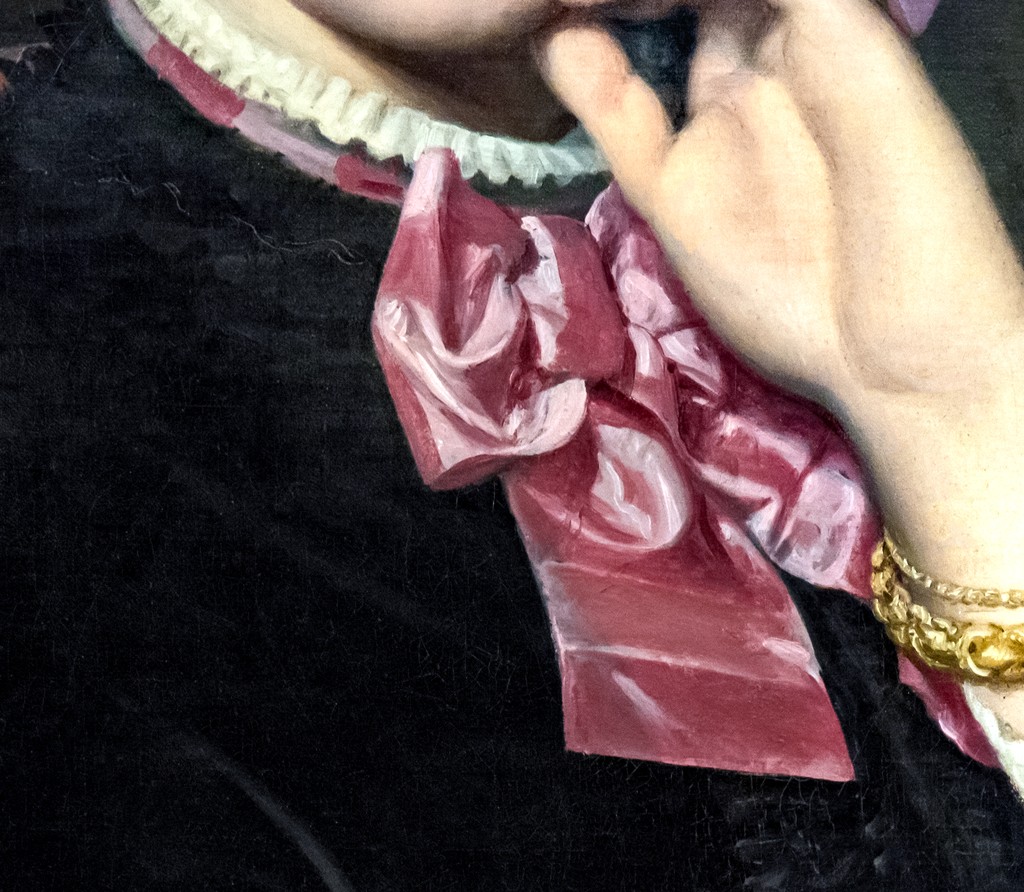
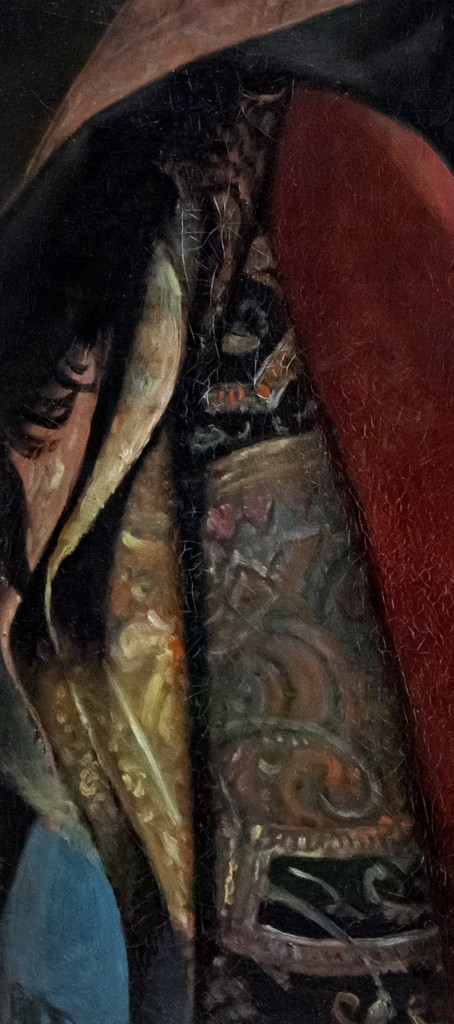
Below, the colour grows stronger. The bow at her throat spreads out over the black dress, its alternating light and shaded folds giving it a crisp, folded shape. Its pink answers the paler ribbons beside the head. Red chair upholstery introduces a deeper, warmer colour at the edges, and the patterned shawl crosses her shoulder on the left. The centre of the dress remains comparatively quiet. That restraint allows a modest patch of pink to command attention.
The face is also less symmetrical than its surrounding oval might first suggest. The head turns slightly, and the two eyes meet the viewer from different positions within that turn. The closed mouth and steady gaze give few narrative clues. We can read attentiveness in the encounter, but the image does not tell us what Madame Gonse was thinking or what passed between painter and sitter. Its interest lies in how precisely that sense of an encounter has been constructed.
Annotated Details from Madame Gonse
The numbered points identify visible features discussed in this article. Return from each detail to the whole composition. Jean-Auguste-Dominique Ingres, Madame Gonse (Joséphine Caroline Maille), 1852. Oil on canvas, 73 × 62 cm. Musée Ingres Bourdelle, Montauban, MI.28.2.1. Photograph: Didier Descouens; Wikimedia Commons. Image source. CC BY-SA 4.0. Numbered overview: resized, with markers added. Detail images: cropped and JPEG-optimised. All these image derivatives are licensed CC BY-SA 4.0.
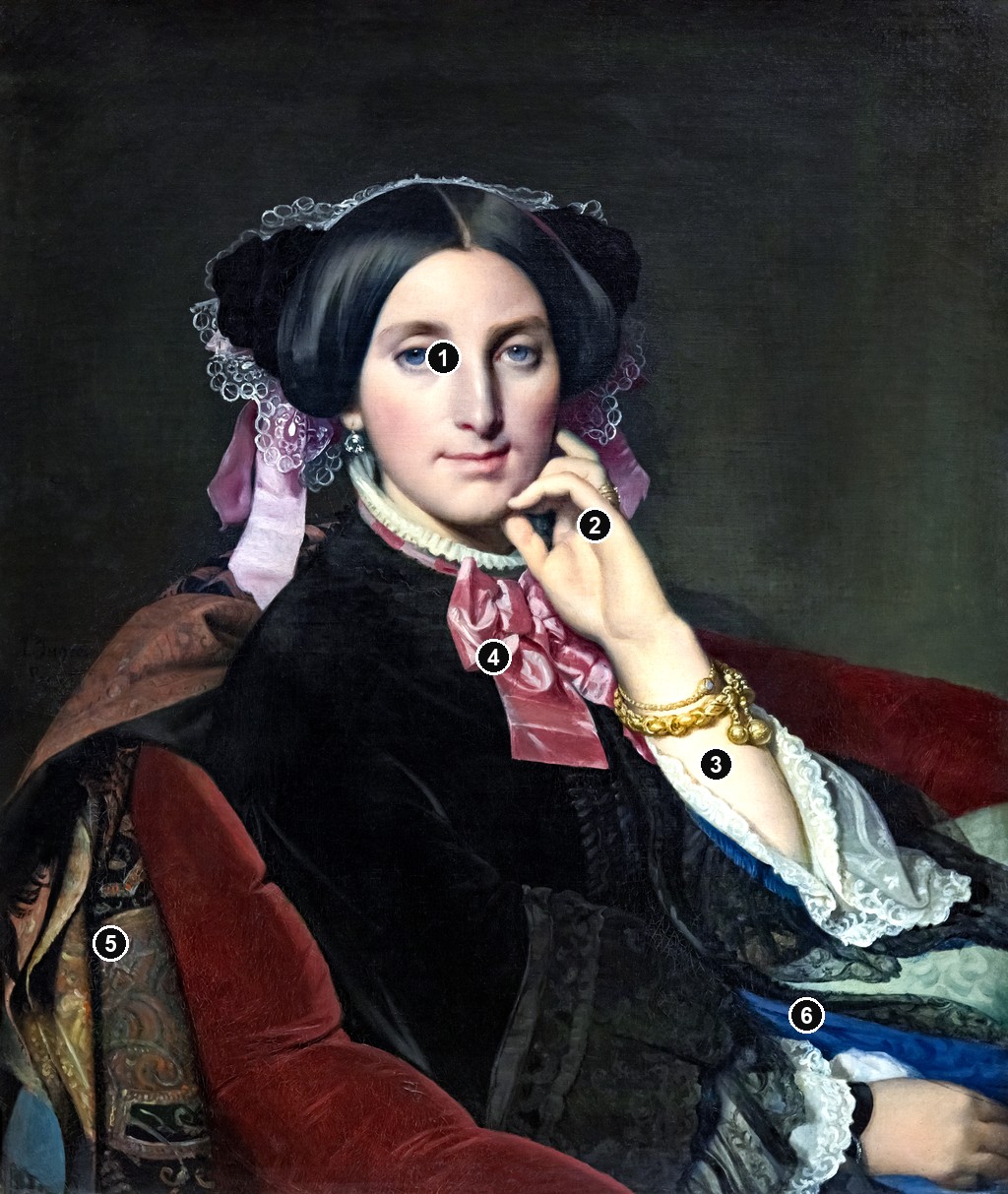
Details from MADAME GONSE
Follow the raised hand, pink ribbons, jewellery and lace around the seated figure.
The face within lace and dark hair
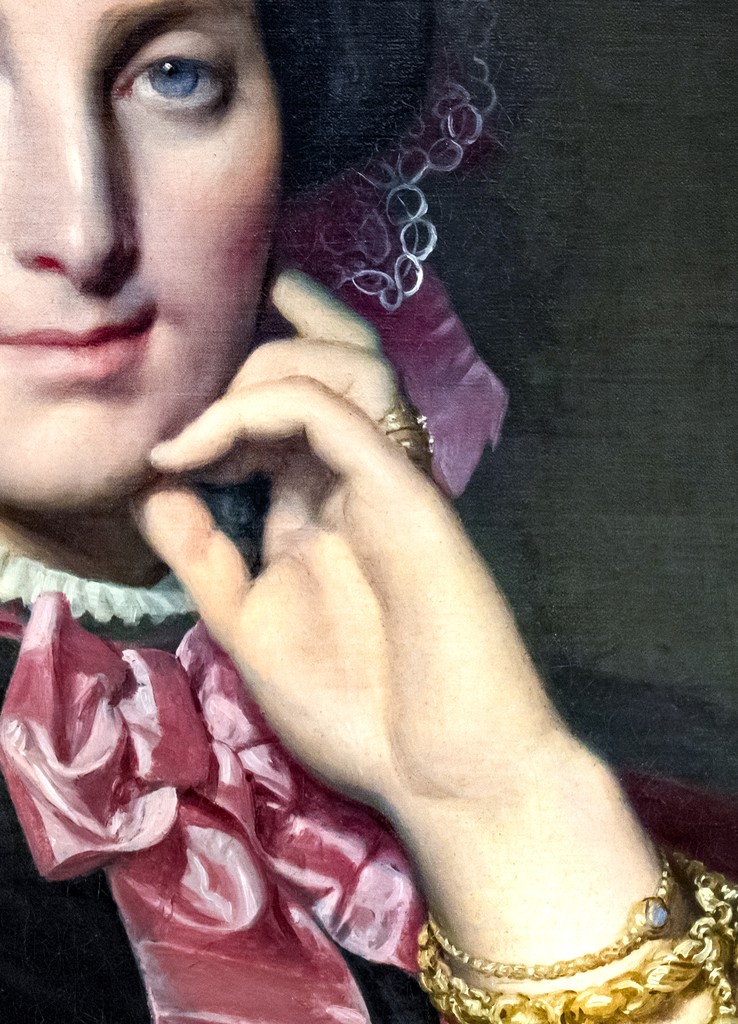
Loops of pale lace follow the dark hair around the face. The narrow pink ribbons descend on either side, giving this rounded arrangement two longer vertical edges.
The raised hand and rings
The fingers bend beside the cheek while rings interrupt their pale outline. Follow the changes of direction from the fingertip beside the face to the wrist below.
Gold bracelets above the open cuff
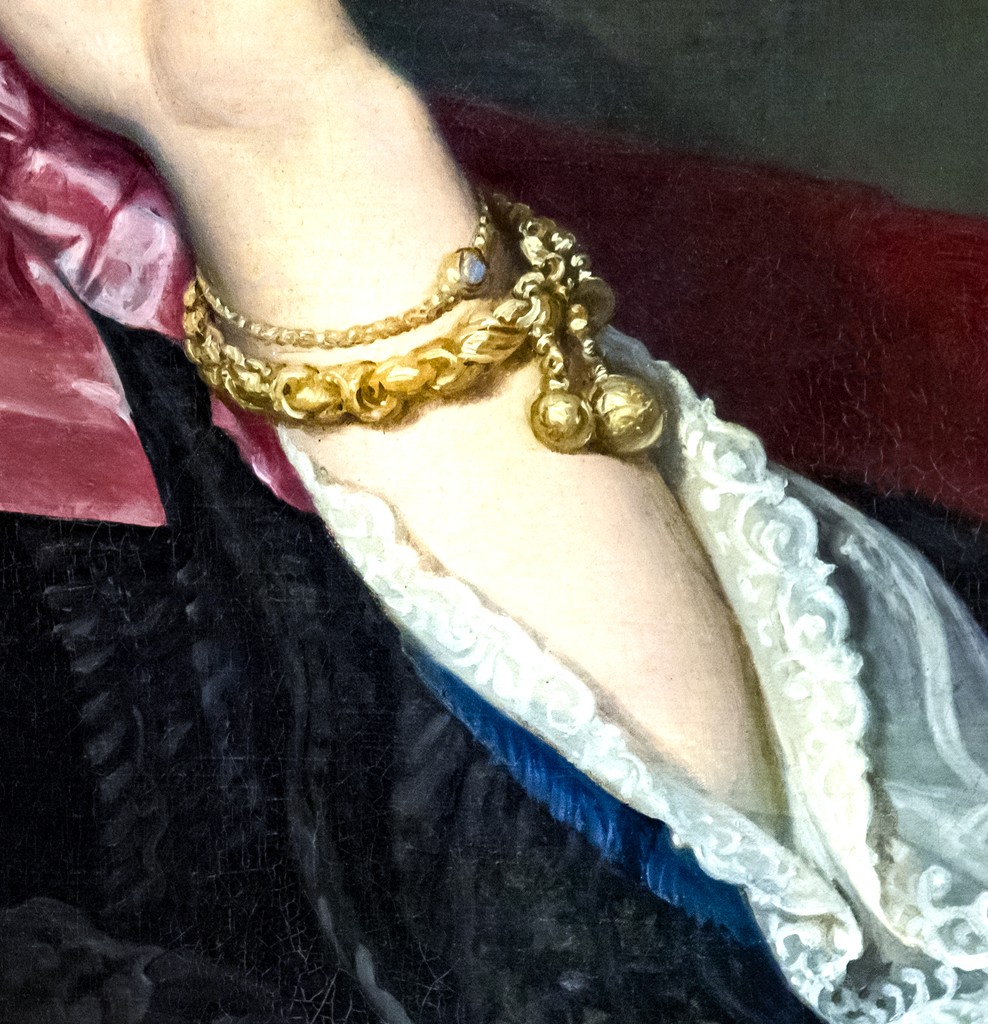
Gold chains and hanging ornaments gather around the wrist above the open cuff. The small rounded links contrast with the broad pale shapes of the forearm and sleeve.
Pink ribbons tied beneath the chin
The tied ribbons spread into several folds beneath the chin. Their bright surfaces and angular ends stand out against the much darker dress.
The patterned shawl beside the chair
A patterned shawl hangs beside the red chair. Its curling motifs and narrow coloured borders interrupt the larger, quieter areas of dark dress and red upholstery.
Lace and blue cloth at the lower edge
The lower hand rests near pale lace and a bright strip of blue fabric. Compare this low horizontal arrangement with the raised forearm reaching towards the face.
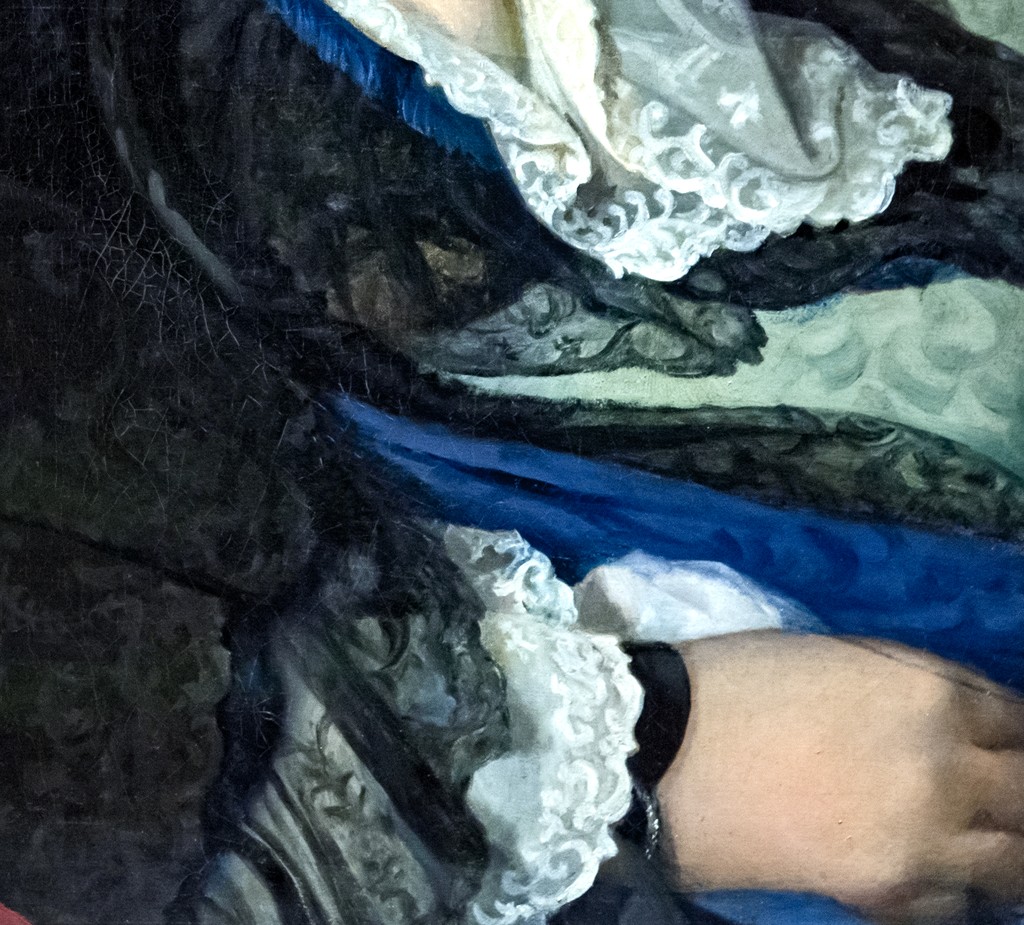
The raised hand and the open cuff
The hand beside the chin is the portrait’s second centre of attention. The fingers curve towards the lower face without covering it. A narrow interval between hand and cheek helps preserve both shapes: the oval of the head remains readable, while the hand has a separate, articulated outline.
Follow the arm downwards and the white cuff opens into a broad, irregular triangle. Its lace edging differs from the smooth skin above it and the uninterrupted darkness beside it. The gold bracelet marks the transition at the wrist. Several linked or looping forms catch the light, giving this small area more activity than the broad expanse of the bodice.
The opposite forearm appears near the lower right edge, partly cut by the frame. This lower arm balances the raised one without attracting equal attention. Together they establish a seated body within the narrow canvas: one arm rises towards the head, the other settles near the bottom. The chair’s red side and the shawl provide a fuller curve on the left, countering the conspicuous pale cuff on the right.
These contrasts are worth looking at before trying to identify every accessory. Skin, lace, ribbon, gold, dark cloth and patterned fabric each behave differently in the image. The face is legible across broad, softly varied areas; the cuff depends on an intricate edge; the ribbon on folds; the bracelet on isolated highlights. Ingres gives the viewer several kinds of looking within a compact portrait.
Who was Madame Gonse?
Joséphine Caroline Maille was born in Rouen in 1815 and died in Paris in 1901. Her husband Henri Gonse was a magistrate associated with Reims. The circumstances of her first meeting with Ingres are less secure. Georges Vigne, in the museum’s commentary, questions the inherited account of her father as an old friend of the painter and cautions that the description “pupil” may exaggerate a relationship consisting of occasional advice or conversations. [1][3]
There is, however, a tangible connection with Ingres’s household. Henri Delaborde’s posthumous catalogue of 1870 records a graphite portrait of the artist’s first wife, Madeleine, with a dedication to Mademoiselle Maille. Delaborde then lists it as belonging to Monsieur Gonse in Rouen. The dedication identifies Caroline by her maiden name and supports a personal association; it cannot establish the length or formality of any artistic instruction. [4] The dedication names Mademoiselle Maille. [4] It belongs to a portrait of Madeleine, a different sitter from the woman on this canvas. The inscription records a named recipient; it gives neither a teaching timetable nor an account of lessons.
The portrait therefore sits at an intersection of personal acquaintance and formal portraiture. Its careful arrangement of clothes and gesture need not imply a distant professional relationship, just as acquaintance does not make the pose a spontaneous glimpse of private life. Madame Gonse presents herself to the viewer through the same deliberate means available to a more ceremonial portrait: controlled posture, selected accessories and an exact distribution of light.
A portrait that took time
The French national collection record identifies the painting as a commission made in Paris. Its inscription supplies the date 1852. [2] That finishing date conceals a longer process. Gary Tinterow’s account in the 1999 exhibition catalogue places the beginning in 1846 and describes Gonse’s impatience by 1851. A December letter shows Ingres still postponing sittings; the portrait was finished in the opening weeks of 1852. [3] Naef discusses a 7 January 1852 letter to Gonse about Ingres’s planned marriage to Delphine Ramel. [3] The letter conveys personal news, rather than a continuous account of sittings.
The finished image offers no simple way to reconstruct those years. A poised hand cannot tell us how long the sitter held that position, and the elaborate cuff does not reveal how many sessions it required. The earlier drawing of Madeleine records a different sitter and a dedication to Mademoiselle Maille; the catalogue entry does not establish a preparatory role for the Gonse canvas. [4] Vigne’s 1999 essay contrasted the handling of skin and fabrics and proposed scientific investigation of possible assistance. It did not establish a named collaborator’s contribution. [3]
The visible effects of the materials remain compelling. Lace appears busy while a cheek looks calm; a ribbon is sharply folded while black clothing merges into shadow. These differences give the image variety, though they cannot by themselves identify who painted each passage.
A familiar gesture, a different portrait
The raised hand invites comparison with Ingres’s later portrait of Madame Ingres, showing his second wife Delphine Ramel in 1859. [5] In both paintings, a hand near the face brings skin, cuff and jewellery into close proximity. The gesture creates a route from the lower part of the picture to the eyes.
The surrounding shapes make the two portraits feel different. Gonse’s high black neckline and pink bow gather attention tightly beneath her chin. Delphine’s blue dress opens across the shoulders, and her pale sleeves spread more broadly. Gonse’s fingers approach the chin from the side; Delphine’s upright finger makes a longer line against her cheek. Looking between them reveals how much can change around a recurring pose.
The comparison is useful within Ingres’s portraits because it keeps costume and composition together. The hand is never an isolated emblem with one fixed meaning. Its effect depends on the space around it, the direction of the forearm, the shape of the neckline and the distance from the face.

Ingres, Portrait of Madame Ingres, 1859. [6]
From private portrait to Montauban collection
Delaborde records that Madame Gonse, signed and dated 1852, was exhibited in 1855. [4] This gives the painting a public history within Ingres’s lifetime. The record does not supply a detailed critical response to this particular portrait, so a general verdict on Ingres’s portraits should not be treated as Gonse’s own reception.
The later collection history returns us to the relationship between family memory and art history. Vigne reports that the historian Henry Lapauze acquired the canvas directly from the family. The national collection record subsequently lists the Lapauze bequest and the museum’s acquisition in 1928. [1][2] Its route into Montauban was therefore distinct from the artist’s own bequest.
Montauban’s municipal collection holds it today. [2] This personal portrait now forms part of a public collection. Yet the small visual decisions remain its most immediate invitation: the uneven lace around the head, the light beneath the cuff and the pink ribbon that connects the pale face to the dark dress.
Artworks directory
Explore 150 paintings, drawings and an original lithograph. This selection includes related versions and studies; dates distinguish completed works from later revisions.
| Name | Date | Medium |
|---|---|---|
| The Apotheosis of Homer | 1827 | Painting |
| Grande Odalisque | 1814 | Painting |
| The Turkish Bath | 1859–1862 | Painting |
| Madame Moitessier Seated | 1856 | Painting |
| Portrait of Monsieur Bertin | 1832 | Painting |
| Napoleon I on His Imperial Throne | 1806 | Painting |
| Odalisque with Slave | 1839 | Painting |
| The Ambassadors of Agamemnon in the Tent of Achilles | 1801 (competition) | Painting |
| The Valpinçon Bather | 1808 | Painting |
| The Source | 1856 | Painting |
| Oedipus Explaining the Enigma of the Sphinx | 1808; revised probably before 1827 | Painting |
| The Vow of Louis XIII | 1824 | Painting |
| Antiochus and Stratonice | 1840 | Painting |
| The Comtesse d’Haussonville | 1845 | Painting |
| The Princesse de Broglie | 1851–1853 | Painting |
| Jupiter and Thetis | 1811 | Painting |
| The Dream of Ossian | 1813 | Painting |
| The Martyrdom of Saint Symphorian | 1834 | Painting |
| Venus Anadyomene | 1808–1848 | Painting |
| Portrait of Madame de Senonnes | 1814 | Painting |
| Madame Rivière | 1805 | Painting |
| Mademoiselle Caroline Rivière | 1805 | Painting |
| Portrait of Philibert Rivière | 1805 | Painting |
| Bonaparte First Consul | 1804 | Painting |
| The Death of Leonardo da Vinci | 1818 | Painting |
| Joan of Arc at the Coronation of Charles VII | 1854 | Painting |
| Madame Duvaucey | 1807 | Painting |
| La Belle Zélie | 1806 | Painting |
| Madame Panckoucke | 1811 | Painting |
| Portrait of Charles Marcotte d’Argenteuil | 1810 | Painting |
| Joseph Antoine Moltedo | c.1810 | Painting |
| Madame Leblanc | 1823 | Painting |
| Delphine Ingres-Ramel (Portrait of Madame Ingres) | 1859 | Painting |
| Portrait of Amédée de Pastoret | 1823–1826 | Painting |
| Portrait of Baronne de Rothschild | 1848 | Painting |
| Madame Marcotte de Sainte Marie | 1826 | Painting |
| Madame Gonse | 1852 | Painting |
| Aretino in the Studio of Tintoretto | 1848 | Painting |
| Don Pedro of Toledo Kissing Henry IV’s Sword | 1831/1832 | Painting |
| Raphael and La Fornarina | 1814 | Painting |
| Roger Freeing Angelica | 1819 | Painting |
| Romulus’ Victory over Acron | 1812 | Painting |
| Self-Portrait at the Age of Twenty-Four | 1804; revised 1841–1851 | Painting |
| Male Torso | c.1800 | Painting |
| Odalisque in Grisaille (Ingres and workshop) | c.1824–1834 | Painting |
| The Small Bather | 1826 | Painting |
| The Little Bather Harem Interior | 1828 | Painting |
| Jesus Among the Doctors | 1862 | Painting |
| The Virgin Adoring the Host | 1852 | Painting |
| The Virgin of the Host | 1841 | Painting |
| Virgin of the Adoption | 1858 | Painting |
| Paolo and Francesca | 1814 | Painting |
| Homer Deified (revised composition, Louvre RF5273) | 1865 | Drawing |
| Odalisque with Slave (Louvre RF4622) | 1858 | Drawing |
| Odalisque (Walters Art Museum; Ingres and Paul Flandrin) | 1842 | Painting |
| Madame Moitessier Standing (National Gallery of Art) | 1851 | Painting |
| Jacques-Louis Leblanc (The Metropolitan Museum of Art) | 1823 | Painting |
| Ferdinand-Philippe, Duke of Orléans (Louvre RF2005-13) | 1842 | Painting |
| Ferdinand-Philippe, Duke of Orléans (Versailles MV5207; Ingres and workshop) | 1843 | Painting |
| Ferdinand-Philippe, Duke of Orléans (Versailles MV5209; Ingres and workshop) | 1844 | Painting |
| Antiochus and Stratonice (Musée Fabre; Ingres and Raymond Balze) | 1866 | Painting |
| Antiochus and Stratonice (Kunstmuseum Bern, Gurlitt bequest) | Undated (early dating proposed) | Drawing |
| Composition study for Antiochus and Stratonice (MIB867.2193) | 1806 | Drawing |
| Study for the Figure of Stratonice (Met63.66) | 1834–1840 | Graphite, black chalk and charcoal |
| Nude figure study for Stratonice (Boijmans F II 36 PK) | c.1834–1840 | Drawing |
| Paolo and Francesca (The Barber Institute,54.6) | c.1814–1820 | Painting |
| Paolo and Francesca (The Hyde Collection,1971.24) | c.1855–1860 | Painting |
| Paolo and Francesca (Amsterdam Museum TA10970) | 1820 | Drawing |
| Paolo and Francesca (dedicated to Artaud de Montor) | 1816 | Drawing |
| Study for the Bust of Francesca (MIB867.1398) | 1819 | Drawing |
| Study for the Bust of Francesca (MIB867.1396) | 1819 | Drawing |
| The Archangel Raphael, first idea (MIB867.2488) | 1842 | Drawing |
| The Archangel Raphael (MIB867.2500) | 1842 | Drawing |
| The Archangel Raphael Carrying Human Prayers to God (Chantilly DE513) | 1844 | Drawing |
| Louis-Philippe as Saint Philip, stained-glass study | 1844 | Drawing |
| Marie Frédéric Eugène de Reiset (Ford Collection RBF171-2) | 1844 | Drawing |
| Virgil Reading the Aeneid (Toulouse) | Begun 1811 | Painting |
| Tu Marcellus Eris (Brussels, inv. 1836) | c.1814 (museum dating) | Painting |
| Jean-François Gilibert | 1804 | Painting |
| François-Marius Granet | 1807 (museum dating) | Painting |
| Count Nikolai Dmitrievich Guryev | 1821 | Painting |
| Caroline Murat, Queen of Naples | 1814 | Painting |
| Count Mathieu Molé | 1834 | Painting |
| Cherubini and the Muse of Lyric Poetry (Louvre) | 1842 | Painting |
| Luigi Cherubini (Cincinnati) | 1841 | Painting |
| Comtesse de Rayneval (Louvre RF4505) | 1841 | Drawing |
| Venus on Paphos (Antonie Balaÿ) | c.1852 | Painting |
| Prince Napoléon | 1855 | Painting |
| Study for The Apotheosis of Napoleon I (Petit Palais) | Late 1853 | Painting |
| The Apotheosis of Napoleon I (destroyed ceiling) | 1853 | Painting |
| The Journalist (MIB867.2733) | 1834? | Drawing |
| Henry VIII, after Holbein | c.1815–1820 (?) | Drawing |
| Madame Récamier, after David (MIB867.3637) | Undated (early Paris period) | Drawing |
| Study for Comtesse d’Haussonville (MIB867.259; background possibly by another hand) | 1842–1845 | Drawing |
| La Source (reduced version reported by Delaborde) | Date unrecorded; reported 1870 | Painting |
| Odalisque (autograph lithograph,NGA1946.21.117) | 1825; published1826 | Lithograph |
| Portrait of a Seated Lady | 1814 | Graphite |
| The Kaunitz Sisters (Leopoldine, Caroline, and Ferdinandine) | 1818 | Graphite |
| Portrait of a Man | 1814 | Graphite |
| Study for the Portrait of Louis-François Bertin (1766–1841) | n.d. | Black chalk and graphite |
| Studies for the Cadaver of Acron | ca. 1810–12 | Graphite on wove paper |
| Study for the Drapery of Molière in "The Apotheosis of Homer" | n.d. | Black chalk with stumping |
| Madame Guillaume Guillon Lethière, née Marie-Joseph-Honorée Vanzenne, and her son Lucien Lethière | 1808 | Graphite |
| Niccolò Paganini (1782–1840) | ca. 1830 | Counterproof or tracing strengthened with graphite and gouache on translucent paper |
| Lady Mary Cavendish-Bentinck (?-1843) | 1816 | Graphite |
| Madame Alexandre Lethière and Her Daughter Letizia | ca. 1815 | Graphite |
| Merry Joseph Blondel (1781–1853) | 1809 | Graphite |
| Ursin-Jules Vatinelle (1798–1881) | 1820 | Graphite |
| Bust of a Gypsy Girl (ascribed to Ingres) | 1819 | Graphite on wove paper |
| Study of a Seated Nude Male | n.d. | Graphite |
| The Archangel Raphael (Study for a stained-glass window in the chapel of Notre-Dame de la Compassion-Saint-Ferdinand, Neuilly) | ca. 1842 | Graphite |
| Lancelot-Théodore, comte Turpin de Crissé | probably 1818 | Graphite |
| Study for the Figure of the Iliad in "The Apotheosis of Homer" | ca. 1827 | Graphite and black chalk heightened with white chalk on brown paper |
| Comtesse Turpin de Crissé | probably 1818 | Graphite |
| Nude Figures for L'Âge d'Or, Château de Dampierre | n.d. | Graphite on brownish paper |
| Study of Figures (attributed to Ingres) | n.d. | Graphite |
| Study of Figures (attributed to Ingres) | n.d. | Graphite; squared in graphite |
| Admiral Sir Fleetwood Broughton Reynolds Pellew | 1817 | Graphite on wove paper |
| Madame Jean-Auguste-Dominique Ingres, née Madeleine Chapelle | 1814 | Graphite on off-white wove paper |
| Virgil Reading the Aeneid to Augustus, Livia, and Octavia | 1809/1819 (?) | Pen and black ink, graphite, brush and gray wash, white gouache heightening, Conté crayon on blue paper |
| General Louis-Étienne Dulong de Rosnay | 1818 | Graphite (hard and soft pencils) |
| Madame Alexandre Lethière, née Rosa Meli, and Her Daughter, Letizia | 1815 | Graphite |
| The Lawyer Paul Grand | 1834 | Graphite |
| Jean-Joseph Fournier | 1815 | Graphite |
| Armand Bertin | 1842 | Graphite |
| Madame Armand Bertin, née Marie-Anne-Cécile Dollfuss | 1843 | Graphite |
| The Architect Charles-Victor Famin | 1836 | Graphite |
| Henri Lehmann | 1850 | Graphite |
| Portrait of a Lady | ca. 1815–17 | Graphite |
| Edmond Cavé (1794–1852) | 1844 | Oil on canvas |
| Head of Saint John the Evangelist | probably ca. 1818–20 | Oil on canvas, laid down on wood |
| Madame Edmond Cavé (Marie-Elisabeth Blavot, ca. 1806–1883) | ca. 1831–34 | Oil on canvas |
| Madame Félix Gallois | 1852 | Graphite with touches of gold in oil to highlight jewelry, on buff wove paper. |
| Dr. François Mêlier | 1849 | Graphite with graphite framing lines, corrected with white, on buff wove paper |
| Portrait of Madame Rhode (Rhoda?) | 1810–20 | Graphite on pale buff wove paper |
| Study for "Raphael and the Fornarina"(?) | ca. 1814(?) | Graphite on white wove paper |
| Portrait of Madame Paul Meurice, née Palmyre Granger | ca. 1845–50 | Graphite on wove paper |
| Alexander the Great presenting Campaspe to Apelles | 1810 | Graphite, brush and brown wash; squared in graphite |
| Study of Hands for "Christ Among the Doctors" | 1852–62 | Graphite on tracing paper |
| Study for The Turkish Bath (RF34502) | about 1850 | Pen and brown ink with graphite, partially squared |
| Study for The Turkish Bath (RF23354) | Undated | Pen and brown ink with graphite on joined sheets |
| Study for The Turkish Bath (RF54702) | about 1859 | Pen and brown ink |
| Studies of women for The Turkish Bath (RF12292) | Undated | Black chalk |
| Achilles Receiving the Envoys of Agamemnon (Nationalmuseum sketch, NM2161) | 1801 | Oil on wood |
| Half-Length Bather (Musée Bonnat-Helleu,89) | 1807 | Oil on canvas |
| Oedipus and the Sphinx (National Gallery,NG3290) | about1826 | Oil on canvas |
| Oedipus and the Sphinx (Walters,37.9) | 1864 | Oil on canvas |
| Oedipus and the Valpinçon Bather, after David (MI.867.2035) | Undated | Graphite on tracing paper, after David |
| Study of the Virgin for The Vow of Louis XIII (Dijon,1758) | about1822 | Black chalk, stump and white chalk on brown wove paper |
| First Thought for The Vow of Louis XIII (MI.885.11.21) | 1822 | Oil on canvas |
Frequently Asked Questions
The Musée Ingres Bourdelle in Montauban holds the painting. [2]
Discussion
Look again at the images and ideas explored in Madame Gonse. These editorial prompts invite your observations.
Reader Insights
Which detail brings your eye back to Madame Gonse’s face most strongly: the pink bow, the lace around her hair, or the raised hand? Follow each route through the picture and consider how the effect changes when you begin at the cuff instead of the eyes.
Compare the pink bow with the blue dress and pale cuff. Which colour relationship most strongly returns you to the face?
How does comparing a familiar hand-to-face gesture across several portraits help you see the differences between their sitters and designs?
Join the Conversation
Share a detail, comparison or question about Madame Gonse below.
References
- Musées Occitanie / Musée Ingres Bourdelle, Georges Vigne, “Portrait de madame Gonse”. Object record and commentary. (In French.) View source.
- Ministère de la Culture, Joconde, “Portrait de Madame Gonse”, record 06070000001, inventory MI.28.2.1. Creation, inscriptions, legal status and acquisition fields; updated 4 September 2026. (In French.) View source.
- Gary Tinterow and Philip Conisbee, eds. Portraits by Ingres: Image of an Epoch. New York: The Metropolitan Museum of Art, 1999. Tinterow, pp. 363–364; Hans Naef, no. 159, pp. 484–485; Georges Vigne, p. 539. Letters read through this catalogue. View source.
- Henri Delaborde, Ingres, sa vie, ses travaux, sa doctrine, d’après les notes manuscrites et les lettres du maître. Paris: Henri Plon, 1870. Catalogue no. 122, p. 249, for the painting and its 1855 exhibition; no. 335, p. 302, for the drawing of Madeleine dedicated to Mademoiselle Maille. Posthumous documentary compilation. (In French.) View source.
- Bundesamt für Kultur, Swiss Federal Collections, “Bildnis Delphine Ingres-Ramel”, inventory SOR1924.6. Date and identification of the sitter as the artist’s second wife; Sammlung Oskar Reinhart «Am Römerholz». (In German.) View source.
- Supporting image. Ingres, Portrait of Madame Ingres, 1859. Sammlung Oskar Reinhart Am Römerholz; Wikimedia Commons. Image source. Public domain.
- Splash image. Jean-Auguste-Dominique Ingres, Madame Gonse (Joséphine Caroline Maille), 1852. Oil on canvas, 73 × 62 cm. Musée Ingres Bourdelle, Montauban, MI.28.2.1. Photograph: Didier Descouens / Wikimedia Commons. Image source. CC BY-SA 4.0. Resized and JPEG-optimised; image derivative licensed CC BY-SA 4.0.