


 Gustave Caillebotte.jpg)
 by Tom Gurney
Tom Gurney BSc (Hons) is an art history expert with over 20 years experience
Published on June 19, 2020 / Updated on November 2, 2026
Email: tomgurney1@gmail.com / Phone: +44 7429 011000
Rooftops in the Snow: Introduction
Snow makes the roofs of Paris unusually legible in Gustave Caillebotte’s Rooftops in the Snow. Broad pale surfaces rise towards a crowded skyline, interrupted by chimney pots, pipes and dormer windows. The nearest building fills so much of the foreground that its roof becomes a landscape in itself. Painted in 1878, the canvas belongs to the Musée d’Orsay. [1]
Its French title, Vue de toits (Effet de neige), identifies both a subject and a condition of seeing: rooftops transformed by snow. Caillebotte exhibited it at the fourth Impressionist exhibition in 1879, alongside another rooftop view. The pair made the upper surfaces of ordinary buildings a subject for sustained attention. [2]
At a Glance
- ArtistGustave Caillebotte
- Date1878
- MediumOil on canvas
- Dimensions64.5 × 81 cm
- CollectionMusée d’Orsay, Paris
- AccessionRF 876
- AcquisitionGift of Martial Caillebotte, 1894. [1]
This work across Gustave Caillebotte’s career
Contents
- A Roof Takes the Foreground
- How Snow Changes the City
- Paris Seen from Above
- Two Rooftop Views at the 1879 Exhibition
- Related Snow Pictures, Separate Objects
- A Gift and a Public Life
- Annotated details
A Roof Takes the Foreground
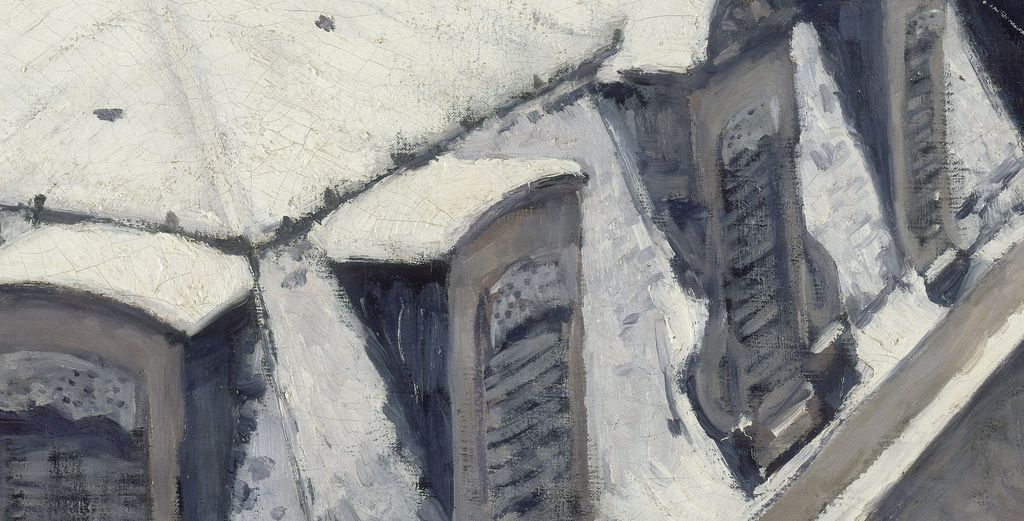
The first thing to notice is how little ground the painting allows us to see. Its nearest surface is a steep roof, cut by the lower edge of the canvas. A row of dormers projects towards the viewer, their curved heads capped with snow. Dark shutters sit beneath these white caps, while the narrow strips of roof between the windows fall away in long, pale slopes. The building’s main façade lies below the picture. We meet its uppermost, normally inaccessible level at close range.
That proximity gives the foreground a physical weight quite different from the distant city. We can follow the broad diagonal of the roofline from the lower left towards the right, then trace the separate protrusions of the dormers. Small dark flecks break the snow’s surface. The irregular dark line along the eaves keeps the large white area from looking like an empty opening in the painting. It remains a roof with edges, obstructions and changes of pitch.
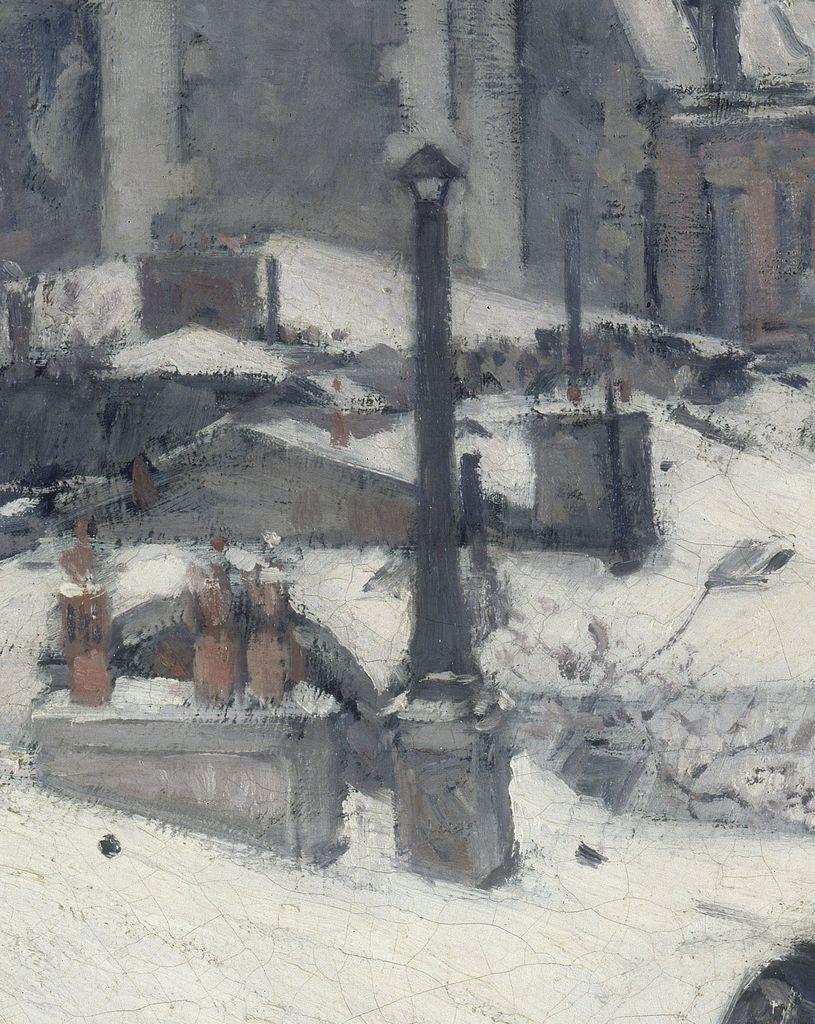
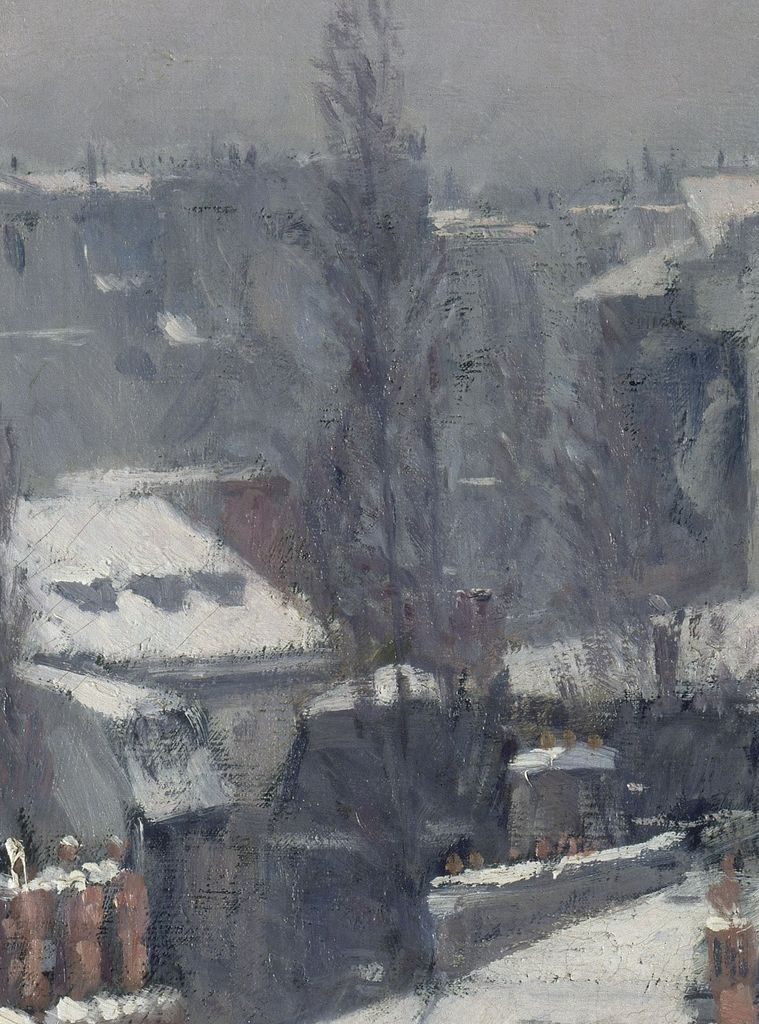
Further back, the same ingredients recur on a smaller scale. Roofs overlap, chimney stacks rise in clusters, and grey walls block portions of the view. The tallest dark pipe, slightly left of centre, provides a strong vertical against the sloping planes. Its cap makes a small, emphatic shape against the pale architecture beyond. Nearby, shorter terracotta pots gather on broader bases. They interrupt the snow with warm upright strokes, giving the middle distance a rhythm that the broad foreground roof lacks.
The right side is harder to penetrate. A dark building presses forward, and a narrow snow-covered space drops away beside it. Bare branches complicate the view further. Here the eye encounters gaps and obstruction rather than the expansive white plane at the left. This uneven distribution matters: the painting offers a commanding elevated prospect, yet parts of the neighbourhood remain hidden behind other buildings. Height brings the viewer close to some surfaces while making the streets almost disappear.
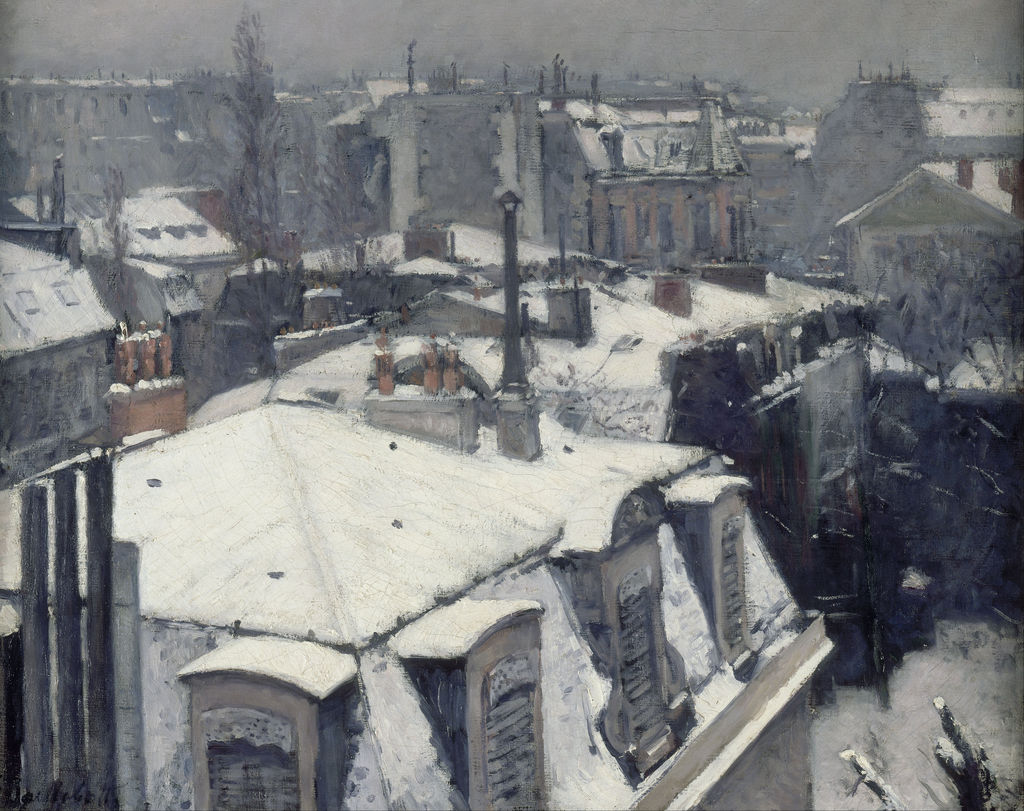
Rooftops in the Snow, 1878; Musée d’Orsay, RF876. UQFK1EaennuyxQ at Google Cultural Institute maximum zoom level. Image source. Public domain. Resized only; source appearance preserved.
How Snow Changes the City
Snow performs two different visual tasks. It joins separate roofs into a loose network of pale shapes, and it picks out the peculiarities of each one. A small cap on a chimney, a thin strip along a ledge and the broad covering of a sloping roof all register differently. The same weather that makes the buildings resemble one another also helps distinguish their forms.
The nearest roof has the most continuous covering. Behind it, dark ridges and steep sides split the snow into smaller patches. The eye moves between those patches, reconstructing the buildings from fragments. Around the dormers, the snow emphasises curved outlines; on the more distant roofs, it makes long horizontal bands. The scene becomes an exercise in recognising a complicated city through a restricted range of light and dark.
White itself is varied. The foreground appears creamy beside the colder grey of the sky. Other pale passages acquire blue-grey shadows or warmer notes from adjacent walls. The brick-red chimney pots and the muted pinkish building near the centre are modest in area, but they prevent the whole view from settling into a uniform grey. Their warmth is particularly noticeable because the rest of the colour is so restrained.
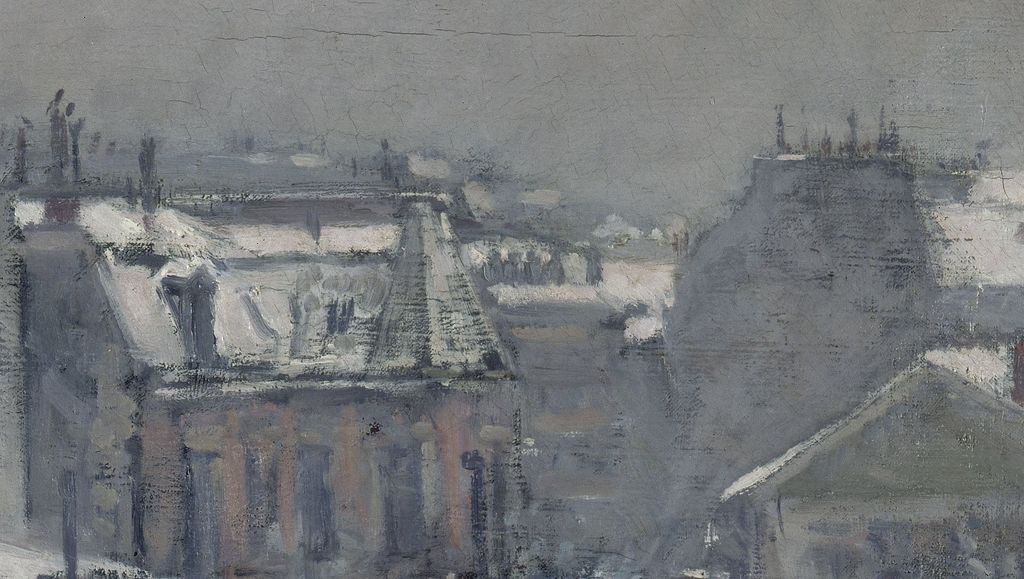
Caillebotte gives us little evidence of direct sunlight. There are no long, crisply cast shadows organising the roofs into a single dramatic lighting scheme. Instead, the sky hangs over them as a broad grey field. The furthest buildings lose definition towards it, whereas the nearest shutters and roof edges retain sharp contrasts. Distance is communicated through this change in clarity as well as through the diminishing size of windows and chimneys.
Look especially at the bare tree rising left of centre. Its narrow, uneven silhouette links the roof zone to the sky without becoming a solid architectural barrier. Smaller branches towards the right make another kind of dark pattern. These trees help separate winter from a merely pale cityscape: their exposed structure belongs to the same seasonal condition as the snow lying on the roofs.
Annotated Details from Rooftops in the Snow
The numbered points identify visible features discussed in this article. Return from each detail to the whole composition. Rooftops in the Snow, 1878; Musée d’Orsay, RF876. UQFK1EaennuyxQ at Google Cultural Institute maximum zoom level. Image source. Public domain. Resized only; source appearance preserved.
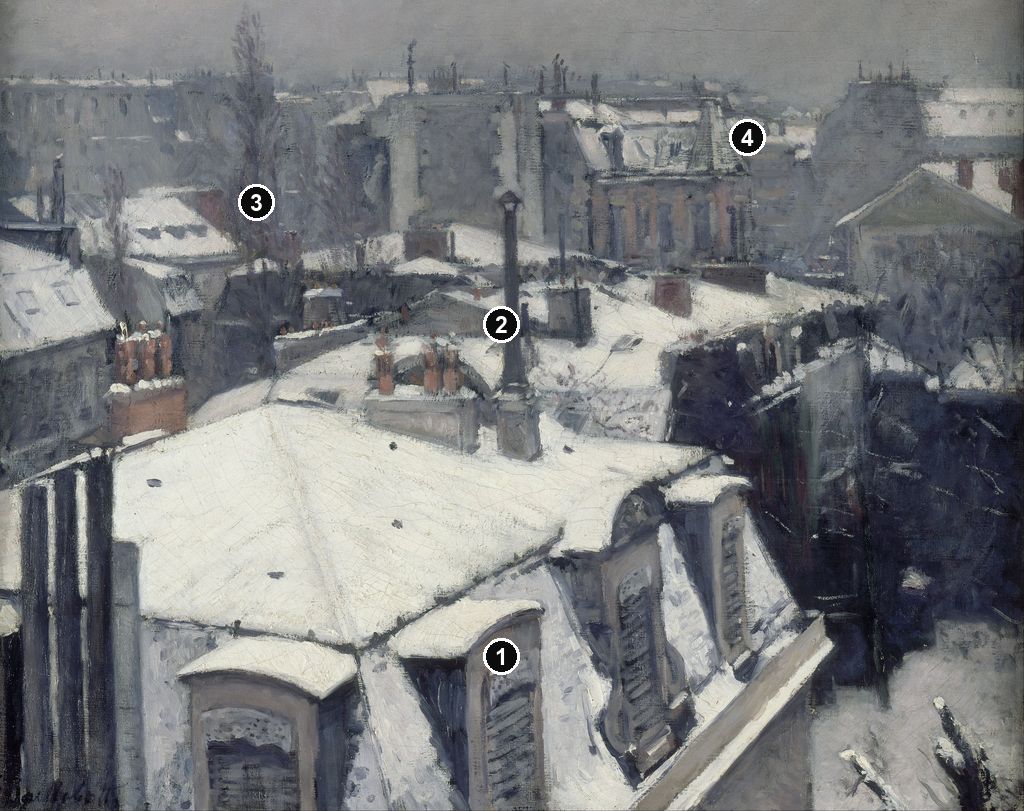
Details from ROOFTOPS IN THE SNOW
Compare the cropped details with the complete images above. Notice how their colours, shapes and positions contribute to the larger compositions.
Snow over the dormers
Snow caps the projecting dormers and spreads across the nearest roof. Dark shutters and the roof edge keep the pale foreground legible as a constructed surface.
The tall chimney and shorter pots
A tall dark pipe rises above a group of shorter, warmer chimney pots. Their upright shapes interrupt the broad slopes and help establish distance.
Bare branches among buildings
The narrow tree breaks up the walls and rooflines behind it. Its bare branches add another winter structure alongside the snow-covered architecture.
A skyline losing definition
The more distant buildings and chimneys become less distinct towards the grey sky. Small pale roof bands carry the snow into the farthest parts of the view.
Paris Seen from Above
An elevated viewpoint changes what qualifies as the face of a building. From the pavement, these houses would be encountered through entrances, windows and façades. Here their backs, roof slopes, chimneys and upper walls take precedence. The city is assembled from surfaces that a pedestrian often sees only obliquely, if at all. There is no prominent monument to identify the view at a glance. Its character emerges through the density and variety of ordinary construction.
The foreground also makes the viewer’s position unusually tangible. We seem close enough to inspect shutters and the snow clinging to a projecting window head, although there is no balcony rail or visible observer to define our location. The high view is an experience built into the composition. It does not require a painted figure looking out on our behalf.
The SCHIRN Kunsthalle Frankfurt’s exhibition texts place Caillebotte’s steep viewpoints, abrupt cropping and geometric organisation within a wider discussion of modern urban perception. Their comparison with photography concerns ways of seeing, including images made after his lifetime. That curatorial argument helps explain the lasting freshness of a view like this one: familiar buildings become unfamiliar when their proportions and relationships change with the observer’s position. It does not establish that this particular painting was copied from a photograph. [4]
A useful comparison is Rue Halévy, Seen from the Sixth Floor, another elevated city view shown in 1879. Berhaut records it as exhibition number 14, two entries after the snowy rooftops. [2] In that painting, the buildings frame a street whose traffic and pedestrians become small marks below. Their façades form deep channels into the city. In Rooftops in the Snow, the intervening roofs occupy the space where we might expect that channel to open. The view spreads across a neighbourhood rather than drawing us down a busy thoroughfare.
The comparison also reveals how much the winter palette contributes. The warmer light and coloured façades of Rue Halévy keep individual buildings distinct. Here, the repeated snow coverings knit different structures together. Both pictures organise Paris through an elevated view, but the snowy canvas makes weather a principal agent of that organisation.
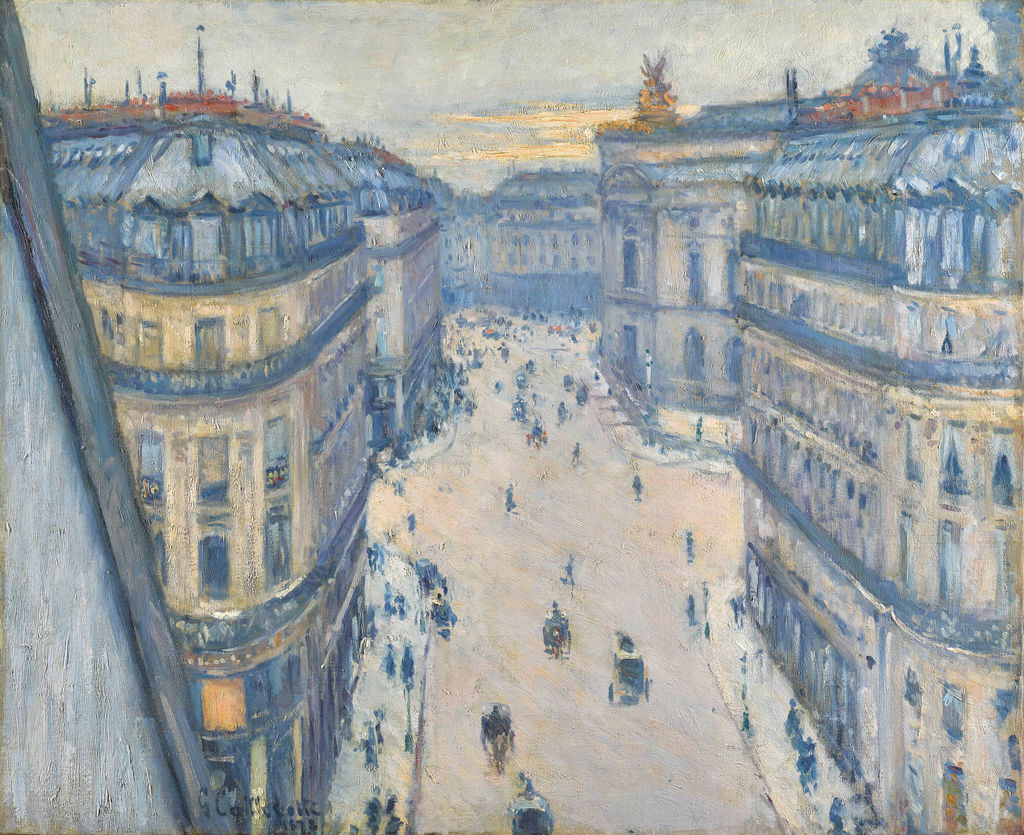
Rue Halévy, Seen from the Sixth Floor, 1878; separate elevated city view. sammlung.museum-barberini.de. Image source. Public domain. Resized only; source appearance preserved.
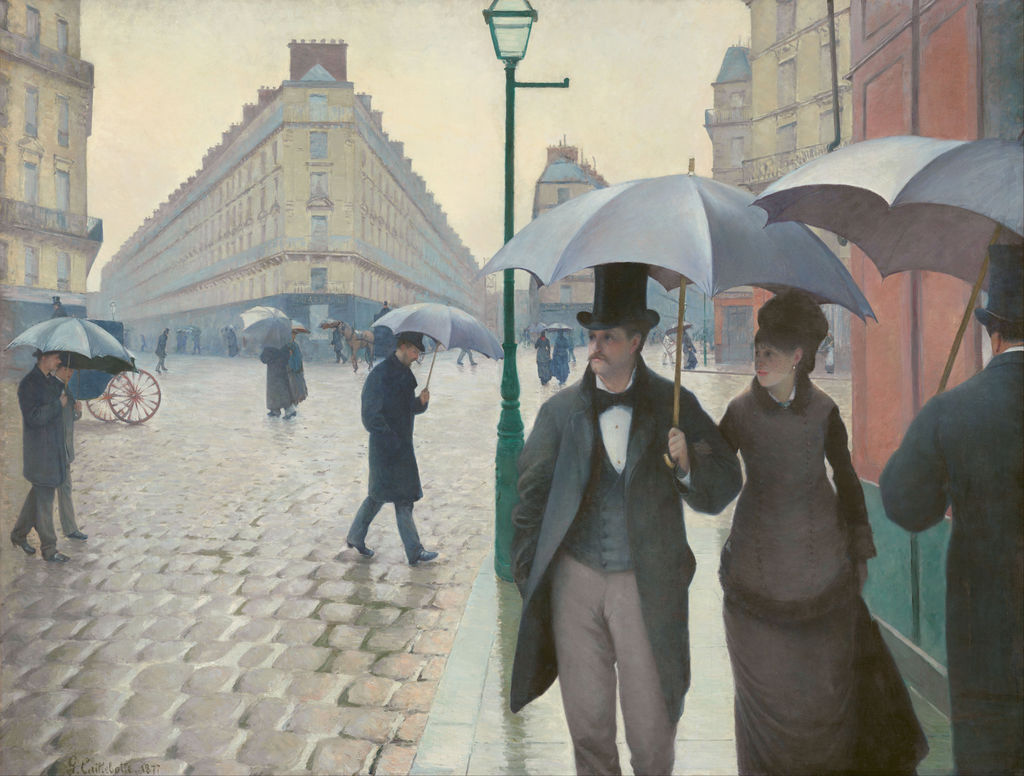
Paris Street; Rainy Day, 1877; a contrasting view from the pavement. 5wEUCOlEf-EaVQ at Google Cultural Institute maximum zoom level. Image source. Public domain. Resized only; source appearance preserved.
Watch: Gustave Caillebotte
Explore a museum overview and two discussions of Paris Street; Rainy Day. This shared selection offers wider context for the artist’s work.
"Who Is Gustave Caillebotte?" - HD version
An introduction to Caillebotte from the Kimbell Art Museum.
Watch on YouTubeTwo Rooftop Views at the 1879 Exhibition
The exhibition history gives the painting a precise place within Caillebotte’s public work. Berhaut’s catalogue reproduces the 1879 listing as number 12, Vue de toits. (Effet de neige). Immediately before it came number 11, Vue de toits, identified with a different canvas, catalogue number 97. Rooftops in the Snow is number 96 in Berhaut’s revised catalogue of 1994. The sequence distinguishes the date of the painting, 1878, from the exhibition year, 1879. [2]
These neighbouring entries show that rooftops formed a deliberate part of the selection presented to visitors. Yet an exhibition pairing does not make the two pictures interchangeable. The other canvas gives much more space to a broad, dark roof crossed by long seams, with upright chimneys and taller buildings enclosing it. In the snowy painting, light spreads over the nearest roof and repeats across the distance. Comparing them makes the subtitle’s importance clear: the snow changes the visual relationships within the built landscape.
The historical ownership line attached to number 12 reads “Appartient à M. K.” Berhaut retains those initials in the provenance. The initials do not securely identify the owner; the catalogue does not establish how the work subsequently reached Martial Caillebotte. [2]
The Musée d’Orsay notes that Caillebotte’s rooftop pictures attracted relatively little contemporary comment, despite the size of his contribution to that exhibition. [1] Their interest lies partly in this quietness. They offer no conspicuous action or readily summarised encounter. The reader of the picture has to attend to relationships between objects: the balance of a tall chimney against a wall, the transition from a bright roof to a dark gap, or the way one snow-covered edge repeats another further back.
Related Snow Pictures, Separate Objects
The catalogue places this canvas within a small group of snowy city views, entries 93–96. Those works have different supports and dimensions. Number 93 is an oil on cardboard left in a sketch-like state; number 94 is painted on the back of a wooden palette; number 95 is another oil on cardboard. The Orsay painting is the oil on canvas numbered 96. Berhaut cross-references the group while preserving their separate identities. [2]
The distinction is useful when looking at reproductions. Number 95 also contains snowy roofs and prominent vertical chimneys, but its arrangement differs markedly: a cluster of tall pipes dominates the upper field, while the foreground opens across a different set of roof planes. The familiar dormer row of the Orsay picture is a particularly helpful point of recognition. A similar title or a snowy Parisian setting is insufficient to identify the same work.
Berhaut’s entry for the neighbouring, snowless rooftop canvas, number 97, records Martial Caillebotte’s note that it was painted from the rue de Clichy studio of the artist’s friend Édouard Dessommes. That statement belongs to number 97. It should not automatically become the address from which the Orsay picture was painted. [2] The distinction leaves the snowy view open to close observation without attaching an unsupported window, room or personal anecdote to it.
Taken together, the group demonstrates how much variation the subject allowed. Changing the position of a chimney, the angle of a roof or the extent of the snow produces a different spatial problem. The Orsay canvas is especially striking for bringing an extensive foreground roof into contact with an irregular, densely built distance. Its balance depends on both: the pale expanse gives the eye room to settle, while the buildings beyond keep drawing it into new complications.
A Gift and a Public Life
Martial Caillebotte gave the picture to the French state in 1894. This was a separate gift alongside The Floor Scrapers, distinct from Gustave’s bequest of works he had collected by other artists. Fanny Matz’s archival account explains that the two Caillebotte paintings were already part of the national collections when the bequest’s display opened at the Luxembourg in February 1897. [5]
In that display, Caillebotte could be encountered in two capacities: as the collector whose choices shaped the ensemble, and as an artist represented through Martial’s gifts. The snowy rooftops stood beside the work of the colleagues whose paintings he had bought. [5]
Matz describes the Luxembourg presentation as crowded and much visited, provoking sharply differing responses. These accounts concern the ensemble, rather than recording a particular reaction to the rooftops. They establish the painting’s place within a public display that encouraged comparison across the Impressionist group. [5]
The current owner record traces its passage through the Luxembourg, the Louvre and the Jeu de Paume before its allocation to the Musée d’Orsay in 1986. It also explains that RF 2730 arose from an erroneous reinventory in 1929; RF 876 identifies the painting today. [1] The changing museum names belong to one canvas’s institutional history, rather than indicating successive versions.
Berhaut’s exhibition list records further opportunities to see the work, including the 1894 retrospective, La Neige et les peintres at Annecy in 1957, the Houston and New York retrospective of 1976–77, and The New Painting in Washington and San Francisco in 1986. These settings brought different aspects of it forward: Caillebotte’s individual career, the subject of snow, and its place within the group exhibitions of Impressionism. [2]
The painting rewards those different approaches because its subject and structure are so closely connected. Viewed as a winter scene, it captures the way snow alters the visibility of an everyday neighbourhood. Viewed as a composition, it turns roofs into a sequence of sloping light surfaces and dark interruptions. The more closely one studies the roof geometry, the more specific the weather becomes; the more one follows the snow, the more clearly the city’s construction emerges.
Catalogue and documented works
This directory brings together 578 entries in the revised 1994 catalogue, 11 further documented records and three groups of study descriptions. It is a directory of records, not a total of authenticated individual works. Albums, print states and surviving decorative panels are grouped. English labels retain the French titles as searchable aliases; dates are supplied only where checked. Numbered entries link to the relevant article or the historical catalogue. Pastels appear under the Drawing filter; original prints remain searchable under All media.
Frequently Asked Questions
It was exhibited as Vue de toits. (Effet de neige). Berhaut’s 1994 catalogue calls it Toits sous la neige, number 96. [2]
It entered the national collections through Martial Caillebotte’s separate gift in 1894. Gustave’s bequest concerned the collection he had assembled of other artists’ work. [5]
No. Berhaut distinguishes several related rooftop views, including different snow pictures and the snowless view exhibited alongside this canvas in 1879. Titles alone can obscure those differences. [2]
Discussion
Look again at the images and ideas explored in Rooftops in the Snow. These editorial prompts invite your observations.
Reader Insights
Snow separates roof planes that might otherwise merge into a single mass.
The nearest roof gives the distant city an unusually close foreground.
Which small change of colour most helps you read the depth?
Join the Conversation
Share a detail, comparison or question about Rooftops in the Snow below.
References
- Musée d’Orsay , Vue de toits (Effet de neige), current collection record, RF 876; date, medium, dimensions, interpretation and “History – Provenance”. View source. (in en/fr).
- Marie Berhaut, with the assistance of Sophie Pietri , Gustave Caillebotte: catalogue raisonné des peintures et pastels (1994), entries 93–100, pp. 107–110; illustrated entries 95–98, pp. 108–109; 1879 exhibition listing, p. 282. Public digital edition, Wildenstein Plattner Institute. View source.
- Marie Berhaut with Sophie Pietri; Wildenstein Plattner Institute, Gustave Caillebotte Catalogue raisonné des peintures et pastels, 1994. View source. (in French).
- SCHIRN Kunsthalle Frankfurt , Gustave Caillebotte: Ein Impressionist und die Fotografie — Wandtexte (2012), pp. 1–3, elevated viewpoints, cropping and modern urban perception. View source. (in German).
- Fanny Matz, Musée d’Orsay , “Le legs Caillebotte : une « affaire délicate »” (2024; updated 2026), “La salle Caillebotte au Luxembourg : premières réactions”, and discussion of the artist-work gifts alongside the collected-art bequest. View source. (in French).
- Art Institute of Chicago, Caillebotte Paintings and Drawings at the Art Institute of Chicago, 2015. View source.
- Petit Palais / Paris Musées, Portrait de Paul Hugot, original print, PPG2319, current. View source. (in French).
- Paul Perrin, Musée d’Orsay, Transcription de l’entretien commissaire Caillebotte, 2024. View source. (in French).
- Cleveland Museum of Art, Caillebotte collection records: 2020.260, 2009.157 and 2020.105, current. View source.
- Splash image, Rooftops in the Snow, 1878.


