



 by Tom Gurney
Tom Gurney BSc (Hons) is an art history expert with over 20 years experience
Published on June 19, 2020 / Updated on November 2, 2026
Email: tomgurney1@gmail.com / Phone: +44 7429 011000
Gustave Caillebotte: Introduction
Gustave Caillebotte (1848–1894) found some of his most arresting subjects close to home: men renovating a room, a brother looking through an open window, pedestrians negotiating a wet pavement. His pictures make these familiar activities difficult to take for granted. Floors seem to rise towards us; streets recede with extraordinary force; a foreground figure stands almost within touching distance while another dwindles far below. An everyday view becomes an encounter with the act of looking. [1]
A painter, collector and organiser at the centre of the Impressionist group, Caillebotte combined financial independence with sustained practical commitment. His inheritance enabled him to buy his friends’ pictures and help organise their exhibitions. It also gave him unusual freedom to pursue his own painting alongside competitive sailing, boat design and horticulture. These activities repeatedly met in his art: the river was a sporting space and a field of colour, while a garden was something to cultivate, organise and paint. [2] [3]
His famous city scenes are the beginning of that story. The portraits, boating pictures, still lifes and flower paintings disclose an artist whose subjects and methods kept changing. Looking across them reveals an abiding interest in how people occupy space, how objects direct attention, and how painting can make a carefully designed image feel like an immediate experience. [1] [4]
At a Glance
- Born19 August 1848, Paris; died: 21 February 1894, Petit Gennevilliers. [3]
- Artistic associationImpressionism; exhibited with the independent group in 1876, 1877, 1879, 1880 and 1882. [3]
- Principal subjectsmodern Paris, family and friends, workers, boating, gardens, landscapes and still life. [1]
- Key paintingsThe Floor Scrapers (1875), Young Man at His Window (1876), The Pont de l’Europe (1876) and Paris Street, Rainy Day (1877). [2]
- Other contributionscollecting Impressionist art, supporting exhibitions and leaving a major collection to the French state. [2]
Caillebotte’s artistic connections
Teaching, artistic exchange, friendship and practical support connect these careers. Each card explains the particular relationship; the arrows do not establish a stylistic lineage.
- Léon Bonnat: Caillebotte studied with Bonnat before his independent exhibition career. [5]
- Edgar Degas: Degas supplied an important comparison in the circle’s figure painting; their relationship also involved disagreements over exhibitions. [6]
- Claude Monet: Caillebotte bought Monet’s paintings and gave practical help; their correspondence also concerns subjects and exhibitions. [5]
- Pierre-Auguste Renoir: Renoir helped carry Caillebotte’s bequest into public collections as his executor. [7]
Gustave Caillebotte in context
Realism: Courbet’s independent pavilion
1855 landmark [8]Impressionist group exhibitions
1874–1886 [8]Caillebotte exhibits with the group
1876–1882 [5]Neo-Impressionism: final group exhibition
1886 landmark [8]Camille Pissarro
1830–1903 · life [8]Edgar Degas
1834–1917 · life [8]Claude Monet
1840–1926 · life [8]Pierre-Auguste Renoir
1841–1919 · life [8]Berthe Morisot
1841–1895 · life [8]Gustave Caillebotte
1848–1894 · life [5]Contents
- A distinctive place within Impressionism
- The city as an experience of space
- Windows, balconies and the person looking
- Work, privilege and the active body
- Friends, private rooms and modern masculinity
- On the river: movement, colour and participation
- From gardens to painted environments
- Still life and the arrangement of attention
- How a convincing instant was constructed
- Painting, collecting and the work of friendship
A distinctive place within Impressionism
Caillebotte’s sharp buildings and firmly modelled figures can initially seem remote from the broken brushwork often associated with Impressionism. That difference is useful. The independent exhibitions brought together artists with different methods, united by their search for ways to represent contemporary life and by their decision to exhibit beyond the official Salon. Caillebotte’s carefully articulated realism belonged to this undertaking as fully as Monet’s changing light or Degas’s studies of bodily movement. Scott Allan, writing for the Getty, places Caillebotte’s urban realism within the broader Impressionist project, especially its ambitious figure painting. [2]
His early training had followed a conventional route. He studied with Léon Bonnat and gained admission to the École des Beaux-Arts in 1873. The Salon jury rejected his work in 1875, a refusal generally associated with The Floor Scrapers, although no surviving document names the submitted canvas. [9] He made his public debut with the Impressionists in 1876, when he showed eight pictures. The change of exhibition setting mattered: modern labour and domestic life could be seen beside the experiments of artists with whom he was already forming friendships. His biography follows this transition and the subsequent career in detail. [2]
Even at this first appearance, he offered more than one account of modernity. The workers in The Floor Scrapers shared the exhibition with his family at lunch, Martial playing the piano and René standing at a window. Public identity, manual effort and private comfort were connected through different bodies in related domestic settings. The Getty’s account identifies these three family interiors as a coherent group, making the debut a useful starting point for understanding the range of his interests. [2]
The invitation itself also brings the movement down to earth. As Galina Olmsted documents, Renoir and Henri Rouart wrote to Caillebotte on 5 February 1876, asking him to join an exhibition with a contribution of 120 francs. Their original proposal allowed five works and anticipated a 20 March opening; the show actually opened on 30 March, with eight Caillebotte entries in its catalogue. Such practical arrangements sit behind the celebrated independent exhibitions. For Caillebotte, painting pictures and helping create the circumstances in which pictures could be seen soon became closely connected activities. [9]
Four stages of Gustave Caillebotte’s career
These phases overlap in subject and method; their boundaries organise the career rather than divide it into separate styles.
Learning to construct a picture
Family resources, law studies and artistic training preceded the large figure paintings of the mid-1870s. [5]
A public place among the Impressionists
Five group exhibitions brought streets, workers, family rooms, river scenes and still lifes before a public. [5]
Working beside the Seine
Painting and sailing continued around Petit Gennevilliers. Joint property ownership became sole ownership before it became his principal home. [10]
Cultivation and painted environments
Gardens and decorative flower paintings gained importance alongside portraits and other subjects. His death in 1894 began the bequest’s public history. [5]
The city as an experience of space
In Paris Street, Rainy Day, the couple approaching on the right feel close enough to pass us on the pavement. The man entering at the edge is cropped, leaving the encounter incomplete. Beyond them, a large interval opens between bodies, and the streets lead the eye towards distant pedestrians. The central lamppost supplies a steady upright in a composition full of approaching and receding movement. Umbrellas repeat across the scene, bringing scattered walkers into a pattern without making them a single social group. [1]
That pattern changes as we look. The foreground couple appear almost isolated against the open intersection, yet the cropped umbrella at the right suggests an imminent negotiation of space. Other walkers overlap, disappear behind umbrellas or turn into small dark marks. Caillebotte gives us enough clarity to identify the everyday business of walking through rain, while the composition makes distances and interruptions unusually conspicuous. The painting’s order accommodates an encounter caught partway through. [1] [11]
These were the new quarters around the Gare Saint-Lazare, shaped by the rebuilding of Paris under Baron Haussmann. Broad roads and uniform apartment blocks offered new spaces for circulation and new arrangements of visibility. Caillebotte knew this neighbourhood intimately. Paul Perrin, curator at the Musée d’Orsay, stresses that the artist often painted the streets between his home and the cafés where he met friends: a familiar Paris encountered through daily movement. That proximity helps explain why the city can appear at once monumental and personal. [4]
The Paris paintings also expose different relationships to the modern city. In The Pont de l’Europe, the diagonal iron structure presses into the view and carries the eye towards the distance. The heavy girders, railing, figures and shadows are given remarkably definite edges, while steam and clouds introduce less fixed forms. Lynn Kellmanson Matheny, in the National Gallery of Art’s account, draws attention to this contrast between precise construction and selected passages of freer handling. The bridge is both a recognisable piece of urban engineering and an organising force within the painting. [1]
The 2025 Getty exhibition adds a social dimension to these views. Its curators connect the commanding viewpoints with Caillebotte’s position as a wealthy man whose family had benefited from property investment in the rebuilt city. They also allow for the sense of separation that the pictures can suggest. Ownership, access and distance all bear on the position from which this city is seen. The Paris guide explores the places and viewpoints behind this part of his work. [12]
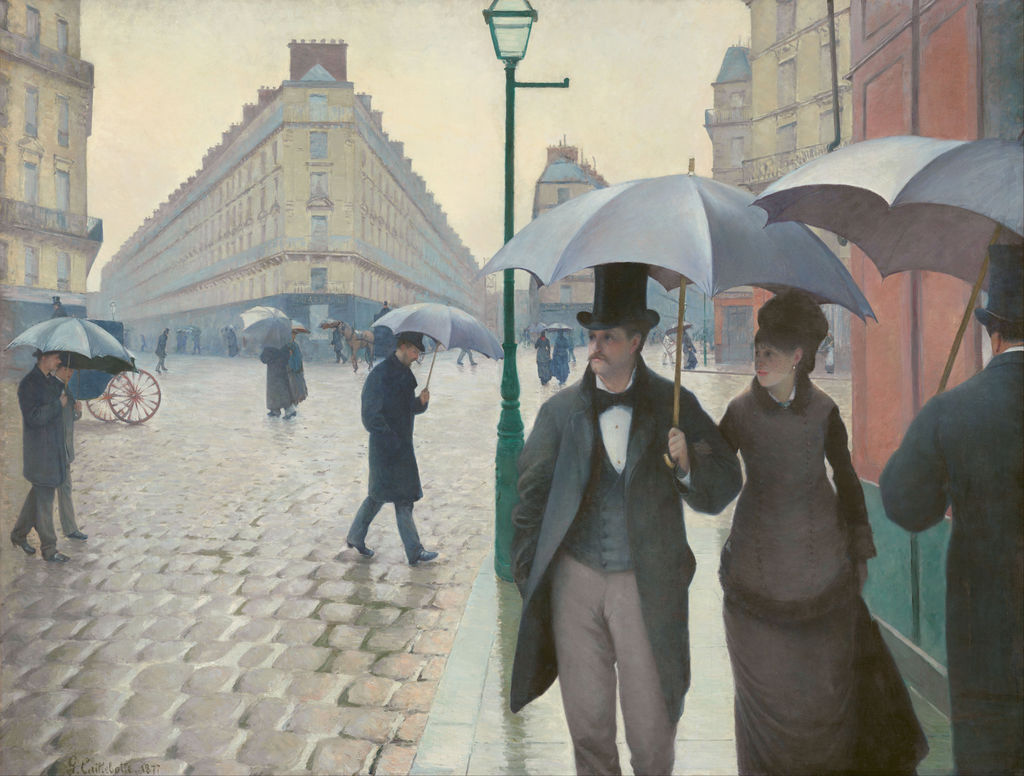
Paris Street, Rainy Day, 1877; Art Institute of Chicago. 5wEUCOlEf-EaVQ at Google Cultural Institute maximum zoom level. Image source. Public domain. Resized only; source appearance preserved.
Windows, balconies and the person looking
A window allows Caillebotte to place one spectator inside another’s view. In Young Man at His Window, René stands with his back towards us, feet planted apart and hands in his pockets. His dark figure interrupts the light opening. Beyond him, the street drops away towards a small woman crossing below. The red armchair at the right belongs to the room we seem to occupy; the street belongs to the view we share with the standing man. The Getty acquired the painting in 2021, identifying René as the model and distinguishing him from Martial, the brother depicted at the piano. [2]
We can follow the man’s direction of attention without knowing its full significance. His back withholds a facial expression, and the distance between him and the woman makes their relationship impossible to establish from the painting alone. This withholding is part of the work’s strength. The architecture and lighting give us an exceptionally clear arrangement, while the human situation remains open. Allan describes the picture’s combination of visual acuity and psychological ambiguity; the ambiguity survives because the image makes us look with such insistence. [2]
Balconies extend this inquiry. Their ironwork can become a foreground barrier, while the street lies far below; a man at a railing is simultaneously outside the room and removed from the crowd. Perrin describes the balcony as a new Parisian space joining private life to the public city. He connects its elevated figures with both a position of dominance and a condition of withdrawal. Looking from above therefore changes more than the geometry of a view: it changes the relationship between the person looking and the people being seen. [4]
In Interior, Woman at the Window, that relationship becomes more complicated. A woman stands at the window while a seated man reads. Matheny draws attention to another figure across the street, visible through curtains, who watches the woman. The room is connected to a chain of looking that extends across the boulevard. What first seems a self-contained interior opens into a wider social space. Readings of emotional distance are possible, but the most securely visible drama concerns bodies, furnishings, windows and the directions in which attention travels. [1]
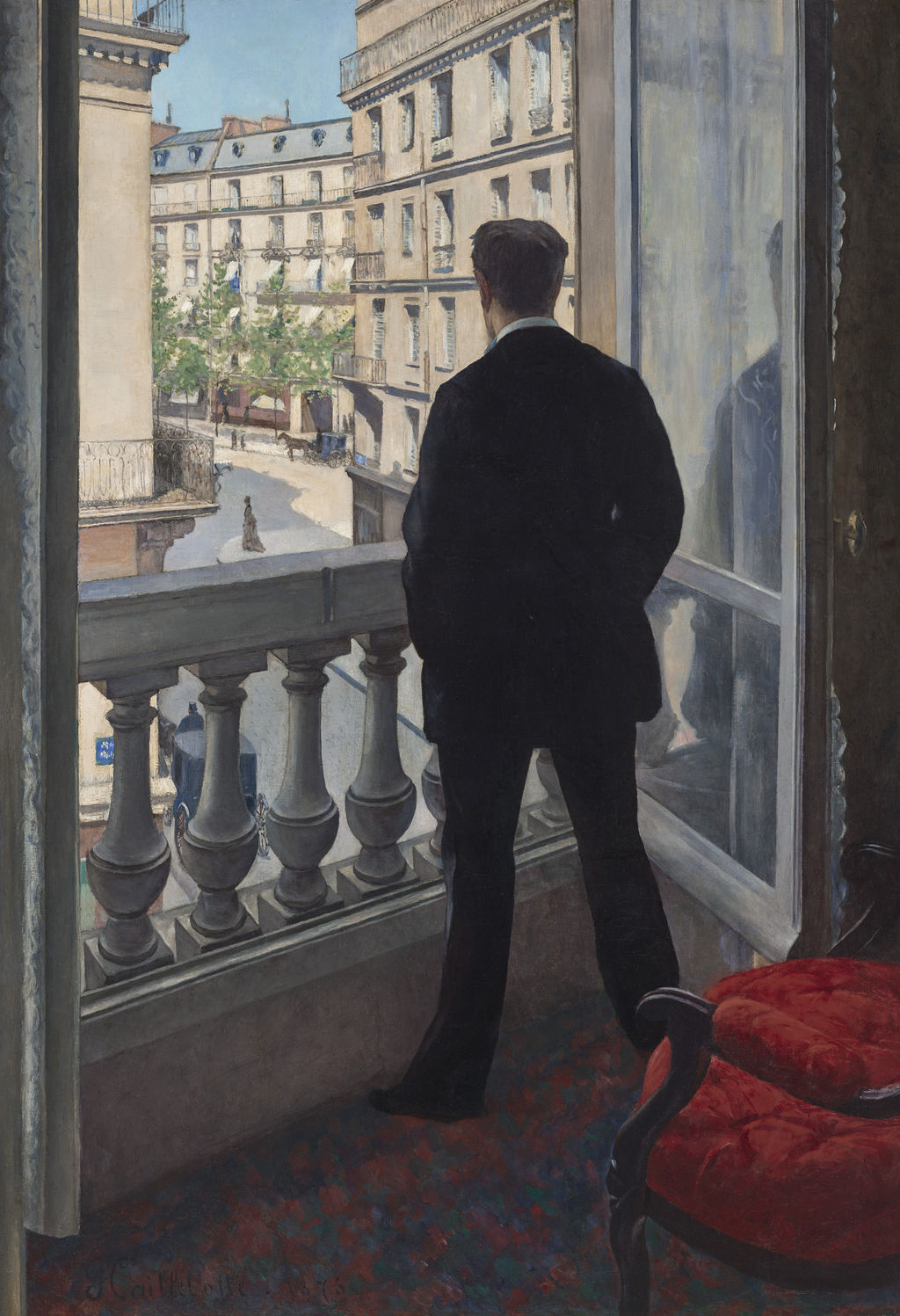
Young Man at His Window, 1876; J. Paul Getty Museum. www.christies.com. Image source. Public domain. Resized only; source appearance preserved.
Work, privilege and the active body
The Floor Scrapers makes the act of working physically persuasive. The men bend low; hands, tools and torsos form a sequence of different pressures. Light from the window crosses the floor, catching bodies and the alternating surfaces of worked and unworked wood. The floorboards sweep towards the foreground, enlarging the area occupied by the task. The room is elegant, but its temporary condition reveals the effort required to produce that elegance. [13]
Samuel Raybone’s study of Caillebotte’s interiors reads this painting in relation to the artist’s unusual position between inherited wealth and a chosen vocation involving manual work. Raybone sees an analogy between the workers’ transformation of the wooden surface and the painter’s transformation of the canvas. The comparison is an interpretation, supported by the attention given to tools, hands and surfaces. It helps articulate why this painting of labour can also prompt thought about the activity of making a painting. [13]
The class relationship remains important. As the Getty’s Painting Men exhibition emphasises, Caillebotte’s workers generally belonged to his immediate surroundings: they were employed by his family or worked in his prosperous neighbourhood. The curators connect his interest in them with republican ideals of fraternity, while acknowledging the privilege of his position. His proximity to the workers makes possible an attentive picture; it does not make the artist and his subjects socially interchangeable. [12]
This attention to action continues in the interiors. Martial’s hands at the piano and René’s hands using cutlery offer small, concentrated forms of activity. Raybone treats such scenes as a meeting point between work and leisure, asking what people do with the free time that wealth provides. The comparison sharpens our sense of Caillebotte’s bodily observation without requiring every scene to deliver the same social message. A hand gripping a tool, pressing a key or holding a knife makes a particular action visible. [13]
Olmsted places these interiors in conversation with Caillebotte’s fellow artists. She compares the near table edge and reflected objects in Luncheon with Monet’s earlier treatment of a meal, and the workers’ gestures with Degas’s interest in precisely observed action. His forceful perspective emerged within this exchange of pictorial ideas about modern subjects. [9]
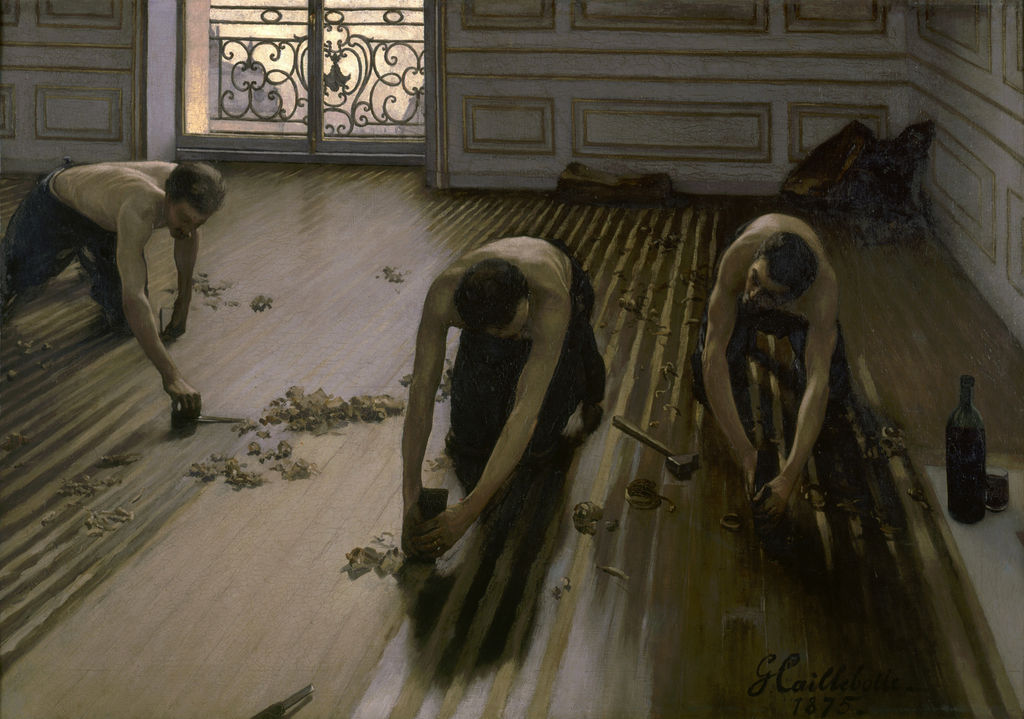
The Floor Scrapers, 1875; Musée d’Orsay. Google Arts & Culture — 0wHXxVpb7UjLNA. Image source. Public domain. Resized only; source appearance preserved.
Friends, private rooms and modern masculinity
The men in Caillebotte’s art inhabit many different roles. Their bodies may be hidden inside dark clothing, exposed through labour, exercised in sport or attended to in private. Perrin draws attention to the cylindrical silhouette of the black suit and the gestures that remain visible within it: walking, holding an umbrella, standing at a window. Clothes can make bodies seem uniform even as posture distinguishes one man from another. [4]
The portraits bring these distinctions closer. Friends sit in armchairs or on sofas, often occupying domestic space with an informality that can feel disconcertingly intimate. The Getty’s curators argue that these pictures challenged conventions about where men belonged in painting and how closely one man might scrutinise another. Their interpretation also changes the significance of the apartment: it becomes a place of male sociability, quiet observation and collaboration between painter and sitter. The men’s willingness to pose helped make this body of work possible. [12]
In The Bezique Game, a shared activity holds the company together. Attention is directed towards the cards and towards the people playing. Seen beside the single portraits, the scene offers another arrangement of the same domestic world: the room accommodates a group whose relationship emerges through looking, waiting and participating. Perrin makes this painting a centre of his discussion of Caillebotte’s apartment and circle of friends. [4]
The nudes test the limits of such proximity. Man at His Bath and Nude on a Couch place naked bodies in modern interiors without the mythological or exotic settings that often supplied public justifications for the nude. The Getty’s exhibition reads their starkness as a challenge to inherited conventions. These works can sustain discussion of gender, intimacy and desire, while the distinction between pictorial interpretation and biographical evidence remains essential: the paintings cannot establish the artist’s sexuality. [12]
This recent attention to masculinity enriches the older emphasis on perspective and modern Paris. It asks who has the freedom to occupy a room, walk a street, enjoy sport or be looked at. It also encourages comparison among paintings whose outward subjects differ. The clothed man at a window, the worker on his knees and the athlete in a boat belong to distinct social situations; Caillebotte’s interest in their posture and physical presence makes their differences worth considering together. [4] [12]
Watch: Gustave Caillebotte
Explore a museum overview and two discussions of Paris Street; Rainy Day. This shared selection offers wider context for the artist’s work.
"Who Is Gustave Caillebotte?" - HD version
An introduction to Caillebotte from the Kimbell Art Museum.
Watch on YouTubeOn the river: movement, colour and participation
The river changes the conditions of looking. In the boating pictures, the spectator may seem to share the unstable space of the craft rather than view the scene from a bank. Perrin singles out the composition of Rower in a Top Hat for the way it places us opposite the rower, inside the boat. The effect belongs to Caillebotte’s wider repertoire of devices for drawing the spectator into a picture: a near figure establishes our place before the distant setting becomes fully legible. [4]
Rowing was also an activity he knew directly. The family property at Yerres provided a setting for the boating pictures, and his involvement in sailing later helped draw him to Petit Gennevilliers on the Seine. The sporting body therefore belongs to a lived environment, as the workers and family members had done. In the Getty curators’ interpretation, the boating pictures connect with a growing culture that valued outdoor exercise, male sociability, strength and discipline. The physical appeal of the figures complicates any entirely straightforward account of those ideals. [12]
Paint itself responds differently to the water. Matheny contrasts the lively blue, green, yellow and white reflections in Boating on the Yerres with the tighter handling of the celebrated city scenes. A river surface invites discontinuous marks and shifts of colour, while the boat and bodies can still give the image a firm structure. His painting accommodates both the constructed object and the changeable surroundings. [1]
The pleasure of the river was accompanied by practical expertise. Caillebotte designed boats and financed a workshop in which they could be built. Perrin treats naval design, regattas, gardening and painting as connected parts of the later life, with painting remaining a major commitment. To call these pursuits hobbies can obscure the sustained attention they required. They supplied different ways of testing form, materials and performance, and they repeatedly brought new subjects within reach of his easel. [4]
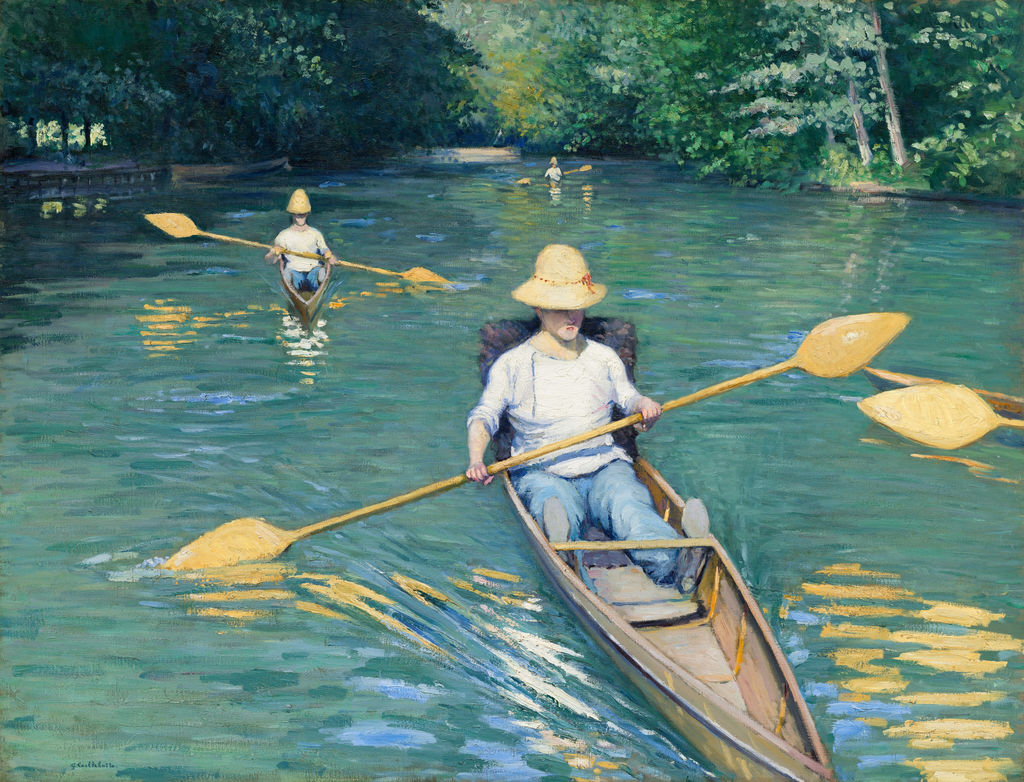
Skiffs, 1877; National Gallery of Art. Collection of Mr. and Mrs. Paul Mellon. Image source. Public domain. Resized only; source appearance preserved.
From gardens to painted environments
Caillebotte’s garden paintings begin in places already shaped by human decisions. At Yerres, the family park had winding paths, planted beds and ornamental structures, as well as a productive kitchen garden. The Musée des impressionnismes Giverny’s 2016 exhibition treated these surroundings as a major strand of his work. Its account emphasised the bold framing and human presence that gave his pictures of the estate their particular character. Cultivation was visible as an arrangement of spaces and activities. [3]
At Petit Gennevilliers, he developed a garden of his own and built a greenhouse. Plants gradually occupied more of his painting, extending from garden views to flowers and decorative projects. This was a substantial development in the work. The same artist who had made a city intersection or an interior floor command the spectator’s attention now explored dense vegetation, blossom and the organisation of a garden. The garden enlarged his subjects and his palette. [3]
His correspondence conveys some of the difficulty. In a letter to Monet dated by the Art Institute of Chicago to June 1883, he wrote, “I’m immersed in the landscape.” Nancy Ireson reproduces the passage in her study of his sketchbook, explaining that he was working hard but dissatisfied, and found flowering trees difficult because the blossom lasted so briefly. Here is a useful correction to the apparent ease of the later outdoor subjects: looking and painting had to keep pace with something that would soon change. [11]
The sketchbook offers a corresponding view of experiment. Ireson notes colour annotations, carefully composed landscapes and unresolved or abandoned compositions. Caillebotte was exploring watercolour as well as drawing, retaining an interest in structure while extending his range. The book includes landscapes around the Seine, studies of people and copies after earlier art. It gives a more varied account of artistic practice than the idea of an artist repeating one successful urban formula. The drawings provide another route into this less familiar Caillebotte. [11]
The late Parterre de marguerites takes the flower subject towards a different scale of experience. The Giverny museum’s 2016 account describes an unfinished decorative undertaking intended for the dining room at Petit Gennevilliers, whose more completed surviving elements were presented as four independent panels. The original ambition was an extensive floral environment. Instead of looking through a window at cultivated nature, the occupant of the room would be surrounded by its painted forms. The project opens an important perspective on the late work, even though Caillebotte’s death interrupted its development. [3]
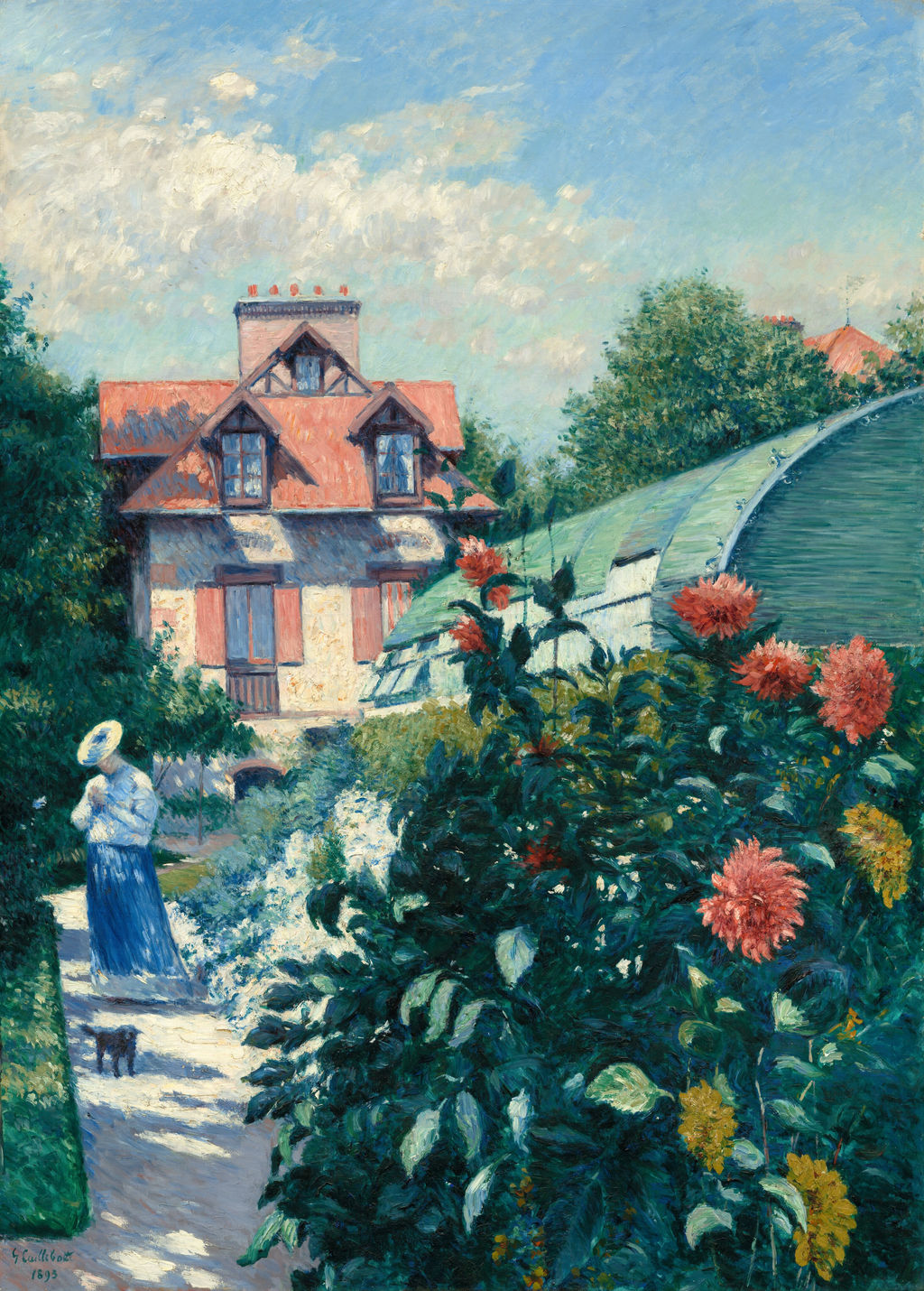
Dahlias, Garden at Petit Gennevilliers, 1893; National Gallery of Art. Gift of the Scharffenberger Family. Image source. Public domain. Resized only; source appearance preserved.
Still life and the arrangement of attention
Caillebotte also found modern life in the display of things. The carefully arranged produce in Fruit Displayed on a Stand fills the canvas with distinct shapes and colours. White paper separates and cradles the fruit, and leaves frame the abundance. Matheny connects these still lifes with the visual attractions of Parisian shops and markets: the arrangement is made to catch a passer-by’s eye. The picture brings commercial display into the same larger inquiry into looking that runs through the interiors and street scenes. [1]
The comparison with a city view is revealing. Streets distribute people through deep space; the fruit stand concentrates objects close to the surface. In each case, the spectator encounters a field of possible attractions organised by repeated shapes, intervals and differences of scale. The painting asks us to move our attention from one part to another. A still life can therefore be as deliberate an experiment in viewing as a dramatic perspective through a room. Matheny’s account gives these less familiar pictures a clear place within Caillebotte’s larger achievement. [1]
The range of subjects also changes what we expect from his realism. Meticulous description can make an object tangible, yet the arrangement may be emphatically selective and constructed. A shop display, a laid table and a garden bed already embody decisions about presentation. Painting them offers a second act of organisation. Across the paintings, attention to ordinary things repeatedly becomes attention to the ways in which a visible world has been put together. [1] [3]
How a convincing instant was constructed
Caillebotte’s abrupt cropping and unusual viewpoints often invite comparison with photography. The resemblance can be illuminating, provided it does not replace the evidence of how a particular work was made. Paris Street, Rainy Day looks sufficiently immediate to evoke an accidental encounter, but its preparatory material and the Art Institute’s examination reveal extensive decisions about architecture, perspective, scale and figures. The sense of an instant is an achieved pictorial effect. [11]
The Art Institute’s research offers a particularly valuable example of how that understanding develops. Close study of the architectural drawing associated with Paris Street, Rainy Day led the museum’s team to question the idea that it had simply been traced from a photograph. Experiments undertaken with Pablo Garcia suggested that a camera lucida, an optical drawing aid, could account for aspects of the initial view. The museum describes this use as likely while stating that no documentary evidence confirms it. The distinction matters: a plausible reconstruction of a process remains different from an instruction left by the artist. [11]
Perrin proposes a broader interpretation of Caillebotte as a painter who conceived forceful compositions and made the studies needed to realise them. He identifies contrasts of colour, shape, full and empty areas, along with oblique lines and cropping, as strategies for creating immediacy. This is a useful way to look across the pictures, rather than a rule proving that every work began with a fully settled design. It directs attention to the choices that turn a plausible view into a compelling image. [4]
There is equal value in the differences between works. The precision of the bridge paintings, the active marks on water and the colour experiments of the sketchbook belong to related but distinct problems. Technical findings from one examined canvas cannot explain every surface he painted. The style and technique guide brings those comparisons together, showing how methods and visible effects vary with the demands of the subject. [1] [11]
Painting, collecting and the work of friendship
Caillebotte’s collecting began alongside his public emergence as an artist. Olmsted records three purchases from Monet in February 1876, shortly before his debut with the independent group. The Getty’s account describes his subsequent assistance to Monet and Pissarro, his loans to exhibitions, and his involvement in choosing participants, arranging displays and paying for advertisements. Collecting could provide immediate help to an artist, while lending and exhibiting helped shape how the work would be encountered. [9] [2]
The 1879 Self-Portrait at the Easel makes the two activities visible together. Behind Caillebotte appears Renoir’s Bal du moulin de la Galette, seen in reverse as part of the mirror arrangement. Perrin reads this conjunction as a declaration both of artistic identity and of commitment to his friends. The other painter’s work enters the self-portrait as a contemporary presence. Caillebotte presents himself through painting, ownership and allegiance at once. This is a different work from the small Orsay self-portrait, dated around 1892 in the museum’s recent exhibition material. [4]
Friendship also had a continuing practical rhythm. On 1 November 1891, Caillebotte wrote to Durand-Ruel about resuming their customary gatherings, ending with the brisk instruction, “Donc à jeudi 7h. Café Riche.” In English: “So, Thursday at 7. Café Riche.” The letter, transcribed in the revised catalogue raisonné, is modest evidence of his continuing role in bringing people together years after his last participation in an Impressionist exhibition. His later life outside Paris did not make those relationships disappear. [14]
When he died, the bequest of his collection made him a decisive figure in the public history of Impressionism. Works by his fellow artists entered the French national collection and became central to its representation of the movement. That consequence needs to be distinguished from the separate history of his own pictures, many of which remained outside public collections. The collector and bequest account follows the purchases, testamentary plans and administration in more detail. He helped create an audience for art that he believed deserved a future. [1] [2]
A reputation that has kept changing
Caillebotte attracted attention during his lifetime. His debut was reviewed, his large paintings made a strong impression, and his work travelled beyond the independent exhibitions. Olmsted traces its presentation in New York in 1886 and Brussels in 1888, as well as later Paris exhibitions. The familiar description of an entirely forgotten painter compresses a more uneven history. His public visibility changed with exhibition contexts, critical preferences and the distinction between his own artistic achievement and his contribution as a collector. [9]
A retrospective of 122 paintings was organised at Durand-Ruel’s gallery in June 1894. Yet, as Olmsted shows, even a substantial posthumous exhibition did not settle how to position him within Impressionism. His own work was subsequently less available to general audiences than the paintings he had collected. Matheny identifies this imbalance as a major factor in the later need to reconsider his artistic contribution. The story concerns access as well as taste: work held privately cannot acquire a public presence in quite the same way as pictures encountered repeatedly in museums. [9] [1]
The introduction to the 1994 revised catalogue raisonné makes a useful distinction: Caillebotte had long been poorly known rather than wholly forgotten. The catalogue itself represented decades of research by Marie Berhaut, revised with Sophie Pietri, and acknowledged the continuing gaps in knowledge. Such scholarship helped expand the artist beyond a handful of familiar pictures. It also reminds us that the range of his work has been reconstructed through sustained attention to drawings, studies, correspondence and paintings dispersed across collections. [14]
More recent exhibitions have shifted the emphasis again. The National Gallery’s The Painter’s Eye in 2015 foregrounded the variety and originality of his ways of seeing. Giverny’s Caillebotte, peintre et jardinier in 2016 gave gardens and the late work a fuller role. The Orsay and Getty Painting Men project of 2024–25 examined class, intimacy, sport and masculinity. These approaches reveal different strengths in the same pictures, encouraging a view of the artist that can accommodate urban construction, physical presence and cultivated nature together. [1] [3] [12]
The most rewarding introduction remains an encounter with those differences. Move from the planed floor to the wet pavement, from the dark figure at a window to the coloured reflections around a boat, and then to flowers occupying an entire painted field. Each subject asks for a different pace of looking. Together they show how much Caillebotte could make of the world immediately around him, and how deliberately he shaped the position from which we enter it. [1] [3] [4]
Essential Gustave Caillebotte works

The Floor Scrapers
1875 · Three workers bend across a sharply receding floor.

Young Man at His Window
1876 · A standing figure divides the room from the street.

Paris Street Rainy Day
1877 · Umbrellas and pedestrians cross a broad, rain-wet intersection.

Skiffs
1877 · Yellow paddles cut diagonals across green water.

The Orange Trees
1878 · Readers occupy a terrace between potted trees and garden shade.

Interior Woman at the Window
1880 · Curtains and furniture frame a woman looking outside.

Man at His Bath
1884 · A drying gesture turns the body away from the viewer.

Dahlias at Petit Gennevilliers
1893 · A path leads through flowers towards the cultivated garden.
Catalogue and documented works
This directory brings together 578 entries in the revised 1994 catalogue, 11 further documented records and three groups of study descriptions. It is a directory of records, not a total of authenticated individual works. Albums, print states and surviving decorative panels are grouped. English labels retain the French titles as searchable aliases; dates are supplied only where checked. Numbered entries link to the relevant article or the historical catalogue. Pastels appear under the Drawing filter; original prints remain searchable under All media.
Frequently Asked Questions
Yes. He exhibited in five of the group’s independent exhibitions, helped organise and finance them, and collected his fellow artists’ work. His precise urban realism shows how varied painting within Impressionism could be. [2]
Some compositions resemble photographic views, but that does not establish a photographic source. The Art Institute’s research on Paris Street, Rainy Day suggests possible use of a camera lucida for an early drawing; no surviving document confirms it. Methods must be considered work by work. [11]
Discussion
Look again at the images and ideas explored in Gustave Caillebotte. These editorial prompts invite your observations.
Reader Insights
Space makes the viewer an active participant in the streets, rooms and boats.
A river scene can be compared with an interior through the position it gives the viewer.
Which work most changes your sense of where you are standing?
Join the Conversation
Share a detail, comparison or question about Gustave Caillebotte below.
References
- Lynn Kellmanson Matheny, National Gallery of Art. Gustave Caillebotte: The Painter’s Eye (2015), exhibition brochure, PDF pp. 2–7. View source.
- J. Paul Getty Museum, with commentary by Scott Allan. “Getty Museum Acquires Gustave Caillebotte’s Iconic Young Man at His Window” (11 November 2021), object, career and collecting account. View source.
- Musée des impressionnismes Giverny. Caillebotte, peintre et jardinier (2016), press dossier, PDF pp. 3–5 and 15–16, exhibition presentation, garden account, chronology and decorative project. View source. (in French).
- Paul Perrin, Musée d’Orsay. “Transcription de l’entretien commissaire Caillebotte” (2024), interview pp. 1–7 and self-portrait caption p. 7. View source. (in French).
- Marie Berhaut with Sophie Pietri; Wildenstein Plattner Institute, Gustave Caillebotte Catalogue raisonné des peintures et pastels, 1994. View source. (in French).
- Galina Olmsted, Making and Exhibiting Modernism: Gustave Caillebotte in Paris, New York, and Brussels, 2019. View source.
- Fanny Matz, Musée d’Orsay, Le legs Caillebotte une affaire délicate, 2024. View source. (in French).
- Department of European Paintings, The Metropolitan Museum of Art, France, 1800–1900 A.D., Heilbrunn Timeline of Art History, 2004. View source.
- Galina Olmsted. Making and Exhibiting Modernism: Gustave Caillebotte in Paris, New York, and Brussels (University of Delaware, 2019), pp. 62–64, 69–82, 270–271, 283, 303 and 310–316, debut, comparisons, international exhibitions and retrospective. View source.
- Musée des impressionnismes Giverny, Caillebotte peintre et jardinier Dossier pédagogique, 2016. View source. (in French).
- Gloria Groom, Kelly Keegan and Nancy Ireson, Art Institute of Chicago. Caillebotte Paintings and Drawings at the Art Institute of Chicago (2015), introduction; cat. 2, Paris Street; Rainy Day, curatorial entry, optical-device discussion; cat. 4, Sketchbook, curatorial entry and note 10. Caillebotte’s June 1883 letter is quoted through Ireson’s museum transcription and translation. View source.
- J. Paul Getty Museum. Gustave Caillebotte: Painting Men (2025), gallery texts, PDF pp. 1–9, family, labour, Paris, portraits, sport and nudes. View source. (in en/es).
- Samuel Raybone. “Gustave Caillebotte’s Interiors: Working Between Leisure and Labor,” nonsite.org 26 (2018), repository PDF pp. 2–7, labour, interior space and active hands. View source.
- Marie Berhaut, revised with Sophie Pietri. Gustave Caillebotte: Catalogue raisonné des peintures et pastels (1994), introduction, pp. V–X; correspondence, letter 48, p. 279, Caillebotte to Durand-Ruel, 1 November 1891. Short English translation supplied here from the published French transcription. View source. (in French).
- Art Institute of Chicago, Caillebotte Paintings and Drawings at the Art Institute of Chicago, 2015. View source.
- Petit Palais / Paris Musées, Portrait de Paul Hugot, original print, PPG2319, current. View source. (in French).
- Paul Perrin, Musée d’Orsay, Transcription de l’entretien commissaire Caillebotte, 2024. View source. (in French).
- Cleveland Museum of Art, Caillebotte collection records: 2020.260, 2009.157 and 2020.105, current. View source.
- Splash image, Self Portrait, about 1892; Musée d’Orsay.

