



 by Tom Gurney
Tom Gurney BSc (Hons) is an art history expert with over 20 years experience
Published on June 19, 2020 / Updated on November 2, 2026
Email: tomgurney1@gmail.com / Phone: +44 7429 011000
Quotes and Letters: Introduction
Gustave Caillebotte’s words become most revealing when they remain attached to the people and problems that prompted them. In his will, he considers how paintings can reach a public that has yet to accept them. Writing to Monet, he counts exhibition admissions, offers encouragement and describes the difficulty of painting trees before their blossom disappears. These are glimpses of a working artist who also took responsibility for the conditions in which other artists worked. [1] [2] [3]
The passages below come from the archival will, letters transcribed in Marie Berhaut’s catalogue raisonné, and a landscape letter published by the Art Institute of Chicago. English translations are newly made from the French. The distinction between Caillebotte’s voice and the voices around him matters: Monet’s descriptions of his own anguish at painting, for example, belong to letters addressed to Caillebotte. Contemporary critics’ responses appear separately at the end. [1] [2] [3]
At a Glance
- Willdated 3 November 1876; later provisions reaffirmed the gift of paintings by other artists. [1]
- Principal correspondents hereClaude Monet, Camille Pissarro and the dealer Paul Durand-Ruel. [2]
- Subjectsindependent exhibitions, public acceptance, landscape painting, literature and friendship. [1] [2] [3]
- Sources of the wordingoriginal will facsimiles, published French letter transcriptions and a museum transcription of the landscape letter. [1] [2] [3]
Contents
- A will that begins with an exhibition
- Acceptance before understanding
- Counting visitors, encouraging Monet
- When organising became exhausting
- Painting a spring that would not wait
- Reading Flaubert, thinking about Delacroix
- Keeping a place at the table
- Other voices: contemporary critics
A will that begins with an exhibition
Caillebotte opens his will of 3 November 1876 by asking for money from his estate to finance an exhibition in 1878. He estimates that it might require thirty or forty thousand francs, perhaps more. He names Degas, Monet, Pissarro, Renoir, Cézanne, Sisley and Berthe Morisot, then adds a short qualification. The phrase is generous in its immediate application: the names establish a group without closing its membership. [1]
Je nomme ceux là sans exclure les autres. I name these without excluding the others. [1]
This is a provision for a particular exhibition, rather than a declaration that every artistic approach must be equally welcome. Its interest lies in the practical breadth of the proposal. Caillebotte wants an exhibition held in the best possible conditions, and he accepts that its cost cannot yet be fixed. The will makes room for the uncertainty involved in arranging a collective enterprise. It also makes his own resources available to artists whose work he valued. Read in this setting, the sentence has more substance than a detached maxim about tolerance: it belongs to a plan with named participants, an estimated budget and an intended date. [1]
The later testament, dated 20 November 1883, explicitly says that the provision for the 1878 exhibition has become unnecessary. Caillebotte nevertheless maintains the part concerning his gift to the state of paintings by other artists. That distinction helps us read the document accurately. Some clauses answered an immediate organisational need; another sought to determine the future of a collection over a much longer period. His plans could change while the commitment to securing a public place for the paintings endured. [1]
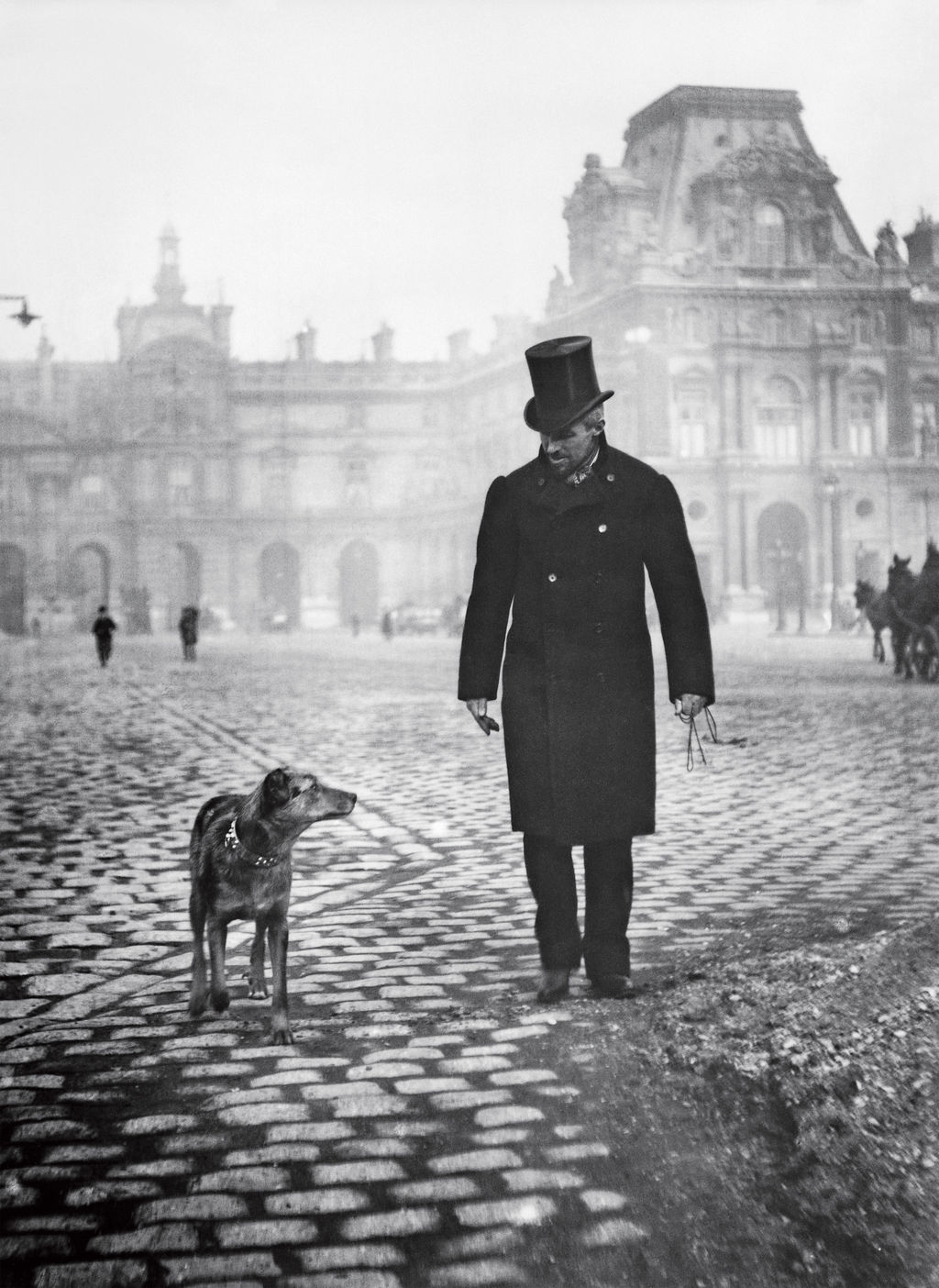
Gustave Caillebotte with Bergère; photograph by Martial Caillebotte. Artbook Dans l’intimité des frères Caillebotte. Image source. Public domain. Resized only; source appearance preserved.
Acceptance before understanding
In the next part of the 1876 will, Caillebotte gives his collected paintings to the state, with conditions. He wants them to go to the Musée du Luxembourg and later the Louvre. He excludes an attic and a provincial museum as destinations. The geography expresses a hierarchy of public visibility: these works should enter the central institutions through which contemporary art could become part of France’s acknowledged artistic inheritance. The Archives départementales de Seine-et-Marne explains that the display conditions of provincial museums were often poor and that Caillebotte wanted a prominent place for the artists he supported. [1]
He allows for a delay before this clause takes effect:
jusqu’à ce que le public, je ne dis pas comprenne, mais admette cette peinture. until the public, I do not say understands, but accepts this painting. [1]
The correction inside the sentence gives it its force. Understanding is a demanding and perhaps elusive condition; acceptance can precede it. The public need not agree on everything that these pictures mean before they can be admitted to a museum. Caillebotte’s wording therefore sets a threshold for institutional inclusion without pretending that controversy will disappear. It leaves room for a painting to be looked at before it has been fully explained. That remains a useful way to approach pictures whose subject or construction initially feels unfamiliar. [1]
The sentence that follows is equally important:
Ce temps peut être de vingt ans ou plus. This period may be twenty years or more. [1]
“Or more” makes this an open estimate. It cannot support the often repeated translation “twenty years at the maximum”. While waiting, his brother Martial, or another heir in Martial’s absence, is to keep the pictures. Caillebotte thus joins an unusually patient assessment of public taste to a specific arrangement for custody. The collection must survive the interval between the artist’s conviction and wider recognition. The text does not give a date on which that recognition is guaranteed to arrive. [1]
Fanny Matz’s account for the Musée d’Orsay makes the later result clearer. The state initially accepted the bequest in March 1894; arguments over displaying it led to further negotiations. The eventual selection comprised thirty-eight works for the Luxembourg and two Millet drawings for the Louvre. Public display opened in February 1897. The difficulty lay partly in translating Caillebotte’s conditions into an achievable museum arrangement. Treating the episode as a simple refusal obscures that process. The fuller history belongs to Caillebotte as collector and benefactor. [4]
Counting visitors, encouraging Monet
Caillebotte’s letter to Monet, dated to late May 1879 by the catalogue’s editors, offers a brisk account of the fourth independent exhibition. It includes payments, the return of pictures, money enclosed and an assessment of the result. At its centre is a statistic that he turns into encouragement. [2]
Nous avons fait 15 400 et quelques entrées. En somme c’est un progrès. We had a little over 15,400 admissions. All in all, it is progress. [2]
The admissions are evidence of an audience, while his concluding judgement gives them meaning. Caillebotte believes the exhibition has achieved something for the painters and the public despite the ill will of the press. Elsewhere in the same letter he reports a profit of 439 francs and 50 centimes per participant. Together, the figures show what success could mean to an organiser: enough visitors to sustain interest, a financial return and the sense that the group had moved forward. He does not have to claim universal approval to recognise a gain. [2]
The rest of the letter shows the labour behind those figures. He needs addresses so that pictures can be returned to their owners. He distinguishes frames from canvases and keeps track of what remains at his own house. The movement of paintings required money, transport, correspondence and someone willing to follow loose ends. Here the encouragement offered to Monet comes from a friend who is attending to the work as well as discussing it. [2]
Berhaut’s catalogue places this letter within a wider pattern of support. It records Caillebotte guaranteeing Monet’s debt and paying bailiff’s expenses in 1878, then helping him recover the pledged Déjeuner sur l’herbe in 1884. It also describes his willingness to help finance the proposed print journal associated with Degas and his contribution to the subscription for Manet’s Olympia. These episodes involved different needs: access to pictures, relief from debt, a possible publishing venture and public acquisition. They explain why the correspondence moves so naturally between artistic judgement and ordinary business. Caillebotte’s engagement could take whichever practical form the occasion required. [2]
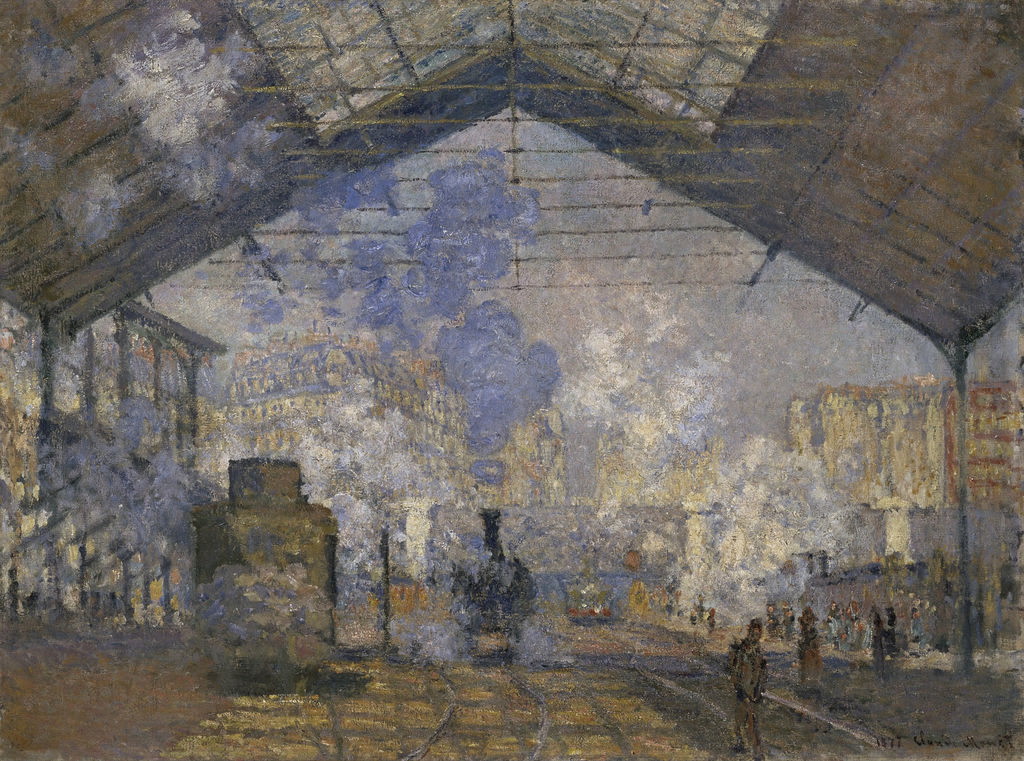
Claude Monet,The Saint-Lazare Station,1877; a work by Caillebotte’s friend and correspondent. wAHOCsl09dhUPw at Google Cultural Institute maximum zoom level. Image source. Public domain. Resized only; source appearance preserved.
When organising became exhausting
The hopeful calculation of 1879 makes an undated letter to Pissarro, assigned to 1882 in the catalogue, especially striking. Caillebotte doubts that an exhibition can be organised satisfactorily without Monet and Renoir. He discusses their immediate circumstances and the difficulty of getting the proposed participants to agree. His frustration then breaks through. [2]
Je suis écoeuré. Je me retire sous ma tente, comme Degas (mais pas comme lui), j’attends des jours meilleurs. I am disgusted. I retire to my tent, like Degas (but not as he does), and wait for better days. [2]
The parenthesis complicates what might otherwise sound like a clean withdrawal. Caillebotte invokes Degas while immediately distinguishing his own position. He is writing from within an argument over an exhibition, with particular people and practical obstacles in view. The statement expresses exhaustion at that situation. It offers no basis for saying that he had decided to stop painting or that he had permanently renounced his friends. [2]
The surrounding correspondence also prevents us from turning the group into a circle of effortless agreement. Pissarro and Caillebotte differed over the terms on which artists should participate and the obligations owed to those previously accepted. These were substantial questions about how a collective exhibition could survive changes in its membership. The letters preserve the disagreements because the participants had invested so much in the enterprise. In the event, Caillebotte, Monet and Renoir all exhibited in 1882, as Nancy Ireson’s Chicago account records. A private letter catches a difficult stage in a negotiation; it need not describe the eventual outcome. [2] [3]
Watch: Gustave Caillebotte
Explore a museum overview and two discussions of Paris Street; Rainy Day. This shared selection offers wider context for the artist’s work.
"Who Is Gustave Caillebotte?" - HD version
An introduction to Caillebotte from the Kimbell Art Museum.
Watch on YouTubePainting a spring that would not wait
A letter to Monet from Petit-Gennevilliers, dated June 1883 in the Art Institute of Chicago’s catalogue, takes us from organising to the act of painting. Caillebotte says he has worked as much as possible during the preceding two months, yet judges his results harshly. Then comes a compact description of his present occupation. [3]
Je suis en plein dans le paysage. I am immersed in landscape. [3]
The French is particularly well suited to a painter working outdoors. It conveys being thoroughly engaged in a subject, while allowing the sense of finding oneself in its midst. The remainder of the passage explains the challenge: he has never seen a more beautiful spring and wants to paint different kinds of flowering tree, but the blossom lasts so little time. His dissatisfaction grows from the mismatch between an abundance of subjects and the short period available to study them. It makes the season feel like a working constraint as well as a source of pleasure. [3]
Ireson relates the letter to Caillebotte’s sketchbook, which contains carefully composed landscapes alongside abandoned or unresolved studies. Her account offers a useful check on the assumption that painting outdoors meant simply recording an effortless first impression. The pictures could involve selection, planned arrangements and experiments that remained incomplete. His written complaint adds the pressure of a changing motif to that account of his methods. It also supplies a first-person counterpart to the material evidence discussed in Caillebotte’s drawings. [3]
The wording here is taken from the French transcription in the museum catalogue’s note 10. That note identifies the letter through the 2011 exhibition catalogue Des lettres et des peintres. This is a museum-published route to the artist’s words; it should be distinguished from the original will, whose handwriting can be examined directly. Both are useful evidence, provided the route by which the text reaches us remains clear. [3]
Reading Flaubert, thinking about Delacroix
On 18 July 1884, writing to Monet from Trouville, Caillebotte describes reading Flaubert’s letters. His response combines admiration for a prodigious artist with irritation and discouragement. He finds the complaints oppressive and questions some of Flaubert’s literary judgements. At one point he reflects on the different effect that other artists have on a reader or viewer. [2]
J’imagine que bien des grands artistes vous rattachent plus à la vie. I imagine that many great artists attach you more closely to life. [2]
The sentence begins “J’imagine”, meaning “I imagine”. Its comparative “plus”, meaning “more”, is indispensable. Caillebotte is comparing responses to particular artists after a particular reading experience. The “you” can carry a general sense here; the letter does not establish that Monet required personal consolation. Removing the comparison would change a judgement about art into a free-floating promise of its healing powers. Keeping the full sentence allows the reader to hear the thoughtful, argumentative movement of the letter. [2]
Caillebotte immediately proposes Delacroix as a comparison. Delacroix, he argues, had ample reason to complain about his contemporaries, yet those grievances do not dominate his art. He calls that art Olympian and suggests that Millet possessed a comparable quality. The value he describes involves an ability to rise above everyday resentments while retaining artistic purpose. Within this discussion he also brings up Degas, whose lack of that quality he considers damaging. The letter ranges freely across painting, literature and character, without reducing artistic achievement to pleasantness. [2]
Its ending makes his response more interesting still. He returns to Flaubert’s exceptional labour and dedication, acknowledging how much the letters reveal about an author capable of producing very different books. Caillebotte can object to the atmosphere of the correspondence while admiring the work and the effort that made it. That combination resists the idea of a neat quotation that supplies a complete aesthetic creed. We hear him testing a judgement, qualifying it and then noticing that his own discussion has become lengthy. [2]
Keeping a place at the table
The brief invitation Caillebotte sent Durand-Ruel on 1 November 1891 has a quieter warmth. There is no critical argument to resolve and no exhibition balance sheet. He wants familiar people to gather again. [2]
Voilà le moment de reprendre nos bonnes habitudes. Je préviens tout le monde et je compte bien que les fidèles seront là. Donc à jeudi 7h. Café Riche. It is time to resume our good habits. I am notifying everyone, and I fully expect the regulars to be there. So, Thursday at 7, Café Riche. [2]
“Les fidèles” carries affection as well as expectation: these are the faithful participants, the people counted on to return. An associated invitation to Georges de Bellio says that Monet and Renoir will come. The pleasure of the passage lies in its assumption of continuity. After the disputes preserved in the earlier correspondence, a regular dinner still required someone to name a day, notify the others and hold the occasion together. [2]
Such a note gives friendship a visible form without requiring claims about anyone’s unspoken feelings. Time, place and attendance are enough. The Café Riche invitation also belongs beside the 1879 exhibition letter: in each, Caillebotte acts as a point of connection. One concerns the circulation of pictures and money; the other brings people to a table. Taken together, these documents show how much of an artistic community’s life depends on repeated, ordinary acts of organisation. [2]
Other voices: contemporary critics
The following responses belong to critics, rather than to Caillebotte. Their value is different from that of the letters: they show what viewers noticed and how they judged it. In its account of Paris Street, Rainy Day, the Art Institute of Chicago cites Paul Sébillot’s 1877 comparison between the painting and what photography might eventually achieve. The comparison registers the extraordinary impression made by the canvas’s sharp, expansive urban view. It records a contemporary response, rather than proving that Caillebotte used a photograph. [5]
Responses to his landscapes could be more approving while remaining prescriptive. As Ireson explains, Arthur Hustin’s 1882 review welcomed what he considered more lifelike greens and less insistent blue and violet. Jean de Nivelle praised the observation in a Trouville landscape. These critics had expectations about what a convincing view of nature should look like, and their approval depended partly on the work’s apparent movement towards those expectations. It helps explain why praise, as well as hostility, needs to be read critically. [3]
Public acceptance also developed unevenly. Matz records a crowded but controversial reception for the bequest’s display in 1897, including opposition from the Académie des Beaux-Arts. Admission to a museum therefore coexisted with argument about artistic worth. Caillebotte’s distinction between acceptance and understanding remained pertinent after his death. [4]
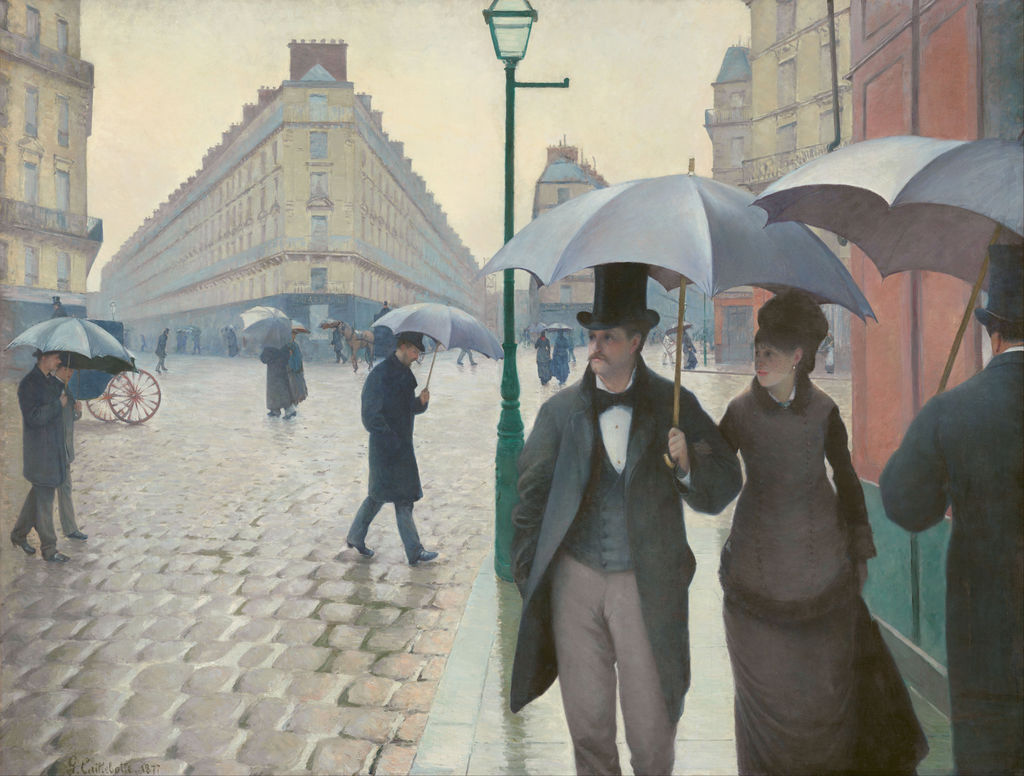
Paris Street; Rainy Day,1877; Art Institute of Chicago. 5wEUCOlEf-EaVQ at Google Cultural Institute maximum zoom level. Image source. Public domain. Resized only; source appearance preserved.
Catalogue and documented works
This directory brings together 578 entries in the revised 1994 catalogue, 11 further documented records and three groups of study descriptions. It is a directory of records, not a total of authenticated individual works. Albums, print states and surviving decorative panels are grouped. English labels retain the French titles as searchable aliases; dates are supplied only where checked. Numbered entries link to the relevant article or the historical catalogue. Pastels appear under the Drawing filter; original prints remain searchable under All media.
Frequently Asked Questions
In his will of 3 November 1876, he asks that his collection enter the state museums after the public has accepted the painting, distinguishing acceptance from understanding. The clause concerns the gift and its display. [1]
No. The French says “vingt ans ou plus”: twenty years or more. It is an estimate allowing a longer interval, rather than a maximum deadline. [1]
Writing to Monet on 18 July 1884, he compared the discouraging effect of reading Flaubert’s letters with his response to artists such as Delacroix and Millet. The full sentence is comparative and belongs to that discussion. [2]
That phrase appears in a letter Monet sent to Caillebotte, dated 4 September 1887 in Berhaut’s catalogue. Monet is describing his own difficulties with painting. [2]
Discussion
Look again at the images and ideas explored in Quotes and Letters. These editorial prompts invite your observations.
Reader Insights
The letters give practical arrangements a place beside artistic judgement.
Reading a sentence with its recipient and occasion changes its emphasis.
Which passage most alters your view of Caillebotte as a friend or organiser?
Join the Conversation
Share a detail, comparison or question about Quotes and Letters below.
References
- Archives départementales de Seine-et-Marne, Le testament de Gustave Caillebotte (undated), archival file AD77 112E623-1: original will of 3 November 1876, facsimiles pp. 1–2 and continuation transcription; testament of 20 November 1883 and archival commentary. View source. (in French).
- Marie Berhaut, with Sophie Pietri, Gustave Caillebotte : catalogue raisonné des peintures et pastels (1994), pp. 10–11 on patronage; correspondence pp. 274–279, especially letters 20, 24–29, 32, 36, 48–49. French printed transcriptions; English translations in this article. Digitised by the Wildenstein Plattner Institute. View source. (in French).
- Nancy Ireson, with Julie Warchol for sheets 32–34, Art Institute of Chicago, “Sketchbook”, in Caillebotte Paintings and Drawings at the Art Institute of Chicago (2015), curatorial entry and notes 6–7, 10; Caillebotte’s June 1883 letter to Monet transcribed in French in note 10, citing Des lettres et des peintres (2011), p. 125. View source.
- Fanny Matz, Musée d’Orsay, “Le legs Caillebotte : une « affaire délicate »” (2024), sections on March 1894 acceptance, the 1895–1896 settlement and the Luxembourg display; notes 6–21. View source. (in French).
- Gloria Groom and Kelly Keegan, Art Institute of Chicago, “Paris Street; Rainy Day”, in Caillebotte Paintings and Drawings at the Art Institute of Chicago (2015), curatorial entry, discussion of Paul Sébillot’s 1877 photography comparison. View source.
- Marie Berhaut with Sophie Pietri; Wildenstein Plattner Institute, Gustave Caillebotte Catalogue raisonné des peintures et pastels, 1994. View source. (in French).
- Art Institute of Chicago, Caillebotte Paintings and Drawings at the Art Institute of Chicago, 2015. View source.
- Petit Palais / Paris Musées, Portrait de Paul Hugot, original print, PPG2319, current. View source. (in French).
- Paul Perrin, Musée d’Orsay, Transcription de l’entretien commissaire Caillebotte, 2024. View source. (in French).
- Cleveland Museum of Art, Caillebotte collection records: 2020.260, 2009.157 and 2020.105, current. View source.
- Splash image, Paris Street, Rainy Day, 1877; Art Institute of Chicago.


