



 by Tom Gurney
Tom Gurney BSc (Hons) is an art history expert with over 20 years experience
Published on June 19, 2020 / Updated on November 2, 2026
Email: tomgurney1@gmail.com / Phone: +44 7429 011000
The Floor Scrapers: Introduction
Three men kneel on a wooden floor, their bare backs catching light from a window behind them. Long pale strips extend towards the viewer; curls of wood gather beside their hands. Gustave Caillebotte's The Floor Scrapers, painted in 1875 and now in the Musée d'Orsay, makes the renovation of a Parisian interior an absorbing encounter with bodies, tools and changing surfaces. The museum records the oil on canvas at 102 × 147 cm. [1]
The room belonged to the Caillebotte family's house at 77 rue de Miromesnil. Its elegant wall mouldings and ornamental balcony railing establish the wealth of the setting, while its stripped floor exposes the work required to make such an interior habitable. Their actions, however, are differentiated with unusual care: one planes, another scrapes, and a third reaches for a tool needed to keep a blade sharp. Preparatory drawings and an oil sketch show how deliberately Caillebotte developed this apparently immediate scene. [2] [3]
The painting became a public statement when Caillebotte exhibited it alongside a second treatment of the subject in 1876, at his first exhibition with the Impressionists. Its force lies in the connection between a precise trade and an unsettling pictorial space: the floor seems to rise towards us even as its boards lead deep into the room. Following that connection makes the painting's modernity more tangible than treating the workers as general symbols of toil. [3]
At a Glance
- ArtistGustave Caillebotte.
- Date1875; signed and dated at the lower right.
- French titleRaboteurs de parquets.
- Medium and dimensionsOil on canvas, 102 × 147 cm.
- CollectionMusée d'Orsay, Paris; inventory RF 2718.
- Catalogue raisonnéBerhaut 1994, no. 34.
- Public exhibitionSecond Impressionist exhibition, Paris, 1876.
- AcquisitionGift of Caillebotte's heirs through Auguste Renoir, 1894; entered the Musée du Luxembourg in 1896. [1] [2]
This work across Gustave Caillebotte’s career
Contents
- A room seen from above
- What the workers are doing
- Bodies shaped by a task
- Drawings behind the apparent immediacy
- The other Floor Scrapers
- The Salon refusal and the exhibition of 1876
- A modern painting that divided its viewers
- Work, wealth and the painter's own surface
- From the artist's collection to the national museums
- Annotated details
A room seen from above
The floor occupies most of the picture. Caillebotte gives us only the lower part of the window and a band of panelled wall, withholding the ceiling and the upper reaches of the interior. We look down towards the men from a position above their heads. The viewpoint lets us see the progress of their work across a broad, continuous surface, but it also makes the space feel steep. Each board narrows rapidly as it approaches the back wall. In the foreground, the strips widen and seem to slide out beneath the frame.
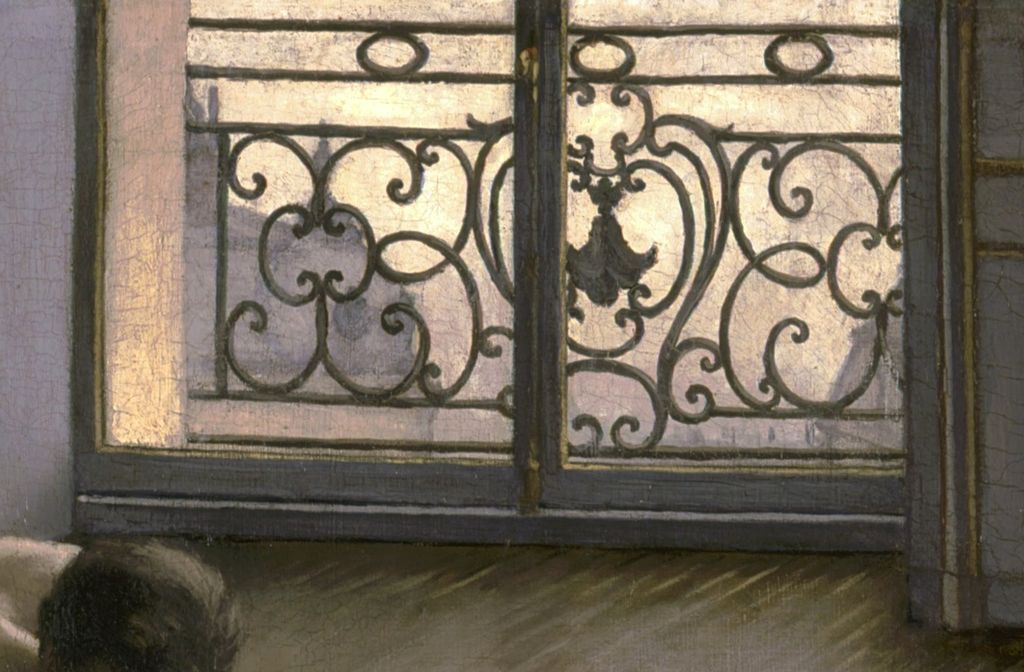
That movement has a counterweight. Rectangles in the wall panelling hold the upper part of the image steady. Their orderly divisions belong to the same geometrical world as the floorboards, yet their comparatively frontal presentation contrasts with the rush of diagonals below. The ornate ironwork at the window introduces a third kind of line: curves and scrolls compressed against the light. Caillebotte puts several forms of made order into one room, from the luxurious decorative finish of the walls to the unfinished surface underneath the workers.
The window sits left of the picture's centre. Its position helps prevent the perspective from becoming a symmetrical demonstration. The two nearer workers occupy the centre and right, while the third man extends into the composition from the left. Their arrangement carries the eye across the floor rather than towards a single central figure. Even before we identify the tools, we register a relationship between repeated architectural lines and the uneven rhythms of bodies at work.
Light makes the room legible without making every part equally bright. The broad scraped area on the left is pale and relatively matt. Darker strips to the right return streaks of illumination towards the viewer. The men's shoulders and upper backs catch a similar light, while heads, trousers and the space beneath their bodies remain dark. Caillebotte gives the viewer enough reflected light to follow a curve of flesh or a board's edge, then allows nearby forms to become difficult to distinguish. The intense brightness of the floor does not produce an evenly illuminated inventory.
Look at the worker in the middle. His bowed head is almost a dark circle framed by shoulders and arms. His back recedes, his hands advance, and the floor's lines pass beside and beneath him. The body has been shortened by the viewpoint, while the arms appear to stretch down towards the bottom edge. The difficulty of holding this position becomes part of the experience of looking. We see a human body arranged around resistance: the floor must support the man even as he works against its surface.
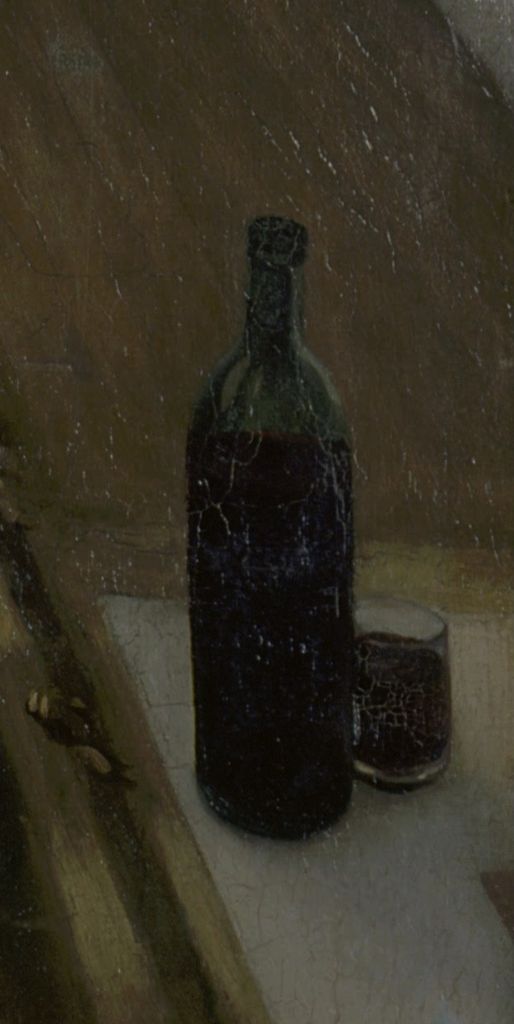
The cropped tool entering at the lower left is another small disturbance. It suggests that the worksite continues on our side of the frame. The bottle and glass near the right edge provide a contrasting vertical accent and a familiar measure of scale. Against the sweeping floor and the concentrated gestures, these objects look remarkably still. They help establish the room as a place occupied over time, where tools are put down and a drink can wait between spells of work.
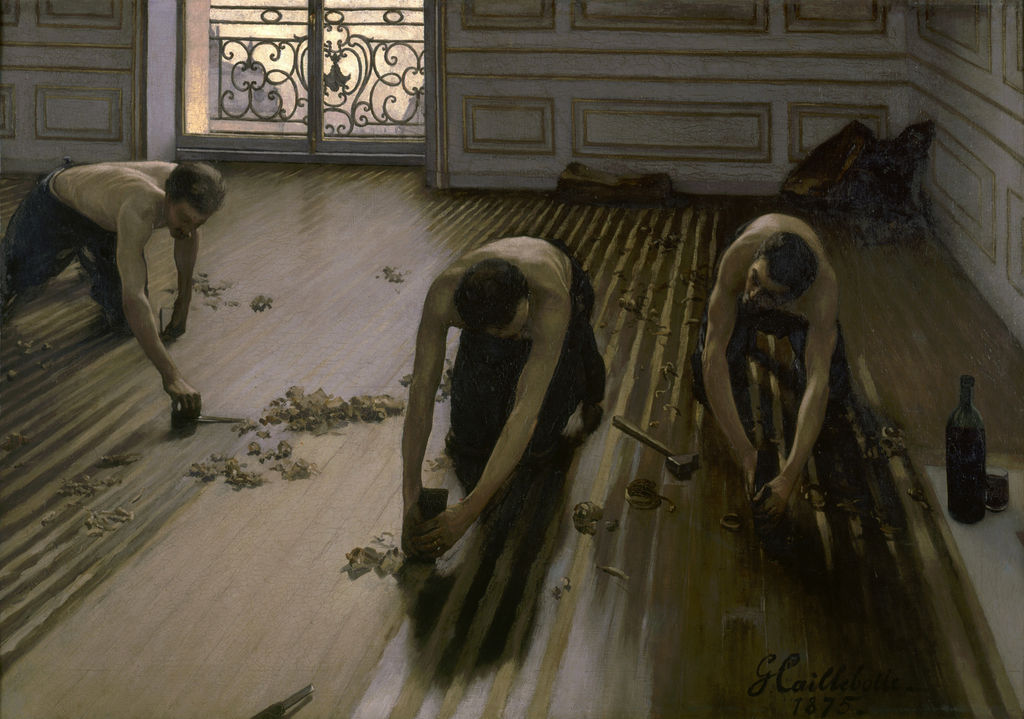
The Floor Scrapers, 1875; Musée d’Orsay. Google Arts & Culture — 0wHXxVpb7UjLNA. Image source. Public domain. Resized only; source appearance preserved.
What the workers are doing
The English title is familiar, but it can flatten distinctions which the image makes unusually clear. Raboter means to plane. In her study of the painting, Galina Olmsted explains the tools through the earlier analysis of Kirk Varnedoe: the rabot is a substantial plane pushed across the boards; the racloir is a finer scraper drawn over the surface after planing; the file maintains the scraper's cutting edge. These are different operations within a connected process. [3]
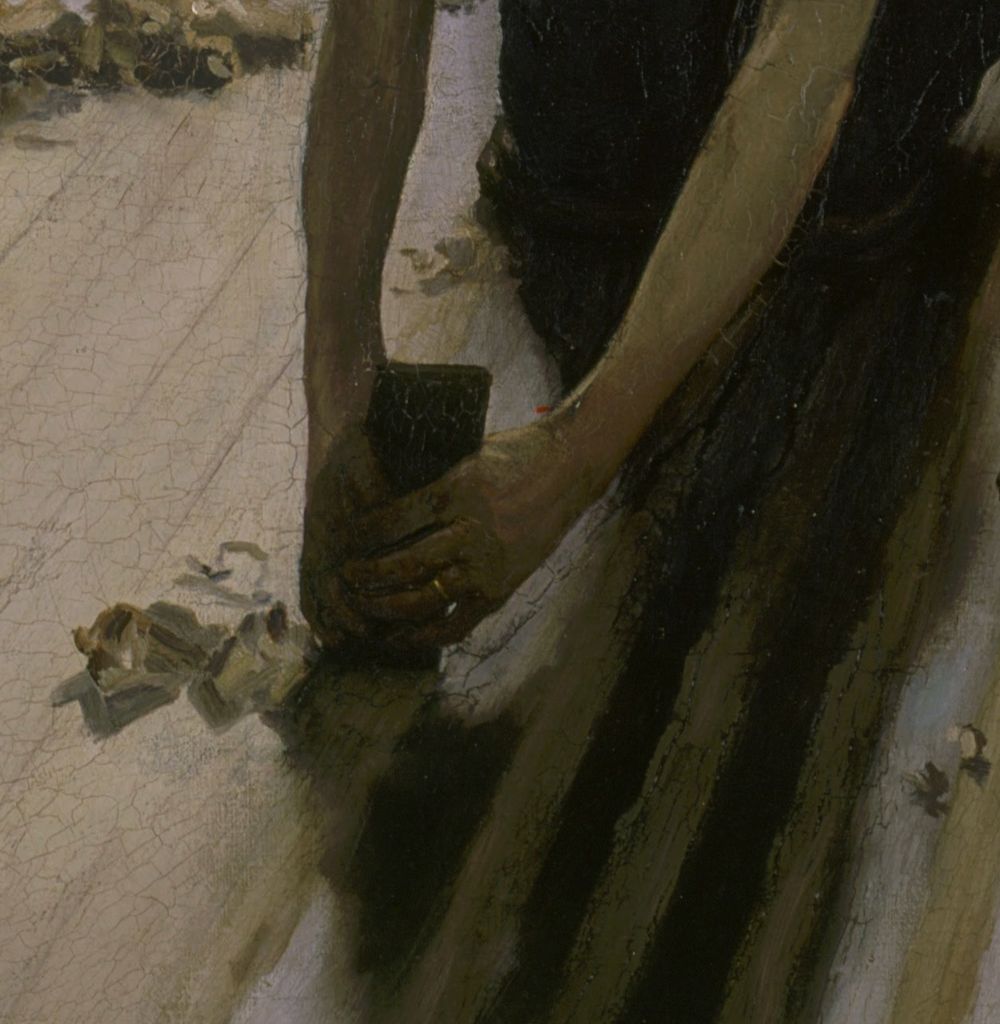
The man at the right works with the two-handled plane. Both hands stay low, close to the floor, and his torso bends over the tool. The centre worker uses the smaller scraper. His grip gathers the hands around a more compact implement, so that the arms converge and the action seems concentrated in the space directly beneath his head. At the left, the third worker holds a scraper while reaching for a file. A second file enters at the bottom of the picture. The gestures distinguish exertion, finishing and maintenance rather than simply repeating the same movement three times. [3]
The distinction changes how we read the floor. The dark and light bands are traces of successive operations. Olmsted reproduces Varnedoe's explanation that the shining dark surface resulted from wetting the bare boards to reduce splintering, while the narrow pale strips followed the plane's passage and the broader light area showed the subsequent scraping. This account concerns the preparation and finishing of a wooden floor, rather than a general operation of scraping away old wax. We can therefore understand the different surfaces as evidence of work in progress. [3]
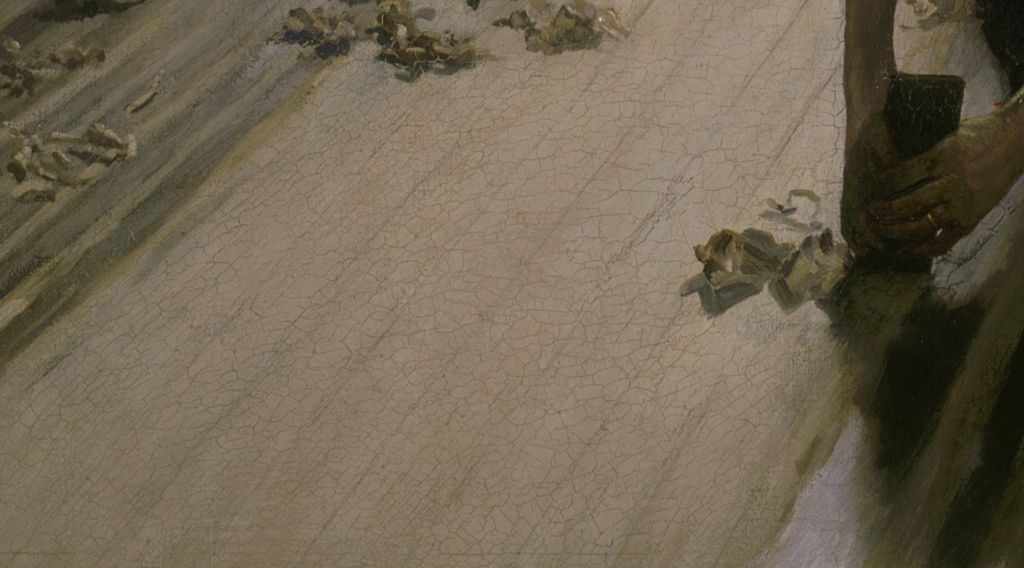
The accumulated shavings are important to that reading. Some lie in small heaps, while others remain as separate coils along the boards. Their forms interrupt the straight lines of the wood from which they have been cut. A long strip of timber becomes a loose curl; a dark surface becomes pale; a rough edge becomes level. Caillebotte lets several stages of material transformation remain visible at once. The room has been emptied sufficiently for this activity, but it has acquired a new, temporary furnishing of implements and waste.
The work has been associated more precisely with the creation of Caillebotte's studio in the family house. Olmsted reports Michael Marrinan's archival account of a studio funded by the artist's father and completed by May 1875. That construction history supports identifying the subject as the finishing of a newly installed floor. It also gives the room a particular relevance: these workers were preparing a surface in a space where Caillebotte would himself make things. This construction history does not establish a particular intention on Caillebotte's part. [3]
Nothing in the scene requires all three men to be at precisely the same stage. One can plane while another scrapes and a third attends to the blade. The painting makes time visible through the coexistence of these tasks. The different positions of the bodies have a practical explanation, and that explanation enriches their visual rhythm. Recognising the trade makes the composition more specific and more compelling.
Annotated Details from The Floor Scrapers
The numbered points identify visible features discussed in this article. Return from each detail to the whole composition. The Floor Scrapers, 1875; Musée d’Orsay. Google Arts & Culture — 0wHXxVpb7UjLNA. Image source. Public domain. Resized only; source appearance preserved.
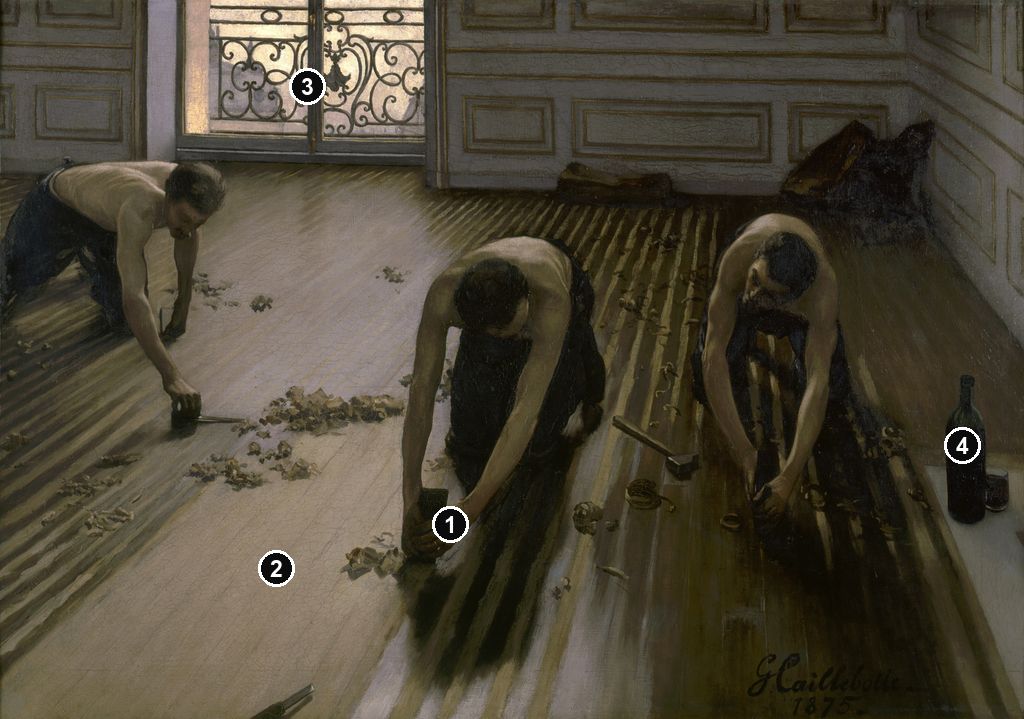
Details from THE FLOOR SCRAPERS
Compare the cropped details with the complete images above. Notice how their colours, shapes and positions contribute to the larger compositions.
Hands and scraping tools
The central worker bends over the floor with both hands close to his tool. Arms, shoulders and knees describe the pressure and balance of the task.
Boards, stripped surface and shavings
Long board edges lead towards the back of the room. Curled shavings interrupt those lines, while pale stripped wood contrasts with the darker surrounding surface.
Light through the ironwork
The bright window and curling ironwork stand behind the workers. Their light runs across the boards and catches the contours of the bent bodies.
Bottle and glass
A bottle and a small glass stand against the right-hand wall. These upright objects punctuate a composition otherwise dominated by receding boards and crouching bodies.
Bodies shaped by a task
The workers' bare torsos expose the mechanics of their movements. Shoulder blades, bent elbows and extended forearms indicate the distribution of weight. The men's dark trousers absorb much of the light and make the pale arcs of their backs especially prominent. Each torso seems to lead towards a different point of pressure at the floor. Their musculature is visible through action, rather than through an isolated pose offered for inspection.
The two nearer heads turn slightly towards one another. That inclination leaves room for the possibility of an exchange during work, although the painting gives us no words and no fixed story. The left-hand worker is more distant, separated from the pair by the pale expanse of floor. His arm reaches across that expanse. Caillebotte varies the relation between physical proximity and attention: the men occupy a shared worksite, while each remains engaged with a particular implement and section of wood.
For Paul Perrin, curator of the Musée d'Orsay's 2024 exhibition Caillebotte: Painting Men, this attention to workers is one of the artist's strongest interventions in modern painting. Discussing The Floor Scrapers beside The House Painters, Perrin emphasises the preparatory studies of gestures, postures, silhouettes and bodies. His account directs attention to how effort registers physically. It is an especially useful way into this painting, because the hands explain what the torsos alone cannot: the exact nature and direction of the work. [5]
There is also a productive tension between the workers and the room. Their exposed bodies occupy a setting designed for the comfortable, clothed life of a prosperous household. Fine wall decoration remains overhead; curled waste accumulates beneath. In this temporary arrangement, the men become the room's principal occupants and their activity determines how its space is used. The absence of furniture gives their kneeling bodies a prominence that would disappear once the interior returned to ordinary domestic use.
Samuel Raybone, writing about Caillebotte's interiors, reads the bottle and the inclination of the heads as hints of workplace sociability. That interpretation makes sense of small details without supplying a full narrative. It also keeps the workers from becoming merely three anatomical specimens. The tools divide their tasks, while a shared space and the possibility of conversation connect them. Their relationship remains lightly indicated, subordinate to the activity through which we encounter them. [6]
Drawings behind the apparent immediacy
The preparatory material changes our sense of the painting's making. Marie Berhaut's catalogue includes a small oil sketch, no. 33, and two groups of pencil studies, nos. 33A and 33B. The oil sketch already establishes the broad composition: three figures spread across a floor, a bright window behind them and a division between pale and dark areas. Berhaut identifies the left-hand worker's attitude as the significant change between this sketch and the finished picture. [2]
The change matters because that figure interrupts the repeated forward bend of the two nearer men. In the final canvas, his reaching arm extends into the light area, his weight shifts sideways, and his attention moves towards the file. The action opens the group. It also makes the maintenance of a tool part of the subject, allowing the picture to show a trade's supporting movements as well as its most obvious exertion.
The pencil sheets isolate aspects of the bodies. One brings together several kneeling attitudes; another studies hands as well as a worker. In the reproductions, the detached hands can be considered almost as separate mechanisms: where the fingers close, how the wrist bends, how the forearm meets the grip. Seen beside the finished painting, these drawings make the concentrated specificity of the gestures easier to appreciate. The detail was worked out before it was absorbed into the larger pattern of light and space. [2]
These studies also reveal that working from life and constructing a composition are compatible activities. A hand can be observed closely, then relocated within an arrangement whose demands exceed a single moment of observation. The final canvas binds the figures to a shared architecture and illumination. Its coherence depends on joining those separately considered elements, including the ornamental window, which Olmsted also identifies as the subject of a preparatory drawing. [3]
Perrin offers a broader interpretation of this procedure. He argues that Caillebotte often had a clear conception of an image before making the studies needed to realise it. For Perrin, the impression of immediacy in the finished pictures grows from deliberate decisions about viewpoint, edges and strong diagonals. The Floor Scrapers supports that interpretation particularly well: its restricted view feels like an encounter with ongoing activity, while the studies show the composition being adjusted and its gestures examined. The drawings provide evidence of preparation; Perrin's account supplies an interpretation of how that preparation served the final effect. [5]
Olmsted also reports a technical investigation undertaken in the early 1990s, whose findings were summarised in the 1994 exhibition catalogue. That investigation associated prominent cracking with the application of new paint before underlying layers had dried. The finding concerns the sequence and pace of paint application, and it sits alongside the extensive evidence of preparation. A carefully designed picture could still have been painted rapidly. Olmsted suggests a possible connection with the Salon submission deadline, but that proposed explanation goes beyond what the cracking itself can establish. [3]
The visible finish remains important. The men's limbs have defined contours, the panelling retains its divisions, and each bright strip on the floor has a direction. Within that structure, shavings and reflected light are handled with greater freedom. The picture rewards attention to both kinds of mark. Its persuasive space depends upon controlled relationships, while the small irregularities keep that space active. Caillebotte's drawings help explain the precision without exhausting what the painted surface contributes.
Watch: Gustave Caillebotte
Explore a museum overview and two discussions of Paris Street; Rainy Day. This shared selection offers wider context for the artist’s work.
"Who Is Gustave Caillebotte?" - HD version
An introduction to Caillebotte from the Kimbell Art Museum.
Watch on YouTubeThe other Floor Scrapers
Caillebotte exhibited two paintings under the same title in 1876. The second composition, Berhaut no. 35, is a smaller, more nearly square canvas, measuring 80 × 100 cm in the 1994 catalogue and bearing the date 1876. It shows workers in another room of the family house. Its existence prevents the Orsay painting from being understood as a subject considered only once and then abandoned. [2]
As Olmsted describes it, the second picture gives a prominent role to a seated worker sharpening a scraper, alongside a kneeling man using the plane. The room's plainer wall treatment and simpler balcony railing distinguish it from the more elaborate interior in the large canvas. Both paintings concern the same kinds of tools and the same connected operations, but their arrangements place different emphases on work, pause and maintenance. A shared subject produces separate pictorial problems. [3]
The dates require care. Berhaut treats the second painting as a return to the subject after the larger work; Olmsted proposes that both might have been made during the studio's construction in 1875, with the smaller canvas receiving the date of its first exhibition. She relates that argument to Caillebotte's dating practices and the building chronology. The proposal is useful because it questions a simple progression from one picture to another, but it does not remove the smaller painting's 1876 inscription or settle their order of execution. [2] [3]
The comparison also helps us see what is distinctive about the Orsay work. Here, the expansive foreground, the differentiated floor surfaces and the low arcs of the bodies create an unusually strong experience of depth and downward looking. The smaller composition gives the seated figure a more evident interruption of the work's rhythm. Neither arrangement functions as a literal diagram of a whole renovation. Each selects and organises a sequence of actions for a viewer.
The Salon refusal and the exhibition of 1876
The Floor Scrapers is closely associated with Caillebotte's failure to enter the Salon of 1875, the official exhibition that offered artists an important route to recognition. The surviving evidence establishes that a painting by Caillebotte was refused. In a letter of 13 April 1875, Marcellin Desboutin reported the painter's distress to Giuseppe de Nittis; de Nittis, in turn, encouraged Caillebotte to make art independently of the jury. Olmsted reproduces and discusses this correspondence. Neither letter names the rejected canvas. [3]
A review of the independent exhibition the following year adds a second piece of evidence. Writing as Émile Blémont in Le Rappel on 9 April 1876, Émile Petitdidier recalled that Caillebotte had been refused the previous year with one of the paintings now on show. Again, the work was not identified. Berhaut explicitly notes this limitation, while Olmsted argues for the large Floor Scrapers on the evidence of its 1875 date and the surviving exhibition works. The identification is persuasive and widely accepted, but the distinction between a documented refusal and an inferred object remains useful. [2] [3]
The jury's reasons are less securely known. Subsequent accounts often connect the rejection with the workers' unidealised bodies, their ordinary occupation and the perspective. These features certainly provoked discussion when the painting was publicly exhibited, but later criticism cannot supply a missing statement by the jury. The refusal should therefore not become a confidently narrated scene in which conservative jurors deliver a particular verdict on this canvas.
The invitation that brought Caillebotte into the next independent exhibition is more concrete. Renoir and Henri Rouart wrote on 5 February 1876, inviting him to join a renewed collective venture in rooms rented from the dealer Paul Durand-Ruel. Their letter specified a fee of 120 francs and initially allowed five works per exhibitor. It proposed an opening on 20 March; the actual exhibition opened on 30 March. Eight paintings appeared under Caillebotte's name in the catalogue, including the two Floor Scrapers. [3]
This was also a developing association with particular artists. Olmsted records three purchases from Monet in February 1876, before the exhibition opened. Caillebotte entered the group as an exhibiting painter who was already investing in a colleague's work. The sequence gives more substance to his debut than a story of a rejected outsider abruptly discovering an alternative. Existing friendships, collecting and the opportunity to show ambitious paintings converged in the same enterprise. [3]
The exhibition placed the workers beside Caillebotte's scenes of domestic life, including Luncheon and Young Man Playing the Piano. This company sharpens a recurring interest in hands and objects. The manual skills used on a floor could be seen alongside fingers at a keyboard and hands attending to a meal. Olmsted also compares the precise occupational gestures of the floor workers with Degas's representations of laundresses. Such comparisons establish a field of shared artistic concerns; they need not become claims that a single earlier picture caused Caillebotte to paint this one. [3]
The edge details connect these interiors as well as their figures do. Olmsted notes how a knife at the near edge of Luncheon recalls the file entering The Floor Scrapers: each object brings a working surface close to the viewer. She compares the backlighting and expansive foreground of Caillebotte's domestic painting with Monet's earlier Luncheon. In the workers' room, a similar attention to reflections and close objects makes illumination something more active than an atmospheric background. The floor throws light back towards us while a tool seems almost within reach. [3]
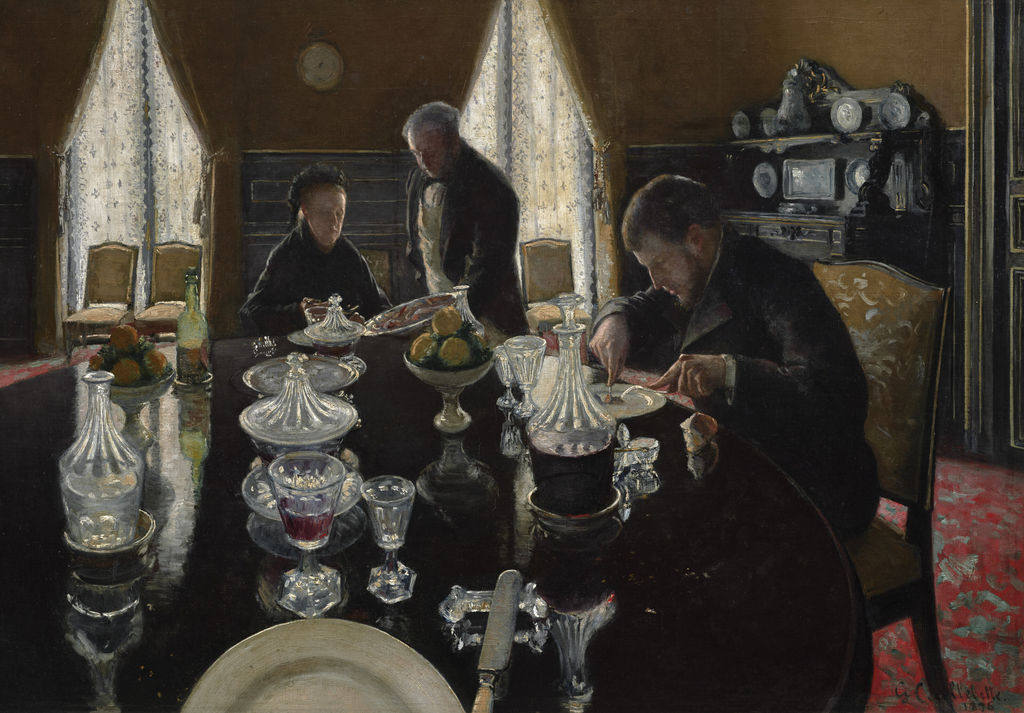
Luncheon, 1876; private collection. Gustave Caillebotte; public-domain reproduction via Wikimedia Commons. Image source. Public domain. Resized only; source appearance preserved.
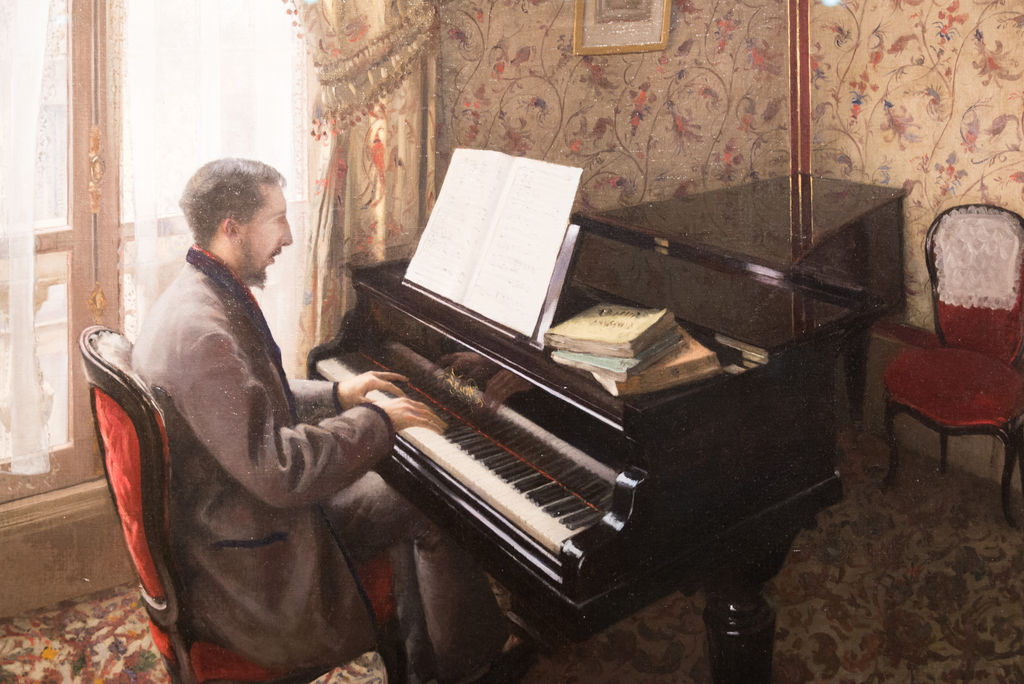
Young Man Playing the Piano, 1876; Artizon Museum, Ishibashi Foundation. Photograph: xiquinhosilva. Image source. CC BY 2.0. Photograph by xiquinhosilva, CC BY 2.0. Resized only; source appearance preserved.
A modern painting that divided its viewers
The response in 1876 contained admiration as well as resistance. Berhaut quotes Adolphe Pothey praising the lighting and the treatment of the nude bodies. She also records Jules Claretie's interest in comparing the painting with Japanese prints. These reactions show contemporary viewers attending to the same combination that remains striking today: the workers' physical presence, the unusual field of vision and the organisation of light. [2]
The National Gallery of Art's 2015 exhibition brochure summarises the divided reception, including praise for the originality and truthfulness of Caillebotte's pictures alongside complaints about unidealised bodies. Its account makes clear how an apparently straightforward occupational subject could disturb expectations about what a male nude should look like in a public exhibition. The objection concerned bodies brought into art with the marks and postures of an ordinary trade. [7]
Émile Zola's response reveals a different reservation. As the Musée d'Orsay recounts it, he recognised the modern subject while objecting to the painting's insistence on exactitude. The painting could therefore appear insufficiently idealised to one viewer and overly painstaking to another. Its realism did not guarantee agreement among critics sympathetic to modern art. [1]
These disagreements help explain why the broad label Impressionist tells only part of the story. Caillebotte's participation in the group's exhibition is a historical fact; the picture's controlled contours and extensively prepared composition remain visible features. Its modernity lies partly in bringing those means to an immediate urban occupation and a viewpoint that unsettles ordinary looking. The same precision that made the tools and hands convincing could seem excessive to a critic who wanted a different relationship between observation and paint.
Work, wealth and the painter's own surface
The setting makes questions of class unavoidable, but it does not dictate a single interpretation. These men perform paid manual work inside a wealthy family's house. The painter had the resources to study them and the freedom to choose painting without needing its income. The difference between his circumstances and theirs forms part of the encounter represented on the canvas. What the painting makes of that difference remains open to argument.
The Getty Museum's 2025 exhibition text interprets Caillebotte's early worker paintings through a bourgeois work ethic, cross-class affinities and the freedom conferred by privilege. It also stresses that the labourers were encountered within his family's property or affluent neighbourhood. This curatorial account connects the image's intimacy with the social conditions that made such intimacy possible. The men occupy his familiar surroundings, even while their work differs from his own. [8]
Raybone proposes another useful emphasis. Drawing on Hannah Arendt's distinction between labour and work, he considers Caillebotte's painting alongside his serious activities in yachting and stamp collecting. His argument challenges the assumption that a wealthy amateur's pursuits were necessarily idle diversions or simple expressions of ownership. For The Floor Scrapers, he identifies an analogy between the workers' alteration of the parquet and the painter's alteration of a canvas: both involve trained hands, specialised tools and the transformation of a surface. [6]
The signature becomes particularly suggestive in this reading. Caillebotte places his name and the date at the lower right, on the dark area of floor that approaches our own space most strongly. Raybone reads it as though it were written on the boards, potentially subject to the workers' next passage. The idea draws attention to something physically visible while remaining an interpretation. The signature belongs to the painted surface, and that surface represents another one being changed by manual skill. [6]
There are limits to what this analogy can establish. It does not make painting and wage labour socially equivalent, or prove that Caillebotte experienced a particular emotion while watching the men. Its value is more concrete: it encourages us to attend to what the image repeatedly shows, the meeting of hand, implement and material. The careful studies of grips support that attention. So does the division between a floor already scraped and one still awaiting the same treatment. The painting's strongest relationships are carried through actions we can inspect.
From the artist's collection to the national museums
The painting remained with Caillebotte despite appearing at the Impressionists' auction at the Hôtel Drouot on 28 May 1877. Berhaut records both Floor Scrapers compositions in that sale and reports that the large canvas was taken back by the artist. The Musée d'Orsay likewise identifies it as retained and subsequently part of his collection until his death. An auction appearance therefore cannot be treated as proof of a lasting transfer to an outside buyer. [2]
In 1894, Caillebotte's heirs gave The Floor Scrapers to the French national museums through Renoir, his executor. Berhaut dates the gift to 22 March. This acquisition was separate from Caillebotte's bequest of paintings he owned by other Impressionists, although the two histories are easily confused because both involved his estate and Renoir. The difference matters: this was the family's gift of a painting by Caillebotte himself. The wider history of his collection belongs to his role as a collector and benefactor. [2] [7]
The canvas entered the Musée du Luxembourg in 1896, moved to the Louvre in 1929, then to the Jeu de Paume in 1947, and became part of the Musée d'Orsay in 1986. That institutional history gave this picture a public presence denied to many works which remained in private hands. [2]
Its subject remains remarkably particular. The bottle waits against the wall; the left-hand man reaches for the file; the floor offers the next resistance to a blade. The room will eventually conceal much of the work that produced its finish. Caillebotte holds it at the moment when that work can still be seen, in pale bands, curling shavings and bodies bent to the surface.
Catalogue and documented works
This directory brings together 578 entries in the revised 1994 catalogue, 11 further documented records and three groups of study descriptions. It is a directory of records, not a total of authenticated individual works. Albums, print states and surviving decorative panels are grouped. English labels retain the French titles as searchable aliases; dates are supplied only where checked. Numbered entries link to the relevant article or the historical catalogue. Pastels appear under the Drawing filter; original prints remain searchable under All media.
Frequently Asked Questions
The 1875 painting belongs to the Musée d'Orsay in Paris, inventory RF 2718. Collection membership does not guarantee that a work is on display at any particular visit. [2]
The detailed tool account discussed by Olmsted identifies the preparation and finishing of a newly laid floor, including planing, finer scraping and sharpening the scraper. It should not be reduced to removing old wax. [3]
Discussion
Look again at the images and ideas explored in The Floor Scrapers. These editorial prompts invite your observations.
Reader Insights
The strips of flooring carry the eye towards the workers’ hands.
The three bent bodies repeat a task without repeating exactly the same pose.
Does the room’s steep perspective make the labour feel closer or more distant?
Join the Conversation
Share a detail, comparison or question about The Floor Scrapers below.
References
- Musée d'Orsay, Raboteurs de parquets, collection record, RF 2718; object information, commentary and provenance, consulted 2026. View source. (in French).
- Marie Berhaut, with Sophie Pietri, Gustave Caillebotte: Catalogue raisonné des peintures et pastels (1994), biography pp. 4–7; entries 33, 33A, 33B, 34 and 35, pp. 74–77. Public digital edition, Wildenstein Plattner Institute. View source. (in French).
- Galina Olmsted, Making and Exhibiting Modernism: Gustave Caillebotte in Paris, New York, and Brussels (2019), printed pp. 61–82, especially pp. 62–71 on the studio, tools, dating and invitation; pp. 74–75 on preparation; pp. 80–82 on interior comparisons and gesture. View source.
- Marie Berhaut with Sophie Pietri; Wildenstein Plattner Institute, Gustave Caillebotte Catalogue raisonné des peintures et pastels, 1994. View source. (in French).
- Paul Perrin / Musée d'Orsay, Exposition « Caillebotte, Peindre les hommes »: Entretien avec Paul Perrin (2024), transcript pp. 2–3 on workers and studies, pp. 5–6 on composition and immediacy. View source. (in French).
- Samuel Raybone, “Gustave Caillebotte's Interiors: Working Between Leisure and Labor”, nonsite.org 26 (2018), repository PDF pp. 4–5, 7–15 and 18–25 on the workers, surfaces, hands, signature and work; pp. 15–17 on the Arendt framework. View source.
- Lynn Kellmanson Matheny / National Gallery of Art, Gustave Caillebotte: The Painter's Eye, exhibition brochure (2015), p. 2 on reception and the heirs' gift, p. 7 on the collection bequest. View source.
- J. Paul Getty Museum, Gustave Caillebotte: Painting Men, gallery text (2025), pp. 1–3, especially the section on work and bourgeois privilege. View source. (in en/es).
- Art Institute of Chicago, Caillebotte Paintings and Drawings at the Art Institute of Chicago, 2015. View source.
- Petit Palais / Paris Musées, Portrait de Paul Hugot, original print, PPG2319, current. View source. (in French).
- Paul Perrin, Musée d’Orsay, Transcription de l’entretien commissaire Caillebotte, 2024. View source. (in French).
- Cleveland Museum of Art, Caillebotte collection records: 2020.260, 2009.157 and 2020.105, current. View source.
- Splash image, The Floor Scrapers, 1875.


