


 by Tom Gurney
Tom Gurney BSc (Hons) is an art history expert with over 20 years experience
Page Created on September 22, 2026 / Page Updated on September 22, 2026
Email: tomgurney1@gmail.com / Phone: +44 7429 011000
At a Glance
- ArtistGeorgia O’Keeffe
- ArtworkPelvis with the Distance
- Artistic contextAmerican modernism
Contents
- A bone large enough to become a landscape
- Identifying the Newfields canvas
- The pelvis seen at close range
- The aperture as a natural viewfinder
- Near and far without a middle ground
- Blue as atmosphere and painted structure
- Ghost Ranch and the summer of 1943
- Anatomy without false certainty
- The first pelvis group of 1943
- Bone, blue and wartime language
- Death, life and the limits of symbolism
- Surrealism without an invented influence
- An American Place in 1944
- Caroline Marmon Fesler and ownership
- O’Keeffe, Moore and recent reception
- What the painting does not disclose
- Correcting the inherited account
- Looking through, around and back
A bone large enough to become a landscape
Georgia O’Keeffe’s Pelvis with the Distance places a sun-whitened animal bone so close that it reaches beyond the upper and side edges of the canvas. Through its largest opening, blue sky appears with an intensity that makes the aperture feel at once hollow and full. Far below, a strip of yellow earth, scattered green growth and blue mountains occupies so little space that the immense foreground object seems to hold an entire country at arm’s length.[1]
The construction is immediately legible but never stable. The bone can appear to hang before the view, lie against it, or enlarge until its cavities become passages through a pale terrain of their own. O’Keeffe preserves enough modelling to keep the object recognisable, then disrupts ordinary scale so thoroughly that looking through the pelvis becomes as consequential as looking at it. Near and far are distinct, yet pictorially interlocked.
This is not a desert still life arranged on a table. It is a carefully compressed encounter between a collected fragment and the distances of northern New Mexico, joined through colour, cropping and a view through negative space. The painting turns an object that could be held in two hands into a structure larger than the horizon, while the distant land remains precise enough to resist becoming a merely decorative band.
Identifying the Newfields canvas
The catalogue raisonné identifies the work as Pelvis with Distance, dated 1943, oil on canvas, measuring 23⅞ by 29¾ inches, or 60.6 by 75.6 centimetres. It is catalogue number 1049 and belongs to the Indianapolis Museum of Art at Newfields.[1] The museum records accession number 77.229 and lists a current framed size of roughly 25 by 31 inches, details that distinguish the object from O’Keeffe’s several related pelvis compositions.[2]
The form used in this page title, Pelvis with the Distance, is Newfields’ title and a documented alternate in the 1999 catalogue raisonné. The catalogue’s preferred form omits “the”, while Alfred Stieglitz’s handwritten backing label uses it.[1] A responsible account can retain the established URL title without pretending that documentary practice has been uniform, because both forms belong to this picture’s history rather than to two different paintings.
No signature or painted inscription is recorded on the visible object; Newfields describes it as “Not Inscribed”.[2] The backing label is more informative, identifying number 5 in O’Keeffe’s exhibition of 11 January to 11 March 1944 and naming the picture Pelvis with the Distance, 1943. It also places the work under the exhibition phrase “New Mexico by Georgia O’Keeffe”, connecting title, date and first public setting.[1]
The pelvis seen at close range
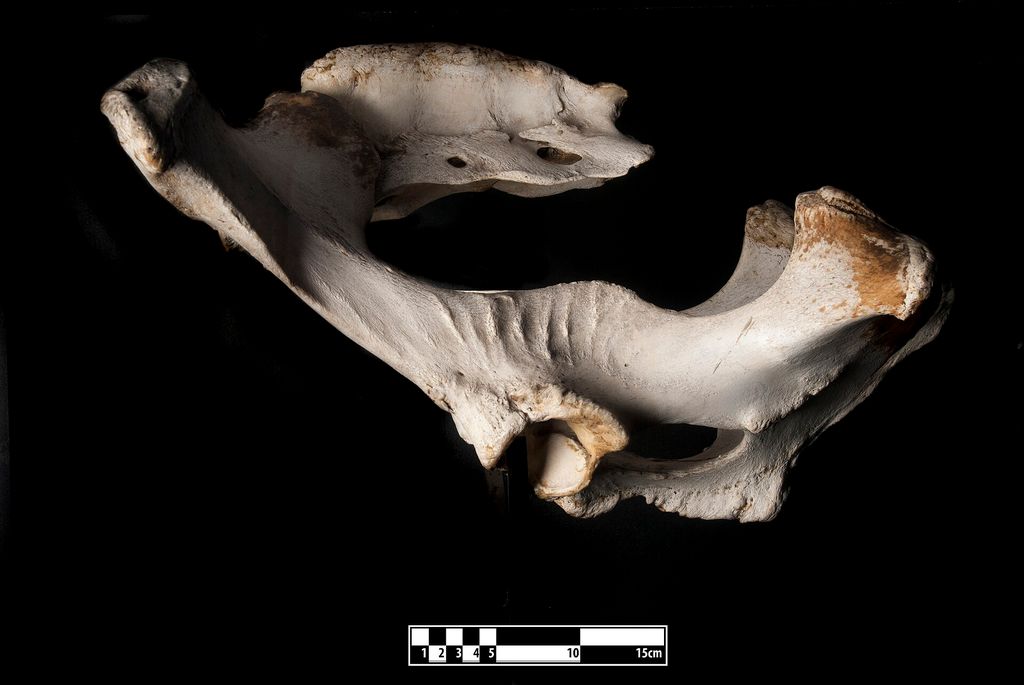
The foreground form is predominantly cream-white, but its surface is not blank. Grey, olive-brown and muted beige settle into hollows, while narrow transitions of light give ridges, sockets and thin edges different weights. The bone broadens across the left, pinches around the central opening and rises into a more intricate right-hand structure, where several projections and recesses crowd close to the canvas edge.
Cropping makes the pelvis impossible to survey as a complete specimen. Its upper boundary disappears above the frame, the left mass continues beyond sight, and the lower-right portion is cut before it resolves. That refusal of total description matters: O’Keeffe offers intense visual access while withholding the detached completeness expected of a scientific illustration, so the viewer experiences an object through selected contours rather than mastering its anatomy.
The central opening provides the clearest interval, an irregular blue window bounded by light bone on the left and darker inner surfaces on the right. A smaller rounded cavity appears near the upper-right edge, while adjacent notches create several competing entrances into depth. These apertures prevent the large pale form from behaving like a flat silhouette; absence becomes an active part of its structure.
The aperture as a natural viewfinder
O’Keeffe later explained that when she began painting pelvis bones, she was especially interested in their holes and in what she saw through them. Holding a bone towards the sun brought the blue sky into those openings, a familiar action in a place where she felt there was “more sky than earth”.[3] Pelvis with the Distance makes that bodily act into a durable composition without illustrating the hand that performed it.
The aperture works like a viewfinder, selecting a concentrated field from an otherwise continuous sky. Yet it differs from a camera’s rectangular finder because the bone supplies an irregular boundary shaped by growth, use and weathering rather than by a manufactured instrument. The Georgia O’Keeffe Museum has used this aspect of her process to invite viewers to notice natural frames in roots, trees and rocks, while acknowledging that its own bone collection remains a subject of zooarchaeological study.[4]
Calling the opening a frame should not reduce it to an empty border. Dark olive-grey modelling runs around the inner edge, establishing thickness and making the blue appear behind the bone rather than painted upon it. The strongest colour contrast therefore coincides with a spatial proposition: brilliant sky is reached visually by passing through a cavity, and the bone becomes the means by which distance is both restricted and intensified.
Near and far without a middle ground
Most landscape paintings lead the eye through foreground, middle ground and distance. Here the middle ground nearly vanishes. A pelvis presses against the picture plane, then the view jumps to a narrow plain and remote mountains, producing a gap that cannot be measured within ordinary pictorial space. The result is less a continuous journey into depth than a sudden switch between touchable surface and inaccessible horizon.
That discontinuity creates scale ambiguity. The pelvis may be understood as a small object held near the eye, but cropping and enlargement also make it resemble a monumental arch through which the land is viewed. O’Keeffe does not settle the alternatives because both depend upon the same painted evidence. The mind supplies the imagined hand and viewing distance even as the canvas encourages architectural magnitude.
The arrangement belongs to a wider habit in O’Keeffe’s art of making small natural things large and bringing remote features close. Recent exhibitions pairing her with Henry Moore have emphasised how both artists turned, rotated and enlarged found objects while investigating internal voids and the spaces around them.[13] That comparison clarifies a shared formal problem, although this painting’s flat, framed encounter remains distinct from sculpture meant to be walked around.
Thai-language scholarship has approached the pelvis series through positive and negative space, arguing that enlargement, cropping, light, shadow, position and direction let bone and sky exchange the roles of form and void.[23] CR 1049 makes that reciprocity especially visible because blue seems both remote atmosphere and a sharply bounded shape, while the pale pelvis operates both as solid object and as a frame perforated by distance.
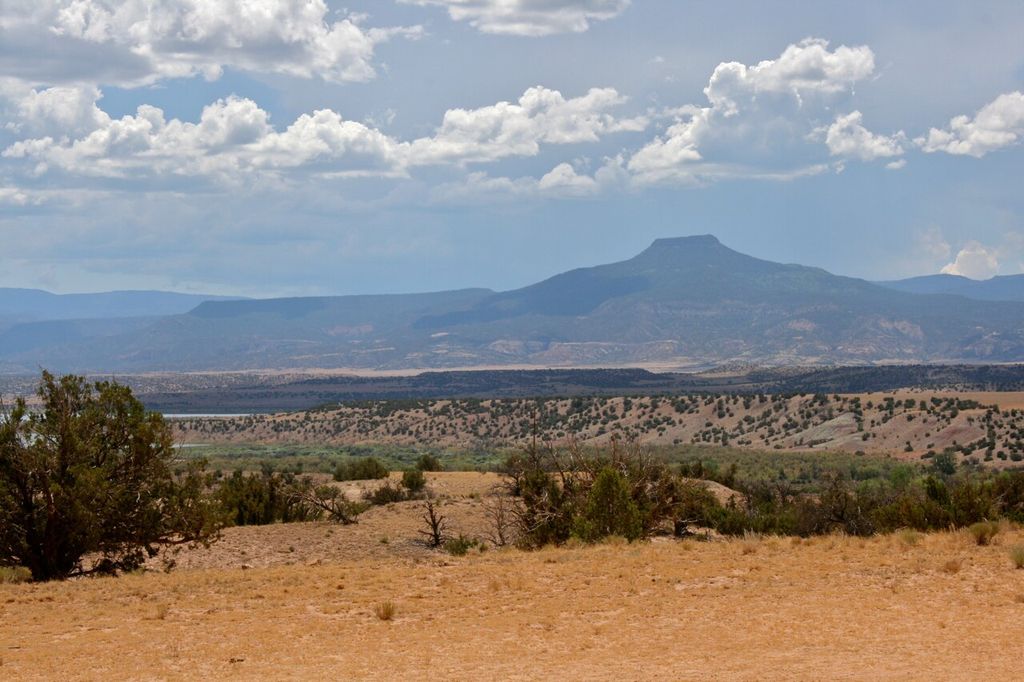
The visible land is exceptionally thin but not empty. Pale yellow and tan ground stretches across the bottom, punctuated by minute dark-green bushes or trees and a narrow reddish line. Beyond it, a cobalt-blue range rises in uneven peaks, with a lower summit towards the right. The economy of this band makes each shift of colour register strongly against the much larger bone and sky.
Nothing in the authoritative record identifies these mountains as Cerro Pedernal.[1][2] That restraint is necessary because another 1943 canvas, Pelvis with Pedernal, names the mountain explicitly and even presents it upside down beyond the bone.[7] Visual resemblance to O’Keeffe’s familiar New Mexican horizons cannot substitute for a title or object record, so the range in CR 1049 should remain an unidentified distance.
The plain also deserves more than the old shorthand of an unoccupied desert. Its tiny vegetation signals a living environment, while contemporary O’Keeffe Museum interpretation stresses that the landscapes around her homes form part of Tewa homelands with continuing communities, not untouched scenery awaiting modernist discovery.[16] This history does not identify the specific view, but it corrects the habit of equating visual sparseness with cultural emptiness.
Blue as atmosphere and painted structure
The sky changes from deep, saturated blue at the top to a much paler tone near the horizon. That gradient helps the bone opening read as transparent rather than filled with a separate patch of colour, because the blue passing through it belongs to the same atmospheric field visible elsewhere. At the same time, the most vivid area is tightly enclosed, making sky behave like a shaped positive form.
O’Keeffe described the pelvis as especially beautiful against blue and said she had tried to paint “the Bone and the Blue”.[3] The phrase identifies a deliberately reduced relation rather than a record of casual outdoor observation. White and blue carry most of the canvas, while earth, vegetation and mountains are compressed into a supporting register; reduction allows subtle differences inside each broad colour family to become structurally important.
General technical research on O’Keeffe shows that she planned dimensions, proportions, forms and colour transitions carefully, and examination of five Thyssen paintings has identified controlled handling and nuanced paint choices.[14] Those findings illuminate her disciplined practice but do not establish the pigments, ground or layer sequence of CR 1049. No public object-specific conservation report supports transferring another canvas’s material results to this one.
Ghost Ranch and the summer of 1943
O’Keeffe purchased her Ghost Ranch house in 1940, a modest property looking across the valley towards Cerro Pedernal beneath yellow and orange cliffs.[10] The museum chronology places her in New Mexico from spring into autumn in 1943, following the seasonal pattern she maintained before settling permanently in the state.[17] The pelvis series emerged from sustained work in this environment rather than from a single picturesque encounter.
Her own 1944 statement says that pelvis bones had lain around the house indoors and outside for years, alternately noticed and overlooked. A particularly beautiful example found on a mountain during a fishing trip prompted the new work.[3] This account joins long familiarity to a fresh visual trigger: collection preceded composition, but possession alone did not determine when an object became urgent enough to paint.
The painting was probably developed within movement between New Mexico and New York, where O’Keeffe returned for exhibitions and where collected bones were transported. Museum accounts note that she sometimes shipped bones east in barrels.[13] It is therefore misleading to imagine the canvas as an untouched view made entirely before the motif; memory, drawings, portable objects and the gallery calendar all participated in her working geography.
O’Keeffe gathered flowers, shells, rocks, pieces of wood and bleached bones when their shapes interested her. Her statement places the pelvis within that broad collecting practice and says she used such things to communicate the wideness and wonder of the world she inhabited.[3] The objects were neither random studio debris nor specimens assembled for taxonomy; they became a personal working archive available for repeated looking and rearrangement.
The O’Keeffe Museum preserves bones associated with the artist and has undertaken identification work with a University of New Mexico zooarchaeology researcher.[4] That continuing study is a useful caution because CR 1049’s public records say only “an animal’s pelvis”.[1] The painting’s simplification, close crop and uncertain orientation make a confident species attribution especially risky, even when viewers recognise familiar mammalian structures.
The National Historic Landmark nomination for the Ghost Ranch house describes the pelvis pictures as the final major experimental cycle O’Keeffe developed there and connects them directly with the act of using bone as a framing device.[24] Its evidence comes partly from her 1967 recollection at the house, twenty-four years after CR 1049. The statement is powerful testimony to sustained practice and place, but its retrospective date still matters when reconstructing the precise order of discovery, handling and painting.
The distinction between the surviving collection and the depicted object must also remain open. A museum’s possession of pelvis bones does not by itself prove which, if any, supplied the exact form in this canvas. O’Keeffe’s statement confirms repeated observation of such objects, but without a matched specimen, preparatory record or technical tracing, claims of one-to-one correspondence would exceed the available evidence.
Anatomy without false certainty
A pelvis joins the vertebral column to the hind limbs and contains openings, sockets and fused bony elements whose forms vary across species. Veterinary anatomical teaching identifies the acetabulum as the socket receiving the head of the femur and the obturator foramen as a large opening bounded by parts of the pelvis.[15] Those terms offer possible orientation points, not a licence to label every contour in this transformed image.
The large opening in O’Keeffe’s painting may correspond to an obturator foramen, and the rounded cavity near the upper right may evoke an acetabular socket. “May” matters because the object has been rotated, cropped and selectively modelled, while the species remains undocumented.[1][15] Formal analysis is secure when it speaks of aperture, ridge, hollow and edge; exact anatomical mapping must remain provisional.
O’Keeffe herself approached the bone through use and appearance rather than death alone, remarking that a pelvis had been useful to any animal that possessed it.[3] That observation acknowledges bodily function before the object’s afterlife in the studio. The painting retains this dual character: it is recognisably part of a skeleton, yet its former motion is converted into a new visual task of holding, framing and measuring space.
The first pelvis group of 1943
CR 1049 belongs to the opening year of O’Keeffe’s concentrated pelvis series. Metropolitan Museum scholarship describes the principal group as developing between 1943 and 1945, while the museum’s current object page uses the broader range 1943–47.[5][6] These accounts are compatible if the first names the core sustained campaign and the second includes its later extensions rather than treating every work as one simultaneous set.
Several 1943 pictures retain a recognisable whole bone against landscape and sky. Pelvis with Pedernal, CR 1053, arches diagonally over an inverted named mountain; Pelvis With Shadows and the Moon, CR 1052, combines complex pelvic forms, blue shadows, coloured strata, a black mesa, moon and Pedernal.[7][8] CR 1049 is quieter, narrowing the landscape band and giving one principal opening dominance without abandoning the distant world.
Another work simply titled Pelvis, CR 1047, confirms that O’Keeffe tested related forms without always naming the landscape relation.[9] Catalogue numbers matter because titles repeatedly recycle “pelvis”, “distance”, “sky”, “moon” and numbered-series language. Treating the group as a single generic image would erase differences of scale, orientation, support, colour and ownership that reveal how deliberately she varied the problem.
The 1943 canvases often preserve enough of the object to make rotation and landscape juxtaposition central. During 1944 and 1945, O’Keeffe increasingly enlarged portions of the pelvis so that holes, rims and surrounding blue could dominate the frame.[5][6] CR 1049 stands near the beginning of that movement: its bone is already too large to fit, but its thin plain and mountains still establish a recognisable external world.
In Pelvis II of 1944, a white arch fills a vertical canvas around a near-circular opening against uninterrupted blue. The Met describes the work as one of a 1943–47 series showing bones whole or in magnified detail and focusing attention on sky through empty sockets.[6] Landscape has disappeared, allowing convex surface, concave recess and open space to carry the entire visual argument.
Pelvis IV, also from 1944, sets a small white moon inside an opening, while Pelvis Series, Red with Yellow of 1945 moves decisively into non-natural colour.[11][12] The sequence is not a simple march from realism to abstraction, because observation and invention coexist throughout. It does show O’Keeffe separating variables—whole form, hole, horizon, moon and colour—to discover how each alters the others.
Bone, blue and wartime language
The exhibition statement printed in 1944 says the blue would remain after human destruction had ended.[3] Written and published during the Second World War, that sentence inevitably brings global violence into the painting’s first context, especially beside an enduring sky and the residue of an animal body. The historical conjunction is firm; a precise allegory about a battle, nation or policy is not documented.
The line can be read as confidence in nature’s duration, but it is not uncomplicated consolation. Human destruction is imagined as finite only against a blue that exceeds it, while the bone has already survived the organism to which it belonged. CR 1049 turns both forms into structures of looking, so persistence lies less in untouched nature than in the uneasy relation between bodily remains, distant land and apparently boundless atmosphere.
O’Keeffe’s phrase also resists a purely decorative understanding of the colour scheme. The blue is visually pleasurable, yet the artist’s contemporary words give that pleasure an historical edge.[3] Because the statement addressed the entire 1943 exhibition rather than providing a private key to every canvas, it should guide interpretation without closing it; endurance, destruction and wonder remain overlapping possibilities rather than fixed iconographic labels.
Death, life and the limits of symbolism
Bones often carry associations with mortality, desiccation and ruin, but O’Keeffe repeatedly challenged the idea that death exhausted their meaning. In a recorded museum audio excerpt, she recalled that bones did not symbolise death to her and stressed their lively shapes against the sky.[18] Her 1939 statement similarly called desert bones more living than moving animals, because they seemed to reach the keen centre of the landscape.[3]
That testimony should correct a reflexive memento-mori reading, although it cannot prevent viewers from encountering skeletal matter through their own cultural knowledge. The bone is literally the remnant of a dead animal, and wartime language intensifies that fact. The historical task is to distinguish an available association from an exclusive intention: mortality belongs to the work’s reception, while vitality and formal beauty belong explicitly to O’Keeffe’s account.
Nor does “symbol of the desert” mean a simple emblem that can be decoded once. O’Keeffe used bones to give form to an environment she found vast, difficult and beyond possession.[3] In CR 1049 the pelvis does not merely stand for New Mexico; it changes how distance can be seen, creating a material threshold through which land and sky appear newly bounded.
Surrealism without an invented influence
The extreme scale shift and improbable union of pelvis and panorama help explain why commentators have called some bone landscapes surreal. The Met notes that odd juxtapositions and discrepancies of scale prompted that response, while the 2021 Thyssen retrospective states that O’Keeffe denied an affiliation with Surrealism despite the metaphysical character of several pelvis works.[5][19] “Surreal” therefore describes a reception effect more securely than a movement membership.
The legacy page singles out Salvador Dalí and claims that O’Keeffe followed his method of isolating an object against a neutral background. No institutional or archival source located for CR 1049 documents that dependence, and the canvas does not possess a neutral backdrop: graded blue sky and a precisely coloured landscape are active components. Similar estrangement can arise from different practices, so resemblance alone cannot establish a line of influence.
O’Keeffe’s own process offers the stronger explanation. She collected a real pelvis, turned it against the sun, attended to its holes and translated what appeared through them.[3] The resulting scale is strange, but it begins in disciplined observation and repeated handling rather than an imported dream narrative. Surrealist comparison remains useful when it names perceptual disturbance and becomes misleading when it substitutes an unsupported genealogy.
An American Place in 1944
Pelvis with the Distance appeared as number 5 in Georgia O’Keeffe: Paintings—1943 at An American Place from 11 January to 11 March 1944.[1] Stieglitz’s backing label preserves the catalogue title and exhibition address, while O’Keeffe’s brochure statement explained the long presence of pelvis bones around her house and her fascination with sky seen through their apertures.[3] Object, installation and artist’s words entered public life together.
The picture was reproduced in Magazine of Art in March 1944, the month the exhibition closed, extending its first reception beyond visitors to the gallery.[1] Daniel Catton Rich’s accompanying discussion repeated O’Keeffe’s desire to express the world’s wideness and wonder.[3] Reproduction would have altered scale and colour, yet it helped establish the pelvis series as a public statement rather than a private studio experiment.
The 1944 context also reveals how titles organised perception. “With the Distance” directs attention beyond the foreground bone, while the exhibition’s “New Mexico” framing places that distance geographically without naming a mountain.[1] The title does not merely list two things; it describes a visual relation in which the pelvis makes remoteness measurable, and the remote view prevents the bone from closing into self-contained abstraction.
Caroline Marmon Fesler and ownership
The artist first owned the canvas, after which Caroline Marmon Fesler purchased it; the public record gives no exact sale date.[1] By the 1946 Museum of Modern Art exhibition it was lent by Mr and Mrs James W. Fesler, showing that it had entered their collection by then.[20] Preserving the interval is preferable to assigning a transaction to 1944 simply because the picture had already been exhibited.
Fesler was an unusually consequential Indianapolis patron. She anonymously funded the John Herron Art Institute’s new school building in 1929 and, as Art Association president, began a major sequence of gifts in 1943 that included European modern and earlier masters.[21] Her ownership places the O’Keeffe within an active programme of collection-building rather than presenting it as an isolated private acquisition.
The painting descended to Anne Marmon Greenleaf in 1960 and was given to the Indianapolis Museum of Art in 1977 in memory of Fesler.[1][2] Its credit line therefore preserves both women’s roles, although the word “gift” marks only the final institutional transfer. Provenance connects artist, patrons and museum across more than three decades, while the accession number fixes the moment it entered the public collection.
In 1946 CR 1049 appeared in the Museum of Modern Art’s O’Keeffe exhibition as item 48, under the title Pelvis with the Distance and with the Feslers named as lenders.[20] The exhibition was MoMA’s first solo presentation devoted to a woman artist, giving the painting a place in a milestone whose institutional importance extends beyond the reception of one canvas.[13]
Subsequent appearances moved the work through changing frames: American Landscape 1760–1960, a 1964 survey in St Louis, a 1970 Indianapolis presentation, and Georgia O’Keeffe: The Poetry of Things in 1999–2000.[1][2] The latter title foregrounded the material objects she collected, making the pelvis legible through still life and studio practice as well as through landscape and abstraction.
From 2014 to 2016 it travelled in Eloquent Objects: Georgia O’Keeffe and Still Life in New Mexico, then entered the 2021–22 retrospective shown in Madrid, Paris and Basel.[1][2] The Spanish checklist translated the title as Pelvis con la distancia and retained Newfields’ dimensions and credit line.[19] Translation confirms international circulation while also showing how the title’s unusual relation between object and remoteness survives in another language.
O’Keeffe, Moore and recent reception
Newfields records the canvas in the 2023–25 tour of O’Keeffe and Moore, shown in San Diego, Albuquerque, Montreal and Boston.[2] The exhibition compared two artists who collected bones, stones, shells and wood, enlarged small natural forms and examined hollows and surrounding space.[13] CR 1049’s own combination of a found object, aperture and distant landscape made it especially responsive to that curatorial frame.
The comparison does not claim direct collaboration or identical meanings. Moore often translated found fragments into three-dimensional sculpture whose changing profiles depend on a moving spectator, whereas O’Keeffe fixed rotation, scale and viewpoint in paint. Their shared interest in internal space becomes revealing precisely because medium changes the experience: a viewer mentally circles O’Keeffe’s pelvis but physically remains before one carefully chosen face.
Carolin Görgen’s review of the 2021 Centre Pompidou retrospective records a further transatlantic shift: it was O’Keeffe’s first French retrospective, and CR 1049 entered a display read through desert objects, biomorphic form and a qualified Surrealist echo.[25] Görgen also judged the exhibition’s Southwestern section insufficiently attentive to Indigenous cultural context. That criticism usefully tests international canonisation, while the distinct histories of Hopi and Tewa peoples caution against answering it with a single generic Indigenous category.
The Montreal presentation also placed the dialogue before a bilingual public, and the tour introduced O’Keeffe’s Indianapolis canvas to audiences outside its home collection.[22] Such circulation is part of the work’s history rather than proof of an original intention. Each exhibition selects a different emphasis—still life, landscape, abstraction, studio collection or comparison with sculpture—showing how one tightly constructed image continues to support distinct, evidence-based readings.
What the painting does not disclose
No public technical examination of CR 1049 identifies its pigments, preparatory drawing, ground, canvas weave, varnish history or conservation treatment. The current Newfields record notes oil on canvas, no inscription and an Optium frame, but present glazing and framing should not be mistaken for O’Keeffe’s original presentation.[2] Visual description can address smooth gradients, opaque pale passages and softened modelling without converting appearance into unsupported laboratory findings.
The species, precise findspot, depicted mountain and exact working sequence also remain unresolved. O’Keeffe’s 1944 statement establishes the general trigger of a mountain-found pelvis and her habit of holding bones against the sky, but it does not explicitly match every sentence to CR 1049.[3] Good interpretation uses that unusually close primary evidence while preserving the difference between a series statement and an object-specific diary entry.
Even the picture’s current display is changeable. Newfields presently lists it as not on view, while its extensive loan history demonstrates repeated movement.[2] Collection ownership is durable; gallery status is temporary. A reliable manuscript should therefore state the institution and accession confidently, date any display claim, and avoid promising that a visitor will encounter the canvas in a particular room.
Correcting the inherited account
The legacy page correctly recognises a pelvis bone enlarged against distant landscape and notices that the construction can feel surreal. It also links the picture to O’Keeffe’s repeated use of bones and to the natural world around her. These useful subjects become more persuasive when grounded in CR 1049’s title history, O’Keeffe’s 1944 statement, the pelvis sequence and the owner’s provenance and exhibition records.[1][2][3]
Its Dalí comparison, however, is presented as though formal resemblance established a source. No supporting evidence has emerged, and its assertion of a neutral background overlooks the active gradient of sky, yellow plain, vegetation and mountain range. The stronger account explains estrangement through the natural-viewfinder process, radical cropping and the collapse of scale, while retaining Surrealism as a historically documented reception category rather than an artistic allegiance.[5][19]
The inherited text also stops before the painting’s richest documentary history. It does not identify Fesler, MoMA, international retrospective travel, the alternate title or the distinction between the early landscape-bearing pelvises and later magnified apertures. Restoring those records changes the article from a general comment on style into an object history in which making, naming, ownership, display and interpretation continually reshape one another.
Looking through, around and back
Begin with the largest opening rather than the outer silhouette. Follow its irregular edge clockwise, noticing how pale bone gives way to olive-grey shadow and back to white, then compare the enclosed blue with the open sky above. The exercise makes negative space tangible: what seems at first like absence gains shape, colour and depth because the pelvis controls exactly where the distance becomes visible.
Next move downward to the landscape strip. Its red line, green marks and blue peaks are minute beside the foreground form, yet they prevent the view from becoming placeless. Then return to the cropped bone and test two readings in succession—an object near the eye and a monumental arch. The canvas sustains both without requiring a literal giant skeleton or denying the pelvis’s portable scale.
Finally, hold together the histories that the image does not visibly narrate: a useful animal structure weathered into a found object, years of looking around Ghost Ranch, a 1943 experiment, a wartime exhibition, Fesler’s patronage and later international display.[1][3][13] The painting’s achievement lies in making distance intimate without making it possessable. Through a fragment, O’Keeffe gives the horizon a boundary and makes that boundary open.
Discussion
Which piece of evidence most changes the way you read Pelvis with the Distance?
Reader Insights
Which visible detail most changes your reading of Pelvis with the Distance?
How do medium, setting and documented history shape the encounter?
What remains uncertain when documented fact is separated from interpretation?
Join the Conversation
Share your reading of Pelvis with the Distance below.
References
- Georgia O’Keeffe Museum, Access O’Keeffe, “Pelvis with Distance, 1943”, CR 1049: View Source
- Newfields, Indianapolis Museum of Art, “Pelvis with Distance”, accession 77.229: View Source
- Georgia O’Keeffe Museum, “Georgia O’Keeffe in Her Own Words”, including “About Painting Desert Bones”, 1944: View Source
- Liz Neely, Georgia O’Keeffe Museum, “View Finding in Nature”: View Source
- Lisa Mintz Messinger, “Georgia O’Keeffe (1887–1986)”, Metropolitan Museum of Art: View Source
- Metropolitan Museum of Art, “Pelvis II”, 1944, accession 47.19: View Source
- Georgia O’Keeffe Museum, Access O’Keeffe, “Pelvis with Pedernal, 1943”, CR 1053: View Source
- Georgia O’Keeffe Museum, Access O’Keeffe, “Pelvis With Shadows and the Moon, 1943”, CR 1052: View Source
- Georgia O’Keeffe Museum, Access O’Keeffe, “Pelvis, 1943”, CR 1047: View Source
- Georgia O’Keeffe Museum, “Growing Up with O’Keeffe: Preserving the Historic Ghost Ranch Home”: View Source
- Georgia O’Keeffe Museum, Access O’Keeffe, “Pelvis IV, 1944”, CR 1078: View Source
- Georgia O’Keeffe Museum, Access O’Keeffe, “Pelvis Series, Red with Yellow, 1945”, CR 1106: View Source
- Museum of Fine Arts Boston, “Georgia O’Keeffe and Henry Moore”: View Source
- Museo Nacional Thyssen-Bornemisza, “El taller de Georgia O’Keeffe”: View Source
- University of Minnesota College of Veterinary Medicine, “Pelvic Limb”, CVM Large Animal Anatomy: View Source
- Georgia O’Keeffe Museum, “Tewa Nangeh/Tewa Country”, exhibition announcement: View Source
- Georgia O’Keeffe Museum, “Chronology”: View Source
- Whitney Museum of American Art, audio transcript for Georgia O’Keeffe, Summer Days: View Source
- Museo Nacional Thyssen-Bornemisza, Georgia O’Keeffe exhibition materials and checklist: View Source and View Source
- Museum of Modern Art, Georgia O’Keeffe, 1946 exhibition press release and checklist: View Source
- Newfields, “History”: View Source
- Montreal Museum of Fine Arts, “O’Keeffe and Moore” guided-tour record: View Source
- Watcharaporn Yoodee, “Physical Abstraction in Georgia O’Keeffe’s Painting”, Veridian E-Journal, Silpakorn University, vol. 12, no. 6, 2019, Thai and English abstract: View Source
- National Park Service, National Historic Landmark nomination, Georgia O’Keeffe Ghost Ranch House: View Source
- Carolin Görgen, “Georgia O’Keeffe, Centre Pompidou, September 8—December 6, 2021”, Transatlantica 1 (2022): View Source