


 by Tom Gurney
Tom Gurney BSc (Hons) is an art history expert with over 20 years experience
Page Created on September 22, 2026 / Page Updated on September 22, 2026
Email: tomgurney1@gmail.com / Phone: +44 7429 011000
Introduction
A wooden ladder hangs in open sky. It neither rests on the dark landscape below nor reaches the small white moon above. Georgia O’Keeffe makes the ordinary implement perfectly recognisable, then removes the wall and roof that would explain its purpose. The result is one of her most direct transformations of lived experience into an image that feels impossible. Ladder to the Moon was painted in 1958.
It is oil on canvas, slightly over forty inches high and thirty inches wide, and carries catalogue raisonné number 1335. Since 2024 it has belonged to the Whitney Museum of American Art, a gift from the Emily Fisher Landau Collection.[1][2] The painting is often called mystical, Surrealist or dreamlike. Those responses are understandable, but O’Keeffe supplied a concrete origin: a handmade ladder at her Ghost Ranch house, an evening spent waiting for a friend, the distant line of Pedernal, a green-blue sky and a high moon. She said the arrangement appeared ready to paint the following day.[1]
At a Glance
- ArtistGeorgia O’Keeffe
- ArtworkLadder to the Moon
- Artistic contextAmerican modernism
Contents
- Object identity
- A vertical painting about suspension
- Title, moon and Pedernal
- Tsí Pín and Tewa country
- The ladder and everyday use
- Photographs, memory and Ghost Ranch
- Pueblo ladders and interpretive caution
- From observation to impossible image
- The painting within 1958
- Material evidence and technical limits
- Debut, criticism and widening exhibition history
- From O’Keeffe’s wall to the Whitney
- Scale, distance and architecture
- Competing interpretations
- Limits of the record
- Close looking and significance
Object identity
- Maker: Georgia O’Keeffe (1887–1986)
- Title: Ladder to the Moon
- Date: 1958
- Medium: oil on canvas
- Dimensions: 40 3/16 × 30 1/4 inches (102.1 × 76.8 cm); the Whitney gives a framed depth of 1 3/8 inches
- Catalogue raisonné: CR 1335
- Current owner: Whitney Museum of American Art, New York
- Accession: 2024.198a-b
- Credit: Gift from the Emily Fisher Landau Collection[1][2]
The title is documented in the Downtown Gallery Archive, O’Keeffe’s Abiquiú Notebooks and the Whitney Archive after 1969.[1] The Smithsonian’s research database independently classifies the subject under abstraction, ladder, moon, Pedernal and New Mexico landscape.[3]
A vertical painting about suspension
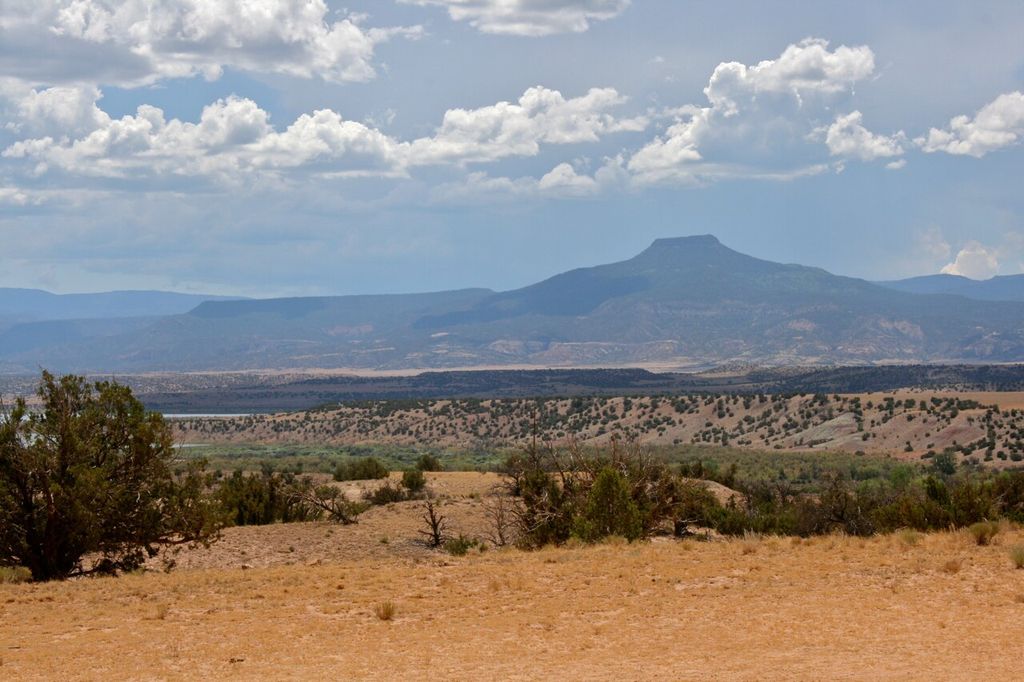
A narrow range of dark hills lies along the bottom edge. At the centre, the flat crest of Pedernal rises just enough to identify the profile. The mountain occupies a tiny fraction of the canvas, establishing a distant earth line beneath a vast field of blue-green evening sky.[1] The ladder floats above that horizon, slightly right of centre.
Its warm, light-brown rails tilt gently towards the right as they rise. Short crosspieces keep it legible as a handmade tool, but the rungs also establish a measured vertical rhythm against the softly modulated colour around them. Near the top is a white half-moon, displaced to the left of the ladder’s implied route.
The ladder therefore does not literally arrive at the moon. Its upper rails end in empty blue, while the moon remains still higher and laterally apart. Most of the picture is sky. Faint horizontal variations pass across it like veiled cloud, light or brushed atmosphere. They prevent the field from becoming a single flat colour, yet they offer no ordinary scale.
The ladder might be close to the viewer, immense over the land or reduced to a sign. The portrait format converts the canvas into an interval between ground and moon. The landscape is compressed downward; celestial space expands. O’Keeffe makes height visible by withholding the structures that ordinarily support ascent. Gravity is the painting’s central disturbance.
A ladder normally requires contact at both feet and pressure against a wall. Here the lower ends stop well above the mountain, and the top leans on nothing. The object retains the expectation of use while losing the mechanics that permit it. That removal creates suspension rather than flight. There is no figure climbing, no wind and no directional blur.
The ladder hangs as if a thought has been detached from the practical world but not altered beyond recognition. Its angle introduces uncertainty. A perfectly upright ladder could become an emblem; this one still remembers the lean of an object placed against a roof edge. O’Keeffe preserves enough asymmetry for the impossible image to remain grounded in observation.
Title, moon and Pedernal
The title is a short directional phrase rather than a description of location. “To” makes the moon a destination and the ladder a means, even before the viewer sees the image. The painting then frustrates the journey the words propose. There is no climber and no first step accessible from the ground. The object does not become a staircase; its narrow rungs still demand bodily balance and handwork.
Yet its destination belongs to a celestial distance that no wooden tool can cross. This tension keeps the title from becoming whimsy alone. A literal route is impossible, but the ordinary language of going “to” somewhere turns separation into imagined movement. The title activates the empty sky as potential space. The source of the wording is securely archival, appearing in gallery, notebook and later Whitney records.[1]
No public source identifies an earlier title or shows that the phrase was supplied by a critic. It should therefore be treated as part of the work’s established identity, while its poetic implications remain open. The title makes the moon the apparent destination, yet the composition resists a simple route. The rails do not touch the white form, and their projected line would pass to its right. The gap is as important as the ascent.
The moon is small, hard-edged and bright. It differs from the varied sky and softly shaded ladder. Its curved outer edge and straight inner edge read as a half-disc, but no documented day or lunar phase has been tied to the painting.[1] It can signify distance, time, transition or desire, but those meanings belong to interpretation. The catalogue records only what O’Keeffe saw: a high white moon in an evening sky.
Turning its shape into an exact astronomical observation would require a date and orientation that the public evidence does not supply. The visual paradox is productive. A ladder promises access; the offset moon withholds it. The painting does not show arrival but the human habit of imagining a route into what remains unreachable. At the bottom, the mountain gives the suspended object a geographical anchor.
Spanish speakers called the flat-topped formation Cerro Pedernal, after the flint associated with it. Museum place research identifies it as the westernmost part of the Jémez volcanic mountains, about 9,862 feet high and formed roughly 1.2 to 1.4 million years ago.[25] O’Keeffe painted its profile repeatedly from 1936 through 1958. The Ghost Ranch house offered an unobstructed southern view, and National Park Service research counts the mountain in twenty-nine drawings and paintings across those years.[4][5]
In Pedernal of 1945, CR 1117, a broad blue silhouette is framed by a much larger abstract red-and-blue form.[10] In Pedernal – From the Ranch II, CR 1334, painted in 1958, the mountain appears through an oval opening within a pale orange foreground shape.[11] Each work turns distance into a relation between a near form and the recognisable crest. CR 1335 reverses that strategy. Nothing physically frames the mountain.
Instead, the ladder occupies the enormous sky above it and makes the thin earth band seem even farther away. The catalogue also directs readers to CR 1337, an untitled Pedernal image of about 1958. That work is a small oil on unstretched canvas, approximately eight inches square, once given by O’Keeffe to Alexander and Susan Girard.[12] The cross-reference suggests a relevant neighbouring study, but the public record does not state that it is preparatory for Ladder to the Moon.
Tsí Pín and Tewa country
“Pedernal” is not the mountain’s only name. The Georgia O’Keeffe Museum’s Indigenous-co-curated exhibition Tewa Nangeh/Tewa Country identifies its Tewa name as Tsí Pín and places it within lands that have been home to Tewa people since time immemorial.[8] That correction matters because reproductions of O’Keeffe’s paintings have helped popularise an image of northern New Mexico as solitary and untouched. The land may appear unpopulated within this canvas, but absence of figures is a pictorial choice, not historical emptiness.
O’Keeffe’s affection for the mountain is well documented, as is her private language of possession. A modern account must hold that attachment beside the continuing Indigenous history and sovereignty that the possessive phrase obscures.[4][8] The distinction changes the picture without assigning it an invented message. Tsí Pín can be named, Tewa continuity acknowledged, and O’Keeffe’s view analysed without claiming that CR 1335 represents a Tewa belief.
The ladder and everyday use
At Ghost Ranch, the ladder was functional. The house had a flat roof, and National Park Service research records a ladder used by O’Keeffe to reach it. She and her guests watched stars from the roof and sometimes slept there; a recreated ladder now leans at the east side of the portal.[4]
Anita Pollitzer remembered being invited up to see a sky crowded with stars during a 1945 visit. The physical ascent therefore belonged to social life as well as solitary looking.[4] Maria Chabot’s archive contains 1944 photographs of O’Keeffe climbing a ladder in the Ghost Ranch patio.[6] Foundation photographs preserve other ladders against the studio and Abiquiú walls, sometimes casting shadows across adobe, sometimes surrounded by snow.[7]
This evidence prevents the floating object from being treated as a purely invented symbol. O’Keeffe knew its weight, spacing and bodily use. She could climb from enclosed patio to open roof, passing from architecture into sky. The painting removes the architecture while retaining that threshold function. The ladder becomes an extracted piece of the house: a built tool set between land and celestial space.
Photographs, memory and Ghost Ranch
The surviving photographs help establish material reality. Chabot’s 1944 sequence proves that O’Keeffe climbed from the patio, and later foundation images show the distinctive handmade form leaning against adobe.[6][7] They are invaluable records of use, scale and setting. They are not automatically preparatory photographs. No public catalogue note says O’Keeffe projected, squared or copied one of them for CR 1335.
The composition differs fundamentally from an architectural photograph because the supporting wall has disappeared and the ladder has been placed far above the horizon. Photography and painting instead preserve different kinds of evidence. The camera records body, wall and ladder together at a particular moment. The canvas isolates the remembered relation among ladder, mountain, moon and sky. Comparing them reveals selection rather than transcription.
O’Keeffe’s own statement remains the strongest source for genesis. It describes standing, looking, waiting and recognising. The image was prepared through repeated daily encounter before one evening supplied the final conjunction.[1] The Ghost Ranch dwelling is a U-shaped Pueblo Revival building arranged around a south-facing patio. Adobe and stucco walls, timber vigas, a flat roof and shaded portals establish its architectural language.
Pedernal is visible across the open side.[4] O’Keeffe first lived there seasonally in 1936 and bought the property in 1940. Even after renovating and settling at the larger Abiquiú house, she kept Ghost Ranch as a retreat. By the 1950s it was quieter and less productive than during the war years, but it remained inseparable from her visual identity.[4][5] The National Park Service nomination makes an important distinction: the house was built in a revival style, drawing on regional Hispanic and Pueblo forms.
The painting’s ladder belonged to that specific modern residence. Calling it simply a “Navajo ladder”, as popular accounts sometimes do, collapses different peoples, architectures and histories. The home’s details also show how O’Keeffe framed experience. Picture windows, patio openings and roof access created deliberate relations between interior space and land. Ladder to the Moon is a landscape painting in which one architectural component survives after the building disappears.
Pueblo ladders and interpretive caution
Ladders do carry important meanings within diverse Pueblo contexts. National Park Service interpretation at Pecos explains that roof openings and ladders provide access to kivas. The floor opening, room and roof can relate to emergence, this world and what lies above, while each community maintains its own ceremonial knowledge.[9]
That context helps explain why a ladder rising through an adobe settlement cannot be treated as culturally neutral. It does not prove that O’Keeffe encoded one universal Pueblo cosmology in CR 1335. Her own origin account mentions the Ranch house, a friend, the mountain, the colour of evening and the moon. It does not cite a kiva, ceremony or Indigenous story.[1]
Interpretation should begin there. A viewer may see ascent between worlds, spiritual passage or emergence. Those are possible responses. They become historical claims only if evidence connects O’Keeffe’s specific decisions to the living traditions from which such ideas come. No such object-specific document has been found in the locked sources.
From observation to impossible image
O’Keeffe described standing against the strong handmade ladder while waiting for a friend. Looking towards Pedernal, she registered a pale greenish-blue sky and high white moon; the ladder, mountain and moon suddenly seemed ready for painting the next day.[1] Her description is striking for its speed. The motif had remained in mind for a long time, but one evening organised it. Long incubation and rapid recognition are both part of the process. The canvas is not a transcript of the view. In ordinary space, the ladder leaned against the house and the viewer stood beside it.
O’Keeffe omitted wall, portal and roof, raised the ladder free of the ground and separated it from the moon. Memory and design converted coexistence into suspension. The missing friend is equally suggestive. The social act of waiting generated an image with no person in it. The viewer occupies that waiting position, looking across a place in which arrival has not yet happened.
The painting within 1958
O’Keeffe was seventy when she made the painting. In February 1958 she visited her sister in Palm Beach, then travelled to New York to install an exhibition of her 1916–17 watercolours at the Downtown Gallery. She returned to Abiquiú in April.[5] The chronology is sparse for the remainder of the year, and the painting should not be forced into an undocumented crisis. It emerged after extensive travel in Europe, Peru and Mexico and before the 1959 journey through Asia, India, the Middle East and Italy that stimulated aerial views.[5]
At Ghost Ranch she had already spent two decades painting cliffs, bones, patio spaces, moon, sky and Pedernal. CR 1335 is late within that local sequence, but it is not a withdrawal from experiment. Its radical emptiness and suspension anticipate the spatial simplifications that remained important in the 1960s. The NPS study describes it as a surprising return to an object that had stood at the portal for years.[4] Familiarity, rather than exotic novelty, produced the strange image.
Randall C. Griffin’s 2025 study Georgia O’Keeffe: The Late Work includes Ladder to the Moon within a reassessment of the neglected postwar decades.[27] Its larger argument situates O’Keeffe’s later images amid postwar debates about abstraction, spirituality, ecology, race and Indigeneity. That frame supports reading CR 1335 as part of an ambitious late practice rather than an isolated popular emblem, while the object’s particular meanings must still rest on its own archival and material record.

Material evidence and technical limits
The catalogues identify oil on canvas. The Whitney supplies the exact overall dimensions and includes the work’s frame or attached components in accession number 2024.198a-b.[1][2] The 1999 catalogue raisonné could not access the stretcher or verso.[1] No public object record states the canvas weave, ground, pigments, binding medium, underdrawing, revision sequence, varnish, condition or treatment history. Visual description must remain distinct from chemistry.
“Turquoise” and “teal” describe perceived colour; they do not identify a pigment. Soft horizontal transitions can be discussed as painted effects, but they do not establish glazing or wet-in-wet procedure. CR 1117 has a detailed conservation entry identifying pastel materials and intentional sketch lines.[10] Those findings demonstrate the value of object-specific study, not a licence to transfer technique from a 1945 pastel to a 1958 oil.
Debut, criticism and widening exhibition history
The first recorded exhibition was Georgia O’Keeffe: Recent Paintings and Drawings at the Downtown Gallery in spring 1961.[1][5] It was O’Keeffe’s final show at the gallery, and she helped organise and install it. A contemporary New Yorker review recognised a marked movement towards simplification. It described the painting as nearing pure abstraction and compared its territory to contemporary geometric work, while also judging O’Keeffe’s recent art through a contrast between classical control, romance and sensuality.[14]
The review is valuable because it shows that the floating ladder did not enter criticism as a sealed timeless icon. It was measured against 1961 abstraction and the work of living contemporaries. The critic’s comparisons are period reception, not proof of influence. The critic also saw a contradiction that later admiration can conceal. Severe drawing and clear colour suggested control, while the suspended subject produced romance and sensual intensity.[14]
That early response helps explain why the painting resists one stylistic label: its geometry is strict, but its spatial premise is emotionally charged. The painting then appeared in the 1966 retrospective at the Amon Carter Museum of Western Art. That exhibition surveyed work from 1915 to 1966, placing CR 1335 inside the full arc of her career rather than treating it as an isolated fantasy.[1][5] The 1993–94 Georgia O’Keeffe: American & Modern tour carried the painting from London’s Hayward Gallery to Mexico City’s Museo del Palacio de Bellas Artes and then to Yokohama.[1]
This was a genuinely transnational reception, not merely a reproduction circulating abroad. In 1999–2000, Georgia O’Keeffe: The Poetry of Things travelled among the O’Keeffe Museum, Dallas Museum of Art, Phillips Collection and Fine Arts Museums of San Francisco. The Phillips archive preserves a dedicated object-research file for Ladder to the Moon, evidence of the scholarship assembled around the loan even though the file itself is not digitised.[16][24] The 2021–22 retrospective joined Spanish, French and German-language institutional frames.
It opened at the Museo Nacional Thyssen-Bornemisza, moved to the Centre Pompidou and ended at the Fondation Beyeler in Riehen.[1][17][18][19] Each venue positioned O’Keeffe beyond a narrow flower-painter reputation, within abstraction, landscape and modernism. A 2025 reference enquiry at the National Museum of Modern Art, Tokyo, supplied Japanese readers with the title Tsuki e no hashigo, the catalogue raisonné entry and a Japanese-language O’Keeffe volume; its 2026 update also records the Whitney as owner.[28] This modest library record documents another form of international access beyond exhibition touring.
At the Whitney, the work appeared in Legacy: The Emily Fisher Landau Collection, Singular Visions and later collection displays.[2][22] The museum called it one of O’Keeffe’s most Surreal and dreamlike canvases, a useful description of effect that should not be converted into membership of the Surrealist movement.[13]
From O’Keeffe’s wall to the Whitney
O’Keeffe retained the painting during her lifetime. A recollection published by El Palacio reports that although she changed the pictures displayed in her living room, Ladder to the Moon remained on the wall.[15] This is remembered testimony, not a complete installation log, but it suggests unusual personal attachment. After her death, Emily Fisher Landau acquired the work from the O’Keeffe estate.[1] Landau displayed her collection through a Long Island City centre devoted to exhibition and study. In 2010 she pledged more than four hundred works to the Whitney, creating one of the museum’s largest gifts.[22][23] For years CR 1335 was accordingly described as a promised gift.
The current records now establish completed transfer: in 2024 it entered the Whitney collection as accession 2024.198a-b.[1][2] Access O’Keeffe records verification by the current collection on 15 September 2025 and a core-field update on 26 August 2026, strengthening the status of that revised provenance.[1] That change is consequential. A privately owned painting with substantial loan history is now held by a public museum with a permanent catalogue record. It is not currently shown at the Whitney, but ownership, conservation responsibility and future access are institutionally secured.[2]
Scale, distance and architecture
At just over one metre high, the canvas has bodily presence. It is large enough for the ladder to confront a standing viewer, yet far smaller than the working object represented. O’Keeffe therefore compresses a usable structure while giving the sky most of the wall space. Reproduction tends to reverse that balance. On a screen the ladder may look like a small icon, and the subtle variation within the blue-green field can flatten into uniform colour.
The original dimensions make emptiness physical: the viewer’s eye must travel upward through a sustained expanse before reaching the moon. The dark land is correspondingly low. Its narrowness is not the effect of a conventional distant panorama alone; it is a deliberate redistribution of the canvas towards atmosphere. Pedernal remains identifiable while surrendering pictorial dominance to the interval above it.
This scale relationship supports both architectural and metaphorical readings. The painted ladder is too small to use and too large to dismiss as a distant detail. It occupies the threshold between object, sign and imagined route. As of September 2026, Ladder to the Moon is on loan to the Detroit Institute of Arts for Georgia O’Keeffe: Architecture.
The exhibition, open from 11 September 2026 to 3 January 2027, is the first museum survey devoted to her sustained engagement with built environments.[20][21][26] The inclusion is revealing. Although the house has vanished from the canvas, the ladder remains a fragment of architecture and a device for inhabiting it. A current review reports that the painting closes the exhibition in a darkened corridor after sections devoted to New York, rural buildings and New Mexico adobe.[26]
The curatorial frame shifts attention from mystical ascent alone to the relation between a tool, a roof, a patio and a landscape. The impossible suspension began with a building. The object’s current movement also demonstrates the practical effect of the Whitney gift. CR 1335 can enter a new scholarly argument while retaining a stable public owner and accession.
Competing interpretations
A biographical reading treats the ladder as an image of transition in O’Keeffe’s later life. Its separated ends, half-moon and evening light can support thoughts of ageing or mortality. Nothing in her recorded origin story explicitly makes it a self-portrait or farewell. A spiritual reading sees ascent between earthly and celestial realms. It responds to the ladder’s ancient symbolic potential but must avoid borrowing specific Pueblo meanings without evidence. A formalist reading emphasises the small warm grid against an immense cool field. Repeated rungs measure space while the horizon and moon provide two remote anchors. The image approaches abstraction without surrendering named things.
An architectural reading begins with roof access. O’Keeffe removes the adobe wall but keeps the tool that joined patio and rooftop. This interpretation has the strongest material documentation and explains why the object can be ordinary and uncanny at once. A Surrealist reading stresses impossible scale and levitation. The Whitney has used “surreal” and “dreamlike” descriptively.[13] O’Keeffe’s own account, however, grounds the image in conscious observation and next-day work rather than dream transcription. These readings can coexist if their evidential status stays clear. The painting encourages metaphor; the archive limits claims about intention.
Limits of the record
The public record does not name the friend O’Keeffe awaited or the exact evening. It does not establish the astronomical date, actual lunar phase, duration of painting or whether drawings preceded the canvas. No accessible technical report identifies pigments, preparation, revisions, surface coating, original frame or treatment. Stretcher and verso evidence remains unpublished.[1]
The relationship of CR 1337 to the finished composition is not explained beyond a catalogue cross-reference. The cultural meaning of the ladder for O’Keeffe cannot be expanded beyond her statement without additional evidence. Even the familiar photograph comparison requires care. Archive images prove that she climbed and lived with ladders; they do not show that one particular photograph served as a direct template.
Close looking and significance
Start with the earth. The dark strip is extremely shallow, and Pedernal’s central crest is small. Notice how little landscape O’Keeffe needs to establish a vast distance. Then follow the ladder from its unsupported feet. Count the pauses created by the rungs without turning their number into a code. Watch the slight rightward lean preserve a memory of physical use. Project the rails upward. They do not meet the moon. Attend to the blue interval between them and to the moon’s offset position. Finally imagine the omitted wall and roof.
Restoring them mentally makes the source ordinary; removing them again reveals how exact O’Keeffe’s transformation was. Ladder to the Moon demonstrates O’Keeffe’s ability to make an extraordinary image without abandoning the facts of a place. Ladder, evening colour, moon and mountain were observed. Levitation, scale and isolation were composed.
Its history joins three kinds of space: the practical architecture of Ghost Ranch, the painted expanse between Tsí Pín and the moon, and the museum settings through which the work has been interpreted. Each changes the meaning of ascent. The current record also revises familiar captions. The work is no longer simply in the Emily Fisher Landau Collection or a promised Whitney gift.
It has been accessioned by the Whitney and is presently participating in a new architectural reading in Detroit.[2][20][26] The image remains open because its ladder is incomplete as a route. It begins nowhere visible and ends before its apparent destination. O’Keeffe turned a tool for reaching a flat roof into a measure of the distance between use and imagination.
Discussion
Which piece of evidence most changes the way you read Ladder to the Moon?
Reader Insights
Which visible detail most changes your reading of Ladder to the Moon?
How do medium, setting and documented history shape the encounter?
What remains uncertain when documented fact is separated from interpretation?
Join the Conversation
Share your reading of Ladder to the Moon below.
References
- Georgia O’Keeffe Museum, Access O’Keeffe, “Ladder to the Moon, 1958,” CR 1335, View Source.
- Whitney Museum of American Art, “Georgia O’Keeffe: Ladder to the Moon,” View Source.
- Smithsonian Institution Research Information System, “Ladder to the Moon,” View Source.
- National Park Service and New Mexico Historic Preservation Division, “Georgia O’Keeffe Ghost Ranch House,” National Register of Historic Places Registration Form, View Source.
- Georgia O’Keeffe Museum, Access O’Keeffe chronology, View Source.
- Georgia O’Keeffe Museum, Access O’Keeffe, “Maria Chabot Archive,” View Source.
- Georgia O’Keeffe Museum, Access O’Keeffe, “Georgia O’Keeffe Foundation Photographs,” View Source.
- Georgia O’Keeffe Museum, “Georgia O’Keeffe Museum Announces ‘Tewa Nangeh/Tewa Country’,” 15 July 2025, View Source.
- National Park Service, Pecos National Historical Park, “Ancestral Sites Tour — Pueblo Ceremonial Room,” View Source.
- Georgia O’Keeffe Museum, Access O’Keeffe, “Pedernal, 1945,” CR 1117, View Source.
- Georgia O’Keeffe Museum, Access O’Keeffe, “Pedernal – From the Ranch II, 1958,” CR 1334, View Source.
- Christie’s, “Georgia O’Keeffe, Untitled (Pedernal),” c.1958, CR 1337, View Source.
- Whitney Museum of American Art, “Singular Visions,” press release, View Source.
- The New Yorker, “Old and New,” 22 April 1961, View Source.
- El Palacio, “An O’Keeffe Odyssey,” 2018, View Source.
- The Phillips Collection, Georgia O’Keeffe: The Poetry of Things exhibition records, View Source.
- Museo Nacional Thyssen-Bornemisza, “Georgia O’Keeffe,” 2021, View Source.
- Centre Pompidou, “Georgia O’Keeffe,” 2021, View Source.
- Fondation Beyeler, “Georgia O’Keeffe,” 2022, View Source.
- Detroit Institute of Arts, “Georgia O’Keeffe: Architecture,” View Source.
- Detroit Institute of Arts, “Detroit Institute of Arts Presents ‘Georgia O’Keeffe: Architecture’,” 8 July 2026, updated 8 September 2026, View Source.
- Whitney Museum of American Art, “Legacy: The Emily Fisher Landau Collection,” View Source.
- Fisher Landau Center for Art, “History of the Center and the Collection,” View Source.
- Georgia O’Keeffe Museum, Access O’Keeffe, Georgia O’Keeffe Papers, “‘Ladder to the Moon’” publication file, View Source.
- Georgia O’Keeffe Museum, “Road Trip: Abiquiú to Ghost Ranch,” View Source.
- Wallpaper, “Georgia O’Keeffe was captivated by architecture, as a landmark new show at the Detroit Institute of Arts proves,” 11 September 2026, View Source.
- Randall C. Griffin, Georgia O’Keeffe: The Late Work, Yale University Press, 2025, A&AePortal, View Source.
- National Diet Library Collaborative Reference Database, National Museum of Modern Art, Tokyo Art Library, “ジョージア・オキーフの、宙に浮かぶはしごを描いた作品があると聞いた。図版を見たい。”, updated 9 June 2026, View Source.