


 by Tom Gurney
Tom Gurney BSc (Hons) is an art history expert with over 20 years experience
Page Created on September 22, 2026 / Page Updated on September 22, 2026
Email: tomgurney1@gmail.com / Phone: +44 7429 011000
Introduction
Georgia O’Keeffe’s drawings are not a minor archive behind the paintings. They include finished abstractions, serial experiments, observed studies, portraits, landscapes, travel impressions and late reconsiderations. Charcoal could cover a large sheet with dense black, be dragged into a grey veil, lifted by erasure or narrowed to a line. Graphite could record a leaf with economy; pastel and watercolour joined drawing to colour; felt-tip pen offered a different late directness.
The scale of the practice is easy to miss because works on paper are light-sensitive and are exhibited in rotations. Access O’Keeffe now links the catalogue raisonné with updated records from institutional owners, making paper, inscriptions, provenance and variant titles more visible.[1] The resulting history changes the familiar story. Drawing did not simply prepare O’Keeffe to become a painter. It was a way of thinking that began before her public career and remained active into her final decade.
When Access O’Keeffe formally launched in March 2026, its searchable corpus exceeded 2,200 artworks and joined object records to visual descriptions, archives and exhibition histories.[33] That figure is larger than the 2,029 numbers in the 1999 catalogue because the digital project can add and revise records. Public collections were contacted for updated data during 2023–25; many privately held works still rely on the printed research.[1] For drawings, whose owners, titles and approximate dates can be especially difficult to trace, the distinction prevents a new database from appearing falsely complete.
At a Glance
- ArtistGeorgia O’Keeffe
- SubjectGeorgia O’Keeffe Drawings
- Artistic contextAmerican modernism
- Art formDrawing
Contents
- What drawing meant to O’Keeffe
- Training, teaching and the Specials
- Charcoal, line and mass
- No. 2-Special and Drawing XIII
- Erasure, paper and evidence
- Paper choice and serial difference
- Graphite after the breakthrough
- Leaves and corrected classifications
- Pastel and watercolour
- Travel, seeing and Drawing X
- Drawing I and unsettled locations
- Memory, reproduction and original sheets
- Exhibitions and the drawing canon
- Late trees and same-title cautions
- Late subjects and photographic portraiture
- Conservation and mounting histories
- Catalogue, provenance and international reception
- Late drawing and close looking
What drawing meant to O’Keeffe
For O’Keeffe, drawing could be academic training, observation, invention or a complete work. Those functions overlap but should not be confused. A classroom study made to demonstrate modelling answers a different demand from a 1915 charcoal abstraction. A small sketch made through an aircraft window records an immediate relation; a large charcoal developed after landing rebuilds that relation at bodily scale.
MoMA’s 2023 exhibition To See Takes Time reunited sequences normally separated among collections. It showed that O’Keeffe repeated and transformed motifs across charcoal, pencil, watercolour and pastel, with works on paper sometimes leading to paintings and sometimes remaining autonomous.[3] Between 1915 and 1918 she made approximately as many paper works as she would during the next four decades. That concentration was a laboratory, but calling it merely preparatory understates its achievement.
Training, teaching and the Specials
O’Keeffe learned drawing within systems that valued proportion, contour, modelling and observation. Study at the School of the Art Institute of Chicago and the Art Students League enabled her to work convincingly within academic expectations. She later taught drawing and design, which required her to analyse how form could be communicated to students.[2] Her dissatisfaction was therefore not a rejection born of technical inability. Arthur Wesley Dow’s emphasis on line, tonal mass and compositional relation helped her imagine another use for the skills she possessed.
The 1915 restart involved limiting herself, temporarily setting colour aside and asking which black-and-white forms felt necessary. O’Keeffe’s years as an art educator matter to the drawings. She was not only absorbing Dow-derived principles; she was teaching line, design and visual order to other people. An exercise can therefore have two lives: as a repeatable pedagogical structure and as the basis from which an artist makes a singular work. The early abstractions should not be reduced to classroom products.
Their large scale, tonal density and sustained sequences exceed a demonstration of balance. Yet their discipline is easier to understand when placed beside teaching. O’Keeffe knew how rules organised looking and could decide when to narrow, intensify or refuse them. This context also qualifies the romance of isolation. The sheets emerged from correspondence with Pollitzer, encounters with modern art, paid teaching and a network of women trained at Teachers College.
Personal language developed within institutions and friendships, even when O’Keeffe described the process as a private beginning. The charcoal sheets O’Keeffe called Specials are often described as spontaneous expressions. Their force is real, but spontaneity should not obscure construction. She chose paper, orientation and scale, built tones by pressure and rubbing, and used erasure as an active light.
Boundaries are softened, repeated or made abrupt. Black is a material range rather than one value. The forms resist stable naming. They can recall water, smoke, plants, bodily interiors, hills or music without illustrating any of them directly. MoMA’s account positions this uncertainty between the objective and abstract, while the Whitney’s 2009 survey restored these sheets to the history of early American abstraction.[4][15]
Charcoal, line and mass
Charcoal is often discussed as if it produced only a black outline. O’Keeffe used it as line, broad band, haze, boundary and field. The side of a stick can cover paper quickly; a point can establish a narrow edge; fingers, cloth or stump can disperse particles; erasure can reopen the support. Fixative may stabilise a surface while changing its saturation.
Surviving studio materials make this range more exact. MoMA’s paper conservator identified both splintery, powdery vine charcoal and manufactured sticks available in different hardnesses; pressure, repeated strokes and blending produced warm and cool blacks as well as grey transitions.[34] O’Keeffe likewise kept pastels from several makers because differing pigment-to-binder ratios altered hardness and brilliance, and she sometimes enlarged a pastel stick to cover more area. Material choice was therefore already compositional: the implement, support and desired scale were selected in relation to one another.
These possibilities let one material move between graphic certainty and atmospheric ambiguity. A dark zone can feel dense without being modelled as a solid object. A taper can imply speed, growth or recession. The paper’s untouched area can act as illumination or as a pause between forms. Scale makes the process physical.
Many early sheets are roughly two feet high, larger than a notebook page and close to the reach of an arm. Their curves are gestures constrained by an edge. Looking only at a thumbnail suppresses pressure, grain and the bodily distance from which they were made. O’Keeffe sent works to her friend Anita Pollitzer in New York.
Pollitzer brought them to Alfred Stieglitz at 291 on New Year’s Day 1916, against O’Keeffe’s instruction not to show them. Stieglitz’s response and exhibition of drawings that May changed their public history.[2][11] Pollitzer’s act was decisive, but the drawings existed before his recognition; discovery should not be confused with creation.
No. 2-Special and Drawing XIII
The legacy page calls this work Drawing No. 2 – Special. The National Gallery’s current preferred title is No. 2-Special. It dates to 1915 and is catalogue raisonné number 45.[8] The distinction may look small, yet accurate wording keeps this object separate from other numbered drawings and later editorial conventions. The sheet is charcoal on Fabriano laid paper, approximately 60 by 46 centimetres.
The National Gallery records an INGRES PMF (ITALIA) watermark. Dark curved forms, veils and a framing border demonstrate how the paper’s surface and the removal of charcoal create light. It was included in the 1916 group exhibition at 291, later passed through O’Keeffe’s estate and Foundation, and entered the National Gallery in 1992.[8] The work is often read as dream-like or organic. Those associations describe a viewer’s recognition, not a decoded subject.
Its more secure history lies in material, sequence and display: a large finished sheet from the 1915 experiment that entered public view before O’Keeffe moved to New York. Drawing XIII is one of the best-known early charcoals, but even its date is not entirely stable. The Metropolitan Museum’s current object record gives 1916–17 and identifies the medium as charcoal with erasing on paper.[10]
The Met’s 1984 Bulletin reproduced it as a 1915 work and connected it with the group Pollitzer took to Stieglitz at the start of 1916.[11] The legacy URL also fixes 1915. A responsible account preserves that discrepancy. The sheet’s catalogue and archival histories have been revised, and a website should not silently make one date appear uncontested. The Met describes three parallel zones: flowing or flame-like lines, rounded forms and a jagged passage sharpened by erasure.
Such descriptions are invitations to look, not evidence that the drawing literally depicts river, trees and lightning. The work entered the Met as part of the Alfred Stieglitz Collection in 1950. Its movement from Pollitzer’s private presentation, through 291 and Stieglitz’s holdings, into a major museum helped make early O’Keeffe synonymous with the charcoal abstractions. The museum’s German-language overview places it within her broader movement from training to modernism, demonstrating how the same object mediates international accounts of American art.[12]
Erasure, paper and evidence
Erasure in these works is not simply correction. It can cut a light edge into charcoal, separate overlapping masses or create a halo that would be difficult to obtain by leaving the paper untouched. A rubbed passage may retain grey residue; a harder erasure can return towards the support’s colour. This makes technical language important.
“Charcoal with erasing” describes a process, while “charcoal on paper” can conceal it. Yet visible light areas cannot all be assigned to one tool without examination. Paper tone, pressure, rubbing, fixative, mounting and later surface change also affect the appearance. The Georgia O’Keeffe Paper Survey Research collection documents a major study by Barbara Buhler Lynes and paper conservator Judith Walsh.
They recorded dimensions, colour, texture, thickness, paper type and watermarks across artworks, correspondence sheets and unused studio material.[13] Their findings helped identify and date works for the catalogue raisonné. This evidence explains why “charcoal on paper” is incomplete. Laid and wove papers receive material differently. Smoothness affects the continuity of graphite; tooth holds charcoal or pastel; a coloured sheet supplies an active middle tone.
Watermarks can connect otherwise uncertain sheets, while pinholes, deckled edges, mounts and inscriptions can preserve use and provenance. The National Gallery’s Untitled (Abstraction), for example, is charcoal on laid paper, carries a Strathmore blind stamp and has an inscription identifying it as early.[9] None of those details provides a full interpretation. Together they establish a physical history that reproduction removes.
Paper choice and serial difference
O’Keeffe did not reserve one prestigious support for finished drawings and another for casual work. Fabriano laid sheets, Strathmore papers, newsprint, coloured wove paper, sketchbook leaves and ruled stationery appear across the record. Availability, desired surface and situation all mattered. The variety prevents a simple hierarchy. Newsprint can carry a resolved botanical study even though it is cheap and chemically unstable.
A felt-tip drawing on ruled green paper can be catalogued as a finished work. Conversely, expensive or watermarked paper does not by itself prove that every mark was intended for exhibition. Mounting changes this evidence. Laying a thin sheet onto card can protect it, flatten it or conceal its reverse. Old adhesives can stain.
Removing a mount may reveal inscriptions but risks damage. Paper conservators therefore treat the support, attachment and mark as one material system.[13][24] Numbered titles are especially vulnerable to confusion. Drawing I, Drawing X, Drawing XIII, No. 2-Special and No. 12 Special belong to different moments or naming systems. Roman numerals do not automatically place every sheet in one continuous sequence.
Serial practice asks the viewer to compare. A curve may be repeated at a different pressure; a horizontal sheet may become vertical; an interior space may close; a tonal mass may be replaced with a line. The meaning lies partly in the difference between attempts. MoMA’s exhibition used this comparative method rather than presenting each sheet as a solitary icon.[3]
Graphite after the breakthrough
After O’Keeffe turned more heavily to oil, drawing did not vanish. Works on paper returned around flowers, portraits, shells, bones, buildings and landscape. The National Gallery’s 2000 survey selected fifty-two works in watercolour, pastel and charcoal spanning the 1910s through the 1950s.[7] Some sheets test motifs later developed elsewhere; others compress an object into a complete statement. The Shell uses charcoal to move from the object’s outer plane into a dark spiral.
Flower drawings can isolate contour or growth without the colour saturation for which the paintings are known. Portraits on paper show a part of the practice obscured by the public focus on flowers and desert. Portrait drawing is especially useful for correcting the idea that O’Keeffe’s paper practice was only abstract or botanical. A head, sleeping figure or hand introduces weight, posture and the ethics of looking at another person. Some later recollections identify subjects that earlier catalogues left ambiguous, but those statements must be dated and compared with the sheet rather than treated as timeless labels.
Architecture also entered drawing through windows, doors, bridges and walls. Pencil can establish proportion with very little shading; charcoal can turn an opening into a near-absolute dark. Such sheets connect the built environment of New York, Lake George and New Mexico without claiming that the places are culturally equivalent. The relation to painting is therefore reciprocal. Drawing can precede, accompany or follow a canvas.
It can also solve a problem that paint would make heavier. The absence of colour may focus weight, interval and edge. Graphite permits a different kind of movement from charcoal. A line can remain thin, shift through pressure or accumulate as hatching. It is well suited to travel notes and to the observation of leaves, roads and architecture, but O’Keeffe did not use it only for quick notation.
Access O’Keeffe’s Untitled (Leaf), dated approximately 1930–36, is graphite on thin beige newsprint. Its title comes from the image, and it is absent from the Whitney Archive, Downtown Gallery Archive and Abiquiú Notebooks.[19] That record is valuable because it states what is not known. A descriptive title supplied through cataloguing should not be mistaken for the artist’s documented wording.
Untitled (Ghost Ranch Patio) (about 1940; CR 1000) demonstrates how much architectural information a small sheet could hold. On nine-by-six-inch smooth white wove paper, O’Keeffe used graphite to place a screen door, five vigas, a canale and a boot scraper within one vertical study. Four punched holes at the upper edge retain the sheet’s working history. The title is later and relational, based on comparison with catalogue numbers 985 and 986 rather than a contemporary inscription, so subject identification is strong while artist-given naming remains unproved.[36]
An earlier double-sided object makes the boundary between drawing and painting equally unstable. The verso of the 1914 oil Untitled (Horse) is CR 43, an oil-and-graphite sketch of the recto’s toy horse and plate, with scattered colour trials across the cardboard. Because the two catalogue entries describe one physical support, they should be studied together. The object records O’Keeffe revisiting an arrangement through line and paint rather than producing an independent finished drawing on a fresh sheet.[37][38]
Leaves and corrected classifications
A Long Leaf (from My Sketch Book) is a modest graphite work, not one of the monumental early charcoals. Sotheby’s records pencil on paper laid down on card, approximately 22.9 by 15.2 centimetres, executed about 1940 and published as catalogue raisonné number 1003.[20] The visible sketchbook perforations belong to the object’s use. They show that the sheet was once part of a bound working group before mounting.
O’Keeffe gave it to its later owner in 1984, and it appeared in the 2020 Passage sale. Auction evidence is useful here for dimensions and provenance, but estimate and price do not establish artistic importance. The drawing’s economy makes enlargement unnecessary. A few changes in pressure establish the leaf’s length and turn. Its intimacy provides a counterweight to the claim that O’Keeffe’s importance always depends on magnification.
The absorbed legacy page places Leaves of a Plant among drawings. Access O’Keeffe identifies it as an oil painting on canvas, 40 by 30 inches, catalogue raisonné number 1038.[16] It therefore belongs in this manuscript only to correct the inherited classification and to show why titles or web groupings cannot substitute for catalogue evidence. The catalogue date is 1942, based on its inclusion in the 1943 An American Place exhibition, although backing inscriptions include 1943 and other later suggestions.
The preferred title is supported by the Whitney Archive, Downtown Gallery Archive, Abiquiú Notebooks, exhibition checklist and backing inscription.[16] Its narrow green leaves and red centre resemble a bromeliad and relate to O’Keeffe’s Hawaiian botanical experience, but the object is not a graphite or charcoal study. The redirect must preserve useful subject information while refusing to repeat the medium error.
Pastel and watercolour
Pastel complicates the boundary between drawing and painting. Sticks deposit dry pigment with little binder, allowing saturated colour and soft transitions, but the surface remains friable. Rubbing, pressure and the tooth of the support determine whether a passage appears dense, granular or translucent. A Smithsonian and Library of Congress study of the 1915 Special No. 32 used non-invasive X-ray fluorescence and a minute sample for X-ray diffraction.
Researchers identified lead- and chromium-based possibilities and confirmed red lead in a darkened coral-red area.[14] The study matters because today’s mottled colour may reflect alteration rather than deliberate dark pastel. This is an object-specific result, not a licence to reinterpret every O’Keeffe pastel. It does demonstrate that colour history is material history. Light, humidity, pollution, pigment manufacture and the minimal binder of pastel can alter what viewers see.
Watercolour allowed O’Keeffe to stain paper, layer transparent colour and work rapidly through changing light. Texas plains, evening stars and sunrise sequences use repetition to record movement without conventional narrative. A small shift of a disc or band can imply time passing. MoMA’s To See Takes Time placed these progressions beside charcoal series to show that her method was not medium-specific.[3]
Watercolour’s absorption makes decisions difficult to reverse, but it also permits luminosity from the paper. Mounting and exposure histories therefore matter to present colour. This page keeps watercolour within drawing’s expanded field while the dedicated watercolours manuscript treats the medium in full. The distinction is editorial, not a claim that O’Keeffe observed rigid modern museum departments.
Travel, seeing and Drawing X
Travel placed limits on time, paper and viewpoint. A sketch from a moving vehicle or aircraft is necessarily selective. It may register only a bend, horizon or cluster of forms. Back in the studio, O’Keeffe could enlarge that fragment, change its orientation or translate it into another medium. This interval matters to claims of realism.
The later charcoal is not a literal trace of the view at one second. It is a reconstruction built from notes and memory. Yet that does not make its source fictitious. O’Keeffe’s aerial drawings demonstrate how observation persists after place names and ordinary scale disappear. International travel also complicates the story that New Mexico contained her mature vision.
Rivers, deserts and forms observed across Asia, the Middle East and elsewhere entered a practice that remained mobile. Drawing was particularly suited to that mobility because paper could travel and a motif could be resumed after return.[4] Drawing X is a 1959 charcoal in MoMA’s collection, measuring approximately 63.2 by 47.3 centimetres.[5]
It grew from O’Keeffe’s international travel and the rivers she observed from aircraft. Small notes made while flying were later reconsidered in broad black bands. The result can look non-objective, yet O’Keeffe insisted that the aerial drawings were realistic to her because they came from what she saw.[4] Her statement should not settle the classification so much as expose its limits.
A river viewed from high altitude already appears as a moving line detached from ordinary scale; drawing intensifies that condition. MoMA’s 2023 research calls the sheet a key instance of the subtle relation between representation and abstraction.[6] It also belongs to a history longer than the flight itself: the same artist who used charcoal in 1915 to clarify intangible form returned more than forty years later to transform an observed landscape.
Drawing I and unsettled locations
Drawing I also dates to 1959, but it is a distinct charcoal, approximately 63.2 by 47.6 centimetres, catalogue raisonné Appendix II number 130.[17] Access O’Keeffe lists its current status or location as unknown. The record traces it from the artist to a later owner and a 2015 Christie’s sale, and it was included in To See Takes Time in 2023. The uncertainty should remain visible.
An exhibition can borrow a work whose later location is not publicly recorded; “unknown” does not mean lost or inauthentic. It means that the accessible catalogue does not name a current holder. Because Drawing I and Drawing X share year, medium and approximate scale, they invite comparison. They should not be merged, and the numeral alone does not prove exact serial order or shared subject without further evidence.
Their later histories differ as well. Drawing X entered MoMA in 1972 through an exchange gift connected with Abby Aldrich Rockefeller and has a stable public object number.[5] Drawing I circulated privately and now has an unknown public location.[17] Canonical visibility can therefore depend on custody as much as quality: a museum work is photographed, catalogued and installed repeatedly, while a private sheet can disappear from view between loans and sales.
Memory, reproduction and original sheets
Some Memories of Drawings is not a single drawing. It names a late publication project through which O’Keeffe selected and reinterpreted earlier work. A 1968 Atlantis Editions portfolio reproduced ten drawings in 300-line screen offset lithography; O’Keeffe worked on proofs and authorised changes in scale, tonality and composition.[21] The expanded 1974 project paired reproductions with O’Keeffe’s written recollections, edited by Doris Bry.
Later editions, including the University of New Mexico Press volume catalogued by the New York Public Library, carried that retrospective account to a wider readership.[22] These texts are precious evidence of how O’Keeffe wanted the drawings understood late in life. They are not transcripts of what she thought in 1915. Memory, publication design, reproduction and decades of criticism stand between event and account.
The portfolio also makes a drawing into another object: different paper, printing process, edition and scale. Drawing is especially altered by reproduction. Charcoal’s velvety accumulation can become flat black; paper tone may be whitened; scale shrinks to a page; deckles, inscriptions and mounts disappear. Even a careful facsimile cannot reproduce the adhesion of particles or the relation of mark to paper fibre.
O’Keeffe’s active role in the Atlantis proofs means the prints are authorised works with their own history, rather than neutral substitutes. The distinction between original sheet, reproductive print and later book illustration must be maintained in captions and provenance. The programme remains text-only because the works are copyright restricted. The Museum’s rights guidance requires separate permission for commercial reproduction, and Access O’Keeffe’s downloadable images carry limits against cropping, colour change and other alteration.[32]
Exhibitions and the drawing canon
Exhibition history determines which drawings become representative. The 1916 display at 291 established No. 2-Special within O’Keeffe’s origin story. Stieglitz’s later annual exhibitions mixed media under his framing. Museum surveys in 1987, 2000, 2009 and 2023 selected different sequences and thereby proposed different careers.[7][15][30]
The 2000 National Gallery exhibition coincided with publication of the catalogue raisonné and stressed technical virtuosity across watercolour, pastel and charcoal. The 2009 Whitney project argued for O’Keeffe’s place among early American abstractionists. MoMA in 2023 focused on time, repetition and paper itself.
None is a neutral container; each is a historical argument. Works unable to travel because of condition, private ownership or light exposure can fall outside those arguments. A checklist should therefore not be mistaken for the entire surviving practice. Conservation limits and loan availability shape art history.
Late trees and same-title cautions
The catalogue contains more than one work that can be called Untitled (Trees). The museum-owned record relevant here is a 1976 drawing in black felt-tip pen on medium-thick green smooth wove paper printed with green lines, catalogue raisonné number 1599.[18] It sketches the top leaves of a palm and came from the artist’s estate through the Georgia O’Keeffe Foundation to the Museum. The ordinary paper and felt-tip medium matter.
They show late drawing as direct and materially varied, rather than an imitation of the famous 1915 charcoals. The green rules participate in the sheet’s appearance even though O’Keeffe did not draw them. An auctioned 1976 charcoal with the same general title has different dimensions and provenance. Title alone cannot identify which object an uncaptioned reproduction shows. The section therefore preserves the legacy topic while anchoring its main account to the verified museum object.
Late subjects and photographic portraiture
O’Keeffe drew cottonwoods, palm crowns, patio doors, bridges, rocks, antlers, shells and roads. These works test contour and interval across very different subjects. A tree can be an observed organism and a branching structure; a door can be architecture and a dark rectangle; a bone can be an object and a frame around space. Drawing made such comparisons possible without requiring the atmospheric completeness of a painting. White paper could become sky or remain simply support.
Travel drawings also require knowledge beyond O’Keeffe’s formal reduction. At Sacsayhuamán in Peru in 1956, she cropped the massive fitted stones into small graphite arrangements that hover between masonry and abstraction.[35] Peruvian artist Armando Andrade Tudela’s response stresses that the site joins landscape, engineering, fortress and sanctuary; a fragment centred on O’Keeffe’s vision can obscure that monumentality. His reading does not invalidate the drawings. It shows why their portable scale and selective frame must be considered beside the cultural and architectural whole from which they were taken.
A graphite edge could imply a wall with almost no surface description. This range also corrects the idea that late O’Keeffe merely repeated flowers. The dedicated MoMA and NGA paper exhibitions revealed recurring returns to works on paper, and the National Gallery centennial had already placed drawings alongside paintings and letters within the career.[3][7][30] Several Stieglitz portraits show O’Keeffe with her charcoal abstractions in the background. National Gallery Key Set research identifies particular sheets, including No. 12 Special and No. 15 Special, across multiple negatives.[23]
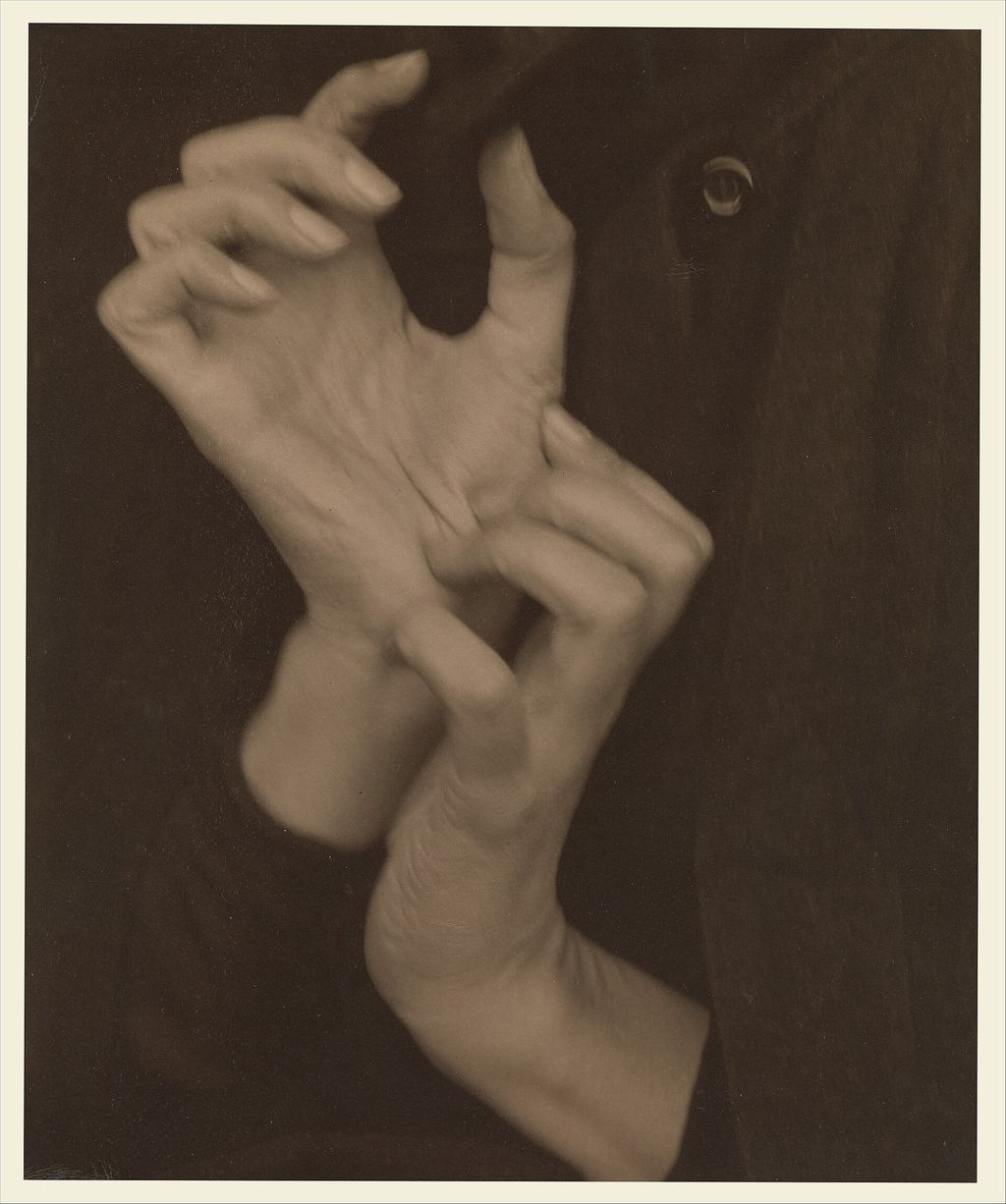
Those photographs changed reception. They joined the artist’s body, clothes, hands and face with forms from her drawings, encouraging viewers to read one through the other. The photographs are evidence of Stieglitz’s construction of a portrait and of how the drawings were staged; they do not prove that every curved charcoal form is anatomical self-portraiture. O’Keeffe later helped preserve and distribute the photographic sequence. Drawing and photography thus intersect through display, intimacy, archive and institutional stewardship as well as visual resemblance.
Conservation and mounting histories
Works on paper are materially vulnerable. Light can fade paper or pigments; acidity and mounts can discolour supports; charcoal and pastel can transfer or abrade; pressure and handling can disturb surfaces. Museums therefore limit exhibition duration and rotate sheets.[24] Technical examination can include raking and transmitted light, microscopy, fibre and watermark study, ultraviolet or infrared imaging, XRF and close recording of mounts and inscriptions.[25]
The right method depends on the question and the work’s condition. Sampling is exceptional, especially for a friable surface. Conservation also changes what scholarship can say. Identifying a watermark can refine a group; detecting altered red lead can challenge a colour reading; distinguishing original mount from later backing can clarify provenance. Treatment should not erase evidence merely to make a sheet look new.
Catalogue, provenance and international reception
The eight legacy topics show why catalogue discipline matters. One title belongs to an oil painting, one to a publication, two numerals belong to 1959 charcoals, and an early Met drawing carries competing dates. A loose online list can flatten these differences. Access O’Keeffe presents current knowledge but also invites corrections.
Its records name sources for titles, dates and remarks; some state that an object does not appear in the Whitney Archive, Downtown Gallery Archive or Abiquiú Notebooks. Absence is part of the evidence.[1][19] The catalogue is therefore an argument assembled from objects, inscriptions, files, exhibitions, owners and technical study. It is authoritative for this programme while remaining revisable. A page should record uncertainty rather than manufacture precision.
Many sheets remained with O’Keeffe for decades. After her death, the estate and Georgia O’Keeffe Foundation transferred groups to museums, including the National Gallery’s early charcoals. Other works had entered the Stieglitz collection, were given to friends or continued through private owners. These routes affect both scholarship and interpretation. A drawing retained by the artist may have been personally important, unsold, unsuitable for an exhibition plan or simply stored; retention alone cannot choose among those explanations.
A gift records a relationship but does not automatically reveal the occasion’s emotional meaning. Auction catalogues can supply ownership, dimensions and literature when an institutional record is absent. They also exist to sell. Their descriptive language and estimates require separation from catalogue identity and independently documented provenance. The treatment of A Long Leaf uses Sotheby’s for object facts while withholding market rhetoric.[20]
The prominence of drawing has grown through exhibitions that challenge the flower-centred canon. The Whitney’s abstraction survey united more than 125 objects across paintings, drawings, watercolours and sculpture.[15] MoMA’s paper exhibition then made serial process the main subject and issued material in Spanish as well as English.[3][6] European retrospectives widened the frame. The Centre Pompidou’s French account positioned the early abstractions within American modernism, while the Madrid–Paris–Basel collaboration brought Spanish, French and German institutional voices into the historiography.[26][27][28]
Tate’s 2016 British retrospective similarly asked audiences to see beyond the established flower image.[29] These surveys do more than add neglected sheets. They change how the paintings look. Once the repetitions, changes and material decisions on paper are visible, a finished canvas appears less like an isolated revelation and more like part of sustained visual research.
Late drawing and close looking
O’Keeffe lost central vision in the early 1970s but did not stop every medium at once. Institutional chronology distinguishes her last unassisted oil in 1972, unassisted watercolour and charcoal through 1978, and graphite through 1984.[2] The dates matter because different tools require different kinds of visual and physical control. A broad charcoal line, a graphite contour and assisted oil painting pose separate questions.
The record should neither turn disability into a triumphal fable nor erase continued authorship. Archives preserve notebooks, writings, correspondence, business files and some medical material, with restrictions on portions of the latter.[31] Responsible interpretation uses what is open and relevant without treating private diagnosis as a shortcut to the work. Begin with the support.
Note its colour, texture, dimensions, orientation, edges, watermark, ruling, mount and inscriptions. Then look at the mark: pressure, grain, rubbing, erasure, overlap, hesitation and speed. Ask whether blank paper acts as light, distance, object or interval. Compare related sheets before naming a symbol. In a sequence, locate what changes and what remains.
Separate the catalogue title from the forms you recognise. Check whether a date is secure, approximate or disputed. Finally, consider the sheet’s later life. Was it exhibited at 291, kept by the artist, reproduced in Some Memories, transferred through the Stieglitz collection, conserved or shown only in rotations? Drawing occurs in the encounter between mark and paper, but its public meaning accumulates through handling, photography, publication and museums.
O’Keeffe’s drawings reward this material patience. They make economy look expansive. A charcoal band can carry the memory of a river; an erased line can become light; a ruled green sheet can hold a palm crown. The practice remained open because seeing, for her, was something repeatedly done rather than once achieved.
Discussion
Which piece of evidence most changes the way you read Georgia O’Keeffe Drawings?
Reader Insights
Which visible detail most changes your reading of Georgia O’Keeffe Drawings?
How do medium, setting and documented history shape the encounter?
What remains uncertain when documented fact is separated from interpretation?
Join the Conversation
Share your reading of Georgia O’Keeffe Drawings below.
References
- Georgia O’Keeffe Museum, “Access O’Keeffe Project Documentation”, View Source
- Access O’Keeffe, “Artist’s Chronology”, View Source
- Museum of Modern Art, “Georgia O’Keeffe: To See Takes Time”, View Source
- Museum of Modern Art, “Georgia O’Keeffe”, View Source
- Museum of Modern Art, “Georgia O’Keeffe. Drawing X. 1959”, View Source
- Museum of Modern Art, “MoMA presenta Georgia O’Keeffe: To See Takes Time”, View Source
- National Gallery of Art, “O’Keeffe on Paper”, View Source
- National Gallery of Art, “No. 2-Special”, View Source
- National Gallery of Art, “Untitled (Abstraction)”, View Source
- Metropolitan Museum of Art, “Drawing XIII”, View Source
- Lisa Mintz Messinger, Georgia O’Keeffe, Metropolitan Museum of Art Bulletin 42, no. 2, View Source
- Metropolitan Museum of Art, “Georgia O’Keeffe (1887–1986)”, View Source
- Georgia O’Keeffe Museum Archives, “Georgia O’Keeffe Paper Survey Research”, MS-59, View Source
- Lynn B. Brostoff, Catherine I. Maynor and Robert J. Speakman, “Preliminary Study of a Georgia O’Keeffe Pastel Drawing Using XRF and μXRD”, View Source
- Whitney Museum of American Art, “Georgia O’Keeffe: Abstraction”, View Source
- Access O’Keeffe, “Leaves of a Plant, 1942”, View Source
- Access O’Keeffe, “Drawing I, 1959”, View Source
- Access O’Keeffe, “Untitled (Trees), 1976”, View Source
- Access O’Keeffe, “Untitled (Leaf), ca. 1930–1936”, View Source
- Sotheby’s, “A Long Leaf (from My Sketch Book)”, View Source
- Woodward Gallery, “Georgia O’Keeffe: Some Memories of Drawings 1968”, View Source
- New York Public Library, “Some Memories of Drawings”, View Source
- National Gallery of Art, Alfred Stieglitz Key Set object research, View Source
- Georgia O’Keeffe Museum, “Conservation”, View Source
- Georgia O’Keeffe Museum, “Artwork Research Support”, View Source
- Centre Pompidou, “Georgia O’Keeffe”, View Source
- Fondation Beyeler, “Georgia O’Keeffe” press dossier, View Source
- Museo Nacional Thyssen-Bornemisza, “Georgia O’Keeffe”, View Source
- Tate, “Georgia O’Keeffe”, View Source
- National Gallery of Art, “Georgia O’Keeffe 1887–1986”, View Source
- Access O’Keeffe, “Georgia O’Keeffe Papers, 1914–1991”, View Source
- Georgia O’Keeffe Museum, “Rights and Reproductions”, View Source
- Georgia O’Keeffe Museum, “Access O’Keeffe, a Groundbreaking Digital Catalogue Raisonné”, 23 February 2026, View Source
- Museum of Modern Art, “Selection of O’Keeffe’s materials”, Georgia O’Keeffe: To See Takes Time audio, View Source
- Museum of Modern Art, “Georgia O’Keeffe: Untitled (Sacsayhuamán), 1956”, Georgia O’Keeffe: To See Takes Time audio, View Source
- Access O’Keeffe, “Untitled (Ghost Ranch Patio), ca. 1940”, CR 1000. View Source
- Access O’Keeffe, “Untitled (Horse), 1914”, CR 42. View Source
- Access O’Keeffe, “Untitled (Horse), 1914”, CR 43. View Source