


 by Tom Gurney
Tom Gurney BSc (Hons) is an art history expert with over 20 years experience
Page Created on September 22, 2026 / Page Updated on September 22, 2026
Email: tomgurney1@gmail.com / Phone: +44 7429 011000
Introduction
A useful Georgia O’Keeffe timeline must do more than place famous paintings beside dates. Her work developed across teaching, travel, galleries, correspondence, domestic labour, exhibitions, illness, conservation and changing public interpretation. Some dates are fixed by inscriptions and contemporary records; others were reconstructed later through archives and the catalogue raisonné. The chronology below makes those differences visible.[1][2]
At a Glance
- ArtistGeorgia O’Keeffe
- SubjectGeorgia O’Keeffe Timeline
- Artistic contextAmerican modernism
Contents
- 1887–1915: origins, training and renewal
- 1916–24: Pollitzer, Texas, New York and marriage
- 1925–28: flowers, Shelton and recognition
- 1929–33: New Mexico and divided years
- 1934–39: Ghost Ranch and Hawai‘i
- 1940–45: houses, war and Abiquiú
- 1946–49: retrospective, estate and permanent move
- 1950–61: travel and aerial vision
- 1962–69: clouds and reassessment
- 1970–79: retrospective and assisted practice
- 1980–86: final years
- 1987–2009: museum and catalogue
- 2016–17: international retrospective
- 2021–26: living catalogue
- Places across the timeline
- Archive, production and reception time
- Women’s institutional recognition
- How to read the chronology
1887–1915: origins, training and renewal
1887. Georgia Totto O’Keeffe was born on 15 November near Sun Prairie, Wisconsin, the second of seven children and the eldest daughter of Francis Calyxtus O’Keeffe and Ida Totto O’Keeffe. The family operated a dairy farm. This rural childhood belongs to her biography, but it should not be used to explain every later natural form as destiny.[1][3] 1902–04. The family moved from Wisconsin to Williamsburg, Virginia.
O’Keeffe attended Chatham Episcopal Institute, now Chatham Hall, and pursued art with increasing seriousness. Family moves, schooling and her early decision to become an artist preceded the public persona later built around New Mexico. 1905–06. O’Keeffe studied at the School of the Art Institute of Chicago. Illness interrupted the year. The curriculum trained observation, drawing and conventional technique; her later rejection of academic imitation was made by someone who had learned its disciplines.[3]
1907–08. At the Art Students League in New York she studied with William Merritt Chase. Her oil Dead Rabbit with Copper Pot won the League’s William Merritt Chase still-life prize, bringing a summer-school scholarship at Lake George. Success did not resolve her doubts about a career based on academic realism.[1][3] 1908–11. Financial pressure and dissatisfaction interrupted formal art-making. She worked as a commercial artist in Chicago and later lived with family in Virginia.
This interval resists a seamless genius narrative: professional formation included paid design, family circumstance and periods when she did not paint. 1912. O’Keeffe attended a University of Virginia summer course for art teachers, where Alon Bement introduced principles associated with Arthur Wesley Dow. Line, tonal mass and colour became compositional relationships rather than tools for copying an object.[3] 1912–14. She taught art in Amarillo, Texas, applying those ideas in education as well as her own experiments.
Teaching supplied income, institutional constraints and a setting in which looking at the Plains could alter her sense of scale. 1914–15. At Teachers College, Columbia University, she studied directly in Dow’s orbit. In autumn 1915, while teaching at Columbia College in South Carolina, she decided to begin again and made a concentrated series of charcoal abstractions. The Georgia O’Keeffe Museum chronology dates this decision to October and the drawings to October–December.[1][2]
1916–24: Pollitzer, Texas, New York and marriage
1916. On New Year’s Day, Anita Pollitzer took O’Keeffe’s drawings to Alfred Stieglitz at 291. Pollitzer acted without the artist being present, a fact that complicates stories of a planned debut. Stieglitz included her charcoals in a group exhibition opening on 23 May. O’Keeffe began an intense correspondence with him and moved to Canyon, Texas, to teach at West Texas State Normal College.[1]
1917. Stieglitz opened O’Keeffe’s first one-person exhibition at 291 on 3 April. She was still living and working in Texas. During an August journey through Colorado she stopped in Santa Fe for the first time, twelve years before the New Mexico stay normally treated as the decisive beginning.[1][2] 1918. After illness and leave from teaching, she recuperated in Waring, Texas.
Paul Strand travelled south to ask whether she would consider moving to New York. She arrived with Strand on 10 June, accepted Stieglitz’s offer to support a year of painting and resigned her teaching post. In July Stieglitz left his wife Emmeline to live with O’Keeffe and began photographing her extensively.[1] 1919–20. O’Keeffe worked between Manhattan and the Stieglitz family property at Lake George. Abstractions, flowers, leaves and landscapes developed beside one another.
Titles and dates from this period can rely on inscriptions, exhibition photographs, correspondence and later notebook evidence; those sources sometimes conflict. 1921. Stieglitz exhibited a large retrospective of his photography at Anderson Galleries. Nude portraits within his composite study of O’Keeffe attracted attention and encouraged critics to read her art through her photographed body. That reception was historically powerful even where it misrepresented her stated purposes.[4][5]
1923. On 29 January, Stieglitz opened an exhibition of more than one hundred O’Keeffe oils, watercolours, pastels and drawings at Anderson Galleries. He then organised annual exhibitions of her work until his death in 1946.[2][5] 1924. O’Keeffe and Stieglitz married on 11 December after his divorce became final. The marriage joined an intimate relationship to a dealer-artist partnership, but it did not merge their agency. O’Keeffe chose, withheld and reworked art while negotiating the gallery system he controlled.[1]
1925–28: flowers, Shelton and recognition
1925. Large flower paintings appeared in the Seven Americans exhibition. In November the couple moved into the Shelton Hotel, whose height, windows and surrounding towers contributed to O’Keeffe’s New York city pictures. Lake George remained an active seasonal workplace.[2] 1926. An Intimate Gallery exhibition included her first sustained depictions of New York architecture. The city works counter the later myth that she belonged naturally and exclusively to remote landscape.
1927. The Brooklyn Museum opened Paintings by Georgia O’Keeffe, her first retrospective, in June. Its institutional setting marked a different form of recognition from Stieglitz’s small galleries.[1] 1928. Stieglitz announced the sale of six calla-lily paintings for $25,000. The publicity reinforced O’Keeffe’s market stature and the identification of her career with flowers, even though she continued making buildings, trees, abstractions and landscapes.
1929–33: New Mexico and divided years
1929. O’Keeffe left for Santa Fe with Rebecca Strand on 27 April before joining Mabel Dodge Luhan’s household in Taos. Work in Taos and Alcalde followed, gathering new subjects without immediately abandoning New York or Lake George. In December, five of her works appeared in MoMA’s Paintings by 19 Living Americans.[1][2]
1930. Her exhibition at An American Place included early paintings of New Mexico crosses and San Francisco de Asís Church at Ranchos de Taos. Returning journeys established a seasonal pattern. New Mexico was inhabited Pueblo, Diné and Hispano country, not the empty territory of older modernist legend. 1931–32. O’Keeffe continued to move among New York, Lake George and the Southwest.
Bones shipped east became studio objects, while paintings of the Shelton and East River remained part of the same career. In late 1932 she stopped painting during a period of ill health and emotional strain. 1933. Hospital treatment and recuperation limited work. Chronology matters here because a gap in production should not be disguised by arranging paintings solely by subject.
1934–39: Ghost Ranch and Hawai‘i
1934. O’Keeffe returned to New Mexico and first visited Ghost Ranch, whose cliffs, buildings and views became recurring subjects. She began renting a house there in later seasons. Recovery did not produce a single new style; it reopened sustained work. 1935–37. Bones, antlers, hills and flowers entered increasingly staged conjunctions. O’Keeffe’s annual New York exhibitions continued to mediate pictures made from New Mexico material.
In 1937, the Cleveland Museum of Art organised a substantial exhibition, while An American Place presented recent work.[1][5] 1938. O’Keeffe received an honorary degree from the College of William and Mary. Advertising agency N. W. Ayer commissioned her to travel to Hawaii and make images for the Hawaiian Pineapple Company, later Dole.
The commercial commission and her refusal simply to paint a supplied pineapple expose negotiation behind the resulting series. 1939. From late January into April she travelled and worked in Hawaii. The paintings include flowers, waterfalls and landscapes; they should not be reduced to advertisements. She returned to the continental United States and resumed the New York–New Mexico rhythm.[1]
1940–45: houses, war and Abiquiú
1940. O’Keeffe acquired the Ghost Ranch house she had rented. Seasonal residence gave her sustained access to nearby cliffs and plains, while practical limits—water, transport, maintenance and distance—shaped daily work. 1941–44. Annual exhibitions at An American Place continued during the Second World War. The Art Institute of Chicago mounted a retrospective in January 1943.
O’Keeffe’s work entered a broader museum history while she continued summer and autumn journeys west.[1][5] 1945. She purchased a ruined compound at Abiquiú from the Catholic Archdiocese of Santa Fe. Restoration involved Maria Chabot and local labour over several years. The house’s patio, doors, walls and road later became motifs; acquisition should not be confused with immediate permanent residence.[1]
The Art Institute identifies its 21 January–22 February 1943 exhibition as O’Keeffe’s first museum retrospective and its first solo exhibition devoted to a woman. Director Daniel Catton Rich presented paintings from 1915 to 1941, then selected Black Cross, New Mexico as the first O’Keeffe work to enter the museum’s collection.[21] The sequence joins exhibition history to collecting history: a retrospective did not merely ratify an existing canon but helped determine which object would represent her within a major permanent collection.
The site carried a history older than O’Keeffe’s ownership. The compound combined reused Spanish-colonial fabric, regional adobe construction and later modern alteration; its garden depended on an acequia irrigation landscape connected to the Chama valley.[17][18] O’Keeffe and Chabot reshaped the property together. Treating the house as a solitary masterpiece erases both its inherited building traditions and the labour that made residence possible.
1946–49: retrospective, estate and permanent move
1946. MoMA opened a career retrospective on 14 May, the museum’s first retrospective devoted to a woman artist. O’Keeffe worked with curator James Johnson Sweeney and the exhibition ranged from early abstraction to flowers and New Mexico landscapes.[6] Stieglitz suffered a stroke in July and died on 13 July. O’Keeffe returned to New York and began the long work of settling his estate.
1947–48. She organised the Stieglitz papers and distributed his collection among public institutions. These decisions created the museum groupings through which both artists are still studied. Restoration of the Abiquiú house continued.[1][4] 1949. In June, O’Keeffe left New York to live permanently in New Mexico, using Abiquiú chiefly during the colder part of the year and Ghost Ranch during warmer seasons. “Permanent” describes her principal residence, not immobility; travel remained central.
1950–61: travel and aerial vision
1950. Edith Halpert of the Downtown Gallery became O’Keeffe’s exclusive dealer. An exhibition of paintings from 1946–50 reopened regular New York presentation after the estate years.[1] 1951. O’Keeffe travelled in Mexico with Eliot and Aline Porter and Spud Johnson, continuing to Yucatán with Rose and Miguel Covarrubias and meeting Diego Rivera and Frida Kahlo. These contacts place her Southwest life within wider hemispheric travel.
1953–58. Journeys to Mexico, the Caribbean and elsewhere broadened her visual archive. Patio doors, walls, pelvises and roads became repeated structures. Exhibition and catalogue dates need to be separated from dates of first conception. 1959. From January to April she travelled through the Pacific and Asia to India, the Middle East and Italy. Aerial views of rivers and deserts generated rapid pen sketches, later charcoals and paintings.
She called such images realistic to what she saw, although viewers often experience them as abstraction.[1] 1960. Worcester Art Museum opened Georgia O’Keeffe: Forty Years of Her Art. She travelled again to Asia late in the year. 1961. Her final exhibition at the Downtown Gallery, Recent Paintings and Drawings, opened in April. Closing this dealer relationship did not end production or exhibition.
1962–69: clouds and reassessment
1963. Doris Bry became O’Keeffe’s exclusive agent. Bry’s archival work later contributed substantially to cataloguing and the management of the artist’s legacy.[1] 1965. O’Keeffe painted Sky Above Clouds IV in the Ghost Ranch garage because the canvas was too large for her studio.
The monumental work extended aerial observation into an all-over field while retaining a horizon. 1966. The Amon Carter Museum of Western Art opened a retrospective covering 1915–66, which travelled to Houston. Such surveys increasingly constructed a long career rather than treating O’Keeffe as a figure of the 1920s alone.[1]
1970–79: retrospective and assisted practice
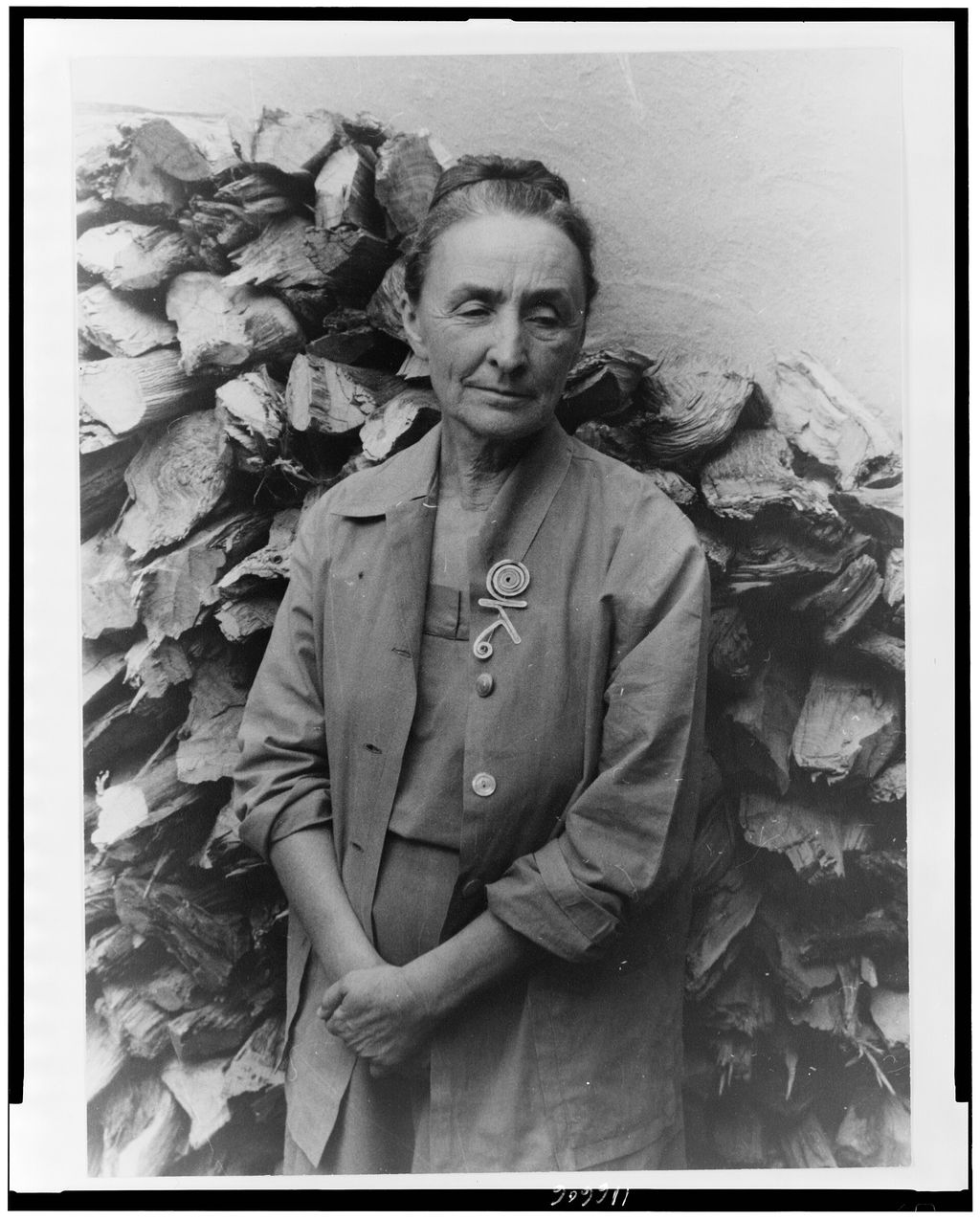
1970. The Whitney Museum opened a major retrospective in October, later travelling to Chicago and San Francisco. O’Keeffe helped install it, participating actively in the presentation of her history.[1] 1971. She lost central vision, retaining peripheral sight. The change was severe but did not create an immediate, total stop. Exact distinctions among media and degrees of assistance are essential.
1972. O’Keeffe completed her last unassisted oil. She continued making oils with assistance until 1977, worked independently in watercolour and charcoal until 1978, and used graphite until 1984.[2] “Stopped painting in 1972” is therefore inaccurate. 1973. She met potter and sculptor Juan Hamilton, who became assistant, travelling companion, close friend and representative. His material help enabled projects, but the record should neither erase collaboration nor transfer authorship wholesale to him.
1976. Viking Press published the large illustrated book Georgia O’Keeffe, through which the artist paired works with retrospective statements. These recollections are valuable primary evidence but were written decades after many early events. 1977. President Gerald Ford awarded O’Keeffe the Presidential Medal of Freedom. Perry Miller Adato’s television film further expanded the late public image of the artist in New Mexico.[1]
The White House announcement dated 1 January placed O’Keeffe among twenty-one recipients and the presentation occurred on 10 January.[19] This documentary precision matters because biographies sometimes give only the year, blurring the difference between nomination, announcement and ceremony. The award formalised national recognition at the same time that books, film and photographs intensified her status as an emblem of independent old age.
1980–86: final years
1980. O’Keeffe’s late work included watercolour and clay projects made amid worsening sight. Her reliance on assistance varied by task and date. 1984. Medical needs prompted her relocation to the Santa Fe property Sol y Sombra, where Juan Hamilton’s family also lived. She continued working in graphite into this year.[2] 1985. President Ronald Reagan awarded her the National Medal of Arts.
The National Endowment for the Arts lists O’Keeffe among the inaugural 1985 National Medal of Arts recipients, alongside figures in music, dance, literature and patronage.[20] The honour was institutional recognition of a long career, not evidence that critical disputes about gender, region or modernism had been settled. 1986. O’Keeffe died at St Vincent Hospital in Santa Fe on 6 March, aged ninety-eight. Her ashes were scattered at the landscape she called the Pedernal, according to her wishes.[2][3]
1987–2009: museum and catalogue
1987–89. The National Gallery of Art opened the centennial exhibition Georgia O’Keeffe 1887–1986 with seventy-five paintings and forty-five works on paper. It travelled to Chicago, Dallas and the Metropolitan Museum and drew 438,182 visitors in Washington.[7] 1997. The Georgia O’Keeffe Museum opened in Santa Fe. Its collection, archive, research and conservation programmes provided institutional infrastructure devoted to the artist while also shaping posthumous interpretation. The museum opened to the public in July, eleven years after O’Keeffe’s death.
Its Research Center followed in July 2001; in 2006 the museum assumed responsibility for the Abiquiú Home and Studio.[17] These dates distinguish three related forms of stewardship: displaying art, supporting scholarship and preserving a working environment. 1998. The Abiquiú Home and Studio entered the National Register of Historic Places and received National Historic Landmark designation on 5 August.[18] Historic status protects a material site but also turns a lived home into public heritage, raising new questions about restoration, visitor access and the construction of authenticity.
1999. Barbara Buhler Lynes’s two-volume catalogue raisonné established catalogue numbers and synthesised object, provenance and exhibition evidence for more than two thousand works. Access O’Keeffe now updates that scholarship digitally and explicitly presents records as subject to revision.[1] 2009–10. The Whitney’s Georgia O’Keeffe: Abstraction reunited 125 works and used newly available correspondence to challenge a flower-centred account of her career. It travelled to the Phillips Collection and Georgia O’Keeffe Museum.[8]
2016–17: international retrospective
Tate Modern presented Georgia O’Keeffe from 6 July to 30 October 2016, one hundred years after her work first appeared at 291. Curated by Tanya Barson with Hannah Johnston, it brought together more than one hundred works and was a rare career-scale presentation in Britain, where public collections held no comparable overview.[9][10] The exhibition began with the 1916–17 breakthrough and moved through abstraction, music and colour; the Stieglitz relationship and photographic portrait; enlarged flowers and still life; New York; New Mexico landscapes; bones; the Black Place; houses; and late aerial and sky subjects.
Its aim was explicitly corrective: to examine the whole practice and resist clichés that reduced the work either to flowers or to a sexual key.[9][11] The project was organised with Bank Austria Kunstforum, Vienna, and the Art Gallery of Ontario. In Toronto, from 22 April to 30 July 2017, it became the only North American venue and included more than eighty works, with Stieglitz, Strand and Ansel Adams photographs used to examine artistic relationships.[9][12]
Changing object counts reflect venue checklists and wording, not necessarily contradictory reporting. The Tate moment belongs in the timeline because retrospectives make historical arguments. It arrived during renewed efforts to examine women artists within modernism and placed O’Keeffe in an international rather than exclusively American frame. Reviews still repeated sensual and erotic language, demonstrating that a curatorial correction does not instantly displace inherited reception.[9][11]
Another 2017 exhibition revised a different part of the chronology. Brooklyn Museum’s Georgia O’Keeffe: Living Modern presented clothing, paintings and photographs together to examine how she shaped a public identity through dress, pose and domestic setting.[22] Organised by Wanda M. Corn within the museum’s feminist Year of Yes, it made self-fashioning an historical practice rather than a decorative supplement to painting. The photographs ranged beyond Stieglitz to later image-makers who helped consolidate O’Keeffe’s Southwestern persona.
2021–26: living catalogue
2021–22. A major retrospective travelled from Madrid’s Museo Nacional Thyssen-Bornemisza to the Centre Pompidou in Paris and Fondation Beyeler in Riehen. Spanish, French and German institutional settings reframed O’Keeffe through their own histories of modernism and nature.[13][14][15] 2023. MoMA’s Georgia O’Keeffe: To See Takes Time concentrated on serial work on paper, reuniting drawings, watercolours and pastels with related paintings.
Its material and process emphasis corrected the tendency to see isolated icons rather than sequences.[16]
2024–25. Georgia O’Keeffe: “My New Yorks” opened at the Art Institute of Chicago before travelling to the High Museum of Art. Access O’Keeffe calls it the first exhibition to investigate seriously her paintings, drawings and pastels of the built city, treating those works as integral to her modernist study of abstracted form.[23] Its timing is historiographically significant: nearly a century after the Shelton paintings, a dedicated exhibition still had to recover New York from the desert-centred public biography.
2025. For the first time in almost twenty-eight years, the Georgia O’Keeffe Museum brought its entire collection back to Santa Fe. Fifty-one paintings had been on loan when preparations began; a temporary loan moratorium allowed conservation, documentation and direct study before a planned new campus, expected to open in 2028.[24] The event makes collection movement part of the chronology. Circulation builds international reception, while temporary reunion lets conservators and curators compare objects whose physical relationships cannot be recovered fully from photographs.
In November, Tewa Nangeh/Tewa Country opened at the Museum. Co-curated by Bess Murphy and Jason Garcia/Okuu Pín of Kha’p’o Owingeh, it brought O’Keeffe’s work and possessions into dialogue with new work by artists, scholars and culture bearers from the six Tewa Pueblos.[25] The exhibition explicitly addresses erasure of continuous Tewa presence from the O’Keeffe story and questions sacred landscape, belonging and ownership. It marks an institutional change from adding Indigenous context around her chronology to sharing interpretive authority within it.
2026. Access O’Keeffe officially launched on 4 March after a decade of development, making more than 2,200 works searchable with images, descriptions, exhibition histories, archival material and research data.[26] The exact launch date refines the broader chronology, while the platform’s structure changes what a date can do. Users can connect production, exhibition, ownership and archival evidence at object level; revisions remain visible instead of being deferred to a new printed edition. Digital publication thus becomes a dated event and an ongoing scholarly process.
Places across the timeline
A chronological page can accidentally make places look like stages waiting for O’Keeffe to arrive. Sun Prairie, Charlottesville, Canyon, Manhattan, Lake George, Taos, Ghost Ranch and Abiquiú each had social and political histories independent of her biography. New Mexico in particular included Pueblo and Diné homelands, Hispano villages, land grants, Catholic institutions, ranching, tourism and federal interventions. O’Keeffe’s movements occurred within those histories.
The distinction affects dates. Her 1917 stop in Santa Fe was an encounter, her 1929 journey began recurring work, the 1940 Ghost Ranch purchase established one household, the 1945 Abiquiú purchase began a restoration project, and the 1949 move made New Mexico her principal residence. Compressing those events into “she moved west in 1929” destroys twenty years of seasonal, legal and practical change.
Lake George likewise changed function over time. It was the Stieglitz family estate, a working farm, a summer household and an artistic site. Manhattan was residence, market, exhibition centre and subject. Travel joined rather than simply replaced these places: materials and memories crossed between them, and paintings made in one location could depict another.
Archive, production and reception time
The Access O’Keeffe chronology was first published in the 1999 catalogue raisonné and draws on primary documents, correspondence and earlier scholarly chronologies.[1] This layered authorship is important. A dated letter may establish when O’Keeffe was in a place; an exhibition checklist shows what was publicly titled at a given moment; an inscription may have been added later; a retrospective interview may compress events remembered after decades. The Library of Congress collection illustrates both value and limitation.
Its 157 items and 618 images concentrate on letters written by O’Keeffe and Stieglitz to Henwar Rodakiewicz between 1929 and 1947, with most material dating from 1935–46.[4] It illuminates those relationships and years, but it is not a complete diary. Many letters were undated, and supplied dates depend on comparison with other archives. Absence from one archive therefore does not prove an event did not happen. Nor does a late account automatically override a contemporary record.
The best chronology triangulates sources, marks uncertainty and resists filling every silence with inference. An artwork has more than one relevant date. O’Keeffe might begin a motif in a small drawing, make an oil later, exhibit it the following year, alter its title in a notebook decades afterwards and give it to a museum near the end of her life. A timeline that lists only the painted date loses this extended history. The annual exhibitions organised by Stieglitz created a regular public rhythm distinct from studio work.[5]
The 1946 MoMA, 1970 Whitney and 1987 National Gallery retrospectives reorganised earlier objects into career narratives. Posthumous exhibitions at the Whitney, Tate, MoMA and European museums then asked new questions of the same chronology.[6][7][8][9][16] Reception time can also reactivate an old work. A flower painted in the 1920s acquired new gendered readings in later decades; an early charcoal entered histories of abstraction after dispersed series were reunited; an Abiquiú door became evidence in preservation studies. Chronology should record these afterlives without pretending that later meanings existed unchanged at the moment of making.
Women’s institutional recognition
Several milestones are often presented as simple triumphs: the 1927 Brooklyn retrospective, the 1946 MoMA retrospective, the 1970 Whitney survey, presidential honours and the museum opened in her name. They do demonstrate exceptional institutional visibility. MoMA identifies its 1946 show as the museum’s first retrospective devoted to a woman artist.[6] That fact belongs beside, rather than outside, the gendered criticism through which O’Keeffe’s work had already been framed. Recognition did not operate in a steady upward line.
Early celebrity could magnify reductive readings; market success could narrow public attention to flowers; the New Mexico persona could eclipse New York and Lake George; late honours could turn a working artist into a national monument before her death. Each institutional event expanded access while reorganising the career. Posthumous scholarship has repeatedly revised this organisation. The abstraction exhibition restored early and continuing non-objective practice; the Tate retrospective disputed familiar clichés; To See Takes Time placed sequences and materials before isolated icons.[8][9][16] A timeline therefore measures changes in the questions institutions ask, not just growing fame.
How to read the chronology
Some apparent facts are useful only with qualifiers. O’Keeffe first saw Santa Fe in 1917, but her sustained New Mexico work began in 1929. She bought Ghost Ranch property in 1940 and Abiquiú in 1945, yet permanent residence dates to 1949. Central vision loss is placed early in 1971; the last unassisted oil belongs to 1972; assisted oils continued later; independent drawing continued into 1984.[1][2] Artwork dates can be less secure than life events.
Catalogue compilers sometimes choose a year from exhibition evidence while a later inscription gives another. Works bearing a year may have been signed or labelled long after execution. Series titles and numbers were also changed, lost or reconstructed. A precise-looking date is not necessarily certain. Even death does not close the chronology.
Estate distribution, foundation activity, cataloguing, conservation and new exhibitions change what can be seen and known. The timeline ends provisionally because Access O’Keeffe continues to revise object records as owners and researchers supply evidence.[1] Dates do different jobs. A birth, journey or exhibition opening may be fixed to a day; an artwork may be dated by inscription, correspondence, stylistic relation or later recollection. A catalogue date can differ from an owner’s record.
“First”, “last” and “permanent” require definitions: first visit is not first working season, last unassisted oil is not last artwork, and permanent residence did not end travel. The timeline also records power. Galleries and museums made visibility; photographs and criticism shaped gendered reception; assistants and conservators affected what could be made or known; O’Keeffe herself selected, retained, gifted and narrated. Her career was neither an isolated march of masterpieces nor a story authored entirely by others. It was a long negotiation among work, place, institutions and memory.
Discussion
Which piece of evidence most changes the way you read Georgia O’Keeffe Timeline?
Reader Insights
Which visible detail most changes your reading of Georgia O’Keeffe Timeline?
How do medium, setting and documented history shape the encounter?
What remains uncertain when documented fact is separated from interpretation?
Join the Conversation
Share your reading of Georgia O’Keeffe Timeline below.
References
- Access O’Keeffe, Artist’s Chronology. View Source
- Georgia O’Keeffe Museum, Timeline. View Source
- National Gallery of Art, Georgia O’Keeffe. View Source
- Library of Congress, Georgia O’Keeffe and Alfred Stieglitz Correspondence. View Source
- Georgia O’Keeffe Museum, Exhibiting O’Keeffe. View Source
- Museum of Modern Art, Georgia O’Keeffe, 1946. View Source
- National Gallery of Art, Georgia O’Keeffe 1887–1986. View Source
- Whitney Museum of American Art, Georgia O’Keeffe: Abstraction. View Source
- Tate Modern, Georgia O’Keeffe, 2016. View Source
- Art Gallery of Ontario, Tate Modern retrospective partnership announcement. View Source
- Georgia O’Keeffe Museum, Examining New Dimensions through the Retrospective. View Source
- Art Gallery of Ontario, Georgia O’Keeffe. View Source
- Museo Nacional Thyssen-Bornemisza, Georgia O’Keeffe exhibition checklist. View Source
- Centre Pompidou, Georgia O’Keeffe. View Source
- Fondation Beyeler, Georgia O’Keeffe. View Source
- Museum of Modern Art, Georgia O’Keeffe: To See Takes Time. View Source
- Georgia O’Keeffe Museum, About the Museum. View Source
- National Park Service, Georgia O’Keeffe Home and Studio. View Source
- Gerald R. Ford Presidential Library, Medal of Freedom Presentation, 10 January 1977. View Source
- National Endowment for the Arts, Georgia O’Keeffe: 1985 National Medal of Arts. View Source
- Art Institute of Chicago, Case 7: Georgia O’Keeffe. View Source
- Brooklyn Museum, Georgia O’Keeffe: Living Modern. View Source
- Access O’Keeffe, Georgia O’Keeffe: “My New Yorks”. View Source
- Georgia O’Keeffe Museum, Homecoming: Museum’s Entire Collection Returns to Santa Fe in Preparation for the Future. View Source
- Georgia O’Keeffe Museum, Tewa Nangeh/Tewa Country. View Source
- Georgia O’Keeffe Museum, Access O’Keeffe Launch Press Release. View Source