 by
Tom Gurney
Tom Gurney BSc (Hons) is an art history expert with over 20 years experience
Published on October 6, 2016 / Updated on October 23, 2026
Email:
tomgurney1@gmail.com
/ Phone:
+44 7429 011000
White Water Lilies, 1899
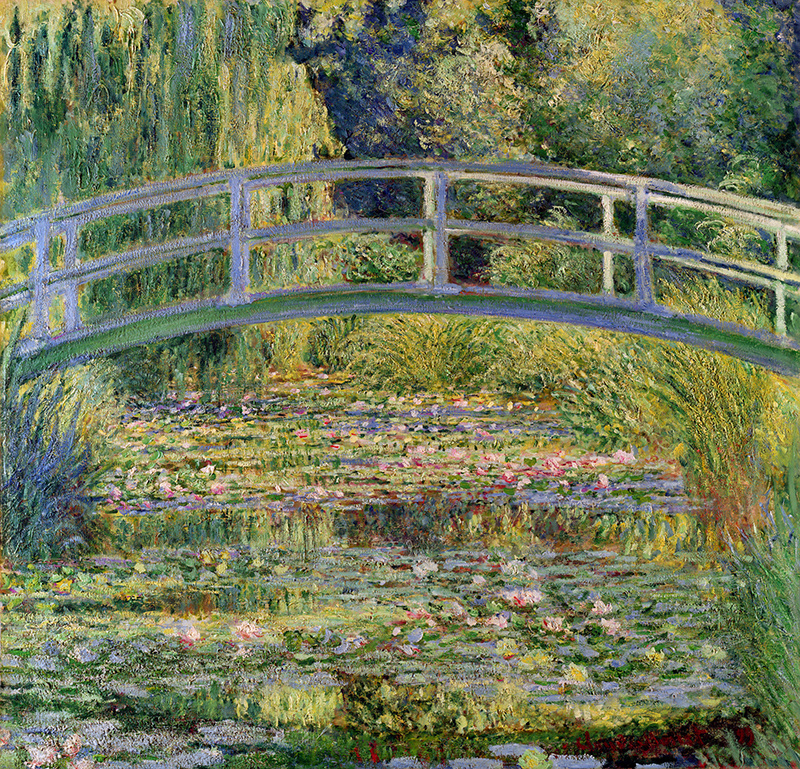
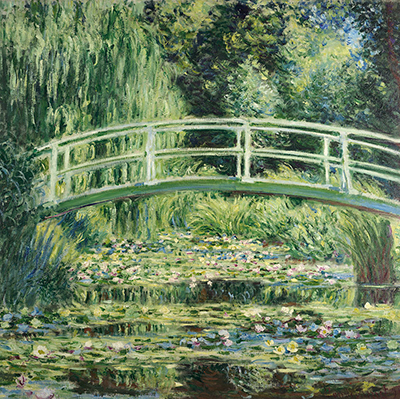
White Water Lilies brings the pale arch of Monet's Japanese-style bridge into a dense, nearly square garden view. Painted in 1899, this particular canvas belongs to the Pushkin State Museum of Fine Arts in Moscow, inventory Zh-3309. It is a distinct work within the many paintings of his Giverny pond. [1]
At a Glance
The pale bridge within the green
The bridge passes across the picture without taking us towards a distant destination. Its ends are cut off, and no figure crosses the walkway. Instead, its rails provide a clear, repeated pattern against the irregular growth.
The arch rises gently towards the middle. Pale highlights along the handrails make it appear lighter than the vegetation surrounding it, while the lower structure carries deeper green and blue tones.
There is a useful tension between this ordered curve and the hanging willow at the left. One gives the eye a measured horizontal movement; the other draws it down through soft, uneven strands.
The bridge is therefore more than an identifiable garden feature. It divides the view into connected zones and gives a stable shape against which leaves, flowers and reflections can vary.
Unlike a bridge seen from its approach, it offers no straightforward route into the picture. We look across it, then beneath it, repeatedly shifting our attention between architecture and water.
Flowers that punctuate the surface
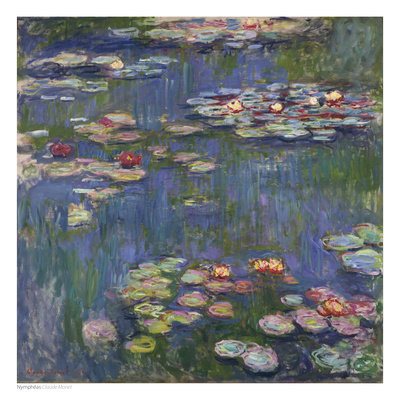
The title directs attention to the blossoms, but the flowers do not stand apart as neatly isolated botanical specimens. Their small bright touches belong to broad, irregular groups of floating leaves.
Some accents appear white or pale blue; others lean towards pink and yellow. Around them, greens become cooler, warmer, darker or lighter according to their neighbours. White here is not simply an empty space left without colour.
The nearest band is large enough for individual pads and broken flower shapes to register. Beyond it, another mass gathers under the bridge, with a darker interval separating the two.
That arrangement suggests recession without the firm geometry of a tiled floor. The pads help us recognise a level surface, yet their interrupted edges keep that surface active.
The Water Lilies overview follows the larger subject. This painting's distinctive pleasure lies in the way small, scattered light marks hold their own within a much larger green field.
A small opening of sky
Much of the upper canvas is occupied by leaves. At the right, however, a small blue opening interrupts the enclosure. It prevents the background from becoming a continuous wall of foliage.
The opening is modest compared with the expanses of sky familiar from many river landscapes. Its effect depends on its position among dense growth, where a little blue can register strongly.
Below, the water also contains lighter blue and pale passages. These relate the upper and lower parts of the picture, although the painting does not give us a diagram tracing each reflected patch to its precise source.
Dark, more vertical marks suggest reflected vegetation. The lily pads interrupt those marks, reminding us that the water can be both a surface supporting plants and an image of something above it.
The Painting Water article considers this double character. Here it makes the space beneath the bridge less settled than the bridge itself: the solid arch is readable at once, while the water asks for slower attention.
The garden was cultivated, not accidental
Monet's setting was a made landscape. In 1893 he acquired additional land and diverted the Ru, a small branch of the Epte, to create the water garden. Planting and maintenance were central to its development. [5]
The density of the painted vegetation should therefore not be mistaken for evidence that the garden had simply been abandoned to grow wild. The artist was looking at living forms within a place that required sustained work.
Nor does the picture merely inventory everything in that place. Its crop excludes the house and almost all the world beyond the pond. What remains is a concentrated relationship between arch, foliage and reflected light.
The Giverny garden had a history outside the canvas, but Monet could choose how much of it to reveal. A physically accessible garden becomes a scene in which there is no obvious position for a visitor to stand.
A distinctive format within the 1899 group
The Moscow painting is close to square, rather than strongly horizontal or vertical. That balance leaves substantial room both above and below the bridge.
Comparison makes the choice more apparent. The Met's separate Bridge over a Pond of Water Lilies , dated 1899, is a vertical canvas measuring 92.7 by 73.7 centimetres. Its museum account distinguishes eighteen bridge views begun from twelve paintings completed that summer. [6]
Those figures concern a particular campaign, not the entire Water Lilies production. Repeated titles can conceal differences of format, viewpoint and date.
The National Gallery of Art's Japanese Footbridge is wider, with the bridge pressed much closer to the upper edge. [7] In the Washington painting , the water consequently occupies a different share of the field.
These are not interchangeable illustrations of one design. The Moscow view grants the foliage above the arch a weight that helps distinguish its enclosed, layered space. The series guide explains why repetition can sharpen such differences rather than erase them.
Japanese context and decorative organisation
The bridge belongs to Monet's engagement with Japanese art, but recognising that context does not require naming a single print as the source of every feature.
His collection included works by Hokusai, Hiroshige and Utamaro, displayed in the house at Giverny. He did not travel to Japan. [8] The Japanese Prints guide explores that collecting interest in greater detail.
In this canvas, a real bridge and real plants are organised into a dense pattern. The Pushkin Museum has interpreted the painting as anticipating the decorative character of Monet's later work. [2]
Decorative need not mean shallow or merely pretty. Here the term draws attention to relationships that operate across the surface: the arch, hanging leaves, repeated pads and dispersed bright touches.
The recognisable garden remains present, but its parts are also shapes and colours in a bounded rectangle. We can read a pond while noticing how insistently the painting asks us to look at its surface.
Shchukin's visit to Monet
The painting's history leads from Giverny to a major Russian collection. Scholar Alexey Petukhov records that Sergei Shchukin visited Monet's studio in December 1900 and bought White Water Lilies, also reserving a Rouen Cathedral painting. [3]
The purchase was direct, rather than simply an acquisition of an older work from an anonymous resale. In the Pushkin Museum's exhibition account, the transaction displeased dealer Paul Durand-Ruel; Monet defended the price, reported as 10,000 francs. [4]
This episode gives a more specific sense of the painting's early reception than a general statement that collectors admired Monet. It involved access to the artist, a choice among available works and the relationship between private buyers and dealers.
It does not imply that Shchukin obtained all his Monets in the same way. Petukhov places him within a wider international collecting culture, while emphasising the personal contacts that could cut across established market arrangements. [3]
From a private collection to the Pushkin Museum
The museum's provenance places White Water Lilies in Shchukin's collection before 1918, subsequently in the institutions that became the Museum of Modern Western Art, and at the Pushkin Museum from 1948. [2]
The current catalogue confirms that arrival year. [1] The painting thus has two connected histories: the garden Monet depicted and the movement of this particular canvas through collections.
Neither history replaces looking. Once the names and dates are established, the picture still turns on delicate visual relationships: a pale rail against dark leaves, scattered blossoms against broad green pads, and a small opening of blue within the enclosing growth.
Its individuality becomes clearer when it is not treated as a generic lily pond. The near-square format lets foliage and water answer one another around the bridge, while its collection history shows how a private view of Giverny became part of a public museum in Moscow.
Frequently Asked Questions
It belongs to the Pushkin State Museum of Fine Arts in Moscow, inventory Zh-3309. [1]
Sergei Shchukin bought it during a visit to Giverny in December 1900. [3]
No. The visible flower accents include several pale and warmer tones, set among varied greens.
Discussion
Look again at the images and ideas explored in White Water Lilies, 1899. These editorial prompts invite your observations.
Reader Insights
Compare the ordered bridge rails with the hanging willow leaves.
Follow the two main bands of lily pads and the darker water between them.
Consider how the small blue opening changes the enclosed garden space.
Join the Conversation
Share a detail, comparison or question about White Water Lilies, 1899 below.
References
- Pushkin State Museum of Fine Arts , current collection record, White Water Lilies, 1899, Zh-3309. View source .
- Pushkin State Museum of Fine Arts , Patrons of Modern Art project, White Water Lilies; provenance and interpretation. View source .
- Alexey Petukhov , Sergei Shchukin and His Contemporaries Abroad: Collectors, Dealers, Connoisseurs, Iskusstvoznanie, 2017, pages 212-231, especially pages 218-219, note 3. View source .
- Pushkin Museum / ARTEFACT , White Water Lilies, Shchukin: Biography of a Collection; direct-purchase account. View source .
- Maison et jardins de Claude Monet , Water lily pond; the garden's creation and maintenance. View source .
- The Met , Bridge over a Pond of Water Lilies, 1899, 29.100.113; comparative format and group chronology. View source .
- National Gallery of Art , The Japanese Footbridge, 1899, 1992.9.1; distinct Washington painting. View source .
- Maison et jardins de Claude Monet , Les estampes japonaises; collecting context. View source .