 by
Tom Gurney
Tom Gurney BSc (Hons) is an art history expert with over 20 years experience
Published on October 6, 2016 / Updated on October 23, 2026
Email:
tomgurney1@gmail.com
/ Phone:
+44 7429 011000
The Waterlily Pond, Green Harmony, 1899
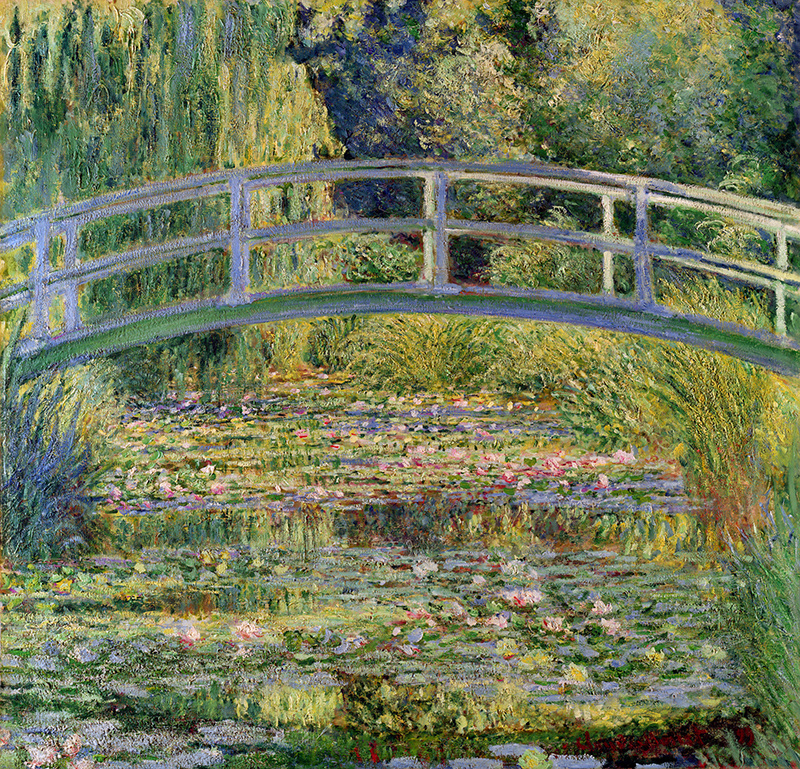
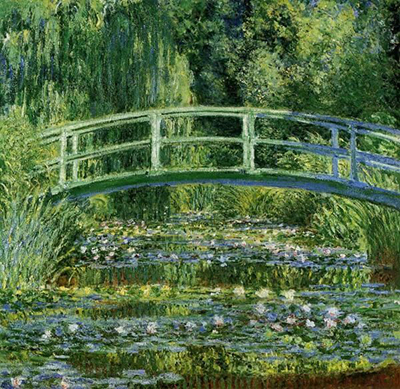
The Waterlily Pond, Green Harmony is Monet's 1899 canvas in the Musee d'Orsay, inventory RF 2004. A light arched bridge crosses a nearly square field of foliage, water and reflections. Green dominates, but the effect depends on many variations within that colour and on quieter touches of blue, pink, violet and white. [1]
At a Glance
Green without monotony
The title gives a useful starting point, but not a complete description. The green of the hanging foliage is different from the cooler blue-green of the bridge and from the darker vertical passages reflected in the pond.
Some leaves catch yellowish light. Others gather into deep masses that nearly hide the space beyond the railing. Thin marks suggest separate fronds and stems without turning the entire scene into a botanical inventory.
Pale waterlilies interrupt this field. Small pink and white accents become more conspicuous because they occupy relatively little of the canvas.
The colour relationships are therefore uneven and active. Green connects the scene, while differences of lightness, temperature and direction prevent that connection from becoming a flat wash.
The Water Lilies overview follows Monet's broader investigation of the pond. This picture shows how a limited setting can contain considerable variety without requiring a distant landscape or a dramatic sky.
A bridge that organises the garden
The bridge extends across the canvas above its midpoint. Its arch creates a broad curve against the more irregular forms of the vegetation.
The rail is especially light towards the left, while cooler shadows become more noticeable on the right. This difference gives the structure volume without making it a fully detailed architectural study.
Its upright supports divide the view into smaller openings. Looking through them, one encounters foliage and shadow rather than a clear prospect into the distance.
The upper edge is filled by trees and hanging branches. There is no separate band of sky to release the scene into a conventional horizon. The bridge supplies a firm landmark within that enclosed field.
Yet the structure does not dominate through size alone. Its comparatively clear lines become legible because the surrounding marks are more scattered. The painting depends on that exchange between an ordered construction and a cultivated garden whose forms remain irregular.
Water as surface and depth
Below the bridge, groups of lily pads spread laterally across the pond. Their pale edges establish horizontal rhythms that contrast with the hanging greenery above.
Darker reflected forms run down into the water between them. The eye can read a passage as a reflection leading into depth, then return to the pads floating across its surface.
Near the lower edge, individual leaves become larger and easier to follow. Farther back, they compress into thinner bands, giving some indication of distance even though the pond has no sharply measured perspective.
The reflection is not a second, equally precise drawing of everything on the bank. It transforms the forms into elongated strokes and patches of colour.
The Painting Water article considers this ambiguity. In Green Harmony, the bridge helps us understand the setting, while the water keeps that understanding from becoming entirely fixed.
A landscape made before it was painted
Monet acquired the water-garden land in 1893 and created the pond by diverting the Ru, a branch of the Epte. The official Giverny history records deliberate planting and continued care, including a gardener dedicated to the water garden. [5]
The apparent abundance was therefore not simply nature left alone. The bridge, banks and plants formed an environment in which gardening and pictorial choices could reinforce one another.
The canvas then restricts that environment. It excludes the house, most paths and the surrounding countryside, concentrating attention on a crossing and the water beneath it.
That restriction makes the garden feel self-contained. The viewer does not need a panoramic account of the property to experience its visual complexity.
The Giverny garden article follows the site's development. Green Harmony turns a selected part of the designed place into a dense arrangement of curves, verticals and floating forms.
Related views are not interchangeable
The Art Institute of Chicago's scholarly catalogue places this canvas within the 1899 bridge group and identifies it as Wildenstein 1515. It notes that Monet varied cropping and canvas format even among closely related views. [2]
Washington's Japanese Footbridge of 1899 is a useful comparison. Its wider proportions and bridge close to the upper edge produce a different balance between structure and pond. [6]
The Washington footbridge article discusses that separate painting. Green Harmony gives more room to foliage above the arch, reinforcing the sense of a garden surrounding and overhanging the water.
Orsay's Pink Harmony is different again: dated 1900, it measures 90 x 100.5 cm and carries inventory RF 2005. It is not this painting with a new colour filter applied. [3]
The Pink Harmony article supplies the neighbouring comparison. Dates, dimensions and arrangements all matter alongside the titles' colour descriptions.
Exhibiting repetition in 1900
The Orsay record includes Green Harmony in Monet's Durand-Ruel exhibition of 1900. The Art Institute's catalogue explains that twelve pond works appeared among twenty-six paintings in that show, bringing related treatments of a narrow subject into public comparison. [1] [2]
Responses were mixed. The scholarly account distinguishes admiration for the pictures' radiance from criticism of their limited variety of viewpoints. [2]
That disagreement concerns more than whether a particular green was attractive. It raises a question about what a viewer should expect from several paintings of one place.
Seen singly, Green Harmony can seem like a self-sufficient garden view. Seen beside related works, its selection of format, light and emphasis becomes part of an investigation that no single canvas entirely contains.
The Painting Series guide follows this approach across Monet's career. Repetition could make small differences newly important, even when some contemporary observers found the repeated motif restrictive.
Isaac de Camondo and the national collection
Durand-Ruel acquired this canvas from Monet on 21 November 1900, and Isaac de Camondo bought it the following day. It entered the French national collection through Camondo's 1911 bequest. After periods at the Louvre and Jeu de Paume, it was assigned to the Musee d'Orsay in 1986. [1]
The Musee des Arts Decoratifs describes Isaac as an eclectic collector whose interests included Japanese art and Impressionism, and who sometimes visited Monet at Giverny. He should not be confused with his cousin Moise de Camondo. [4]
This history connects the painting with a particular collector, not simply with an anonymous transfer between museums. It also explains why Green Harmony and Pink Harmony share a bequest credit while remaining distinct works.
The inventory number RF 2004 is the clearest safeguard against confusion. A familiar title or a broadly similar bridge image is not enough to identify every canvas in Monet's pond groups.
An enclosed view that keeps changing
A recent Orsay interpretation presents Monet's repeated motifs as a sustained inquiry into time rather than a succession of interchangeable snapshots. Its discussion places Green Harmony within the water garden that became a long-term field of experiment. [7]
The painting itself makes that idea concrete without requiring us to assign an exact hour to the scene. The bridge holds a stable curve, while foliage, reflected forms and pale flowers compete for attention.
Looking first at the rail produces one sense of order. Following the darker strokes down into the pond produces another. Looking across the lily pads restores the surface and interrupts that depth.
Green Harmony remains recognisable as a garden, but recognition does not exhaust it. Its achievement lies in making a carefully framed place feel visually abundant, with no single route through the colour that settles every relationship at once.
Frequently Asked Questions
It belongs to the Musee d'Orsay, inventory RF 2004. [1]
It is signed and dated 1899. [1]
No. Pink Harmony is a separate 1900 canvas, RF 2005. [3]
Count Isaac de Camondo bequeathed it in 1911. [1]
Discussion
Look again at the images and ideas explored in The Waterlily Pond, Green Harmony, 1899. These editorial prompts invite your observations.
Reader Insights
Compare the greens of the bridge, hanging leaves and reflected trees.
Follow the horizontal bands of lily pads against the vertical reflections.
Consider how the scene changes when your attention moves from the rail to the water.
Join the Conversation
Share a detail, comparison or question about The Waterlily Pond, Green Harmony, 1899 below.
References
- Musee d'Orsay , Le Bassin aux nympheas, harmonie verte, 1899, RF 2004; object details, provenance and exhibition history. View source .
- Art Institute of Chicago , Monet Paintings and Drawings, Cat. 37, Water Lily Pond, 1900; the 1899-1900 groups, Orsay comparison and reception. View source .
- Musee d'Orsay , Le Bassin aux nympheas, harmonie rose, 1900, RF 2005; distinct work. View source .
- Musee des Arts Decoratifs , Isaac de Camondo, 1851-1911; collecting and the national bequest. View source .
- Maison et jardins de Claude Monet , Water lily pond; construction, planting and maintenance. View source .
- National Gallery of Art , The Japanese Footbridge, 1899, 1992.9.1; a distinct wider view. View source .
- Sophie Crepy / Musee d'Orsay , Monet, le peintre qui courait apres le temps, 7 October 2026; institutional interpretation of repeated motifs and the pond. View source .