 by
Tom Gurney
Tom Gurney BSc (Hons) is an art history expert with over 20 years experience
Published on October 6, 2016 / Updated on October 23, 2026
Email:
tomgurney1@gmail.com
/ Phone:
+44 7429 011000
The Seine near Giverny
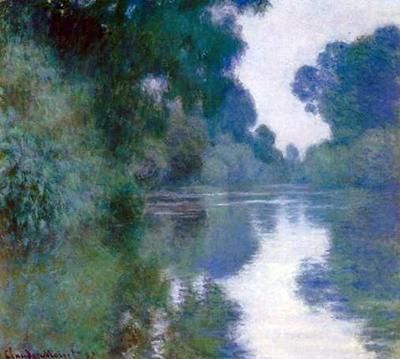
The Seine near Giverny shows the painting titled Morning on the Seine near Giverny in the Metropolitan Museum of Art. Dated 1897, it belongs to Monet's Mornings on the Seine series. [1] Dark trees surround a pale opening, and their reflections extend the landscape downwards into the water.
At a Glance
An opening framed by trees
The largest mass of foliage occupies the left side. It reaches across the upper edge and descends towards the river in an irregular, deeply coloured curtain. Across the water, a smaller group of rounded trees rises at the right.
Between them lies an opening of pale sky. It narrows as it approaches the distant bank, creating a view into the scene without relying on a road, building or boat to lead the eye. The same light shape appears below, where it becomes a bright passage on the river.
The result is almost a landscape doubled around a horizontal axis. Dark foliage above answers darker passages below; the opening in the sky answers the opening in the reflection. Yet the two halves are not mechanically identical. The water breaks and softens what it receives.
This interplay makes the scene both readable and slightly uncertain. We can recognise trees, sky and river, but their edges do not remain equally clear everywhere. Monet allows the act of recognition to unfold gradually, as the eye moves between solid-looking forms and more elusive patches of colour.
A river motif near Giverny
The Art Institute of Chicago's study locates the principal motif of the series near the meeting of the Epte and Seine, with a riverbank on one side and the Ile aux Orties on the other. [3]
This was a river subject, not a view of the water-lily pond in Monet's garden. The difference matters even though both kinds of painting give reflections a major role. Here, the trees enclose an opening towards a more distant bank, and the river continues beyond the visible scene.
The absence of a conspicuous built landmark makes the place harder to identify from the painting alone. There is no cathedral facade or bridge to supply an immediate name. Instead, the arrangement of foliage and reflected light gives the motif its distinctive structure.
Within the broader Giverny landscapes , this view is particularly absorbed in the relationship between the visible world and its reflection. The banks are present, but the water occupies enough of the composition to make their apparent boundaries unstable.
Painting before sunrise
The Kreeger Museum's account of a companion canvas describes Monet rising at 3:30 in the morning and using a boat as a floating studio during the 1896-1897 campaign. [4] The routine placed him before the motif while the early light was still changing.
This is useful context for the painting's atmosphere. It helps explain why the subject is not organised around the strong shadows of midday or a dramatic sunset. The contrast depends instead on relatively subdued colour and the gradual emergence of light between dark forms.
An early start did not mean that the scene remained fixed. A bank could become more legible, a reflection could brighten, or the balance between sky and foliage could shift. The painter had to decide which appearance belonged to which canvas.
The Art Institute connects the series with Maurice Guillemot's visit in August 1897, when he saw fourteen works in progress. [3] That account supports the idea of a coordinated group of paintings. It does not mean that all fourteen were finished during one morning, or that every surviving picture records a precisely known minute.
Different mornings, related compositions
The North Carolina Museum of Art explains the series through changes in sunrise and weather. Its own Morning Mists canvas is particularly delicate, with softened distant forms and restrained contrasts. [5]
The Met painting retains a stronger distinction between dark vegetation and light. Its left-hand trees are dense enough to act as a substantial frame, while the pale sky remains comparatively open. The bright reflection below is interrupted by thin horizontal strokes, suggesting that the water is not a perfectly still mirror.
Looking at related canvases therefore involves more than checking whether the same trees appear. The balance of colour can change the apparent weight of the entire scene. A darker canopy closes the view; a paler one allows the atmosphere to seem more pervasive.
The repeating motif gives those differences significance. We can compare the treatment of a similar opening or bank while noticing how each painting arranges its own contrasts. The series is not simply a collection of duplicate views, nor is it a scientific chart with every stage of the morning evenly represented.
Outdoor observation and studio completion
The Met records that poor weather delayed the project from 1896 into 1897. After working from the boat, Monet arranged the canvases in his studio and completed them together. Fifteen paintings from the series were exhibited at Galerie Georges Petit in 1898. [1]
This sequence complicates the idea that a convincing impression must have been painted in one uninterrupted outdoor sitting. Observation before the motif was essential, but the group also received sustained attention away from the river. Comparing canvases could help Monet judge relationships that were harder to hold in mind during rapidly changing conditions.
The distinction is especially relevant to the picture's apparent softness. Soft edges should not automatically be read as evidence of haste. A carefully considered arrangement can still convey something transient, just as a visibly energetic brushstroke can be the result of repeated thought and adjustment.
The Chicago study documents substantial changes beneath the pale surface of its own companion painting, W1475. [3] Those findings belong to that separate object, not automatically to the Met canvas. They nevertheless remind us that the series involved making paintings, rather than merely transferring ready-made atmospheric effects onto blank cloth.
Colour, reflection and a sense of depth
Cool greens and blues dominate the foliage, while mauve and pale pink appear within the lighter passages. These colours link the sky and water without making them indistinguishable. The brightest reflection carries the eye towards the lower edge, while the distant bank draws it back into space.
The direction of the marks helps organise this movement. Around the canopy, colour gathers into irregular patches. Across the river, narrower horizontal touches suggest a surface spreading between the banks. The two kinds of handling keep trees and reflections related but not identical.
No figure supplies a human scale. Instead, distance depends on the gradual reduction of the forms near the centre and on the overlap of the banks. The view feels enclosed, yet the bright opening prevents it from becoming a flat wall of foliage.
Wildenstein catalogued this particular canvas as Morning on the Seine, Clear Weather and noted that Durand-Ruel supplied that title in 1906. Its later history leads through Arthur B. Emmons and Julia W. Emmons to the Met. [2] Those records distinguish it from other similarly named works, while its visual identity lies in the distinctive meeting of a dark canopy and a luminous reflected sky.
Frequently Asked Questions
The Met's Morning on the Seine near Giverny, dated 1897. [1]
Wildenstein 1482. [2]
No. The series depicts a river motif near the meeting of the Epte and Seine. [3]
No. The Met records completion together in his studio. [1]
Discussion
Look again at the images and ideas explored in The Seine near Giverny. These editorial prompts invite your observations.
Reader Insights
Where do you find the clearest distinction between a tree and its reflection?
Does the bright opening lead your eye into the distance or down across the water?
How would a paler canopy change the balance of the picture?
Join the Conversation
Share a detail, comparison or question about The Seine near Giverny below.
References
- The Metropolitan Museum of Art , Morning on the Seine near Giverny, 1897, accession 56.135.4. View source .
- Daniel Wildenstein , Monet: Catalogue raisonne, 1996, volume III, W1482, p. 620, Wildenstein Plattner Institute digital edition. View source .
- Art Institute of Chicago , Branch of the Seine near Giverny (Mist), Cat. 36, scholarly series context and object-specific technical study. View source .
- The Kreeger Museum , Arm of the Seine near Giverny in the Fog, 1897, contextual account of the dawn painting routine. View source .
- North Carolina Museum of Art , The Seine at Giverny, Morning Mists, 1897, interpretation of the series. View source .