

 by Tom Gurney
Tom Gurney BSc (Hons) is an art history expert with over 20 years experience
Published on June 19, 2020 / Updated on August 2, 2026
Email: tomgurney1@gmail.com / Phone: +44 7429 011000
Contents
Introduction
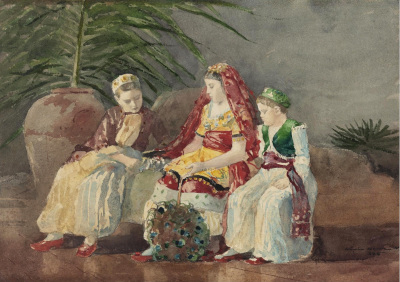
Children under a Palm sits in the quieter edge of Winslow Homer's Bahamas work. It is not one of the large late marine paintings, and it does not carry the immediate drama of The Gulf Stream or After the Hurricane, Bahamas. Its value is more intimate: three children gathered beneath tropical foliage, their costumes, pose and setting turning a private social moment into a watercolor study of figure, color and travel. [1]
The work is usually dated to 1885 and associated with Homer's first Bahamas journey. That matters because the Bahamas were not a casual backdrop in his career. During the mid-1880s and again in the late 1890s, Homer used Caribbean travel to test watercolor against brilliant light, pale walls, palms, sea air and colonial island settings. The subject here is small in scale, but it belongs to the same broad turn that produced Nassau and Bahamas scenes across his late work. [2]
The picture is also a reminder that Homer's tropical watercolors were not only about coastlines and storms. He could use the same travel medium for a social encounter. The children sit close to the front of the composition, dressed in theatrical costume rather than everyday clothing. The title directs attention to the palm, but the eye settles on the group: the contrast between bright garments, delicate faces and shaded setting gives the sheet its particular tension. It is both a portrait-like study and a travel watercolor. [3]
Homer had been working seriously in watercolor since the 1870s. Local planning sources for this cluster treat watercolor as a central medium in his career, not a sideline. By the time of the Bahamas trip, he had already used the medium for Gloucester children, Adirondack subjects and English coastal figures. Watercolor gave him speed, portability and luminosity, but it also demanded discipline. In Children under a Palm, the medium helps keep the scene light and open. The figures are described enough to anchor the moment, while the setting remains airy and suggestive. [4]
The costume is the feature that most separates this work from a straightforward tropical genre scene. Rather than presenting the children as anonymous figures in a landscape, Homer records a staged moment, probably connected with the household of Sir Henry Blake, governor of the Bahamas during Homer's visit. The traditional account identifies the sitters as Blake children in fancy dress. That history is best handled carefully before final publication, because the best current manuscript route still needs a stronger object record than the general online retellings provide. Even with that caution, the broad reading is clear enough: Homer was responding to a particular social occasion, not inventing a generic island scene. [5]
That social character links the watercolor to Homer's wider interest in children and young people. Earlier Gloucester watercolors such as Boys in a Dory and A Basket of Clams present children within working coastal environments, where play, labor and future risk sit close together. Children under a Palm is different in tone. The children are costumed, posed and sheltered. Yet the work still depends on Homer's ability to make young figures feel observed rather than merely decorative. Their stillness keeps the image from becoming a postcard of exotic setting. [6]
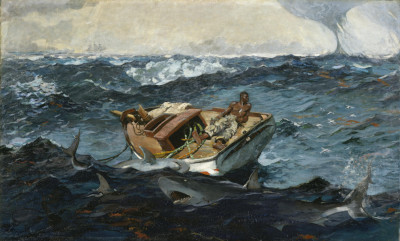
The Bahamas context should also be kept in view. In adjacent works such as A Wall, Nassau, Palm Tree, Nassau and Hurricane, Bahamas, Homer used tropical architecture, vegetation, weather and island signs to think through place. Later, The Gulf Stream would turn Caribbean waters into a scene of danger, empire, survival and unresolved history. Children under a Palm is not that kind of painting. It does not ask the same historical weight of its subject. But it does show how Homer's Bahamas material could move between private encounter, travel observation and formal experiment. [7]
The palm itself is more than background. It gives the article its route into the watercolors hub because it locates the sheet within Homer's travel practice: paper, wash, graphite or pencil, portable looking and a sensitivity to light that changes from region to region. Compared with his Maine seascapes, this work lowers the emotional temperature. Instead of waves, wreckage or weather, the composition rests on color, costume and shade. That quieter register is exactly why the article earns a concise rescue rather than a flagship treatment. [8]
For readers exploring Homer, Children under a Palm works best as a bridge page. It can lead backward to the 1870s watercolor children, sideways to Nassau and Bahamas subjects, and forward to the more ambitious Caribbean and Gulf Stream works. It does not need to be made to carry more certainty than the sources support. Its strongest public use is to show that Homer's Bahamas work included intimate figure studies as well as storms, palms, walls and sea drama. [9]
Discussion
Winslow Homer rewards close looking because his strongest images rarely close down into one easy meaning. Use the prompts below to test how the work changes as you move between subject, place, medium and history.
Reader Insights
First Look
What detail in Children under a Palm changes how the whole work feels?
Homer's Method
Where do you see Homer's balance between clear observation and unresolved meaning?
Cluster Context
Which related Homer work helps you read this page more carefully?
Join the Conversation
Share a thoughtful observation below, especially if a detail, source connection or related Homer page changed the way you read the work.
References
- Local planning:
phase-1-approval-brief-draft-2026-07-20.md. - Local planning:
provisional-url-decision-matrix-2026-07-20.md. - Local packet:
phase-1a-medium-hub-source-packets-2026-07-20.md. - Local packet:
phase-1a-homepage-biography-source-packets-2026-07-20.md. - Local ledgers:
internal-link-ledger-2026-07-20.md,quote-ledger-2026-07-20.md,glossary-ledger-2026-07-20.md,tom-image-policy-issue-bearing-pd-assets-2026-07-20.md. - The Metropolitan Museum of Art, Heilbrunn Timeline of Art History essay on Winslow Homer: https://www.metmuseum.org/essays/winslow-homer-1836-1910.
- The Metropolitan Museum of Art object record, A Wall, Nassau: https://www.metmuseum.org/art/collection/search/11147.
- The Metropolitan Museum of Art object record, Palm Tree, Nassau: https://www.metmuseum.org/art/collection/search/11131.
- The Metropolitan Museum of Art object record, Hurricane, Bahamas: https://www.metmuseum.org/art/collection/search/11124.
- The Metropolitan Museum of Art object record, The Gulf Stream: https://www.metmuseum.org/art/collection/search/11122.
- Wikimedia Commons file page for Children Under a Palm Tree: https://commons.wikimedia.org/wiki/File:Winslow_Homer%27s_%27Children_Under_a_Palm_Tree%27.jpg. Used only as a provisional object-fact and image-route lead, not as final image approval.
- Wikidata item Children Under a Palm: https://www.wikidata.org/wiki/Q5098351. Used only as a provisional cross-check for title/date/medium/dimensions; not a substitute for final object capture.
- Irish Times correction naming the work Children Under a Palm: https://www.irishtimes.com/opinion/corrections-and-clarifications-1.592158. Used only to support title caution, not interpretive claims.
 Winslow Homer.jpg)