

 by Tom Gurney
Tom Gurney BSc (Hons) is an art history expert with over 20 years experience
Published on June 19, 2020 / Updated on August 29, 2026
Email: tomgurney1@gmail.com / Phone: +44 7429 011000
Sunrise at the Edge of the Picture
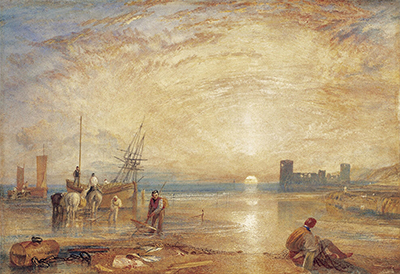
The sun rises low over the Dee estuary, but Flint Castle does not stand beneath it. J. M. W. Turner pushes the ruin toward the far right, where its towers interrupt a narrow horizon under an immense revolving sky. The decision is startling for a work named after a castle. Architecture supplies the location, yet light claims the largest share of attention.
The privately held watercolour is Flint Castle, North Wales, made in the early 1830s. It measures 230 by 325 millimetres and is signed at lower left `JMWT / RA`. Turner worked over pencil with transparent watercolour, touches of bodycolour, stopping out and scratching out.[1] These materials allowed him to build both the broad radiance of the sky and the sharp, scattered lights of wet sand, horses, clothing and water.
At centre left, boats and tall spars rise from the shallows. A mounted figure and several horses approach a vessel. People wade nearby, while a man seated at lower right appears to mend a net. Equipment and the remains of a catch lie across the immediate foreground. Beyond them, the sun touches the horizon and throws a pale reflection toward the spectator.[1]
The scene has the spaciousness of a panorama despite its modest physical dimensions. Much of that breadth comes from displacement. The castle no longer acts as a conventional central climax. It becomes one point on an extended horizontal circuit that runs from boats and figures through the sun to masonry, shore and hill. The eye must travel sideways rather than settle.
Sotheby's described the effect as sunrise when the sheet was sold in 2004 and again in 2010.[1][2] The interpretation fits the catalogue's account of fishing boats preparing for the day and figures working in early light. Yet the 2010 condition paragraph calls the same glow “sun-set.”[1] That inconsistency advises restraint. Dawn is the best-supported reading, not an astronomical fact proved by the image alone.
The work last appeared at public auction in London on 6 July 2010. Its reported price was £541,250, above the estimate of £300,000 to £500,000.[1][3] The buyer was not named in the locked public record. It should therefore be described as privately held, rather than assigned to a collector or museum without evidence.
That private identity matters because another major Turner watercolour called Flint Castle belongs to Amgueddfa Cymru - Museum Wales. The Cardiff sheet differs substantially in size and arrangement.[4][5] Turner returned to the subject repeatedly, and any serious reading must begin by recognising which sunrise, which castle and which set of foreground lives it is looking at.
At a Glance
- ArtistJoseph Mallord William Turner
- TitleFlint Castle, North Wales
- DateEarly 1830s
- MediumWatercolour over pencil with bodycolour
- Dimensions230 × 325 mm
- SignatureJMWT / RA, lower left
- OwnershipPrivate collection
- Wilton catalogueNo. 885
- Last documented saleSotheby's, 6 July 2010
- Sale result£541,250
Contents
- Sunrise at the Edge of the Picture
- The Vast Dome of Sky
- Work across the Tidal Shallows
- A Castle Kept to One Side
- How Turner Made the Light
- From a Colour Beginning to a Finished Shore
- Four Decades of Looking at Flint
- The Related Watercolour in Cardiff
- Turning Watercolour into Engraving
- Ruskin on Light, Colour and Distance
The Vast Dome of Sky
The sky occupies well over half the private composition. It is not a flat yellow field around a solar disc. Blue-grey, pale gold, cream, orange and muted red pass through one another in layers of minute movement. Cooler colour collects at the upper left and along cloud edges; warmer light expands across the centre and right. The result resembles a dome because the colour seems to curve over the estuary.
The sun sits just above the horizon, smaller and more definite than the radiance around it. A vertical reflection breaks beneath it, crossing horizontal bands of distant water. This opposition gives the image its basic geometry: a low, long shore cut by a descending column of light, under a sky whose cloud strokes spread outward.
Sotheby's connected that outward movement with peripheral vision.[1] Rays and cloud marks draw the gaze away from the solar centre toward the margins. The spectator cannot absorb the watercolour by staring at one focal point. Attention moves between bright disc, boats, castle, foreground fisherman and the coloured sweep overhead.
The castle benefits from this dispersal. Its dark towers are legible against the luminous air, but they do not need detailed masonry to announce themselves. Their silhouette catches vision near the edge, much as a solid object becomes suddenly noticeable when the eye has been following light elsewhere. Architecture is perceived within atmosphere rather than placed outside it.
The upper colour is built from small hatchings and stipplings as well as wider passages. Sotheby's recorded these minute touches in the object itself.[1] In reproduction they create a vibrating grain. Some marks align into cloud streaks; others loosen the boundary between blue and gold. Their scale makes the great sky paradoxical: immensity is generated through repeated small actions.
The sky also establishes time without narrative incident. There is no clock, procession or historical costume that fixes an hour. The low sun, cool residual shadow and waking labour suggest transition. Boats are not yet under full sail, and figures occupy the intertidal margin. The entire landscape seems poised between rest and activity.
Turner avoids the sharp orange-red drama often associated with sunset. The surviving colour is paler, partly because the sheet has lost brightness over time.[1] Even allowing for that change, the composition depends more on diffusion than blaze. The sun emerges through humid air, and its power is shown through reflected spread rather than a saturated disc.
This makes the sky an active environment. It alters the apparent colour of castle, shore, boats and water. Warm masonry retreats into haze; dark masts stand clear; white clothing catches gold. Nothing keeps a wholly local colour. The atmosphere binds distant military ruin and immediate working bodies into one morning condition.
Work across the Tidal Shallows
Turner's foreground is busy but not crowded into a single anecdote. A seated fisherman bends over material in his lap, identified in the auction catalogue as a net. Horses and handlers gather near the central boat. Two figures wade through shallow water, interpreted as shrimpers. A second vessel raises or prepares its sail farther left.[1]
These actions explain the landscape physically. The exposed sand and ankle- or knee-deep channels belong to a tidal estuary. People can walk far from a dry bank because the water has withdrawn or remains shallow. Boats sit within the same space as horses and pedestrians, showing that the boundary between land and water shifts.
The Dee estuary historically supported varied livelihoods. Local archaeological and community history records fishing, cockling and shrimping alongside shipping and later industry.[17][21] Turner does not supply a census of occupations, but his figures are credible within that environment. Their tools, nets, boats and relation to the tide make labour inseparable from place.
The mounted figure and loose horses create another kind of movement. They may be bringing people or goods toward the vessel, but no exact transaction is documented. Their pale bodies catch recovered highlights and provide large, rounded forms against the thin vertical masts. They also suggest how estuary transport could connect watercraft with movement on shore.
At lower left, fish or discarded parts of a catch lie among ropes and equipment. The reproduction does not support confident species identification. Their pictorial function is clearer: pale shapes pull the spectator close to the surface and lead toward the boat. The working foreground is not polished scenery; it contains weight, dampness and the remains of use.
The seated fisherman offers a quiet counterpoint to the sunrise. His body turns toward the estuary, yet his hands remain occupied. He can be read as admiring the view, as Sotheby's suggests, but he may equally be concentrating on repair.[1] Turner allows both. Labour and looking coexist in one posture.
Figures are distributed across depth rather than grouped into a theatrical cast. Large foreground bodies give way to smaller waders and boatmen. The castle is still smaller, though far more massive in reality. This sequence turns the shallow water into measurable distance. Human scale makes the atmospheric breadth intelligible.
Their colours are equally structural. Warm reds, ochres and pale clothing stand forward against grey-blue water. More muted figures near the boats sink into haze. Turner can therefore direct the eye without heavy outline. Near colour and distant atmosphere create spatial hierarchy while preserving the impression that everything shares one moist light.
A Castle Kept to One Side
Flint Castle appears almost as an afterthought, but its placement is carefully calculated. Two principal tower forms and a lower wall mass rise at far right, backed by a faint slope. Their dark silhouette balances the taller cluster of masts left of centre. Boats and ruin become unequal weights across the horizontal span.
The castle's position changes the meaning of the title. A conventional architectural portrait might put the monument in the middle and arrange incidental figures around it. Turner makes the named structure one participant in an estuary world. Its old military function has ended; tides, fishing and small craft continue around its remains.
This does not make the castle insignificant. The right edge would feel unresolved without its blocky forms. The towers stop the outward rush of light and provide a counterweight to the boats. Because masonry is compact while the sky is dispersed, a small dark area can balance a much larger luminous one.
Sotheby's noted a blue thumbprint in the painted castle.[1] The mark is unusually direct evidence of touch. It turns the ruin's distant solidity into the record of a finger pressing pigment. Turner did not need laborious architectural finish to make the mass convincing. A bodily accident or deliberate impression could contribute texture at precisely the point where stone meets haze.
The composition's lateral structure also reflects how a traveller might encounter Flint. The castle stands on the low southern shore of the Dee rather than crowning a mountain. It does not dominate by elevation. Its distinctive isolated great tower and square ward gain force from separation and profile against estuary air.[16][18]
By reducing descriptive detail, Turner lets the ruin operate across several distances. From afar it is unmistakably architectural; closer inspection reveals soft and broken handling. The spectator alternates between recognising a fortified outline and seeing touches of blue, brown and warm light. Historical monument and painted matter never fully separate.
There is no visual enactment of a siege, surrender or royal meeting. The foreground people wear the visual world of Turner's own era, not medieval costume. The castle's history remains available to an informed viewer, but the image's present tense belongs to work on the shore.
The lateral position finally prevents the ruin from becoming a nostalgic emblem detached from society. Boats, horses and workers occupy more immediate attention. Flint's past is neither erased nor allowed to consume the living estuary. Turner shows historical architecture enduring at the margin of daily time.
How Turner Made the Light
The 2010 catalogue supplies unusually specific evidence about the private sheet's manufacture. Turner began over pencil, then used transparent watercolour with touches of bodycolour, stopping out and scratching out.[1] These methods gave him several routes to brightness: reserving paper, removing colour, placing opaque light and cutting through a dried layer.
Sotheby's examination proposed that he used a sponge or cloth to draw colour out of the paper for the sun, rays and reflection.[1] The technique differs from simply painting a pale circle. Removal lets the support itself become light, producing edges that can be soft, irregular and embedded in surrounding wash.
The white horses, clothing and foreground fish were also described as areas where underlying colour had been removed to expose paper.[1] Their light is therefore materially related to the sun. A horse's flank, a garment and a strip of water all participate in the same system of recovery, even though they represent different substances.
Other whites, especially ripples, were scratched out. A sharp tool, brush end or Turner's prepared thumbnail could break narrow lines through colour.[1] Scratching is well suited to water because it creates sudden glints that remain distinct from broad reflection. The marks catch the eye as discontinuous flashes rather than painted ribbons.
Stopping out works by preventing a wash from reaching selected areas, often through a resist later removed. Bodycolour provides the opposite strategy: adding relatively opaque paint over what is already there. Turner could preserve, uncover and reapply brightness in one object. The final radiance is not the product of a single wash recipe.
Minute hatching and stippling in the sky show another scale of work. Tiny coloured touches animate cloud and keep large pale areas from becoming blank. At the castle, the recorded thumbprint introduces a broader, blunt texture.[1] Fine point, scratch, cloth and finger all contribute to a unified atmosphere.
General accounts of Turner's watercolour practice describe his willingness to lift, rub, scrape and combine transparent and opaque applications.[23] Here, however, the strongest claims come from the specific examination of the sheet. General method explains that such actions belonged to his vocabulary; the 2010 record identifies their proposed presence in this work.
The technical variety should not be mistaken for display of tricks. Each action answers a visual problem. Broad lifting makes the sun breathe; scratches make ripples flash; pale horses articulate depth; hatching gives cloud movement; a thumbprint roughens distant masonry. Means remain subordinate to the experience of light spreading across wet ground.
What the 2010 Condition Record Can Tell Us
Works on paper change with exposure, mounting and handling. Sotheby's reported in 2010 that the private watercolour was attached at its edges to a conservation board, probably in a fairly recent treatment. The sheet was considered in good condition, with slight residual mount staining and tiny cuts caused by glass damage in the sky above a mast.[1]
The colour record was more consequential. The catalogue stated that delicate tints had lost some brightness after long framing and glazing. It named crimson lake, gamboge and indigo as colours whose reduction would have made the original light more vibrant.[1] This evidence helps explain why the present reproduction appears softly golden rather than intensely red, blue and yellow.
The report also noted a small area of retouching near the lower left edge. Such intervention should be acknowledged without inflating it into general reconstruction. Most of the composition remains legible, and the catalogue still described the watercolour as lively.[1]
Important limitations accompanied the statement. The work was viewed outside studio conditions, and Sotheby's stressed that the opinion was general and not a substitute for assessment by a professional conservator.[1] It also dates from 2010. No present conclusion about mounting, fading or later treatment can be drawn without renewed examination.
Colour change affects interpretation. If cool blue and strong warm tints weaken at different rates, the relationships Turner established can shift. The sun may look less brilliant, clouds less deep and foreground accents less forceful. Description must distinguish the surviving appearance from a confident reconstruction of original intensity.
Yet fading does not erase the design. The low disc, reflection, opposing silhouettes and dome-like distribution of cloud remain powerful. Material change may soften contrast, but it also makes close attention to tonal structure more important. Turner's composition does not rely only on saturated pigment.
The recorded condition further cautions against exact digital comparison. Reproductions vary in white balance, crop and contrast. The local detailed image and auction imagery permit broad close reading; they do not provide calibrated colour measurement. Terms such as gold, blue-grey and orange describe visible relations rather than laboratory values.
Conservation evidence thus deepens rather than diminishes the work. It reveals that Turner's light was made through vulnerable materials and physical actions. The sunrise is both represented weather and an arrangement of paper, colour and exposed fibres that has continued to change since the early nineteenth century.
From a Colour Beginning to a Finished Shore
Tate D35986 is titled Sunset: Study for 'Flint Castle, on the Welsh Coast'.[15] Sotheby's dates it around 1830 and connects it with the private finished watercolour.[1] The study concentrates on a low solar effect and radiating colour rather than supplying every boat, horse and working figure.
Such works are often called colour beginnings because they establish the broad chromatic and atmospheric premise from which a composition may develop. They are not necessarily first thoughts in a strict chronological sequence, nor complete cartoons waiting to be enlarged. Their purpose can be exploratory: testing how a sun, horizon and field of wash might hold together.
The relationship is persuasive because both study and finished sheet direct the gaze outward through rays and reflection.[1] The private watercolour then builds a social and topographical world around that optical structure. Flint Castle, vessels, people and horses enter an atmosphere that had already been considered as a problem of colour.
This order matters. The finished landscape does not appear to begin with a fully drawn castle to which a sunrise was added. Light governs the placement and visibility of the architecture. A small ruin can remain at the edge because the colour design already carries the composition.
At the same time, D35986 should not be treated as proof for every finished detail. It does not establish the exact identity of each foreground action or dictate all final hues. Turner could alter scale, insert figures and adapt the relation of sun to shore while retaining the study's atmospheric logic.
The title “sunset” introduces the same temporal ambiguity found in the 2010 record. Sotheby's reads the private scene as sunrise but links it to a sunset or sunrise study.[1][15] The most useful conclusion is not to force one universal hour across all related works. Turner explored low sun over the Dee, and different catalogues have named that light differently.
The study also belongs to a wider practice of memory. Turner's first encounter with Flint occurred decades earlier. A colour beginning made around 1830 could combine recollected topography, later observation and studio experiment. The gap between travel and finish was productive rather than a failure of immediacy.
What emerges in the private sheet is therefore constructed naturalism. The scene feels observed because tidal labour, boats, wet reflection and castle profile cohere. Its coherence comes from design: an atmospheric beginning developed into a finished world, not an instantaneous transcription of everything before the artist at one dawn.
Four Decades of Looking at Flint
Turner first visited Flint in 1792, when he was still a teenager. Sotheby's records two early watercolours of the ruin that were engraved in 1795 and 1797.[1] The later sheet cannot be understood as his first discovery of the place. It is a return to a motif already embedded in his professional development.
The 1797 print known as Flint, from Park-Gate presents an extensive view across the estuary, with figures and dogs in the foreground, fields and buildings below, shipping on the water and distant castle and town.[13] Its prospect-like breadth belongs to a young artist supplying topographical imagery for publication.
Turner returned to the area in 1799. A drawing in the Dolbadarn Sketchbook records Flint Castle and the Dee estuary.[1] Welsh journeys were central to his early landscape education, allowing him to study coasts, rivers, mountains, ruins and changing weather across repeated tours.[22]
By 1807 he had transformed the motif for the Liber Studiorum. The print was etched by Turner and completed in mezzotint by Charles Turner.[14] It shows vessels unloading near a low castle, but its identity has never been entirely stable. Institutional records preserve alternate titles including Scene on the French Coast and French Coast, Smugglers.[14]
That ambiguity is valuable. The design may have drawn on Flint while being generalised into a category of marine landscape. Its brown-ink etching and mezzotint differ profoundly from the later coloured sunrise. Flint could function as named topography, remembered source and adaptable coastal type.
The British Museum's records bring the chronology into view: early engraved prospects, the 1807 Liber plate and the 1836 Kernot print are separate objects after separate designs.[12] Repetition did not mean stagnation. Each project asked the castle to do something different.
Viewpoint changed with purpose. The early Parkgate prospect looks across a broad territory and makes the castle one distant component of mapped country.[13] The Liber design comes closer to boats and unloading, reducing topographical certainty while strengthening marine type.[14] In the private early-1830s sheet, the spectator is virtually on the wet shore among gear, horses and workers. The castle moves laterally, while the low sun establishes a horizon experienced through moisture and glare. The Cardiff version then retains proximity to estuary labour but recentres the monument and thickens the inhabited foreground.[4][5] This sequence is not a straight march from factual youth to abstract maturity. Turner repeatedly adjusts distance, naming and human activity according to whether he is preparing a topographical print, a tonal category or a richly coloured autonomous watercolour.
In the early 1830s, the private sunrise returned to close observation and colour experiment. The low sun, horses and fishing labour make the shore specific, while the castle's marginal position loosens it from architectural illustration. Soon afterward, Turner produced the related design now in Cardiff for Picturesque Views in England and Wales.[1][4]
Across these decades, Flint shifts from distant prospect to tonal marine subject, then to radiant estuary life. The repeated motif lets us see Turner's changing priorities. Topographical recognition remains, but atmosphere, material experiment and the lives around the ruin become increasingly important.
The Related Watercolour in Cardiff
Museum Wales NMW A 1757 is a distinct finished Flint Castle. The museum dates it circa 1834 and records dimensions of 27.7 by 40.1 centimetres. Its materials are watercolour, bodycolour and paper, with scratching out.[4] Sotheby's calls it a second version made in 1835.[1] “Circa 1834-35” preserves both records without pretending they agree exactly.
The composition differs immediately. In the Cardiff image the castle sits nearer the centre, partly dissolved in mist.[5] A dense group of vessels and masts rises to its left. Waders, horses and upright figures extend to the right, while a family-like group and a person carrying a net occupy the foreground. There is no comparable hard solar disc at the horizon.
Light remains the governing subject, but it is dispersed. Warm cream, pale blue, rose and grey wash across sky and water. Reflections blur verticals downward. The castle appears less as a dark boundary than as a warm form materialising within haze.[5]
Foreground emphasis also changes. The private version gives the seated net-mender considerable isolation at lower right and places working debris near the spectator. Cardiff brings figures forward in a more open sandy field. Nets become broad translucent shapes, and brighter green and orange clothing helps separate near bodies from atmospheric distance.[5][6]
The Cardiff shore also changes the relation between work and spectatorship. A net-bearing figure faces a small cluster that includes women and children, while horses and upright figures form a busier band farther back.[5] The private sheet isolates separate tasks: mending, wading, handling animals and preparing boats. Cardiff makes the foreground more conversational and socially connected. Neither arrangement should be treated as a literal inventory of one observed instant. Their differences show Turner testing how much anecdotal clarity an atmospheric landscape can absorb. In the mistier version, vivid near clothing and pale nets prevent the human group from dissolving; in the sunrise design, the seated man and horses punctuate a shore already structured by the hard solar disc and its reflection.
Ruskin owned this later sheet, not the private sunrise. His 1878 catalogue called it the loveliest pure watercolour in his collection and praised the play of light across the water and the purity of colour near the sand.[6] He accepted that the near green and orange could feel harsh by themselves, arguing that they made distant water, castle and sky recede.
That optical insight is specific to the Cardiff arrangement but useful in comparison. Turner's forceful foreground colour is not careless decoration. Near accents establish a key against which muted distance can be perceived. In the private version, reds, pale horses and darker gear perform a related spatial task, though Ruskin did not write those words about it.
The Cardiff watercolour's later institutional history is unusually clear at its endpoint. In 1982 it and Turner's Salisbury were accepted by the government in satisfaction of £50,662 in tax, with no destination condition.[7] Flint Castle was allocated to Museum Wales, whose record calls the acquisition a gift. It is currently listed as in store.[4]
The two finished sheets should not be ranked automatically as preliminary and definitive. The private work's hard low sun and lateral ruin create one coherent experience; Cardiff's mist and central architecture create another. Their relationship shows Turner rethinking a successful configuration for different purposes, including eventual translation into print.
Turning Watercolour into Engraving
The Cardiff design became part of Picturesque Views in England and Wales, the largest of Turner's topographical print enterprises. Publisher Charles Heath began the project with Jennings and Company in 1825. Ninety-six views appeared between 1827 and 1838, short of the proposed 120.[8]
James H. Kernot engraved Flint Castle, North Wales in 1836. The Fitzwilliam Museum identifies its impression as a line engraving in volume II and associates it with Rawlinson number 292.[9] Museum Wales owns another steel-engraved impression, acquired in 1914.[11]
Engraving transformed Turner's coloured atmosphere into a reproducible tonal structure. The print could not carry the original's green, orange, rose and blue as colours. Kernot had to express distance through line density, cross-hatching, reserved paper and contrast. Bright water became white or lightly worked areas; darker figures and masts accumulated ink.
The National Library of Wales impression makes the transformation visible.[10] Castle, central shipping and foreground groups preserve the watercolour's arrangement, but contours become firmer. Nets, garments and reflections must be clarified enough to survive printing at a smaller image size.
This process involved interpretation rather than neutral copying. An engraver had to decide which soft edges to define, which marks to suppress and how to translate subtle colour opposition into black and white. Turner's designs were made with reproduction in mind, but their watercolour effects still tested the limits of line engraving.
The print also changed the audience. A privately owned watercolour could be seen by a small circle or in temporary display. Published impressions circulated through parts, bound volumes and later collections. Flint's estuary, workers and castle became available far beyond Wales.[8][9]
Publication reinforced the title. Earlier Flint-related images had carried ambiguous or broader labels. Kernot's plate firmly named Flint Castle, North Wales. Topography mattered to the national survey promised by the series, even when Turner's atmosphere made the place look dreamlike.
The series joined historical monuments with contemporary life, violent weather, industrial towns, rivers and coasts. Flint fit especially well because it contained several Englands and Waleses at once: Edwardian conquest architecture, Shakespearean memory, working shoreline and modern print culture. The watercolour's beauty did not remove those tensions; reproduction spread them.
Ruskin on Light, Colour and Distance
John Ruskin exhibited his Turner collection at the Fine Art Society in 1878. In his catalogue, the Cardiff Flint Castle appeared as number 41.[6] His assessment is among the strongest tributes he gave any watercolour he owned.
Ruskin focused first on the water. He praised the play of light across its surface and what he called the “infinite purity” of the ripples near sand.[6] The language suits the sheet's dissolution of boundaries. Water, wet shore and air share pale colour, while scratched and reserved lights prevent the field from becoming blank.
He then addressed an apparent defect. The strongest green and orange on foreground figures seemed painful when isolated. Their value emerged relationally: those near notes pushed softer greens and warm castle colour into aerial distance.[6] Ruskin was describing a system in which one area's intensity changes how another is perceived.
His comments resist the idea that Turner's late or mature colour was merely uncontrolled brilliance. The startling accents had a spatial function. Remove or mute them, and distant atmosphere would lose force. Beauty depended on opposition, not uniform sweetness.
The analysis also explains why black-and-white engraving posed a problem. Kernot could translate value contrasts but not the exact optical work of complementary or adjacent hues. The print records composition with great fidelity while offering a different experience of distance.[9][10]
Ruskin's ownership shaped the watercolour's reputation. His 1878 exhibition placed it among a carefully arranged account of Turner's versatility. The praise was not an auction-room phrase invented later; it came from sustained looking by the critic who had made Turner's treatment of water, atmosphere and colour central to Modern Painters.[6]
Attribution of the remark must remain exact. Sotheby's cited it when discussing the private variant and suggested that it might equally describe that work.[1] This is a comparison, not provenance. Ruskin's “whole collection” refers to the later Cardiff sheet.
Once correctly assigned, the passage enriches both watercolours. It documents direct nineteenth-century response to one and offers a disciplined way to compare the other. The private sunrise similarly depends on forceful near colour and distant warmth, but its low sun, dome sky and edge-set castle create a different optical argument.
A Fortress of Edwardian Conquest
Flint Castle was begun in 1277 during Edward I's campaign against Llywelyn ap Gruffudd. Cadw describes it as the first of the king's new North Welsh fortresses and says it was largely complete by 1284.[16] It was not an indigenous Welsh stronghold later absorbed by the Crown. Its origin lay in English military occupation and territorial control.
The location was strategic. A rocky headland projected from the otherwise low southern shore of the Dee, midway between Chester and Rhuddlan and accessible by land and sea.[17] Ships could supply the garrison, while the castle and planned borough secured a point from which further conquest might proceed.
Its design was unusual. An almost square inner ward had round towers at three corners. A detached great tower, or donjon, occupied the south-eastern corner, separated by its own moat and reached by drawbridge.[16][18] Cadw describes this as a castle within a castle, a final refuge with exceptionally thick walls.
Castle and town formed an integrated colonial plan. The borough was laid out for predominantly English settlers, with market privileges and routes aligned to the fortress. Crown, civic and ecclesiastical authority were embedded in the geometry of settlement.[17] The apparently lonely ruin in Turner's watercolour once belonged to an administrative system imposed on the landscape.
The crisis intensified in 1282 when Dafydd ap Gruffudd attacked Hawarden and the Welsh revolt drew in Llywelyn. Coflein identifies Flint as instrumental in the English campaign that ended organised resistance after Llywelyn's death.[18] A picturesque silhouette therefore carries a history of coercion as well as architectural ingenuity.
Turner does not narrate that conquest. The towers are too distant for banners, soldiers or siege action. Yet naming the structure makes its history relevant. Calling it simply a romantic Welsh ruin would obscure who built it and why.
The living foreground creates a productive historical reversal. A fortress designed to control movement now stands beyond fishers, horses and small boats whose activity is not visibly governed by it. Military architecture has become a landmark within civilian rhythms. The estuary outlasts the castle's original command.
This does not turn Turner into a modern critic of colonial power. No evidence supplies that declared intention. The responsible interpretation keeps history and image together: the monument arose from conquest, while the watercolour repositions its remains inside atmosphere and labour rather than celebrating intact fortification.
Richard II, Shakespeare and the Ruin
Flint Castle entered national historical memory through the fall of Richard II. In 1399 Richard met Henry Bolingbroke there during the crisis that led to his deposition and Bolingbroke's accession as Henry IV.[16] Shakespeare made the castle a principal setting in Act 3 of Richard II.[20]
The play turns physical height into political meaning. Richard appears above on the castle walls while Bolingbroke waits below. He then descends to the base court. Folger's analysis traces how this movement transfers the play's solar imagery: the king who imagined himself as the sun is brought down as his rival rises.[19]
Turner's low sun and ruined towers make that literary connection tempting. It would be easy to call the solar disc Richard's setting power or the castle a direct illustration of his descent. There is no documentary basis for that claim. The foreground contains nineteenth-century estuary life, and no figure is identified as a king.
Shakespeare nevertheless changed how British viewers understood Flint. A named view could summon remembered language and stage action even without depicting them. Historical association becomes one layer of reception, not a coded programme imposed on every mark.
The castle's ruinous state came much later. It remained a county administrative and financial centre during the later medieval period.[18] In the English Civil War it was garrisoned for the Royalists, changed hands and surrendered to Parliament in 1646. Parliament then ordered its demolition along with other Welsh fortifications.[18]
This slighting produced the broken profile Turner knew. The low walls and isolated towers are not the slow work of weather alone. They record deliberate military disabling after a second conflict over sovereignty. Flint's appearance joins Edwardian construction and parliamentary destruction.
By the early nineteenth century, ruin could be valued aesthetically while remaining close to working town and estuary. Turner does not clear away boats, nets and animals to recover an imagined medieval purity. The historic silhouette shares space with ordinary use. That mixture distinguishes his vision from a theatrical reconstruction of Richard's surrender.
Sun, castle and labour therefore carry different kinds of time. The sun marks an hour; fishing follows tide and day; the ruin condenses centuries; Shakespeare supplies cultural memory; the watercolour belongs to Turner's repeated encounters. Their coexistence gives the small sheet historical depth without turning it into an illustrated chronicle.
Flint between Estuary and Industry
Turner presents Flint from the waterward side, where castle, boats and shallows meet. That orientation corresponds to the fortress's original supply logic. The Dee was not a decorative background but the approach that made the location militarily useful.[17]
By Turner's era, the estuary also sustained fishing, shipping and harvesting from tidal sands. Local history identifies shrimpers wading in the shallows and fishers repairing nets among the details preserved in his Flint images.[21] The private watercolour makes those activities the foreground subject rather than incidental staffage.
The Dee's broad flats allow unusual combinations. Horses can stand near hulls; people walk where water will later return; reflections appear in channels rather than a continuous sea. Turner uses this unstable geography to blur categories. Sand behaves like a mirror, and boats seem momentarily grounded inside light.
Flint was also changing economically. The urban character study traces metal processing, chemical production and expanding works along the estuary from the eighteenth into the nineteenth century.[17] Industrial development would later transform the town and shore, while the railway arrived in 1848 after the watercolour's creation.
Little heavy industry is explicit in the private image. Masts, boats and working figures belong to older and continuing estuary economies. It would be misleading to read every haze as smoke or the sunrise as judgement on manufacture. Turner selects a shore scene in which labour remains intimate and dispersed.
Yet the date prevents an entirely timeless pastoral interpretation. The castle stood beside a town already moving toward industrial expansion. Turner could present nets and horses without claiming they represented all of Flint. The beauty of the sunrise coexisted with economic change beyond the frame.
This selectivity is part of landscape art. A view can be geographically true while excluding prominent structures outside its chosen direction. Turner's purpose was not municipal inventory. He organised the estuary around light, repeated verticals and shore activity, preserving one experience of a more complex place.
The later history sharpens the value of that experience. Railway walls eventually separated castle from parts of town, and industry altered land use.[17] Turner's scene records neither an untouched medieval coast nor the mature industrial landscape, but a moment when ruin, tidal work and modern development overlapped.
Provenance and Two Different Afterlives
The private watercolour's documented ownership begins with Sam Mendel of Manley Hall before 1875. It passed through sales associated with John Knowles in 1877 and 1880, then appeared in the 1918 executor's sale of James Barrow, where a buyer named King acquired it.[1]
It later belonged to J. M. Harvey and descended to his widow, then to Mrs Nuttall. Agnew's bought it in 1974; subsequent recorded owners or dealers include Richard Green and M. M. Yamanaka in Tokyo.[1] The sheet was exhibited at the National Museum of Western Art in Tokyo and the Kyoto Municipal Museum of Art in 1986.[1][2]
At Sotheby's in 2004 it was lot 17, estimated at £250,000 to £400,000.[2] The buyer returned it to Sotheby's in 2010, when lot 251 achieved the publicly reported £541,250.[1][3] No later owner is identified by the locked sources.
This chain differs completely from the Cardiff sheet's. Ruskin owned the related engraving-design and exhibited it in 1878.[6] In 1982, government acceptance in lieu brought it and Salisbury into public consideration; Museum Wales received Flint Castle.[4][7] It is now preserved in a national Welsh collection, although listed as in store.
The Kernot engraving has yet another afterlife. Impressions entered libraries and museums, including the Fitzwilliam, National Library of Wales and Museum Wales.[9][10][11] Reproduction detached Turner's composition from ownership of the original watercolour and gave it broad circulation in monochrome.
These histories affect recognition. The private sunrise can disappear from regular view between sales and loans, while its image circulates online and in books. The Cardiff version has stable public custody but may not be displayed. The engraving remains accessible in multiple institutional copies. “Flint Castle” reaches audiences through objects with very different material and legal lives.
Provenance also prevents critical confusion. Ruskin's ownership cannot be borrowed to enhance the private sheet, just as the private sheet's 2010 price cannot be assigned to the museum work. Each record belongs to a specific object. Comparison becomes richer when those boundaries remain firm.
The paired afterlives finally mirror Turner's own repetition. One composition remained a singular coloured sheet moving through private collections. Another was designed for multiplication, praised by a celebrated critic and eventually allocated to Wales. Both preserve Flint, but they preserve different decisions about sun, mist, architecture and people.
Why Flint Castle Still Matters
The private Flint Castle, North Wales compresses several of Turner's enduring concerns into a sheet only 230 by 325 millimetres. It is a topographical view, a study of low light, a marine scene, an account of labour and a material experiment in removing and restoring brightness.[1]
Its boldest decision is compositional. Turner gives the title to a building at the edge. The castle remains necessary but not sovereign. Sun, water, boats and working figures distribute attention across the whole field. A fortress built to dominate territory becomes one dark interval inside changing air.
The technical evidence confirms that this transformation was made physically, not achieved by vagueness. Pencil established form; colour spread; a sponge or cloth drew out the sun; scratches recovered ripples; bodycolour heightened selected areas; hatching animated the sky; a thumbprint roughened the distant castle.[1] Atmosphere is the result of exact material choices.
The related works reveal equal persistence. Turner had studied Flint since 1792, moving through topographical prospects, an ambiguous Liber Studiorum coast, a colour beginning and at least two mature watercolours before Kernot's 1836 engraving.[12][13][14][15] Repetition allowed revision rather than formula.
The private and Cardiff sheets provide the most revealing contrast. One concentrates low sun and sets the ruin at the margin; the other diffuses light through mist and brings architecture toward the centre.[4][5] Ruskin's praise of the latter records how powerfully Turner's colour relationships worked for a nineteenth-century owner.[6]
History remains present without becoming illustration. Edward I's conquest fortress, Richard II's fall and Civil War demolition explain the ruin's cultural weight.[16][18][19][20] Turner does not reenact those episodes. He asks what the remains look like beside people making a living from the tide.
That choice gives the watercolour ethical complexity without requiring a declared political message. Monument and livelihood occupy the same shore. Military authority is distant and broken; human work is close, coloured and active. The sunrise does not erase history, but it changes the terms under which the castle is seen.
Flint matters because Turner never lets beauty become empty. The broad dome of light rests on a specific estuary, vulnerable paper, named ruin and observed forms of labour. Even after colour loss, the composition makes vision move outward through the world it contains. The castle at the edge is not neglected. It is placed within a larger history of water, weather and daily life that no fortress could permanently command.
Discussion
How does Turner make a peripheral castle, a low sun and everyday estuary labour share one field of attention?
Reader Insights
How do rays and reflection pull the eye away from the castle?
What do horses, boats, shrimpers and net-mending contribute?
Why must the private and Cardiff watercolours remain distinct?
Join the Conversation
Share a close observation or a source-based question for other readers.
References
- Sotheby's, J. M. W. Turner, *Flint Castle, North Wales*, lot 251, 6 July 2010: https://www.sothebys.com/en/auctions/ecatalogue/2010/old-master-british-drawings-l10040/lot.251.html
- Sotheby's, J. M. W. Turner, *Flint Castle, North Wales*, lot 17, 1 July 2004: https://www.sothebys.com/en/auctions/ecatalogue/2004/important-british-pictures-l04121/lot.17.html
- ArtDaily, Sotheby's July 2010 sale report: https://artdaily.com/news/39181/Sotheby-s-Sales-of-Old-Master---British-Pictures-Bring-a-Total-of--94-5-Million
- Amgueddfa Cymru - Museum Wales, J. M. W. Turner, *Flint Castle*, NMW A 1757: https://museum.wales/collections/online/object/8aea6957-1745-3e92-bdef-ddbdfe085ce1/Flint-Castle/content/
- Amgueddfa Cymru - Museum Wales, official image of *Flint Castle*, NMW A 1757: https://museum.wales/media-dams/5a46fa59-3a63-3191-ac8f-4d998f9664a6/mid/
- John Ruskin, *Notes by Mr Ruskin on His Drawings by the Late J. M. W. Turner*, 1878, no. 41: https://upload.wikimedia.org/wikipedia/commons/5/52/Notes_by_Mr._Ruskin_%28IA_notesbymrruskin00ruskrich%29.pdf
- House of Commons, “Objects in Lieu of Tax,” 7 April 1982: https://api.parliament.uk/historic-hansard/written-answers/1982/apr/07/objects-in-lieu-of-tax
- British Museum, *Stone Henge*, 1850,0112.15, including the history of *Picturesque Views in England and Wales*: https://www.britishmuseum.org/collection/object/P_1850-0112-15
- Fitzwilliam Museum, James H. Kernot after Turner, *Flint Castle, North Wales*, P.4125-R-36: https://data.fitzmuseum.cam.ac.uk/id/object/158062
- National Library of Wales, IIIF manifest for *Flint Castle, north Wales*, 1133660: https://damsssl.llgc.org.uk/iiif/2.0/1133660/manifest.json
- Amgueddfa Cymru - Museum Wales, James H. Kernot after Turner, *Flint Castle*, NMW A 22066: https://museum.wales/collections/online/object/5727caa5-2463-33e2-8031-9af66d50f3b5/
- British Museum, Flint collection index: https://www.britishmuseum.org/collection/term/x26795
- British Museum, *Flint, from Park-Gate*, 1862,0712.1000: https://www.britishmuseum.org/collection/object/P_1862-0712-1000
- Harvard Art Museums, Turner and Charles Turner, *Scene on the French Coast*, M4174: https://harvardartmuseums.org/collections/object/262178
- Tate, J. M. W. Turner, *Sunset: Study for 'Flint Castle, on the Welsh Coast'*, D35986: https://www.tate.org.uk/art/artworks/turner-sunset-study-for-flint-castle-on-the-welsh-coast-d35986
- Cadw, Flint Castle: https://cadw.gov.wales/visit/places-to-visit/flint-castle
- Cadw, *Flint: Understanding Urban Character*: https://cadw.gov.wales/sites/default/files/2019-05/Flint-%20Understanding%20Urban%20Character_0.pdf
- Royal Commission on the Ancient and Historical Monuments of Wales, Flint Castle, NPRN 94448: https://coflein.gov.uk/en/sites/94448
- Folger Shakespeare Library, “Reading Shakespeare's Language: Richard II”: https://www.folger.edu/explore/shakespeares-works/richard-ii/reading-shakespeares-language-richard-ii/
- Folger Shakespeare Library, *Richard II*, complete text: https://www.folger.edu/explore/shakespeares-works/richard-ii/read/
- Heneb / Clwyd-Powys Archaeological Trust, Flint community history: https://heneb.org.uk/archive/cpat/ycom/flint/fli170.htm
- National Library of Wales, “Turner and Wales”: https://www.library.wales/discover-learn/digital-exhibitions/pictures/turner-and-wales
- Wallace Collection, “Turner's Watercolour Materials and Techniques”: https://www.wallacecollection.org/explore/explore-in-depth/turner/turners-watercolors/turners-watercolour-materials-and-techniques/