

 by Tom Gurney
Tom Gurney BSc (Hons) is an art history expert with over 20 years experience
Published on June 19, 2020 / Updated on August 29, 2026
Email: tomgurney1@gmail.com / Phone: +44 7429 011000
Introduction
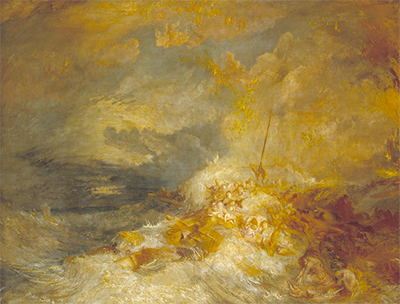
The Turner picture often searched for as Fire at Sea is now best handled under Tate's current title, A Disaster at Sea. The older name remains useful because it preserves a strand of reception history and explains the familiar path by which many viewers still find the work. Yet the object authority is Tate's N00558: an unfinished oil on canvas of about 1835, now in Tate through the 1856 Turner Bequest, and associated with the wreck of the female convict ship Amphitrite off Boulogne in 1833.[1][2][3]
This is one of Turner's most disturbing marine paintings because its danger is not only natural. Storm, surf and wreckage matter, but the human scandal behind the picture matters more. The Amphitrite was carrying women convicts and children when it grounded near Boulogne. Historical records and later summaries agree on the essential horror: rescue was possible, assistance was refused, and only three men from the crew survived. The exact numbers vary across sources, so the safest summary is that more than one hundred women and children died within sight of shore.[7][8][9]
Turner never exhibited the canvas in his lifetime, and the Amphitrite identification should be stated with care rather than overclaimed. The work was unfinished, and its current title is a later institutional title rather than a public declaration made by Turner. Still, Tate-supplied and curatorial sources connect the painting to the Amphitrite disaster, and the visual structure makes sense within that context: a mass of bodies, wreckage, mast, wave and light, with human life almost swallowed by the sea.[2][5][6]
At a Glance
- ArtistJoseph Mallord William Turner
- Current titleA Disaster at Sea
- Former titleFire at Sea / A Fire at Sea
- Datec.1835
- MediumOil on canvas; unfinished
- Dimensions171.4 x 220.3 cm
- CollectionTate
- AccessionN00558 / NG558
- Probable subjectWreck of the Amphitrite, 1833
- ProvenanceTurner Bequest, accepted 1856
Tate's current object title is A Disaster at Sea. The work is by J. M. W. Turner, dated about 1835, and recorded as oil on canvas. Art UK/Tate metadata gives the dimensions as 171.4 x 220.3 cm, while Google Arts & Culture records the same scale as 1714 x 2203 mm. The collection is Tate, with the accession N00558, also historically linked with National Gallery number NG558. The painting is unfinished and was accepted through the Turner Bequest in 1856.[2][3]
The older wording Fire at Sea should be understood as an alternate or former title rather than the best current title. Wikimedia's Tate-derived file metadata preserves that naming history and describes the work as probably based on the foundering of the Amphitrite.[4] The distinction is important: Fire at Sea sounds elemental and theatrical, while A Disaster at Sea leaves more room for the human and political specificity of the event.
Contents
- Introduction
- At a Glance
- Object Identity
- Fire at Sea and A Disaster at Sea
- The Amphitrite
- A Scandal Within Sight of Shore
- Women, Children and Custody
- Géricault and Contemporary Disaster
- Bodies, Mast and Sea
- Unfinished Surface
Object Identity
The object is a large oil painting, not a watercolour, print or finished exhibition picture. Its physical scale is imposing: more than two metres wide. That size matters because Turner is working near the register of public history painting. The image is not a small marine incident but an immense scene of wreck, bodies and weather. The National Gallery of Australia exhibition archive records it as c.1835?, oil on canvas, 171.4 x 220.3 cm, held by Tate and accepted through the Turner Bequest.[5]
Google Arts & Culture, using Tate material, describes the canvas as never exhibited and probably unfinished, while calling it one of Turner's powerful statements on maritime disaster.[2] The Metropolitan Museum of Art likewise identifies it as unfinished, not shown publicly by Turner, and probably a response to the destruction of the Amphitrite.[6] These points should shape interpretation. An unfinished canvas does not give us the same evidence as a titled Royal Academy exhibit. It gives us an intense object whose subject, date and completion state have to be reconstructed through later cataloguing and scholarship.
The image also carries more than one title history. Current cataloguing prefers A Disaster at Sea. Earlier usage includes A Fire at Sea, while some exhibition descriptions call it The Wrecked Female Convict Ship, the Amphitrite: Women and Children Abandoned in a Gale or The Wreck of the Amphitrite.[4][5][6] Such title variation is not an obstacle to understanding; it is part of the work's history. Each title pulls the viewer in a different direction: element, disaster, named ship, abandoned women and children, legal transport, moral outrage.
Fire at Sea and A Disaster at Sea
The legacy title Fire at Sea has an obvious imaginative power. It suggests a frightening compound of elements: flame where water should dominate, light amid storm, red or gold paint against dark sea. But the current title, A Disaster at Sea, is more exact in its caution. The scene need not depend on literal fire. It is disaster that matters: wreckage, bodies, refusal, institutional failure and the overwhelming movement of water.
That caution suits Turner's painting. The surface is full of light, but not in the reassuring sense of rescue. Light flashes across bodies and foam; it exposes rather than saves. If the older title led viewers to expect a burning ship, the present title redirects attention toward catastrophe itself. The painting's fire is as much ethical as optical.
The movement from one title to another also mirrors a larger shift in Turner interpretation. Nineteenth- and early twentieth-century viewers often celebrated Turner as a painter of elemental effects: storms, fires, sunsets, steam, mist. Recent attention has been more willing to ask what those effects are doing socially and historically. A Disaster at Sea needs both approaches. It is a great storm painting, but it is also a painting about the abandonment of transported women under a bureaucratic logic that valued custody over life.[7][8]
This is why the Amphitrite association matters even when treated as probable rather than certain. Without it, the painting remains a terrifying marine vision. With it, the same forms become sharper. Bodies in the water are not generic victims. They belong to a system of convict transportation, imperial punishment and gendered vulnerability. The title A Disaster at Sea allows that wider meaning to remain active without pretending Turner wrote a courtroom brief in paint.
The Amphitrite
The Amphitrite was a British convict transport bound for New South Wales. State Library of NSW indexes point to a transportation list dated 20 August 1833 for female convicts, Home Office register material, Admiralty documents concerning the wreck, and a departure from Woolwich in late August 1833.[9] The National Library of Australia record for an 1833 broadside says the vessel sailed on 25 August and grounded near Boulogne at the end of the month while carrying women convicts, children, the surgeon James Forrester, his wife and crew.[8]
Royal Museums Greenwich's record for Andrew C. A. Jampoler's Horrible Shipwreck! summarizes the tragedy starkly. The ship sank off Boulogne on 31 August 1833 after running aground in bad weather. It was bound for New South Wales, carried female convicts and children, and foundered in view of the French coast. The event drew sensational press attention, accusations against the British Consul, blame directed at Captain John Hunter and an Admiralty investigation chaired by Lieutenant Henry Ducie Chads.[7]
The crucial fact is not simply that the ship wrecked. It is that local help was refused. The National Library of Australia broadside record notes that the passengers could have been taken off relatively easily by a French pilot boat, but the master and surgeon agreed that landing the prisoners was an unnecessary risk. It also records that another local sailor swam out to warn of the current and take a line ashore, but assistance was refused.[8] In such accounts, the catastrophe is not an unavoidable act of weather alone. It is a decision made under the pressure of custody, fear and authority.
This is the moral world that Turner's painting can be understood to enter. The sea is violent, but the scandal is human. When the painting shows bodies and wreckage thrown together, the viewer is not asked merely to admire dramatic brushwork. The scene points toward a system in which imprisoned women and their children could be treated as cargo whose control outweighed their survival.
A Scandal Within Sight of Shore
One reason the Amphitrite wreck became so shocking was visibility. Royal Museums Greenwich notes that the vessel sank in full view of the French coastline and was watched by onlookers from the shore.[7] The National Library of Australia record similarly emphasizes that the wreck unfolded near Boulogne and that help was offered. This was not a disappearance in the open ocean. It was a public failure of rescue.[8]
Contemporary press material shows how quickly the event entered public discussion. The Spectator of 14 September 1833 reported further details after the gale, including the Admiralty's decision to send Captain Chads to Boulogne to investigate. It also printed a letter from Boulogne describing the burial of bodies that had washed ashore, the role of the English Consul and the testimony of survivors who viewed the dead.[10] Such reporting made the wreck part of a national conversation about responsibility.
The numbers vary between sources. Some records speak of 100 or 101 listed women convicts; others of 106 or 108 women, twelve children, and additional crew or ship personnel.[8][9] This variation is itself a warning against false precision. The reliable interpretive point is larger: the dead were overwhelmingly transported women and children, and only three crew members survived in most accounts. Turner's painting does not require a fixed headcount to carry its indictment.
The scandal also belongs to the history of penal transportation. These women were not passengers in the ordinary sense. They were prisoners being moved across empire. Their legal status shaped the decisions made around rescue. The reported fear that landing them would allow escape turns the wreck into a brutally concentrated image of state power: people endangered by weather, then held within a logic that made their freedom more frightening to officials than their deaths.
Women, Children and Custody
The gendered nature of the Amphitrite disaster is indispensable. Sources repeatedly identify the transported prisoners as women and note that children were on board.[7][8][9] In nineteenth-century Britain, the female convict ship already carried a heavy imaginative burden. It sat at the intersection of punishment, poverty, gender discipline, empire and moral panic. To be sentenced to transportation was not only to be imprisoned; it was to be removed from Britain and inserted into colonial labour, domestic service and social control.
This history changes how the painting should be read. The bodies in Turner's sea are not anonymous figures added for pathetic effect. If the Amphitrite identification is accepted, they represent people whose vulnerability had been institutionally produced before the storm ever began. The women were under legal restraint. The children were present through that same machinery of forced movement. The wreck did not create their lack of freedom; it exposed it under lethal pressure.
The National Library of Australia record is particularly chilling because it frames the refused rescue as a decision about prisoners rather than people. Assistance from shore was reportedly rejected because landing the women was treated as an unnecessary risk.[8] That detail gives the disaster its ethical shape. It was not enough that the ship had run aground in bad weather. What made the episode notorious was the apparent willingness to preserve custody until custody became death.
Turner's painting does not need to illustrate each detail to carry that meaning. Indeed, the absence of individuated biography may be part of its force. The dead are hard to distinguish, just as transported prisoners could be reduced in paperwork to lists, sentences, destinations and numbers. Against that bureaucratic reduction, the violence of the canvas insists on bodily fact. These were lives, not entries.
The children intensify the indictment. Their presence makes any narrow legal defence feel obscene. A system built to transport convicted women also carried dependants into danger, and the logic of preventing escape could swallow both. Turner, whose mature art often makes light and weather bear moral meaning, found in this event an image in which natural violence and social violence could not be separated.
Géricault and Contemporary Disaster
Tate-supplied commentary and the Metropolitan Museum both compare Turner's canvas with Théodore Géricault's The Raft of the Medusa.[2][6] The comparison is not casual. Géricault's painting, first shown at the Salon of 1819, transformed a recent shipwreck into a monumental image of suffering, survival and political failure. The Louvre describes it as a dramatic scene based on a recent wreck that shocked the public, involving survivors who drifted for thirteen days on a makeshift raft, with only fifteen surviving to tell the tale.[11]
The formal connection is also important. Tate-supplied material notes the pyramidal structure of Turner's painting and sees it in relation to Géricault.[2] The Louvre describes Géricault's pyramidal composition and precise draughtsmanship as classically inspired, even though the subject was modern and politically charged.[11] Turner adapts that model in a different medium and a different register. His image is less sculptural and more turbulent. The bodies and wreckage seem thrown into formation by wave, wind and paint rather than arranged with Géricault's dense anatomical clarity.
The topicality matters more than simple influence. Géricault painted victims of a recent maritime catastrophe that exposed incompetence and political privilege. Turner, if responding to the Amphitrite, painted victims of a recent maritime catastrophe that exposed imperial punishment, bureaucratic obedience and gendered expendability. Both works ask whether modern disasters can become history painting.
Turner's answer is rougher and less resolved. Géricault produced a finished public statement. Turner left an unfinished canvas that was never publicly shown in his lifetime. That difference does not weaken A Disaster at Sea. It makes the work feel raw, as if the subject resisted closure. The unfinished state becomes part of its charge, though it should not be romanticized into a known intention. We can say what the surface does; we cannot confidently say why Turner stopped.
Bodies, Mast and Sea
The National Gallery of Australia archive describes the image as a tangle of bodies, sea spume and wreckage, with an upright mast held by small figures.[5] That description catches the painting's terrifying compression. It is difficult to separate people from water, wood and foam. Bodies appear as part of the wreck, and the wreck appears almost bodily. Turner makes the sea a force that absorbs distinctions.
The mast is crucial. It gives the picture a vertical axis amid chaos. In a conventional marine painting, a mast might promise order: ship, rigging, navigation, command. Here it becomes a desperate remnant. It is held or clung to by figures who have almost nothing else left. Its uprightness does not restore the ship. It marks the last structure around which bodies gather.
The large scale intensifies this effect. At more than two metres wide, the painting can surround the viewer with broken movement.[3][5] The sea is not a strip at the bottom of a landscape; it is the environment of death. Turner uses the width of the canvas to spread panic laterally, while the central rise of bodies and wreckage gives the image an unstable core.
What makes the image hard to look at is not simply violence. It is indistinction. The viewer strains to identify limbs, faces, timbers and waves. That strain matters. It recreates, ethically, the problem of recognition: are these people being seen as persons, or only as a mass of cargo and disaster? Turner refuses easy legibility, but he does not allow comfortable distance.
Unfinished Surface
Both Google Arts & Culture/Tate and the Met describe A Disaster at Sea as probably unfinished.[2][6] The status is essential. The picture's force partly comes from the way its surface seems unresolved: paint gathers, breaks, flashes and smears, with form struggling to emerge from turbulence. That unfinished quality can intensify the sense of catastrophe, because the image itself feels almost overwhelmed.
But unfinished does not mean careless. Turner was a profoundly experienced painter by the mid-1830s. He knew how to make rough handling carry meaning. The Turner Society's discussion of Turner's materials and techniques, drawing on conservation research, emphasizes his experimental handling of paint, his debt to watercolour practice and his willingness to use materials in innovative ways.[12] In an oil such as this, rapid or open handling can be a deliberate expressive resource even when the work was not brought to exhibition finish.
The caution is important. We should not say the canvas is unfinished because Turner could not resolve the subject, or because he intended incompletion as a memorial gesture. Those are possibilities, not evidence. What we can say is that the visible state of the painting supports the subject's violence. Loose, bright, broken passages make bodies and foam difficult to distinguish. The image is materially unstable in a way that suits an unstable scene.
The roughness also pushes against heroic history painting. A polished finish could have made the wreck easier to possess visually. Turner's unfinished surface leaves it resistant. It does not present suffering as a perfectly composed moral tableau. It gives us an image that seems to keep moving, as if the sea has not yet released its victims.
The scale of the canvas makes that roughness more unsettling. A small oil sketch might be expected to remain open and abbreviated. This is a large work, physically close to public exhibition ambition, yet it never arrives at the clarity that such ambition might imply.[3][5] The surface remains caught between statement and irresolution. The viewer sees Turner building a monumental disaster image, but also sees the image resisting polish.
That resistance is not a defect in the modern viewing experience. It prevents the painting from becoming comfortably ceremonial. There is no clean memorial architecture, no stable roll call of victims, no easy heroic rescuer. Instead there is paint under strain. The image behaves as if the subject cannot be tidied into historical distance.
Turner's handling also belongs to his larger technical evolution. By the mid-1830s he was increasingly willing to let colour, light and surface movement do interpretive work that academic drawing might once have controlled more tightly. Conservation-informed discussions of his materials stress experimentation, new pigments, unusual procedures and a dialogue between oil practice and his long watercolour experience.[12] A Disaster at Sea should be placed in that mature context. Its turbulence is not merely iconographic; it is technical.
Turner and Modern Events
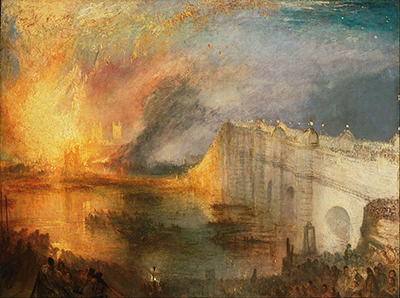
The 1830s were a crucial decade for Turner's treatment of modern catastrophe. Around the same moment, he painted or began works connected with public fire, steam, industry, shipwreck and political outrage. The Met's Turner exhibition placed Disaster at Sea near works such as The Burning of the Houses of Lords and Commons, emphasizing Turner's response to recent events and his interest in the sublime power of modern life.[6]
The National Gallery's Turner biography provides the larger career frame: he moved from early topographical watercolour into ambitious oils, print culture, travel subjects and increasingly radical treatments of light and atmosphere.[13] A Disaster at Sea belongs to the mature part of that arc. It is not picturesque marine incident. It is a large, modern, morally charged seascape.
The word "modern" is doing real work here. The subject is not a mythological drowning, a biblical deluge or a heroic naval battle. It is a recent transport disaster linked to empire, punishment and the press. It belonged to the news before it belonged to art. Turner brings that event into a pictorial language of storm and wreck, but the modern scandal remains inside the image.
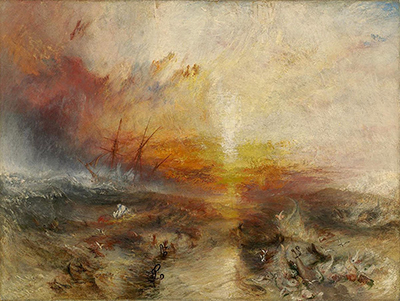
This is why the painting feels close to Slave Ship, even though the subjects must not be conflated. Both works place vulnerable bodies in a sea governed by human cruelty as well as natural force. Both make colour and weather carry moral shock. Both force viewers to ask whether maritime commerce and empire depend on acts of abandonment that polite society would rather not see.
The comparison with the 1834 fire at Parliament is also illuminating. That event was public, spectacular and nationally symbolic; crowds watched as an old seat of authority burned. The Amphitrite wreck was also public, but in a more unbearable way: people on shore could see danger unfolding, and the reports that followed focused attention on failed rescue, official conduct and responsibility.[10] Turner was drawn to both kinds of modern catastrophe. One involved the destruction of architecture and government symbolism; the other involved expendable bodies within an imperial punishment system.
In both cases, Turner made spectacle difficult. Fire, water, smoke and light are visually thrilling in his art, but they do not settle into mere entertainment. They reveal the fragility of institutions that claimed order. In A Disaster at Sea, the institution is not Parliament but penal transportation. The painting asks what order is worth if it preserves authority while letting the vulnerable drown.
Related Maritime Pictures
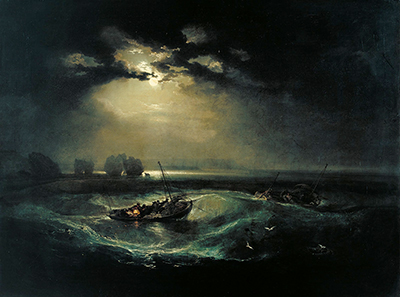
Turner's marine career gives A Disaster at Sea a deep background. Earlier works such as The Shipwreck had already shown his ability to make the sea a theatre of danger. Later works such as Slave Ship would make maritime violence inseparable from commerce and moral indictment. Other works, including A Ship Aground and Ships bearing up for Anchorage, explore grounding, labour, weather, navigation and human vulnerability without the same Amphitrite charge.
The comparisons are useful only if the differences remain clear. The Shipwreck is not A Disaster at Sea. Slave Ship is not A Disaster at Sea. Ships bearing up for Anchorage is an Egremont/Petworth sea piece, not a convict-transport tragedy. Turner returned to ships in danger many times because the sea gave him a way to connect weather, labour, technology, commerce, travel and mortality. Each work chooses a different ethical pressure.
In the case of A Disaster at Sea, the pressure is abandonment. The sea threatens everyone, but the disaster becomes scandalous because decisions prevented rescue. This separates the painting from generic shipwreck imagery. It is not only about frailty before nature; it is about what institutions do when vulnerable lives are inconvenient.
That ethical dimension also explains why the painting's unresolved state is so compelling. A finished marine spectacle might risk turning the scene into grand theatre. Turner's surface keeps the viewer close to confusion. It leaves the bodies difficult to count, the wreckage difficult to sort and the moment difficult to stabilize.
The relation to The Shipwreck is especially revealing. Earlier shipwreck imagery often asks the viewer to admire courage, fear and elemental danger within an accepted genre. A Disaster at Sea pushes beyond genre because the implied cause of horror is not only the storm. The picture refuses the comfort of saying that nature alone is responsible. If the Amphitrite reading is followed, human decisions are embedded in the disaster.
The relation to Slave Ship is darker still. Both paintings connect the sea to systems that turn human beings into cargo. In Slave Ship, the victims are explicitly tied to the slave trade and insurance logic. In A Disaster at Sea, the victims are transported women and children whose rescue was reportedly subordinated to custody.[7][8] Turner did not paint the same event twice. He returned to the same moral abyss from different historical directions.
Looking Closely
Begin with the central rise of forms. The composition pulls bodies, timbers and mast into a tense upward thrust, then lets the surrounding water attack that fragile structure. The eye wants a clear hierarchy, but Turner denies one. Human limbs, cloth, foam and broken wood slide into each other.
Then look at the colour. White, yellow, brown and darker accents create a storm-light that is both illuminating and destructive. Light does not rescue; it exposes. The brightness makes the horror visible while denying the calm clarity of a finished narrative.
Next consider the edge between sea and body. Turner makes that boundary uncertain. This is not just a painterly flourish. It is the painting's moral difficulty. The transported women and children were treated by the system as controlled cargo; the wreck threatens to make them visually anonymous as well. The viewer's effort to see them becomes part of the work.
Finally, attend to the absence of rescue. In many disaster pictures, a distant sail or heroic figure offers hope. Here the image is dominated by the wreck itself. If the Amphitrite association is accepted, that absence is devastating, because rescue was not merely impossible; it was refused.[7][8]
What the Painting Refuses
One reason A Disaster at Sea remains so uncomfortable is that it refuses several consolations at once. It refuses clear narrative sequence. We are not shown a beginning, middle and end, with causes neatly separated from consequences. We meet the disaster in the middle of its violence, where bodies, wreckage and water cannot be calmly sorted.
It also refuses heroic rescue. The Amphitrite sources make that absence morally loaded. Royal Museums Greenwich, the National Library of Australia and contemporary press summaries all stress the offered or discussed possibility of intervention, the refusal of assistance and the later investigation of responsibility.[7][8][10] Turner gives no compensating saviour to redeem that refusal. The painting leaves the viewer with abandonment.
The work refuses a comfortable boundary between natural and human violence. The storm is real, but it is not the whole cause. The sea may break the ship, but the reported decisions around custody and escape make the scene historically specific. Turner lets those forces occupy the same visual field. Wave and institution become inseparable pressures.
Finally, the canvas refuses finish. That refusal may be accidental, biographical, practical or aesthetic; the evidence does not let us decide. Yet the visible result matters. The unresolved surface denies the viewer a polished tragedy. It keeps the event abrasive, partial and difficult, closer to a question than to a monument.
That unresolved quality also affects the viewer's sense of time. The picture does not feel safely after the event, as a memorial might. Nor does it feel before catastrophe, as a warning might. It feels trapped inside the interval when rescue could matter and when refusal has already begun to harden into consequence. That suspended timing is central to the painting's pressure.
It keeps responsibility present, not settled safely in the past or softened by historical distance and later retelling.
Why It Matters
A Disaster at Sea matters because it shows Turner using the language of maritime catastrophe to confront a modern moral failure. The painting is spectacular, but spectacle is not the end. Its storm, light and wreckage point toward the deaths of women and children held inside a penal-transport system that made control more important than rescue.
It also matters because it complicates the familiar phrase "painter of light." Turner is not using light here as beauty alone. Light reveals drowning, wreckage and institutional cruelty. It makes the subject harder to ignore. The painting's brilliance is therefore inseparable from its bleakness.
The work matters finally because it sits between public scandal and private unresolved canvas. Géricault's Raft of the Medusa became a monumental public statement about recent disaster and political failure. Turner's Amphitrite-associated painting remained unfinished and unexhibited in his lifetime, yet it still carries a comparable ambition: to make a contemporary tragedy large enough for history painting, and unsettled enough that the viewer cannot convert suffering into decorative drama.[6][11]
Discussion
How does the probable Amphitrite context change the painting from elemental spectacle into an image of custody, gender and institutional failure?
Reader Insights
What changes when Fire at Sea gives way to A Disaster at Sea?
How does unfinished paint intensify the difficulty of distinguishing bodies, foam and wreckage?
Where does the picture place the boundary between natural violence and human refusal?
Join the Conversation
Share a close observation or a source-based question for other readers.
References
- Tate, *A Disaster at Sea*, N00558. https://www.tate.org.uk/art/artworks/turner-a-disaster-at-sea-n00558
- Google Arts & Culture / Tate, *A Disaster at Sea*. https://artsandculture.google.com/asset/a-disaster-at-sea-joseph-mallord-william-turner/uQFUIEJ0ZTnAIQ?hl=en
- Wikimedia Commons after Art UK/Tate, *A Disaster at Sea*, N00558. https://commons.wikimedia.org/wiki/File:Joseph_Mallord_William_Turner_(1775-1851)_-_A_Disaster_at_Sea_-_N00558_-_National_Gallery.jpg
- Wikimedia Commons, *Turner A Fire at Sea.jpg*. https://commons.wikimedia.org/wiki/File:Turner_A_Fire_at_Sea.jpg
- National Gallery of Australia archive, Turner exhibition, *A disaster at sea*. https://digital.nga.gov.au/archive/exhibition/turner/default.cfm?irn=230479&bioartistirn=18113&mnuid=3&galid=7&viewid=2
- Metropolitan Museum of Art, J. M. W. Turner exhibition photo gallery, *Disaster at Sea*. https://www.metmuseum.org/exhibitions/listings/2008/j-m-w-turner/photo-gallery
- Royal Museums Greenwich library record, Andrew C. A. Jampoler, *Horrible Shipwreck!* https://www.rmg.co.uk/collections/library/rmgl-149628
- National Library of Australia, *Frightful wrecks!* broadside record. https://catalogue.nla.gov.au/Record/5980837
- State Library of NSW content lists, Ships Index A-E, Amphitrite entries. https://content-lists.sl.nsw.gov.au/tabular-list/ships-index-a-e
- *The Spectator* archive, "The Late Gale," 14 September 1833. https://archive.spectator.co.uk/article/14th-september-1833/8/the-late-gale
- Louvre, "Romanticism, topicality, sensuality," *The Raft of the Medusa*. https://www.louvre.fr/en/explore/visitor-trails/the-louvre-s-masterpieces/romanticism-topicality-sensuality
- Turner Society, "Turner's Painting Materials and Techniques." https://www.turnersociety.com/turners-painting-materials-and-techniques/
- National Gallery, London, "Joseph Mallord William Turner." https://www.nationalgallery.org.uk/artists/joseph-mallord-william-turner