by Tom Gurney
Tom Gurney BSc (Hons) is an art history expert with over 20 years experience
Published on June 19, 2020 / Updated on October 13, 2026
Email: tomgurney1@gmail.com / Phone: +44 7429 011000
Introduction
Vesuvius in Eruption, also known as Eruption of Vesuvius, is a watercolour by J. M. W. Turner in the Yale Center for British Art, Paul Mellon Collection, accession B1975.4.1857. Yale dates it to about 1818-20, records the materials as watercolour, gum and scraping out on medium, slightly textured, cream wove paper, and gives the sheet dimensions as 11 1/4 x 15 5/8 inches, or 28.6 x 39.7 cm.[1]
The image is not a direct eyewitness report of an eruption. Yale's interpretive label states that Turner visited Naples and ascended Vesuvius in 1819, but never witnessed an eruption firsthand, and that this composition probably preceded his Italian journey.[2] Its drama belongs to imagination, visual inheritance, travel culture, scientific curiosity and studio technique rather than to a documented encounter with this particular erupting scene.
Vesuvius was already a major subject in European art by the time Turner took it up. The volcano carried ancient catastrophe, Grand Tour prestige, modern geology, theatre of light and the sublime all at once. In this small but intensely finished sheet, Turner enters that crowded tradition and tries to surpass it. The eruption becomes not merely something seen, but something imagined as force: fire, smoke, night, mountain, water, city and sky compressed into one unstable spectacle.
At a Glance
- ArtistJoseph Mallord William Turner
- TitleVesuvius in Eruption
- Datec.1818–20
- MediumWatercolour, gum and scraping out on cream wove paper
- Dimensions28.6 × 39.7 cm
- CollectionYale Center for British Art
- Collection groupPaul Mellon Collection
- AccessionB1975.4.1857
- ClassificationDrawings and watercolours
- Eyewitness statusImagined; Turner did not witness an eruption firsthand
Yale identifies the artist as Joseph Mallord William Turner, born in London in 1775 and active in Britain until his death in 1851. The title is Vesuvius in Eruption. The date is given as about 1818-20 in the collection record, while Yale's Critique of Reason display used 1817-20. The medium is watercolour, gum and scraping out on cream wove paper. The sheet measures 28.6 x 39.7 cm. It belongs to the Yale Center for British Art's Paul Mellon Collection and is classified among drawings and watercolours.[1][2]
Yale records a graphite inscription on the reverse: "Mount Vesuvius in Eruption | J M W Turner R.a 1817". Its published catalogue entry specifies that the inscription is not in Turner's hand. The written year is therefore not an autograph date establishing when he made the watercolour. The sheet belongs to a broader group of Vesuvius subjects made around his preparation of Italian imagery, with its precise chronology still uncertain.[1]
Boats, geology, Grand Tour, landscape, lava, mountain, science, smoke and volcano are among Yale's subject terms.[1] They connect the image with tourism, natural history, spectacle and hazard as well as with the expanding ambition of watercolour. The mountain is both a recognizable destination and the source of a violent imagined event.
Contents
- Introduction
- At a Glance
- Object Identity
- Not an Eyewitness Eruption
- Vesuvius Before Turner
- Hamilton, Fabris and Volcanic Seeing
- Hakewill, Cooke and Italian Imagery
- Walter Fawkes and Finish
- The Sublime and Geology
- Joseph Wright and the Vesuvius Tradition
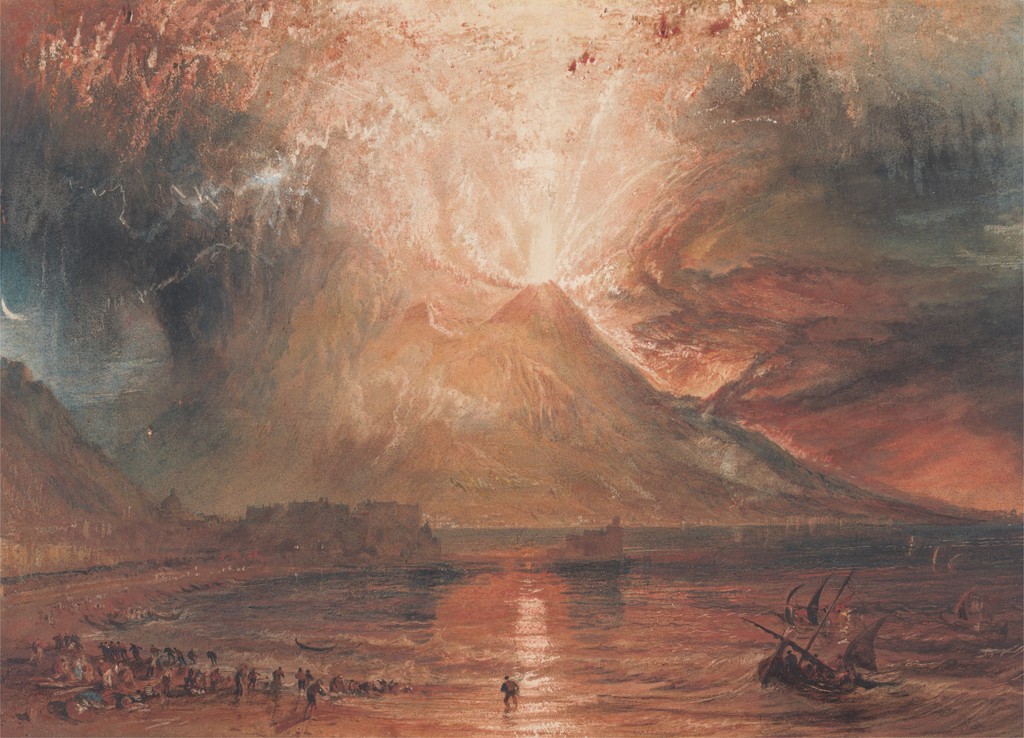
J. M. W. Turner, Vesuvius in Eruption, about 1818-20. Watercolour, gum and scraping out on cream wove paper, 28.6 x 39.7 cm. Yale Center for British Art, Paul Mellon Collection, B1975.4.1857. Public domain (CC0).
Object Identity
Yale's B1975.4.1857 identifies this particular watercolour within a wider group of Turner works involving Vesuvius.[1] It is distinct from his later Naples views and the engraved designs for Hakewill's Italian publication. Joseph Wright's Vesuvius paintings and Turner's 1815 oil of the Soufrière eruption in St Vincent are separate works with different subjects and histories.
The material description is unusually important: watercolour, gum and scraping out on cream wove paper.[1] This is not a neutral technical label. The subject demands violent light, and the medium gives Turner a way to make light feel as if it has broken through pigment. Gum can intensify colour and depth; scraping out can recover brilliant white from the support; layered watercolour can build darkness without the weight of oil.
The relatively modest size also matters. At 28.6 x 39.7 cm, the sheet is physically intimate, but the event it proposes is vast.[1] Turner uses a compact format to stage a grand natural convulsion. That compression is part of the effect. The volcano seems too powerful for the boundaries of the sheet, as if the image is being forced to contain more force than paper can reasonably hold.
Yale's 2025 gallery label describes the showers of molten magma as resembling a huge firework display and places the work within the early nineteenth-century tradition in which erupting Vesuvius became a key emblem of the artistic sublime.[1] That label captures the central paradox: the image is spectacularly artificial and yet committed to nature's intensity. It is built from formulas, but it wants to overpower formula.
Not an Eyewitness Eruption
Turner visited Naples and climbed Vesuvius in 1819, but Yale states that he never saw an eruption firsthand and that this image probably preceded his Italian journey.[2] The sheet's vividness is not evidence that he stood beside the crater during an eruption. Its approximate dating and likely use of secondhand material connect it with imaginative preparation rather than a verified record of one volcanic event.
That does not mean Turner had no experience of the place. His first Italian journey transformed his art, and later Naples material shows his direct engagement with the bay, the mountain and the landscape around it. But this watercolour belongs to a different process: the studio invention of an erupting Vesuvius from inherited visual knowledge and secondhand material.
The image combines a recognizable volcano with heightened light, darkness and movement. Its force comes from that imaginative synthesis rather than from accuracy at a documented hour. The eruption becomes an encounter with the sublime, in which a known place appears capable of overwhelming familiar ways of seeing.
That question suited Turner perfectly. From his early mountain and storm subjects to his later fire, sea and steam pictures, he repeatedly chose phenomena that overwhelm ordinary sight. Vesuvius gave him a subject already loaded with fear, beauty, science and classical memory. He could approach it without being bound to a single observed event.
Vesuvius Before Turner
By the late eighteenth century, Vesuvius had become one of the most represented volcanoes in Europe. The Smithsonian Global Volcanism Program describes Vesuvius, or Vesuvio, as one of the world's most noted volcanoes, forming the dramatic backdrop to the Bay of Naples. Its active cone stands within the older Monte Somma caldera, and its history includes the famous 79 CE eruption that buried Pompeii and Herculaneum.[7]
The volcano also erupted repeatedly in the period that shaped Turner's visual culture. Smithsonian data records major historical activity including the powerful 1794 eruption and the long eruptive period that ended with a major explosive and effusive eruption in 1822.[7] Yale's label similarly notes that eighteenth- and nineteenth-century fascination with Vesuvius was fueled by eruptions in 1794, 1807, 1819 and 1822.[1] Turner did not need to witness the volcano erupt to know it was visually and intellectually alive.
Vesuvius carried unusual cultural density. It belonged to ancient catastrophe through Pompeii and Herculaneum. It belonged to Grand Tour travel through Naples. It belonged to natural philosophy through the study of volcanoes and the age of the earth. It belonged to theatrical spectacle through night eruptions, glowing lava and tiny human spectators. An artist approaching it inherited all those meanings at once.
Turner's sheet presses those meanings into visual conflict. The volcano is not presented as a calm geological specimen. Nor is it only an entertaining tourist spectacle. It appears as an event that strains vision itself. Fire seems to enter the sky; dark masses close around light; the earth's interior becomes visible at the surface.
The Bay of Naples setting intensified that inheritance. Vesuvius was not remote wilderness. It rose beside one of Europe's most celebrated landscapes, a coast associated with classical poetry, villas, ruins, excavations, islands, ports and fashionable travel. This proximity made the volcano doubly powerful. It offered catastrophe beside beauty, geological violence beside cultivated pleasure, ancient destruction beside modern tourism. Turner could therefore make Vesuvius speak to more than fear. It was a subject in which civilization and deep earth met under the pressure of light.
That meeting helps explain why night eruption became so attractive to artists. Darkness allowed lava, ash, flame and reflection to become visual protagonists. Instead of merely showing a mountain, the painter could show the mountain producing light. This reverses the usual relation between landscape and illumination. In many views, sun or moon lights the scene from outside; in Vesuvius pictures, the land itself burns and throws its own unstable light across water and sky.
Hamilton, Fabris and Volcanic Seeing
A crucial background to any Vesuvius image in this period is Sir William Hamilton's Campi Phlegraei. The Society of Antiquaries describes Hamilton as a diplomat, archaeologist, volcanologist and antiquarian whose account of the volcanoes of the Two Sicilies was published in Naples in 1776 with dramatic coloured plates after Pietro Fabris. The book included eruption scenes, landscapes and volcanic specimens, and it joined observation with the new aesthetics of the sublime.[8]
Royal Museums Greenwich emphasizes Hamilton's personal commitment to Vesuvius: he ascended the crater more than sixty-five times and understood the dangers of living near an active volcano. Its account also quotes his awareness that whole cities could be buried under pumice and ash or overwhelmed by rivers of liquid fire.[9] This is the world of knowledge behind Turner's volcano: not mythology alone, but repeated observation, collecting, publication and scientific spectacle.
Hamilton and Fabris helped make volcanic vision both empirical and theatrical. Their images documented phenomena, but they also taught viewers how to look at eruptions as staged contrasts: dark night and burning lava, tiny observers and vast force, landscape and catastrophe. Turner inherits that grammar and makes it more unstable.
The difference is important. Hamilton's project insists on observation and classification; Turner intensifies emotional encounter. He does not abandon knowledge, but he converts it into pictorial pressure. The volcano becomes a form of seeing in crisis.
Hamilton's importance also lies in the prestige he gave to looking at volcanoes carefully. Volcanic spectacle could have remained a popular thrill, a travel anecdote or a theatre of danger. Through Hamilton and Fabris it became something that could be published, compared, collected and discussed by learned audiences. That is close to the world Turner entered: an educated market in which viewers might value both the drama of Vesuvius and the knowledge culture behind it.
Turner did not need to imitate Hamilton's observational language to benefit from it. The existence of such books made Vesuvius available as a serious modern subject. A watercolour of eruption could be understood as more than fantasy because volcanoes had become central evidence in arguments about natural process. Turner's image rides that tension: it looks almost impossibly theatrical, yet it belongs to a culture increasingly aware that the earth itself was dynamic.
Hakewill, Cooke and Italian Imagery
Yale connects Turner's Vesuvius works to the visual material of James Hakewill and the publishing culture around Italian views. The collection entry states that W. B. Cooke commissioned Turner to make companion watercolours of Vesuvius in eruption and repose around 1817, and that the Yale sheet, the third of the group and the most spectacular, may have been made around the same time if the verso inscription is reliable.[1]
The Hakewill context is central. The Sir John Soane's Museum record for a catalogue of Hakewill's original sketches and Turner's drawings explains that Hakewill's Picturesque Tour of Italy was published by John Murray in parts between 1818 and 1820. The catalogue promoted sketches made in 1816 and 1817 and drawings by Turner prepared for the project.[5] The Morgan Library's record for the 1820 publication adds that it contained sixty-three plates and that eighteen engravings were after Turner from Hakewill's Italian camera-obscura pencil sketches.[6]
These facts clarify the status of Turner's invention. He was not inventing Italy from nothing. He was working within a system of travel sketches, camera-obscura studies, publishers, engravers, subscribers and collectors. Hakewill supplied Italian material; Turner transformed such material into heightened watercolour designs. The Yale Vesuvius belongs near that system even if it was not itself engraved.[1][5][6]
Christie's discussion of a different Turner Naples/Vesuvius watercolour identifies an earlier group of three views, two in eruption and one in repose, around 1817 and probably derived from Hakewill's sketches. It also records uncertainty about which Vesuvius works appeared in Cooke's 1822 exhibition.[4] Yale's published catalogue associates its sheet with that group without establishing a definite commission, engraving or lifetime exhibition history for B1975.4.1857.[1]
The Hakewill relationship also sharpens Turner's role as transformer. Hakewill's Italian sketches were valued for topographical information and travel memory. Turner could take such information and convert it into atmosphere, movement and emotional scale. That conversion is not a secondary embellishment. It is the artistic event. The Yale Vesuvius shows how far Turner could move from received visual data while still staying attached to a recognizable place.
This process was essential to nineteenth-century illustrated travel culture. Publishers needed views that could satisfy curiosity about famous places. Collectors wanted works that carried both authority and invention. Turner excelled because he could preserve enough topographical identity for recognition while making the image feel newly alive. With Vesuvius, that means using the volcano as both named landmark and unleashed force.
Walter Fawkes and Finish
Yale's published catalogue records Walter Fawkes's ownership and suggests that the sheet's high degree of finish may indicate a specific purpose, perhaps a commission. It was not included in his 1819 London-house exhibition, and the catalogue proposes that he probably acquired it, and possibly that Turner made it, later.[1] These possibilities leave the precise purpose and chronology open rather than establishing a definite commission in 1817.
Fawkes matters because he was one of Turner's important patrons, and because the Farnley/Fawkes circle supported ambitious works on paper. A finished Vesuvius watercolour would have suited a collector interested in Turner at his most dramatic. Yet the absence from the 1819 display prevents an easy story in which the sheet simply becomes a known exhibit or straightforward display object.
The finish itself is visible in the object description and Yale's commentary. This is not a quick sketch of volcanic fire. It is a resolved performance of light, dark, surface and scale. The high finish allows Turner to demonstrate control over a subject that depicts loss of control. That tension is one of the sheet's pleasures.
The watercolour's finish distinguishes it from a rapid travel note. Its beauty, novelty, technical command and learned associations suited the tastes of collectors such as Fawkes. That suitability helps explain the catalogue's suggestion of a possible commission, but it does not identify a documented request or establish the circumstances in which Turner made the sheet.
There is a useful tension between private ownership and public spectacle here. A volcano erupting over Naples is a huge public event in imagination, but this sheet entered the intimate world of collection. The viewer could hold, examine or display a controlled version of catastrophe. Turner makes that control unstable. The paper may be small, but the eruption strains against possession. It is a collector's object that seems to resist being domesticated.
The Sublime and Geology
Yale explicitly links the work to the aesthetics of the sublime and to changing ideas in geology. The Critique of Reason label says Turner's imagined natural disaster reflects both sublime interest and awareness of geological breakthroughs, especially changing ideas about the age of the earth and the evolution of landmasses.[2] This is not decorative background. It tells us why volcanoes mattered so much in the period.
The sublime in Turner's Vesuvius is not only size. The sheet is small. Its sublimity comes from threatened comprehension: light too intense, darkness too deep, force too unstable, human scale too fragile. The eruption opens the earth and throws matter into the sky. It turns landscape into process.
Geology adds another pressure. Volcanoes made visible the idea that the earth was not fixed and young, but ancient, active and self-transforming. Hamilton's published observations and Fabris's plates had already helped make volcanic activity a subject of elite study as well as spectacle.[8][9] Turner absorbs this intellectual climate without becoming an illustrator of theory.
The watercolour's geological associations coexist with its poetic and visual effects.[1] It does not diagram a measured eruption or explain a volcanic mechanism. Instead, light and darkness give a dramatic form to the period's interest in an active, changing earth.
Joseph Wright and the Vesuvius Tradition
Joseph Wright of Derby is one useful comparison because he painted Vesuvius repeatedly and made the volcano a drama of light and darkness. Google Arts & Culture's Tate-supplied entry for Wright's Vesuvius in Eruption, with a View over the Islands in the Bay of Naples notes that Wright emphasized contrast: tranquil sea against volcanic violence, moonlit coolness against fire and lava, tiny foreground figures against sublime natural grandeur. It also notes that Wright did not witness the 1777 eruption but produced more than thirty views of the volcano.[10]
Turner inherits and sharpens that tradition. Wright's volcano is already theatrical and imagined, but Turner makes the visual field more volatile. Where Wright often keeps the bay and islands legible, Turner pushes harder into vortex, glare and darkness. The viewer is less calmly positioned before the scene and more drawn into its energy.
Neither Wright's nor Turner's volcanic imagery depended on witnessing the depicted eruption firsthand. Their imagined scenes drew on travel culture, reports, existing images, scientific curiosity and the pictorial challenge of fire against night. That combination gave secondhand knowledge an intensity extending beyond a straightforward record of presence.
Turner's difference lies in acceleration. His Vesuvius feels less like an observed nocturne than a force exploding inside watercolour itself. The sheet's drama is not just what it shows, but what it makes the medium do.
Watercolour, Gum and Scraping Out
Yale's material description names watercolour, gum and scraping out on cream wove paper.[1] That combination is perfectly suited to the subject. Volcano painting depends on extremes: blackness and brilliance, smoke and molten light, atmospheric veils and sharp sparks. Turner had to create luminosity without the opacity of oil, and the chosen techniques gave him that range.
Scraping out is especially important. By removing or disturbing pigment, Turner could recover bright accents from the paper below. Yale's labels point to showers of molten magma and the firework effect of the eruption.[1] Those effects depend on light appearing to burst through darkness rather than merely sitting on top of it.
The Wallace Collection's account describes paper, washes, lifting, scraping and stopping-out within Turner's wider technical repertoire.[12] David Blayney Brown's Tate account places watercolour at the centre of his career, from travel work to luminous finished compositions.[13] This is general context for his practice; Yale's object-specific description establishes watercolour, gum and scraping out here, but not a detailed pigment analysis of the sheet.
The gum also matters visually. Gum could deepen colour and create rich, glossy or intensified passages. In a volcano subject, that intensification helps turn red, orange, brown and black into a sensory event. The sheet does not simply depict heat; it makes the colour feel materially concentrated.
Yale describes the support as medium, slightly textured, cream wove paper.[1] Its tone gives the watercolour a warm material ground. Bright scraped or reserved passages emerge from that surface rather than from an abstract blank space, connecting the eruption's luminosity with the physical structure of the sheet.
The technical drama also mirrors the geological drama. Scraping, layering and saturating are acts of making and unmaking. Pigment is laid down, disturbed, deepened, opened. The volcano is likewise a subject of formation and destruction. Turner does not simply illustrate geology; he finds a watercolour procedure that feels analogically alive to volcanic process.
This is why the image can appear both precise and ungovernable. The materials are controlled by a skilled hand, but their effects suggest forces escaping control. That paradox is central to Turner's mature greatness. He makes technique look like event.
Related Volcanic Works
Turner had already treated volcanic catastrophe before the Yale Vesuvius. In 1815 he exhibited The Eruption of the Souffrier Mountains, in the Island of St Vincent, based on a Caribbean eruption he did not witness. The British Museum record for Charles Turner's colour mezzotint after that painting confirms the subject as the Soufrière volcano on St Vincent and ties the print to Turner's 1815 Royal Academy oil.[11]
The Soufrière connection matters because it shows that Turner was already using volcanic subjects as studio inventions based on other people's visual or textual evidence. Vesuvius was not an isolated experiment. It belonged to a burst of volcanic imagination in which Turner tested how far landscape could become catastrophe, spectacle and natural philosophy at once.
Soufrière and Vesuvius have different geographical and historical settings. The former concerns St Vincent and a Caribbean eruption, with colonial associations; the latter belongs to Naples, Grand Tour culture, ancient catastrophe and European geology. Their volcanic imagery links the works without making them scenes of the same place or event.
Turner's direct studies of Naples, its bay and Vesuvius followed his arrival in Italy in 1819. The Yale sheet is probably earlier, although its approximate date remains broader than a securely documented year.[1][2] That distinction separates observation of the mountain from witnessing an eruption: visiting Vesuvius did not make this imagined catastrophe an eyewitness account.
Turner in 1817-20
The years around Vesuvius in Eruption were unusually charged for Turner. The National Gallery's artist record places him within a career that had already moved beyond youthful topography into watercolour, oil, print culture and ambitious exhibition painting.[14] By the late 1810s, he was not simply recording scenery. He was trying to make landscape bear historical, poetic and scientific weight.
Yale's 2025 Romance and Reality exhibition connects Turner's English topographical training with a wider European landscape inheritance and his expressive use of colour and light.[3] In the Vesuvius sheet, recognizable topography becomes the basis for an intense encounter with glare, darkness and imagined volcanic force.
The period sits between two kinds of Italy in Turner's art. Before 1819, he encountered the country through collections, prints, guidebooks, other artists' drawings, Royal Academy culture, Claudean landscape and patron expectation. His first Italian journey then filled sketchbooks with direct studies of Rome, Venice, Naples and the roads between them. Yale's probable pre-journey interpretation places Vesuvius in Eruption near that transition, while its approximate dating leaves the exact sequence open.[1][2]
The eruption presents a different Italy from the orderly ruins and balanced prospects associated with classical landscape. Its geological violence interrupts harmony with glare, movement and unstable forms. In the probable pre-journey context, that contrast connects the sheet with imaginative expectations of Italy rather than a declaration of what Turner had already witnessed there.
Yale's exhibition emphasizes Turner's expressive use of landscape, colour and light.[3] The volcano's imaginative construction belongs to that wider practice. A famous natural subject becomes a field of heightened visual effects through watercolour, rather than a documentary image of an eruption Turner observed.
Highly finished watercolours were major works for collectors, exhibitions, engravers and patrons in Turner's career. The Hakewill and Cooke projects connect works on paper with private commissions, publication designs and connoisseurship.[1][5][6] The Yale sheet's ambitious finish belongs to that culture, without establishing that this particular composition became an engraving or a known lifetime exhibit.
The National Gallery's wider Turner account also stresses his engagement with engravings and published imagery.[14] That is relevant because Vesuvius reached Turner through circulated images as much as through texts. A volcanic subject could be made, collected, engraved, compared and reimagined. Turner operated inside this exchange and raised it to a higher pitch.
In this sense, the Yale sheet is both anticipatory and retrospective. It anticipates the Italian journey and Turner's later obsession with light. It also looks back to eighteenth-century volcanic imagery, Hamilton's scientific theatre, Wright's imagined eruptions and the Grand Tour marketplace. The work stands at the hinge between inherited Vesuvius and Turner's own Vesuvius.
The picture brings inherited images and technical invention into a vividly imagined scene. Its force does not depend on a claim of physical presence during an eruption. Turner's documented visit to Naples and ascent of Vesuvius in 1819 are distinct from the watercolour's uncertain chronology and its construction of the volcano as a source of light.[1][2]
Looking Closely
The eruption's central brightness reorganizes the image. Dark masses gather around it, the surrounding sky takes on its force, and the water and land receive its reflected light. The volcano becomes a source of illumination and disorder at once.
The eruption is seen across landscape and water rather than from within the crater. That distance gives the composition the breadth of a Grand Tour prospect. The intensity of the colour, however, makes the event feel close despite the separating space.
The small boats and human traces matter because they provide scale. Yale's subject terms include boats, and the visual structure uses such motifs to make the volcanic force measurable by human vulnerability.[1] Tiny forms do not domesticate the eruption; they make its magnitude bodily.
The boundaries between smoke, cloud and flame remain unstable. Instead of a neatly separated plume, the eruption creates a moving field of light and darkness. The shifting forms make the watercolour feel less like a settled view than an unfolding event.
The water is equally important. A Bay of Naples eruption is never only mountain and sky. It is also reflection. The sea receives volcanic light and redistributes it horizontally, spreading the eruption beyond the cone. This gives Turner a way to make the entire scene participate in the event. The mountain burns upward; the bay answers outward.
The viewer's position is therefore both safe and threatened. We are not inside the eruption, yet the light reaches us. We are distant enough to see the spectacle, but not distant enough to remain emotionally neutral. Turner uses that unstable position to keep the image from becoming either geological diagram or picturesque souvenir.
Why It Matters
Vesuvius in Eruption matters because it shows Turner converting secondhand Italian material into a first-order imaginative achievement. He had not witnessed such an eruption, but he understood how Vesuvius functioned in modern visual culture: as science, spectacle, travel subject, ancient memory and sublime force.
It also matters because it demonstrates the ambition of Turner's watercolour practice. The sheet is small, but its finish is intense. Gum, scraping out and layered watercolour become instruments for making fire, darkness and geological violence visible. The medium does not limit the subject; it energizes it.
Finally, the work matters because it complicates the idea of truth in landscape. Turner is not truthful here because he reports a single moment from life. He is truthful because he grasps what Vesuvius meant to an age fascinated by deep time, catastrophe, scientific observation and overwhelming natural power. The image is imagined, but it is not arbitrary. It is an invention built from a culture that had learned to see volcanoes as both evidence and revelation.
Discussion
How does Turner's imagined eruption balance visual inheritance, geological curiosity and the expressive possibilities of watercolour?
Reader Insights
Where does scraped or exposed paper make volcanic light feel most forceful?
How do boats, water and the Bay of Naples shape the viewer's relation to danger?
What changes when the work is understood as a pre-journey studio invention?
Join the Conversation
Share a close observation or a source-based question for other readers.
References
- Yale Center for British Art, J. M. W. Turner, Vesuvius in Eruption, B1975.4.1857. https://collections.britishart.yale.edu/catalog/tms:5472
- Yale Center for British Art, Critique of Reason: Romantic Art, Vesuvius in Eruption. https://interactive.britishart.yale.edu/critique-of-reason/352/vesuvius-in-eruption
- Yale Center for British Art, J. M. W. Turner: Romance and Reality. https://britishart.yale.edu/exhibitions-programs/j-m-w-turner-romance-and-reality
- Christie's, J. M. W. Turner, Vesuvius seen from Naples, Morning, lot 6594209. https://www.christies.com/lot/lot-6594209
- Sir John Soane's Museum Collections Online, Hakewill catalogue for Picturesque Tour of Italy. https://collections.soane.org/b5607
- Morgan Library & Museum, James Hakewill, A picturesque tour of Italy. https://www.themorgan.org/printed-books/312304
- Smithsonian Institution, Global Volcanism Program, Vesuvius. https://volcano.si.edu/volcano.cfm?vn=211020
- Society of Antiquaries of London, Campi Phlegraei: Observations on the Volcanos of the Two Sicilies. https://www.sal.org.uk/collections/explore-our-collections/collections-highlights/campi-phlegraei/
- Royal Museums Greenwich, "Campi Phlegraei: Sir William Hamilton's account of eruptions of Mounts Vesuvius and Etna." https://www.rmg.co.uk/stories/art-culture/library-archive/campi-phlegraei-sir-william-hamiltons-account-eruptions-mounts
- Google Arts & Culture / Tate, Joseph Wright, Vesuvius in Eruption, with a View over the Islands in the Bay of Naples. https://artsandculture.google.com/asset/vesuvius-in-eruption-with-a-view-over-the-islands-in-the-bay-of-naples-joseph-wright/2wGacn0NsRO65Q
- British Museum, Charles Turner after J. M. W. Turner, Eruption of the Soufrière on April 30 1812, 1893,0612.171. https://www.britishmuseum.org/collection/object/P_1893-0612-171
- Joyce Townsend, "Turner's Watercolour Materials and Techniques," Wallace Collection. https://www.wallacecollection.org/explore/explore-in-depth/turner/turners-watercolors/turners-watercolour-materials-and-techniques/
- David Blayney Brown, JMW Turner Watercolours, Tate Publishing / Tate Shop. https://shop.tate.org.uk/jmw-turner-watercolours/23603.html
- National Gallery, London, "Joseph Mallord William Turner." https://www.nationalgallery.org.uk/artists/joseph-mallord-william-turner