

 by Tom Gurney
Tom Gurney BSc (Hons) is an art history expert with over 20 years experience
Published on June 19, 2020 / Updated on August 29, 2026
Email: tomgurney1@gmail.com / Phone: +44 7429 011000
Overview
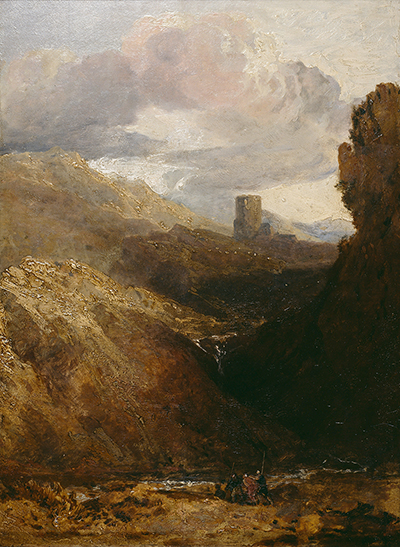
J. M. W. Turner's Dolbadarn Castle should be approached as a National Library of Wales painting connected to, but distinct from, the larger Royal Academy diploma picture. The National Library describes its work as an oil painting of Dolbadarn Castle in Llanberis, north Wales, and identifies it as a study for Turner's diploma composition.[1] Its catalogue data gives the material form as oil on panel, with a visible image measuring 45.5 x 30 cm and a frame measuring 62 x 50 cm.[1]
That distinction is the key to reading the work responsibly. Turner also made the larger Dolbadern Castle, North Wales, exhibited at the Royal Academy in 1800 and later presented as his Diploma work.[4][5] The spelling "Dolbadern" belongs to some records of the larger exhibition picture and to Tate's research titles for related studies.[4] The standard title for the National Library painting remains Dolbadarn Castle.[1][3]
The painting brings together Welsh topography, medieval history and early career ambition. The round tower of Dolbadarn Castle stands in the landscape of Llanberis, but Turner does not treat the ruin as a simple architectural note. The scene becomes an image of confinement, historical memory and mountain isolation. The figure of Owain Goch ap Gruffydd, associated with imprisonment at Dolbadarn from 1255 until 1277, gives the landscape a human and political charge.[2][5]
The work matters because it shows Turner using landscape to carry the seriousness usually attached to history painting. The mountains, tower, figures and deep tonal contrasts are not separate topics. They work together to make a small panel feel emotionally large. The result is one of the clearest early examples of Turner turning Welsh travel and historical reading into a charged landscape subject.
At a Glance
- ArtistJoseph Mallord William Turner
- TitleDolbadarn Castle
- DateAbout 1798–1800
- MediumOil on panel
- Visible image45.5 x 30 cm
- Frame62 x 50 cm
- CollectionNational Library of Wales
- Accession199804702
- PlaceLlanberis, north Wales
- Object relationStudy for the larger diploma composition
Contents
- Overview
- Object Identity
- Study and Diploma Picture
- Dolbadarn and Llanberis
- Owain Goch and Welsh History
- Welsh Travel and Preparation
- Composition and Mood
- Panel, Scale and Material Form
- History Painting Through Landscape
- Tate Studies and the Dolbadern Spelling
Object Identity
The work treated here is the National Library of Wales Dolbadarn Castle, not the larger Royal Academy diploma painting. The National Library's record describes a painting in oil on panel, visible image 45.5 x 30 cm, in a 62 x 50 cm frame.[1] Art UK also records Dolbadarn Castle by J. M. W. Turner at the National Library of Wales, with measurements of 45.5 x 30 cm and accession number 199804702.[3]
The date needs care. The National Library and related records connect the object with Turner's work toward the diploma composition around 1798-1800.[1][2] The larger Royal Academy picture belongs to the 1800 exhibition context.[4][5] It is safer to describe the National Library work as a late 1790s oil study connected with the 1800 diploma composition than to call it simply the 1800 Royal Academy work.
The medium also needs care. Local inherited copy used "oil on wood," while the National Library catalogue wording available through search and catalogue data uses "oil on panel."[1] Those descriptions are compatible in broad material terms, but the tighter public wording should follow the holding institution: oil on panel.
The relationship between the objects is important. The National Library says the panel was the result of work first developed on paper and that Turner likely used this version when making the larger oil on canvas presented to the Royal Academy.[2] Tate research preserves related composition studies, using the title spelling Dolbadern Castle, North Wales for several sheets.[4] These related works support the making history without turning every version into the same object.
Butlin and Joll remain the standard catalogue backbone for Turner's oil paintings and their exhibition histories.[7] For this subject, that framework helps keep the National Library study, Tate studies and Royal Academy painting in a disciplined relation.
Study and Diploma Picture
The National Library painting has unusual interest because it sits between travel observation and public exhibition ambition. It is not just a small independent landscape, and it is not the Royal Academy diploma painting itself. It is a study connected to the larger composition that Turner would use to declare himself within the Academy world.
The National Library's account says Turner worked first from paper studies and then executed the small panel once the overall idea was ready.[2] That sequence matters. It shows a young artist moving from place observation into a more deliberate historical landscape. Dolbadarn was not simply copied from one outdoor view. Turner combined prospects, figures, tower, mountain forms and historical meaning into a composed image.[2]
The larger Royal Academy work had a public role. Tate research states that Turner submitted his painting Dolbadern Castle, North Wales to the Royal Academy exhibition of 1800 and presented it as his Diploma work when elected a full Academician.[4] The Royal Academy story hosted through Google Arts & Culture also identifies the 1800 work as one of Turner's early oil paintings and connects it with Dolbadarn Castle in Llanberis.[5]
The National Library painting therefore has double value. It has its own material identity as a small oil panel, and it also records Turner's preparation for a larger statement. The panel gives viewers a close look at how the subject was shaped before it became the Academy diploma picture.
This relation should be described without inflation. The small panel is not important because it is secretly the larger work. It is important because it lets us see the process by which Turner made a Welsh castle into a history landscape.
Dolbadarn and Llanberis
Dolbadarn Castle stands near Llanberis in north Wales. The National Library identifies the castle's location and treats the work as part of Turner's engagement with Welsh scenery and history.[1][2] The Royal Academy story likewise describes the 1800 painting as depicting the thirteenth-century castle in Llanberis.[5]
The castle's form is simple and powerful: a round tower in a mountain setting. Turner makes that architectural fact carry emotional weight. The tower is not a grand inhabited palace; it appears isolated, elevated and severe. The surrounding landscape does not merely decorate the building. It intensifies the sense of confinement.
Llanberis also matters because it gave Turner a landscape of mountains, steep approaches and dramatic light. The National Library says Turner combined several prospects around the castle to produce a scene with atmosphere, light and a sense of place.[2] That sentence is crucial. It confirms that the work is not a photographic transcript of one fixed position. It is a composed image drawn from local knowledge.
This makes the painting both topographical and imaginative. It has enough place identity to remain Dolbadarn, yet it arranges the landscape for emotional force. The castle's history and the terrain's pressure become inseparable.
The result is not a neutral view for antiquarian interest. Turner makes the ruin look active within memory. The tower seems to hold past suffering, and the pass around it feels less like open scenery than a landscape shaped by power, distance and enclosure.
Owain Goch and Welsh History
The Owain Goch story gives the painting its historical force. The National Library connects the foreground figures with Owain Goch and soldiers, and states that Owain was captured by his brother Llywelyn ap Gruffudd and imprisoned at Dolbadarn tower from 1255 until 1277.[2] The Royal Academy story similarly says Owain Goch ap Gruffydd was imprisoned there by his brother Llywelyn and later released under treaty terms.[5]
This history should be handled carefully. Turner is not illustrating every detail of thirteenth-century Welsh politics. He is using a remembered episode of imprisonment to charge a landscape with meaning. The tower becomes more than an architectural feature because it is associated with confinement.
Owain's presence changes how the figures are read. They are not casual staffage inserted only for scale. They help carry a story of captivity and lost liberty. At the same time, they remain small within the landscape, which makes the historical drama feel subdued rather than theatrical.
The subject also suited Turner's early interest in history as a way of raising landscape's status. A castle in Wales could have been treated as picturesque ruin. Turner makes it a scene of political memory. The mountain setting becomes a moral environment.
The Royal Academy story notes that the 1800 exhibition work was accompanied by lines of verse about "Owen" long imprisoned.[5] Those lines should not be overused, but they confirm that the historical association was part of the work's intended resonance. Turner wanted viewers to connect the tower with captivity and liberty, not only with scenic grandeur.
The painting is therefore both local and historical. It belongs to Dolbadarn and Llanberis, but it also belongs to a broader question about how Welsh history could be pictured through landscape.
Welsh Travel and Preparation
Turner's Welsh travel gave him the material from which the Dolbadarn subject grew. The National Library says the study was based on sketches taken at the castle in 1798.[2] The Royal Academy story notes that Turner made multiple tours of Wales between 1792 and 1799.[5] Those travels help explain why the painting feels observed even when it is highly composed.
The National Library's broader Turner and Wales essay emphasizes his practice of travelling to draw and his interest in Welsh landscape, history and regional identity.[2] It also states that for Dolbadarn he spent considerable time preparing working drawings.[2] That preparation is visible in the painting's balance between topographical anchor and dramatic arrangement.
Travel, however, should not be allowed to replace the object. The painting is not valuable merely because Turner visited Wales. It matters because he transformed travel material into a compact historical landscape. The process moved from sketching to paper studies to panel and then toward the larger Academy painting.
This is one reason the National Library panel is so useful. It preserves an intermediate state of thought. The image has the concentration of a small object, but it already carries the scale of Turner's public ambition. The mountains and tower seem ready to expand into a larger exhibition canvas.
The Welsh setting also placed Turner within an existing artistic tradition. The National Gallery notes that Turner's earliest works formed part of the eighteenth-century topographical tradition and that he was inspired by artists including Richard Wilson.[6] Dolbadarn had already been an important subject within British landscape art. Turner entered that tradition, then pushed it toward historical drama.
Composition and Mood
The painting's power depends on the relation between tower, path, figures and mountain forms. The tower rises as a concentrated vertical accent, while the landscape around it presses with darker slopes and atmospheric distance. The viewer's attention is drawn upward, but not easily. The path toward the castle feels difficult.
The figures help turn the climb into an event. They give the scene a human scale, but they also carry narrative pressure because of the Owain Goch association. The viewer understands the landscape as a place of movement toward confinement.
Light is crucial. Turner does not simply show a ruin under a clear sky. The contrast between dark land and brighter atmospheric passages gives the tower a severe presence. The building is small in physical terms, yet the whole scene seems to gather around it.
This is where the painting's mood emerges. It is not only melancholy, and it is not only picturesque. The image carries restraint, pressure and historical weight. The emotional force comes from a measured composition, not from exaggerated gesture.
The National Library says Turner combined several prospects around the castle, creating a landscape with atmosphere, light and place while giving the scene a deep melancholy.[2] That statement gives a strong institutional basis for discussing the painting's mood without treating it as a private projection.
The small panel format intensifies this effect. Because the visible image is only 45.5 x 30 cm, the composition compresses mountain space, historical action and architectural focus into a narrow field.[1][3] The result feels concentrated rather than expansive.
Panel, Scale and Material Form
The National Library record's material wording, "oil on panel," is important.[1] It separates the work from watercolour studies and from the larger oil on canvas associated with the Royal Academy diploma picture. The panel is a compact painted object, not a sheet from a sketchbook and not the large Academy submission.
Its size also shapes the reading. At 45.5 x 30 cm, the visible image is small enough to encourage close looking.[1][3] The viewer is not overwhelmed by physical scale. Instead, the painting creates intensity through compression. Tower, mountain, path, figures and atmosphere are held tightly together.
That compression suits the subject. A story of imprisonment and isolation does not require breadth alone. It requires pressure. The panel's narrow format reinforces the climb toward the tower and the sense that landscape and history are closing around the figures.
Material form also matters because it reveals Turner's early experimentation. The National Library says the panel resulted after working first on paper and before the larger oil on canvas.[2] The work therefore stands at a point where drawing, study and painting meet.
This helps prevent a common mistake. The National Library painting should not be judged as though it were a reduced reproduction of the Academy picture. It is a working object with its own density. The smaller scale lets Turner test arrangement, tone and meaning before enlarging the idea.
The panel also reminds us that Turner's early career was materially varied. He worked with watercolour, drawing, oil on panel and oil on canvas, adapting each format to the problem before him. Dolbadarn Castle belongs to that flexible practice.
History Painting Through Landscape
Turner's Dolbadarn Castle belongs to an early moment when he was testing how landscape could carry the seriousness of history painting. The National Gallery notes that his Royal Academy presence began with watercolours in 1790 and moved into oil exhibition from 1796.[6] By the time of the Dolbadarn subject, Turner had already entered the exhibition world and was seeking larger claims for landscape.
The Owain Goch subject gave him a way to do that. A Welsh castle view became a scene of imprisonment, dynastic conflict and lost freedom. The historical story does not sit on top of the landscape. It is built into the tower, the climb and the atmosphere.
This approach differs from a conventional history painting centered on large figures. Turner keeps the human actors small. The landscape does much of the expressive work. Mountain, ruin, light and distance convey the gravity that another artist might have assigned to gesture or costume.
That decision is central to Turner's development. He was learning how to make landscape itself carry narrative force. The Dolbadarn subject shows that ambition before the later marine, Alpine and modern-life paintings for which he is often remembered.
The work should not be described with unsupported claims about Turner transforming all landscape painting at once. Its achievement is more precise. In this subject, Turner makes a Welsh ruin and a medieval captivity story serve as a serious early test of landscape as historical art.
The result is powerful because it does not abandon place. Dolbadarn remains Dolbadarn. Llanberis remains the setting. Yet the painting asks the viewer to feel the historical pressure contained within that place.
Tate Studies and the Dolbadern Spelling
Tate research preserves related studies for the composition and uses the title spelling Dolbadern Castle, North Wales in those records.[4] That spelling should be preserved when naming the Tate research titles or the Royal Academy exhibition picture, but it should not replace the standard title of the National Library work treated here.
Tate research states that the Dolbadern Castle, North Wales painting went to the Royal Academy exhibition in 1800 and became Turner's Diploma work when he was elected a full Academician.[4] This provides an important external anchor for the larger picture's public role.
The studies also help explain why the subject has a layered making history. Turner did not arrive at the diploma composition in a single jump. Drawings and studies allowed him to test figure placement, tower emphasis, landscape structure and historical mood.
The National Library panel belongs within that chain, but it is not identical with every sheet or the final Academy picture. Keeping the spelling and object distinctions clear makes the whole group easier to understand.
This matters because Turner titles are often unstable in casual discussion. A slight difference between Dolbadarn and Dolbadern can signal a different record, not merely a spelling preference. The public title here should stay simple, while the research spelling appears only where it belongs.
Not the Royal Academy Picture
The larger Royal Academy painting is central to the story, but the National Library panel must not disappear into it. The Academy work was exhibited in 1800 and presented as Turner's Diploma work.[4][5] The National Library panel is the smaller oil study associated with that composition.[1][2]
The difference is material. The panel is recorded as oil on panel with a visible image of 45.5 x 30 cm.[1] The Academy work is a larger oil painting, discussed in connection with the RA Collection and shown in the Google Arts & Culture story as Dolbadern Castle, North Wales.[5]
The difference is also historical. The National Library acquired its painting in 1998 with assistance from the National Lottery Heritage Fund and the National Art Collections Fund.[2] The Academy painting belongs to Turner's Diploma work history. Both histories matter, but they are not the same.
Clear separation improves interpretation. The National Library object shows Turner's preparatory thinking and his movement from Welsh sketches toward a major Academy statement. The Academy picture shows the public result. Treating them as one object would flatten the evidence.
For this reason, claims about display or current institutional setting need careful wording. The National Library panel is held by the National Library of Wales.[1][3] The larger Academy painting is associated with the Royal Academy.[5] A viewer planning a visit should check the relevant institution for current display details.
How to Look at Dolbadarn Castle
Begin with the tower. Its round form is small but forceful, and it gathers the meaning of the scene. It is the architectural sign of Dolbadarn and the historical sign of imprisonment.
Then follow the path and figures. The movement toward the castle is not casual. Because of the Owain Goch story, the figures give the landscape a human cost. Their smallness increases rather than weakens the sense of pressure.
Next, look at the surrounding mountains and sky. Turner uses the landscape to intensify the historical subject. The terrain does not simply frame the event; it helps create the feeling of isolation.
After that, consider the panel's scale. The work is small, but its mood is large. Turner compresses place, history and atmosphere into a tight vertical field.
Finally, keep the object distinction in mind. The National Library panel is a study related to the larger Royal Academy painting. Seeing that relationship makes the work more interesting, not less. It becomes evidence of Turner thinking through landscape, history and exhibition ambition.
Why the Painting Matters
Dolbadarn Castle matters because it shows Turner using Welsh landscape as a vehicle for historical feeling. A ruin, a pass, a mountain setting and a story of imprisonment become a serious early subject.
It matters because it preserves a stage in the making of a larger Academy work. The National Library panel stands between sketching and public exhibition, making visible Turner's process of transformation.[2]
It matters because the object requires careful evidence. Title, date, medium and institutional identity must be kept distinct from the related Royal Academy and Tate material. That discipline makes the painting clearer.
The work also matters within Turner's early career. The National Gallery's summary of his early training and exhibition history places him in the topographical tradition while showing his rapid movement into oil painting and broader ambition.[6] Dolbadarn Castle sits exactly at that point: observed place becomes historical landscape.
Most of all, the painting matters because it demonstrates how much Turner could do with restraint. The panel is small. The figures are modest. The tower is distant. Yet the subject carries weight because every element points toward confinement, memory and the psychological force of place.
Frequently Asked Questions
The National Library catalogue wording gives the material as oil on panel.[1]
Owain Goch ap Gruffydd belongs to the castle's imprisonment history. The National Library connects him with capture by Llywelyn ap Gruffudd and confinement in the tower between 1255 and 1277.[2]
Discussion
How does Turner make a small Welsh oil panel carry the weight of landscape, captivity and public ambition?
Reader Insights
How does the distant round tower organise the vertical composition?
How does the Owain Goch story change your reading of the landscape?
What does the small panel reveal about preparation for the larger diploma picture?
Join the Conversation
Share a close observation or a source-based question for other readers.
References
- National Library of Wales, "JMW Turner, 'Dolbadarn Castle'." https://www.library.wales/discover-learn/digital-exhibitions/pictures/europeana-280/jmw-turner-dolbadarn-castle
- National Library of Wales, "Turner and Wales." https://www.library.wales/discover-learn/digital-exhibitions/pictures/turner-and-wales
- Art UK, "Dolbadarn Castle." https://artuk.org/discover/artworks/dolbadarn-castle-119919
- Tate Research Publication, Joseph Mallord William Turner, "Study for the Composition of 'Dolbadern Castle, North Wales' c.1799-1800." https://www.tate.org.uk/art/research-publications/jmw-turner/joseph-mallord-william-turner-study-for-the-composition-of-dolbadern-castle-north-wales-r1177996
- Royal Academy of Arts via Google Arts & Culture, "Explore JMW Turner's painting, 'Dolbadern Castle'." https://artsandculture.google.com/story/kAXRW2sW6AH-JQ
- National Gallery, London, "Joseph Mallord William Turner." https://www.nationalgallery.org.uk/artists/joseph-mallord-william-turner
- Martin Butlin and Evelyn Joll, *The Paintings of J. M. W. Turner*, revised edition, Yale University Press, 1984.