 by Tom Gurney
Tom Gurney BSc (Hons) is an art history expert with over 20 years experience
Published on June 19, 2020 / Updated on October 19, 2026
Email: tomgurney1@gmail.com / Phone: +44 7429 011000
Isabella and the Pot of Basil
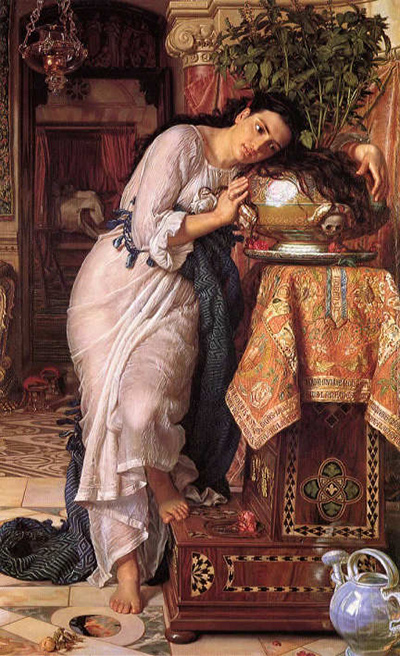
A woman bends around a large ceramic pot, her arms and dark hair almost enclosing it. Basil rises thickly above her head, while skulls on the vessel suggest what cannot be seen inside. William Holman Hunt's Isabella and the Pot of Basil gives a scene of private mourning an unusually large and richly furnished setting. The woman is Isabella, and the pot contains the head of her murdered lover Lorenzo in John Keats's poem Isabella; or, the Pot of Basil. Hunt made the painting in 1866–68 and returned to it in 1886, according to the National Gallery of Art exhibition brochure. The Laing Art Gallery, which owns it, commonly labels the picture 1867. That is a useful display date within a longer documented making history, not a reason to erase the later retouching. [1] [2]
Lead image: Laing Art Gallery, Tyne & Wear Archives and Museums, via VanGoYourself[3]. Its source page marks the original image Public Domain and the displayed image CC BY-SA 3.0[4]. This web copy was resized from the source, with no other visual changes, and is shared under the same licence.
At a Glance
- ArtistWilliam Holman Hunt (1827–1910)
- TraditionBritish Pre-Raphaelite art
- Work or subjectIsabella and the Pot of Basil
- ContextIllustrated paintings guide
- Further readingArtist biography
The work is oil on canvas, approximately 186.7 × 115.6 cm, in the Laing Art Gallery, Newcastle upon Tyne. The gallery records its gift from Dr Wilfred Hall in 1953 and earlier ownership by the Tynemouth collector James Hall. These facts help place the painting's scale and collection history beside the intimate scene it depicts. It is not the smaller 1848–49 Isabella by John Everett Millais; the two Pre-Raphaelite artists chose different moments from Keats's poem. [1] [2] [5]
What happened to Lorenzo?
Keats's poem reworks a story from Boccaccio's Decameron. Isabella loves Lorenzo, who works for her brothers. They murder him and conceal his body. After learning where it lies, she removes his head and hides it beneath basil in a pot, tending the plant with her tears. Her brothers later take the pot away, and she dies of grief. Hunt represents the period when the pot is still with her. The violent action has already happened; the evidence is hidden in the apparently beautiful domestic object she holds. [1] [5]
That choice changes the viewer's task. Lorenzo is absent as a figure, yet his loss governs everything Isabella does. Her face rests against the decorated vessel. One arm crosses its upper edge, and the other curves around its side. The tall plant grows from a small, terrible burial place. Even without knowing the entire poem, a viewer can sense that the embrace is directed at more than a houseplant; with the story in mind, the pot becomes a substitute for the person Isabella cannot hold.
A room filled with signs
The skulls on the pot are the most explicit hint of death. The Laing also points to dying roses on the floor as a sign of love's ending. At the same time, the basil is green and vigorous. Hunt sets decay and growth together in one image, so the plant's flourishing does not bring simple consolation. It depends, in the story, on the remains Isabella has concealed and the tears she gives it. The pot is both a memorial and an object her brothers will be able to steal. [1]
Watch: William Holman Hunt
Begin with Hunt’s paintings, then place his work alongside two fellow Pre-Raphaelite founders.
William Holman Hunt Paintings
An overview of Hunt’s paintings from TheHistoryOfArt video archive.
Watch on YouTubeHunt invites slow looking around the rest of the room. An ornate hanging lamp, carved and inlaid furniture, patterned covering, tile floor, fabrics and small objects fill the space. Isabella's white nightdress and bare feet separate her from the polished surfaces and elaborate textiles. The shifted cloth and objects near the floor suggest a private moment rather than a formal sitting. Dr Rebecca Jeffrey Easby reads the decorative details as a meeting point between Hunt's long-standing Pre-Raphaelite interest in exact description and a later Victorian taste for richly patterned, exotic interiors. That is an interpretation of the work's style, not a literal identification of a single real room. [5]
The painting can be unsettling because beauty and violence share the same surfaces. The skulls are decorative forms on an expensive vessel, yet they also name the secret inside it. The tapestry's colours and the tiled floor are attractive, but their sharp visibility leaves Isabella exposed rather than shielding her from the story. The eye moves between the woman's face, the pot and the other worked objects, returning to the point where she presses against the container. Details reward attention without making grief disappear into decoration.
Fanny Waugh Hunt and the painting's long making
Hunt began the work in Florence while travelling with his wife Fanny Waugh Hunt. Their son was born in October 1866, and Fanny died in December after illness following childbirth. Dr Easby reports that Hunt used Fanny's likeness for Isabella; she presents the painting's mournful mood as a possible expression of his own grief. The relationship between sitter and subject is an important part of the picture's history, but Isabella remains a character from Keats rather than a straightforward portrait of Fanny. The inherited page's broad memorial claim can be understood in that qualified sense: a personal loss entered a literary painting begun before Fanny died. [5]
Hunt worked on the painting over a period usually given as 1866–68. Dr Easby notes that he exhibited it at the dealer Ernest Gambart's showroom in 1868. The 2013 National Gallery of Art brochure records further retouching in 1886. None of these dates needs to be treated as a rival identity for the work: the Laing's 1867 label is a concise collection date, 1868 marks a public presentation, and 1886 identifies later work on the same canvas. [5] [2]
Hunt and other readers of Keats
Keats was a sustained source for Hunt and his circle. Hunt's earlier Study of a Bloodhound belongs to his Eve of Saint Agnes painting of 1848, and The Flight of Madeline and Porphyro addresses another scene from that poem. Here Hunt turns from impending danger to what a woman does after a murder. Millais's Isabella instead shows the lovers together before Lorenzo's death, amid a table of hostile relatives. The comparison makes Hunt's chosen moment distinctive: nearly all the other characters are absent, and the story is concentrated in the woman's relation to one pot. [5]
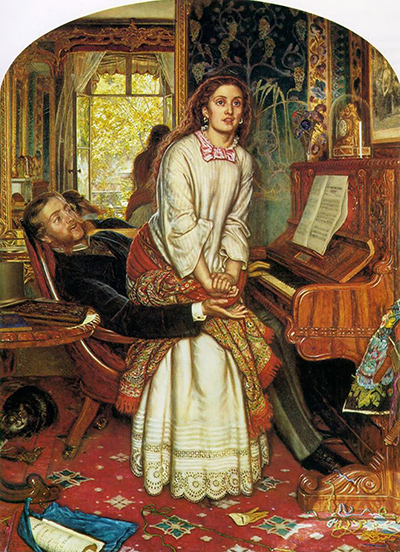
The Laing's picture also shows Hunt's interest in making material things carry narrative weight. Pattern, vessel, flowers and clothing are not a neutral background for a poem. They let viewers discover a painful story through close observation. For Hunt's wider development after the early Brotherhood years, see the paintings guide and biography; The Awakening Conscience offers another interior in which visible objects shape the reading of a person's emotional state.
Discussion
Look closely at Isabella and the Pot of Basil, then compare your reading with the documented history.
Reader Insights
Which detail in Isabella and the Pot of Basil most affects your reading?
How do the date, medium and collection records shape that interpretation?
What remains uncertain about this work or its history?
Join the Conversation
Share a close observation or a source-backed question about Isabella and the Pot of Basil. The prompts above are starting points for discussion.
References
- Laing Art Gallery collection labels. View source.
- National Gallery of Art exhibition brochure. View source.
- via VanGoYourself. View source.
- CC BY-SA 3.0. View source.
- Dr Rebecca Jeffrey Easby, Smarthistory. View source.