 by Tom Gurney
Tom Gurney BSc (Hons) is an art history expert with over 20 years experience
Published on June 19, 2020 / Updated on October 19, 2026
Email: tomgurney1@gmail.com / Phone: +44 7429 011000
William Holman Hunt quotations, with context
William Holman Hunt left far more than a handful of memorable sayings. His letters, published arguments about art and later memoir let us hear how he described painting, friendship, landscape and the Pre-Raphaelite Brotherhood. They also show why a short line should be read with its date and audience attached. A private answer to John Ruskin does a different job from a statement written for visitors to an exhibition.
The selections below are brief on purpose. Each names the speaker and a traceable document, then explains what the words tell us about a particular work or dispute. The distinction between Hunt's words and words about Hunt matters: a critic's praise or complaint is evidence of reception, not a statement of the painter's beliefs. For a chronological account of his life, see the biography.
At a Glance
- ArtistWilliam Holman Hunt (1827–1910)
- TraditionBritish Pre-Raphaelite art
- PageWilliam Holman Hunt Quotes
- ExplorePaintings · Drawings · Watercolours · Prints
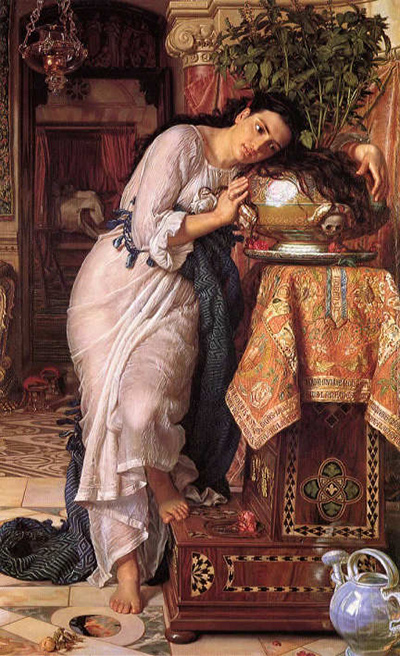
Lead image: Hunt's Isabella and the Pot of Basil, Laing Art Gallery, Tyne & Wear Archives and Museums, via VanGoYourself[1]. Its source page marks the original image Public Domain and the displayed image CC BY-SA 3.0[2]. This web copy was resized from the source, with no other visual changes, and is shared under the same licence.
Hunt on the cost of a long painting
“Prosperity means advancing with my picture”
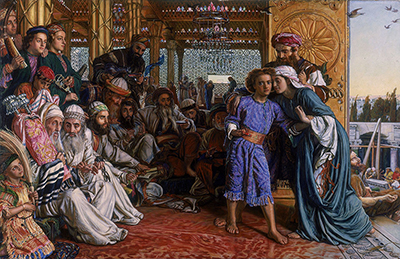
Hunt wrote this in a 28 December 1857 letter to Ruskin, during the extended making of The Finding of the Saviour in the Temple. He was answering Ruskin's concern about spending too long on one work. The rest of the letter compares the importance of that picture to Leonardo's Last Supper in its maker's eyes, while acknowledging that he also had to earn a living. The six-word excerpt is therefore an unusually direct measure of what “success” meant to him at that moment: progress on a picture, despite financial pressure. It is not a general promise that every painter should work slowly. [3]
This letter also corrects a simple story in which Ruskin only endorsed Hunt. The critic worried about the consequences of a drawn-out undertaking, and Hunt defended his priorities. Their correspondence holds admiration and disagreement together. The date matters because The Finding of the Saviour in the Temple was still incomplete when Hunt made this defence; later success could not yet settle their argument.
Hunt on the painter's first ambition
“the first ambition of the painter ... should be to give a delightsome aspect”
In a 1865 pamphlet, Hunt argued for visual appeal alongside meaning. Judith Bronkhurst quotes this passage in her Christie's essay on Asparagus Island[4], placing it beside his landscape practice. The sentence continues by allowing that a picture might lack a separate “special moral” and still reveal grace in nature. This matters when a landscape is approached only as a religious code: Hunt could value the sight of sea, rock and sunlight as a painterly achievement. The quotation comes from Hunt's argument as transmitted in a specialist catalogue; the pamphlet's full context should be consulted before treating it as a complete theory of his art.
Asparagus Island, Kynance, Cornwall supplies a good test. Hunt recorded a specific cove, yet the picture's shifting colours and foam are not reducible to a hidden message. Its documented materials and later refinements are described in the watercolours guide. The 1865 words let us understand why delight in the observed place and seriousness of purpose need not exclude each other.
Watch: William Holman Hunt
Begin with Hunt’s paintings, then place his work alongside two fellow Pre-Raphaelite founders.
William Holman Hunt Paintings
An overview of Hunt’s paintings from TheHistoryOfArt video archive.
Watch on YouTubeHunt on Ruskin and the Brotherhood
“All that the Preraphaelite brotherhood had of Ruskinism came from this reading of mine.”
Hunt wrote this in a candid letter drafted on 6 November 1880. He told Ruskin that reading Modern Painters and The Stones of Venice had helped give direction to his work. George P. Landow's edition prints the letter from a Cornell manuscript and explains that Hunt sent it later, enclosed with another letter of 4 July 1882. The quoted claim is Hunt's own retrospective account; it should be weighed against other members' memories and the Brotherhood's history, not repeated as an uncontested fact about every founder. [3]
The distinction between written in 1880 and sent in 1882 is useful. Hunt was speaking privately and personally about a debt to Ruskin, long after the Brotherhood's first meetings. He also remembered artistic disagreements, which makes a slogan about complete agreement between the two men misleading. Read beside the 1857 letter, this later passage shows both independence and gratitude.
Ruskin on The Scapegoat
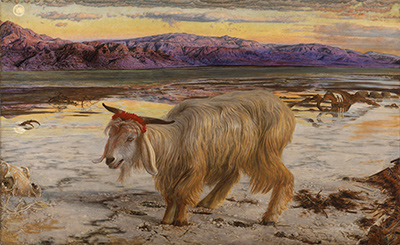
“the one of all in the gallery which should furnish us with most food for thought”
These are Ruskin's words, from his published Academy Notes for 1856[5], on Hunt's The Scapegoat. The praise followed an opening admission that Ruskin found parts of the picture faulty. He admired the ambition and difficult subject while challenging its composition and painterly result. Quoting only his praise would distort the review as much as quoting only his complaint. [3]
In 1858, Hunt answered Ruskin's criticisms in a long letter about colour and reflection, arguing that the eye's experience of light could require choices different from a literal ratio of pigment tones. This was a technical disagreement, not proof that Hunt had abandoned observation. The two artists were debating how an observed effect should be translated into paint. Their exchange is a useful companion to the painting page and the watercolours, where the surface of paper can itself become light. [3]
A remembered mishap in Cornwall
One of Hunt's most lively anecdotes describes a gust of wind carrying his nearly finished Kynance watercolour over a cliff and a later gust lodging it where he and Val Prinsep could retrieve it. The Christie's account[4] reports his recollection to his daughter Gladys and identifies the documentary trail. This page paraphrases the story because the inherited long quotation lacks an edition and page reference. It is best treated as Hunt's later recollection of Asparagus Island, not as a contemporaneous diary entry proving each instant of the episode.
The story is valuable even without an extended extract. It places drawing materials, wind, an exposed viewpoint and another artist's help into the making of a closely observed landscape. It also reminds us that a finished sheet can carry evidence of danger, interruption and work completed after the journey. The watercolours guide follows the object record, its technique and its sale to Henry Virtue Tebbs in 1862.
Lines that cannot be assigned to Hunt
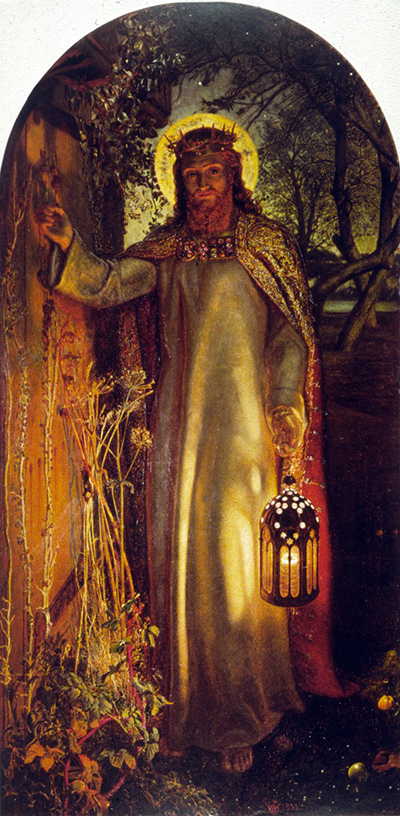
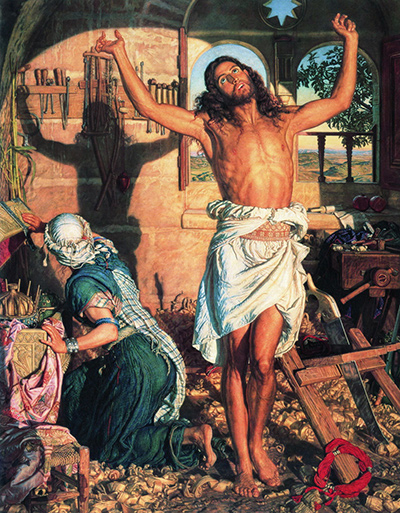
The former version of this page attributed “The door of the human heart, can only be opened from the inside” to Hunt. The symbolism of the closed door in The Light of the World is well established, but that does not establish those exact words as his. Until a dated Hunt text is found, the aphorism should be treated as an unverified later paraphrase, rather than printed as a quotation by him. The earlier page also carried a sentence about fairies, wizards and trolls without any credible Hunt source. It has been omitted.
Likewise, an extended modern critical summary and a biographical paragraph from other websites were placed in quotation blocks. They did not offer primary testimony from Hunt or a contemporary witness. For what the paintings show, use the linked artwork pages; for what Hunt and his contemporaries actually said, begin with dated letters, pamphlets, reviews and the published memoir, checking the exact edition where wording matters. The shorter the quotation, the more important its context becomes.
Discussion
What stands out when you compare the works and sources in William Holman Hunt Quotes?
Reader Insights
Which work or period changes how you understand Hunt’s career?
How do the cited collection records support or complicate that reading?
What further source would help answer a question left open here?
Join the Conversation
Share a close observation or a source-backed question about William Holman Hunt Quotes. The prompts above are starting points for discussion.
References
- via VanGoYourself. View source.
- CC BY-SA 3.0. View source.
- Hunt to Ruskin, 28 December 1857, letter 19 in George P. Landow's edition. View source.
- Christie's essay on Asparagus Island. View source.
- Academy Notes for 1856. View source.