 by Tom Gurney
Tom Gurney BSc (Hons) is an art history expert with over 20 years experience
Published on June 19, 2020 / Updated on October 19, 2026
Email: tomgurney1@gmail.com / Phone: +44 7429 011000
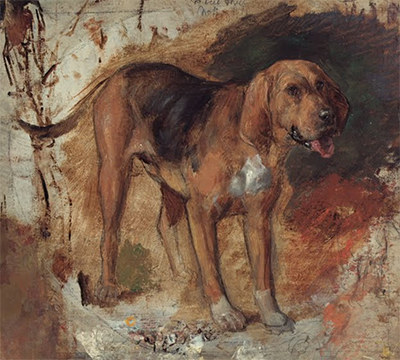
Study of a Bloodhound
William Holman Hunt's Study of a Bloodhound brings a single dog close to the viewer. The animal stands with its head turned, mouth slightly open and tongue visible. Hunt worked its reddish and dark coat against a background of exposed-looking ground and quick strokes of colour. Some passages are more finished than others, making this a study of a living pose as well as a striking picture in its own right. The work dates from 1848, before the formal foundation of the Pre-Raphaelite Brotherhood later that year. It is oil over pencil on an irregular board laid down on card, now in the Art Gallery of New South Wales, accession 105.2002. The collection-supplied record gives its board as 25.6 × 28.9 cm. [1] [2]
The study belongs to the making of Hunt's 1848 painting The Eve of Saint Agnes, based on John Keats's poem. The larger picture, rather than this dog study, was exhibited at the Royal Academy. Art UK identifies it as the work that caught Dante Gabriel Rossetti's attention and helped begin his friendship with Hunt. The bloodhound sheet therefore connects a carefully observed animal with a turning point in the artists' early relationship, but it should not be described as Hunt's separate Royal Academy exhibit. [1] [3]
At a Glance
- ArtistWilliam Holman Hunt (1827–1910)
- TraditionBritish Pre-Raphaelite art
- Work or subjectStudy of a Bloodhound
- ContextIllustrated paintings guide
- Further readingArtist biography
Looking closely at the dog
The bloodhound is nearly full length, with its long legs, broad chest and hanging ears set clearly against the unfinished surroundings. Hunt has noticed small variations in the animal's coat: a warmer brown on the head and legs, darker shading along the back and side, and lighter patches at the chest and feet. The eye and dark muzzle hold attention near the top right, while the tail extends in the other direction. The dog's stance looks momentarily still, but the open mouth prevents it from seeming like a stuffed specimen.
The surrounding marks show how Hunt could isolate the subject without making an elaborate setting. Pale and reddish areas sit behind the body; near the lower edge, brushwork suggests uneven earth or debris. These passages help separate the paws from the ground but do not define a specific outdoor place. A written mark near the top belongs to the study's surface, although its exact words are not secure from the small reproduction. The picture records an animal with enough individuality to serve a narrative painting, while keeping the edges of the study visibly provisional.
Calling the work a “study” does not make it an anonymous exercise. The dog's weight, direction of gaze and partly open mouth are decisions about how a particular creature would appear in a scene. Hunt's approach was to look at a real model rather than substitute a generic emblem of vigilance. The result can be appreciated independently of the larger painting, but its purpose becomes clearer when set beside Keats's story.
Watch: William Holman Hunt
Begin with Hunt’s paintings, then place his work alongside two fellow Pre-Raphaelite founders.
William Holman Hunt Paintings
An overview of Hunt’s paintings from TheHistoryOfArt video archive.
Watch on YouTubeKeats and The Eve of Saint Agnes
Keats's poem places a watchful bloodhound within the dangerous world through which Porphyro and Madeline move. Hunt drew on that literary detail for his painted narrative. The AGNSW account notes that the dog mattered enough for Hunt to quote lines about it in the 1848 Royal Academy catalogue entry for The Eve of Saint Agnes. Those lines described the hound waking and shaking its hide. A real dog's body and response would make the poem's animal credible in paint. [1]
The literary context is important, but it should not overwhelm the study itself. This image does not show Madeline, Porphyro or the full castle scene. It lets Hunt test a single actor before fitting it into an event with many parts. A viewer can move from the directness of this painted dog to the composed drama of The Flight of Madeline and Porphyro, a related Hunt treatment of the same Keats narrative. Art UK also connects the 1848 exhibition picture to Rossetti's decision to seek out Hunt. [3]
The borrowed model and the young artists
According to Hunt's later recollection as reported in the AGNSW collection text, the bloodhound was lent by John Blount Price of Islington. The distinction matters: Price is the lender's full name, not “John Blount, Prince of Islington,” and the dog was not a gift to Hunt. A living animal cannot be ordered to hold a pose as reliably as a studio prop. Hunt's need for direct observation helps explain why a preparatory study was worthwhile. The available account does not establish the dog's sex, name or every circumstance of its sitting. [1]
The same collection account says Hunt sought John Everett Millais's help and worked on The Eve of Saint Agnes in the younger artist's studio. Rossetti then admired the exhibited picture. These links make the study part of a cooperative period before the Brotherhood was formally named. Hunt, Millais and Rossetti would become its three best-known painters later in 1848. That sequence is more precise than treating the dog study itself as a finished Brotherhood manifesto: it arose from the work and friendships that made the movement possible. [1] [3]
From Rossetti's family to Sydney
Hunt later gave the study to William Michael Rossetti, another founding member of the Brotherhood. The AGNSW provenance places the gift around 1853. It then passed by descent to Rossetti's son Gabriel Arthur Rossetti, and through later family and private ownership. The museum purchased it in 2002 with funds provided by John and Julie Schaeffer. This path gives the work a history beyond the brief period in which it served a studio purpose. [1]
The object remained in the Rossetti family for decades after Hunt's gift, long after the original painting was exhibited. That survival lets us see an otherwise fleeting stage of the work: an animal observed and painted before it was fitted into a literary story. The study's uneven finish is part of its value as evidence of process. The careful coat and alert head are there, while the setting is still open to change.
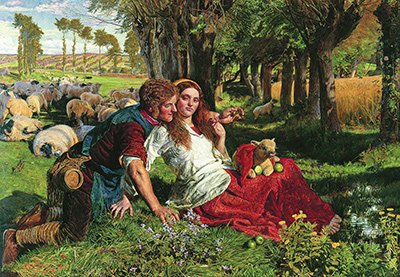
For more of Hunt's early work with animals and outdoor observation, compare The Hireling Shepherd and the small 1849 landscapes Cornfield at Ewell and The Haunted Manor. The drawings guide considers why studies and preparatory records matter alongside finished canvases.
Discussion
Look closely at Study of a Bloodhound, then compare your reading with the documented history.
Reader Insights
Which detail in Study of a Bloodhound most affects your reading?
How do the date, medium and collection records shape that interpretation?
What remains uncertain about this work or its history?
Join the Conversation
Share a close observation or a source-backed question about Study of a Bloodhound. The prompts above are starting points for discussion.
References
- AGNSW collection feed via Google Arts & Culture. View source.
- AGNSW object URL. View source.
- Art UK on the 1848 exhibition. View source.