by Tom Gurney
Tom Gurney BSc (Hons) is an art history expert with over 20 years experience
Published on June 19, 2020 / Updated on October 27, 2026
Email: tomgurney1@gmail.com / Phone: +44 7429 011000
The Voyage of Life: Manhood by Thomas Cole: Introduction
A man kneels in a golden boat as the current carries him towards a narrow gap between rocks. His hands are clasped, his face lifted. Above him, sinister figures hover in the clouds; far to the left, another opening reveals a radiant guardian. In The Voyage of Life: Manhood, Thomas Cole gives the traveller two directions at once: the river drives him forwards, while prayer turns his attention upwards. The scene is frightening, but it contains a presence that its frightened passenger cannot see. [1]
This is the third painting in Cole's four-part Voyage of Life. It follows the hopeful, self-directed traveller of Youth and precedes the spiritual revelation of Old Age. Cole painted the first complete set in 1840 for Samuel Ward; those pictures belong to Munson in Utica, New York. He made the second set in Rome in 1841–42, and it belongs to the National Gallery of Art in Washington. The 1842 Manhood considered here measures 134.3 × 202.6 cm and is accession 1971.16.3. Its kneeling figure differs significantly from the standing traveller in the first version. [1]
Cole supplied an explanation of the allegory, identifying its dangers and its religious answer. Those words help distinguish the forms he intended from shapes a viewer might imagine in a dark sky. Yet the picture's impact begins before anything is named. The sloping water, enormous rocks and twisting trees make a small human body look exposed. Understanding its symbols sharpens an experience already carried by the landscape.
At a Glance
- ArtistThomas Cole. [1]
- TitleThe Voyage of Life: Manhood, third in a four-picture series. [1]
- Version discussedRoman replica, dated 1842; the first version was completed in 1840. [1]
- Medium and sizeOil on canvas, 134.3 × 202.6 cm. [1]
- CollectionNational Gallery of Art, Washington; Ailsa Mellon Bruce Fund, accession 1971.16.3. [1]
- Central subjectA middle-aged voyager facing danger and appealing to a higher power, within Cole's Christian allegory. [1]
This work in Cole’s career
First European journey
1829–1832The Course of Empire
1834–1836The Oxbow
1836The Voyage of Life
1840 and 1842Church’s training
1844–1846Notes and sources
American recognition. Three New York sales brought Cole to the attention of artists and patrons. [2]
First European journey. Looking in Britain and Italy enlarged the repertoire of his American landscapes. [2]
The Course of Empire. Five invented landscapes turn the rise and fall of civilisation into a visual argument. [2]
The Oxbow. An American prospect joined direct observation to a carefully staged view. [2]
The Voyage of Life. The original cycle and Roman replicas give human life the course of a river. [2]
The Voyage of Life: Manhood. The 1842 Roman version carries the voyager into turbulent water, where prayer replaces his earlier confidence in steering. [1]
Church’s training. Cole taught Frederic Edwin Church in Catskill. [2]
Home in the Woods. A late cabin landscape brings settlement and surrounding woodland into one scene. [2]
Contents
- Introduction
- A river with no room to turn
- What the storm does to the landscape
- The praying man and the golden vessel
- The figures that hover in the clouds
- A guardian beyond the voyager's sight
- Why Cole painted Manhood again
- Between youthful hope and the last horizon
A river with no room to turn
The boat occupies the lower part of a wide canvas, well below the immense sky and cliffs. Water gathers around it in a broad, dark sweep before breaking into foam against the rocks. The current appears to have room to move, but the traveller has no clear choice of route. Ahead, the passage tightens. The eye follows the golden prow into a sequence of obstructions and then towards the distant sea.
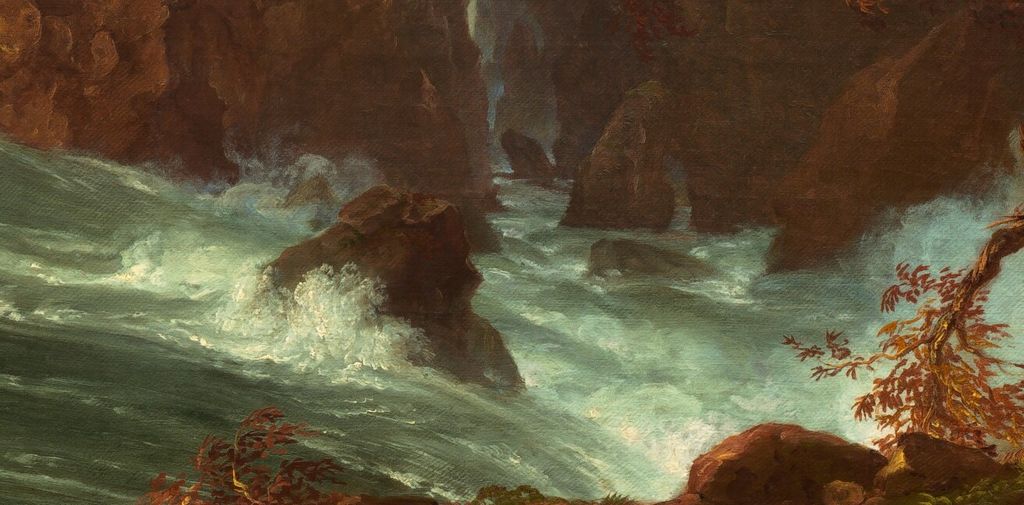
Cole makes speed legible through contrasting surfaces. Around the boat, the green water still holds reflections; farther along, pale streaks and white turbulence interrupt its smoothness. Solid rocks resist that movement. Their angular edges divide the stream into channels and make its force visible. The landscape does not merely surround the man's ordeal: it gives the ordeal its direction and scale.
The cliffs on the left rise so high that their upper limits disappear into darkness. Across the lower distance, broken rock formations create another barrier. At the right, a damaged tree leans over the water, its branches twisting back into the sky. These forms produce an enclosing space without the reassurance of shelter. A cave or overhanging bank could protect a traveller; here the surrounding mass threatens to crush or obstruct him.
This setting was a deliberate development in Cole's design. Franklin Kelly's National Gallery catalogue explains that the small preliminary study suggested a turbulent ocean coast. Before completing the first version, Cole replaced that setting with a gorge bounded by rocks. The difference matters: an exposed coast threatens through limitless force, whereas this ravine also threatens through confinement. The finished composition leaves the voyager almost nowhere to move except along the current. [1]
A thin band of warm light remains near the horizon. Its brightness does not make the foreground safe. It marks a distance separated from the boat by rushing water and jagged terrain. In his accompanying description, Cole identifies the barely visible ocean as the approaching end of life. It is therefore more than a possible destination beyond the storm: it places the immediate emergency within a journey that cannot be stopped. [1]
The distinction between movement and control is central to the picture. The stream has carried the traveller in every stage, including those in which he appeared secure. Its continuity now becomes uncomfortable. Time proceeds whether or not he feels prepared, and a vessel that once seemed to offer passage cannot guarantee safety. Cole gives that abstract idea a physical pressure through the water's downward course.
Annotated Details from Manhood
Compare four details with the full composition, then open the photographs for a closer view.
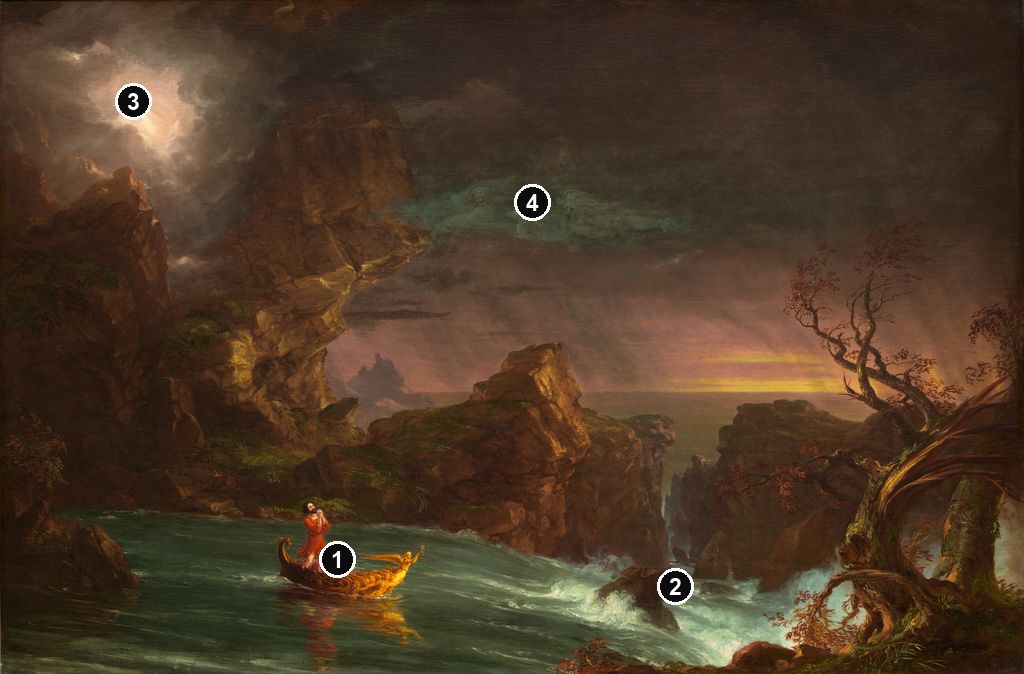
Details from MANHOOD
Each crop comes from the same painting shown above.
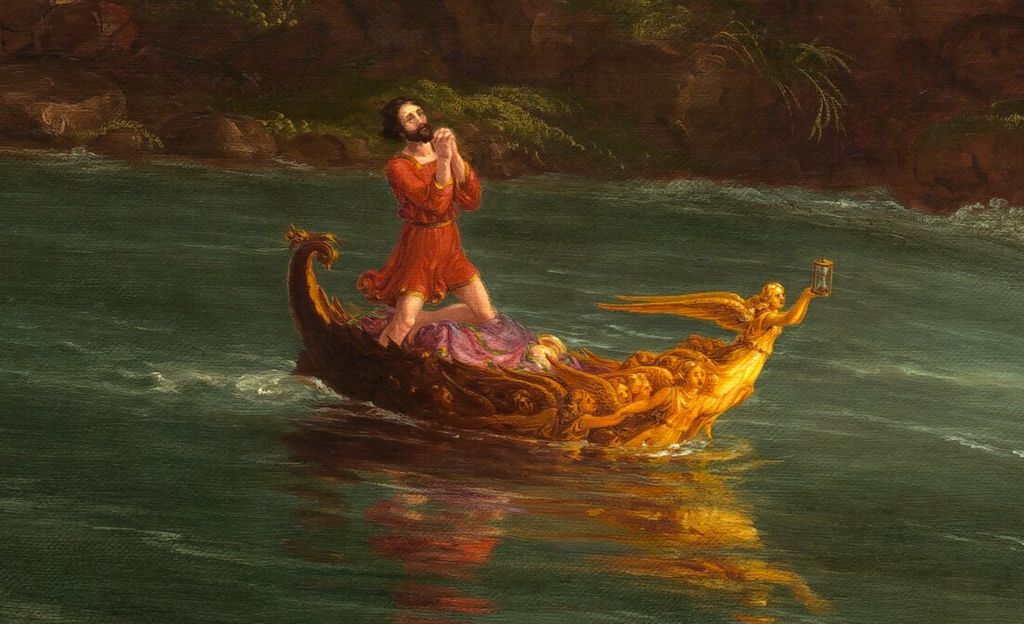
The praying voyager
The mature traveller kneels in the boat with hands raised in prayer. This is the 1842 replica’s pose, distinct from the standing figure in the 1840 version. [1]
Water over the rocks
Foaming water presses between the rocks below the boat. Its turbulent direction replaces the broad, navigable river of the earlier stages. [1]
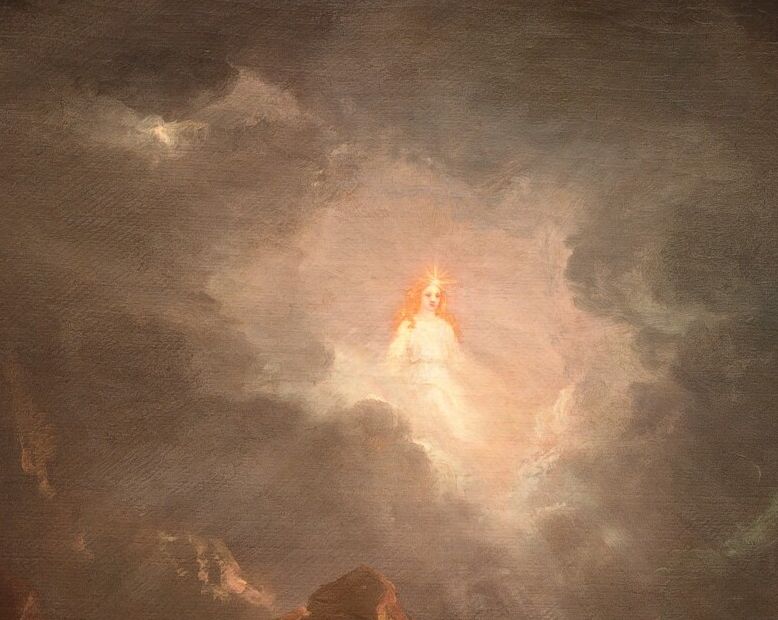
The distant guardian angel
The angel is high above the voyager, separated from him by the dark landscape. Cole makes continuing guardianship visible to the viewer even when the traveller appears alone. [1]
The threatening sky
Dark cloud and the rocky pass limit the boat’s surroundings. The atmosphere turns life’s difficulties into a landscape that offers little clear prospect ahead. [1]
What the storm does to the landscape
The storm's darkness spreads across most of the upper canvas. It has neither the clear atmosphere of Youth nor the gentle morning of Childhood. Brown, grey and green clouds seem to weigh upon the rocks. Light catches their surfaces unevenly, allowing some edges to glow while adjacent recesses remain almost unreadable. The effect is less like a single flash illuminating a scene than a world in which dependable visibility has been lost.
The damaged trees are especially expressive. Their remaining leaves do not restore the abundant growth of the earlier landscapes. Bent trunks and broken limbs expose the force that has passed through them. Cole explicitly associated the storm-riven trees and the sombre, almost eclipsed light with the troubles of adult experience. The trees therefore have a stated allegorical function, as well as supplying sharply observed forms through which the viewer can feel the storm. [1]
The close foreground also prevents a comfortable spectator's position. Branches and rock faces press against the edges of the image. There is no inviting path beside the river on which we could imagine walking calmly through the scene. Our view is spacious enough to understand the danger, but the traveller's immediate world remains narrow. The contrast gives viewers knowledge without giving them a means to intervene.
Cole does not show an undifferentiated black landscape. The golden boat, orange-red clothing, green water and illuminated rock edges make separate points of attention within the gloom. Most crucially, the guardian occupies a luminous opening above the left-hand cliffs. Colour and light preserve distinctions between the mortal figure, physical danger and spiritual protection. Darkness threatens to overwhelm the scene but never erases its structure.
These observations help explain why the painting works as landscape rather than simply as a figure illustrating distress. The man's pose tells us that he appeals for help. The setting tells us how overwhelming the need for help feels. If the same figure were placed on a tranquil stream, the gesture would lose much of its urgency. Cole makes weather, terrain and human action depend upon one another.
The praying man and the golden vessel
The voyager wears a vivid garment that separates him from the muted rocks. His lifted head and clasped hands draw a line upwards from the boat. In the 1842 version, he kneels on one leg; the posture is unstable enough to belong to this moving vessel, yet recognisable as prayer. Cole's description identifies him as middle-aged and explains that he looks towards heaven because he can no longer save himself by ordinary means. [1]
The loss of the helm gives that change a concrete cause. In Youth, the traveller confidently steers. Here Cole says the helm is gone. The absence is easily missed if attention stays on the spectacular sky, but it changes the man's relationship to the whole picture. He still occupies the boat, though his position within it no longer allows him to determine its course. His hands now perform an appeal rather than an act of navigation. [1]
The vessel itself remains strikingly elaborate. Its bright ornament catches the light, and its warm reflection touches the green surface beneath it. Cole explained that the figures decorating the boat represent the Hours: the traveller is borne along by time. That identification links the small object to all four scenes. A familiar shape persists while the passenger ages and the environment changes around him. [1]
Its beauty makes its helplessness more affecting. Golden ornament does not strengthen its passage between rocks, and the boat supplies no roof or protective enclosure. It holds a human body without insulating that body from the world. In this scene, the luxurious surface and the precarious situation coexist. The viewer can recognise the vessel at once, then discover how little its recognisability helps its passenger.
Cole's explanation makes faith the answer to the danger. That is his stated religious proposition, rather than a hidden meaning inferred from the presence of an angel. The upward gaze demonstrates dependence on a higher power, and the artist describes faith as preventing the destruction that otherwise appears certain. The water continues to rush; the response takes place in the traveller's relationship to that danger. [1]
The painting does not depict the end of the crisis. We see neither a rescue enacted in the foreground nor the boat safely past every obstruction. Cole suspends the voyager within the emergency. Knowledge of the next picture assures a continuing journey, but Manhood itself maintains the sensation of exposure. That tension allows the artist's confidence in salvation to coexist with a convincing image of fear.
The figures that hover in the clouds
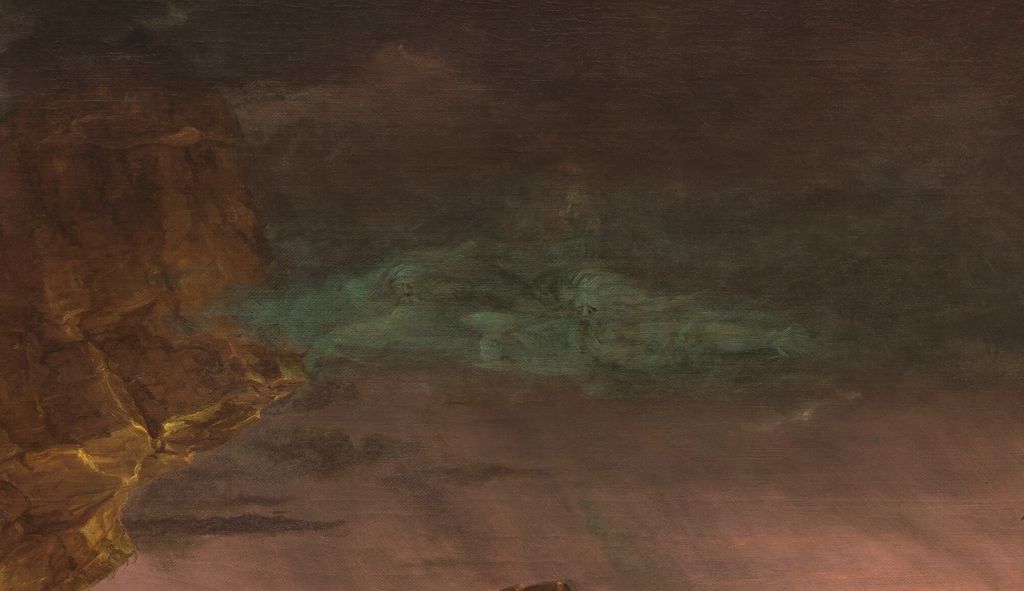
Across the central sky, several dark, greenish forms emerge from the cloud bank. Their faces and bodies are less sharply defined than the man in the boat. They seem suspended between weather and apparition. At a first glance, it is possible to follow the cliffs and current without noticing them; once seen, they make the surrounding darkness feel inhabited.
Cole names these demon forms as Suicide, Intemperance and Murder in his written explanation. He presents them as temptations that beset people in extreme distress. Those identifications are the artist's, and they give the threatening group a specific moral meaning. The forms need not be assigned additional identities based on every face-like patch elsewhere in the clouds. [1]
Their position makes the danger different from that of the rocks. A cliff can strike or block the vessel; these apparitions threaten the voyager through possible actions and responses. The painting combines external forces with an inward struggle. The man is not merely waiting for rough water to subside. Cole asks how someone might respond when suffering makes destructive choices seem possible.
The nineteenth-century terms deserve care. Cole's allegory does not provide a general account of psychological distress, nor does it establish that adulthood inevitably brings these particular dangers. His explanation belongs to a Christian moral narrative in which faith counters despair and temptation. Reading the figures in that context preserves the specificity of his position while leaving room for viewers whose understanding of suffering differs from his.
The cloud figures are visually unsettling precisely because they have no firm ground. They gather above the traveller without sharing his clear bodily scale. Their uncertain contours turn the sky into a space where anxiety can take form. By contrast, the guardian is set apart within a bright opening. The opposition is visible before the artist's terms are supplied: one group seems to arise from oppressive darkness, while the other inhabits a distinct and calmer light.
Watch: Thomas Cole
Choose a film to explore the artist’s work, its interpretation and its wider setting.
Thomas Cole: Painting the American Landscape (remastered audio)
An introduction to Cole’s landscapes and artistic ambitions.
Watch on YouTubeA guardian beyond the voyager's sight
The guardian sits high above the left side of the scene, looking towards the man. Its small scale and pale colour allow it to recede into the clouds, but its luminous setting distinguishes it from the threatening figures. Cole describes it as calmly attentive. The calm is essential: the spirit does not duplicate the traveller's panic, even though its attention remains directed towards him. [1]
This creates a difference between the passenger's experience and our view of it. We can see danger and guardianship together. His gesture reveals an urgent need, without revealing knowledge of the guardian's exact position. Within Cole's account of the sequence, the protecting presence continues even when the traveller is unaware of it. The picture stages felt isolation within a story that denies ultimate abandonment. [1]
The angel's distance does not mean that it has simply left the narrative. In Childhood, it steers from the boat. In Youth, it stands on the bank while the young man takes control. In Manhood, it watches from the clouds. These changes place guidance progressively farther from the traveller's immediate physical surroundings, before Old Age brings recognition of it again. Cole uses position to convey changing awareness, rather than repeating the same protective gesture in every canvas. [1]
The separation also makes the painting demanding to look at. Its loudest visual events are low in the scene: the bright boat, the figure and foaming water. The guardian asks for attention elsewhere. A viewer who searches only for an escape along the river may overlook the element that Cole regards as decisive. Looking upward, like the man, changes the balance of the composition even though it does not change the current.
Why Cole painted Manhood again
The Roman Manhood belongs to a second complete set, rather than being an isolated alternative to the Ward painting. The circumstances were practical as well as artistic. After Samuel Ward died in November 1839, Cole negotiated with the family and their lawyer over exhibition rights. Although the first set appeared publicly in November 1840, access became difficult after delivery. Cole and his nephew Henry Bayless made full-size tracings and copies of the figures that would allow the series to be painted again. [1]
Cole carried his studies and tracings to Europe in 1841. Kelly reports that he apparently began the replicas with Manhood, since a December letter described progress on the third picture. The catalogue suggests that dissatisfaction with the original may explain this choice. That is a plausible scholarly interpretation, supported by the number of revisions, rather than a securely recorded statement of why Cole selected it first. [1]
The most conspicuous alteration concerns the passenger. Standing in the 1840 picture, he kneels on one leg in 1842. Cole also gives him a fuller, darker beard and reworks the storm-damaged trees, middle-distance rocks and horizon. The revised pose makes his appeal more directly resemble devotional kneeling. Kelly nevertheless observes that the bodily arrangement retains awkwardness. The change should be examined as an effort to improve the figure, rather than treated as evidence that every difficulty was resolved. [1]
The National Gallery set also appears brighter in colour than the originals. Kelly notes that comparison was especially revealing when both sets were shown together in Utica in 1985. He leaves the reason unsettled: the difference might have been deliberate, or it might reflect the pigments available to Cole. It cannot securely be explained as a decision to make adulthood more hopeful. [1]
Technical evidence gives a more precise view of the 1842 painting's preparation. The National Gallery catalogue records herringbone twill canvas, a white ground and coloured secondary grounds. In Manhood, yellow lies beneath areas including the figure, boat, brown rocks and dark sky; red lies beneath parts of the water and the guardian's illuminated setting. Infrared examination detected drawing around the boat's figure, including changes to the legs. These findings concern this canvas, and they make the revision of the body materially observable. [1]
The comparatively small amount of underdrawing across the replicas, together with red chalk on surviving tracings, supports Kelly's suggestion that Cole transferred parts of the designs. It remains a reconstruction from physical evidence. The second set combines the use of an established composition with renewed work on particular details; calling it a replica does not mean that Cole simply repeated every painted mark. [1]
His journal supplies a useful counterweight to the picture's spiritual confidence. On 28 February 1842, he wondered whether the replicas were better than Ward's set and hoped they would prove profitable. He also regretted time lost from study and longed for his family. In a March entry, he described Bertel Thorvaldsen's admiration for the allegory and its scenery. These passages record Cole's doubts and encouragement while working, rather than establishing the storm as a direct portrait of his personal circumstances. [3]
Between youthful hope and the last horizon
Youth prepares this scene by showing a river that turns away from the traveller's imagined castle and descends into a ravine. Manhood brings that partly glimpsed destination close. The change is therefore more than an abrupt shift from fine to bad weather: the earlier landscape already contains a course that the hopeful passenger does not fully comprehend. [1]
In Old Age, the narrowing gorge gives way to an ocean. The damaged boat continues, but the guardian directs the traveller towards a heavenly opening. Comparing the two makes the compression of Manhood especially clear. Here rocks and water dominate the immediate future; there earthly landmarks lose their power to define a destination. The third picture is the sequence's most intense confrontation with worldly danger, followed by a change in what the voyager can perceive. [1]
That constructed sequence remains open to discussion. Reynolda's 2021 exhibition placed the Voyage of Life framework alongside art from three centuries and stories contributed by its community. Its approach treated a familiar allegory as an invitation to consider varied lives. For Manhood, the question is particularly pointed: Cole makes trouble characteristic of middle age, but viewers can recognise the force of his image without accepting one fixed timetable of suffering, dependence or belief. [4]
The lasting power of the picture lies in how carefully it holds its tensions together. The man is small, but the bright clothing keeps him visible. The guardian is distant, but its light persists. The river gives no freedom to reverse direction, yet the traveller can turn his attention beyond it. Cole's religious answer is explicit; the landscape makes the difficulty to which he offers that answer palpable.
Artworks directory
Explore paintings, drawings and studies across Cole’s career. The two Voyage of Life sets appear separately. Dates and study identifications draw on the exhibition and collection catalogues, supplemented by the National Gallery’s drawing records. [2] [5] [6] [7]
| Name | Date | Medium |
|---|---|---|
| The Oxbow | 1836 | Painting |
| The Titan’s Goblet | 1833 | Painting |
| The Architect’s Dream | 1840 | Painting |
| The Course of Empire: The Savage State | ca. 1834 | Painting |
| The Course of Empire: The Arcadian or Pastoral State | ca. 1834 | Painting |
| The Course of Empire: The Consummation of Empire | 1835–1836 | Painting |
| The Course of Empire: Destruction | 1836 | Painting |
| The Course of Empire: Desolation | 1836 | Painting |
| The Voyage of Life: Childhood | 1842 | Painting |
| The Voyage of Life: Youth | 1842 | Painting |
| The Voyage of Life: Manhood | 1842 | Painting |
| The Voyage of Life: Old Age | 1842 | Painting |
| Home in the Woods | 1847 | Painting |
| Distant View of Niagara Falls | 1830 | Painting |
| View on the Catskill—Early Autumn | 1836–37 | Painting |
| Lake with Dead Trees (Catskill) | 1825 | Painting |
| River in the Catskills | 1843 | Painting |
| A View of the Mountain Pass Called the Notch of the White Mountains (Crawford Notch) | 1839 | Painting |
| Expulsion from the Garden of Eden | 1828 | Painting |
| The Subsiding of the Waters of the Deluge | 1829 | Painting |
| The Mountain Ford | 1846 | Painting |
| American Lake Scene | 1844 | Painting |
| A View near Tivoli (Morning) | 1832 | Painting |
| Aqueduct near Rome | 1832 | Painting |
| The Hunter’s Return | 1845 | Painting |
| The Voyage of Life: Childhood (first version) | 1840 | Painting |
| The Voyage of Life: Youth (first version) | 1840 | Painting |
| The Voyage of Life: Manhood (first version) | 1840 | Painting |
| The Voyage of Life: Old Age (first version) | 1840 | Painting |
| Panorama of the Oxbow on the Connecticut River as seen from Mount Holyoke | ca. 1832 (museum); 1833 (2018 catalogue) | Drawing |
| Sketch for The Oxbow | 1836 | Painting |
| From Nature | 1823 | Drawing |
| View of the Round-Top in the Catskill Mountains (Sunny Morning on the Hudson) | 1827 | Painting |
| Scene from The Last of the Mohicans: Cora Kneeling at the Feet of Tamenund | 1827 | Painting |
| View of Monte Video, the Seat of Daniel Wadsworth | 1828 | Painting |
| The Garden of Eden | 1828 | Painting |
| Tomb of General Brock, Queenston Heights, Ontario | 1830 | Painting |
| Effect for Newstead Abbey, Nottinghamshire, England | 1830 | Drawing |
| The Ilissos, from the Parthenon West Pediment | 1829 or 1830 | Drawing |
| Life Study for the Prostrate Shepherd in The Angel Appearing to the Shepherds | 1831–1832 | Painting |
| Interior of the Colosseum, Rome | ca. 1832 | Painting |
| Campagna di Roma (Study for Aqueduct near Rome) | 1832 | Painting |
| Landscape with a Round Temple | ca. 1830s | Painting |
| Stormy Landscape | 1832 | Painting |
| View of Florence from San Miniato | 1837 | Painting |
| Mount Holyoke, Massachusetts (after Basil Hall) | ca. 1829–1831 | Drawing |
| Layout for The Course of Empire | 1833 | Drawing |
| Study for The Course of Empire: The Savage State | ca. 1834 | Painting |
| Study for The Course of Empire: The Arcadian or Pastoral State | ca. 1834 | Painting |
| Study for The Course of Empire: Desolation | 1836 | Painting |
| Study for Dream of Arcadia | 1838 | Painting |
| Clouds | ca. 1830s | Painting |
| Study for The Hunter’s Return | 1845 | Painting |
| Study for Home in the Woods | ca. 1847 | Painting |
| Sunrise in the Catskills | 1826 | Painting |
| Study for The Mountain Ford | 1846 | Drawing |
| Tree Trunks | 1825–1840 | Drawing |
Frequently Asked Questions
Cole completed the first version in 1840. He began the second set in Rome in 1841 and finished its Manhood by mid-March 1842. The National Gallery painting is dated 1842. [1]
The 1840 version belongs to Munson in Utica, New York. The 1842 version belongs to the National Gallery of Art in Washington, accession 1971.16.3. Their dates and collection credits identify which painting a reproduction shows. [1]
Cole identifies the threatening forms as Suicide, Intemperance and Murder. They represent temptations during extreme distress in his moral and religious allegory. The radiant guardian at the upper left is a separate, protective presence. [1]
Cole explains that the helm is gone and the traveller appeals to heaven because he cannot master the surrounding dangers. In the 1842 version, the man kneels on one leg; he stands in the first version. [1]
Within Cole's narrative, the guardian remains attentive from the clouds. Its distance expresses the voyager's limited awareness of protection, rather than its disappearance from his journey. Old Age makes that spiritual guidance visible to him again. [1]
Discussion
Look again at The Voyage of Life: Manhood and compare your reading with the questions below.
Reader Insights
Does noticing the guardian change how threatening the rocks and current feel, or do their dangers remain equally powerful?
How does the kneeling pose in the second version alter the balance between human vulnerability and determination?
Which detail or comparison would you add to this account, and what evidence supports your reading?
Join the Conversation
Share the details that shaped your response, or suggest a comparison for other readers.
References
- Franklin Kelly, “The Voyage of Life”, in American Paintings of the Nineteenth Century, Part I, National Gallery of Art, 1996, printed pp. 95–108; PDF pp. 111–118 and 123–124 contain text and notes, with illustrations on PDF pp. 119–122. Includes Cole's explanatory descriptions, printed pp. 102 and 107. Catalogue PDF.
- Elizabeth Mankin Kornhauser and Tim Barringer, Thomas Cole’s Journey: Atlantic Crossings (2018). Career context and artwork/study metadata: catalogue entries 10–66 and chronology, PDF pp. 137–231 and 249–262; related Barringer essay passages, PDF pp. 23–66.
- Thomas Cole, Thoughts & Occurrences, transcribed by Peter Fedoryk, Thomas Cole National Historic Site, 2022; entries of 28 February and March 1842, PDF pp. 53–54. Journal transcription.
- Reynolda House Museum of American Art, The Voyage of Life: Art, Allegory, and Community Response, exhibition description and selected artwork list, 16 July–12 December 2021. Exhibition description.
- Franklin Kelly et al., American Paintings of the Nineteenth Century, Part I (National Gallery of Art, 1996). Cole catalogue and both Voyage of Life sets, PDF pp. 91–124.
- National Gallery of Art, Study for The Mountain Ford (1846), accession 2015.19.772. Collection record and open-access image.
- National Gallery of Art, Tree Trunks (1825–1840), accession 2015.19.607. Collection metadata and open-access image.
- Splash image source.
Thomas Cole, The Voyage of Life: Manhood, 1842. Oil on canvas, 134.3 × 202.6 cm. National Gallery of Art, Washington, Ailsa Mellon Bruce Fund (1971.16.3).