by Tom Gurney
Tom Gurney BSc (Hons) is an art history expert with over 20 years experience
Published on June 19, 2020 / Updated on October 27, 2026
Email: tomgurney1@gmail.com / Phone: +44 7429 011000
The Course of Empire: The Consummation of Empire: Introduction
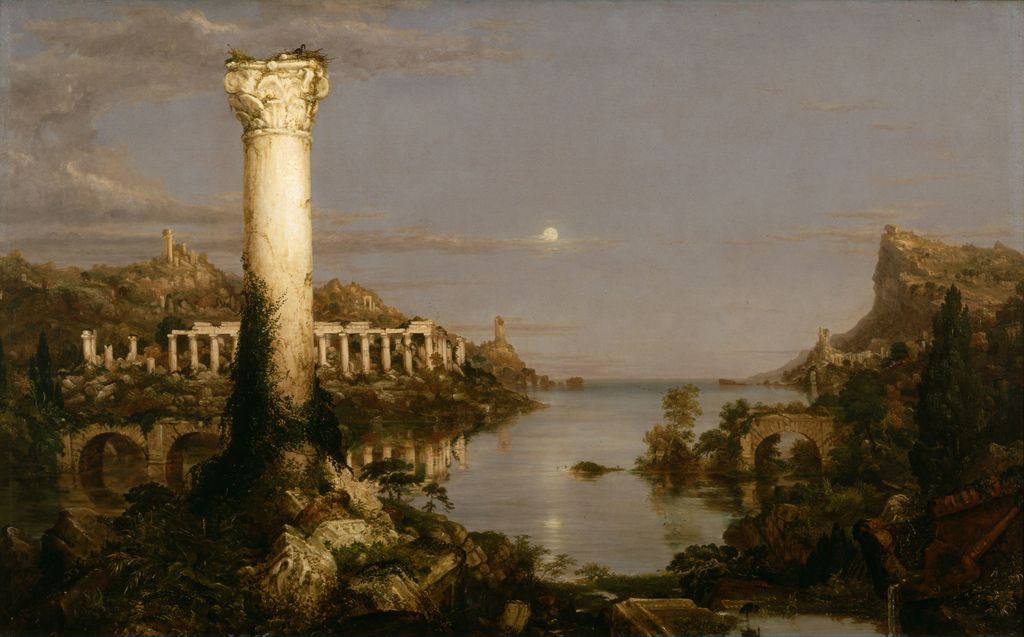
A harbour city glitters beneath a pale sky. Marble terraces rise from the water, boats crowd the bay, and a conquering ruler advances through a triumphal procession. Thomas Cole's The Consummation of Empire presents civilisation at the height of its wealth and apparent confidence. Yet its splendour carries a warning: a society that can organise so much beauty has also organised conquest, hierarchy and excess. Painted in 1835–1836, it is the third and largest canvas in The Course of Empire, the five-part sequence now belonging to New York Historical. [1]
The painting rewards two kinds of looking. From a distance, the city seems harmonious, its architecture enclosing a luminous passage of water. Up close, its crowded stages disclose unequal roles: ruler and captive, celebrant and observer, monumental goddess and inattentive human beings. Cole makes the empire seductive enough that its moral instability emerges through looking, rather than through an obviously sinister atmosphere.
At a Glance
- ArtistThomas Cole (1801–1848).
- Full titleThe Course of Empire: The Consummation of Empire.
- Date1835–1836.
- MediumOil on canvas.
- Dimensions130.2 × 193 cm, unframed.
- CollectionNew York Historical; gift of the New-York Gallery of the Fine Arts, accession 1858.3.
- Place in the seriesThird of five paintings; the imperial city's zenith.
- Signature“T. Cole / 1836”, on an architectural element at the right. [1]
This work in Cole’s career
First European journey
1829–1832The Course of Empire
1834–1836The Oxbow
1836The Voyage of Life
1840 and 1842Church’s training
1844–1846Notes and sources
American recognition. Three New York sales brought Cole to the attention of artists and patrons. [2]
First European journey. Looking in Britain and Italy enlarged the repertoire of his American landscapes. [2]
The Course of Empire. Five invented landscapes turn the rise and fall of civilisation into a visual argument. [2]
The Course of Empire: The Consummation of Empire. The cycle’s central canvas presents a harbour city at the height of its wealth, monumental building and public ceremony. [1]
The Oxbow. An American prospect joined direct observation to a carefully staged view. [2]
The Voyage of Life. The original cycle and Roman replicas give human life the course of a river. [2]
Church’s training. Cole taught Frederic Edwin Church in Catskill. [2]
Home in the Woods. A late cabin landscape brings settlement and surrounding woodland into one scene. [2]
Contents
- Introduction
- A city that has filled the landscape
- The conqueror and the procession
- Ancient sources and modern cities
- Spectators who do not celebrate
- Luxury, literature and political interpretation
- How Cole built the picture
- An uneasy achievement
- What changes in Destruction
A city that has filled the landscape
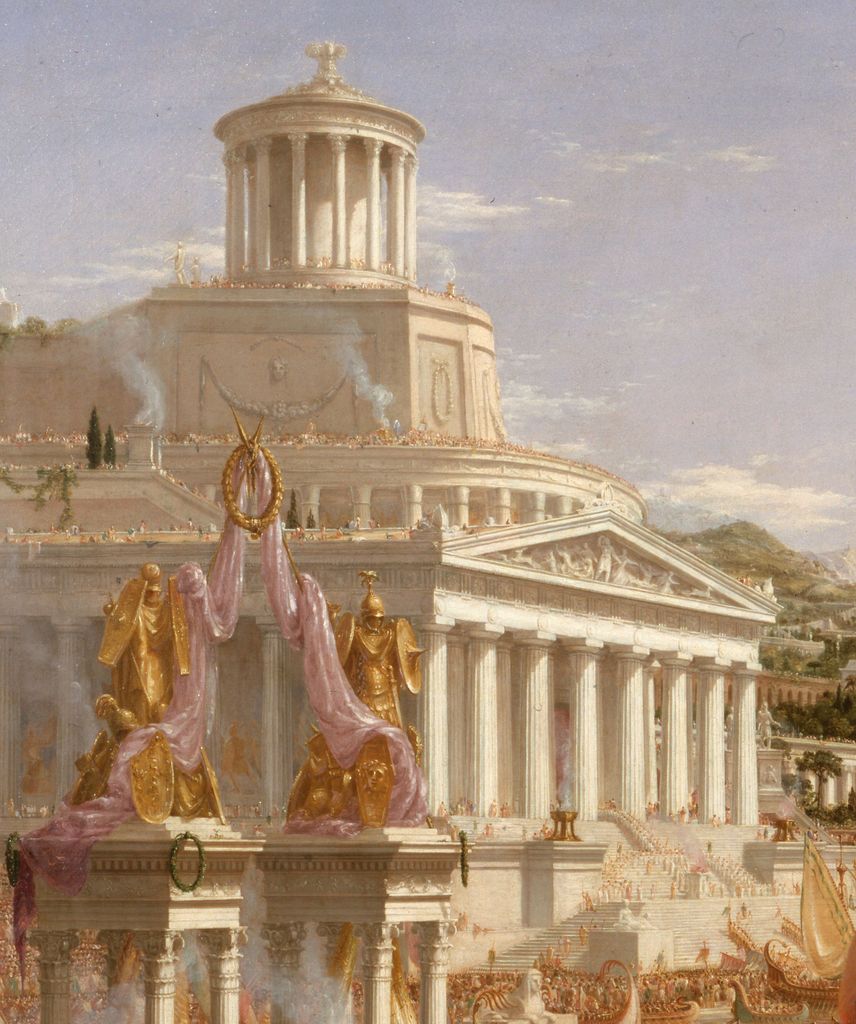
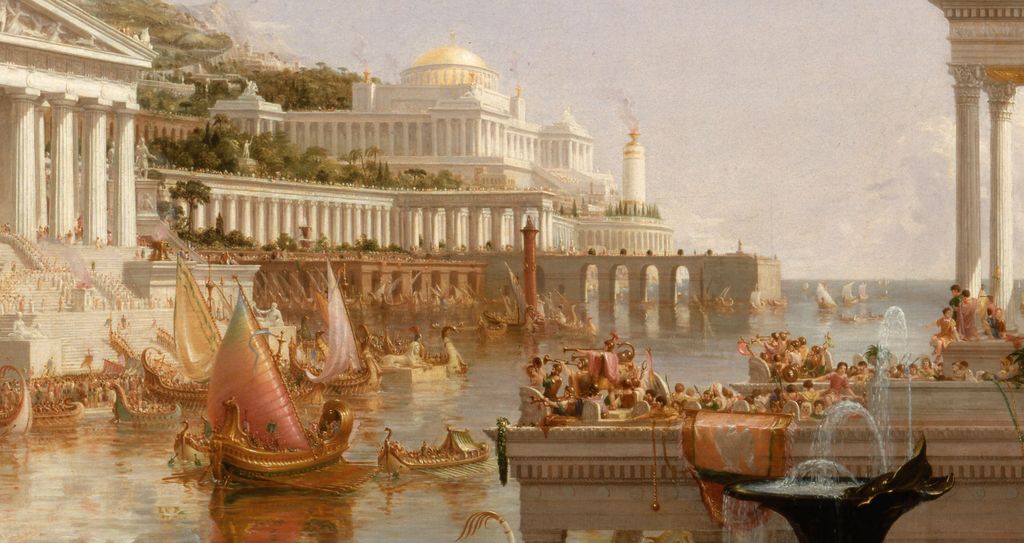
The first impression is of abundance under control. On the left, a temple front and a tall circular monument build upwards in successive tiers. Long colonnades curve into the distance. At the right edge, enormous columns and an overhanging entablature frame the view, giving the spectator the sensation of standing within the city's architecture. The central waterway offers an escape from these crowded edges, but even there sails, gilded hulls and ceremonial boats occupy the surface.
Cole varies the scale of structures with exceptional care. The closest columns exceed the height of the people many times over; distant figures shrink into coloured marks along parapets and steps. Between them, bridges and terraces divide the scene into platforms. The city seems capable of accommodating an almost inexhaustible population. At the same time, all those diminutive spectators make its civic grandeur feel oppressive. Human beings animate the buildings but scarcely challenge their dominance.
The atmosphere makes this enormous accumulation readable. Stronger colours and more pronounced contrasts gather in the foreground; distant architecture becomes paler, losing definition across the bay. The open sky occupies a substantial part of the canvas and prevents the composition from becoming a solid wall of masonry. Its quietness also gives the ceremony an air of security. There is no threatening storm to tell the inhabitants that their triumph is temporary.
The mountain at the right is especially important. It identifies the place across the series, although the surrounding city has altered the view almost beyond recognition. Here its rocky form is squeezed between monuments and distant construction. Comparison with The Arcadian or Pastoral State shows how thoroughly open ground, working landscape and modest settlement have yielded to the imperial metropolis. The museum describes nature itself as subordinated to the ruler, through the trained elephant and the flowers and plants arranged for display. [1]
Those plants deserve attention. Greenery has not vanished, but it appears contained in pots, arranged along ledges or woven into decoration. Leaves and flowers now adorn architecture instead of defining an independent living environment. In the foreground, their irregular shapes soften the hard stonework, yet their placement belongs to the city's ceremonial design. Even the luxuriance of nature has become another possession to exhibit.
Annotated Details from The Consummation of Empire
Compare four details with the full composition, then open the photographs for a closer view.
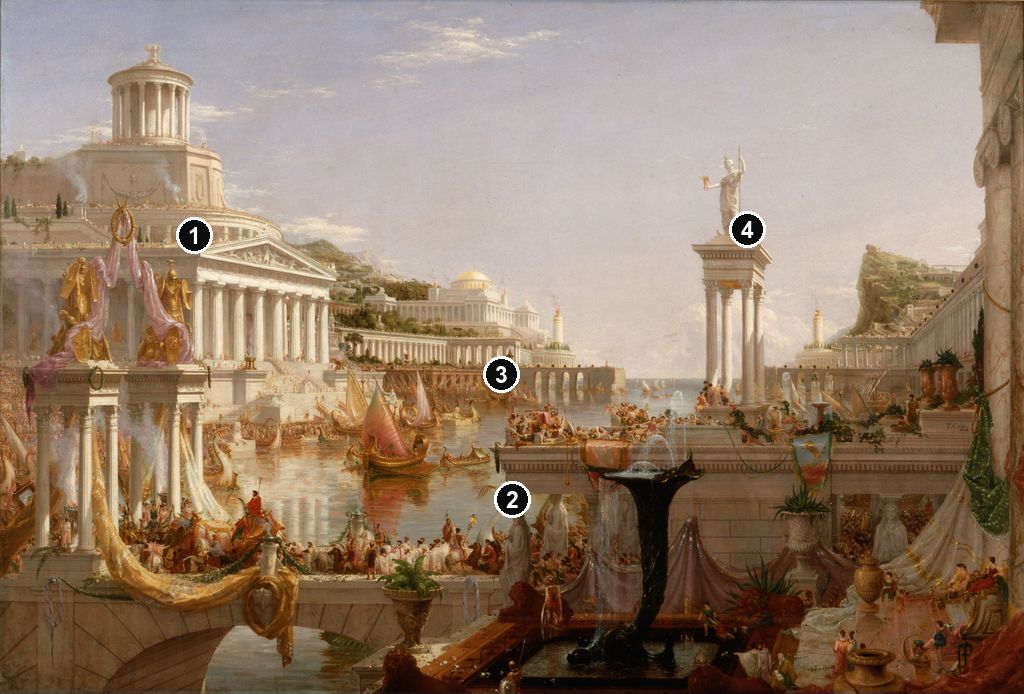
Details from THE CONSUMMATION OF EMPIRE
Each crop comes from the same painting shown above.
A city of classical buildings
The monumental temple and neighbouring structures turn the shore into a dense architectural display. Repeated columns and terraces make the city’s wealth visible through accumulated forms. [3]
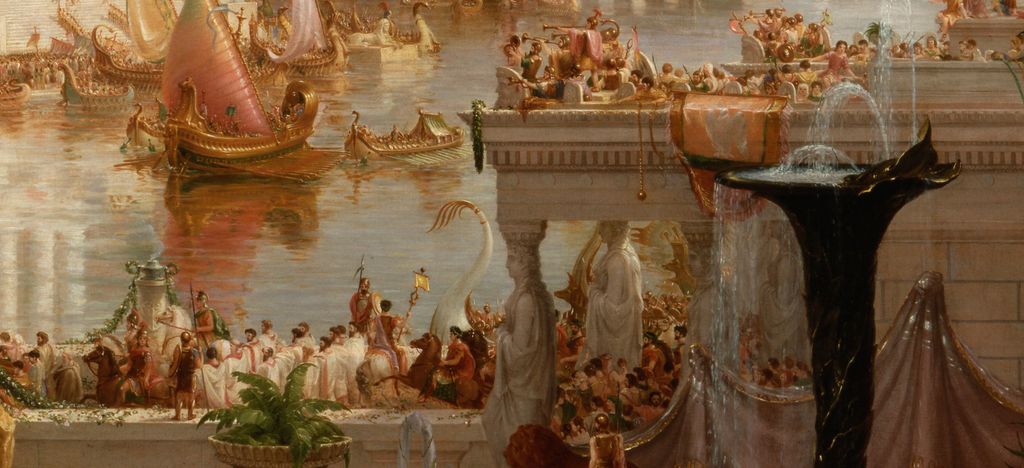
The procession across the bridge
The bridge brings crowds and ceremony into the foreground. Its crowded passage connects the two shores and makes public spectacle central to the scene. [1]
A crowded harbour
Vessels occupy the water between the buildings. The harbour joins the city’s architectural magnificence to movement, commerce and organised human activity. [3]
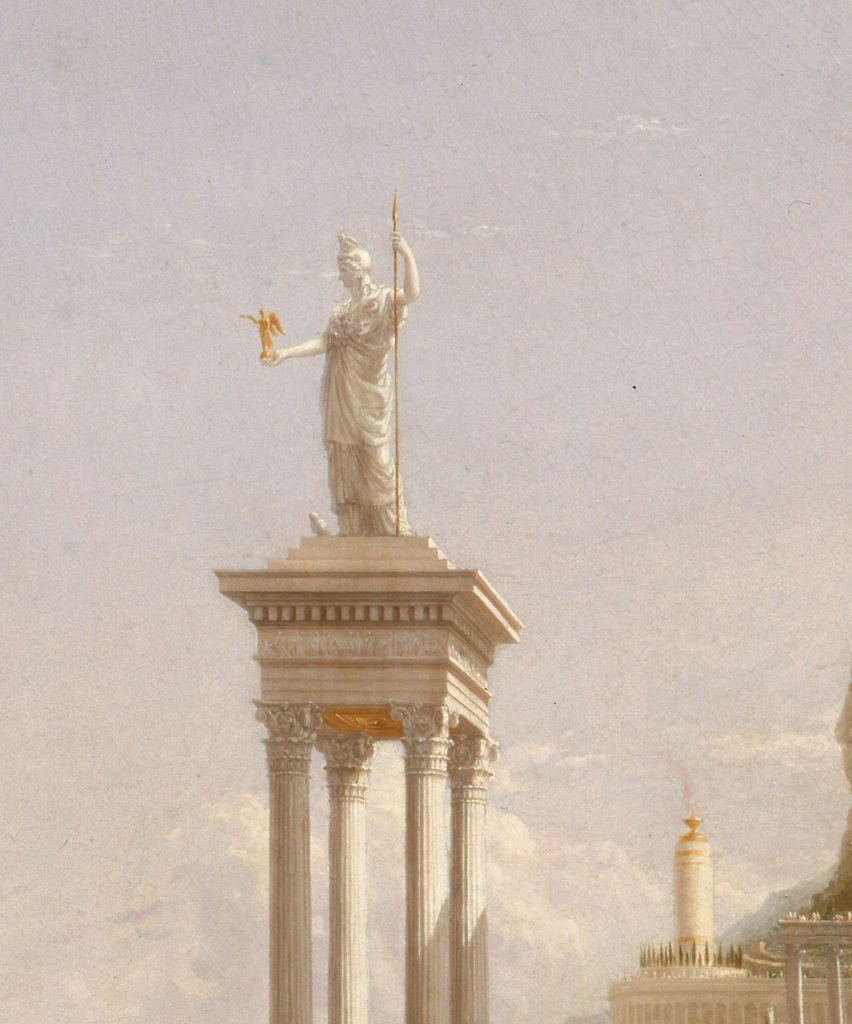
The elevated statue
A statue rises on its tall column above the waterside structures. Its commanding position belongs to the city’s display of power and monumental achievement. [1]
The conqueror and the procession
The ruler in red crosses the foreground bridge amid a dense train of attendants. His bright clothing distinguishes him from the crowd without making him enormous. His authority is communicated through the organisation surrounding him: the elephant drawing his chariot, the gathered procession, the trophies above the arch and the spectators assembled to witness his passage. Architecture supplies both his route and the theatre of his arrival. [1]
The bridge directs this movement across the lower part of the composition. Above it, draperies hang between columns and golden objects catch the light. The ceremony is sumptuous in several different materials: gleaming metal, heavy fabric, carved stone and living flowers. These variations prevent the wealth from becoming merely an abstract quantity. Cole asks the eye to relish individual surfaces, while the procession turns that pleasure towards an act of domination.
Tim Barringer's catalogue entry explains the scene as the return of a conqueror with captives and treasures. Cole's own 1836 description, reproduced there, specifies “captives on foot”. The objects carried before the ruler include pictures as well as gold, so the arts enter the triumph both as achievements and as spoils. Barringer also connects the elephant to the ceremonies of British India, where imperial and East India Company processions employed the animal. This is a useful historical association rather than proof that Cole painted one particular documented procession. [3]
The mixture complicates the apparent Roman setting. Classical temples establish the language of ancient empire, but the elephant allows that language to reach towards forms of domination familiar in Cole's own century. The city is an imaginative construction that brings different imperial spectacles together. Its historical breadth is part of the warning: the mechanisms of triumph can recur even when costumes, rulers and countries change.
There is another ceremony across the water. Small white-robed figures occupy the broad temple steps on the left. Their ordered arrangement answers the crowded movement of the bridge. Religion, military success and public entertainment are presented together, each enjoying a monumental setting. Barringer suggests that the distant rite may recall Catholic ceremonies Cole witnessed in Rome, although its depicted setting is pagan. The suggestion concerns a possible visual memory, not a literal identification of the ritual. [4]
The boats extend the festivities into the harbour. Their decorated forms and warm-coloured sails create a second field of movement, at a different angle from the procession. Water reflections carry patches of red, gold and white into the centre. They bind the buildings and vessels together optically, making the city appear to overflow with its own wealth. The harbour also broadens the implied reach of the empire: this is a capital connected to places beyond the visible bay.
Ancient sources and modern cities
The composition owes a clear debt to J.M.W. Turner. Cole saw Dido Building Carthage in London and admired its architectural masses, central bay and effects of sunlight. Turner's painting, in turn, belonged to the tradition of luminous seaports developed by Claude Lorrain. Cole adapted that arrangement into a more densely inhabited city. Buildings on either side conduct the eye towards water and distance, allowing an elaborate architectural scene to retain the breadth of landscape. [4]
Turner's subject also offered a way of treating a city's fortunes through landscape. Dido Building Carthage bore a subtitle identifying the rise of the Carthaginian empire, and Turner painted a companion showing its decline. Cole made the historical argument more extended and explicit across five canvases. In Consummation, however, the influence is tangible before one considers the series: sunlit stonework, vessels on bright water and a city held together by a spacious central opening. [4]
Individual details draw upon identifiable antiquities. Barringer traces the caryatids supporting the musicians' balcony, and related figures on the distant palace, to the Erechtheion in Athens. Cole could encounter that architectural vocabulary through illustrated publications and through examples in London. The catalogue identifies the Diana of Versailles as a source for the central sculpture in the Doric temple's pediment, and the Borghese vase as the model for an elaborate plant pot at the right. These borrowings identify particular motifs; they do not make the whole fictional city a reconstruction of Athens or Rome. [3]
Their displacement is revealing. A celebrated antique vessel becomes a container for ornamental greenery; sculpted human bodies become architectural supports. The city has appropriated prestigious forms and multiplied them. Its artistic sophistication is real within the fiction, but the accumulation also produces a sense of competitive display. Almost every available surface can support another ornament, figure or spectator.
Barringer proposes modern London as another point of reference, comparing the pale, theatrical architecture with John Nash's Cumberland Terrace in Regent's Park, close to Cole's London lodgings. He also considers John Constable's The Opening of Waterloo Bridge as a parallel for a great waterway serving imperial celebration. These comparisons expand the painting's historical resonance without reducing it to an encoded map of London. Cole's architecture combines observation, printed sources, remembered paintings and invention. [4]
Spectators who do not celebrate
Not everyone participates with equal enthusiasm. At the lower right, an enthroned woman receives the spectacle from beneath drapery, surrounded by attendants. Barringer cautiously identifies her as possibly the empress. Nearby, a bearded man holding a scroll appears absorbed in thought. His stillness differs from the collective excitement behind him; the catalogue proposes a historian's role for this figure. [3]
The distinction changes how the spectator can enter the painting. We may follow the procession as admiring onlookers, but the foreground also offers a model of reflective distance. The man does not need a conspicuous gesture of denunciation. His separation from the general movement is enough to suggest that spectacle and understanding are different activities. Barringer's wider essay reads the pensive figures as poet and historian, whose insight is overlooked by the triumphant city. [4]
Minerva supplies a more monumental version of that contrast. The goddess stands high above the people, holding a small winged Victory. Her great pedestal places wisdom and victory together in a commanding position, yet the celebration below seems directed towards the returning ruler. New York Historical interprets her as an ignored goddess of wisdom. The small golden Victory can seem like an emblem the city has embraced while neglecting the judgement needed to sustain its success. [1]
An incident at the left foreground brings the warning down to the scale of childhood. Barringer describes an older boy sinking a smaller boy's toy boat with a stick. Beside the enormous public display, the action is easily missed. It supplies a modest version of destructive power: one person spoils another's pleasure because he can. The connection with the following canvas is the catalogue's interpretation, and it is persuasive precisely because the episode is so small. Violence already exists inside this apparently peaceful society. [3]
Watch: Thomas Cole
Choose a film to explore the artist’s work, its interpretation and its wider setting.
Thomas Cole: Painting the American Landscape (remastered audio)
An introduction to Cole’s landscapes and artistic ambitions.
Watch on YouTubeLuxury, literature and political interpretation
Cole's initial name for this stage was Luxury. The eventual title, Consummation, identifies a fulfilment or culmination, but the earlier name makes clear that fulfilment was morally unstable. New York Historical connects the sequence to Gibbon's history of Rome and Byron's Childe Harold's Pilgrimage, from which Cole took a motto describing a movement from freedom and glory towards wealth, vice and corruption. The city stands at that precarious transition. [1]
That literary framework explains why the painting can acknowledge achievement while preparing its reversal. The empire has acquired knowledge, technical competence and artistic skill. Its mistake is to interpret those accomplishments as evidence of lasting security. The composition gives such confidence a visual form: extensive buildings, fixed ceremonial routes and crowds whose attention converges on their own triumph. The historian and goddess introduce other measures of value into the scene.
Political readings should retain their attribution. New York Historical notes that some scholars understand the red-cloaked conqueror as a metaphor for President Andrew Jackson. Barringer develops the association with Jacksonian expansion, the rapid growth of New York and the fortunes of its commercial elite. He also relates the figure to British monarchy, especially George IV. The emperor is therefore not an established portrait of Jackson, nor does the painting have one conclusively decoded contemporary target. [1] [3]
Barringer further interprets the captives as enslaved Africans and discusses the procession in relation to contemporary debates over slavery. He proposes sympathy with abolitionism in Cole's association of enslavement with imperial greed and violence. This reading gives the victory parade a human cost that a general phrase such as prosperity can conceal. It remains a scholarly interpretation of the painting rather than an explicit political programme supplied by Cole. [4]
How Cole built the picture
Technical examination reveals how materially different this painting is from a rapidly executed landscape. In her 2018 study, conservator Dorothy Mahon describes a fine, plain-weave linen prepared with a substantial white ground containing lead white and a little calcite, followed by a vermilion priming. The thick ground filled the weave and created a smooth surface suited to precise buildings and minute figures. Mahon relates the intense orange priming to the intended effect of high noon. [5]
Cole established the architecture through an extensive drawing. Ruled lines and pinpricks helped control perspective; a compass inscribed circular architectural details into wet paint, while a stylus formed the scrolls of Ionic capitals. The evidence gives an unexpectedly physical account of the city's apparent precision. Its geometry depended on tools, measurements and marks that survive beneath, and sometimes within, the finished painting. [5]
He then worked out many figures by drawing directly onto already painted architecture. Infrared examination exposes searching pencil lines beneath the imperial procession and other groups. The statue of Minerva shows evidence of transfer from a study drawing, whereas much of the human activity was developed on the canvas itself. Cole reduced the number of caryatids, adjusted small decorative features and added a soldier over a previously painted reclining lion. The orderly city emerged through repeated decisions rather than a completely fixed preliminary design. [5]
Some changes made architecture more dominant. Mahon found that landscape originally reaching the upper right corner was replaced by massive Ionic columns and an entablature. On the opposite side, an enlarged palace covered part of a painted green hillside. These discoveries are particularly pertinent to what the finished work shows: the natural setting really did recede as Cole developed the city, although the technical sequence alone cannot prove a symbolic intention for every alteration. [5]
There is also an important connection with The Oxbow, painted while Cole interrupted this demanding commission. Architectural pencil experiments relating to Consummation lie beneath that landscape, but the two pictures have distinct canvases and different grounds. Mahon's study does not establish that Cole painted The Oxbow over a completed Course of Empire scene. The evidence concerns preliminary architectural ideas on the support later used for the landscape. [5]
An uneasy achievement
Cole's own assessment was more troubled than the painting's spectacular appearance might suggest. In his journal entry of 22 May 1836, he recorded completing the large picture but criticised its perspective and overcrowding. He felt that too many objects had become too small, and that a simpler, more massive design would have worked better. He also described the difficulty of painting the figures without models and imagined Rome as a more suitable setting for such work. Financial pressure made beginning a replacement daunting. [6]
This self-criticism makes the visual experience unusually interesting. What troubled Cole also helps characterise the fictional empire: proliferating objects, compressed inhabitants and a restless desire for richness. It would be misleading to turn every difficulty into deliberate symbolism. Nevertheless, the painter's dissatisfaction and the city's ostentation meet in the same crowded surface. The picture can seem brilliantly accomplished and almost overfilled at once.
The public response offered reassurance. On 29 October 1836, after taking the completed series to New York, Cole noted that the paintings had pleased viewers more than his anxious expectations allowed. Oswaldo Rodriguez Roque's account in American Paradise places the sequence's reception within Cole's effort to give landscape the seriousness traditionally associated with history painting. The acclaim belonged to the five-canvas argument as a whole, rather than supplying a separate verdict on every figure in Consummation. [6] [7]
A contemporary response also recognised the city's moral ambiguity. The New-York Mirror, quoted by Barringer, associated its achievements in art with the conqueror's triumph and read the display of riches as succeeding more virtuous industry. That response matters because it shows that the warning was legible amid the splendour. The painting's beauty did not necessarily obscure its criticism for its first audience. [4]
What changes in Destruction
The next painting, Destruction, transforms the same urban world into a scene of invasion, fire and collapsing structures. The bridge ceases to organise a ceremonial entrance and becomes a place of catastrophe. Dense crowds, which here demonstrate civic magnificence, become desperately vulnerable. Cole does not need to invent an entirely different city to portray disaster: the earlier picture has already assembled its human and material stakes. [4]
Looking back from that successor changes the meaning of the calm harbour. Stone terraces and columns seemed to promise permanence; their destruction exposes that promise as an illusion. In Consummation, the mountain is still present beyond the metropolis, offering a timescale larger than the festival or the reign of any ruler. Its survival within the crowded scene makes the empire's confidence seem provisional even before the storm arrives.
Artworks directory
Explore paintings, drawings and studies across Cole’s career. The two Voyage of Life sets appear separately. Dates and study identifications draw on the exhibition and collection catalogues, supplemented by the National Gallery’s drawing records. [2] [8] [9] [10]
| Name | Date | Medium |
|---|---|---|
| The Oxbow | 1836 | Painting |
| The Titan’s Goblet | 1833 | Painting |
| The Architect’s Dream | 1840 | Painting |
| The Course of Empire: The Savage State | ca. 1834 | Painting |
| The Course of Empire: The Arcadian or Pastoral State | ca. 1834 | Painting |
| The Course of Empire: The Consummation of Empire | 1835–1836 | Painting |
| The Course of Empire: Destruction | 1836 | Painting |
| The Course of Empire: Desolation | 1836 | Painting |
| The Voyage of Life: Childhood | 1842 | Painting |
| The Voyage of Life: Youth | 1842 | Painting |
| The Voyage of Life: Manhood | 1842 | Painting |
| The Voyage of Life: Old Age | 1842 | Painting |
| Home in the Woods | 1847 | Painting |
| Distant View of Niagara Falls | 1830 | Painting |
| View on the Catskill—Early Autumn | 1836–37 | Painting |
| Lake with Dead Trees (Catskill) | 1825 | Painting |
| River in the Catskills | 1843 | Painting |
| A View of the Mountain Pass Called the Notch of the White Mountains (Crawford Notch) | 1839 | Painting |
| Expulsion from the Garden of Eden | 1828 | Painting |
| The Subsiding of the Waters of the Deluge | 1829 | Painting |
| The Mountain Ford | 1846 | Painting |
| American Lake Scene | 1844 | Painting |
| A View near Tivoli (Morning) | 1832 | Painting |
| Aqueduct near Rome | 1832 | Painting |
| The Hunter’s Return | 1845 | Painting |
| The Voyage of Life: Childhood (first version) | 1840 | Painting |
| The Voyage of Life: Youth (first version) | 1840 | Painting |
| The Voyage of Life: Manhood (first version) | 1840 | Painting |
| The Voyage of Life: Old Age (first version) | 1840 | Painting |
| Panorama of the Oxbow on the Connecticut River as seen from Mount Holyoke | ca. 1832 (museum); 1833 (2018 catalogue) | Drawing |
| Sketch for The Oxbow | 1836 | Painting |
| From Nature | 1823 | Drawing |
| View of the Round-Top in the Catskill Mountains (Sunny Morning on the Hudson) | 1827 | Painting |
| Scene from The Last of the Mohicans: Cora Kneeling at the Feet of Tamenund | 1827 | Painting |
| View of Monte Video, the Seat of Daniel Wadsworth | 1828 | Painting |
| The Garden of Eden | 1828 | Painting |
| Tomb of General Brock, Queenston Heights, Ontario | 1830 | Painting |
| Effect for Newstead Abbey, Nottinghamshire, England | 1830 | Drawing |
| The Ilissos, from the Parthenon West Pediment | 1829 or 1830 | Drawing |
| Life Study for the Prostrate Shepherd in The Angel Appearing to the Shepherds | 1831–1832 | Painting |
| Interior of the Colosseum, Rome | ca. 1832 | Painting |
| Campagna di Roma (Study for Aqueduct near Rome) | 1832 | Painting |
| Landscape with a Round Temple | ca. 1830s | Painting |
| Stormy Landscape | 1832 | Painting |
| View of Florence from San Miniato | 1837 | Painting |
| Mount Holyoke, Massachusetts (after Basil Hall) | ca. 1829–1831 | Drawing |
| Layout for The Course of Empire | 1833 | Drawing |
| Study for The Course of Empire: The Savage State | ca. 1834 | Painting |
| Study for The Course of Empire: The Arcadian or Pastoral State | ca. 1834 | Painting |
| Study for The Course of Empire: Desolation | 1836 | Painting |
| Study for Dream of Arcadia | 1838 | Painting |
| Clouds | ca. 1830s | Painting |
| Study for The Hunter’s Return | 1845 | Painting |
| Study for Home in the Woods | ca. 1847 | Painting |
| Sunrise in the Catskills | 1826 | Painting |
| Study for The Mountain Ford | 1846 | Drawing |
| Tree Trunks | 1825–1840 | Drawing |
Frequently Asked Questions
It shows an imaginary empire at its greatest wealth and power, with a conquering ruler returning through a harbour city. It is the third painting in Cole's five-part Course of Empire. [1]
Cole made it the visual climax of the series. Its larger canvas accommodates the elaborate architecture, harbour activity and procession that characterise the empire's zenith. [1]
It belongs to New York Historical, where its accession number is 1858.3. The work entered the collection as a gift from the New-York Gallery of the Fine Arts in 1858. [1]
Discussion
Look again at The Course of Empire: The Consummation of Empire and compare your reading with the questions below.
Reader Insights
Which detail first makes the city's celebration seem uneasy: the captives, the overlooked Minerva, the reflective man or the boys' toy boat?
Does the painting's abundance strengthen its warning about luxury, or make the empire's achievements harder to dismiss?
Which detail or comparison would you add to this account, and what evidence supports your reading?
Join the Conversation
Share the details that shaped your response, or suggest a comparison for other readers.
References
- New York Historical, The Course of Empire: The Consummation of Empire, collection record and interpretive text, accession 1858.3, accessed 6 October 2026.
- Elizabeth Mankin Kornhauser and Tim Barringer, Thomas Cole’s Journey: Atlantic Crossings (2018). Career context and artwork/study metadata: catalogue entries 10–66 and chronology, PDF pp. 137–231 and 249–262; related Barringer essay passages, PDF pp. 23–66.
- Tim Barringer, catalogue entry 57, The Course of Empire: The Consummation of Empire, in Elizabeth Mankin Kornhauser and Tim Barringer, Thomas Cole's Journey: Atlantic Crossings, 2018, pp. 210–212 (PDF pp. 214–216).
- Tim Barringer, “Thomas Cole's Atlantic Crossings”, in Kornhauser and Barringer, Thomas Cole's Journey: Atlantic Crossings, 2018, pp. 37, 56–58 (PDF pp. 41, 60–62); includes the contemporary New-York Mirror response.
- Dorothy Mahon, “Thomas Cole’s The Oxbow and The Consummation of Empire: A Technical Comparison”, in Kornhauser and Barringer, Thomas Cole's Journey: Atlantic Crossings, 2018, pp. 107–108, 111–115 (PDF pp. 111–112, 115–119).
- Thomas Cole, Journal, modern transcription published by the Thomas Cole National Historic Site, 2022, entries 22 May and 29 October 1836, PDF pp. 23–24.
- Oswaldo Rodriguez Roque, “The Exaltation of American Landscape Painting”, in John K. Howat, ed., American Paradise: The World of the Hudson River School, 1987, pp. 29–31 (PDF pp. 49–51).
- Franklin Kelly et al., American Paintings of the Nineteenth Century, Part I (National Gallery of Art, 1996). Cole catalogue and both Voyage of Life sets, PDF pp. 91–124.
- National Gallery of Art, Study for The Mountain Ford (1846), accession 2015.19.772. Collection record and open-access image.
- National Gallery of Art, Tree Trunks (1825–1840), accession 2015.19.607. Collection metadata and open-access image.
- Splash image source.
Thomas Cole, The Course of Empire: The Consummation of Empire, 1835–1836. Oil on canvas, 130.2 × 193 cm. New York Historical, gift of the New-York Gallery of the Fine Arts, 1858 (1858.3).