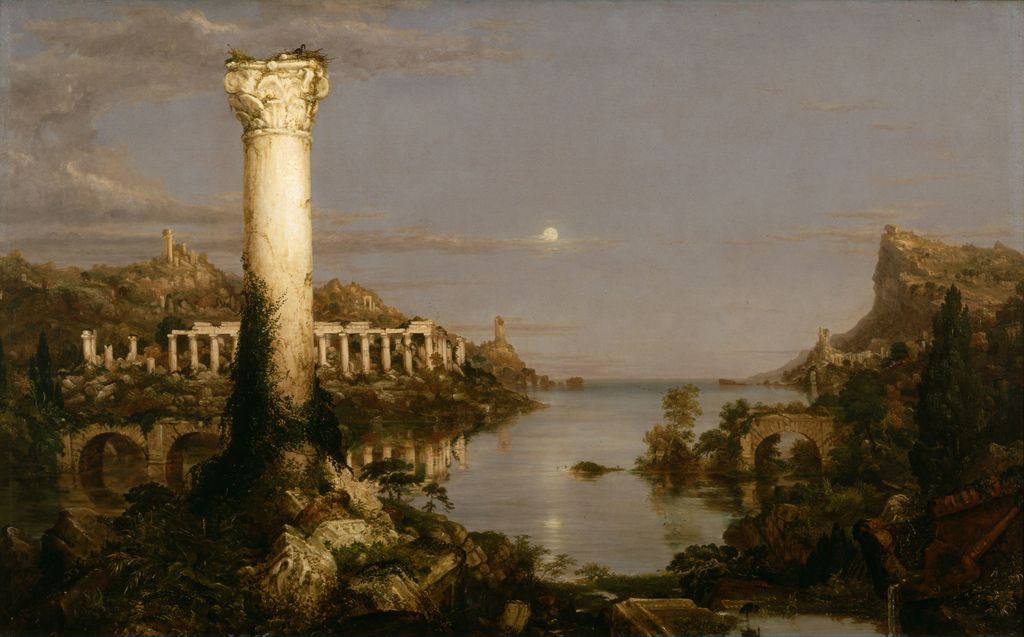
by Tom Gurney
Tom Gurney BSc (Hons) is an art history expert with over 20 years experience
Published on June 19, 2020 / Updated on October 27, 2026
Email: tomgurney1@gmail.com / Phone: +44 7429 011000
The Course of Empire: Destruction by Thomas Cole: Introduction
A broken bridge, burning temples and a headless statue turn Thomas Cole’s Destruction into a picture of movement without escape. Soldiers fight above the water while people fall into it; architecture that once organised a magnificent city now traps its inhabitants. Painted in 1836, this is the fourth canvas in The Course of Empire, Cole’s five-part account of an imaginary civilisation’s rise and collapse. The oil painting belongs to the New York Historical, accession 1858.4. [1]
Its violence is especially disturbing beside The Consummation of Empire. The earlier scene displays a city celebrating its wealth and military success. Here the same capacity to concentrate people, monuments and spectacle becomes a source of vulnerability. Cole makes the disaster legible through individual gestures as well as panoramic effects: a woman’s raised hands, a body suspended above the bay, the diagonal thrust of an immense stone warrior. Looking closely means moving between these human emergencies and the storm that appears to engulf them.
At a Glance
- ArtistThomas Cole (1801–1848)
- TitleThe Course of Empire: Destruction
- Date1836
- MediumOil on canvas
- Dimensions99.7 × 161.3 cm, unframed
- CollectionNew York Historical
- Accession1858.4
- Place in the seriesFourth of five paintings, following The Consummation of Empire and preceding Desolation [1]
This work in Cole’s career
First European journey
1829–1832The Course of Empire
1834–1836The Oxbow
1836The Voyage of Life
1840 and 1842Church’s training
1844–1846Notes and sources
American recognition. Three New York sales brought Cole to the attention of artists and patrons. [2]
First European journey. Looking in Britain and Italy enlarged the repertoire of his American landscapes. [2]
The Course of Empire. Five invented landscapes turn the rise and fall of civilisation into a visual argument. [2]
The Course of Empire: Destruction. The fourth scene overturns the prosperous city: broken crossings, fire and violence replace its earlier ceremonial order. [1]
The Oxbow. An American prospect joined direct observation to a carefully staged view. [2]
The Voyage of Life. The original cycle and Roman replicas give human life the course of a river. [2]
Church’s training. Cole taught Frederic Edwin Church in Catskill. [2]
Home in the Woods. A late cabin landscape brings settlement and surrounding woodland into one scene. [2]
Contents
- Introduction
- A city under assault
- The bridge becomes a trap
- Women, children and the cost of spectacle
- The headless warrior
- How Cole changed the design
- A landscape built from other pictures
- Fire and the first audience
A city under assault
The scene combines invasion, fire and tempest. None offers a separate problem that the inhabitants could solve in turn. Flames climb through buildings as dark clouds sweep across the sky; the crowded bridge is damaged while fighting continues on its remaining passage. The water receives people and wreckage rather than carrying a peaceful exchange of goods. Cole’s accompanying description identifies a city entered by an enemy after luxury has weakened its population. That explanation belongs to his moral narrative, rather than to a documented account of a particular historical battle. [3]
The painting gives that narrative a physical form. The pale architecture stands out against smoke and cloud, but its brightness no longer suggests secure prosperity. It exposes the city’s vulnerable surfaces. Columns and walls can still be recognised as elements of an elaborate design even as their usefulness disappears. Because enough survives to indicate the buildings’ former splendour, the ruin feels like the disintegration of an inhabited world, rather than an already ancient archaeological site.
Fire and weather complicate the direction of the action. The flames rise while human bodies fall. Smoke loosens the sharp architectural divisions, and the storm opens great areas of darkness beyond the crowded foreground. The drama depends on this unequal scale. A fighting figure can dominate a small patch of stonework, yet remain almost negligible beneath the sky. The viewer can inspect an individual struggle without forgetting that the wider catastrophe will overwhelm it.
There is light towards the upper left, where the sun breaks through the cloud. It does not illuminate a safe destination. Instead it gives the eye a direction across the turmoil and sharpens the contrast between the darkened city and the immense atmosphere above it. Tim Barringer’s catalogue entry notes that the composition drives attention from right to left, with the colossal statue supplying a forceful diagonal towards this light. The painting therefore has a broad visual current even though its human actions are fragmented and contradictory. [3]
Cole never gives the attackers the secure identity of a named historical army. Classical forms and literary associations invite comparisons with the decline of Rome, but the civilisation is invented. His designation of its enemy uses the hierarchical vocabulary of his century. We can understand the hostile force’s role in the story without treating that vocabulary as an objective description of a people, or assigning the soldiers a modern nationality. The uncertainty keeps attention on what the picture actually shows: the destruction of a society that believed itself triumphant. [1]
Annotated Details from Destruction
Compare four details with the full composition, then open the photographs for a closer view.
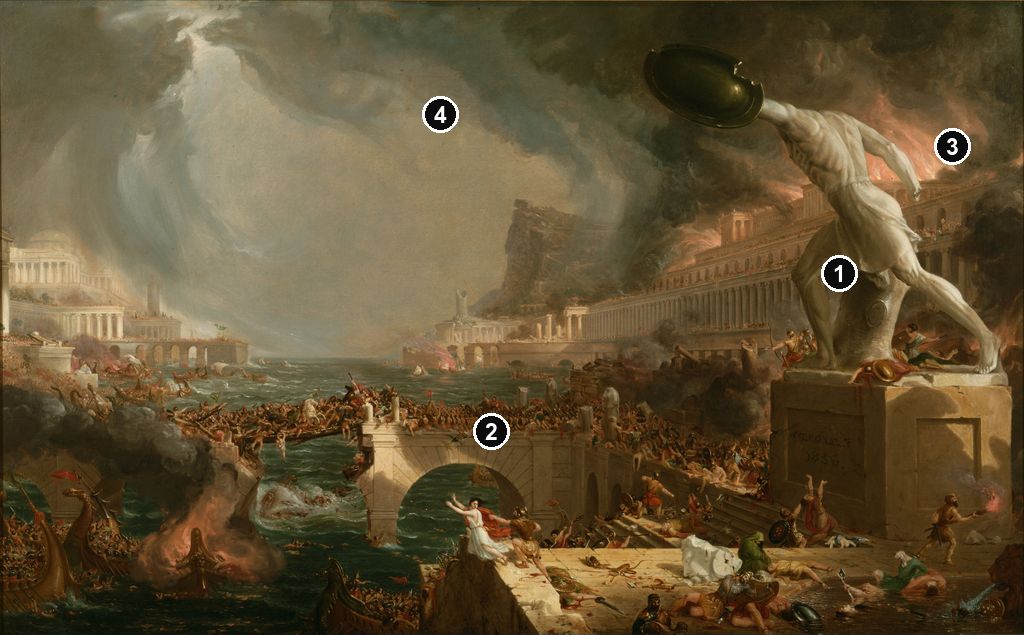
Details from DESTRUCTION
Each crop comes from the same painting shown above.
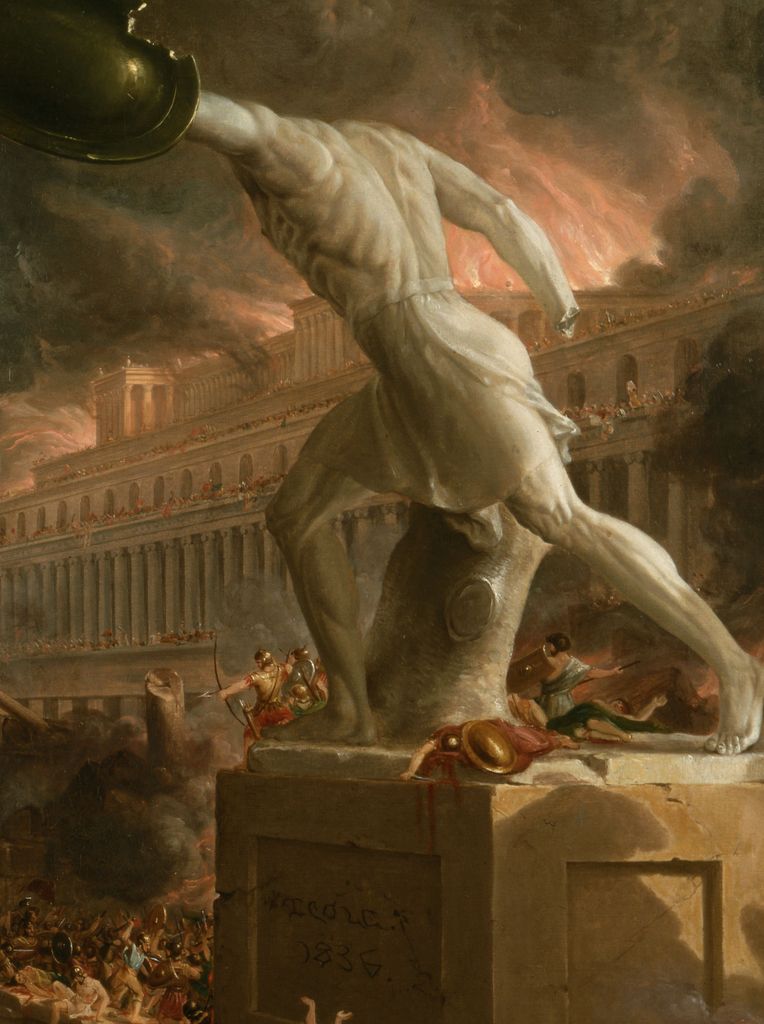
The headless statue
The enormous statue has lost its head while the surrounding city collapses into violence. A form once associated with civic magnificence has become another damaged object. [1]
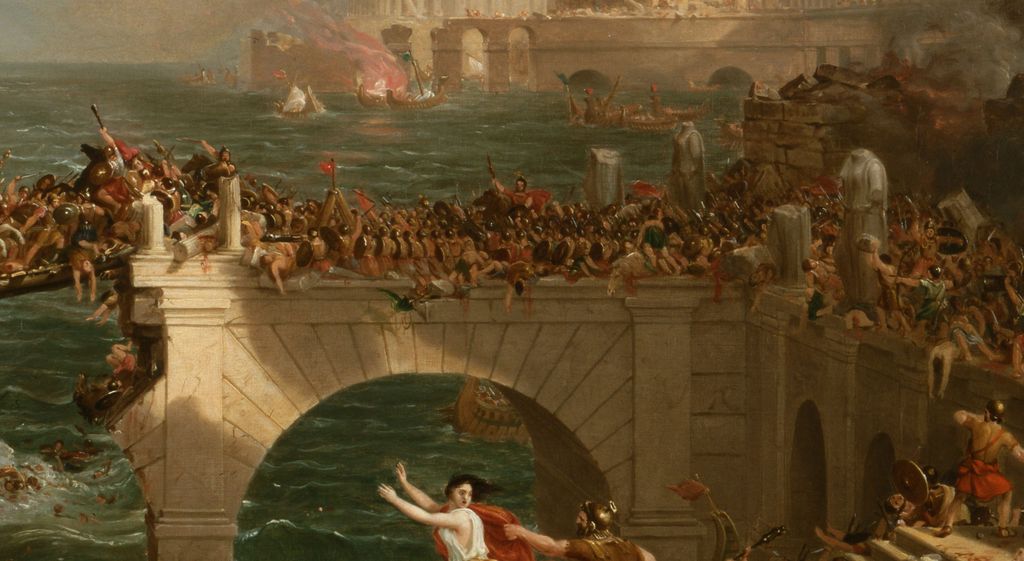
The broken bridge
Crowds press across a bridge whose ordered passage has broken apart. Comparing it with the bridge in Consummation shows how Cole turns a repeated structure into evidence of catastrophe. [3]
Fire among the buildings
Flames and smoke rise beside the right-hand architecture. They merge human destruction with the darker weather that spreads across the view. [1]
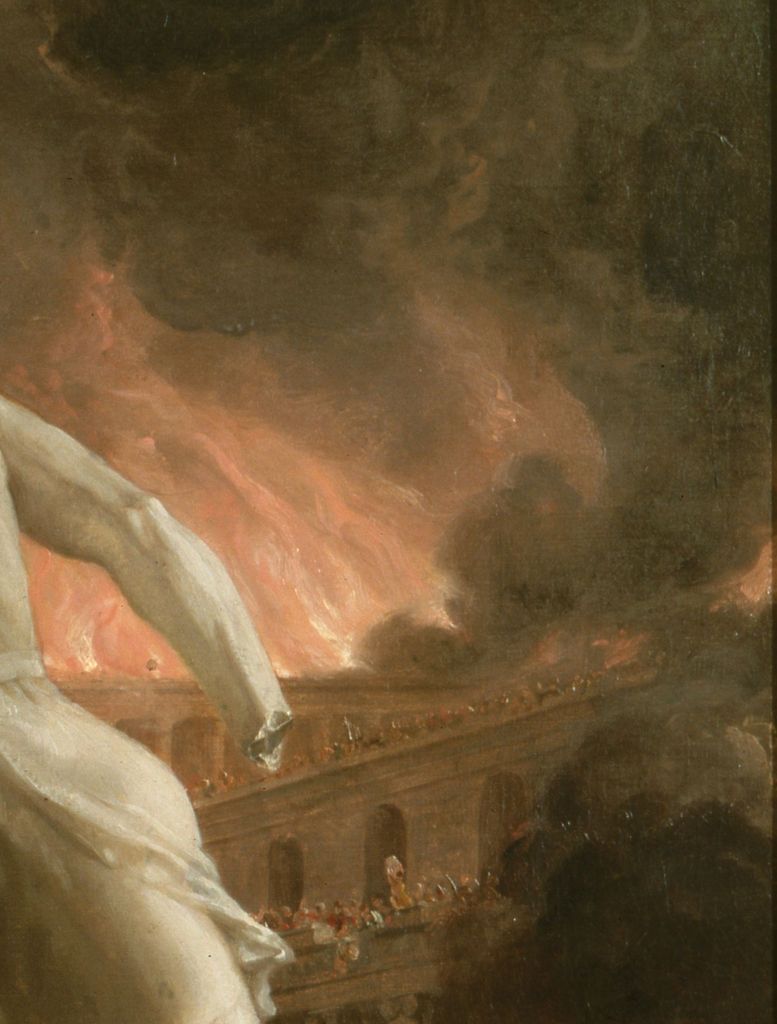
A darkened sky
Thick, unsettled clouds replace the clear atmosphere of imperial splendour. The change in light extends the disturbance beyond individual buildings and figures. [1]
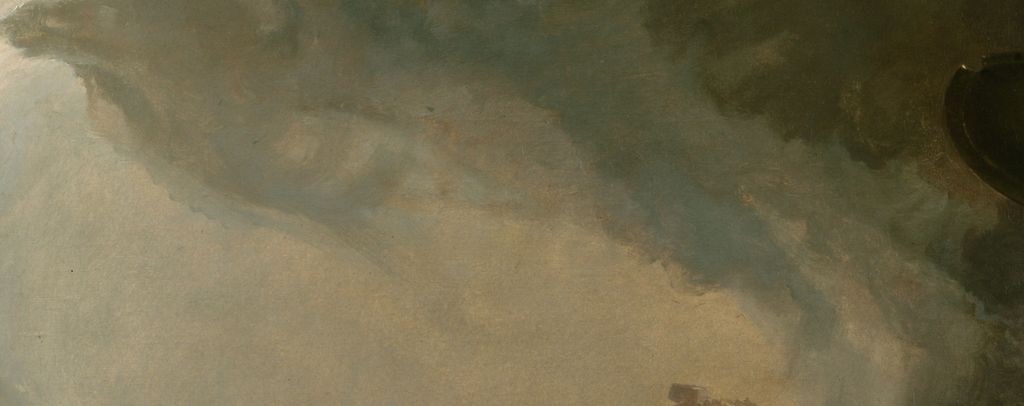
The bridge becomes a trap
The bridge is the picture’s most concentrated meeting of architecture and action. In Consummation it carries an imperial procession. It directs movement, joins the banks and makes the city’s power visible as ceremony. In Destruction its capacity to gather people becomes disastrous. Combatants converge on a passage that can no longer support orderly circulation, and falling figures expose the terrible distance between its elevated roadway and the water.
Cole’s 1836 description, reproduced in the 2018 catalogue, explains that one of the arches has been battered down. Broken pillars, damaged war machinery and a temporary crossing mark an earlier phase of fighting; the battle we see is taking place on a bridge already compromised. This is a useful distinction. The structure is not merely a dramatic backdrop collapsing at the convenient instant of the assault. It carries evidence of repeated pressure and makes the present struggle more precarious. [3]
The remaining connection creates a cruel necessity. Crossing might promise escape or military advantage, but the route itself forces enemies and vulnerable inhabitants together. From a distance the bridge looks like a single crowded line; closer attention separates it into people with competing intentions. Its narrowness prevents those intentions from becoming independent paths. The opposing movements of the figures make the architecture feel congested before we register any particular victim.
Below, falling bodies break the bridge’s horizontal rhythm. They connect the organised stone city with the turbulent bay through sudden downward trajectories. This changes the meaning of the harbour. In the previous panel, boats, festivities and the procession place water within the empire’s system of transport and display. Here it becomes the space into which that system sheds its inhabitants. Even a strong surviving pier offers no comfort: the structure’s monumental scale makes the people look more exposed.
The broken bridge also helps Cole tell a story across paintings without repeating his viewpoint exactly. Recognition depends on the function and shape of the crossing, while the surrounding scene changes. The viewer remembers the earlier procession and sees its reversal. The contrast turns military triumph into something unstable: an empire accustomed to exhibiting the results of conquest can itself become a place of conquest. The bridge makes that argument through a material connection we have already learned to recognise.
Women, children and the cost of spectacle
The great panorama contains episodes that deserve slower looking. At the right, beneath the colossal statue, a man seizes a woman by her hair. Her raised hands communicate anguish, while a child falls beside her on the steps. The stone platform, which might appear at first to be a support for monumental art, becomes the setting of an assault on an ordinary person. Barringer draws particular attention to this group and to the way the woman’s gesture leads towards Cole’s signature on the pedestal. [4]
Another woman, dressed in white, plunges from the elevated architecture while a pursuer grasps her red cloak. The contrast of the pale dress and red fabric makes the encounter distinct within the surrounding mass of figures. Barringer interprets her fall as a choice of death over sexual violation. That reading gives the gesture a specific narrative, beyond the visible facts of pursuit and falling; it should be recognised as the scholar’s interpretation of Cole’s violent scene. [4]
These episodes change the ethical balance of the painting. An account of imperial downfall might allow the city to remain an abstraction, punished collectively for luxury or pride. The women and child make collective punishment harder to contemplate at a comfortable distance. Their vulnerability is not diminished by the grandeur of the city or by an explanation of its leaders’ failings. The picture can present collapse as the consequence of imperial excess while showing how unequally its suffering falls.
The scale of the figures contributes to that tension. They are small enough to belong to the panorama, but sufficiently articulated to register as encounters between bodies. The gestures are not all equivalent marks of excitement. Arms can threaten, appeal, grasp or fail to find support. A viewer who initially sees an impressive arrangement of flame, stone and cloud gradually finds acts of terror within it. Cole’s achievement depends partly on refusing to let the general effect erase these particulars.
Barringer also identifies a green-clad elderly historian among the bodies in water at the lower right, perhaps wounded, his head hanging in despair. He connects this figure with Cole’s role as an observer of history. The identification is interpretive, and the uncertainty about the figure’s physical state matters. It nevertheless offers a valuable way of considering the presence of reflection within the action: someone who might understand the collapse cannot necessarily prevent it or stand safely outside it. [4]
The headless warrior
The enormous statue is both a compositional device and a broken emblem of the city. Its pose derives from the ancient sculpture known as the Borghese Gladiator or Borghese Warrior, in the Louvre. Cole enlarges that model until it towers above the immediate human struggles, and removes its head. The owning museum contrasts this martial figure with Minerva, goddess of wisdom, in Consummation. The change from wisdom to aggressive bodily force supports its reading of the imperial city’s moral collapse. [1]
The statue’s survival is uneasy. It remains powerful enough to command the foreground, yet its missing head announces that monumental strength cannot guarantee completeness. Its sweeping gesture seems to participate in the tumult, although stone cannot act on the events below. The discrepancy between its heroic pose and its uselessness is central to the effect. An image built to display force now presides over suffering without protecting anyone.
Its diagonal also competes with the architecture’s former order. Columns, stairs and walls establish systems of upright and horizontal lines; the warrior’s extended body cuts across them. This movement carries the eye towards the storm and the damaged crossing. The viewer’s journey through the scene is partly governed by a monument that itself embodies mutilation. Cole turns a classical model of energetic anatomy into an unstable guide through a city whose classical pretensions are failing.
On the pedestal his signature is unusually assertive. The museum describes the slashing letters as almost an act of vandalism. That interpretation brings the artist’s name into the scene’s broken material culture. Rather than sitting quietly outside the narrative, the inscription occupies a support implicated in its violence. The painter leaves a legible presence where the city’s monumental assurances have become unreliable. It is a strikingly different way of signing a picture from simply placing a discreet name beneath the action. [1]
Watch: Thomas Cole
Choose a film to explore the artist’s work, its interpretation and its wider setting.
Thomas Cole: Painting the American Landscape (remastered audio)
An introduction to Cole’s landscapes and artistic ambitions.
Watch on YouTubeHow Cole changed the design
The statue was not the inevitable outcome of a fully settled plan. An early composition drawing places a huge lion fountain in the foreground area that troubled Cole. The finished painting retains a much smaller fountain at the lower right, but the dominant animal monument disappears. This revision matters because a fountain and a warrior organise attention differently. The fountain would have concentrated the scene around a conspicuous architectural ornament; the standing figure introduces a bodily diagonal that appears to thrust into the disaster. [3]
Cole also considered a rearing horse. In a letter to Asher B. Durand, cited in the catalogue entry, he asked for a miniature plaster cast of a suitably energetic horse and suggested a male figure as an alternative if one could not be found. The eventual Borghese-derived figure shows how practical access to a model could shape an ambitious historical landscape. The progression from lion fountain to proposed horse and then man is evidence of active composition, not a licence to imagine unrecorded studio experiments. [3]
In January 1836 Cole wrote to Luman Reed that he hoped this panel would be the finest, associating his strongest abilities with stormy and wild subjects. By 30 August he told Durand that painting the city’s burning and sacking had become exhausting. These letters, preserved through the owning museum’s account and the scholarly catalogue, connect confidence in the subject’s pictorial possibilities with weariness at its sustained violence. They need not be read as contradictory. Making the scene compelling involved returning repeatedly to actions the artist found horrible. [1] [3]
Reed died on 7 June 1836, before the fourth and fifth canvases were painted. Cole worked on them in his Catskill studio that summer and completed the sequence by the beginning of October. The final disaster therefore emerged after the loss of the patron who had made the series possible, although that circumstance does not establish an autobiographical meaning for every distressed figure. The documented chronology helps us understand the labour and conditions of completion without converting the entire scene into a coded expression of bereavement. [5]
A landscape built from other pictures
Cole’s storm belongs to an established tradition of historical landscape. Barringer connects its swirling darkness to J.M.W. Turner’s Snow Storm: Hannibal and His Army Crossing the Alps. In both, human ambition is dwarfed by atmospheric force. The comparison is especially useful here because it explains the sky’s active role: weather can organise a history painting rather than provide its background. Cole places a crowded invented city beneath that kind of overwhelming natural theatre. [3]
John Martin supplies another important comparison. The catalogue situates Destruction alongside Martin’s Seventh Plague of Egypt and the broader popularity of apocalyptic spectacles. Panoramas and dioramas offered audiences enormous disasters, moral narratives and elaborate effects. Cole’s public could therefore approach this scene with an existing appetite for catastrophe on a grand scale. The relationship does not prove that he copied a particular entertainment: it locates the painting within a culture that made destruction both instructive and spectacular. [3]
Oswaldo Rodriguez Roque’s earlier account adds a useful qualification. He sees Martin’s apocalyptic effects in Destruction, but argues that the spatial structure of the whole series remains indebted to Claude Lorrain. The calm organisation associated with Claude need not disappear when the subject becomes violent. A deep prospect, articulated foreground and carefully managed distances can hold the fragments together. Cole’s panorama remains comprehensible because its dramatic disorder exists within a designed pictorial space. [6]
Barringer further compares the bridge fighting with Johann Zoffany’s Plundering the King’s Cellar at Paris, an image circulated in mezzotint. His reading emphasises Cole’s fears of the crowd as well as the narrative of foreign assault. It is an interpretation that complicates a straightforward modern celebration of resistance to empire: Cole could distrust imperial vanity while also fearing popular violence. The canvas brings those anxieties together without supplying the viewer with an uncomplicated victorious side. [4]
Fire and the first audience
For viewers in 1836, burning monumental buildings had immediate associations. The Palace of Westminster burned in October 1834; Lower Manhattan suffered its Great Fire on 16–17 December 1835. Barringer places both events beside Cole’s painting. Reed’s house escaped the New York fire, but the destruction of businesses and homes made urban catastrophe a recent local experience. These events sharpen the painting’s historical setting without identifying its fictional city as London or New York. [3]
The distinction is essential because Cole had conceived the larger cycle before the New York disaster. Destruction is not a literal illustration of that fire, and its invasion, classical monuments and recurring landscape serve the sequence’s allegory. Nor should Turner’s paintings of the Westminster fire be treated as pictures Cole saw while making this panel. The catalogue allows possible knowledge through press reports, while stating that he could not have seen the paintings themselves at that time. [3]
The completed series was exhibited at the National Academy of Design in New York from October to December 1836. Cole’s journal entry of 29 October records his fear that it would disappoint friends’ expectations, followed by relief at its reception. He also notes that he had written a descriptive catalogue. His report is valuable evidence of an artist responding to an audience; its broad enthusiasm should not be mistaken for a survey of every visitor’s opinion. [5] [7]
The owning museum reports that the New-York Mirror welcomed the fourth panel’s critique of imperial rule and treated its downfall as deserved. That response reveals how readily a contemporary critic could convert the pictured suffering into a moral judgement about empires. A close reading today can retain the force of the warning while noticing what that judgement leaves unresolved: the women, child and falling bodies make the cost of a deserved downfall painfully individual. [1]
The next canvas, Desolation, removes the immediate human struggles and lets vegetation occupy the remains. Its stillness is inseparable from this panel’s excess of action. Destruction supplies the terrible interval between a city that imagines its glory permanent and ruins that have outlasted the people who built them. Within that interval, Cole asks the viewer to recognise the scale of historical collapse and to look carefully at the people caught inside it.
Artworks directory
Explore paintings, drawings and studies across Cole’s career. The two Voyage of Life sets appear separately. Dates and study identifications draw on the exhibition and collection catalogues, supplemented by the National Gallery’s drawing records. [2] [8] [9] [10]
| Name | Date | Medium |
|---|---|---|
| The Oxbow | 1836 | Painting |
| The Titan’s Goblet | 1833 | Painting |
| The Architect’s Dream | 1840 | Painting |
| The Course of Empire: The Savage State | ca. 1834 | Painting |
| The Course of Empire: The Arcadian or Pastoral State | ca. 1834 | Painting |
| The Course of Empire: The Consummation of Empire | 1835–1836 | Painting |
| The Course of Empire: Destruction | 1836 | Painting |
| The Course of Empire: Desolation | 1836 | Painting |
| The Voyage of Life: Childhood | 1842 | Painting |
| The Voyage of Life: Youth | 1842 | Painting |
| The Voyage of Life: Manhood | 1842 | Painting |
| The Voyage of Life: Old Age | 1842 | Painting |
| Home in the Woods | 1847 | Painting |
| Distant View of Niagara Falls | 1830 | Painting |
| View on the Catskill—Early Autumn | 1836–37 | Painting |
| Lake with Dead Trees (Catskill) | 1825 | Painting |
| River in the Catskills | 1843 | Painting |
| A View of the Mountain Pass Called the Notch of the White Mountains (Crawford Notch) | 1839 | Painting |
| Expulsion from the Garden of Eden | 1828 | Painting |
| The Subsiding of the Waters of the Deluge | 1829 | Painting |
| The Mountain Ford | 1846 | Painting |
| American Lake Scene | 1844 | Painting |
| A View near Tivoli (Morning) | 1832 | Painting |
| Aqueduct near Rome | 1832 | Painting |
| The Hunter’s Return | 1845 | Painting |
| The Voyage of Life: Childhood (first version) | 1840 | Painting |
| The Voyage of Life: Youth (first version) | 1840 | Painting |
| The Voyage of Life: Manhood (first version) | 1840 | Painting |
| The Voyage of Life: Old Age (first version) | 1840 | Painting |
| Panorama of the Oxbow on the Connecticut River as seen from Mount Holyoke | ca. 1832 (museum); 1833 (2018 catalogue) | Drawing |
| Sketch for The Oxbow | 1836 | Painting |
| From Nature | 1823 | Drawing |
| View of the Round-Top in the Catskill Mountains (Sunny Morning on the Hudson) | 1827 | Painting |
| Scene from The Last of the Mohicans: Cora Kneeling at the Feet of Tamenund | 1827 | Painting |
| View of Monte Video, the Seat of Daniel Wadsworth | 1828 | Painting |
| The Garden of Eden | 1828 | Painting |
| Tomb of General Brock, Queenston Heights, Ontario | 1830 | Painting |
| Effect for Newstead Abbey, Nottinghamshire, England | 1830 | Drawing |
| The Ilissos, from the Parthenon West Pediment | 1829 or 1830 | Drawing |
| Life Study for the Prostrate Shepherd in The Angel Appearing to the Shepherds | 1831–1832 | Painting |
| Interior of the Colosseum, Rome | ca. 1832 | Painting |
| Campagna di Roma (Study for Aqueduct near Rome) | 1832 | Painting |
| Landscape with a Round Temple | ca. 1830s | Painting |
| Stormy Landscape | 1832 | Painting |
| View of Florence from San Miniato | 1837 | Painting |
| Mount Holyoke, Massachusetts (after Basil Hall) | ca. 1829–1831 | Drawing |
| Layout for The Course of Empire | 1833 | Drawing |
| Study for The Course of Empire: The Savage State | ca. 1834 | Painting |
| Study for The Course of Empire: The Arcadian or Pastoral State | ca. 1834 | Painting |
| Study for The Course of Empire: Desolation | 1836 | Painting |
| Study for Dream of Arcadia | 1838 | Painting |
| Clouds | ca. 1830s | Painting |
| Study for The Hunter’s Return | 1845 | Painting |
| Study for Home in the Woods | ca. 1847 | Painting |
| Sunrise in the Catskills | 1826 | Painting |
| Study for The Mountain Ford | 1846 | Drawing |
| Tree Trunks | 1825–1840 | Drawing |
Frequently Asked Questions
It depicts Cole’s imaginary imperial city under attack during a storm. Temples burn, the bridge is damaged and crowded with fighting, and civilians suffer amid the collapsing social order. It is the fourth painting in The Course of Empire. [1]
Its mutilation makes an emblem of martial strength vulnerable. The figure derives from the Borghese Warrior, and the museum contrasts it with the statue of Minerva in Consummation. Its precise meaning remains open to interpretation. [1]
It provided a recent context for New York viewers, but Cole’s cycle was already conceived. The canvas depicts an allegorical assault and collapse, rather than recording the Manhattan fire. [3]
It belongs to the New York Historical, accession 1858.4. It entered the collection in 1858 through the gift of the New-York Gallery of the Fine Arts. [1]
Discussion
Look again at The Course of Empire: Destruction and compare your reading with the questions below.
Reader Insights
Does the broken bridge most strongly suggest failed engineering, military vulnerability or the reversal of imperial celebration? Which visible details support your reading?
How do the women and child affect your response to the idea that the empire’s downfall is deserved?
Which detail or comparison would you add to this account, and what evidence supports your reading?
Join the Conversation
Share the details that shaped your response, or suggest a comparison for other readers.
References
- New York Historical, The Course of Empire: Destruction, collection record, accession 1858.4; object metadata, description, interpretive text and provenance.
- Elizabeth Mankin Kornhauser and Tim Barringer, Thomas Cole’s Journey: Atlantic Crossings (2018). Career context and artwork/study metadata: catalogue entries 10–66 and chronology, PDF pp. 137–231 and 249–262; related Barringer essay passages, PDF pp. 23–66.
- Tim Barringer, “The Course of Empire: Destruction,” in Elizabeth Mankin Kornhauser and Tim Barringer, Thomas Cole’s Journey: Atlantic Crossings, 2018, pp. 213–215, catalogue entry 58 (PDF pp. 217–219).
- Tim Barringer, “Thomas Cole’s Atlantic Crossings,” in Thomas Cole’s Journey: Atlantic Crossings, 2018, pp. 57–59 (PDF pp. 61–63).
- Shannon Vittoria, “Chronology,” in Thomas Cole’s Journey: Atlantic Crossings, 2018, p. 256 (PDF p. 260).
- Oswaldo Rodriguez Roque, “The Exaltation of American Landscape Painting,” in John K. Howat et al., American Paradise: The World of the Hudson River School, Metropolitan Museum of Art, 1987, pp. 27–30, especially p. 30 (PDF pp. 46–49).
- Thomas Cole, Journals, 1834–1848, Thomas Cole National Historic Site transcription, entry 29 October 1836, PDF p. 24.
- Franklin Kelly et al., American Paintings of the Nineteenth Century, Part I (National Gallery of Art, 1996). Cole catalogue and both Voyage of Life sets, PDF pp. 91–124.
- National Gallery of Art, Study for The Mountain Ford (1846), accession 2015.19.772. Collection record and open-access image.
- National Gallery of Art, Tree Trunks (1825–1840), accession 2015.19.607. Collection metadata and open-access image.
- Splash image source.
Thomas Cole, The Course of Empire: Destruction, 1836. Oil on canvas, 99.7 × 161.3 cm. New-York Historical Society, gift of the New-York Gallery of the Fine Arts, 1858 (1858.4).