by Tom Gurney
Tom Gurney BSc (Hons) is an art history expert with over 20 years experience
Published on June 19, 2020 / Updated on October 27, 2026
Email: tomgurney1@gmail.com / Phone: +44 7429 011000
Distant View of Niagara Falls by Thomas Cole: Introduction
The waterfall in Thomas Cole’s Distant View of Niagara Falls shines beyond a foreground of autumn trees and dark rock. Two small figures stand near the edge of a projecting ledge, overlooking the river. Their presence gives the immense landscape a human measure, but the eye keeps travelling past them towards white water, mist and a sky divided between storm and light. Cole painted this view in 1830, after visiting Niagara in May 1829. The picture belongs to the Art Institute of Chicago, which identifies its medium as oil on wood panel. [1]
The apparent remoteness is an artistic construction. Hotels, mills and other developments already served and altered Niagara when Cole arrived. His painting removes them, allowing a celebrated destination to appear beyond the reach of modern commerce. That transformation helps explain the picture’s beauty, but also its historical difficulty: the image of an untouched American wilderness rests on choices about whose presence and whose history to show. [1]
At a Glance
- ArtistThomas Cole, 1801–1848.
- Title and dateDistant View of Niagara Falls, 1830.
- Mediumoil on wood panel.
- Dimensions47.9 × 60.6 cm.
- CollectionArt Institute of Chicago, Friends of American Art Collection, accession 1946.396. [1]
- Starting pointCole’s May 1829 Niagara visit and sketches; the finished picture was painted in London. [2]
This work in Cole’s career
First European journey
1829–1832The Course of Empire
1834–1836The Oxbow
1836The Voyage of Life
1840 and 1842Church’s training
1844–1846Notes and sources
American recognition. Three New York sales brought Cole to the attention of artists and patrons. [3]
First European journey. Looking in Britain and Italy enlarged the repertoire of his American landscapes. [3]
Distant View of Niagara Falls. Painted in London during Cole’s first European journey, this view transforms studies from his May 1829 Niagara visit. [2]
The Course of Empire. Five invented landscapes turn the rise and fall of civilisation into a visual argument. [3]
The Oxbow. An American prospect joined direct observation to a carefully staged view. [3]
The Voyage of Life. The original cycle and Roman replicas give human life the course of a river. [3]
Church’s training. Cole taught Frederic Edwin Church in Catskill. [3]
Home in the Woods. A late cabin landscape brings settlement and surrounding woodland into one scene. [3]
Contents
- Introduction
- Looking across the river
- A visit before the Atlantic crossing
- What the sketch supplied
- Two figures and an inhabited landscape
- The destination Cole leaves out
- An American prospect painted in London
- From printed view to serving platter
- Similar titles, separate paintings
Looking across the river
Cole gives the spectator somewhere to stand before drawing attention towards the falls. The foreground contains an irregular shelf of rock, foliage in warm reds and golds, and darker vegetation below. The ledge projects into the open space of the river, offering a vantage point that also makes its height apparent. There is no comfortable enclosure around the figures. They occupy a narrow piece of ground above a much larger landscape, and the exposed edge helps turn viewing into a physical experience.
From there the river carries the eye towards the waterfall. Its surface offers a broad area of relative stillness between the rough foreground and the falling water. The wooded bank on the right curves inward, while vegetation on the left partly screens the cataract. These opposing edges give the water a course through the composition. Cole makes the falls unmistakable without allowing them to consume the whole picture: they remain one part of a connected arrangement of banks, trees, atmosphere and sky.
Light establishes their importance. The white descent and rising mist stand out against the darker country beyond, and their brightness answers the illuminated clouds above. Near the spectator, individual trees and the broken contours of rock are comparatively legible. Farther away, forms become less definite and rely more on tonal masses. This movement from particular objects to softened distance lets a panel less than sixty-one centimetres wide suggest a much greater expanse. The measurements belong to the Chicago object; its sense of scale comes from the relations within the image. [1]
The title’s word distant therefore describes more than a position. We are asked to take in Niagara through its surroundings, with space between our bodies and the source of its power. The small people help register that interval. Their looking also mirrors our own, giving the composition a second audience within the scene. Yet Cole does not place them where they could dominate our response: the water and changing sky command far more of the surface.
Shannon Vittoria’s catalogue entry explains that Cole preserved the scene’s sublimity through a threatening sky and an opposing burst of sunshine. That account fits the visible contrast between the long dark cloud mass and the warmer light to the right. The weather prevents distance from becoming mere tranquillity. Power is distributed across the picture, in the depth below the ledge, the white cataract and the weight of the clouds, rather than concentrated in a close encounter with the falling water. [2]
Annotated Details from Distant View of Niagara Falls
Compare four details with the full composition, then open the photographs for a closer view.
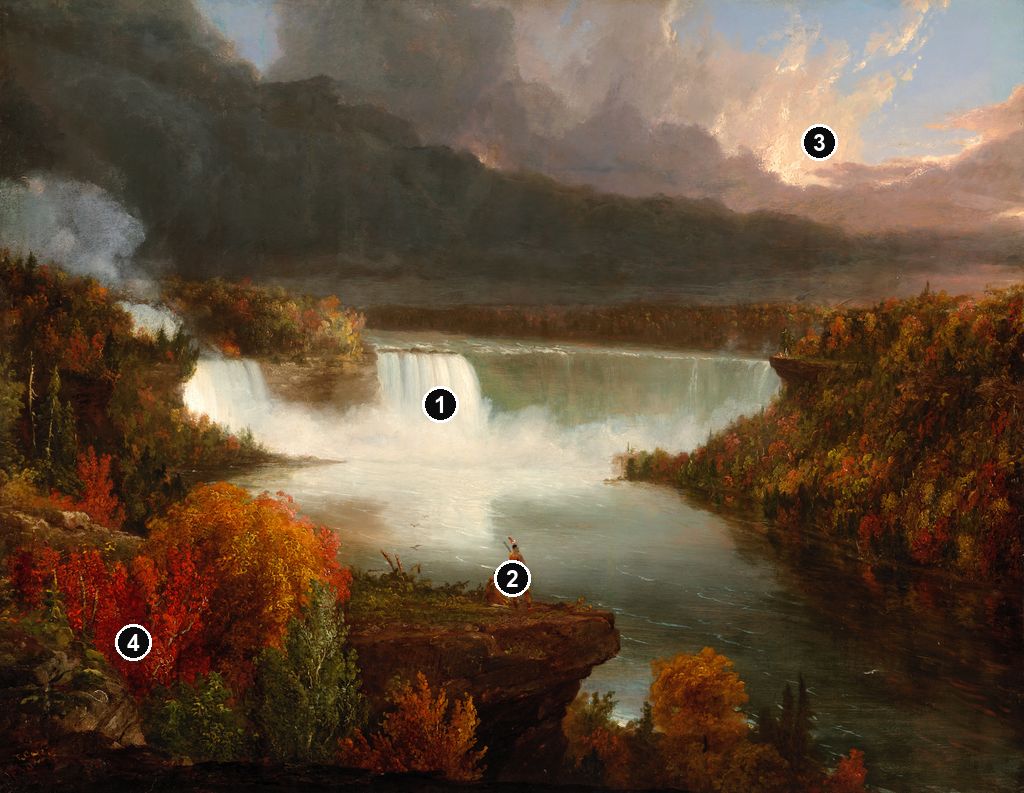
Details from DISTANT VIEW OF NIAGARA FALLS
Each crop comes from the same painting shown above.
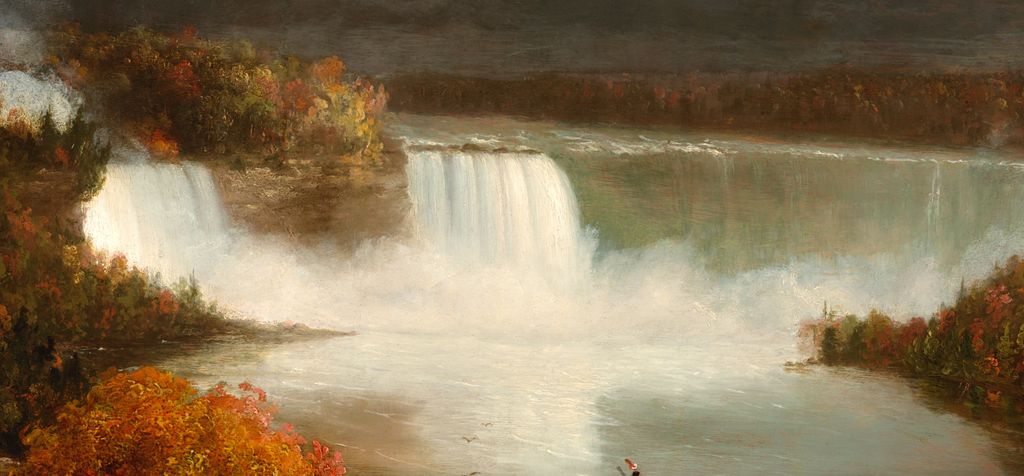
Water falling across the distance
The broad cascade and rising spray dominate the middle distance. Cole’s autumnal panorama presents the falls through an arrangement developed after his 1829 visit. [1]
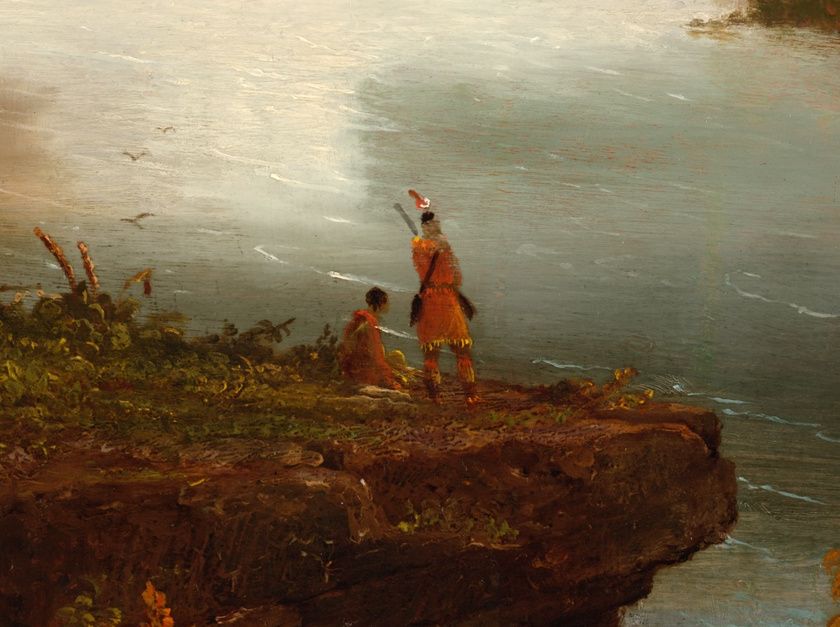
Two figures on the near ledge
Two Indigenous figures occupy the rocky foreground. The Art Institute interprets their diminished scale within the apparently unspoilt scene as part of a false nineteenth-century vanishing-people narrative, rather than an acknowledgement of stolen sovereignty. [1]
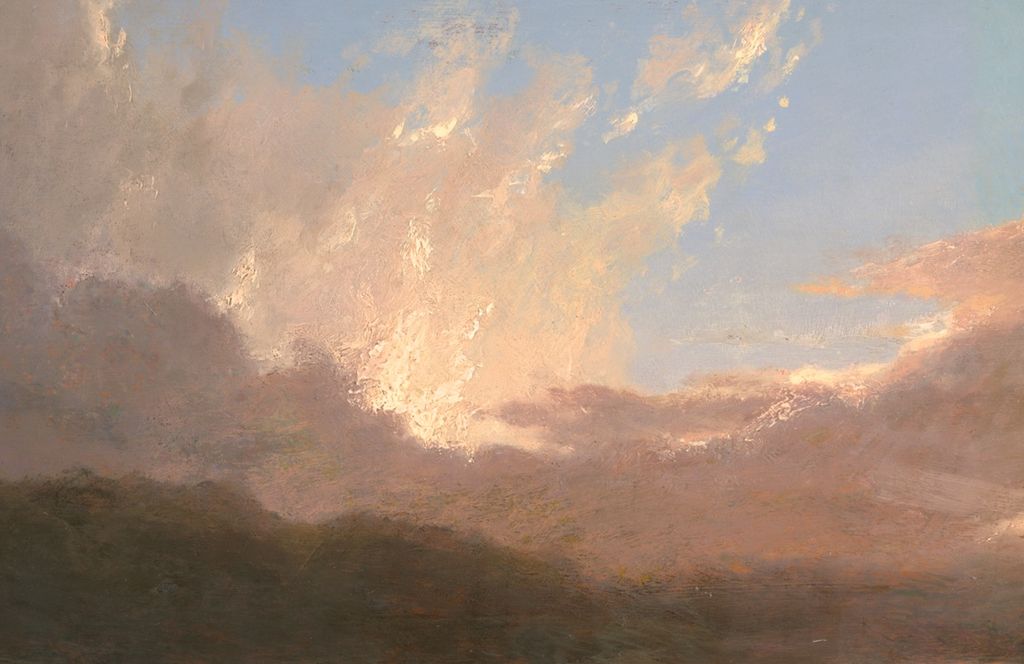
The changing sky
Light opens at the upper right against a bank of darker cloud. The sky extends the contrast of brightness and shadow already visible around the falls. [2]
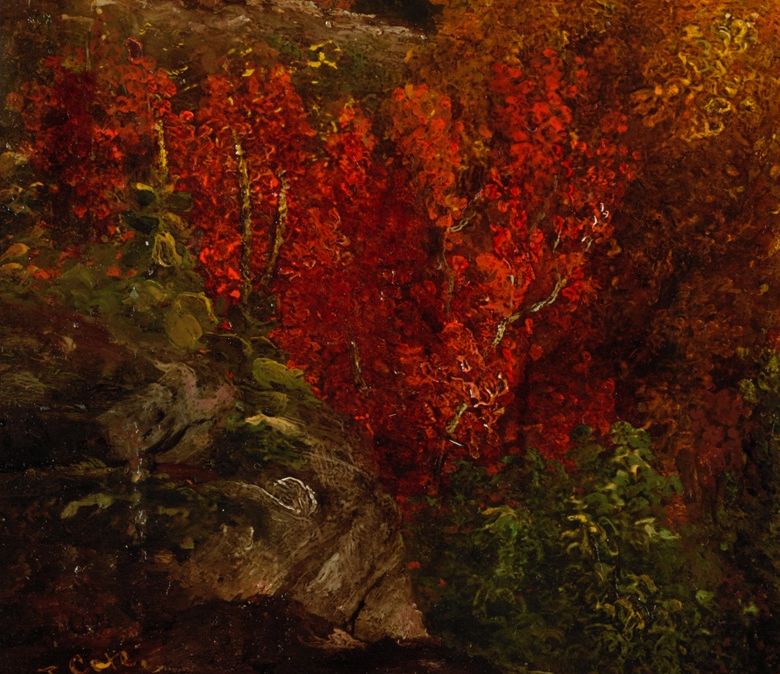
The wooded foreground
Trees, exposed roots and rough ground make the near shore dense and irregular. The museum notes that Cole omitted the industrial and tourist structures already present around Niagara. [1]
A visit before the Atlantic crossing
Niagara mattered to Cole before he had seen it. In a letter to his patron Robert Gilmor dated 26 April 1829, he connected the proposed visit with his approaching journey to Europe. Vittoria explains that he wanted the experience of American scenery to remain vivid while he studied landscapes abroad. This makes the trip part of a developing artistic education: Niagara would supply remembered forms and impressions against which other places could be encountered. [2]
The catalogue dates his arrival to 8 May 1829. He stayed approximately a week, making more than twenty graphite drawings from different viewpoints on the American side. His sketchbook recorded an encounter that exceeded his expectations, alongside uncertainty about whether a painted representation could do it justice. The combination matters. Admiration did not make representation straightforward; it raised the problem of selecting a view and translating an overwhelming experience into a bounded image. [2]
Conditions also limited his movements. The catalogue’s notes reproduce his account of ice running in the river and preventing a crossing to the Canadian side. His drawings were therefore the product of a real visit with practical constraints, rather than an unrestricted survey of every possible vantage point. Cole departed for England in June 1829, taking this recently gathered material with him. The Chicago painting’s date of 1830 separates the moment of observation from the making of the finished object. [2]
Its autumnal foliage makes that separation visible. Cole had visited in May, but the painting presents a later season. The warm colours enliven the near bank and distinguish it from the cooler river and remote sky. Autumn here is a compositional choice, not evidence that the recorded visit occurred in autumn. The Art Institute explicitly describes the finished scene as a romanticised reconstruction made in the following year. [1]
What the sketch supplied
Vittoria identifies an on-site drawing inscribed “Niagara 2 Miles Off”, now at the Detroit Institute of Arts, as the basis of the distant view. She relates its vantage point to the stage road carrying visitors from Lewiston towards the falls. The inscription gives the drawing a useful geographical bearing without making the painting a survey accurate in every detail. Cole could retain a prospect observed during travel while changing its season and removing contemporary structures. [2]
The catalogue describes his Niagara drawings as annotated with colour and composition notes. Those additions helped preserve information that graphite alone could not retain, making the sheets useful after the landscape itself was far away. A dark mark might record a contour, while written observations could recall the appearance of water or the organisation of a view. The finished London picture emerged from this store of visual and verbal evidence. [2]
This process complicates a simple opposition between accurate observation and imaginative painting. Cole looked carefully enough to make many studies, rather than relying on one remembered glimpse. He nevertheless selected from that evidence when constructing the panel. The sketch could answer questions about the relationship between the falls and the surrounding country; it did not oblige him to preserve every hotel, mill or seasonal condition that belonged to the visit.
The difference is especially useful when looking at the foreground. Its autumn vegetation, exposed rock and human observers give a distant prospect a dramatic point of entry. They organise the experience of the scene as much as they describe it. The drawing’s identification establishes an important link in the picture’s making, but it does not by itself establish the origin of every painted detail. Nor does a written distance justify locating a modern spectator on an exact surviving spot. The evidence supports a remembered approach to Niagara, transformed through studio composition. [2]
Cole’s drawings are consequently worth considering as working instruments. In this instance the study carried a specific encounter across the Atlantic and across time. The finished painting retains the authority of that encounter while offering a scene that the artist did not see in precisely this form.
Two figures and an inhabited landscape
The two people on the ledge are small, but they change the picture’s meaning. One is upright while the other is lower to the ground; both belong to the near landscape rather than the remote falls. Their warm touches of colour connect them visually with the autumn foliage. Vittoria identifies them as anonymous Native Americans and interprets the shared colours as suggesting a supposed closeness to nature. This is an account of Cole’s representation, not evidence about the actual cultural identity of particular people. [2]
Their anonymity is consequential. They do not appear as named individuals with histories or as members of a securely identified community. The image gives them a place within the landscape while withholding the kinds of detail that might distinguish their lives from an imagined general category. From the spectator’s position, their scale makes them seem vulnerable to the vast setting. At the same time, their activity is familiar: they look out, occupying the prospect before us.
The Art Institute reads their reduced scale and number in relation to the nineteenth-century fiction of the “vanishing Indian”. In that ideology, Indigenous peoples were represented as destined to disappear as settler society advanced. The museum argues that Cole’s scene signals impending transformation while obscuring stolen sovereignty. These are interpretive claims about the picture’s participation in a historical way of seeing; they must not be mistaken for a statement that Indigenous peoples actually vanished. [1]
The museum also situates Niagara within Attiwonderonk, Haudenosaunee and Wenrohronon lands. Naming that context changes what an apparently unoccupied expanse can mean. The absence of factories or hotels does not establish the absence of communities, political relationships or claims to land. Nor do the two painted figures stand as a comprehensive account of the people whose histories belong to the region. The landscape is inhabited even when the composition allows very little human activity to register. [1]
A careful reading can hold these questions alongside the figures’ compositional function. They provide scale and encourage contemplation, but they also carry the burden of identifying the scene as American. That burden is unequal: enormous water and woodland become general signs of nature, while a pair of anonymous people become signs of a continent and an imagined past. Recognising that arrangement does not remove the pleasure of looking. It makes the image’s apparently effortless harmony something to examine rather than simply accept.
The destination Cole leaves out
The vanished buildings distinguish this picture from an ordinary record of a tourist destination. By 1829 Niagara already possessed facilities that made visiting possible and profitable. Vittoria lists hotels, factories and mills among the developments absent from the finished composition. The Art Institute adds scenic overlooks to its account of the structures Cole omitted. Viewers see the result of that selection, not the complete environment through which he travelled. [2] [1]
There is an irony in the chosen approach. The view was associated with a road used by visitors, yet the painting conceals the organised tourism that helped bring such visitors to Niagara. It offers the prospect while suppressing the infrastructure of access. The two observers on the ledge create a model of direct contemplation, with no visible crowds or commercial arrangements mediating their experience. An already familiar attraction acquires the appearance of an encounter outside modern time. [2]
Vittoria links this reconstruction to Cole’s poem “Niagara”, written in May 1829 from the perspective of an early European explorer. Her reading places the painting within an imagined earlier encounter, before the modern developments Cole knew. The poem’s historical perspective helps explain the picture’s omissions, but it is not a transparent account of the region before colonisation. An explorer’s supposed discovery already assumes a particular relationship between European seeing and land known to others. [2]
The Art Institute brings environmental concern and colonial erasure into the same interpretation. Cole could object to industrial damage while producing a wilderness image that concealed the damage done to Indigenous sovereignty. These concerns need not have operated consistently within his representation. The picture’s protection of a landscape from visible industry does not ensure a complete or equitable account of its human history. [1]
The tension is visible in what the composition makes easy to admire. Trees frame the water; small figures look towards it; light draws attention to the cataract. Nothing visibly interrupts this relationship with a demand for payment, labour or ownership. The resulting unity is persuasive precisely because troublesome contemporary details have been removed. Understanding the omissions lets us recognise the painting as a powerful interpretation of Niagara without using it as proof of an untouched place.
Watch: Thomas Cole
Choose a film to explore the artist’s work, its interpretation and its wider setting.
Thomas Cole: Painting the American Landscape (remastered audio)
An introduction to Cole’s landscapes and artistic ambitions.
Watch on YouTubeAn American prospect painted in London
Cole’s first European journey placed American scenery within a British artistic and commercial setting. He arrived in London in June 1829 and studied major collections and contemporary landscape painting. The 2018 chronology records his encounter with paintings by John Constable and J. M. W. Turner at the Royal Academy shortly after his arrival. These experiences formed part of the setting in which the 1830 Niagara panel was made, although they do not prove that any one cloud or compositional device was copied from a particular British work. [2]
Tim Barringer describes the difficulties Cole faced in finding sufficient buyers in London and the demand for illustrated travel books that offered another form of employment. John Howard Hinton’s The History and Topography of the United States drew on Cole’s American material. Its illustrations could familiarise foreign readers with places they had never visited, allowing landscape art to participate in a broader account of the country. [4]
The Hinton project included twelve views supplied by Cole: ten paintings and two drawings. A Niagara painting was delivered in January 1831 and translated into a printed image by Fenner, Sears & Co. The association is important to the history of Cole’s distant Niagara composition, but the various painted versions require care. The 2018 catalogue discusses the Chicago panel beside this commission and its reproductions; that association should not make the Chicago object and the separate Hinton-associated panel interchangeable. [2]
Cole also exhibited a much larger Falls of Niagara at the British Institution in 1830. The catalogue describes it as approximately seven feet wide and records a later proposed mezzotint that was never realised. Its exhibition history, scale and proposed reproduction belong to that separate picture. They do not describe the small wood panel in Chicago or the published 1831 book illustration. Even within the same London period, Niagara supported more than one artistic project. [2]
From printed view to serving platter
Fenner, Sears & Co.’s Distant View of the Falls of Niagara appeared on 1 April 1831 as the frontispiece to the first English edition of Hinton’s second volume. Vittoria follows it into later European and American editions and into circulation apart from the book, including publications in Germany, Ireland and Scotland. These movements gave a distant Niagara design an audience much larger than the people who could inspect a painted panel. The printmakers’ credit remains essential: this was a reproductive work after Cole, not a plate engraved by Cole himself. [2]
The distinction between a painting and a print also changes how an image can be encountered. A book illustration has a sequence, a scale and a textual setting of its own. It can accompany an account of a nation, be turned past and returned to, or circulate separately. Its relationship to Cole’s design is part of its identity, but it also belongs to the work of those who made and published the printed object.
William Adams & Sons took the design into another setting through its American Views dinnerware. The Niagara engraving supplied imagery for a large serving platter. Vittoria describes substantial alterations: the landscape was extended on the left, a large arching tree was introduced, and a row of trees replaced the distant thunderstorm. Flowers and shells formed a surrounding decorative border. The pottery adapted a landscape to its new shape and use rather than preserving an exact miniature of Cole’s composition. [2]
Those changes affect the emotional balance as well as the format. Removing the threatening weather reduces one of the elements that made the distant scene powerful. An ornamental border introduces a repeated, enclosing rhythm around a landscape whose original foreground offered an exposed edge. The cataract remains recognisable, but its new frame encourages a different relationship with the view. This is a practical example of how reproduction can become interpretation.
Vittoria notes that Cole’s name did not appear on the pottery and that he received no payment for this use of his imagery. Wider circulation therefore did not necessarily mean wider recognition of the painter or additional income for him. A landscape could become part of domestic life while its maker receded from view. The related history of prints after Cole reveals both the reach of his designs and the importance of distinguishing the people and objects involved in carrying them elsewhere. [2]
Similar titles, separate paintings
Another small Niagara panel belongs to the Billings collection at Marsh–Billings–Rockefeller National Historical Park. Robert L. McGrath’s 2001 study describes its relationship to the Chicago painting, but also records in a note that Elizabeth McKinsey had classified it as attributed to Cole. The Billings panel’s attribution and identity therefore need to remain qualified. Its collection history and recorded restoration cannot be imported into the Chicago painting’s history simply because the compositions and titles are related. [5]
For the Chicago object, the Art Institute’s record gives a documented later sequence: Frank Sabin in London by 1936, M. Knoedler & Co. in 1937, and Edith Mendelssohn-Bartholdy by 1946, followed by transfer to the museum that year. This account supplies a secure institutional identity without filling the earlier gaps by borrowing the history of another Niagara picture. Its accession number, 1946.396, makes clear which object is being discussed. [1]
The painting’s later exhibition history also records renewed attention to Cole. It appeared in the centenary retrospective held in Hartford in 1948–49 and New York in 1949, and in Thomas Cole’s Journey: Atlantic Crossings in New York and London in 2018. These are documented episodes in its reception, rather than statements about where it is displayed today. They show a work first made in London continuing to be considered within both American and transatlantic histories of landscape. [1]
Artworks directory
Explore paintings, drawings and studies across Cole’s career. The two Voyage of Life sets appear separately. Dates and study identifications draw on the exhibition and collection catalogues, supplemented by the National Gallery’s drawing records. [3] [6] [7] [8]
| Name | Date | Medium |
|---|---|---|
| The Oxbow | 1836 | Painting |
| The Titan’s Goblet | 1833 | Painting |
| The Architect’s Dream | 1840 | Painting |
| The Course of Empire: The Savage State | ca. 1834 | Painting |
| The Course of Empire: The Arcadian or Pastoral State | ca. 1834 | Painting |
| The Course of Empire: The Consummation of Empire | 1835–1836 | Painting |
| The Course of Empire: Destruction | 1836 | Painting |
| The Course of Empire: Desolation | 1836 | Painting |
| The Voyage of Life: Childhood | 1842 | Painting |
| The Voyage of Life: Youth | 1842 | Painting |
| The Voyage of Life: Manhood | 1842 | Painting |
| The Voyage of Life: Old Age | 1842 | Painting |
| Home in the Woods | 1847 | Painting |
| Distant View of Niagara Falls | 1830 | Painting |
| View on the Catskill—Early Autumn | 1836–37 | Painting |
| Lake with Dead Trees (Catskill) | 1825 | Painting |
| River in the Catskills | 1843 | Painting |
| A View of the Mountain Pass Called the Notch of the White Mountains (Crawford Notch) | 1839 | Painting |
| Expulsion from the Garden of Eden | 1828 | Painting |
| The Subsiding of the Waters of the Deluge | 1829 | Painting |
| The Mountain Ford | 1846 | Painting |
| American Lake Scene | 1844 | Painting |
| A View near Tivoli (Morning) | 1832 | Painting |
| Aqueduct near Rome | 1832 | Painting |
| The Hunter’s Return | 1845 | Painting |
| The Voyage of Life: Childhood (first version) | 1840 | Painting |
| The Voyage of Life: Youth (first version) | 1840 | Painting |
| The Voyage of Life: Manhood (first version) | 1840 | Painting |
| The Voyage of Life: Old Age (first version) | 1840 | Painting |
| Panorama of the Oxbow on the Connecticut River as seen from Mount Holyoke | ca. 1832 (museum); 1833 (2018 catalogue) | Drawing |
| Sketch for The Oxbow | 1836 | Painting |
| From Nature | 1823 | Drawing |
| View of the Round-Top in the Catskill Mountains (Sunny Morning on the Hudson) | 1827 | Painting |
| Scene from The Last of the Mohicans: Cora Kneeling at the Feet of Tamenund | 1827 | Painting |
| View of Monte Video, the Seat of Daniel Wadsworth | 1828 | Painting |
| The Garden of Eden | 1828 | Painting |
| Tomb of General Brock, Queenston Heights, Ontario | 1830 | Painting |
| Effect for Newstead Abbey, Nottinghamshire, England | 1830 | Drawing |
| The Ilissos, from the Parthenon West Pediment | 1829 or 1830 | Drawing |
| Life Study for the Prostrate Shepherd in The Angel Appearing to the Shepherds | 1831–1832 | Painting |
| Interior of the Colosseum, Rome | ca. 1832 | Painting |
| Campagna di Roma (Study for Aqueduct near Rome) | 1832 | Painting |
| Landscape with a Round Temple | ca. 1830s | Painting |
| Stormy Landscape | 1832 | Painting |
| View of Florence from San Miniato | 1837 | Painting |
| Mount Holyoke, Massachusetts (after Basil Hall) | ca. 1829–1831 | Drawing |
| Layout for The Course of Empire | 1833 | Drawing |
| Study for The Course of Empire: The Savage State | ca. 1834 | Painting |
| Study for The Course of Empire: The Arcadian or Pastoral State | ca. 1834 | Painting |
| Study for The Course of Empire: Desolation | 1836 | Painting |
| Study for Dream of Arcadia | 1838 | Painting |
| Clouds | ca. 1830s | Painting |
| Study for The Hunter’s Return | 1845 | Painting |
| Study for Home in the Woods | ca. 1847 | Painting |
| Sunrise in the Catskills | 1826 | Painting |
| Study for The Mountain Ford | 1846 | Drawing |
| Tree Trunks | 1825–1840 | Drawing |
Frequently Asked Questions
The Art Institute of Chicago identifies accession 1946.396 as oil on wood panel, measuring 47.9 × 60.6 cm. [1]
The museum and the 2018 catalogue identify them as Indigenous figures, but the catalogue describes them as anonymous. Their appearance does not establish a specific tribal identity. The museum interprets their small scale in relation to nineteenth-century ideas of Indigenous disappearance, which were an ideology rather than an established historical outcome. [2] [1]
No. It is a reproductive work by Fenner, Sears & Co. after a Cole Niagara design, published for Hinton’s book. The catalogue associates the Chicago painting with this history, but the separate Hinton-associated panel and the surviving print must retain their own identities. [2]
Discussion
Look again at Distant View of Niagara Falls and compare your reading with the questions below.
Reader Insights
How does the distance between the foreground ledge and the falls shape your experience of the water’s power?
What changes when we understand the apparently unspoiled landscape as a composition that removed tourism and obscured Indigenous sovereignty?
Which detail or comparison would you add to this account, and what evidence supports your reading?
Join the Conversation
Share the details that shaped your response, or suggest a comparison for other readers.
References
- Art Institute of Chicago, Distant View of Niagara Falls, 1830, accession 1946.396; collection metadata, interpretive text, provenance and exhibition history, accessed 6 October 2026. Collection record.
- Shannon Vittoria, catalogue entries 19–21 and chronology, in Elizabeth Mankin Kornhauser and Tim Barringer, Thomas Cole’s Journey: Atlantic Crossings, Metropolitan Museum of Art, 2018, printed pp. 152–155, 249–252 and 269; PDF pp. 156–159, 253–256 and 273. Catalogue PDF.
- Elizabeth Mankin Kornhauser and Tim Barringer, Thomas Cole’s Journey: Atlantic Crossings (2018). Career context and artwork/study metadata: catalogue entries 10–66 and chronology, PDF pp. 137–231 and 249–262; related Barringer essay passages, PDF pp. 23–66.
- Tim Barringer, “Thomas Cole’s Atlantic Crossings”, in Thomas Cole’s Journey: Atlantic Crossings, Metropolitan Museum of Art, 2018, printed pp. 41–42; PDF pp. 45–46. Catalogue PDF.
- Robert L. McGrath, Art and the American Conservation Movement: Special History Study, National Park Service, 2001, printed pp. 89–90 and 113–114; PDF pp. 98–99 and 122–123. The Billings panel is a separate object with a recorded attribution caution. Study PDF.
- Franklin Kelly et al., American Paintings of the Nineteenth Century, Part I (National Gallery of Art, 1996). Cole catalogue and both Voyage of Life sets, PDF pp. 91–124.
- National Gallery of Art, Study for The Mountain Ford (1846), accession 2015.19.772. Collection record and open-access image.
- National Gallery of Art, Tree Trunks (1825–1840), accession 2015.19.607. Collection metadata and open-access image.
- Splash image source.
Thomas Cole, Distant View of Niagara Falls, 1830. Oil on wood panel, 47.9 × 60.6 cm. Art Institute of Chicago, Friends of American Art Collection, 1946.396.