 by Tom Gurney
Tom Gurney BSc (Hons) is an art history expert with over 20 years experience
Published on June 19, 2020 / Updated on October 2, 2026
Email: tomgurney1@gmail.com / Phone: +44 7429 011000
A closer look
A woman turns her head as her body seems to rise lightly from the ground. Her drapery swirls around one leg, one arm extends outward, and a slender olive branch climbs behind the other. On this narrow sheet Botticelli explored a figure identified as Pallas, or Minerva, through black chalk, brown ink, wash and white touches on partly pink-tinted paper. The drawing is in the Uffizi's prints and drawings collection as 201 E. It is an independent object from Botticelli's much larger painted Pallas and the Centaur.[1][2]
The sheet preserves more than an attractive outline. The 2022 Minneapolis–Uffizi exhibition catalogue describes changes to the head and body, a grid beneath the drawn figure and pinpricks along selected outer contours. On the reverse are architectural studies. These marks show a design being developed and later made available for reuse, but they do not establish that this one sheet was simply copied into any surviving painting. The catalogue dates it to the early 1480s and follows its afterlife into later workshop designs.[1]
At a glance
- Catalogue titlePallas (recto); Study of Architectural Decorations (verso)
- ArtistSandro Botticelli in the 2022 Minneapolis–Uffizi exhibition catalogue
- DateEarly 1480s in that catalogue; not inscribed with a creation year
- MaterialsBlack chalk, brown pen and ink, brown brush wash and lead-white heightening on paper partly tinted pink with red chalk; pen and brown ink on the verso
- Size22.2 × 13.8 cm
- Collection and inventoryUffizi, Gabinetto dei Disegni e delle Stampe, 201 E
- Later reuseA related Oxford workshop drawing and a French Minerva Pacifica tapestry are discussed by the catalogue; their later dates do not date the original sheet[1]
This work in Botticelli’s career
Fortitude
1470Pallas Drawing
early 1480sPrimavera
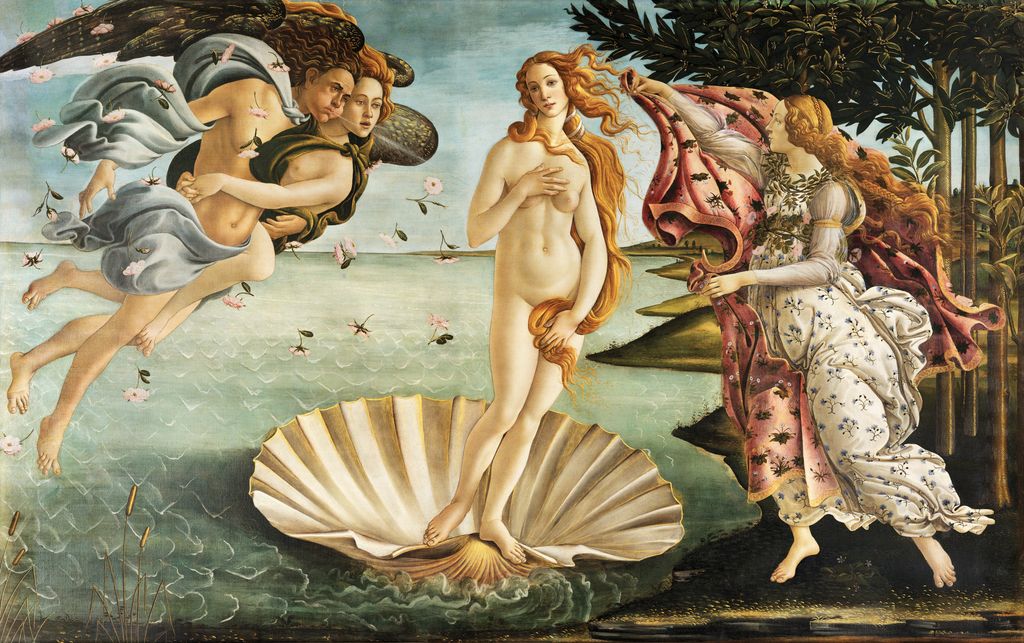
c. 1480Birth of Venus
c. 1485Mystic Nativity
1500Contents
- At a Glance
- Following the Line Through the Figure
- Grid, Pinpricks and the Reverse
- Related Paintings and a Later Tapestry
Following the Line Through the Figure
Pallas's pose is sinuous without being unstable. Her head tilts toward one shoulder, the upper body turns, and the legs cross into a light step. One foot seems barely to touch the ground. The drapery does not hang as a single heavy curtain. It pulls across her torso, opens around the thighs and gathers into folds that move in different directions. The result makes the figure look both poised and wind-touched.[1]
The catalogue identifies her as Pallas Athena or Minerva, the classical goddess associated with war, wisdom and the arts. It sees a helmet in her right hand and an olive branch in the other. The helmet belongs to her martial identity, while the olive branch directs attention to peace and abundance. These attributes give the sketch a more specific subject than a generic graceful woman, even though parts of them can be difficult to separate in a small reproduction.[1]
The head is particularly revealing. The catalogue finds two alternative positions worked into the face and neck: a more inclined version and a more upright one. The alternatives are close enough to share an eye, yet they change the direction of the figure's attention. Botticelli did not merely draw a finished contour and add shading. He tested how the expression, head angle, torso and flowing cloth could work together. Those visible choices help explain the figure's sense of movement.[1]
Several drawing media have different jobs here. Black chalk gives an initial structure. Pen and brown ink strengthen selected edges; brown wash makes darker recesses and rounder forms; lead-white touches lift the cloth and body out from the warm paper. The pink tint is part of the sheet's preparation, not the flesh colour of an oil painting. The materials let the artist revise proportions and folds while still suggesting a complete moving figure.[1]
At the bottom left, the exhibition catalogue transcribes an ink inscription naming “Sandro Botticello.” Its presence is part of the sheet's physical record. It is not, on its own, proof that Botticelli signed this study while making it. The catalogue's artist attribution rests on the object and its scholarship, rather than a claim here that the short inscription is an authenticated autograph signature.[1]
Grid, Pinpricks and the Reverse
Faint squaring lines lie underneath the figure's media. This order matters. A grid drawn over a completed design could mark a later plan to enlarge or transfer it; the catalogue says these lines preceded the figure. It discusses the possibility that they helped Botticelli judge placement and proportion as he drew. The sheet therefore shows a preparatory structure that is more nuanced than a simple transfer grid applied after the fact.[1]
Pinpricks also appear, but only selectively. The catalogue records them on some outer boundaries of the figure and drapery, including one of the alternative head outlines. Most internal detail—features, hair, fingers and many folds—was left unpricked. This suggests that a broad silhouette could be reproduced for another design while its finer marks remained open to change. It does not mean that every line we see was mechanically transferred to the same later artwork.[1]
Turn the sheet over, and its subject changes. The verso contains architectural decorations in pen and brown ink. The exhibition author notes loose echoes of decorative forms in Botticelli's wall paintings and frescoes, but finds no direct match with a known finished work. The reverse is not a second Pallas composition or proof of a particular commission. It is another use of the paper, one that makes the object's status as a working drawing especially plain.[1]
Related Paintings and a Later Tapestry
The drawing's closest painted parallel in the exhibition author's analysis is the Venus in Primavera. The face, stance, lightness and aspects of the dress recall her, while the sheet's floating drapery has affinities with other figures in that painting. The catalogue entertains the idea that the Pallas design was copied or adapted so that attributes could be altered for Venus. It presents that sequence as a proposal. Similarity between two figures is real visual evidence; it is not a surviving instruction from Botticelli saying that one was copied directly from this sheet.[1]
The name also brings to mind Botticelli's painted Pallas and the Centaur. That canvas shows a woman controlling a centaur, and the Uffizi notes that her identity has been debated between Pallas or Minerva and the warrior Camilla. The painted scene has its own Medici history and possible marriage context. This drawing is a single figure with a helmet and olive branch, not the full encounter with the centaur. The painting's subject debate should not erase the specific attributes recorded for 201 E, nor should its proposed commission be assigned to the drawing.[1][2]
The figure had a longer life after the first design. The catalogue connects the Uffizi sheet with a larger Botticelli-workshop drawing in Oxford and a French woven Minerva Pacifica tapestry made for Guy de Baudreuil after 1492. In its reconstruction, the Oxford drawing is an enlarged, simplified step between the Uffizi study and a lost workshop cartoon. Some features in Oxford preserve details of the Uffizi design absent from the tapestry, making a simple copy after the finished weaving unlikely. The later tapestry shows reuse of a figure, not necessarily the first moment of its invention.[1]
That relationship was visible to an earlier catalogue writer, although his assignment of hands was his own. In 1906, Sidney Colvin catalogued the Oxford figure as School of Botticelli, from the reverse of a sheet in the Douce collection. He compared its upright head with the tapestry's, and distinguished both from the Uffizi study's inclined, twice-tried head. This is useful independent evidence for the specific change of pose across three objects. Colvin's unfavorable judgment of the Oxford draughtsman's quality is a historical attribution opinion, not proof of precisely which assistant made it. The 2022 exhibition catalogue instead explains the sequence through enlargement and workshop reuse while preserving the Uffizi sheet as the early experimental drawing.[3][1]
This chronology is important because older dating linked the sheet to the later tapestry. The 2022 catalogue argues instead for an early 1480s origin, citing the drawing's many experiments and its visual ties to Botticelli's paintings of that decade. An early study can be drawn upon years later by the artist's workshop. The approximate date should be understood as a scholarly assessment, while the tapestry's later production is a separate event.[1]
The sheet came from the Medici collection before entering the Uffizi, according to the exhibition catalogue. That provenance establishes a broad historical path for the paper. It does not, by itself, tell us which patron first requested this figure or exactly where it was kept when it was drawn. What survives is more immediate: a graceful figure tested in successive marks, with traces of the practical methods that allowed Botticelli and his workshop to keep exploring her pose.[1]
Botticelli and related artworks
Discussion
Which detail changes how you read Pallas Drawing?
Reader Insights
How do the lines suggest movement?
What do the grid and pinpricks tell us about working method?
How might the sheet relate to later paintings or tapestry?
Join the Conversation
Share a source-led observation or question below.
References
- Minneapolis Institute of Art and Uffizi Galleries, Botticelli and Renaissance Florence: Masterworks from the Uffizi, catalogue no. 2, printed pp. 74–77 / PDF pp. 47–48, entry by Rachel McGarry for Pallas recto and architectural studies verso, Uffizi 201 E; materials, process, provenance, dating and later reuse, accessed 1 October 2026 View source.
- Uffizi Galleries, “Pallas and the Centaur,” owner record for the distinct painted canvas and its debated female identification, accessed 1 October 2026 View source.
- Sidney Colvin, Selected Drawings from Old Masters in the University Galleries and in the Library at Christ Church, Oxford, part V (Oxford: Clarendon Press, 1906), unnumbered plate commentary “School of Botticelli: Figure of Minerva” (PDF p. 23), on the Oxford, Uffizi and Baudreuil versions; original catalogue consulted 1 October 2026 View source.