 by Tom Gurney
Tom Gurney BSc (Hons) is an art history expert with over 20 years experience
Published on June 19, 2020 / Updated on October 2, 2026
Email: tomgurney1@gmail.com / Phone: +44 7429 011000
A closer look
A woman in a long dress steps forward while children gather around her. At her right, a small boy holds grapes; at her left, the forms become harder to disentangle, but a horn of plenty and more putti emerge from the lines. Botticelli's drawing in the British Museum is often called Allegory of Abundance. The museum's fuller title, Abundance or Autumn, leaves room for a second reading of the fruit and the season it evokes. That uncertainty is part of the sheet's interest.[1]
This is a working image on paper, not a painting. The woman's figure has a firm contour and carefully lit folds, while the children and horn on the other side show visible changes of mind. Looking between those passages lets us see how Botticelli could test a grouping and give a figure presence before any final purpose for the design is known. The museum dates the drawing to about 1480–85 and identifies Botticelli as its maker, but knows of no painting that directly repeats it.[1]
At a glance
- Museum titleAbundance or Autumn
- ArtistSandro Botticelli, catalogued by the British Museum as the draughtsman
- DateAbout 1480–85
- MediumPen and brown ink, brown wash and white heightening over black and red chalk on orange-red prepared paper
- Size317 × 252 mm
- CollectionBritish Museum, London
- Museum number1895,0915.447
- SubjectA classically dressed woman with putti, grapes and a horn of plenty; her exact allegorical name remains open
The sheet's back bears a decorative border in pen and wash. Its two sides should not be confused: the figure group discussed here is on the front, while the border belongs to the reverse. The paper has also been trimmed and repaired. Those physical facts matter when considering claims about its early mounting and original edges.[1]
This work in Botticelli’s career
Fortitude
1470Allegory of Abundance
about 1480–85Primavera
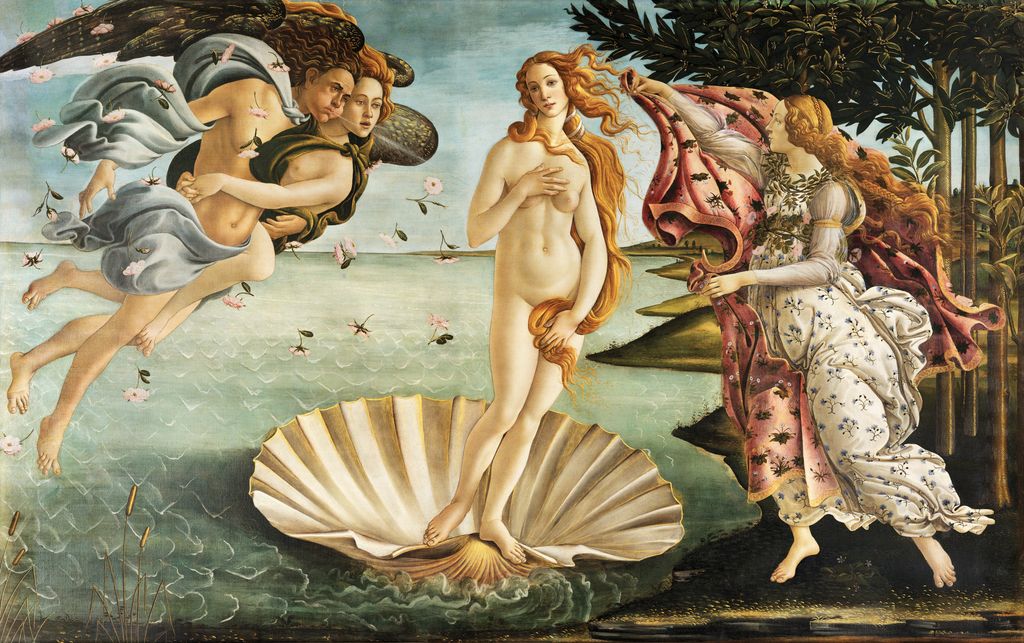
c. 1480Birth of Venus
c. 1485Mystic Nativity
1500Contents
- At a Glance
- A Figure Between Two Groups
- The Colour of the Paper and the Work of Light
- Why Abundance, and Why Autumn?
- A Design without a Known Painting
- Changing Names in a Collection
A Figure Between Two Groups
The woman rises nearly the full height of the composition. Her head inclines toward the children on her right, and her extended hand meets that of the nearest boy. Her dress has a fitted upper part and long, clinging folds below. Botticelli uses their dark and pale passages to make the body turn and advance. The figure has weight despite the lightness of the material: ink, chalk and wash on a single sheet of paper.[1]
At the right, the child beside her holds a bunch of grapes. Another putto presses in beyond him. Their round bodies and shifting poses contrast with the woman's long vertical movement. The handhold gives the grouping a social centre. We are not merely seeing a woman accompanied by symbolic fruit; she is in contact with a child, while the others cluster close enough to make abundance feel like something shared.[1]
On the left, a horn and further small figures are much less settled. In the small reproduction, they can seem to fade into the paper. The museum's account describes this group as drawn freely and notes changes, especially to the legs of the putto nearest the woman. These are not missing pieces of a finished painting. They are marks of a process that remains visible on the sheet. Botticelli tried positions and kept the earlier traces rather than covering every alternative.[1]
The woman's outline and the figures at the right have fewer apparent corrections. The British Museum suggests that Botticelli may have followed an earlier study for this part while exploring the left group more openly. That is a reasoned reading of the marks, not a surviving preliminary sheet or proof of a fixed sequence. What we can see is the unequal degree of resolution: one side stabilised, another still searching.[1]
The Colour of the Paper and the Work of Light
The prepared surface has an orange-red tone, which the museum says comes mainly from red lead. Botticelli used black and red chalk beneath the pen lines, added brown wash, then touched passages with white. The coloured ground supplies a middle tone across the whole drawing. Dark strokes can turn away from the light, while white marks bring forward an edge or swelling fold. The drawing's modelling therefore depends on the paper as much as on the lines placed over it.[1]
This method is especially effective in the woman's drapery. The gathered fabric around her waist and the length of the skirt do not need a painted blue or red to suggest volume. White accents pick up the relief of the cloth; brown wash deepens recesses. Her face and hair are more delicately worked than the exploratory left-hand forms. The contrasts invite a viewer to move close, then step back to recover the full group.[1]
The museum describes the light as arriving from the left. That is a technical observation about how Botticelli distributed white heightening and shadow, not a claim that the scene took place in a particular outdoor setting. The background supplies no clear architecture, landscape or time of day. The figures occupy a pictorial space shaped largely by their own movement and by the warm surface on which they were drawn.[1]
Why Abundance, and Why Autumn?
The horn of plenty and grapes explain both halves of the museum's title. Fruit can stand for plenty, a successful harvest or the season in which it is gathered. Botticelli has not written a name beside the woman. It is therefore more precise to describe her as an allegorical figure than to say that he definitively portrayed one named goddess. The British Museum preserves that openness in Abundance or Autumn.[1]
One ancient story helps explain the horn. In Book IX of Ovid's Metamorphoses, the river god Achelous recounts his fight with Hercules. After Hercules broke off one of his horns, nymphs filled it with fruit and flowers; it became the horn associated with Plenty. A nymph then brings autumn produce in an overflowing horn. The story joins the ideas of abundance and season that the drawing holds together.[2]
Hercules and Achelous do not appear in Botticelli's sheet. The horn can recall their story without turning the drawing into an illustration of the battle. Nor does Ovid's account tell us that Botticelli was commissioned to depict it. The myth gives an intelligible vocabulary for the image, while the exact identity of the woman and the drawing's original intended use remain unknown.[1][2]
Putti reinforce the sense of fecundity but also keep the image lively. The right-hand child handles grapes; the left-hand figures seem to collect around the horn. Their different degrees of finish prevent the sheet from becoming a rigid emblem. Botticelli was arranging bodies as well as signs. The picture balances a dignified central figure with children's restless activity, a combination that makes the abstract subject approachable.[1]
A Design without a Known Painting
Because drawings can precede paintings, it is tempting to treat this sheet as a preparatory work for a lost canvas or panel. The British Museum says that no direct painted counterpart is known. Earlier comparisons with paintings of the Four Seasons attributed to Botticelli's circle are not secure enough to supply one. The drawing can be valued as a surviving work in its own right without inventing a finished version.[1]
One comparison can now be made more exact. The Musée Condé at Chantilly owns a tall canvas called Autumn or Allegory against the Abuse of Wine (PE 16), generally assigned today to Botticelli's workshop. Its catalogue says the British Museum drawing has often been treated as a preparatory sketch for the painting, but does not accept that relationship as established. Chantilly also weighs different names for its own subject: Autumn is possible, while details such as the fruit around a putto's neck may point toward wine and intoxication. The two works thus share an allegorical vocabulary without forming a documented drawing-to-painting pair. Keeping their supports, titles and attributions distinct prevents the larger canvas from supplying an invented destination for the London sheet.[3][1]
The museum relates its style to the period of Primavera and The Birth of Venus, hence its approximate 1480–85 date. This does not make Abundance or Autumn a discarded figure from either painting or prove that it shared a patron with them. The works can be compared for Botticelli's interest in classical dress, movement and mythological personification while their commission histories remain separate.[1]
The uneven finish is also no measure of failure. In the woman's contour and white-lit folds, the artist shows how far an idea could be carried. In the shifting children to the left, he leaves the alternatives visible. Those different states are precisely what a drawing can preserve for later viewers. They make the sheet evidence of artistic decisions as well as a compelling image of plenty.[1]
Changing Names in a Collection
The drawing's documented ownership goes back to nineteenth-century sales, not to Botticelli's studio. It appeared in the 1801 Fagel sale as a work of Mantegna and in the 1856 Samuel Rogers sale as Verrocchio. John Charles Robinson identified it as Botticelli in the 1876 catalogue of John Malcolm's collection. The British Museum bought it in 1895. The shifting names record the history of connoisseurship; they are not evidence that several artists collaborated on this sheet.[1]
An early sale description said the drawing was set in an ornament associated with Giorgio Vasari's Libro de' Disegni. No such mount survives, so the museum cannot verify that claim. It is a possibility in the work's collecting history, not a firm sixteenth-century provenance. The lost mount should not be used to fill the longer gap between Botticelli and the first documented sale.[1]
Look once more from the poised woman to the lightly reworked children at her left. The grapes and horn offer a language of harvest and plenty; the actual chalk and ink reveal an artist negotiating how that language should take shape. The title remains double, and no matching painting settles the drawing's destination. What survives is the sheet itself, carrying both a finished visual thought and the traces of how it was made.[1][2]
Botticelli and related artworks
Discussion
Which detail changes how you read Allegory of Abundance?
Reader Insights
How do the children relate to the central figure?
What does the prepared paper contribute to the drawing?
Why do both Abundance and Autumn remain possible titles?
Join the Conversation
Share a source-led observation or question below.
References
- British Museum, “Abundance or Autumn,” drawing 1895,0915.447, collection record and curator's comments, accessed via current indexed museum text 29 September 2026 (direct page request returned 403) View source.
- Ovid, Metamorphoses, Book IX, English translation in the University of Virginia's Ovid Collection, accessed 29 September 2026 View source.
- Musée Condé, Chantilly, L'Automne ou allégorie contre l'abus du vin, PE 16, object record on workshop attribution, iconographic uncertainty and the often-asserted but unproven connection to the British Museum drawing; consulted 1 October 2026 View source.