 by Tom Gurney
Tom Gurney BSc (Hons) is an art history expert with over 20 years experience
Published on June 19, 2020 / Updated on October 2, 2026
Email: tomgurney1@gmail.com / Phone: +44 7429 011000
A closer look
Mary bends over a book with a pen in her hand. The infant Jesus, seated on her lap, reaches towards the page as if guiding her words. Angels hold the book, offer an inkwell and lower a crown above her head. Botticelli has gathered an act of writing and an act of honour into the same circle. The words Mary writes are the beginning of the Magnificat, the song of praise that gives this painting its familiar name.[1][2]
Made around 1483, the Madonna of the Magnificat is a round painting, or tondo, 118 centimetres across. It is now in the Uffizi in Florence (inventory 1890 no. 1609). Its circular format does more than provide an elegant frame: it draws five angels, the Virgin and Child, a book, a fruit and a glimpse of landscape into a close, continuous movement around Mary’s writing hand.[1][2]
At a glance
- ArtistSandro Botticelli
- Full titleVirgin and Child, and Angels (Madonna of the Magnificat)
- Dateabout 1483
- Mediumtempera on wood
- Size118 cm in diameter
- Current locationUffizi Galleries, Florence, Room A12
- Inventory number1890 no. 1609
- Original settingunknown
The Uffizi records the panel as bought from a private collection in 1784. The Italian national object record names that collection as Ottavio Magherini's, but gives 1785 in its separate fields for departure from his collection and arrival at the Uffizi. Those entries could reflect different administrative moments; the acquisition documents have not been checked here, so the one-year discrepancy should remain visible. Neither record identifies an original patron, household or civic room. Suggestions about the picture’s first setting must therefore be judged from its shape, size and imagery, rather than treated as a documented commission.[1][8]
This work in Botticelli’s career
Fortitude
1470Madonna of the Magnificat
about 1483Primavera
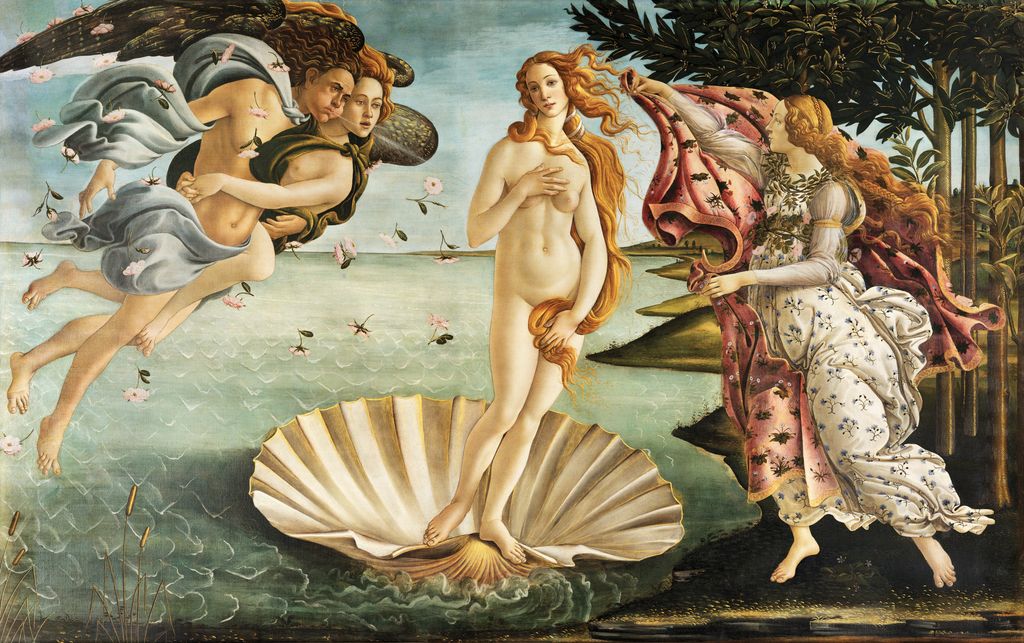
c. 1480Birth of Venus
c. 1485Mystic Nativity
1500Contents
- At a Glance
- Mary Writes Her Own Song
- Five Angels Within a Circle
- The Pomegranate in the Child’s Hand
- Where Might the Tondo Have Hung?
- A Design Repeated Beyond This Panel
Mary Writes Her Own Song
The first words on the page are Magnificat anima mea Dominum—“My soul magnifies the Lord.” They come from the beginning of Mary’s song in Luke 1:46–55. In the Gospel narrative she speaks these words after visiting Elizabeth, while she is still pregnant. Botticelli instead shows the infant Jesus on her lap guiding her hand as she writes them. He joins the future child to an earlier expression of his mother’s praise, making a devotional image rather than an illustration of one literal moment in Luke.[1][3]
The action of writing gives Mary an unusually active role. Her attention stays on the book even as a crown approaches her head. The Child’s outstretched hand meets hers near the page, creating a small point of contact at the heart of a crowded composition. The image can be read as a meditation on the relationship between the words of the canticle and the child to whom Mary has given birth. That meaning comes from the visible arrangement and the biblical text; it need not be attributed to an unrecorded instruction from the painting’s patron.
The surrounding angels make the activity possible. One seated figure steadies the open book. Another offers an inkwell so Mary can continue. A standing angel embraces the pair, joining their heads and shoulders into a compact group. These are not merely decorative attendants: their hands and bodies lead the viewer towards the pen, book and Child.[2]
Luke’s song praises God for noticing the lowly and for overturning human expectations of power and wealth.[3] Botticelli does not write out every verse in the small open book, but its text goes beyond a title or one opening line. The national catalogue transcribes parts of Mary's Magnificat through the line about God doing great things for her on the right-hand page. On the left it records phrases from the Benedictus, Zechariah's song later in Luke 1, including the covenant with Abraham and an address to his son as a future prophet. The two painted canticles thus connect Mary's praise with the promised birth and mission of John the Baptist. They make the viewer imagine sacred voices even though the picture shows Mary's silent concentration.[5][8]
Susan Schibanoff has proposed a more searching reading of Mary's pen. She places this unusual image of the Virgin writing against the limited place accorded to women authors in early humanist culture: the Child's guidance can make her writing appear miraculous, while the ordinary physical act of putting pen to page also makes a woman writer visible. That tension is Schibanoff's interpretation, not a documented statement of Botticelli's or his patron's intentions. It adds a question to the devotional reading: how much agency does the painting give Mary when her hand and the Child's meet over the text?[6]
Five Angels Within a Circle
There are five angels, according to the Uffizi’s close reading. Two at the top prepare to settle a crown and a light veil on Mary. Three more cluster at her side around the book and inkwell. None has visible wings. Their fine clothes and carefully arranged hair resemble the fashions of wealthy late fifteenth-century Florence, giving the sacred scene a familiar human scale without identifying any one figure as a portrait of a particular Florentine.[1][2]
The circle shapes how their bodies fit. The angels at the upper edge curve around Mary’s head; the seated figures compress themselves along the lower left. The Child’s legs and Mary’s blue mantle occupy the lower arc. Faces, arms and fabric make a chain that bends with the edge of the tondo. Botticelli avoids a rigid row of figures, instead using their slight turns and overlapping hands to keep the eye travelling around the group and back to the page.
The crown marks Mary’s honoured place, but it has not simply been fixed upon her. Its two bearers are still in the act of lowering it. That suspended motion sits beside the continuing act of writing. The painting’s moment feels alive because both actions are unfinished: Mary can add another word, and the angels can complete the coronation.[1][2]
Behind the group, a window opens onto a clear country landscape. The Uffizi describes the grey pietra serena stone frame above it as a boundary between heavenly and earthly realms. The landscape is quiet and spacious, a relief from the dense ring of people in the foreground. Looking through the opening, then back to the figures, the viewer can feel the difference between distant world and intimate sacred encounter.[1]
The Pomegranate in the Child’s Hand
Jesus touches a pomegranate while seated on Mary’s lap. The Uffizi reads the fruit’s red seeds as an allusion to the blood he will shed in the Passion. That gives a forward-looking note to a picture otherwise centred on infancy, praise and honour.[1]
The fruit is held close to the exchange at the book. It offers another way to connect present and future: Mary writes words of thanksgiving as the Child’s hand touches a sign that later Christian viewers could associate with sacrifice. The interpretation belongs to a tradition of reading sacred images through Christ’s whole life; the painting itself does not carry a written explanation of the fruit’s meaning.
The Uffizi has another, larger tondo by Botticelli usually called the Madonna of the Pomegranate. In that later painting the fruit is central to a different arrangement of Mary, Child and angels. The shared object and round format can make the titles easy to confuse. The Magnificat tondo is the one in which Mary writes under the Child’s guidance; its inventory number is 1890 no. 1609, while the separate Madonna of the Pomegranate is 1890 no. 1607.[1][4]
Where Might the Tondo Have Hung?
The picture’s first destination is unknown. The Uffizi notes that round sacred paintings were often made for secular settings, especially noble homes, and could mark marriages or births. That pattern makes a domestic location plausible for a Virgin and Child tondo. Yet at 118 centimetres across, this is a substantial work. The museum also raises the possibility that it hung in a tribunal of the Florentine Republic, whose rooms could contain holy images.[1]
Neither possibility names the person who ordered this panel or proves a specific occasion. The prudent conclusion is a useful one: Botticelli made an image that could function as religious devotion in more than one kind of Florentine interior. Its bright landscape, elaborate dress and moving circle of angels give it a presence beyond a private miniature, while the close exchange between mother and child invites sustained, intimate looking.
There is a more specific scholarly proposal. Saetti discusses an earlier suggestion that a 1498 inventory entry for a Madonna panel in the Via Larga house of Lorenzo di Pierfrancesco de' Medici might describe this tondo. She relates its veil and crown to his 1482 marriage to Semiramide d'Appiano or the birth of their son in 1485.[5] The timing and visual argument make the proposal worth considering, but the inventory wording does not identify this painting securely. The Uffizi still lists its original destination as unknown.[1]
An older identification points to a different place. The national catalogue records Milanesi's proposal that this was the round Madonna described by Vasari and Bocchi at San Francesco al Monte in Florence. It also gives the reason most scholars do not accept the match: Vasari's account has eight angels, while five appear here. The picture's unknown first setting cannot be filled in by attaching a famous old description to it when the figure count disagrees. The catalogue also mentions a possible origin in a convent closed under Pietro Leopoldo, but marks that as a possibility, not a traced provenance.[8]
The recorded history becomes firmer in 1784, when the painting was purchased from a private collection for the Uffizi. It remains there today. Seen beside Botticelli’s other Madonnas, its special invention is still the pen at its centre. The Child helps Mary put praise into words, and the angels organise the whole circle around that act.[1][2]
A Design Repeated Beyond This Panel
The Uffizi painting was not the only version of this composition. Rachel McGarry, writing in the 2022 Minneapolis Institute of Art and Uffizi exhibition catalogue, records six surviving replicas of the Madonna of the Magnificat. She places them among the wider body of devotional pictures produced by Botticelli, his workshop and other artists who adopted his models. That count is evidence of a design with an afterlife, not evidence that Botticelli himself painted every surviving copy.[7]
Repetition changes the way this tondo can be read as a product of a workshop. The tightly fitted circle of figures, book, crown and fruit offered a coherent design that could be taken up again. A later replica might preserve the arrangement while varying its execution, quality or details; deciding whether any particular example is by Botticelli, an assistant or a follower requires an examination of that object. The Uffizi panel remains the work described here, with its own recorded acquisition in 1784. The replicas explain how the image could become familiar well beyond its first, still unknown destination.[1][7]
Botticelli and related artworks
Discussion
Which detail changes how you read Madonna of the Magnificat?
Reader Insights
How do the five angels shape the circle?
What do Mary’s hand and the open book make visible?
What is known about the painting’s first setting?
Join the Conversation
Share a source-led observation or question below.
References
- Daniela Parenti, “Virgin and Child, and Angels (Madonna of the Magnificat),” Uffizi Galleries, collection record, accessed 29 September 2026 View source.
- Uffizi Galleries, “In the Light of Angels,” sections 12–13 on the Madonna of the Magnificat, accessed 29 September 2026 View source.
- Gospel of Luke 1:39–55, the Visitation and Mary’s canticle; text of Luke 1:46–55, King James Version, accessed 29 September 2026 View source.
- Daniela Parenti, “Virgin and Child with Angels (Madonna of the Pomegranate),” Uffizi Galleries, collection record, accessed 29 September 2026 View source.
- Valentina Saetti, “‘Prendere il velo’: sull'iconografia e committenza della Madonna del Magnificat di Sandro Botticelli,” Figure 4 (2019), pp. 125–28, on the two canticles, veil and qualified Medici patron proposal View source.
- Susan Schibanoff, “Botticelli's Madonna del Magnificat: Constructing the Woman Writer in Early Humanist Italy,” PMLA 109, no. 2 (March 1994): 190–206. The public abstract supports the interpretive summary; full text was not accessible during this audit View source.
- Rachel McGarry, “Finding Sandro Botticelli,” in Cecilia Frosinini and Rachel McGarry, eds., Botticelli and Renaissance Florence: Masterworks from the Uffizi, Minneapolis Institute of Art, 2022, p. 17 (PDF p. 19), on six surviving replicas and wider workshop reuse; consulted 1 October 2026 View source.
- Italian Ministry of Culture, national object record for the Uffizi Madonna del Magnificat, record 0900188562, pp. 2–4, Magherini provenance, conflicting 1784 acquisition and 1785 movement fields, the rejected San Francesco al Monte identification and the qualified suppressed-convent suggestion; consulted 1 October 2026. The original eighteenth-century acquisition entries and the Vasari/Bocchi descriptions were not inspected for this pass View source.